

ISO 3199:1975
(Main)Sodium chlorate for industrial use — Determination of chlorate content — Dichromate titrimetric method
General Information
- Abstract
Not applicable to the analysis of mixtures for agricultural use such as herbicides or pesticides. Indicates the risk in handling with clorates. Dissolution of the test portion in water and reduction by a known quantity, in access, of an iron(II) salt in a sulphuric acid and orthophosphoric acid medium. Titration of the excess iron(II) salt with a standard volumetric solution of potassium dichromate in the presence of barium diphenylamine-4-sulphonate solution as indicator.
- Status
- Published
- Publication Date
- 31-Jan-1975
- Technical Committee
- ISO/TC 47 - Chemistry
- Drafting Committee
- ISO/TC 47 - Chemistry
- Current Stage
- 9093 - International Standard confirmed
- Start Date
- 14-Feb-2025
- Completion Date
- 29-Aug-2026
Buy Documents

ISO 3199:1975 - Sodium chlorate for industrial use -- Determination of chlorate content -- Dichromate titrimetric method
ISO 3199:1975 - Sodium chlorate for industrial use — Determination of chlorate content — Dichromate titrimetric method/1/1975
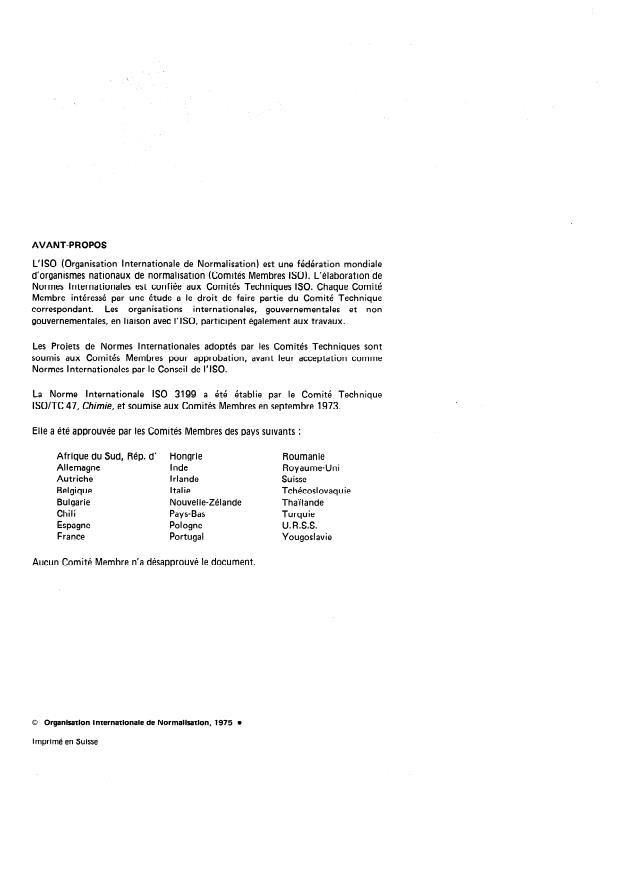
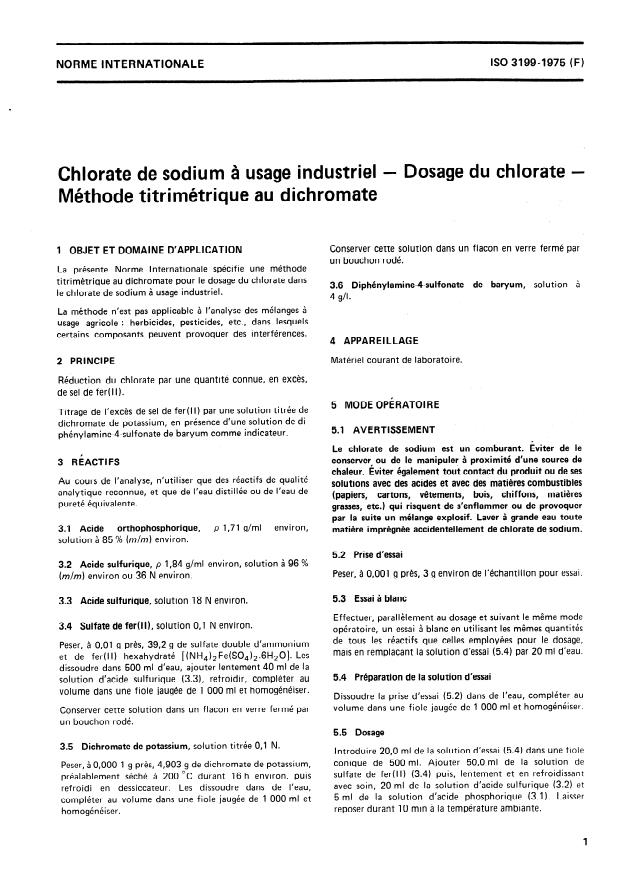

ISO 3199:1975 - Chlorate de sodium a usage industriel -- Dosage du chlorate -- Méthode titrimétrique au dichromate
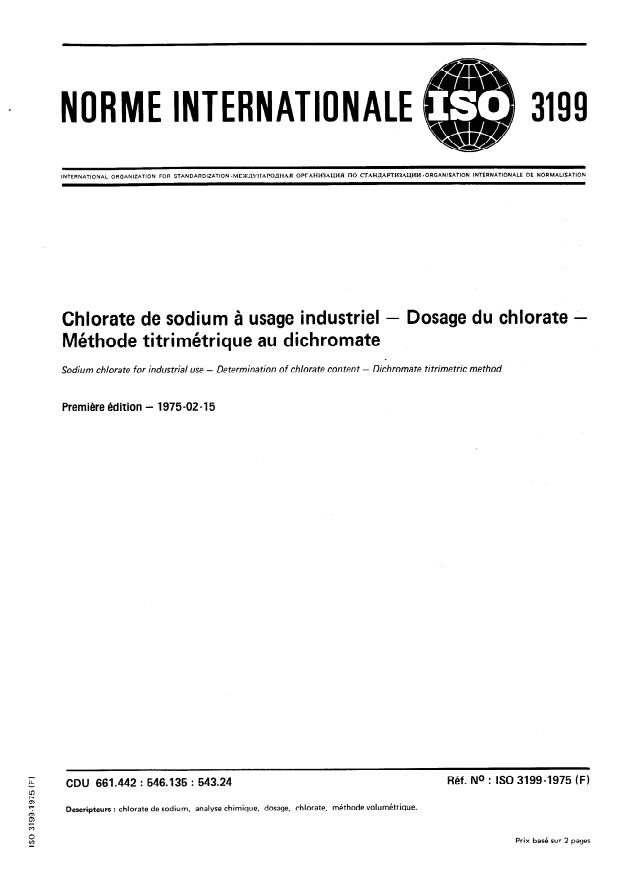
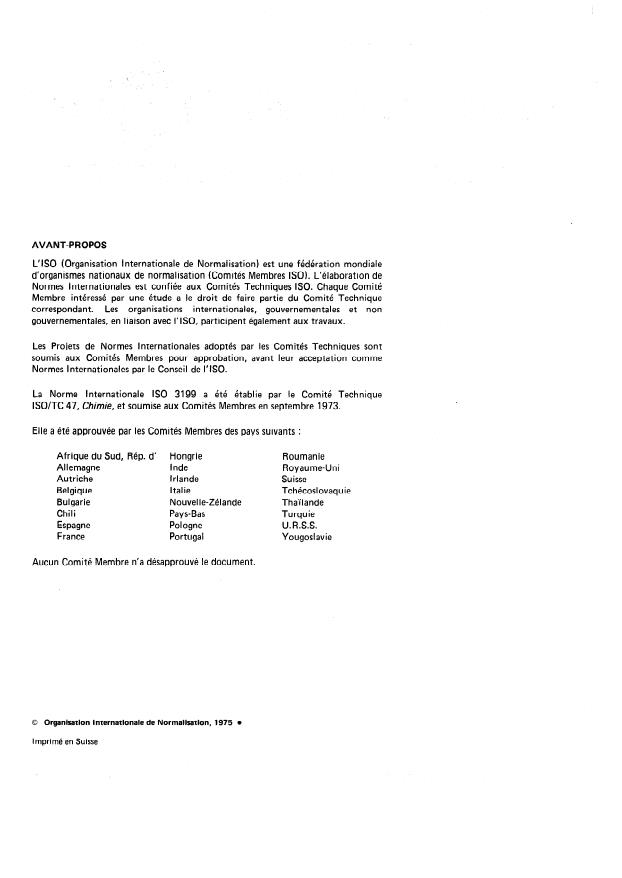

ISO 3199:1975 - Chlorate de sodium a usage industriel -- Dosage du chlorate -- Méthode titrimétrique au dichromate
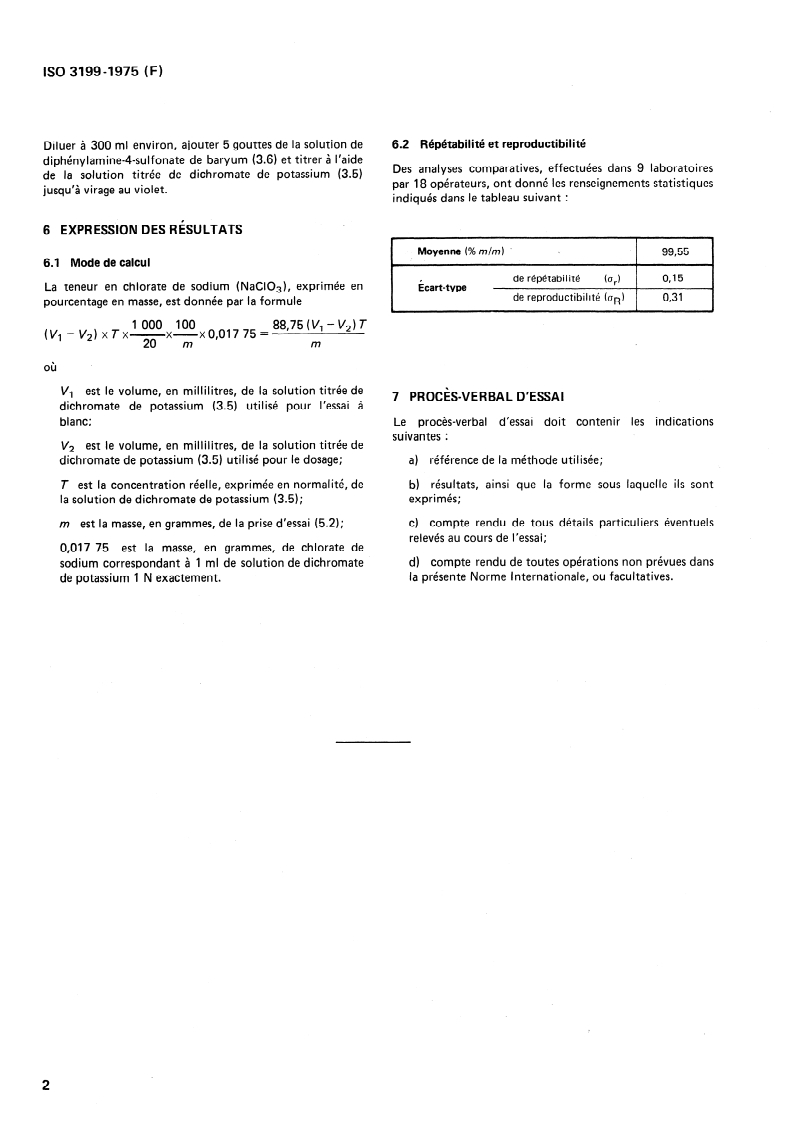
ISO 3199:1975 - Chlorate de sodium à usage industriel — Dosage du chlorate — Méthode titrimétrique au dichromate/1/1975
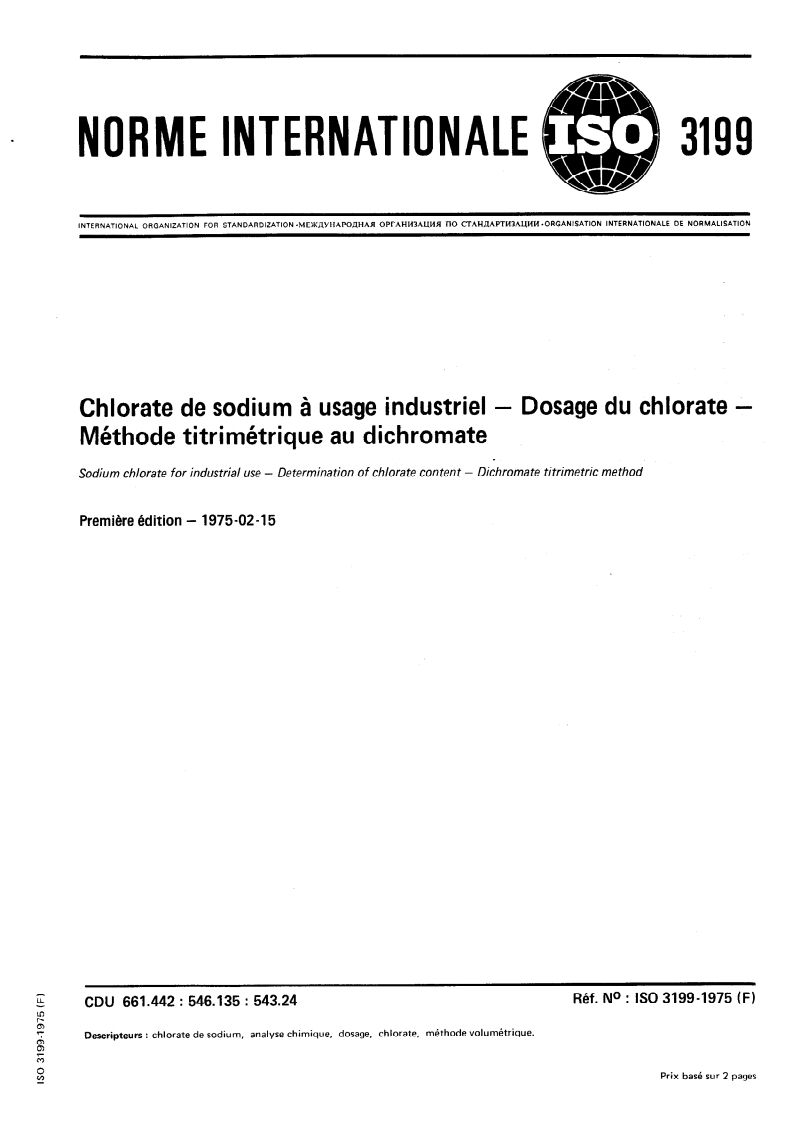
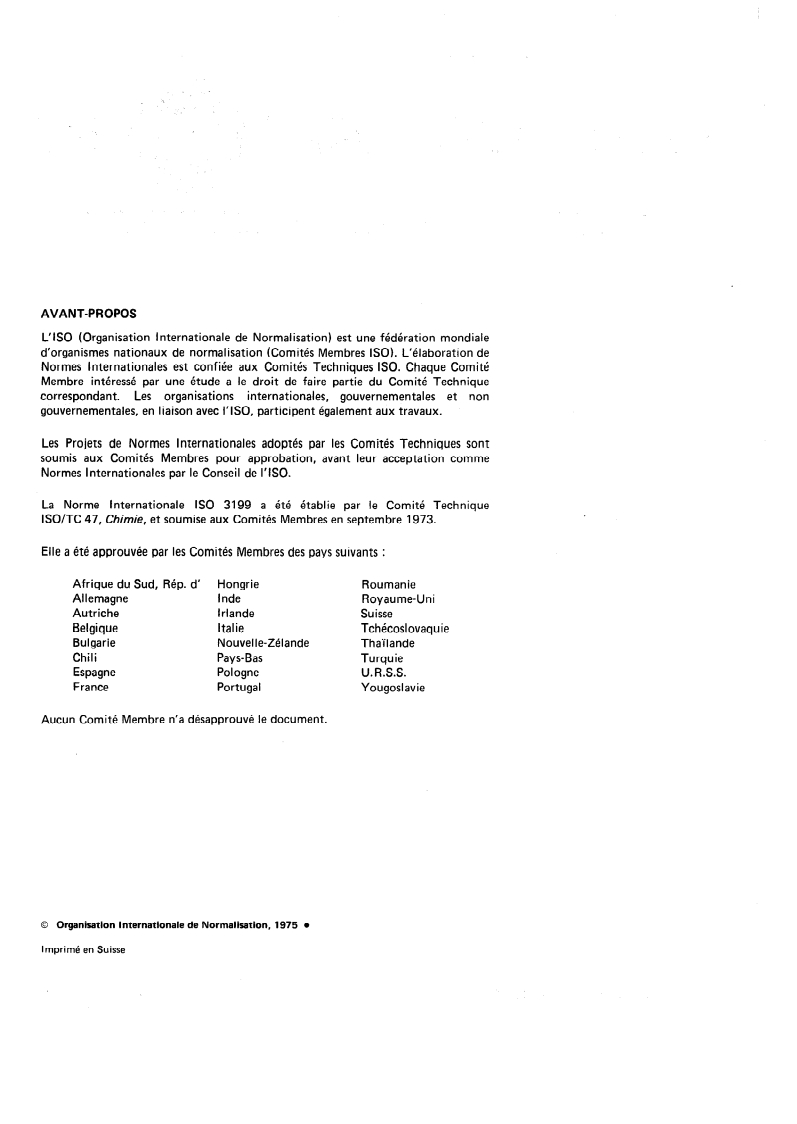
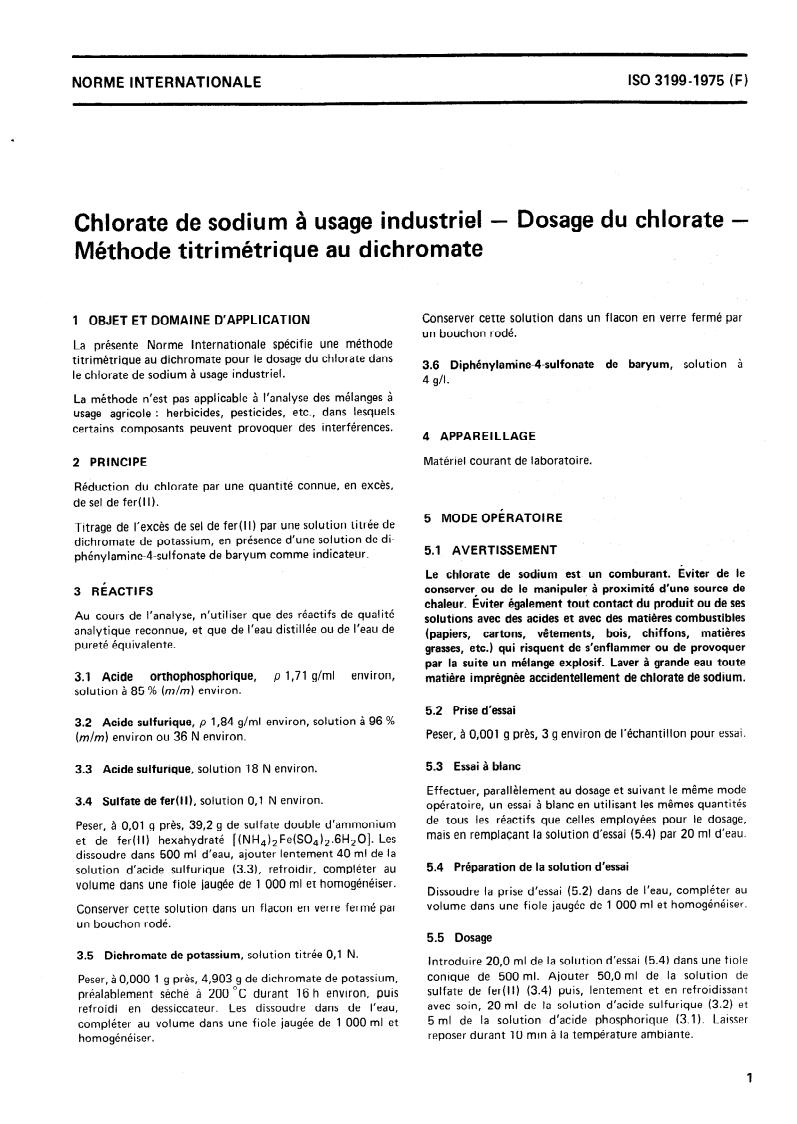
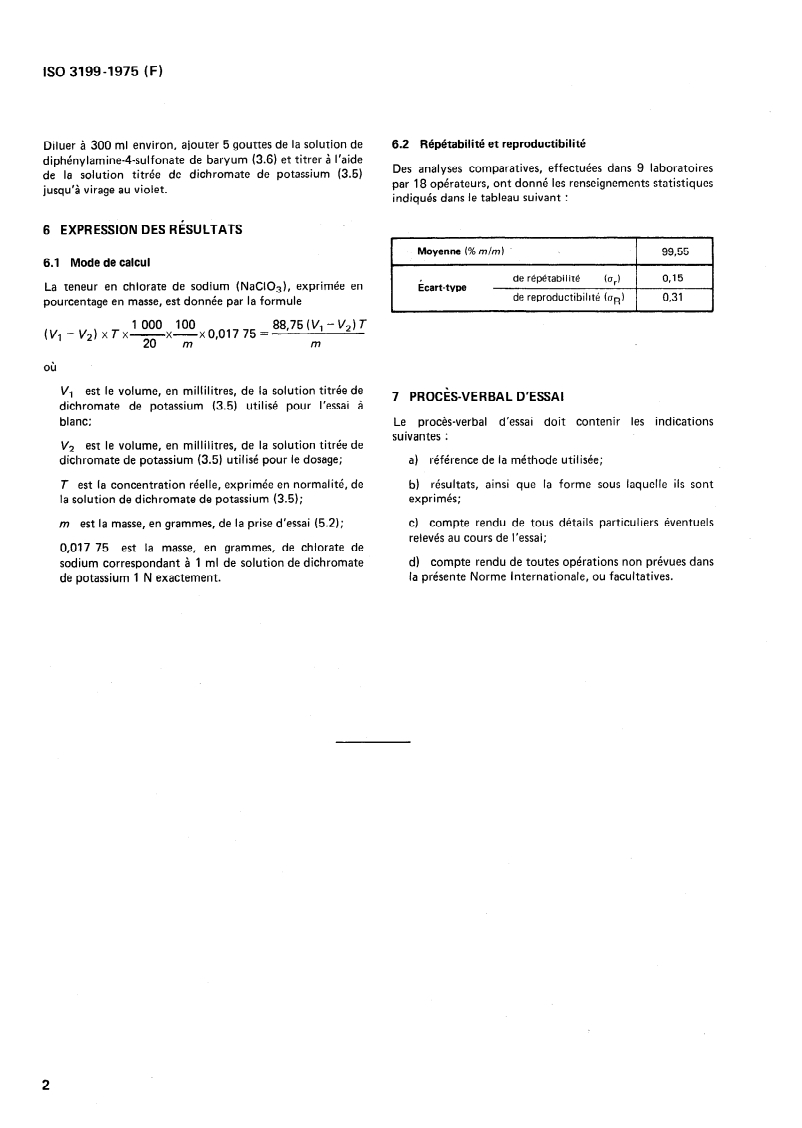
ISO 3199:1975 - Chlorate de sodium à usage industriel — Dosage du chlorate — Méthode titrimétrique au dichromate/1/1975
Overview
ISO 3199:1975 specifies a method for determining the chlorate content in sodium chlorate intended for industrial use. Developed by ISO Technical Committee 47 (Chemistry), this international standard outlines a precise dichromate titrimetric method. It is important to note that ISO 3199:1975 is not suitable for mixtures formulated for agricultural uses, such as herbicides and pesticides, because certain components in these products may interfere with the analysis.
The standard emphasizes safety considerations associated with chlorates, especially their strong oxidizing potential and combustion risk. Proper handling, storage, and disposal during testing are highlighted to ensure laboratory safety.
Key Topics
- Chlorate Content Analysis: This standard establishes a reproducible method to quantify sodium chlorate using titrimetric analysis, aiding quality control in industrial production.
- Dichromate Titrimetric Method: The procedure involves reducing chlorate ions by adding an excess of iron(II) salt in an acidic medium, then titrating the remaining iron(II) with a standard potassium dichromate solution in the presence of an indicator.
- Scope Limitations: The method is specifically excluded from use in agricultural products or formulations where interfering substances might be present.
- Reagents and Apparatus: Only reagents of recognized analytical grade and distilled water (or equivalent) should be used, along with standard laboratory glassware and titration equipment.
- Safety Warnings: Sodium chlorate’s oxidative properties can induce combustion. The standard specifies careful handling-keeping the substance away from heat, acids, and combustible materials.
- Result Calculation and Reporting: The standard provides a formula for calculating chlorate content, and outlines guidelines for test reporting to ensure consistent and transparent documentation.
Applications
Organizations involved in the production and quality assurance of industrial sodium chlorate rely on ISO 3199:1975 for:
- Quality Control: Ensuring that sodium chlorate meets purity and content specifications before industrial application.
- Process Validation: Confirming the concentration of sodium chlorate in raw materials used in processes such as paper bleaching, textile manufacturing, and water treatment.
- Safety Compliance: Supporting safe laboratory and industrial handling by clarifying the risk factors and necessary precautions with chlorates.
- Regulatory Documentation: Providing recognized results for audits, certification, or regulatory filings where the accurate measurement of chlorate content is required.
This standard is especially valuable for analytical laboratories, chemical manufacturers, and industries where sodium chlorate purity directly impacts product quality or user safety.
Related Standards
For comprehensive quality and safety management, ISO 3199:1975 can be referenced alongside other relevant international standards, such as:
- ISO 9001 - Quality management systems for consistent industrial practices.
- ISO 17025 - General requirements for laboratory competence.
- ISO 6353 - Reagents for chemical analysis.
- ISO/TC 47 Standards - Additional chemical analysis standards for industrial chemicals.
Routine use of ISO 3199:1975 alongside these standards helps ensure reliable, safe, and high-quality industrial sodium chlorate production, reinforcing industry best practices in chemical analysis and handling.
Relations
- Consolidated By
ISO 4014:1999 - Hexagon head bolts — Product grades A and B - Effective Date
- 06-Jun-2022
Buy Documents
ISO 3199:1975 - Sodium chlorate for industrial use -- Determination of chlorate content -- Dichromate titrimetric method
ISO 3199:1975 - Sodium chlorate for industrial use — Determination of chlorate content — Dichromate titrimetric method/1/1975
ISO 3199:1975 - Chlorate de sodium a usage industriel -- Dosage du chlorate -- Méthode titrimétrique au dichromate
ISO 3199:1975 - Chlorate de sodium a usage industriel -- Dosage du chlorate -- Méthode titrimétrique au dichromate
ISO 3199:1975 - Chlorate de sodium à usage industriel — Dosage du chlorate — Méthode titrimétrique au dichromate/1/1975
ISO 3199:1975 - Chlorate de sodium à usage industriel — Dosage du chlorate — Méthode titrimétrique au dichromate/1/1975
Get Certified
Connect with accredited certification bodies for this standard

ECOCERT
Organic and sustainability certification.

Eurofins Food Testing Global
Global leader in food, environment, and pharmaceutical product testing.

Intertek Bangladesh
Intertek certification and testing services in Bangladesh.
Sponsored listings
Frequently Asked Questions
ISO 3199:1975 is a standard published by the International Organization for Standardization (ISO). Its full title is "Sodium chlorate for industrial use — Determination of chlorate content — Dichromate titrimetric method". This standard covers: Not applicable to the analysis of mixtures for agricultural use such as herbicides or pesticides. Indicates the risk in handling with clorates. Dissolution of the test portion in water and reduction by a known quantity, in access, of an iron(II) salt in a sulphuric acid and orthophosphoric acid medium. Titration of the excess iron(II) salt with a standard volumetric solution of potassium dichromate in the presence of barium diphenylamine-4-sulphonate solution as indicator.
Not applicable to the analysis of mixtures for agricultural use such as herbicides or pesticides. Indicates the risk in handling with clorates. Dissolution of the test portion in water and reduction by a known quantity, in access, of an iron(II) salt in a sulphuric acid and orthophosphoric acid medium. Titration of the excess iron(II) salt with a standard volumetric solution of potassium dichromate in the presence of barium diphenylamine-4-sulphonate solution as indicator.
ISO 3199:1975 is classified under the following ICS (International Classification for Standards) categories: 71.060.50 - Salts. The ICS classification helps identify the subject area and facilitates finding related standards.
ISO 3199:1975 has the following relationships with other standards: It is inter standard links to ISO 4014:1999. Understanding these relationships helps ensure you are using the most current and applicable version of the standard.
ISO 3199:1975 is available in PDF format for immediate download after purchase. The document can be added to your cart and obtained through the secure checkout process. Digital delivery ensures instant access to the complete standard document.
Standards Content (Sample)
INTERNATIONAL STANDARD
INTERNATIONAL ORGANIZATION FOR STANDARDIZATION l MEXAYHAPOAHA9 OPTAHM3AUMfi l-f0 CTAHAAPTM3AUMM *ORGANISATION INTERNATIONALE DE NORMALISATIOIU
Sodium chlorate for industrial use - Determination of
Dichromate titrimetric method
chlorate content F
Chlorate de sodium 5 usage industriel - Dosage du chlorate - Mk thode ti trinie trique au dich roma te
First edition - 1975-02-15
w
UDC 661.442 : 546.135 : 543.24
- Ref. No. ISO 31994975 (E)
Descriptors : sodium chlorate, Chemical analysis, determination of content, chlorates, voiumetric analysis.
Price based on 2 payes
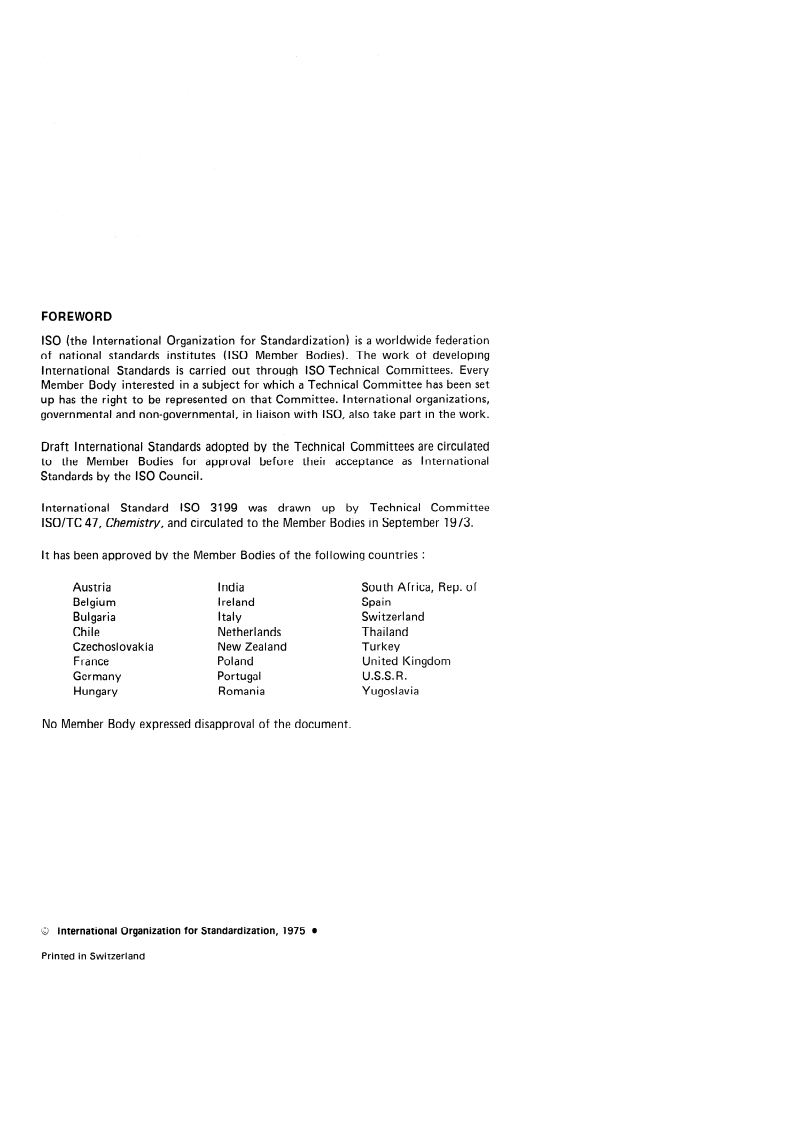
FOREWORD
ISO (the International Organization for Standardization) is a worldwide federation
of national Standards institutes (ISO Member Bodies). The work of developing
International Standards is carried out through ISO Technical Committees. Ewery
Member Body interested in a subject for which a Technical Committee has been set
up has the right to be represented on that Committee. International organizations,
governmental and non-governmental, in liaison with ISO, also take part in the work.
Draft International Standards adopted by the Technical Committees are circulated
to the Member Bodies for approval before their acceptance as International
Standards by the ISO Council.
International Standard ISO 3199 was drawn up by Technical Committee
ISO/TC 47, Chemistry, and circulated to the Member Bodies in September 1973.
lt has been approved by the Member Bodies of the foilowing countries :
India South Africa, Rep. of
Austria
Belgium I reland Spain
Switzerland
Bulgaria Italy
Chile Netherlands Thailand
Czechoslovakia New Zealand Turkey
France Poland United Kingdom
Germany Portugal U.S.S.R.
Hungary Romania Yugoslavia
No Member Body expressed disapproval of the document.
@ International Organkation for Standardkation, 1975 l
Printed in Switzerland
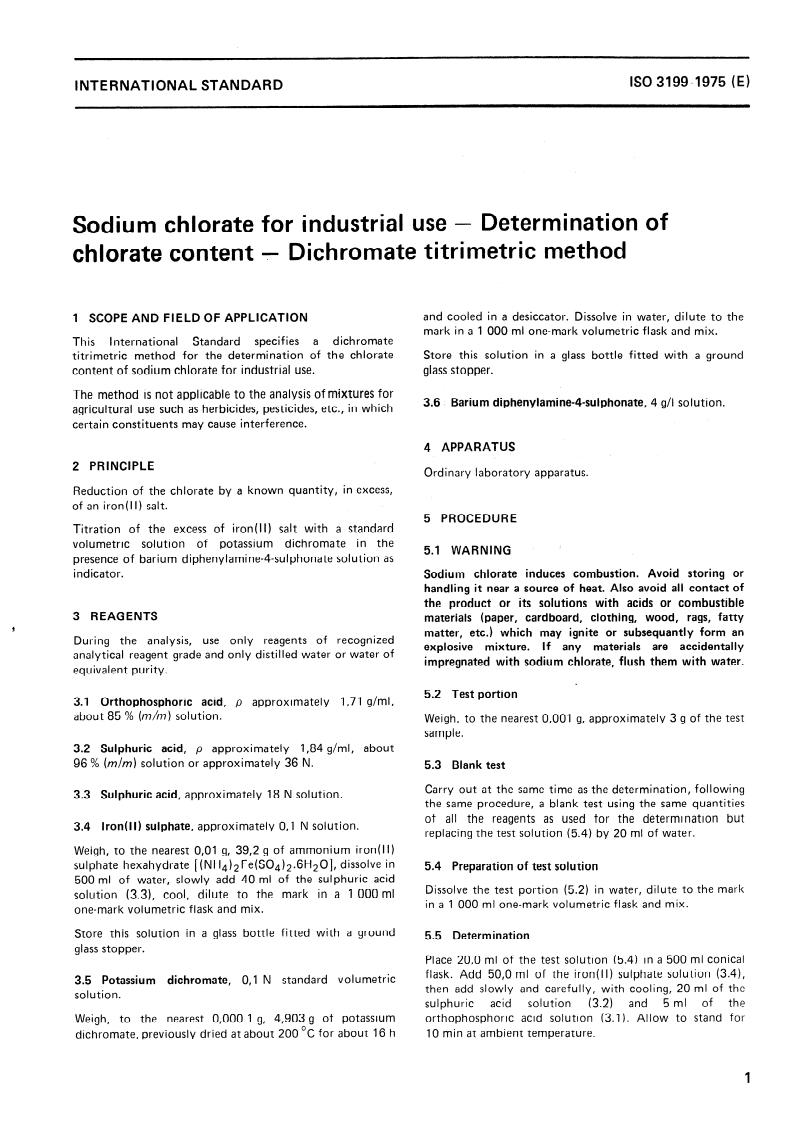
ISO 3199-1975 (E)
INTERNATIONAL STANDARD
Sodium chlorate for industrial use - Determination of
Dichromate titrimetric method
chlorate content :
1 SCOPE AND FIELD OF APPLICATION and cooled in a desiccator. Dissolve in water, dilute to the
mark in a 1 000 ml one-mark volumetric flask and mix.
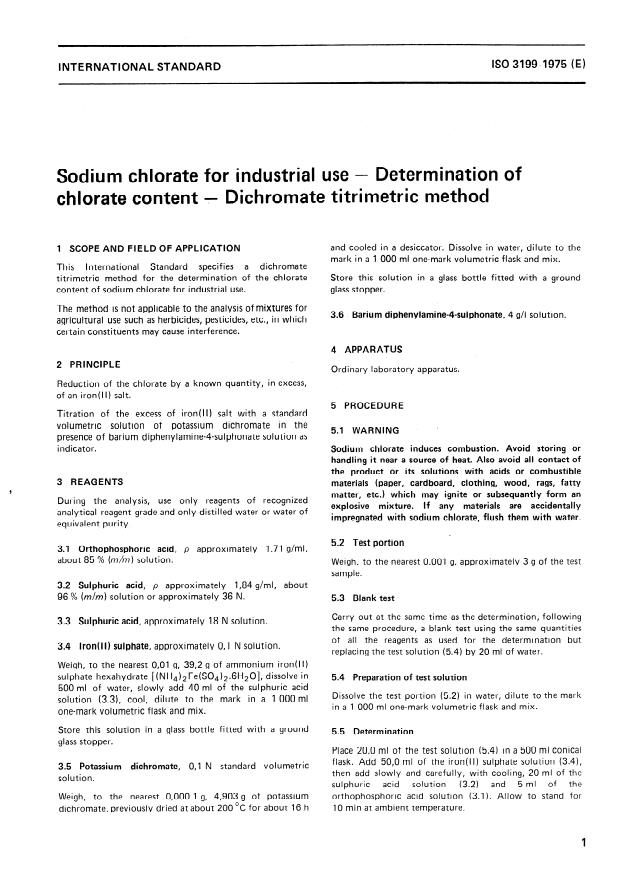
This International Standard specifies a dichromate
titrimetric method for the determination of the chlorate Store this Solution in a glass bottle fitted with a ground
content of sodium chlorate for industrial use. glass stopper.
The method is not applicable to the analysis of mixtures for
3.6 Barium diphenylamine=4+ulphonate, 4 g/l Solution.
agricultural use such as herbicides, pesticides, etc., in which
certain constituents may Cause interference.
4 APPARATUS
2 PRINCIPLE
Ordinary laboratory apparatus.
Reduction of the chlorate by a known quantity, in excess,
of an iron( II) salt.
5 PROCEDURE
Titration of the excess of iron(ll) salt with a Standard
volumetric Solution of potassium dichromate in the
5.1 WARNING ’
presence of barium diphenylamine-4-sulphonate Solution as
indicator.
Sodium chlorate induces combustion. Avoid storing or
handling it near a Source of heat. Also avoid all contact of
the product or its solutions with acids or combustible
3 REAGENTS
materials (Paper, cardboard, clothing, wood, rags, fatty
matter, etc.) which may ignite or subsequantly form an
During the analysis, use only reagents of recognized
explosive mixture. If any materials are accident
...
INTERNATIONAL STANDARD
INTERNATIONAL ORGANIZATION FOR STANDARDIZATION l MEXAYHAPOAHA9 OPTAHM3AUMfi l-f0 CTAHAAPTM3AUMM *ORGANISATION INTERNATIONALE DE NORMALISATIOIU
Sodium chlorate for industrial use - Determination of
Dichromate titrimetric method
chlorate content F
Chlorate de sodium 5 usage industriel - Dosage du chlorate - Mk thode ti trinie trique au dich roma te
First edition - 1975-02-15
w
UDC 661.442 : 546.135 : 543.24
- Ref. No. ISO 31994975 (E)
Descriptors : sodium chlorate, Chemical analysis, determination of content, chlorates, voiumetric analysis.
Price based on 2 payes
FOREWORD
ISO (the International Organization for Standardization) is a worldwide federation
of national Standards institutes (ISO Member Bodies). The work of developing
International Standards is carried out through ISO Technical Committees. Ewery
Member Body interested in a subject for which a Technical Committee has been set
up has the right to be represented on that Committee. International organizations,
governmental and non-governmental, in liaison with ISO, also take part in the work.
Draft International Standards adopted by the Technical Committees are circulated
to the Member Bodies for approval before their acceptance as International
Standards by the ISO Council.
International Standard ISO 3199 was drawn up by Technical Committee
ISO/TC 47, Chemistry, and circulated to the Member Bodies in September 1973.
lt has been approved by the Member Bodies of the foilowing countries :
India South Africa, Rep. of
Austria
Belgium I reland Spain
Switzerland
Bulgaria Italy
Chile Netherlands Thailand
Czechoslovakia New Zealand Turkey
France Poland United Kingdom
Germany Portugal U.S.S.R.
Hungary Romania Yugoslavia
No Member Body expressed disapproval of the document.
@ International Organkation for Standardkation, 1975 l
Printed in Switzerland
ISO 3199-1975 (E)
INTERNATIONAL STANDARD
Sodium chlorate for industrial use - Determination of
Dichromate titrimetric method
chlorate content :
1 SCOPE AND FIELD OF APPLICATION and cooled in a desiccator. Dissolve in water, dilute to the
mark in a 1 000 ml one-mark volumetric flask and mix.
This International Standard specifies a dichromate
titrimetric method for the determination of the chlorate Store this Solution in a glass bottle fitted with a ground
content of sodium chlorate for industrial use. glass stopper.
The method is not applicable to the analysis of mixtures for
3.6 Barium diphenylamine=4+ulphonate, 4 g/l Solution.
agricultural use such as herbicides, pesticides, etc., in which
certain constituents may Cause interference.
4 APPARATUS
2 PRINCIPLE
Ordinary laboratory apparatus.
Reduction of the chlorate by a known quantity, in excess,
of an iron( II) salt.
5 PROCEDURE
Titration of the excess of iron(ll) salt with a Standard
volumetric Solution of potassium dichromate in the
5.1 WARNING ’
presence of barium diphenylamine-4-sulphonate Solution as
indicator.
Sodium chlorate induces combustion. Avoid storing or
handling it near a Source of heat. Also avoid all contact of
the product or its solutions with acids or combustible
3 REAGENTS
materials (Paper, cardboard, clothing, wood, rags, fatty
matter, etc.) which may ignite or subsequantly form an
During the analysis, use only reagents of recognized
explosive mixture. If any materials are accident
...
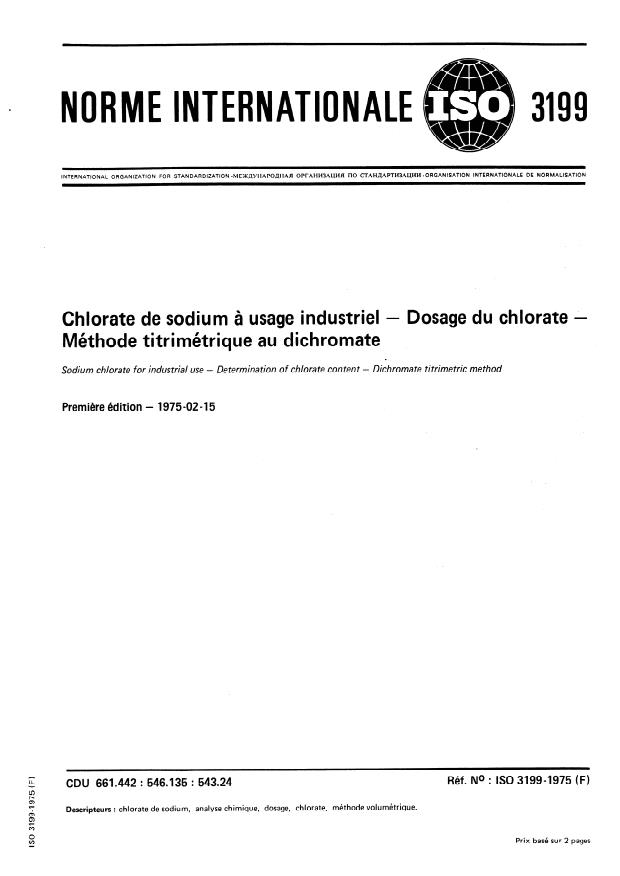
NORME INTERNATIONALE
INTERNATIONAL ORGANIZATION FOR STANDARDIZATION l MElKfiYHAPOAHAfl OPI-‘AHM3ALIM5I I--l0 CTAHAAPTM3ALJWM~ORGANISATION INTERNATIONALE DE NORMALISATION
Chlorate de sodium à usage industriel - Dosage du chlorate L
Méthode titrimétrique au dichromate
De termination of chlora te content - Dich roma te ti trime trie me thod
Sodium chlorate for industrial use -
Première édition - 1975-02-15
UI Réf. No : ISO 3199-1975 (F)
Y CDU 661.442 : 546.135 : 543.24
Descripteurs : chlorate de sodium, analyse chimique, dosage, chlorate, méthode volumétrique.
Prix basé sur 2 pages
AVANT-PROPOS
L’ISO (Organisation Internationale de Normalisation) est une fédération mondiale
d’organismes nationaux de normalisation (Comités Membres 60). L’élaboration de
Normes Internationales est confiée aux Comités Techniques ISO. Chaque Comité
Membre intéressé par une étude a le droit de faire partie du Comité Technique
correspondant. Les organisations internationales, gouvernementales et non
gouvernementales, en liaison avec I’ISO, participent également aux travaux.
Les Projets de Normes Internationales adoptés par les Comités Techniques sont
soumis aux Comités Membres pour approbation, avant leur acceptation comme
Normes Internationales par le Conseil de I’ISO.
La Norme Internationale ISO 3199 a été établie par le Comité Technique
ISO/TC 47, Chimie, et soumise aux Comités Membres en septembre 1973.
Elle a été approuvée par les Comités Membres des pays suivants :
Hongrie Roumanie
Afrique du Sud, Rép. d’
Inde Royaume-Uni
Allemagne
Irlande Suisse
Autriche
Italie Tchécoslovaquie
Belgique
Nouvelle-Zélande Thaïlande
Bulgarie
Turquie
Chili Pays-Bas
U.R.S.S.
Espagne Pologne
Yougoslavie
France Portugal
Aucun Comité Membre n’a désapprouvé le document.
0 Organisation Internationale de Normalisation, 1975 l
Imprimé en Suisse
NORME INTERNATIONALE ISO 3199-1975 (F)
Chlorate de sodium à usage industriel - Dosage du chlorate -
Méthode titrimétrique au dichromate
Conserver cette solution dans un flacon en verre fermé par
1 OBJET ET DOMAINE D’APPLICATION
un bouchon rodé.
La présente Norme Internationale spécifie une méthode
titrimétrique au dichromate pour le dosage du chlorate dans
3.6 Diphénylamine-4-sulfonate de baryum, solution à
le chlorate de sodium à usage industriel.
4 g/l.
La méthode n’est pas applicable à l’analyse des mélanges à
usage agricole : herbicides, pesticides, etc., dans lesquels
certains composants peuvent provoquer des interférences.
4 APPAREILLAGE
2 PRINCIPE Matériel courant de laboratoire.
Réduction du chlorate par une quantité connue, en excès,
de sel de fer(H).
5 MODE OPÉRATOIRE
Titrage de l’excès de sel de fer( II) par une solution titrée de
dichromate de potassium, en présence d’une solution de di-
5.1 AVERTISSEMENT
phénylamine-4-sulfonate de baryum comme indicateur.
Le chlorate de sodium est un comburant. Éviter de le
3 RÉACTIFS conserver, ou de le manipuler à proximité d’une source de
chaleur. Eviter également tout contact du produit ou de ses
Au cours de l’analyse, n’utiliser que des réactifs de qualité
solutions avec des acides et avec des matières combustibles
analytique reconnue, et que de l’eau distillée ou de l’eau de
(papiers, cartons, vêtements, bois, chiffons, matières
pureté équivalente.
grasses, etc.) qui risquent de s’enflammer ou de provoquer
par la suite un mélange explosif. Laver à grande eau toute
3.1 Acide orthophosphorique, environ,
p 1,71
...
NORME INTERNATIONALE
INTERNATIONAL ORGANIZATION FOR STANDARDIZATION l MElKfiYHAPOAHAfl OPI-‘AHM3ALIM5I I--l0 CTAHAAPTM3ALJWM~ORGANISATION INTERNATIONALE DE NORMALISATION
Chlorate de sodium à usage industriel - Dosage du chlorate L
Méthode titrimétrique au dichromate
De termination of chlora te content - Dich roma te ti trime trie me thod
Sodium chlorate for industrial use -
Première édition - 1975-02-15
UI Réf. No : ISO 3199-1975 (F)
Y CDU 661.442 : 546.135 : 543.24
Descripteurs : chlorate de sodium, analyse chimique, dosage, chlorate, méthode volumétrique.
Prix basé sur 2 pages
AVANT-PROPOS
L’ISO (Organisation Internationale de Normalisation) est une fédération mondiale
d’organismes nationaux de normalisation (Comités Membres 60). L’élaboration de
Normes Internationales est confiée aux Comités Techniques ISO. Chaque Comité
Membre intéressé par une étude a le droit de faire partie du Comité Technique
correspondant. Les organisations internationales, gouvernementales et non
gouvernementales, en liaison avec I’ISO, participent également aux travaux.
Les Projets de Normes Internationales adoptés par les Comités Techniques sont
soumis aux Comités Membres pour approbation, avant leur acceptation comme
Normes Internationales par le Conseil de I’ISO.
La Norme Internationale ISO 3199 a été établie par le Comité Technique
ISO/TC 47, Chimie, et soumise aux Comités Membres en septembre 1973.
Elle a été approuvée par les Comités Membres des pays suivants :
Hongrie Roumanie
Afrique du Sud, Rép. d’
Inde Royaume-Uni
Allemagne
Irlande Suisse
Autriche
Italie Tchécoslovaquie
Belgique
Nouvelle-Zélande Thaïlande
Bulgarie
Turquie
Chili Pays-Bas
U.R.S.S.
Espagne Pologne
Yougoslavie
France Portugal
Aucun Comité Membre n’a désapprouvé le document.
0 Organisation Internationale de Normalisation, 1975 l
Imprimé en Suisse
NORME INTERNATIONALE ISO 3199-1975 (F)
Chlorate de sodium à usage industriel - Dosage du chlorate -
Méthode titrimétrique au dichromate
Conserver cette solution dans un flacon en verre fermé par
1 OBJET ET DOMAINE D’APPLICATION
un bouchon rodé.
La présente Norme Internationale spécifie une méthode
titrimétrique au dichromate pour le dosage du chlorate dans
3.6 Diphénylamine-4-sulfonate de baryum, solution à
le chlorate de sodium à usage industriel.
4 g/l.
La méthode n’est pas applicable à l’analyse des mélanges à
usage agricole : herbicides, pesticides, etc., dans lesquels
certains composants peuvent provoquer des interférences.
4 APPAREILLAGE
2 PRINCIPE Matériel courant de laboratoire.
Réduction du chlorate par une quantité connue, en excès,
de sel de fer(H).
5 MODE OPÉRATOIRE
Titrage de l’excès de sel de fer( II) par une solution titrée de
dichromate de potassium, en présence d’une solution de di-
5.1 AVERTISSEMENT
phénylamine-4-sulfonate de baryum comme indicateur.
Le chlorate de sodium est un comburant. Éviter de le
3 RÉACTIFS conserver, ou de le manipuler à proximité d’une source de
chaleur. Eviter également tout contact du produit ou de ses
Au cours de l’analyse, n’utiliser que des réactifs de qualité
solutions avec des acides et avec des matières combustibles
analytique reconnue, et que de l’eau distillée ou de l’eau de
(papiers, cartons, vêtements, bois, chiffons, matières
pureté équivalente.
grasses, etc.) qui risquent de s’enflammer ou de provoquer
par la suite un mélange explosif. Laver à grande eau toute
3.1 Acide orthophosphorique, environ,
p 1,71
...
NORME INTERNATIONALE
INTERNATIONAL ORGANIZATION FOR STANDARDIZATION l MElKfiYHAPOAHAfl OPI-‘AHM3ALIM5I I--l0 CTAHAAPTM3ALJWM~ORGANISATION INTERNATIONALE DE NORMALISATION
Chlorate de sodium à usage industriel - Dosage du chlorate L
Méthode titrimétrique au dichromate
De termination of chlora te content - Dich roma te ti trime trie me thod
Sodium chlorate for industrial use -
Première édition - 1975-02-15
UI Réf. No : ISO 3199-1975 (F)
Y CDU 661.442 : 546.135 : 543.24
Descripteurs : chlorate de sodium, analyse chimique, dosage, chlorate, méthode volumétrique.
Prix basé sur 2 pages
AVANT-PROPOS
L’ISO (Organisation Internationale de Normalisation) est une fédération mondiale
d’organismes nationaux de normalisation (Comités Membres 60). L’élaboration de
Normes Internationales est confiée aux Comités Techniques ISO. Chaque Comité
Membre intéressé par une étude a le droit de faire partie du Comité Technique
correspondant. Les organisations internationales, gouvernementales et non
gouvernementales, en liaison avec I’ISO, participent également aux travaux.
Les Projets de Normes Internationales adoptés par les Comités Techniques sont
soumis aux Comités Membres pour approbation, avant leur acceptation comme
Normes Internationales par le Conseil de I’ISO.
La Norme Internationale ISO 3199 a été établie par le Comité Technique
ISO/TC 47, Chimie, et soumise aux Comités Membres en septembre 1973.
Elle a été approuvée par les Comités Membres des pays suivants :
Hongrie Roumanie
Afrique du Sud, Rép. d’
Inde Royaume-Uni
Allemagne
Irlande Suisse
Autriche
Italie Tchécoslovaquie
Belgique
Nouvelle-Zélande Thaïlande
Bulgarie
Turquie
Chili Pays-Bas
U.R.S.S.
Espagne Pologne
Yougoslavie
France Portugal
Aucun Comité Membre n’a désapprouvé le document.
0 Organisation Internationale de Normalisation, 1975 l
Imprimé en Suisse
NORME INTERNATIONALE ISO 3199-1975 (F)
Chlorate de sodium à usage industriel - Dosage du chlorate -
Méthode titrimétrique au dichromate
Conserver cette solution dans un flacon en verre fermé par
1 OBJET ET DOMAINE D’APPLICATION
un bouchon rodé.
La présente Norme Internationale spécifie une méthode
titrimétrique au dichromate pour le dosage du chlorate dans
3.6 Diphénylamine-4-sulfonate de baryum, solution à
le chlorate de sodium à usage industriel.
4 g/l.
La méthode n’est pas applicable à l’analyse des mélanges à
usage agricole : herbicides, pesticides, etc., dans lesquels
certains composants peuvent provoquer des interférences.
4 APPAREILLAGE
2 PRINCIPE Matériel courant de laboratoire.
Réduction du chlorate par une quantité connue, en excès,
de sel de fer(H).
5 MODE OPÉRATOIRE
Titrage de l’excès de sel de fer( II) par une solution titrée de
dichromate de potassium, en présence d’une solution de di-
5.1 AVERTISSEMENT
phénylamine-4-sulfonate de baryum comme indicateur.
Le chlorate de sodium est un comburant. Éviter de le
3 RÉACTIFS conserver, ou de le manipuler à proximité d’une source de
chaleur. Eviter également tout contact du produit ou de ses
Au cours de l’analyse, n’utiliser que des réactifs de qualité
solutions avec des acides et avec des matières combustibles
analytique reconnue, et que de l’eau distillée ou de l’eau de
(papiers, cartons, vêtements, bois, chiffons, matières
pureté équivalente.
grasses, etc.) qui risquent de s’enflammer ou de provoquer
par la suite un mélange explosif. Laver à grande eau toute
3.1 Acide orthophosphorique, environ,
p 1,71
...
NORME INTERNATIONALE
INTERNATIONAL ORGANIZATION FOR STANDARDIZATION l MElKfiYHAPOAHAfl OPI-‘AHM3ALIM5I I--l0 CTAHAAPTM3ALJWM~ORGANISATION INTERNATIONALE DE NORMALISATION
Chlorate de sodium à usage industriel - Dosage du chlorate L
Méthode titrimétrique au dichromate
De termination of chlora te content - Dich roma te ti trime trie me thod
Sodium chlorate for industrial use -
Première édition - 1975-02-15
UI Réf. No : ISO 3199-1975 (F)
Y CDU 661.442 : 546.135 : 543.24
Descripteurs : chlorate de sodium, analyse chimique, dosage, chlorate, méthode volumétrique.
Prix basé sur 2 pages
AVANT-PROPOS
L’ISO (Organisation Internationale de Normalisation) est une fédération mondiale
d’organismes nationaux de normalisation (Comités Membres 60). L’élaboration de
Normes Internationales est confiée aux Comités Techniques ISO. Chaque Comité
Membre intéressé par une étude a le droit de faire partie du Comité Technique
correspondant. Les organisations internationales, gouvernementales et non
gouvernementales, en liaison avec I’ISO, participent également aux travaux.
Les Projets de Normes Internationales adoptés par les Comités Techniques sont
soumis aux Comités Membres pour approbation, avant leur acceptation comme
Normes Internationales par le Conseil de I’ISO.
La Norme Internationale ISO 3199 a été établie par le Comité Technique
ISO/TC 47, Chimie, et soumise aux Comités Membres en septembre 1973.
Elle a été approuvée par les Comités Membres des pays suivants :
Hongrie Roumanie
Afrique du Sud, Rép. d’
Inde Royaume-Uni
Allemagne
Irlande Suisse
Autriche
Italie Tchécoslovaquie
Belgique
Nouvelle-Zélande Thaïlande
Bulgarie
Turquie
Chili Pays-Bas
U.R.S.S.
Espagne Pologne
Yougoslavie
France Portugal
Aucun Comité Membre n’a désapprouvé le document.
0 Organisation Internationale de Normalisation, 1975 l
Imprimé en Suisse
NORME INTERNATIONALE ISO 3199-1975 (F)
Chlorate de sodium à usage industriel - Dosage du chlorate -
Méthode titrimétrique au dichromate
Conserver cette solution dans un flacon en verre fermé par
1 OBJET ET DOMAINE D’APPLICATION
un bouchon rodé.
La présente Norme Internationale spécifie une méthode
titrimétrique au dichromate pour le dosage du chlorate dans
3.6 Diphénylamine-4-sulfonate de baryum, solution à
le chlorate de sodium à usage industriel.
4 g/l.
La méthode n’est pas applicable à l’analyse des mélanges à
usage agricole : herbicides, pesticides, etc., dans lesquels
certains composants peuvent provoquer des interférences.
4 APPAREILLAGE
2 PRINCIPE Matériel courant de laboratoire.
Réduction du chlorate par une quantité connue, en excès,
de sel de fer(H).
5 MODE OPÉRATOIRE
Titrage de l’excès de sel de fer( II) par une solution titrée de
dichromate de potassium, en présence d’une solution de di-
5.1 AVERTISSEMENT
phénylamine-4-sulfonate de baryum comme indicateur.
Le chlorate de sodium est un comburant. Éviter de le
3 RÉACTIFS conserver, ou de le manipuler à proximité d’une source de
chaleur. Eviter également tout contact du produit ou de ses
Au cours de l’analyse, n’utiliser que des réactifs de qualité
solutions avec des acides et avec des matières combustibles
analytique reconnue, et que de l’eau distillée ou de l’eau de
(papiers, cartons, vêtements, bois, chiffons, matières
pureté équivalente.
grasses, etc.) qui risquent de s’enflammer ou de provoquer
par la suite un mélange explosif. Laver à grande eau toute
3.1 Acide orthophosphorique, environ,
p 1,71
...