


ISO/IEC TR 14369:2014
(Main)Information technology — Programming languages, their environments and system software interfaces — Guidelines for the preparation of Language-Independent Service Specifications (LISS)
Information technology — Programming languages, their environments and system software interfaces — Guidelines for the preparation of Language-Independent Service Specifications (LISS)
ISO/IEC TR 14369:2014 provides guidelines to those concerned with developing specifications of information technology services and their interfaces intended for use by clients of the services, in particular by external applications that do not necessarily all share the environment and assumptions of one particular programming language. The guidelines do not directly or fully cover all aspects of service or interface specifications, but they do cover those aspects required to achieve language independence, i.e. required to make a specification neutral with respect to the language environment from which the service is invoked. The guidelines are primarily concerned with the interface between the service and the external applications making use of the service, including the special case where the service itself is already specified in a language-dependent way but needs to be invoked from environments of other languages. Language bindings, already addressed by another Technical Report, ISO/IEC/TR 10182, are dealt with by providing advice on how to use the two Technical Reports together. ISO/IEC TR 14369:2014 provides technical guidelines, rather than organizational or administrative guidelines for the management of the development process, though in some cases the technical guidelines may have organizational or administrative implications.
Technologies de l'information — Langages de programmation, leurs environnements et interfaces du logiciel d'exploitation — Lignes directrices pour l'élaboration de spécifications de service indépendantes du langage (LISS)
General Information
- Status
- Withdrawn
- Publication Date
- 23-Nov-2014
- Withdrawal Date
- 23-Nov-2014
- Current Stage
- 9599 - Withdrawal of International Standard
- Start Date
- 30-Jan-2018
- Completion Date
- 12-Feb-2026
Relations
- Effective Date
- 16-Jul-2016

Get Certified
Connect with accredited certification bodies for this standard

BSI Group
BSI (British Standards Institution) is the business standards company that helps organizations make excellence a habit.

NYCE
Mexican standards and certification body.
Sponsored listings
Frequently Asked Questions
ISO/IEC TR 14369:2014 is a technical report published by the International Organization for Standardization (ISO). Its full title is "Information technology — Programming languages, their environments and system software interfaces — Guidelines for the preparation of Language-Independent Service Specifications (LISS)". This standard covers: ISO/IEC TR 14369:2014 provides guidelines to those concerned with developing specifications of information technology services and their interfaces intended for use by clients of the services, in particular by external applications that do not necessarily all share the environment and assumptions of one particular programming language. The guidelines do not directly or fully cover all aspects of service or interface specifications, but they do cover those aspects required to achieve language independence, i.e. required to make a specification neutral with respect to the language environment from which the service is invoked. The guidelines are primarily concerned with the interface between the service and the external applications making use of the service, including the special case where the service itself is already specified in a language-dependent way but needs to be invoked from environments of other languages. Language bindings, already addressed by another Technical Report, ISO/IEC/TR 10182, are dealt with by providing advice on how to use the two Technical Reports together. ISO/IEC TR 14369:2014 provides technical guidelines, rather than organizational or administrative guidelines for the management of the development process, though in some cases the technical guidelines may have organizational or administrative implications.
ISO/IEC TR 14369:2014 provides guidelines to those concerned with developing specifications of information technology services and their interfaces intended for use by clients of the services, in particular by external applications that do not necessarily all share the environment and assumptions of one particular programming language. The guidelines do not directly or fully cover all aspects of service or interface specifications, but they do cover those aspects required to achieve language independence, i.e. required to make a specification neutral with respect to the language environment from which the service is invoked. The guidelines are primarily concerned with the interface between the service and the external applications making use of the service, including the special case where the service itself is already specified in a language-dependent way but needs to be invoked from environments of other languages. Language bindings, already addressed by another Technical Report, ISO/IEC/TR 10182, are dealt with by providing advice on how to use the two Technical Reports together. ISO/IEC TR 14369:2014 provides technical guidelines, rather than organizational or administrative guidelines for the management of the development process, though in some cases the technical guidelines may have organizational or administrative implications.
ISO/IEC TR 14369:2014 is classified under the following ICS (International Classification for Standards) categories: 35.060 - Languages used in information technology. The ICS classification helps identify the subject area and facilitates finding related standards.
ISO/IEC TR 14369:2014 has the following relationships with other standards: It is inter standard links to ISO/IEC TR 14369:2018. Understanding these relationships helps ensure you are using the most current and applicable version of the standard.
ISO/IEC TR 14369:2014 is available in PDF format for immediate download after purchase. The document can be added to your cart and obtained through the secure checkout process. Digital delivery ensures instant access to the complete standard document.
Standards Content (Sample)
TECHNICAL ISO/IEC TR
REPORT 14369
First edition
2014-12-01
Information technology —
Programming languages, their
environments and system software
interfaces — Guidelines for the
preparation of Language-Independent
Service Specifications (LISS)
Technologies de l’information — Langages de programmation,
leurs environnements et interfaces du logiciel d’exploitation —
Lignes directrices pour l’élaboration de spécifications de service
indépendantes du langage (LISS)
Reference number
©
ISO/IEC 2014
© ISO/IEC 2014
All rights reserved. Unless otherwise specified, no part of this publication may be reproduced or utilized otherwise in any form
or by any means, electronic or mechanical, including photocopying, or posting on the internet or an intranet, without prior
written permission. Permission can be requested from either ISO at the address below or ISO’s member body in the country of
the requester.
ISO copyright office
Case postale 56 • CH-1211 Geneva 20
Tel. + 41 22 749 01 11
Fax + 41 22 749 09 47
E-mail copyright@iso.org
Web www.iso.org
Published in Switzerland
ii © ISO/IEC 2014 – All rights reserved
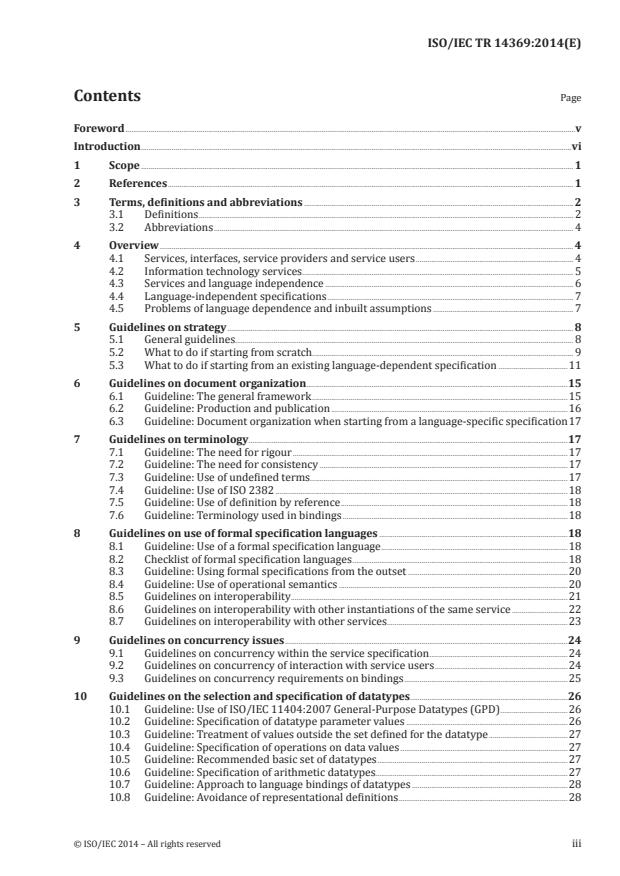
Contents Page
Foreword .v
Introduction .vi
1 Scope . 1
2 References . 1
3 Terms, definitions and abbreviations . 2
3.1 Definitions . 2
3.2 Abbreviations . 4
4 Overview . 4
4.1 Services, interfaces, service providers and service users . 4
4.2 Information technology services . 5
4.3 Services and language independence . 6
4.4 Language-independent specifications . 7
4.5 Problems of language dependence and inbuilt assumptions . 7
5 Guidelines on strategy . 8
5.1 General guidelines. 8
5.2 What to do if starting from scratch. 9
5.3 What to do if starting from an existing language-dependent specification .11
6 Guidelines on document organization.15
6.1 Guideline: The general framework .15
6.2 Guideline: Production and publication .16
6.3 Guideline: Document organization when starting from a language-specific specification 17
7 Guidelines on terminology .17
7.1 Guideline: The need for rigour .17
7.2 Guideline: The need for consistency .17
7.3 Guideline: Use of undefined terms .17
7.4 Guideline: Use of ISO 2382 .18
7.5 Guideline: Use of definition by reference .18
7.6 Guideline: Terminology used in bindings .18
8 Guidelines on use of formal specification languages .18
8.1 Guideline: Use of a formal specification language .18
8.2 Checklist of formal specification languages .18
8.3 Guideline: Using formal specifications from the outset .20
8.4 Guideline: Use of operational semantics .20
8.5 Guidelines on interoperability .21
8.6 Guidelines on interoperability with other instantiations of the same service .22
8.7 Guidelines on interoperability with other services .23
9 Guidelines on concurrency issues .24
9.1 Guidelines on concurrency within the service specification .24
9.2 Guidelines on concurrency of interaction with service users .24
9.3 Guidelines on concurrency requirements on bindings .25
10 Guidelines on the selection and specification of datatypes.26
10.1 Guideline: Use of ISO/IEC 11404:2007 General-Purpose Datatypes (GPD) .26
10.2 Guideline: Specification of datatype parameter values .26
10.3 Guideline: Treatment of values outside the set defined for the datatype .27
10.4 Guideline: Specification of operations on data values .27
10.5 Guideline: Recommended basic set of datatypes .27
10.6 Guideline: Specification of arithmetic datatypes.27
10.7 Guideline: Approach to language bindings of datatypes .28
10.8 Guideline: Avoidance of representational definitions .28
© ISO/IEC 2014 – All rights reserved iii
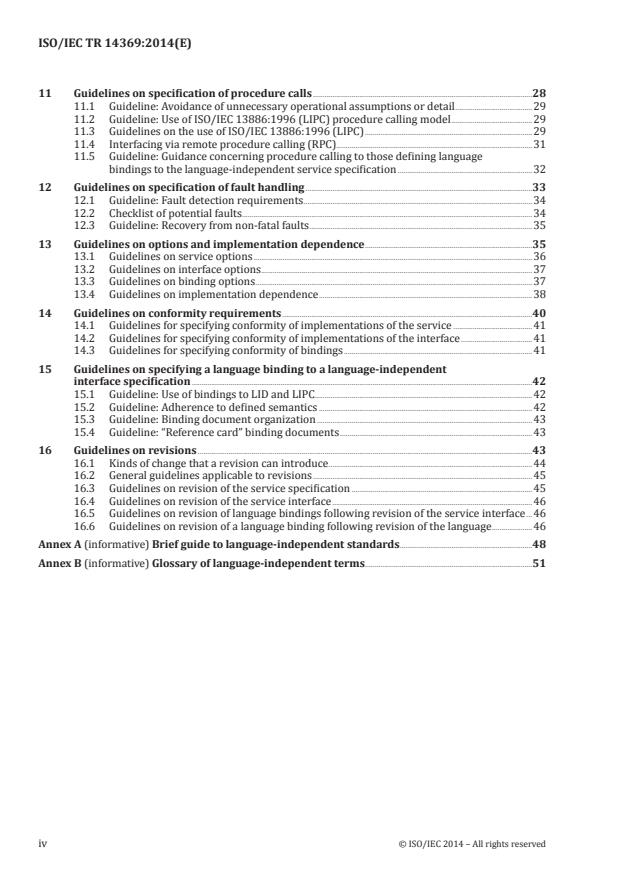
11 Guidelines on specification of procedure calls .28
11.1 Guideline: Avoidance of unnecessary operational assumptions or detail .29
11.2 Guideline: Use of ISO/IEC 13886:1996 (LIPC) procedure calling model .29
11.3 Guidelines on the use of ISO/IEC 13886:1996 (LIPC) .29
11.4 Interfacing via remote procedure calling (RPC).31
11.5 Guideline: Guidance concerning procedure calling to those defining language
bindings to the language-independent service specification .32
12 Guidelines on specification of fault handling .33
12.1 Guideline: Fault detection requirements .34
12.2 Checklist of potential faults .34
12.3 Guideline: Recovery from non-fatal faults .35
13 Guidelines on options and implementation dependence .35
13.1 Guidelines on service options .36
13.2 Guidelines on interface options .37
13.3 Guidelines on binding options .37
13.4 Guidelines on implementation dependence .38
14 Guidelines on conformity requirements .40
14.1 Guidelines for specifying conformity of implementations of the service .41
14.2 Guidelines for specifying conformity of implementations of the interface .41
14.3 Guidelines for specifying conformity of bindings .41
15 Guidelines on specifying a language binding to a language-independent
interface specification .42
15.1 Guideline: Use of bindings to LID and LIPC .42
15.2 Guideline: Adherence to defined semantics .42
15.3 Guideline: Binding document organization .43
15.4 Guideline: “Reference card” binding documents .43
16 Guidelines on revisions .43
16.1 Kinds of change that a revision can introduce .44
16.2 General guidelines applicable to revisions .45
16.3 Guidelines on revision of the service specification .45
16.4 Guidelines on revision of the service interface .46
16.5 Guidelines on revision of language bindings following revision of the service interface .46
16.6 Guidelines on revision of a language binding following revision of the language .46
Annex A (informative) Brief guide to language-independent standards .48
Annex B (informative) Glossary of language-independent terms .51
iv © ISO/IEC 2014 – All rights reserved
Foreword
ISO (the International Organization for Standardization) is a worldwide federation of national standards
bodies (ISO member bodies). The work of preparing International Standards is normally carried out
through ISO technical committees. Each member body interested in a subject for which a technical
committee has been established has the right to be represented on that committee. International
organizations, governmental and non-governmental, in liaison with ISO, also take part in the work.
ISO collaborates closely with the International Electrotechnical Commission (IEC) on all matters of
electrotechnical standardization.
The procedures used to develop this document and those intended for its further maintenance are
described in the ISO/IEC Directives, Part 1. In particular the different approval criteria needed for the
different types of ISO documents should be noted. This document was drafted in accordance with the
editorial rules of the ISO/IEC Directives, Part 2. www.iso.org/directives
Attention is drawn to the possibility that some of the elements of this document may be the subject of
patent rights. ISO shall not be held responsible for identifying any or all such patent rights. Details of any
patent rights identified during the development of the document will be in the Introduction and/or on
the ISO list of patent declarations received. www.iso.org/patents
Any trade name used in this document is information given for the convenience of users and does not
constitute an endorsement.
For an explanation on the meaning of ISO specific terms and expressions related to conformity
assessment, as well as information about ISO’s adherence to the WTO principles in the Technical Barriers
to Trade (TBT), see the following URL: Foreword - Supplementary information
The committee responsible for this document is ISO/IEC JTC 1, Information technology, subcommittee
SC 22, Programming languages, their environments and system software interfaces.
© ISO/IEC 2014 – All rights reserved v
Introduction
This Technical Report is dedicated to Brian L. Meek in grateful recognition of his leadership and vision in
the development of the concepts on programming language independent specifications, and his efforts
in producing a set of standards documents in this area. Without his commitment this Technical Report
never would have been published.
0.1 Background
This Technical Report provides guidance to those writing specifications of services, and of interfaces to
services, in a language-independent way, in particular as standards. It can be regarded as complementary
to ISO/IEC/TR 10182, which provides guidance to those performing language bindings for such services
and their interfaces.
NOTE 1 Here and throughout, “language”, on its own or in compounds like “language-independent”, means
“programming language”, not “specification language” nor “natural (human) language”, unless explicitly stated.
NOTE 2 A “language-independent” service or interface specification may be expressed using either or both of a
natural language like English or a formal specification language like VDM-SL or Z; in a sense, a specification might
be regarded as “dependent” on (say) VDM-SL. The term “language-independent” does not imply otherwise, since
it refers only to the situation where programming language(s) might otherwise be used in defining the service or
interface.
The development of this Technical Report was prompted by the existence of an earlier draft IEEE Technical
Report (IEEE TCOS-SCC Technical Report on Programming Language Independent Specification Methods,
draft 4, May 1991). The TCOS draft was concerned with specifications of services in a POSIX systems
environment, and as such contained much detailed POSIX-specific guidance; nevertheless it was clear
that many of the principles, if not the detail, were applicable much more generally. This Technical Report
was conceived as a means of providing such more general guidance. Because of the very different formats,
and the POSIX-related detail in the TCOS draft, there is almost no direct correspondence between the
two documents, except in the discussion of the benefits of a language-independent principles below.
However, the spirit and principles of the TCOS draft were of great value in developing this Technical
Report, and reappear herein, albeit in much altered and more general form.
NOTE 3 The TCOS draft has not in fact been published, as the result of an IEEE decision to concentrate activities
in other POSIX areas.
0.2 Principles
Service or interface specifications that are independent of any particular language, particularly
when embodied in recognized standards, are increasingly seen as an important factor in promoting
interoperation and substitution of system components, and reducing dependence on and consequent
limitations due to particular language platforms.
NOTE It is of course possible for a specification to be “independent” of a particular language in a formal sense,
but still be dependent on it through inbuilt assumptions derived from that language which do not necessarily hold
for other languages. The term “language-independent” here is meant in a much stronger sense than that, though
complete independence from all inbuilt assumptions may be difficult if not impossible to achieve.
Potential benefits from language-independent service or interface specifications include:
— A language-independent interface specification specifies those requirements that are common to all
language bindings to that interface, and hence provides a specification to which language bindings
may conform.
— A language-independent interface specification is a re-usable component for constructing language
bindings.
— A language-independent interface specification aids the construction of language bindings by
providing a common reference to which all bindings can relate. Through this common reference
it is possible to make use of pre-existing language bindings to language-independent standards
vi © ISO/IEC 2014 – All rights reserved
for common features such as datatypes and procedure calls, and to other language-independent
specifications with related concepts.
— A language-independent service or interface specification provides an abstract specification of a
service in isolation from language-dependent extensions or restrictions, and hence facilitates more
rigorous modelling of services and interfaces.
— Language-independent service specifications facilitate the specification of relationships between
one service and another, by making it easier to relate common concepts than is generally possible
when the specifications are dependent on different languages.
— A language-independent interface specification facilitates the definition of relationships between
different language bindings to a common service (such as requirements for interoperability between
applications based on different languages that are sharing a common service implementation), by
providing a common reference specification to which all the languages can relate.
— A language-independent interface specification facilitates the definition of relations between
bindings to multiple services, including the requirements on management of multiple name spaces.
— fort and resources needed to ensure compatibility and consistency of behaviour between
implementations of the same service in different languages or between applications based on
different languages using the same interface.
© ISO/IEC 2014 – All rights reserved vii
TECHNICAL REPORT ISO/IEC TR 14369:2014(E)
Information technology — Programming languages,
their environments and system software interfaces —
Guidelines for the preparation of Language-Independent
Service Specifications (LISS)
1 Scope
This Technical Report provides guidelines to those concerned with developing specifications of
information technology services and their interfaces intended for use by clients of the services, in
particular by external applications that do not necessarily all share the environment and assumptions of
one particular programming language. The guidelines do not directly or fully cover all aspects of service
or interface specifications, but they do cover those aspects required to achieve language independence,
i.e. required to make a specification neutral with respect to the language environment from which the
service is invoked. The guidelines are primarily concerned with the interface between the service and
the external applications making use of the service, including the special case where the service itself
is already specified in a language-dependent way but needs to be invoked from environments of other
languages. Language bindings, already addressed by another Technical Report, ISO/IEC/TR 10182, are
dealt with by providing advice on how to use the two Technical Reports together.
This Technical Report provides technical guidelines, rather than organizational or administrative
guidelines for the management of the development process, though in some cases the technical guidelines
may have organizational or administrative implications.
2 References
The following documents, in whole or in part, are normatively referenced in this document and are
indispensable for its application. For dated references, only the edition cited applies. For undated
references, the latest edition of the referenced document (including any amendments) applies.
ISO 8807:1989, Information processing systems — Open Systems Interconnection — LOTOS — A formal
description technique based on the temporal ordering of observational behaviour
1)
ISO/IEC 9074:1997 , Information technology — Open Systems Interconnection — Estelle: A formal
description technique based on an extended state transition model Amendment 1)
ISO/IEC/TR 10034:1990, Guidelines for the preparation of conformity clauses in programming language
standards
ISO/IEC/TR 10176:2003, Information technology — Guidelines for the preparation of programming
language standards
ISO/IEC/TR 10182:—, Information technology — Programming languages, their environments and system
software interfaces — Guidelines for language bindings
ISO/IEC 10967-1:2012, Information technology — Language independent arithmetic — Part 1: Integer and
floating point arithmetic
ISO/IEC 11404:2007, Information technology — Programming languages, their environments and system
software interfaces — Language-independent datatypes
ISO/IEC 11578:1996, Information technology — Open Systems Interconnection — Remote Procedure Call
(RPC)
1) Withdrawn.
© ISO/IEC 2014 – All rights reserved 1
ISO/IEC 13719:1998, Information technology — Portable Common Tools Environment (PCTE)
ISO/IEC 13817-1:1996, Information technology — Programming languages, their environments and system
software interfaces — Vienna Development Method — Specification Language – Part 1: Base language
ISO/IEC 13886:1996, Information technology — Language-Independent Procedure Calling (LIPC)
ISO/IEC 14977:1996, Information technology — Syntactic metalanguage — Extended BNF
3 Terms, definitions and abbreviations
For the purposes of this document, the following terms and definitions apply.
3.1 Definitions
3.1.1
client
see service user
3.1.2
datatype
set of values, usually accompanied by a set of operations on those values
3.1.3
formal language
formal specification language
see specification language
3.1.4
interface
mechanism by which a service user invokes and makes use of a service
3.1.5
language
unless otherwise qualified, “language” means “programming language”, not “specification language” or
“natural (human) language”
3.1.6
language binding
specification of the standard interface to a service, or set of services, for applications written in a
particular programming language
3.1.7
language-dependent
making use of the concepts, features or assumptions of a particular programming language
3.1.8
language-independent
not making use of the concepts, features or assumptions of any particular programming language or
style of language
3.1.9
language processor
entire computing system which enables a programming language user to translate and execute programs
written in the language, in general consisting both of hardware and of the relevant associated software
Note 1 to entry: This definition comes from ISO/IEC/TR 10176, Guidelines for the preparation of programming
language standards.
2 © ISO/IEC 2014 – All rights reserved
3.1.10.1
mapping
(noun) defined association between elements (such as concepts, features or facilities) of one entity (such
as a programming language, or a specification, or a standard) with corresponding elements of another
entity
Note 1 to entry: Mappings are usually defined as being from one entity into another. A language binding of a
language L into a standard S usually incorporates both a mapping from L into S and a mapping from S into L.
3.1.10.2
mapping
(verb) process of determining or utilizing a mapping
Note 1 to entry: Depending upon what is being mapped, a mapping is not necessarily one-to-one. This means that
mapping an element E from system A into an element E’ of system B, followed by mapping E’ back into system A,
may not necessarily get back to the original E. In such situations, if a two-way correspondence is to be preserved,
execution of the mappings must include recording the place of origin and returning to it.
3.1.11
marshalling
process of collecting the actual parameters used in a procedure call, converting them if necessary, and
assembling them for transfer to the called procedure
Note 1 to entry: This process is also carried out by the called procedure when preparing to return the results of
the call to the caller
Note 2 to entry: Marshalling can be regarded as being performed by a service user when preparing input values
for a service provider, and by a service provider when preparing results for a service user, the service concerned
being regarded as the procedure being called.
3.1.12
procedure
subprogram which may or may not return a value (the former variant is sometimes called a subroutine,
the latter is sometimes called a function)
Note 1 to entry: Some programming languages use different terminology.
3.1.13
server
see service provider
3.1.14
service
facility or set of facilities made available to service users through an interface
3.1.15
service provider
computer system or set of computer systems that implements a service and makes it available to service
uers
Note 1 to entry: In this definition, “computer system” means a logical system, not a physical system; it may
correspond to part of all of one or more physical computer systems.
Note 2 to entry: The term “server” is often used in a similar sense, though sometimes implying a physical computer
system that has no other function than to provide its service
3.1.16
service user
application (typically a program in some language) which makes use of a service
Note 1 to entry: The term “client” is often used in a similar sense, though sometimes implying the physical
computer system on which the application is running, rather than just the application itself.
© ISO/IEC 2014 – All rights reserved 3
3.1.17
specification language
formal language for defining the semantics of a service or an interface precisely and without ambiguity
3.1.18
unmarshalling
process of receiving and disassembling transferred parameters, and converting them if necessary, to
prepare the values for further use
Note 1 to entry: This process is carried out by the called procedure on receipt of the actual parameters for the call,
and by the caller on receipt of the returned results of the call
Note 2 to entry: Unmarshalling can be regarded as being performed by a service provider when receiving input
values from a service user, and by a service user when receiving results from a service provider, the service
concerned being regarded as the procedure being called.
3.1.19.1
Z
e.g. ISO/IEC 10967-1:2012) the complex numbers
3.1.19.2
Z
formal specification language, see ISO/IEC WD 13568
3.2 Abbreviations
3.2.1
LID
language-independent datatypes, as defined in ISO/IEC 11404:2007
3.2.2
LIPC
language-Independent Procedure Calling, as defined in ISO/IEC 13886:1996
3.2.3
RPC
remote Procedure Call, as defined in ISO/IEC 11578:1996
4 Overview
4.1 Services, interfaces, service providers and service users
The concept of a “service” is a very general one. In some contexts it is customary to use it in a restricted
sense, e.g. when talking about “service industries” as contrasted with “manufacturing industries”.
Despite such usages, almost any activity or behaviour can be regarded as a “service”, if it serves some
useful purpose to do so (for example, manufacturing spoons can be regarded as a service for those
needing spoons).
With the concept of a service come the concepts of a “service provider” and a “service user”. The
provider performs the activity that constitutes the service; the user is the customer or the client for
the service, for whom the service is performed. In the information technology field, the “client-server
model” incorporates these concepts: the server provides, the client uses.
Between the service provider and the service user is an interface that allows them to communicate.
The service user communicates through the interface the requirement for the service, and any relevant
information (e.g. not only the need for spoons, but the number and size of spoons required), and the
service provider communicates through the interface the response to the order for the service, and any
additional information or queries (e.g. the spoons can be delivered in six days, do you want silver spoons
or plastic spoons?). In the information technology field, such interfaces are usually explicit, realized
4 © ISO/IEC 2014 – All rights reserved
in hardware or software or both. In the world in general, they are sometimes explicit, but sometimes
subsumed in more general human or other interactions.
This distinction between provider and user (client and server) must not be assumed to correspond to
identifiable distinct entities. The distinction, and the service interface, may be purely notional, and
possibly not normally thought of in that way. The service itself may similarly not correspond to a distinct,
separate activity, and again possibly not normally thought of as such; it may be subsumed in some other
activity or group of activities, and may possibly be implicit.
Hence, for example, in a transaction between two parties, each one may be providing a service for the
other: each is a client, and each a server. In another context, the provider is providing the service to
itself; the provider is also the user. Though it may be possible to subdivide the provider/user into a
provider part and a user part when considering provision of the service, this may be inconvenient in
other respects.
In summary, “client” and “server”, are roles that are carried out, rather than elements that necessarily
must be implemented separately. Though the term “client-server” is sometimes used in the information
technology field in ways that are more specific than it is used here, it is important not to carry over
assumptions from particular client-server models when reading this Technical Report. It is still more
important not to assume that implementation of any service, in the sense used here, has to be done using
a client-server model.
4.2 Information technology services
The history of information technology has many instances of the technology, or a product, being used for
very different purposes and in very different ways from those originally envisaged. The kinds of service
that information technology and products provide have continually expanded and diversified, and this
is still continuing.
It is as common in information technology as in the outside world for the term “service” in particular
contexts to be used in a rather specific way. The history of the technology suggests that, for the purposes
of formulating guidelines about services, the term should instead be used as generally as possible.
This Technical Report has adopted this very general approach to the concept of “service”. It is therefore
important that, when using this Technical Report and the guidelines it contains, no presuppositions
should be made about what a service is, or about how and by what it is provided or how and by what it is
used. The guidelines should be interpreted and applied in that light.
This Technical Report does, however, carefully distinguish between the service itself, and the interface
used to communicate with it. In some usages the term “service” includes the interface, and the interface
may be embedded in the service and its specification (as in the phrase “all parts of the service”). However,
logically they are distinct, and this logical distinction is maintained throughout this Technical Report.
Services in the most general sense often simply evolve naturally, but information technology services
are usually consciously designed. They are also often built from explicit specifications, though some are
developed ad hoc. Whichever the case, it is useful to make a clear logical distinction between service
providers, service users, and the interface between them, even if, when implemented, one or both of these
distinctions will be purely notional, and will not be embodied in identifiable and separable artefacts like
particular hardware components or particular blocks of code. Indeed, thinking about service provision
in such a way, in an environment that is normally regarded as a more integrated whole, can help to
improve a specification, or at least to test it and verify its validity.
This is especially so in the increasing number of cases where information technology environments and
services, though originally conceived as self-contained, have to interact with external environments
and services, many of which will need the distinction between providers and users to be made explicit.
An instance of direct relevance to this Technical Report is where interacting entities are based upon
different languages and hence different sets of underlying assumptions.
© ISO/IEC 2014 – All rights reserved 5
4.3 Services and language independence
The term “language-independent service (or interface) specification” means “language-independent
specification of a service (or interface)”, not “specification of a language-independent service (or
interface)”. Hence a language-independent specification of a service does not imply that the service itself
is “language independent” in the sense intended here. The service specified may be relevant only to
environments of particular languages.
NOTE 1 The implementation of a service which meets the specification will use some language or other, if only
machine language, and so will in a sense be “dependent” on that language, but that is not the sense intended here.
Also, a language-independent specification of an interface does not imply that the service interfaced to
is either itself “language independent”, or specified in a language-independent way (though it may be).
A trivial instance is that of a language processor for a particular language providing a service by
executing a program in that language. For one of the long-established languages (like Cobol or Fortran)
the interface is the provision of input data and the output of results. The language was designed for
particular forms of input and output media, presumed under the control of a human user. However, a
language-independent interface specification could define the input and output in such a way that the
data can come from, and the results be returned to, some other system, in general using a different
language.
In a simple case like that, the user system and the interface are distinct and not closely coupled. The
interface can be implemented as a “black box” which acts in the same way that a human interpreter
would for two people with different languages conversing: it takes input from the client and translates it
into the equivalent input for the service, and takes the output from the service and translates it into the
equivalent output for the client.
In the more general case the interface might need to be embedded in the client system so that it appears
to be integrated in that host environment. That environment may require invocations of the service
to be expressed in more meaningful terms, not limited to the data transmitted to it and the results
expected from it.
NOTE 2 One example involves the functional standards for graphics. In some languages the most suitable
invocation method is a procedure call to an external library, while in others the most suitable method is the use
of additional commands (keywords).
Both the simple and the general case are referred to as “binding” to the interface, though the binding is
much tighter in the general case. A “language binding” to the interface binds a particular programming
language (in general not the same programming language as the one used by the server), so that
programs written in that language can have access to the service. A good language binding allows
language users to use a style of accessing the service which is familiar to them, and will also accord with
official standards for the language.
ISO/IEC/TR 10182, Guidelines for language bindings, provides guidance to those performing language
bindings and writing standards for them. This Technical Report provides complementary guidance to
those specifying service interfaces in a language-independent way, and writing standards for them.
A useful way of looking at language independence is by considering levels of abstraction. The various
elements of programming languages can be regarded as existing at three levels of abstraction: abstract,
computational, or representational, where the middle, computational level can be divided into two
sublevels, linguistic and operational. The linguistic elements are regarded as instantiations at the
computational level of the abstract concepts, while the operational level deals with manipulation of the
elements, which inevitably looks “downwards” to the realization of the elements in actual, processible
entities at the representational level.
NOTE 3 The representational level does not necessarily mean the physical hardware level, or the logical level
of bits and bytes; see the discussion in 4.5.1 below.
6 © ISO/IEC 2014 – All rights reserved
4.4 Language-independent specifications
As the preceding discussion has shown, a language-independent specification may be a service
specification, specifying the service itself, or be an interface specification, specifying how the service is
accessed by clients. It may of course cover both.
This Technical Report is concerned primarily with specification of the interface to the service, rather
than of the service itself. The service may be predefined in a language-dependent way. How a service
is specified is likely to depend to some extent on the nature of the service and its application area,
so guidelines on specification of the service are definitely outside the scope of this Technical Report.
However, where it is wished to produce a language-independent specification of a service, so that it can
be implemented in a variety of different languages, then the guidelines presented may be useful, directly
or indirectly. For example, they may draw attention to factors that should be borne in mind, and it may
then be possible to adapt them to the particular circumstances.
This Technical Report therefore provides guidelines applicable in the following cases:
— specification of a service interface;
— specification both of a service interface and of the corresponding service itself, together;
— specifying from scratch (i.e. without anything pre-existing to base it on);
— specifying on the basis of an existing (probably language-dependent) service;
— specifying on the basis of an existing (language-dependent) binding.
Guidelines are grouped under various headings, dealing with different aspects. As far as possible each
group is independent, in the sense that they can be referred to without necessarily working through
preceding groups. Any necessary cross-references are provided.
4.5 Problems of language dependence and inbuilt assumptions
Producing a language-independent specification can present many problems, especially if starting from
an existing service which was not originally designed to be language independent - typically, a service
designed in and for a particular language environment. If a service is specified in the “wrong” way - it may
of course not have been “wrong” in its original context - it can make producing a language-independent
interface very difficult. In particular, it may depend on explicit or (more likely) implicit assumptions
about the lang
...
Questions, Comments and Discussion
Ask us and Technical Secretary will try to provide an answer. You can facilitate discussion about the standard in here.
Loading comments...