

ISO 20408:2017
(Main)Traditional Chinese medicine — Panax notoginseng seeds and seedlings
General Information
- Abstract
ISO 20408:2017 specifies minimum requirements and test methods for seeds and seedlings of Panax notoginseng (Burk.) F. H. Chen. It is suitable for marketing of cultivated Panax notoginseng seeds and seedlings. It is also suitable to be used for quality assurance by cultivators of Panax notoginseng.
- Status
- Published
- Publication Date
- 15-Jan-2017
- Technical Committee
- ISO/TC 249 - Traditional Chinese medicine
- Drafting Committee
- ISO/TC 249 - Traditional Chinese medicine
- Current Stage
- 9093 - International Standard confirmed
- Start Date
- 31-Oct-2022
- Completion Date
- 29-Aug-2026
Buy Documents
ISO 20408:2017 - Traditional Chinese medicine -- Panax notoginseng seeds and seedlings
ISO 20408:2017 - Traditional Chinese medicine — Panax notoginseng seeds and seedlings/16/2017
Overview
ISO 20408:2017 - "Traditional Chinese medicine - Panax notoginseng seeds and seedlings" defines minimum quality requirements and test methods for cultivated Panax notoginseng seeds and one‑year seedlings. Published by ISO/TC 249 (Traditional Chinese medicine), the standard is intended for marketing, quality assurance and seed/seedling production control of this medicinal species.
Key topics and technical requirements
The standard covers descriptive definitions, sampling, testing and post‑harvest handling. Major technical topics include:
- Definitions & descriptions: clear morphology of seeds and seedlings (seed parts, hibernaculum, taproot, seedling groups - long/short).
- Quality requirements:
- Purity of seed lots (seed purity not less than 98%).
- Viability (assessed by tetrazolium testing; viability not less than 90%).
- Maturity (mature seeds by number; not less than 90%).
- Fungi: absence of Fusarium spp. and Alternaria spp. in seeds/seedlings.
- Physical metrics: 1 000‑seed weight, seed width, thickness and length, seedling weight, seedling and hibernaculum diameter.
- Moisture: the document specifies a moisture content requirement (as stated in the standard).
- Test methods: specified procedures for moisture, dimensional measurements, purity, viability (Topographical Tetrazolium Test per ISTA guidance), fungi and nematode testing, and sampling protocols.
- Sampling, reporting and traceability: composite/primary sample definitions, lot identification, required test report elements.
- Packaging, storage and marking: requirements for preserving seed/seedling quality during transport and marketing.
Relevant normative references include ISTA rules for seed testing and tetrazolium testing procedures.
Applications and who uses it
ISO 20408:2017 is practical for:
- Seed producers and nurseries cultivating Panax notoginseng for medicinal production.
- Quality assurance and R&D teams in Traditional Chinese Medicine supply chains ensuring seed lot compliance.
- Seed marketers and traders who need standardized quality specifications for domestic and international trade.
- Regulatory bodies and certification schemes requiring harmonized test methods and acceptance criteria.
- Laboratories performing seed testing (moisture, tetrazolium viability, fungi and nematode assays).
Using the standard helps ensure consistent germination performance, disease‑free planting material, and reliable traceability for cultivation of medicinal ginseng.
Related standards
- International Seed Testing Association (ISTA) International Rules for Seed Testing (referenced).
- ISTA Working Sheets on Tetrazolium testing (referenced).
- ISO/TC 249 outputs on Traditional Chinese medicine (context for standardization).
Buy Documents
ISO 20408:2017 - Traditional Chinese medicine -- Panax notoginseng seeds and seedlings
ISO 20408:2017 - Traditional Chinese medicine — Panax notoginseng seeds and seedlings/16/2017
Get Certified
Connect with accredited certification bodies for this standard

Control Union Certifications
Global certification for agriculture and sustainability.

ECOCERT
Organic and sustainability certification.

FSC International
Forest Stewardship Council certification.
Sponsored listings
Frequently Asked Questions
ISO 20408:2017 is a standard published by the International Organization for Standardization (ISO). Its full title is "Traditional Chinese medicine — Panax notoginseng seeds and seedlings". This standard covers: ISO 20408:2017 specifies minimum requirements and test methods for seeds and seedlings of Panax notoginseng (Burk.) F. H. Chen. It is suitable for marketing of cultivated Panax notoginseng seeds and seedlings. It is also suitable to be used for quality assurance by cultivators of Panax notoginseng.
ISO 20408:2017 specifies minimum requirements and test methods for seeds and seedlings of Panax notoginseng (Burk.) F. H. Chen. It is suitable for marketing of cultivated Panax notoginseng seeds and seedlings. It is also suitable to be used for quality assurance by cultivators of Panax notoginseng.
ISO 20408:2017 is classified under the following ICS (International Classification for Standards) categories: 65.020.20 - Plant growing. The ICS classification helps identify the subject area and facilitates finding related standards.
ISO 20408:2017 is available in PDF format for immediate download after purchase. The document can be added to your cart and obtained through the secure checkout process. Digital delivery ensures instant access to the complete standard document.
Standards Content (Sample)
INTERNATIONAL ISO
STANDARD 20408
First edition
2017-01
Traditional Chinese medicine — Panax
notoginseng seeds and seedlings
Médecine traditionnelle chinoise — Graines et plants de Panax
notoginseng
Reference number
©
ISO 2017
© ISO 2017, Published in Switzerland
All rights reserved. Unless otherwise specified, no part of this publication may be reproduced or utilized otherwise in any form
or by any means, electronic or mechanical, including photocopying, or posting on the internet or an intranet, without prior
written permission. Permission can be requested from either ISO at the address below or ISO’s member body in the country of
the requester.
ISO copyright office
Ch. de Blandonnet 8 • CP 401
CH-1214 Vernier, Geneva, Switzerland
Tel. +41 22 749 01 11
Fax +41 22 749 09 47
copyright@iso.org
www.iso.org
ii © ISO 2017 – All rights reserved
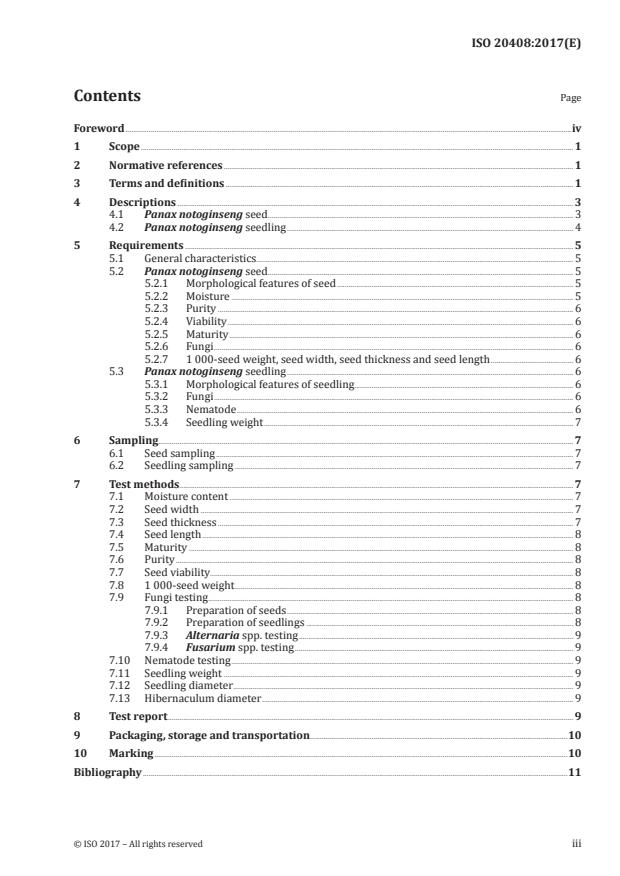
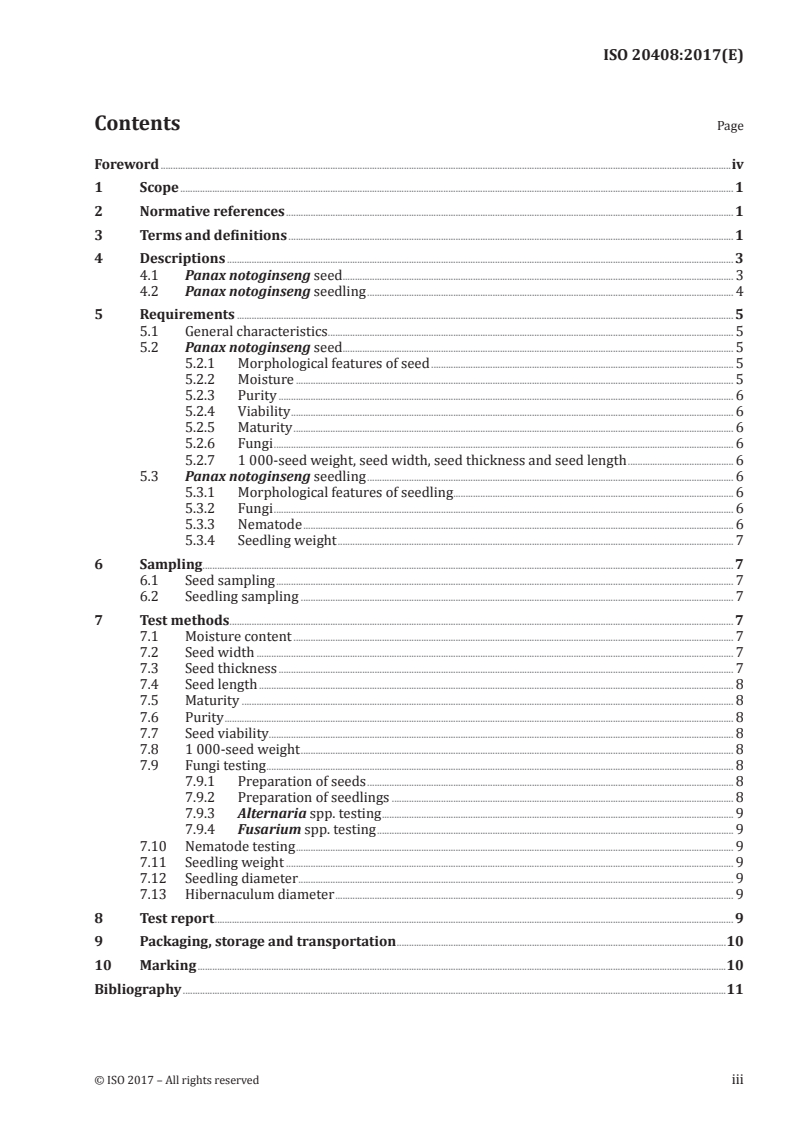
Contents Page
Foreword .iv
1 Scope . 1
2 Normative references . 1
3 Terms and definitions . 1
4 Descriptions . 3
4.1 Panax notoginseng seed . 3
4.2 Panax notoginseng seedling . 4
5 Requirements . 5
5.1 General characteristics . 5
5.2 Panax notoginseng seed . 5
5.2.1 Morphological features of seed . 5
5.2.2 Moisture . 5
5.2.3 Purity . 6
5.2.4 Viability . 6
5.2.5 Maturity . 6
5.2.6 Fungi . 6
5.2.7 1 000-seed weight, seed width, seed thickness and seed length . 6
5.3 Panax notoginseng seedling . 6
5.3.1 Morphological features of seedling . 6
5.3.2 Fungi . 6
5.3.3 Nematode . 6
5.3.4 Seedling weight . 7
6 Sampling . 7
6.1 Seed sampling . 7
6.2 Seedling sampling . 7
7 Test methods . 7
7.1 Moisture content . 7
7.2 Seed width . 7
7.3 Seed thickness . 7
7.4 Seed length . 8
7.5 Maturity . 8
7.6 Purity . 8
7.7 Seed viability. 8
7.8 1 000-seed weight . 8
7.9 Fungi testing . 8
7.9.1 Preparation of seeds . 8
7.9.2 Preparation of seedlings . 8
7.9.3 Alternaria spp. testing . 9
7.9.4 Fusarium spp. testing . 9
7.10 Nematode testing . 9
7.11 Seedling weight . 9
7.12 Seedling diameter . 9
7.13 Hibernaculum diameter . 9
8 Test report . 9
9 Packaging, storage and transportation .10
10 Marking .10
Bibliography .11
Foreword
ISO (the International Organization for Standardization) is a worldwide federation of national standards
bodies (ISO member bodies). The work of preparing International Standards is normally carried out
through ISO technical committees. Each member body interested in a subject for which a technical
committee has been established has the right to be represented on that committee. International
organizations, governmental and non-governmental, in liaison with ISO, also take part in the work.
ISO collaborates closely with the International Electrotechnical Commission (IEC) on all matters of
electrotechnical standardization.
The procedures used to develop this document and those intended for its further maintenance are
described in the ISO/IEC Directives, Part 1. In particular the different approval criteria needed for the
different types of ISO documents should be noted. This document was drafted in accordance with the
editorial rules of the ISO/IEC Directives, Part 2 (see www .iso .org/ directives).
Attention is drawn to the possibility that some of the elements of this document may be the subject of
patent rights. ISO shall not be held responsible for identifying any or all such patent rights. Details of
any patent rights identified during the development of the document will be in the Introduction and/or
on the ISO list of patent declarations received (see www .iso .org/ patents).
Any trade name used in this document is information given for the convenience of users and does not
constitute an endorsement.
For an explanation on the meaning of ISO specific terms and expressions related to conformity assessment,
as well as information about ISO’s adherence to the World Trade Organization (WTO) principles in the
Technical Barriers to Trade (TBT) see the following URL: www . i so .org/ iso/ foreword .html.
The committee responsible for this document is ISO/TC 249, Traditional Chinese medicine.
iv © ISO 2017 – All rights reserved
INTERNATIONAL STANDARD ISO 20408:2017(E)
Traditional Chinese medicine — Panax notoginseng seeds
and seedlings
1 Scope
This document specifies minimum requirements and test methods for seeds and seedlings of Panax
notoginseng (Burk.) F. H. Chen. It is suitable for marketing of cultivated Panax notoginseng seeds and
seedlings. It is also suitable to be used for quality assurance by cultivators of Panax notoginseng.
2 Normative references
The following documents are referred to in the text in such a way that some or all of their content
constitutes requirements of this document. For dated references, only the edition cited applies. For
undated references, the latest edition of the referenced document (including any amendments) applies.
International Seed Testing Association (ISTA): 2016, International Rules for Seed Testing
International Seed Testing Association (ISTA): 2003, Working Sheets on Tetrazolium testing
3 Terms and definitions
For the purposes of this document, the following terms and definitions apply.
ISO and IEC maintain terminological databases for use in standardization at the following addresses:
— IEC Electropedia: available at http:// www .electropedia .org/
— ISO Online browsing platform: available at http:// www .iso .org/ obp
3.1
1 000-seed weight
average weight of every 1 000 pure seeds of a test sample (3.19)
3.2
composite sample
portion formed by combining and mixing all the primary samples (3.8) taken from the lot (3.6)
3.3
foreign matter
parts of Panax notoginseng seeds (3.11) or seedlings (3.15) other than those named with the limits
specified for the herbal materials concerned
Note 1 to entry: Foreign matter is any organism, part or product of an organism, other than that named in the
specification and description of Panax notoginseng seeds or seedlings.
Note 2 to entry: Foreign matter is mineral admixtures not adhering to Panax notoginseng seeds or seedlings, such
as soil, stones, sand and dust.
3.4
hibernaculum
hibernated bud with bud scales
3.5
hibernaculum diameter
largest distance at the site of the hibernaculum (3.4)
Note 1 to entry: See Figure 2.
Note 2 to entry: It is expressed in centimetres.
3.6
lot
specified quantity of seeds (3.11) or seedlings (3.15) that is physically and uniquely identifiable
3.7
maturity
percentage of mature seeds, determined by number, in the test sample (3.19)
3.8
primary sample
portion taken from the lot (3.6) during one si
...
INTERNATIONAL ISO
STANDARD 20408
First edition
2017-01
Traditional Chinese medicine — Panax
notoginseng seeds and seedlings
Médecine traditionnelle chinoise — Graines et plants de Panax
notoginseng
Reference number
©
ISO 2017
© ISO 2017, Published in Switzerland
All rights reserved. Unless otherwise specified, no part of this publication may be reproduced or utilized otherwise in any form
or by any means, electronic or mechanical, including photocopying, or posting on the internet or an intranet, without prior
written permission. Permission can be requested from either ISO at the address below or ISO’s member body in the country of
the requester.
ISO copyright office
Ch. de Blandonnet 8 • CP 401
CH-1214 Vernier, Geneva, Switzerland
Tel. +41 22 749 01 11
Fax +41 22 749 09 47
copyright@iso.org
www.iso.org
ii © ISO 2017 – All rights reserved
Contents Page
Foreword .iv
1 Scope . 1
2 Normative references . 1
3 Terms and definitions . 1
4 Descriptions . 3
4.1 Panax notoginseng seed . 3
4.2 Panax notoginseng seedling . 4
5 Requirements . 5
5.1 General characteristics . 5
5.2 Panax notoginseng seed . 5
5.2.1 Morphological features of seed . 5
5.2.2 Moisture . 5
5.2.3 Purity . 6
5.2.4 Viability . 6
5.2.5 Maturity . 6
5.2.6 Fungi . 6
5.2.7 1 000-seed weight, seed width, seed thickness and seed length . 6
5.3 Panax notoginseng seedling . 6
5.3.1 Morphological features of seedling . 6
5.3.2 Fungi . 6
5.3.3 Nematode . 6
5.3.4 Seedling weight . 7
6 Sampling . 7
6.1 Seed sampling . 7
6.2 Seedling sampling . 7
7 Test methods . 7
7.1 Moisture content . 7
7.2 Seed width . 7
7.3 Seed thickness . 7
7.4 Seed length . 8
7.5 Maturity . 8
7.6 Purity . 8
7.7 Seed viability. 8
7.8 1 000-seed weight . 8
7.9 Fungi testing . 8
7.9.1 Preparation of seeds . 8
7.9.2 Preparation of seedlings . 8
7.9.3 Alternaria spp. testing . 9
7.9.4 Fusarium spp. testing . 9
7.10 Nematode testing . 9
7.11 Seedling weight . 9
7.12 Seedling diameter . 9
7.13 Hibernaculum diameter . 9
8 Test report . 9
9 Packaging, storage and transportation .10
10 Marking .10
Bibliography .11
Foreword
ISO (the International Organization for Standardization) is a worldwide federation of national standards
bodies (ISO member bodies). The work of preparing International Standards is normally carried out
through ISO technical committees. Each member body interested in a subject for which a technical
committee has been established has the right to be represented on that committee. International
organizations, governmental and non-governmental, in liaison with ISO, also take part in the work.
ISO collaborates closely with the International Electrotechnical Commission (IEC) on all matters of
electrotechnical standardization.
The procedures used to develop this document and those intended for its further maintenance are
described in the ISO/IEC Directives, Part 1. In particular the different approval criteria needed for the
different types of ISO documents should be noted. This document was drafted in accordance with the
editorial rules of the ISO/IEC Directives, Part 2 (see www .iso .org/ directives).
Attention is drawn to the possibility that some of the elements of this document may be the subject of
patent rights. ISO shall not be held responsible for identifying any or all such patent rights. Details of
any patent rights identified during the development of the document will be in the Introduction and/or
on the ISO list of patent declarations received (see www .iso .org/ patents).
Any trade name used in this document is information given for the convenience of users and does not
constitute an endorsement.
For an explanation on the meaning of ISO specific terms and expressions related to conformity assessment,
as well as information about ISO’s adherence to the World Trade Organization (WTO) principles in the
Technical Barriers to Trade (TBT) see the following URL: www . i so .org/ iso/ foreword .html.
The committee responsible for this document is ISO/TC 249, Traditional Chinese medicine.
iv © ISO 2017 – All rights reserved
INTERNATIONAL STANDARD ISO 20408:2017(E)
Traditional Chinese medicine — Panax notoginseng seeds
and seedlings
1 Scope
This document specifies minimum requirements and test methods for seeds and seedlings of Panax
notoginseng (Burk.) F. H. Chen. It is suitable for marketing of cultivated Panax notoginseng seeds and
seedlings. It is also suitable to be used for quality assurance by cultivators of Panax notoginseng.
2 Normative references
The following documents are referred to in the text in such a way that some or all of their content
constitutes requirements of this document. For dated references, only the edition cited applies. For
undated references, the latest edition of the referenced document (including any amendments) applies.
International Seed Testing Association (ISTA): 2016, International Rules for Seed Testing
International Seed Testing Association (ISTA): 2003, Working Sheets on Tetrazolium testing
3 Terms and definitions
For the purposes of this document, the following terms and definitions apply.
ISO and IEC maintain terminological databases for use in standardization at the following addresses:
— IEC Electropedia: available at http:// www .electropedia .org/
— ISO Online browsing platform: available at http:// www .iso .org/ obp
3.1
1 000-seed weight
average weight of every 1 000 pure seeds of a test sample (3.19)
3.2
composite sample
portion formed by combining and mixing all the primary samples (3.8) taken from the lot (3.6)
3.3
foreign matter
parts of Panax notoginseng seeds (3.11) or seedlings (3.15) other than those named with the limits
specified for the herbal materials concerned
Note 1 to entry: Foreign matter is any organism, part or product of an organism, other than that named in the
specification and description of Panax notoginseng seeds or seedlings.
Note 2 to entry: Foreign matter is mineral admixtures not adhering to Panax notoginseng seeds or seedlings, such
as soil, stones, sand and dust.
3.4
hibernaculum
hibernated bud with bud scales
3.5
hibernaculum diameter
largest distance at the site of the hibernaculum (3.4)
Note 1 to entry: See Figure 2.
Note 2 to entry: It is expressed in centimetres.
3.6
lot
specified quantity of seeds (3.11) or seedlings (3.15) that is physically and uniquely identifiable
3.7
maturity
percentage of mature seeds, determined by number, in the test sample (3.19)
3.8
primary sample
portion taken from the lot (3.6) during one si
...