

ISO 20395:2019
(Main)Biotechnology — Requirements for evaluating the performance of quantification methods for nucleic acid target sequences — qPCR and dPCR
General Information
- Abstract
This document provides generic requirements for evaluating the performance and ensuring the quality of methods used for the quantification of specific nucleic acid sequences (targets). This document is applicable to the quantification of DNA (deoxyribonucleic acid) and RNA (ribonucleic acid) target sequences using either digital (dPCR) or quantitative real-time PCR (qPCR) amplification technologies. It applies to target sequences present in nucleic acid molecules including double-stranded DNA (dsDNA) such as genomic DNA (gDNA) and plasmid DNA, single stranded DNA (ssDNA), complementary DNA (cDNA), and single stranded RNA (ssRNA) including ribosomal RNA (rRNA), messenger RNA (mRNA), and long and short non-coding RNA [microRNAs (miRNAs) and short interfering RNAs (siRNAs)], as well as double-stranded RNA (dsRNA). This document applies to nucleic acids derived from biological sources such as viruses, prokaryotic and eukaryotic cells, cell-free biological fluids (e.g. plasma or cell media) or in vitro sources [e.g. oligonucleotides, synthetic gene constructs and in vitro transcribed (IVT) RNA]. This document is not applicable to quantification of very short DNA oligonucleotides ( This document covers: — analytical design including quantification strategies (nucleic acid copy number quantification using a calibration curve as in qPCR or through molecular counting as in dPCR, quantification relative to an independent sample and ratio measurements) and use of controls; — quantification of total nucleic acid mass concentration and quality control of a nucleic acid sample including assessment of nucleic acid quality (purity and integrity); — PCR assay design, optimization, in silico and in vitro specificity testing; — data quality control and analysis including acceptance criteria, threshold setting and normalization; — method validation (precision, linearity, limit of quantification, limit of detection, trueness and robustness) with specific requirements for qPCR and dPCR; — approaches to establishing metrological traceability and estimating measurement uncertainty. This document does not provide requirements or acceptance criteria for the sampling of biological materials or processing of biological samples (i.e. collection, preservation, transportation, storage, treatment and nucleic acid extraction). Nor does it provide requirements and acceptance criteria for specific applications (e.g. food or clinical applications where specific matrix issues can arise).
- Status
- Published
- Publication Date
- 07-Aug-2019
- Technical Committee
- ISO/TC 276 - Biotechnology
- Drafting Committee
- ISO/TC 276/WG 3 - Analytical methods
- Current Stage
- 9092 - International Standard to be revised
- Start Date
- 26-Mar-2025
- Completion Date
- 29-Aug-2026
Buy Documents



ISO 20395:2019 - Biotechnology -- Requirements for evaluating the performance of quantification methods for nucleic acid target sequences -- qPCR and dPCR

ISO 20395:2019 - Biotechnology — Requirements for evaluating the performance of quantification methods for nucleic acid target sequences — qPCR and dPCR/8/2019
Overview
ISO 20395:2019 - Biotechnology - Requirements for evaluating the performance of quantification methods for nucleic acid target sequences - qPCR and dPCR - defines generic, science-based requirements to evaluate and ensure the performance of methods used to quantify specific nucleic acid targets. It covers both quantitative real-time PCR (qPCR) and digital PCR (dPCR) for DNA and RNA targets (gDNA, plasmid DNA, ssDNA, cDNA, ssRNA, dsRNA) from biological and in vitro sources. The standard focuses on analytical design, assay performance, data quality, validation, metrological traceability and reporting, but does not cover biological sampling or application-specific acceptance criteria.
Key topics and technical requirements
ISO 20395:2019 specifies practical technical elements required for robust nucleic acid quantification, including:
- Quantification strategies: qPCR using calibration curves (copy number via calibration) and dPCR via molecular counting; relative quantification and ratio measurements.
- Sample QC: total nucleic acid mass concentration, purity and integrity assessment (spectrophotometry, fluorometry and PCR-based checks).
- Assay design & optimization: amplicon selection, primer/probe design, in silico specificity testing, RT-qPCR/RT-dPCR considerations, fluorescence and efficiency optimization.
- Controls and normalization: use of no-template controls, internal/external controls and strategies for normalization.
- Data quality control: acceptance criteria, threshold setting, preprocessing, outlier identification, and calibration-curve analysis.
- Method validation: precision, linearity, limit of detection (LOD), limit of quantification (LOQ), trueness, robustness, and validation specifics for qPCR and dPCR.
- Metrological traceability & uncertainty: approaches to traceability, use of reference materials, instrument calibration and estimation of measurement uncertainty.
- Reporting: essential information to include in quantitative method reports; Annex E cross-references MIQE/dMIQE checklists.
Practical applications
ISO 20395:2019 is applicable wherever reliable quantification of specific nucleic acid targets is required, such as:
- Biopharmaceutical process control and quality assurance
- Gene therapy and advanced therapy medicinal product (ATMP) characterization
- Viral load and molecular diagnostics workflows (method development/validation)
- Research and development in molecular biology and synthetic biology
- Environmental and industrial biotechnology assays requiring accurate copy-number or ratio measurements
This standard helps labs produce comparable, traceable, and auditable quantitative results across qPCR and dPCR platforms.
Who should use this standard
- Clinical, research and quality laboratories developing or validating qPCR/dPCR assays
- Method validation and regulatory affairs teams in biotech and pharma
- Instrument and reagent manufacturers designing or qualifying assays and workflows
- Metrology institutes and organizations establishing reference materials and traceability
Related standards and guidance
- MIQE (Minimum Information for Publication of Quantitative Real-Time PCR Experiments) and dMIQE checklists (referenced in Annex E) - complementary for reporting and experimental metadata.
- Users should consult ISO 20395:2019 alongside sector-specific standards or regulatory guidance when application-specific acceptance criteria (e.g., clinical or food matrices) are required.
Relations
- Effective Date
- 25-Aug-2026
- Effective Date
- 25-Aug-2026
Buy Documents
ISO 20395:2019 - Biotechnology -- Requirements for evaluating the performance of quantification methods for nucleic acid target sequences -- qPCR and dPCR
ISO 20395:2019 - Biotechnology — Requirements for evaluating the performance of quantification methods for nucleic acid target sequences — qPCR and dPCR/8/2019
Frequently Asked Questions
ISO 20395:2019 is a standard published by the International Organization for Standardization (ISO). Its full title is "Biotechnology — Requirements for evaluating the performance of quantification methods for nucleic acid target sequences — qPCR and dPCR". This standard covers: This document provides generic requirements for evaluating the performance and ensuring the quality of methods used for the quantification of specific nucleic acid sequences (targets). This document is applicable to the quantification of DNA (deoxyribonucleic acid) and RNA (ribonucleic acid) target sequences using either digital (dPCR) or quantitative real-time PCR (qPCR) amplification technologies. It applies to target sequences present in nucleic acid molecules including double-stranded DNA (dsDNA) such as genomic DNA (gDNA) and plasmid DNA, single stranded DNA (ssDNA), complementary DNA (cDNA), and single stranded RNA (ssRNA) including ribosomal RNA (rRNA), messenger RNA (mRNA), and long and short non-coding RNA [microRNAs (miRNAs) and short interfering RNAs (siRNAs)], as well as double-stranded RNA (dsRNA). This document applies to nucleic acids derived from biological sources such as viruses, prokaryotic and eukaryotic cells, cell-free biological fluids (e.g. plasma or cell media) or in vitro sources [e.g. oligonucleotides, synthetic gene constructs and in vitro transcribed (IVT) RNA]. This document is not applicable to quantification of very short DNA oligonucleotides ( This document covers: — analytical design including quantification strategies (nucleic acid copy number quantification using a calibration curve as in qPCR or through molecular counting as in dPCR, quantification relative to an independent sample and ratio measurements) and use of controls; — quantification of total nucleic acid mass concentration and quality control of a nucleic acid sample including assessment of nucleic acid quality (purity and integrity); — PCR assay design, optimization, in silico and in vitro specificity testing; — data quality control and analysis including acceptance criteria, threshold setting and normalization; — method validation (precision, linearity, limit of quantification, limit of detection, trueness and robustness) with specific requirements for qPCR and dPCR; — approaches to establishing metrological traceability and estimating measurement uncertainty. This document does not provide requirements or acceptance criteria for the sampling of biological materials or processing of biological samples (i.e. collection, preservation, transportation, storage, treatment and nucleic acid extraction). Nor does it provide requirements and acceptance criteria for specific applications (e.g. food or clinical applications where specific matrix issues can arise).
This document provides generic requirements for evaluating the performance and ensuring the quality of methods used for the quantification of specific nucleic acid sequences (targets). This document is applicable to the quantification of DNA (deoxyribonucleic acid) and RNA (ribonucleic acid) target sequences using either digital (dPCR) or quantitative real-time PCR (qPCR) amplification technologies. It applies to target sequences present in nucleic acid molecules including double-stranded DNA (dsDNA) such as genomic DNA (gDNA) and plasmid DNA, single stranded DNA (ssDNA), complementary DNA (cDNA), and single stranded RNA (ssRNA) including ribosomal RNA (rRNA), messenger RNA (mRNA), and long and short non-coding RNA [microRNAs (miRNAs) and short interfering RNAs (siRNAs)], as well as double-stranded RNA (dsRNA). This document applies to nucleic acids derived from biological sources such as viruses, prokaryotic and eukaryotic cells, cell-free biological fluids (e.g. plasma or cell media) or in vitro sources [e.g. oligonucleotides, synthetic gene constructs and in vitro transcribed (IVT) RNA]. This document is not applicable to quantification of very short DNA oligonucleotides ( This document covers: — analytical design including quantification strategies (nucleic acid copy number quantification using a calibration curve as in qPCR or through molecular counting as in dPCR, quantification relative to an independent sample and ratio measurements) and use of controls; — quantification of total nucleic acid mass concentration and quality control of a nucleic acid sample including assessment of nucleic acid quality (purity and integrity); — PCR assay design, optimization, in silico and in vitro specificity testing; — data quality control and analysis including acceptance criteria, threshold setting and normalization; — method validation (precision, linearity, limit of quantification, limit of detection, trueness and robustness) with specific requirements for qPCR and dPCR; — approaches to establishing metrological traceability and estimating measurement uncertainty. This document does not provide requirements or acceptance criteria for the sampling of biological materials or processing of biological samples (i.e. collection, preservation, transportation, storage, treatment and nucleic acid extraction). Nor does it provide requirements and acceptance criteria for specific applications (e.g. food or clinical applications where specific matrix issues can arise).
ISO 20395:2019 is classified under the following ICS (International Classification for Standards) categories: 07.080 - Biology. Botany. Zoology. The ICS classification helps identify the subject area and facilitates finding related standards.
ISO 20395:2019 has the following relationships with other standards: It is inter standard links to CEN/TS 17883:2024, CEN/TS 17883:2022. Understanding these relationships helps ensure you are using the most current and applicable version of the standard.
ISO 20395:2019 is available in PDF format for immediate download after purchase. The document can be added to your cart and obtained through the secure checkout process. Digital delivery ensures instant access to the complete standard document.
Standards Content (Sample)
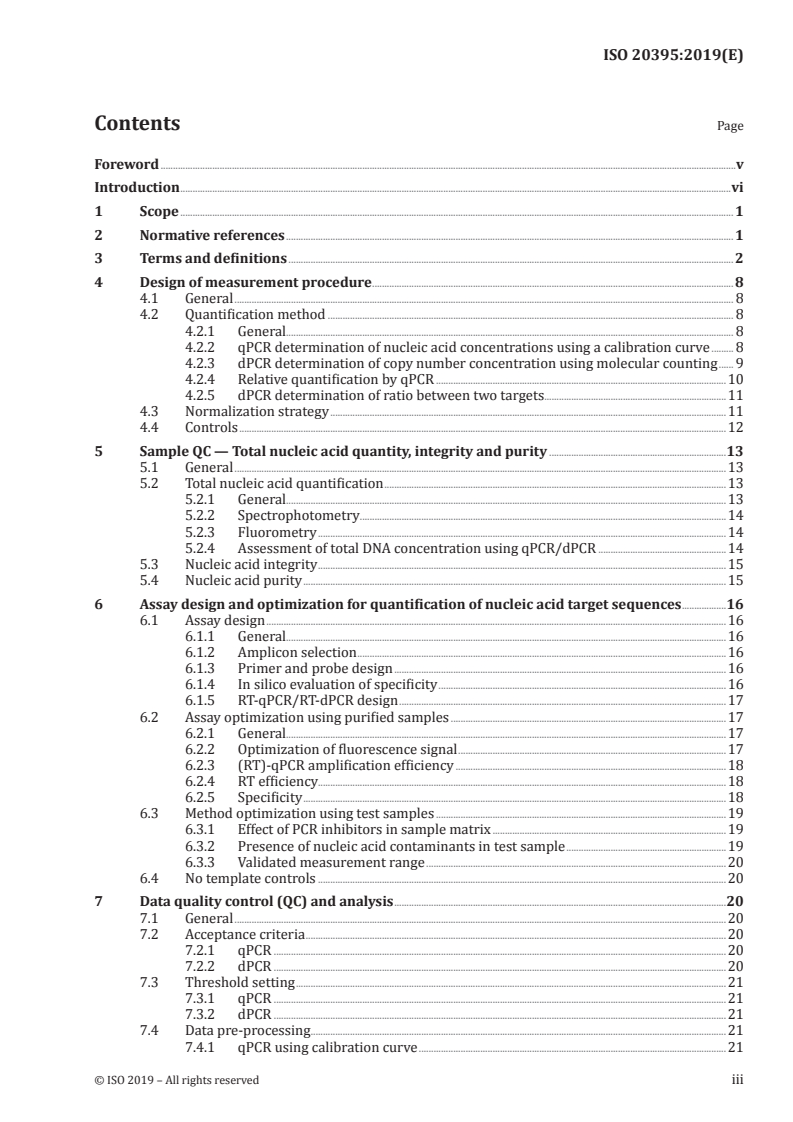
INTERNATIONAL ISO
STANDARD 20395
First edition
2019-08
Biotechnology — Requirements
for evaluating the performance of
quantification methods for nucleic acid
target sequences — qPCR and dPCR
Biotechnologie — Exigences relatives à l'évaluation de la
performance des méthodes de quantification des séquences d'acides
nucléiques cibles — qPCR et dPCR
Reference number
©
ISO 2019
© ISO 2019
All rights reserved. Unless otherwise specified, or required in the context of its implementation, no part of this publication may
be reproduced or utilized otherwise in any form or by any means, electronic or mechanical, including photocopying, or posting
on the internet or an intranet, without prior written permission. Permission can be requested from either ISO at the address
below or ISO’s member body in the country of the requester.
ISO copyright office
CP 401 • Ch. de Blandonnet 8
CH-1214 Vernier, Geneva
Phone: +41 22 749 01 11
Fax: +41 22 749 09 47
Email: copyright@iso.org
Website: www.iso.org
Published in Switzerland
ii © ISO 2019 – All rights reserved
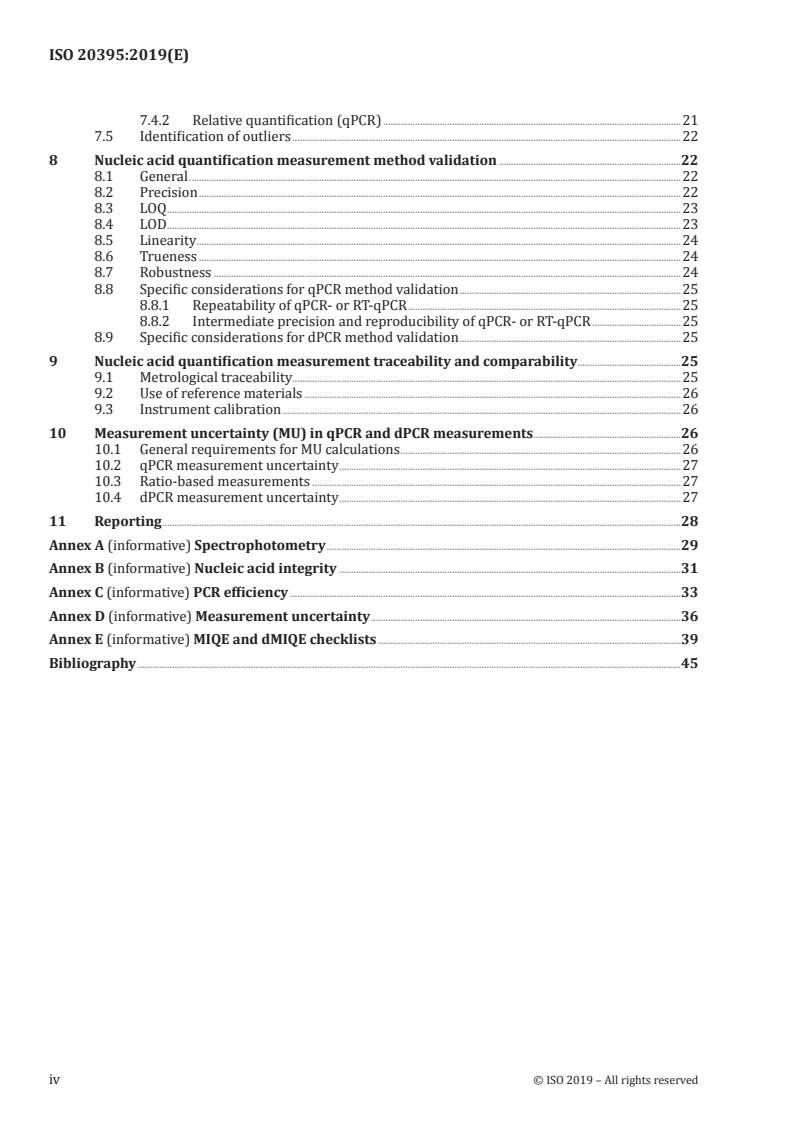
Contents Page
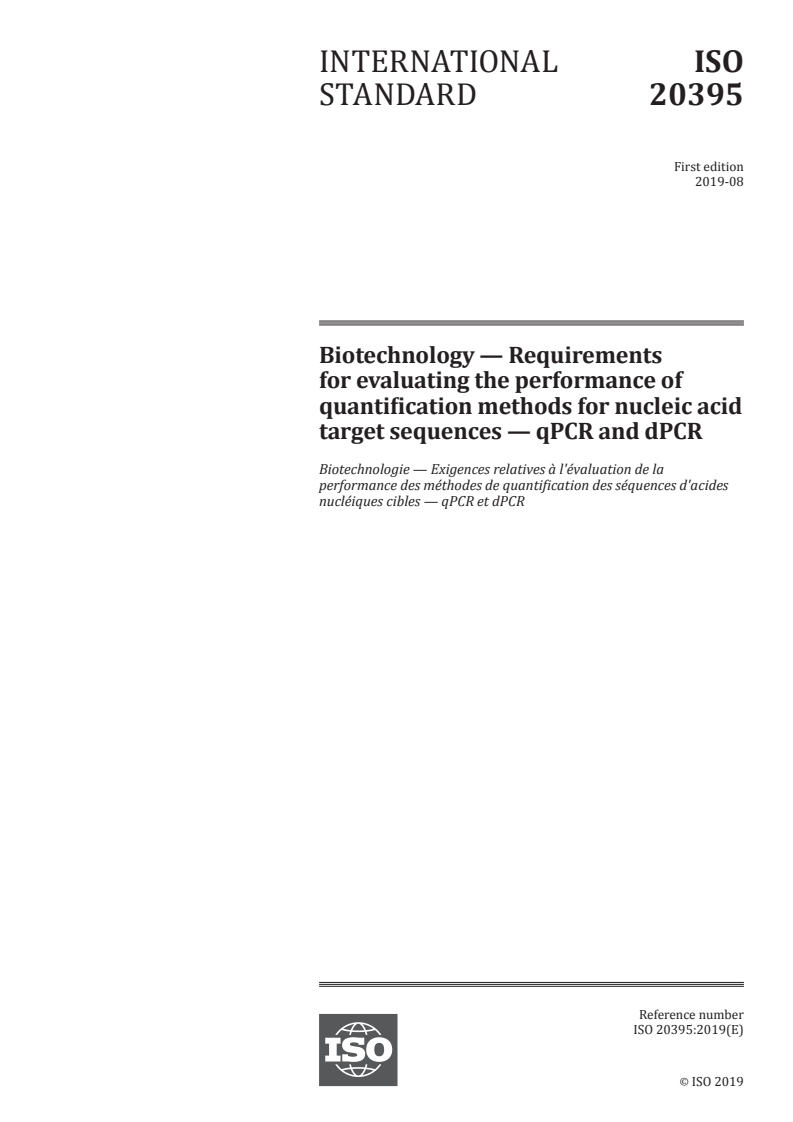
Foreword .v
Introduction .vi
1 Scope . 1
2 Normative references . 1
3 Terms and definitions . 2
4 Design of measurement procedure . 8
4.1 General . 8
4.2 Quantification method . 8
4.2.1 General. 8
4.2.2 qPCR determination of nucleic acid concentrations using a calibration curve . 8
4.2.3 dPCR determination of copy number concentration using molecular counting . 9
4.2.4 Relative quantification by qPCR .10
4.2.5 dPCR determination of ratio between two targets .11
4.3 Normalization strategy .11
4.4 Controls .12
5 Sample QC — Total nucleic acid quantity, integrity and purity .13
5.1 General .13
5.2 Total nucleic acid quantification .13
5.2.1 General.13
5.2.2 Spectrophotometry . .14
5.2.3 Fluorometry .14
5.2.4 Assessment of total DNA concentration using qPCR/dPCR .14
5.3 Nucleic acid integrity .15
5.4 Nucleic acid purity .15
6 Assay design and optimization for quantification of nucleic acid target sequences .16
6.1 Assay design .16
6.1.1 General.16
6.1.2 Amplicon selection .16
6.1.3 Primer and probe design .16
6.1.4 In silico evaluation of specificity .16
6.1.5 RT-qPCR/RT-dPCR design .17
6.2 Assay optimization using purified samples .17
6.2.1 General.17
6.2.2 Optimization of fluorescence signal .17
6.2.3 (RT)-qPCR amplification efficiency .18
6.2.4 RT efficiency.18
6.2.5 Specificity .18
6.3 Method optimization using test samples .19
6.3.1 Effect of PCR inhibitors in sample matrix .19
6.3.2 Presence of nucleic acid contaminants in test sample .19
6.3.3 Validated measurement range .20
6.4 No template controls .20
7 Data quality control (QC) and analysis .20
7.1 General .20
7.2 Acceptance criteria .20
7.2.1 qPCR .20
7.2.2 dPCR .20
7.3 Threshold setting .21
7.3.1 qPCR .21
7.3.2 dPCR .21
7.4 Data pre-processing .21
7.4.1 qPCR using calibration curve .21
7.4.2 Relative quantification (qPCR) .21
7.5 Identification of outliers .22
8 Nucleic acid quantification measurement method validation .22
8.1 General .22
8.2 Precision .22
8.3 LOQ .23
8.4 LOD .23
8.5 Linearity . .24
8.6 Trueness .24
8.7 Robustness .24
8.8 Specific considerations for qPCR method validation .25
8.8.1 Repeatability of qPCR- or RT-qPCR .25
8.8.2 Intermediate precision and reproducibility of qPCR- or RT-qPCR .25
8.9 Specific considerations for dPCR method validation .25
9 Nucleic acid quantification measurement traceability and comparability .25
9.1 Metrological traceability .25
9.2 Use of reference materials .26
9.3 Instrument calibration .26
10 Measurement uncertainty (MU) in qPCR and dPCR measurements .26
10.1 General requirements for MU calculations .26
10.2 qPCR measurement uncertainty .27
10.3 Ratio-based measurements .27
10.4 dPCR measurement uncertainty .27
11 Reporting .28
Annex A (informative) Spectrophotometry .29
Annex B (informative) Nucleic acid integrity .31
Annex C (informative) PCR efficiency .33
Annex D (informative) Measurement uncertainty .36
Annex E (informative) MIQE and dMIQE checklists .39
Bibliography .45
iv © ISO 2019 – All rights reserved
Foreword
ISO (the International Organization for Standardization) is a worldwide federation of national standards
bodies (ISO member bodies). The work of preparing International Standards is normally carried out
through ISO technical committees. Each member body interested in a subject for which a technical
committee has been established has the right to be represented on that committee. International
organizations, governmental and non-governmental, in liaison with ISO, also take part in the work.
ISO collaborates closely with the International Electrotechnical Commission (IEC) on all matters of
electrotechnical standardization.
The procedures used to develop this document and those intended for its further maintenance are
described in the ISO/IEC Directives, Part 1. In particular, the different approval criteria needed for the
different types of ISO documents should be noted. This document was drafted in accordance with the
editorial rules of the ISO/IEC Directives, Part 2 (see www .iso .org/directives).
Attention is drawn to the possibility that some of the elements of this document may be the subject of
patent rights. ISO shall not be held responsible for identifying any or all such patent rights. Details of
any patent rights identified during the development of the document will be in the Introduction and/or
on the ISO list of patent declarations received (see www .iso .org/patents).
Any trade name used in this document is information given for the convenience of users and does not
constitute an endorsement.
For an explanation of the voluntary nature of standards, the meaning of ISO specific terms and
expressions related to conformity assessment, as well as information about ISO's adherence to the
World Trade Organization (WTO) principles in the Technical Barriers to Trade (TBT), see www .iso
.org/iso/foreword .html.
This document was prepared by Technical Committee ISO/TC 276, Biotechnology.
Any feedback or questions on this document should be directed to the user’s national standards body. A
complete listing of these bodies can be found at www .iso .org/members .html.
Introduction
This document has been developed to specifically support the analytical requirements with
respect to quantification of specific nucleic acid sequences (targets). It can also benefit the broader
biomanufacturing, bioscience research and development, industrial biotechnology, engineering
biology and advanced therapeutics industries which need to demonstrate product quality based on
measurement and quantification of specific nucleic acid targets.
Quantification of nucleic acid target sequences is a cross-cutting fundamental measurement
that broadly impacts many aspects of biotechnology. For example, quantification of nucleic acid
biomarkers for monitoring bioprocess efficiency and conformity with quality by design parameters for
biopharmaceutical manufacture and industrial biotechnology, characterization of purity and quality
of cell-derived advanced therapy medicinal products (ATMPs); assessment of gene copy number for
evaluating the potency and efficacy of gene-based therapies and process control assays for gene editing
and engineering biology applications.
The underpinning technique of polymerase chain reaction (PCR) has transformed the field of nucleic
acid analysis, due to its robustness and simplicity. Technological advances in instrumentation have
resulted in a wide range of PCR-based nucleic acid quantification approaches/instruments with
subsequent developments such as:
— quantitative real-time PCR (qPCR) which offers methods for quantification of DNA and RNA
molecules relative to a calibration material or independent sample, and
— digital PCR (dPCR) which offers the ability to perform SI traceable quantification through the
concept of molecular enumeration without the need for a calibration curve.
However, performing nucleic acid quantification assays to a high standard of analytical quality can be
challenging. For example, it is well known that impure or degraded nucleic acid extracts can affect the
accuracy of quantification. Similarly, a poorly designed qPCR or dPCR assay with poor amplification
efficiency and primer specificity will have an impact on accuracy of quantification. In addition, aspects
such as calibrators, standard curves, data normalization and processing can have a large influence on
the accuracy of quantitative measurement of nucleic acid targets.
This document is expected to improve confidence in the data produced, support selection and
optimization procedures and provide supporting performance parameters that may be utilized during
performance qualification of a particular measurement procedure for quantification of nucleic acid
target sequences. Biotechnology and bioscience industry data with higher measurement confidence
will enable data interoperability, improved product quality, reduced risks and costs and facilitate
international trade.
In this document, the following verbal forms are used:
— “shall” indicates a requirement;
— “should” indicates a recommendation;
— “may” indicates a permission;
— “can” indicates a possibility or a capability.
Further details can be found in the ISO/IEC Directives, Part 2.
vi © ISO 2019 – All rights reserved
INTERNATIONAL STANDARD ISO 20395:2019(E)
Biotechnology — Requirements for evaluating the
performance of quantification methods for nucleic acid
target sequences — qPCR and dPCR
1 Scope
This document provides generic requirements for evaluating the performance and ensuring the quality
of methods used for the quantification of specific nucleic acid sequences (targets).
This document is applicable to the quantification of DNA (deoxyribonucleic acid) and RNA (ribonucleic
acid) target sequences using either digital (dPCR) or quantitative real-time PCR (qPCR) amplification
technologies. It applies to target sequences present in nucleic acid molecules including double-
stranded DNA (dsDNA) such as genomic DNA (gDNA) and plasmid DNA, single stranded DNA (ssDNA),
complementary DNA (cDNA), and single stranded RNA (ssRNA) including ribosomal RNA (rRNA),
messenger RNA (mRNA), and long and short non-coding RNA [microRNAs (miRNAs) and short
interfering RNAs (siRNAs)], as well as double-stranded RNA (dsRNA).
This document applies to nucleic acids derived from biological sources such as viruses, prokaryotic
and eukaryotic cells, cell-free biological fluids (e.g. plasma or cell media) or in vitro sources [e.g.
oligonucleotides, synthetic gene constructs and in vitro transcribed (IVT) RNA].
This document is not applicable to quantification of very short DNA oligonucleotides (<50 bases).
This document covers:
— analytical design including quantification strategies (nucleic acid copy number quantification using
a calibration curve as in qPCR or through molecular counting as in dPCR, quantification relative to
an independent sample and ratio measurements) and use of controls;
— quantification of total nucleic acid mass concentration and quality control of a nucleic acid sample
including assessment of nucleic acid quality (purity and integrity);
— PCR assay design, optimization, in silico and in vitro specificity testing;
— data quality control and analysis including acceptance criteria, threshold setting and normalization;
— method validation (precision, linearity, limit of quantification, limit of detection, trueness and
robustness) with specific requirements for qPCR and dPCR;
— approaches to establishing metrological traceability and estimating measurement uncertainty.
This document does not provide requirements or acceptance criteria for the sampling of biological
materials or processing of biological samples (i.e. collection, preservation, transportation, storage,
treatment and nucleic acid extraction). Nor does it provide requirements and acceptance criteria for
specific applications (e.g. food or clinical applications where specific matrix issues can arise).
2 Normative references
The following documents are referred to in the text in such a way that some or all of their content
constitutes requirements of this document. For dated references, only the edition cited applies. For
undated references, the latest edition of the referenced document (including any amendments) applies.
ISO/IEC Guide 98-3:2008, Uncertainty of measurement — Part 3: Guide to the expression of uncertainty in
me a s ur ement (GUM: 1995)
ISO/IEC Guide 99, International vocabulary of metrology — Basic and general concepts and associated
terms (VIM)
3 Terms and definitions
For the purposes of this document, the terms and definitions given in ISO/IEC Guide 99 and the
following apply.
ISO and IEC maintain terminological databases for use in standardization at the following addresses:
— ISO Online browsing platform: available at https: //www .iso .org/obp
— IEC Electropedia: available at http: //www .electropedia .org/
3.1
amplicon
specific DNA fragment produced by a DNA-amplification technology, such as the polymerase chain
reaction (PCR)
[SOURCE: ISO 13495:2013, 3.3.1]
3.2
amplification plot
graph representing the generation of a reporter (usually fluorescent) signal during a qPCR or dPCR
reaction
Note 1 to entry: For qPCR and some dPCR systems, the amplification plot shows the relationship between cycle
number (x-axis) and fluorescence signal (y-axis).
Note 2 to entry: For end point dPCR, the fluorescent signal of each dPCR partition is displayed. For a single
fluorophore, a one-dimensional amplification plot shows partition number (x-axis) against end point fluorescent
signal (y-axis). A multi-dimensional amplification plot shows fluorescent signal for each detector channel on
each axis.
3.3
calibration curve
standard curve
expression of the relation between indication and corresponding measured quantity value
[SOURCE: ISO/IEC Guide 99:2007, 4.31, modified — The notes have been deleted.]
3.4
calibrator
measurement standard used in calibration
Note 1 to entry: The term “calibrator” is only used in certain fields.
EXAMPLE A qPCR interplate calibrator sample is often included on each qPCR plate in a study comprising
multiple qPCR plates or experiments to compensate for variations across plates due to instrument measurement
factors such as baseline and threshold setting. The interplate calibrator contains the target sequence(s) detected
by the PCR assay and is measured with the same PCR assays as the studied samples.
[SOURCE: ISO/IEC Guide 99:2007, 5.12, modified — The example has been added.]
3.5
cDNA
complementary DNA
single-stranded DNA, complementary to a given RNA and synthesised in the presence of reverse
transcriptase to serve as a template for DNA amplification
2 © ISO 2019 – All rights reserved
3.6
copy number
number of molecules (copies) containing a specific nucleic acid sequence
[SOURCE: ISO 16577:2016, 3.28, modified — "of a DNA sequence" replaced with "containing a specific
nucleic acid sequence"]
3.7
copy number concentration
number of molecules (copies) containing a specific nucleic acid sequence in a defined volume
3.8
quantification cycle
C
q
cycle at which the fluorescence from the reaction crosses a specified threshold level at which
the signal can be distinguished from background levels
Note 1 to entry: Quantification cycle is a generic term which includes cycle threshold (C ), crossing point (C ),
t p
take off point and all other instrument specific terms referring to the fractional cycle used to quantify the
concentration of target in the qPCR assay.
Note 2 to entry: The quantification cycle is based either on a threshold applied to all samples or on a regression
analysis of the signal, for each sample.
[1]
[SOURCE: ISO 16577:2016, 3,32 modified according to MIQE Guidelines — Notes 1 and 2 to entry have
been added.]
3.9
delta C
q
ΔC
q
difference between two C values, ΔC = C − C
q q q(1) q(2)
3.10
digital PCR
dPCR
procedure in which nucleic acid templates are distributed across multiple partitions of nominally
equivalent volume, such that some partitions contain template and others do not, followed by
PCR amplification of target sequences and detection of specific PCR products, providing a count of the
number of partitions with a positive and negative signal for the target template
Note 1 to entry: Nucleic acid target sequences are assumed to be randomly and independently distributed across
the partitions during the partitioning process.
Note 2 to entry: The count of positive and negative partitions is normally based on end point detection of
PCR products following thermal cycling, however real-time qPCR monitoring of PCR product accumulation is
additionally possible for some dPCR platforms.
3.11
gene of interest
GOI
gene target sequence under investigation
3.12
lambda value
λ
mean number of targets per dPCR partition based on the fraction of droplets where amplification has
occurred
Note 1 to entry: Essential dPCR quantities for calculation of lambda are the number of positive partitions (N )
P
and the total number of partitions (N ).
T
3.13
limit of quantification
LOQ
lowest concentration or quantity of the nucleic acid target sequence per defined volume that can be
measured with reasonable statistical certainty consistently under the experimental conditions
specified in the method
Note 1 to entry: Generally expressed in terms of the signal or measurement (true) value that will produce
estimates having a specified coefficient of variation (CV).
[SOURCE: ISO 16577:2016, 3.91, modified — replaced "content of the analyte of interest" with "quantity
of the nucleic acid target sequence", "amount of matrix" with "volume" and "relative standard deviation
(RSD)" with ‘coefficient of variation (CV)".]
3.14
limit of detection
LOD
measured quantity value, obtained by a given measurement procedure, for which the probability of
falsely claiming the absence of a component in a material is β, given a probability α of falsely claiming
its presence
[SOURCE: ISO/IEC Guide 99:2007, 4.18 definition for ‘detection limit’; Notes to entry not included.]
3.15
linearity
ability of a method of analysis, within a certain range, to provide an instrumental response or results
proportional to the quantity of nucleic acid target sequence to be determined in the laboratory sample
Note 1 to entry: In the case of qPCR, the cycle threshold is proportional to the logarithm to the base 10 of the
quantity of nucleic acid target sequence.
Note 2 to entry: The term linearity is frequently linked with the linear range of the method and refers to the
ability of a method to give a response or result that is directly proportional to the concentration of the nucleic
acid target sequence.
[SOURCE: ISO 16577:2016, 3.92 modified — Notes 1 and 2 to entry added; "quantity of analyte" replaced
with "quantity of the nucleic acid target sequence".]
3.16
measurand
quantity intended to be measured
Note 1 to entry: The specification of a measurand requires knowledge of the kind of quantity, description of the
state of the phenomenon, body, or substance carrying the quantity, including any relevant component, and the
chemical entities involved.
Note 2 to entry: In the second edition of the VIM and in IEC 60050-300:2001, the measurand is defined as the
“particular quantity subject to measurement”.
Note 3 to entry: The measurement, including the measuring system and the conditions under which the
measurement is carried out, might change the phenomenon, body, or substance such that the quantity being
measured differs from the measurand as defined. In this case, adequate correction is necessary.
EXAMPLE 1 Quantity of a gene target measured by PCR is influenced by the amplicon size of the PCR assay
and fragment size of the template (~ < amplicon size).
EXAMPLE 2 Denaturation of DNA in a sample into ssDNA influences quantification by dPCR as the two strands
are partitioned separately.
[SOURCE: ISO/IEC Guide 99:2007, 2.23, modified —Note 3 and examples have been modified, and Note 4
has been omitted.]
4 © ISO 2019 – All rights reserved
3.17
melting curve
analysis describing the dissociation characteristics of double-stranded DNA observed during heating
[SOURCE: ISO 16577:2016, 3.107, modified — Note 1 to entry has been deleted.]
3.18
melting temperature
T
m
temperature at which 50 % of double-stranded DNA helices are dissociated since a DNA helix melts in a
temperature range rather than at one very specific temperature
[SOURCE: ISO 16577:2016, 3.108]
3.19
mRNA
messenger RNA
subtype of ribonucleic acid which serves as the template for protein synthesis
3.20
no template control
NTC
control reaction containing all reagents except the extracted test sample template nucleic acid
Note 1 to entry: This control is used to demonstrate the absence of contaminating nucleic acids. Instead of the
template DNA, for example, a corresponding volume of nucleic acid free water is added to the reaction. The term
“PCR reagent control” is also sometimes used.
3.21
normalization
modification of the measured quantity of a nucleic acid target sequence by subtraction of (C scale) or
q
division by (linear scale) quantity or quantities of parameters which reflect non-specific technical factors
3.22
partitions
droplets or chambers of nominally equivalent volume into which dPCR mix of reagents and template is
randomly distributed and then amplified by PCR
3.23
PCR assay
assay
qPCR (3.25) or dPCR (3.10) measurement method with specified oligonucleotide primers (and, in some
cases, a probe or probes) that is used to identify and/or quantify a nucleic acid target
3.24
PCR efficiency
E
fraction of molecules amplified in each PCR cycle
EXAMPLE If a test tube contains 100 target molecules and after one cycle of PCR contains 180 molecules
E = 0,8. The calculated rate of amplification is reported as a percentage or a fraction of 1. A 100 % efficiency
equates to amplicon doubling during every cycle.
3.25
quantitative real-time PCR
qPCR
enzymatic procedure which combines the in vitro amplification of specific DNA segments with the
detection and quantification of specific PCR products during the amplification process
Note 1 to entry: While the PCR is producing copies of the relevant DNA sequence, the fluorescent marker
fluoresces in direct proportion to the amount of DNA present (which can theoretically be back-calculated to infer
the original amount of that particular DNA present in a sample prior to initiation of PCR).
[SOURCE: ISO 16577:2016, 3.162, modified — The word “quantitative” has been added to the term as
well as “quantification” to the definition.]
3.26
reference gene
endogenous gene
gene target present in each sample at approximately constant concentration that is resistant to response
fluctuations due to changes in biological or experimental conditions, or stable within a particular
species or taxon
Note 1 to entry: Reference genes have, historically, been referred to as housekeeping genes. However, when
measuring RNA, many targets can be used which cannot be considered as housekeeping genes; hence the term of
[1]
preference is now reference gene .
3.27
reverse transcription
RT
process of making cDNA from an RNA template, using the enzymatic activity of a reverse transcriptase
associated with one or more oligonucleotide primers under a suitable set of conditions
[SOURCE: ISO 16577:2016, 3.180, modified — “DNA” has been replaced by “cDNA”.]
3.28
reverse transcription efficiency
RT efficiency
proportion of RNA molecules converted to cDNA expressed as a percentage
EXAMPLE An RT efficiency of 80 % refers to 80 % of RNA templates being converted to cDNA.
3.29
RT minus control
RT(−)
RT-PCR containing test sample template nucleic acid and all the amplification reagents except the
reverse transcriptase enzyme
Note 1 to entry: RT minus control is used when quantifying RNA and measures background arising from residual
genomic DNA in the sample.
3.30
reverse transcription dPCR
RT-dPCR
process by which an RNA strand is first reverse transcribed into its DNA complement (complementary
DNA or cDNA) using reverse transcriptase and the resulting cDNA is amplified using dPCR
Note 1 to entry: This process can be one- or two-step.
Note 2 to entry: In one-step RT-dPCR, RT and dPCR amplification steps are performed sequentially, in the same
tube with gene-specific primers.
Note 3 to entry: In two-step RT-dPCR, RT and dPCR stages are performed as two independent reactions. In this
case, the RT step can use non-specific primers (i.e. a blend of oligo-dT primers and/or random oligonucleotides) to
produce a global cDNA population from all transcripts in the RNA sample. The cDNA is then used for subsequent
analysis by dPCR and interrogated for the sequences of interest using gene-specific PCR primers.
3.31
reverse transcription qPCR
RT-qPCR
process by which an RNA strand is first reverse transcribed into its DNA complement (complementary
DNA or cDNA) using reverse transcriptase and the resulting cDNA is amplified using qPCR
Note 1 to entry: This process can be one- or two-step as is the case for RT-dPCR.
6 © ISO 2019 – All rights reserved
[SOURCE: ISO 16577:2016, 3.181 modified — Note 1 to entry has been added.]
3.32
sample
small portion or quantity, taken from a population or lot that is ideally a representative selection of
the whole
[SOURCE: ISO 16577:2016, 3.185]
3.33
specificity
analytical specificity
ability of a measurement procedure to determine solely the quantity it purports to measure
EXAMPLE PCR assay specificity corresponds to its ability to detect only the intended target and that
quantification of the target is not affected by cross-reactivity from related or potentially interfering nucleic acids
or specimen-related conditions.
[SOURCE: ISO 15193:2009, 3.9, modified — Example has been added.]
3.34
single nucleotide polymorphism
SNP
single nucleotide variation in a genetic sequence that occurs at appreciable frequency in the population
[SOURCE: ISO 25720: 2009, 4.23]
3.35
single nucleotide variant
SNV
DNA sequence variation that occurs when a single nucleotide, A, T, C, or G, in the genome (or other
target sequence) differs between templates
3.36
target sequence
nucleic acid target sequence
specific DNA sequence targeted for detection, e.g. by PCR
[SOURCE: ISO 16577:2016, 3.203]
3.37
template
strand of DNA or RNA that specifies the base sequence of a newly synthesized strand of DNA or RNA,
the two strands being complementary
[SOURCE: ISO 16577:2016, 3.206]
3.38
test sample
sample prepared for testing or analysis, the whole quantity or part of it being used for testing or
analysis at one time
[SOURCE: ISO 16577:2016, 3.210]
3.39
total nucleic acid
total quantity of nucleic acid in a sample following nucleic acid extraction expressed as mass
concentration
Note 1 to entry: Total nucleic acid refers to the expected majority species in a particular extract (i.e. DNA or RNA).
4 Design of measurement procedure
4.1 General
Design of a nucleic acid quantification experiment shall include the selection of appropriate type and
number of samples, the process stages for replication, the controls that should be incorporated, the
need for randomization of samples and standard arrangement within the experiment. Specific factors
to be considered are outlined below. Evaluation of the precision of the assay for the nucleic acid target
sequence at the intended test sample range during method validation (8.2) should guide the number of
replicate reactions performed during a routine analysis.
4.2 Quantification method
4.2.1 General
The choice of quantification strategy will be dependent upon the application. The major methodological
approaches which may be used, together with the requirements for application, are described in 4.2.2
to 4.2.5.
4.2.2 qPCR determination of nucleic acid concentrations using a calibration curve
The calibration curve shall be constructed using independent measurement standards with specified
absolute or relative concentrations [e.g. copy number concentration (copies/μl); mass ratio standards
(g/kg); International system of units (SI)] that have the same or similar matrix as the test samples.
The imprecision of the calibration curve shall reflect the uncertainty of the measurements and
propagate when estimating the measurement uncertainty of test sample concentrations.
If RNA is analysed, the calibration standards shall contain RNA and be pre-treated in the same way
as the test samples, i.e. including a reverse transcription step. If circular DNA is analysed, it shall be
linearized to remove any supercoiling. If the test sample is single stranded DNA (ssDNA) (e.g. cDNA), the
measurement standards should either be single stranded DNA or the calibration curve formula should
be amended to reflect the C difference of 1 unit as the ssDNA template is not amplified in the first PCR
q
[2]
cycle .
Calibration solutions shall be evenly spread across the concentration range, and preferably extend
[3]
beyond it . A minimum of 5 different concentrations should be used, each in at least duplicate.
Concentrations of test samples are estimated from the calibration curve. The concentration (c) is
i
estimated using Formula (1):
Ca−
q
log c = (1)
10 i
b
where
C is the C of the test sample;
q q
a is the intercept of the calibration curve;
b is the slope.
NOTE "Absolute quantification" is frequently used by instrument manufacturers referring to the estimation
of concentrations of unknown samples by means of a calibration curve. This usage of the term "absolute
quantification" is incorrect, as the calibration curve is constructed using calibration solutions of known
concentrations.
8 © ISO 2019 – All rights reserved
4.2.3 dPCR determination of copy number concentration using molecular counting
dPCR is an end-point measurement that provides the ability to quantify nucleic acid target sequence
without the use of a calibration curve. The dPCR mix containing test solution is randomly distributed
into discrete partitions of nominally equivalent volume such that some partitions contain no nucleic
acid template and others contain one or more template copies. The partitions are thermally cycled
to end-point and then read to determine the fraction of partitions with a positive reaction. Poisson
[4]
statistics should be used to estimate the target DNA copy number.
The mean number of copies per partition (λ) is calculated using Formula (2):
N
P
λ =−ln 1− (2)
N
T
where
N is the number of positive partitions;
P
N is the total number of partitions.
T
−1
Copy number concentration (copies µl ) in the dPCR (C ) is estimated by Formula (3):
dPCR mix
N
P
Cl=− n 1− ⋅ (3)
dPCR mix
NV
TP
where V is the average partition volume (nl).
P
The partition volume applied in calculation of copy number concentration shall be based on empirical
measurements performed during instrument validation or based on published reports, and uncertainty
in the measurement of partition volume shall be reflected in the combined uncertainty of the copy
number concentration measurement (see 10.4).
If the dPCR mix and prior dilutions of the test samples are prepared volumetrically, copy number
−1
concentration (copies µl ) in the test solution (C) is estimated by Formula (4):
N 10
P
Cl=− n 1− ⋅⋅D (4)
dPCR mix
NV
TP
where D is the volumetric dilution factor from the test solution to the dPCR mix.
If the dPCR mix and prior dilutions of the test solution are prepared gravimetrically, copy number
−1
concentration (copies µl ) in the test solution (C) is estimated using [Formula (5)] compared volumetri
...
INTERNATIONAL ISO
STANDARD 20395
First edition
2019-08
Biotechnology — Requirements
for evaluating the performance of
quantification methods for nucleic acid
target sequences — qPCR and dPCR
Biotechnologie — Exigences relatives à l'évaluation de la
performance des méthodes de quantification des séquences d'acides
nucléiques cibles — qPCR et dPCR
Reference number
©
ISO 2019
© ISO 2019
All rights reserved. Unless otherwise specified, or required in the context of its implementation, no part of this publication may
be reproduced or utilized otherwise in any form or by any means, electronic or mechanical, including photocopying, or posting
on the internet or an intranet, without prior written permission. Permission can be requested from either ISO at the address
below or ISO’s member body in the country of the requester.
ISO copyright office
CP 401 • Ch. de Blandonnet 8
CH-1214 Vernier, Geneva
Phone: +41 22 749 01 11
Fax: +41 22 749 09 47
Email: copyright@iso.org
Website: www.iso.org
Published in Switzerland
ii © ISO 2019 – All rights reserved
Contents Page
Foreword .v
Introduction .vi
1 Scope . 1
2 Normative references . 1
3 Terms and definitions . 2
4 Design of measurement procedure . 8
4.1 General . 8
4.2 Quantification method . 8
4.2.1 General. 8
4.2.2 qPCR determination of nucleic acid concentrations using a calibration curve . 8
4.2.3 dPCR determination of copy number concentration using molecular counting . 9
4.2.4 Relative quantification by qPCR .10
4.2.5 dPCR determination of ratio between two targets .11
4.3 Normalization strategy .11
4.4 Controls .12
5 Sample QC — Total nucleic acid quantity, integrity and purity .13
5.1 General .13
5.2 Total nucleic acid quantification .13
5.2.1 General.13
5.2.2 Spectrophotometry . .14
5.2.3 Fluorometry .14
5.2.4 Assessment of total DNA concentration using qPCR/dPCR .14
5.3 Nucleic acid integrity .15
5.4 Nucleic acid purity .15
6 Assay design and optimization for quantification of nucleic acid target sequences .16
6.1 Assay design .16
6.1.1 General.16
6.1.2 Amplicon selection .16
6.1.3 Primer and probe design .16
6.1.4 In silico evaluation of specificity .16
6.1.5 RT-qPCR/RT-dPCR design .17
6.2 Assay optimization using purified samples .17
6.2.1 General.17
6.2.2 Optimization of fluorescence signal .17
6.2.3 (RT)-qPCR amplification efficiency .18
6.2.4 RT efficiency.18
6.2.5 Specificity .18
6.3 Method optimization using test samples .19
6.3.1 Effect of PCR inhibitors in sample matrix .19
6.3.2 Presence of nucleic acid contaminants in test sample .19
6.3.3 Validated measurement range .20
6.4 No template controls .20
7 Data quality control (QC) and analysis .20
7.1 General .20
7.2 Acceptance criteria .20
7.2.1 qPCR .20
7.2.2 dPCR .20
7.3 Threshold setting .21
7.3.1 qPCR .21
7.3.2 dPCR .21
7.4 Data pre-processing .21
7.4.1 qPCR using calibration curve .21
7.4.2 Relative quantification (qPCR) .21
7.5 Identification of outliers .22
8 Nucleic acid quantification measurement method validation .22
8.1 General .22
8.2 Precision .22
8.3 LOQ .23
8.4 LOD .23
8.5 Linearity . .24
8.6 Trueness .24
8.7 Robustness .24
8.8 Specific considerations for qPCR method validation .25
8.8.1 Repeatability of qPCR- or RT-qPCR .25
8.8.2 Intermediate precision and reproducibility of qPCR- or RT-qPCR .25
8.9 Specific considerations for dPCR method validation .25
9 Nucleic acid quantification measurement traceability and comparability .25
9.1 Metrological traceability .25
9.2 Use of reference materials .26
9.3 Instrument calibration .26
10 Measurement uncertainty (MU) in qPCR and dPCR measurements .26
10.1 General requirements for MU calculations .26
10.2 qPCR measurement uncertainty .27
10.3 Ratio-based measurements .27
10.4 dPCR measurement uncertainty .27
11 Reporting .28
Annex A (informative) Spectrophotometry .29
Annex B (informative) Nucleic acid integrity .31
Annex C (informative) PCR efficiency .33
Annex D (informative) Measurement uncertainty .36
Annex E (informative) MIQE and dMIQE checklists .39
Bibliography .45
iv © ISO 2019 – All rights reserved
Foreword
ISO (the International Organization for Standardization) is a worldwide federation of national standards
bodies (ISO member bodies). The work of preparing International Standards is normally carried out
through ISO technical committees. Each member body interested in a subject for which a technical
committee has been established has the right to be represented on that committee. International
organizations, governmental and non-governmental, in liaison with ISO, also take part in the work.
ISO collaborates closely with the International Electrotechnical Commission (IEC) on all matters of
electrotechnical standardization.
The procedures used to develop this document and those intended for its further maintenance are
described in the ISO/IEC Directives, Part 1. In particular, the different approval criteria needed for the
different types of ISO documents should be noted. This document was drafted in accordance with the
editorial rules of the ISO/IEC Directives, Part 2 (see www .iso .org/directives).
Attention is drawn to the possibility that some of the elements of this document may be the subject of
patent rights. ISO shall not be held responsible for identifying any or all such patent rights. Details of
any patent rights identified during the development of the document will be in the Introduction and/or
on the ISO list of patent declarations received (see www .iso .org/patents).
Any trade name used in this document is information given for the convenience of users and does not
constitute an endorsement.
For an explanation of the voluntary nature of standards, the meaning of ISO specific terms and
expressions related to conformity assessment, as well as information about ISO's adherence to the
World Trade Organization (WTO) principles in the Technical Barriers to Trade (TBT), see www .iso
.org/iso/foreword .html.
This document was prepared by Technical Committee ISO/TC 276, Biotechnology.
Any feedback or questions on this document should be directed to the user’s national standards body. A
complete listing of these bodies can be found at www .iso .org/members .html.
Introduction
This document has been developed to specifically support the analytical requirements with
respect to quantification of specific nucleic acid sequences (targets). It can also benefit the broader
biomanufacturing, bioscience research and development, industrial biotechnology, engineering
biology and advanced therapeutics industries which need to demonstrate product quality based on
measurement and quantification of specific nucleic acid targets.
Quantification of nucleic acid target sequences is a cross-cutting fundamental measurement
that broadly impacts many aspects of biotechnology. For example, quantification of nucleic acid
biomarkers for monitoring bioprocess efficiency and conformity with quality by design parameters for
biopharmaceutical manufacture and industrial biotechnology, characterization of purity and quality
of cell-derived advanced therapy medicinal products (ATMPs); assessment of gene copy number for
evaluating the potency and efficacy of gene-based therapies and process control assays for gene editing
and engineering biology applications.
The underpinning technique of polymerase chain reaction (PCR) has transformed the field of nucleic
acid analysis, due to its robustness and simplicity. Technological advances in instrumentation have
resulted in a wide range of PCR-based nucleic acid quantification approaches/instruments with
subsequent developments such as:
— quantitative real-time PCR (qPCR) which offers methods for quantification of DNA and RNA
molecules relative to a calibration material or independent sample, and
— digital PCR (dPCR) which offers the ability to perform SI traceable quantification through the
concept of molecular enumeration without the need for a calibration curve.
However, performing nucleic acid quantification assays to a high standard of analytical quality can be
challenging. For example, it is well known that impure or degraded nucleic acid extracts can affect the
accuracy of quantification. Similarly, a poorly designed qPCR or dPCR assay with poor amplification
efficiency and primer specificity will have an impact on accuracy of quantification. In addition, aspects
such as calibrators, standard curves, data normalization and processing can have a large influence on
the accuracy of quantitative measurement of nucleic acid targets.
This document is expected to improve confidence in the data produced, support selection and
optimization procedures and provide supporting performance parameters that may be utilized during
performance qualification of a particular measurement procedure for quantification of nucleic acid
target sequences. Biotechnology and bioscience industry data with higher measurement confidence
will enable data interoperability, improved product quality, reduced risks and costs and facilitate
international trade.
In this document, the following verbal forms are used:
— “shall” indicates a requirement;
— “should” indicates a recommendation;
— “may” indicates a permission;
— “can” indicates a possibility or a capability.
Further details can be found in the ISO/IEC Directives, Part 2.
vi © ISO 2019 – All rights reserved
INTERNATIONAL STANDARD ISO 20395:2019(E)
Biotechnology — Requirements for evaluating the
performance of quantification methods for nucleic acid
target sequences — qPCR and dPCR
1 Scope
This document provides generic requirements for evaluating the performance and ensuring the quality
of methods used for the quantification of specific nucleic acid sequences (targets).
This document is applicable to the quantification of DNA (deoxyribonucleic acid) and RNA (ribonucleic
acid) target sequences using either digital (dPCR) or quantitative real-time PCR (qPCR) amplification
technologies. It applies to target sequences present in nucleic acid molecules including double-
stranded DNA (dsDNA) such as genomic DNA (gDNA) and plasmid DNA, single stranded DNA (ssDNA),
complementary DNA (cDNA), and single stranded RNA (ssRNA) including ribosomal RNA (rRNA),
messenger RNA (mRNA), and long and short non-coding RNA [microRNAs (miRNAs) and short
interfering RNAs (siRNAs)], as well as double-stranded RNA (dsRNA).
This document applies to nucleic acids derived from biological sources such as viruses, prokaryotic
and eukaryotic cells, cell-free biological fluids (e.g. plasma or cell media) or in vitro sources [e.g.
oligonucleotides, synthetic gene constructs and in vitro transcribed (IVT) RNA].
This document is not applicable to quantification of very short DNA oligonucleotides (<50 bases).
This document covers:
— analytical design including quantification strategies (nucleic acid copy number quantification using
a calibration curve as in qPCR or through molecular counting as in dPCR, quantification relative to
an independent sample and ratio measurements) and use of controls;
— quantification of total nucleic acid mass concentration and quality control of a nucleic acid sample
including assessment of nucleic acid quality (purity and integrity);
— PCR assay design, optimization, in silico and in vitro specificity testing;
— data quality control and analysis including acceptance criteria, threshold setting and normalization;
— method validation (precision, linearity, limit of quantification, limit of detection, trueness and
robustness) with specific requirements for qPCR and dPCR;
— approaches to establishing metrological traceability and estimating measurement uncertainty.
This document does not provide requirements or acceptance criteria for the sampling of biological
materials or processing of biological samples (i.e. collection, preservation, transportation, storage,
treatment and nucleic acid extraction). Nor does it provide requirements and acceptance criteria for
specific applications (e.g. food or clinical applications where specific matrix issues can arise).
2 Normative references
The following documents are referred to in the text in such a way that some or all of their content
constitutes requirements of this document. For dated references, only the edition cited applies. For
undated references, the latest edition of the referenced document (including any amendments) applies.
ISO/IEC Guide 98-3:2008, Uncertainty of measurement — Part 3: Guide to the expression of uncertainty in
me a s ur ement (GUM: 1995)
ISO/IEC Guide 99, International vocabulary of metrology — Basic and general concepts and associated
terms (VIM)
3 Terms and definitions
For the purposes of this document, the terms and definitions given in ISO/IEC Guide 99 and the
following apply.
ISO and IEC maintain terminological databases for use in standardization at the following addresses:
— ISO Online browsing platform: available at https: //www .iso .org/obp
— IEC Electropedia: available at http: //www .electropedia .org/
3.1
amplicon
specific DNA fragment produced by a DNA-amplification technology, such as the polymerase chain
reaction (PCR)
[SOURCE: ISO 13495:2013, 3.3.1]
3.2
amplification plot
graph representing the generation of a reporter (usually fluorescent) signal during a qPCR or dPCR
reaction
Note 1 to entry: For qPCR and some dPCR systems, the amplification plot shows the relationship between cycle
number (x-axis) and fluorescence signal (y-axis).
Note 2 to entry: For end point dPCR, the fluorescent signal of each dPCR partition is displayed. For a single
fluorophore, a one-dimensional amplification plot shows partition number (x-axis) against end point fluorescent
signal (y-axis). A multi-dimensional amplification plot shows fluorescent signal for each detector channel on
each axis.
3.3
calibration curve
standard curve
expression of the relation between indication and corresponding measured quantity value
[SOURCE: ISO/IEC Guide 99:2007, 4.31, modified — The notes have been deleted.]
3.4
calibrator
measurement standard used in calibration
Note 1 to entry: The term “calibrator” is only used in certain fields.
EXAMPLE A qPCR interplate calibrator sample is often included on each qPCR plate in a study comprising
multiple qPCR plates or experiments to compensate for variations across plates due to instrument measurement
factors such as baseline and threshold setting. The interplate calibrator contains the target sequence(s) detected
by the PCR assay and is measured with the same PCR assays as the studied samples.
[SOURCE: ISO/IEC Guide 99:2007, 5.12, modified — The example has been added.]
3.5
cDNA
complementary DNA
single-stranded DNA, complementary to a given RNA and synthesised in the presence of reverse
transcriptase to serve as a template for DNA amplification
2 © ISO 2019 – All rights reserved
3.6
copy number
number of molecules (copies) containing a specific nucleic acid sequence
[SOURCE: ISO 16577:2016, 3.28, modified — "of a DNA sequence" replaced with "containing a specific
nucleic acid sequence"]
3.7
copy number concentration
number of molecules (copies) containing a specific nucleic acid sequence in a defined volume
3.8
quantification cycle
C
q
cycle at which the fluorescence from the reaction crosses a specified threshold level at which
the signal can be distinguished from background levels
Note 1 to entry: Quantification cycle is a generic term which includes cycle threshold (C ), crossing point (C ),
t p
take off point and all other instrument specific terms referring to the fractional cycle used to quantify the
concentration of target in the qPCR assay.
Note 2 to entry: The quantification cycle is based either on a threshold applied to all samples or on a regression
analysis of the signal, for each sample.
[1]
[SOURCE: ISO 16577:2016, 3,32 modified according to MIQE Guidelines — Notes 1 and 2 to entry have
been added.]
3.9
delta C
q
ΔC
q
difference between two C values, ΔC = C − C
q q q(1) q(2)
3.10
digital PCR
dPCR
procedure in which nucleic acid templates are distributed across multiple partitions of nominally
equivalent volume, such that some partitions contain template and others do not, followed by
PCR amplification of target sequences and detection of specific PCR products, providing a count of the
number of partitions with a positive and negative signal for the target template
Note 1 to entry: Nucleic acid target sequences are assumed to be randomly and independently distributed across
the partitions during the partitioning process.
Note 2 to entry: The count of positive and negative partitions is normally based on end point detection of
PCR products following thermal cycling, however real-time qPCR monitoring of PCR product accumulation is
additionally possible for some dPCR platforms.
3.11
gene of interest
GOI
gene target sequence under investigation
3.12
lambda value
λ
mean number of targets per dPCR partition based on the fraction of droplets where amplification has
occurred
Note 1 to entry: Essential dPCR quantities for calculation of lambda are the number of positive partitions (N )
P
and the total number of partitions (N ).
T
3.13
limit of quantification
LOQ
lowest concentration or quantity of the nucleic acid target sequence per defined volume that can be
measured with reasonable statistical certainty consistently under the experimental conditions
specified in the method
Note 1 to entry: Generally expressed in terms of the signal or measurement (true) value that will produce
estimates having a specified coefficient of variation (CV).
[SOURCE: ISO 16577:2016, 3.91, modified — replaced "content of the analyte of interest" with "quantity
of the nucleic acid target sequence", "amount of matrix" with "volume" and "relative standard deviation
(RSD)" with ‘coefficient of variation (CV)".]
3.14
limit of detection
LOD
measured quantity value, obtained by a given measurement procedure, for which the probability of
falsely claiming the absence of a component in a material is β, given a probability α of falsely claiming
its presence
[SOURCE: ISO/IEC Guide 99:2007, 4.18 definition for ‘detection limit’; Notes to entry not included.]
3.15
linearity
ability of a method of analysis, within a certain range, to provide an instrumental response or results
proportional to the quantity of nucleic acid target sequence to be determined in the laboratory sample
Note 1 to entry: In the case of qPCR, the cycle threshold is proportional to the logarithm to the base 10 of the
quantity of nucleic acid target sequence.
Note 2 to entry: The term linearity is frequently linked with the linear range of the method and refers to the
ability of a method to give a response or result that is directly proportional to the concentration of the nucleic
acid target sequence.
[SOURCE: ISO 16577:2016, 3.92 modified — Notes 1 and 2 to entry added; "quantity of analyte" replaced
with "quantity of the nucleic acid target sequence".]
3.16
measurand
quantity intended to be measured
Note 1 to entry: The specification of a measurand requires knowledge of the kind of quantity, description of the
state of the phenomenon, body, or substance carrying the quantity, including any relevant component, and the
chemical entities involved.
Note 2 to entry: In the second edition of the VIM and in IEC 60050-300:2001, the measurand is defined as the
“particular quantity subject to measurement”.
Note 3 to entry: The measurement, including the measuring system and the conditions under which the
measurement is carried out, might change the phenomenon, body, or substance such that the quantity being
measured differs from the measurand as defined. In this case, adequate correction is necessary.
EXAMPLE 1 Quantity of a gene target measured by PCR is influenced by the amplicon size of the PCR assay
and fragment size of the template (~ < amplicon size).
EXAMPLE 2 Denaturation of DNA in a sample into ssDNA influences quantification by dPCR as the two strands
are partitioned separately.
[SOURCE: ISO/IEC Guide 99:2007, 2.23, modified —Note 3 and examples have been modified, and Note 4
has been omitted.]
4 © ISO 2019 – All rights reserved
3.17
melting curve
analysis describing the dissociation characteristics of double-stranded DNA observed during heating
[SOURCE: ISO 16577:2016, 3.107, modified — Note 1 to entry has been deleted.]
3.18
melting temperature
T
m
temperature at which 50 % of double-stranded DNA helices are dissociated since a DNA helix melts in a
temperature range rather than at one very specific temperature
[SOURCE: ISO 16577:2016, 3.108]
3.19
mRNA
messenger RNA
subtype of ribonucleic acid which serves as the template for protein synthesis
3.20
no template control
NTC
control reaction containing all reagents except the extracted test sample template nucleic acid
Note 1 to entry: This control is used to demonstrate the absence of contaminating nucleic acids. Instead of the
template DNA, for example, a corresponding volume of nucleic acid free water is added to the reaction. The term
“PCR reagent control” is also sometimes used.
3.21
normalization
modification of the measured quantity of a nucleic acid target sequence by subtraction of (C scale) or
q
division by (linear scale) quantity or quantities of parameters which reflect non-specific technical factors
3.22
partitions
droplets or chambers of nominally equivalent volume into which dPCR mix of reagents and template is
randomly distributed and then amplified by PCR
3.23
PCR assay
assay
qPCR (3.25) or dPCR (3.10) measurement method with specified oligonucleotide primers (and, in some
cases, a probe or probes) that is used to identify and/or quantify a nucleic acid target
3.24
PCR efficiency
E
fraction of molecules amplified in each PCR cycle
EXAMPLE If a test tube contains 100 target molecules and after one cycle of PCR contains 180 molecules
E = 0,8. The calculated rate of amplification is reported as a percentage or a fraction of 1. A 100 % efficiency
equates to amplicon doubling during every cycle.
3.25
quantitative real-time PCR
qPCR
enzymatic procedure which combines the in vitro amplification of specific DNA segments with the
detection and quantification of specific PCR products during the amplification process
Note 1 to entry: While the PCR is producing copies of the relevant DNA sequence, the fluorescent marker
fluoresces in direct proportion to the amount of DNA present (which can theoretically be back-calculated to infer
the original amount of that particular DNA present in a sample prior to initiation of PCR).
[SOURCE: ISO 16577:2016, 3.162, modified — The word “quantitative” has been added to the term as
well as “quantification” to the definition.]
3.26
reference gene
endogenous gene
gene target present in each sample at approximately constant concentration that is resistant to response
fluctuations due to changes in biological or experimental conditions, or stable within a particular
species or taxon
Note 1 to entry: Reference genes have, historically, been referred to as housekeeping genes. However, when
measuring RNA, many targets can be used which cannot be considered as housekeeping genes; hence the term of
[1]
preference is now reference gene .
3.27
reverse transcription
RT
process of making cDNA from an RNA template, using the enzymatic activity of a reverse transcriptase
associated with one or more oligonucleotide primers under a suitable set of conditions
[SOURCE: ISO 16577:2016, 3.180, modified — “DNA” has been replaced by “cDNA”.]
3.28
reverse transcription efficiency
RT efficiency
proportion of RNA molecules converted to cDNA expressed as a percentage
EXAMPLE An RT efficiency of 80 % refers to 80 % of RNA templates being converted to cDNA.
3.29
RT minus control
RT(−)
RT-PCR containing test sample template nucleic acid and all the amplification reagents except the
reverse transcriptase enzyme
Note 1 to entry: RT minus control is used when quantifying RNA and measures background arising from residual
genomic DNA in the sample.
3.30
reverse transcription dPCR
RT-dPCR
process by which an RNA strand is first reverse transcribed into its DNA complement (complementary
DNA or cDNA) using reverse transcriptase and the resulting cDNA is amplified using dPCR
Note 1 to entry: This process can be one- or two-step.
Note 2 to entry: In one-step RT-dPCR, RT and dPCR amplification steps are performed sequentially, in the same
tube with gene-specific primers.
Note 3 to entry: In two-step RT-dPCR, RT and dPCR stages are performed as two independent reactions. In this
case, the RT step can use non-specific primers (i.e. a blend of oligo-dT primers and/or random oligonucleotides) to
produce a global cDNA population from all transcripts in the RNA sample. The cDNA is then used for subsequent
analysis by dPCR and interrogated for the sequences of interest using gene-specific PCR primers.
3.31
reverse transcription qPCR
RT-qPCR
process by which an RNA strand is first reverse transcribed into its DNA complement (complementary
DNA or cDNA) using reverse transcriptase and the resulting cDNA is amplified using qPCR
Note 1 to entry: This process can be one- or two-step as is the case for RT-dPCR.
6 © ISO 2019 – All rights reserved
[SOURCE: ISO 16577:2016, 3.181 modified — Note 1 to entry has been added.]
3.32
sample
small portion or quantity, taken from a population or lot that is ideally a representative selection of
the whole
[SOURCE: ISO 16577:2016, 3.185]
3.33
specificity
analytical specificity
ability of a measurement procedure to determine solely the quantity it purports to measure
EXAMPLE PCR assay specificity corresponds to its ability to detect only the intended target and that
quantification of the target is not affected by cross-reactivity from related or potentially interfering nucleic acids
or specimen-related conditions.
[SOURCE: ISO 15193:2009, 3.9, modified — Example has been added.]
3.34
single nucleotide polymorphism
SNP
single nucleotide variation in a genetic sequence that occurs at appreciable frequency in the population
[SOURCE: ISO 25720: 2009, 4.23]
3.35
single nucleotide variant
SNV
DNA sequence variation that occurs when a single nucleotide, A, T, C, or G, in the genome (or other
target sequence) differs between templates
3.36
target sequence
nucleic acid target sequence
specific DNA sequence targeted for detection, e.g. by PCR
[SOURCE: ISO 16577:2016, 3.203]
3.37
template
strand of DNA or RNA that specifies the base sequence of a newly synthesized strand of DNA or RNA,
the two strands being complementary
[SOURCE: ISO 16577:2016, 3.206]
3.38
test sample
sample prepared for testing or analysis, the whole quantity or part of it being used for testing or
analysis at one time
[SOURCE: ISO 16577:2016, 3.210]
3.39
total nucleic acid
total quantity of nucleic acid in a sample following nucleic acid extraction expressed as mass
concentration
Note 1 to entry: Total nucleic acid refers to the expected majority species in a particular extract (i.e. DNA or RNA).
4 Design of measurement procedure
4.1 General
Design of a nucleic acid quantification experiment shall include the selection of appropriate type and
number of samples, the process stages for replication, the controls that should be incorporated, the
need for randomization of samples and standard arrangement within the experiment. Specific factors
to be considered are outlined below. Evaluation of the precision of the assay for the nucleic acid target
sequence at the intended test sample range during method validation (8.2) should guide the number of
replicate reactions performed during a routine analysis.
4.2 Quantification method
4.2.1 General
The choice of quantification strategy will be dependent upon the application. The major methodological
approaches which may be used, together with the requirements for application, are described in 4.2.2
to 4.2.5.
4.2.2 qPCR determination of nucleic acid concentrations using a calibration curve
The calibration curve shall be constructed using independent measurement standards with specified
absolute or relative concentrations [e.g. copy number concentration (copies/μl); mass ratio standards
(g/kg); International system of units (SI)] that have the same or similar matrix as the test samples.
The imprecision of the calibration curve shall reflect the uncertainty of the measurements and
propagate when estimating the measurement uncertainty of test sample concentrations.
If RNA is analysed, the calibration standards shall contain RNA and be pre-treated in the same way
as the test samples, i.e. including a reverse transcription step. If circular DNA is analysed, it shall be
linearized to remove any supercoiling. If the test sample is single stranded DNA (ssDNA) (e.g. cDNA), the
measurement standards should either be single stranded DNA or the calibration curve formula should
be amended to reflect the C difference of 1 unit as the ssDNA template is not amplified in the first PCR
q
[2]
cycle .
Calibration solutions shall be evenly spread across the concentration range, and preferably extend
[3]
beyond it . A minimum of 5 different concentrations should be used, each in at least duplicate.
Concentrations of test samples are estimated from the calibration curve. The concentration (c) is
i
estimated using Formula (1):
Ca−
q
log c = (1)
10 i
b
where
C is the C of the test sample;
q q
a is the intercept of the calibration curve;
b is the slope.
NOTE "Absolute quantification" is frequently used by instrument manufacturers referring to the estimation
of concentrations of unknown samples by means of a calibration curve. This usage of the term "absolute
quantification" is incorrect, as the calibration curve is constructed using calibration solutions of known
concentrations.
8 © ISO 2019 – All rights reserved
4.2.3 dPCR determination of copy number concentration using molecular counting
dPCR is an end-point measurement that provides the ability to quantify nucleic acid target sequence
without the use of a calibration curve. The dPCR mix containing test solution is randomly distributed
into discrete partitions of nominally equivalent volume such that some partitions contain no nucleic
acid template and others contain one or more template copies. The partitions are thermally cycled
to end-point and then read to determine the fraction of partitions with a positive reaction. Poisson
[4]
statistics should be used to estimate the target DNA copy number.
The mean number of copies per partition (λ) is calculated using Formula (2):
N
P
λ =−ln 1− (2)
N
T
where
N is the number of positive partitions;
P
N is the total number of partitions.
T
−1
Copy number concentration (copies µl ) in the dPCR (C ) is estimated by Formula (3):
dPCR mix
N
P
Cl=− n 1− ⋅ (3)
dPCR mix
NV
TP
where V is the average partition volume (nl).
P
The partition volume applied in calculation of copy number concentration shall be based on empirical
measurements performed during instrument validation or based on published reports, and uncertainty
in the measurement of partition volume shall be reflected in the combined uncertainty of the copy
number concentration measurement (see 10.4).
If the dPCR mix and prior dilutions of the test samples are prepared volumetrically, copy number
−1
concentration (copies µl ) in the test solution (C) is estimated by Formula (4):
N 10
P
Cl=− n 1− ⋅⋅D (4)
dPCR mix
NV
TP
where D is the volumetric dilution factor from the test solution to the dPCR mix.
If the dPCR mix and prior dilutions of the test solution are prepared gravimetrically, copy number
−1
concentration (copies µl ) in the test solution (C) is estimated using [Formula (5)] compared volumetri
...