


ISO 3951-2:2006
(Main)Sampling procedures for inspection by variables - Part 2: General specification for single sampling plans indexed by acceptance quality limit (AQL) for lot-by-lot inspection of independent quality characteristics
Sampling procedures for inspection by variables - Part 2: General specification for single sampling plans indexed by acceptance quality limit (AQL) for lot-by-lot inspection of independent quality characteristics
ISO 3951-2:2006 specifies an acceptance sampling system of single sampling plans for inspection by variables, indexed in terms of the Acceptance Quality Limit (AQL). ISO 3951-2:2006 is primarily designed for use under the following conditions: where the inspection procedure is to be applied to a continuing series of lots of discrete products all supplied by one producer using one production process; where the quality characteristics of the items of product are measurable on a continuous scale; where the measurement error is negligible (i.e. with a standard deviation no more than 10 % of the corresponding process standard deviation); where production is stable (under statistical control) and the quality characteristics are distributed, at least to a close approximation, according to normal distributions; where, in the case of multiple quality characteristics, the characteristics are independent of one another, at least approximately; where a contract or standard defines an upper specification limit, a lower specification limit, or both on each of the quality characteristics.
Règles d'échantillonnage pour les contrôles par mesures — Partie 2: Spécification générale pour les plans d'échantillonnage simples, indexés d'après la limite d'acceptation de qualité (LAQ), pour les contrôles lot par lot des caractéristiques de qualité indépendantes
General Information
Relations
Frequently Asked Questions
ISO 3951-2:2006 is a standard published by the International Organization for Standardization (ISO). Its full title is "Sampling procedures for inspection by variables - Part 2: General specification for single sampling plans indexed by acceptance quality limit (AQL) for lot-by-lot inspection of independent quality characteristics". This standard covers: ISO 3951-2:2006 specifies an acceptance sampling system of single sampling plans for inspection by variables, indexed in terms of the Acceptance Quality Limit (AQL). ISO 3951-2:2006 is primarily designed for use under the following conditions: where the inspection procedure is to be applied to a continuing series of lots of discrete products all supplied by one producer using one production process; where the quality characteristics of the items of product are measurable on a continuous scale; where the measurement error is negligible (i.e. with a standard deviation no more than 10 % of the corresponding process standard deviation); where production is stable (under statistical control) and the quality characteristics are distributed, at least to a close approximation, according to normal distributions; where, in the case of multiple quality characteristics, the characteristics are independent of one another, at least approximately; where a contract or standard defines an upper specification limit, a lower specification limit, or both on each of the quality characteristics.
ISO 3951-2:2006 specifies an acceptance sampling system of single sampling plans for inspection by variables, indexed in terms of the Acceptance Quality Limit (AQL). ISO 3951-2:2006 is primarily designed for use under the following conditions: where the inspection procedure is to be applied to a continuing series of lots of discrete products all supplied by one producer using one production process; where the quality characteristics of the items of product are measurable on a continuous scale; where the measurement error is negligible (i.e. with a standard deviation no more than 10 % of the corresponding process standard deviation); where production is stable (under statistical control) and the quality characteristics are distributed, at least to a close approximation, according to normal distributions; where, in the case of multiple quality characteristics, the characteristics are independent of one another, at least approximately; where a contract or standard defines an upper specification limit, a lower specification limit, or both on each of the quality characteristics.
ISO 3951-2:2006 is classified under the following ICS (International Classification for Standards) categories: 03.120.30 - Application of statistical methods. The ICS classification helps identify the subject area and facilitates finding related standards.
ISO 3951-2:2006 has the following relationships with other standards: It is inter standard links to ISO 3951-2:2006/Amd 1:2009, ISO 3951-2:2013, ISO 3951:1989; is excused to ISO 3951-2:2006/Amd 1:2009. Understanding these relationships helps ensure you are using the most current and applicable version of the standard.
You can purchase ISO 3951-2:2006 directly from iTeh Standards. The document is available in PDF format and is delivered instantly after payment. Add the standard to your cart and complete the secure checkout process. iTeh Standards is an authorized distributor of ISO standards.
Standards Content (Sample)
INTERNATIONAL ISO
STANDARD 3951-2
First edition
2006-04-01
Sampling procedures for inspection
by variables —
Part 2:
General specification for single sampling
plans indexed by acceptance quality limit
(AQL) for lot-by-lot inspection of
independent quality characteristics
Règles d'échantillonnage pour les contrôles par mesures —
Partie 2: Spécification générale pour les plans d'échantillonnage
simples, indexés d'après la limite d'acceptation de qualité (LAQ), pour
les contrôles lot par lot des caractéristiques de qualité indépendantes
Reference number
©
ISO 2006
PDF disclaimer
This PDF file may contain embedded typefaces. In accordance with Adobe's licensing policy, this file may be printed or viewed but
shall not be edited unless the typefaces which are embedded are licensed to and installed on the computer performing the editing. In
downloading this file, parties accept therein the responsibility of not infringing Adobe's licensing policy. The ISO Central Secretariat
accepts no liability in this area.
Adobe is a trademark of Adobe Systems Incorporated.
Details of the software products used to create this PDF file can be found in the General Info relative to the file; the PDF-creation
parameters were optimized for printing. Every care has been taken to ensure that the file is suitable for use by ISO member bodies. In
the unlikely event that a problem relating to it is found, please inform the Central Secretariat at the address given below.
All rights reserved. Unless otherwise specified, no part of this publication may be reproduced or utilized in any form or by any means,
electronic or mechanical, including photocopying and microfilm, without permission in writing from either ISO at the address below or
ISO's member body in the country of the requester.
ISO copyright office
Case postale 56 • CH-1211 Geneva 20
Tel. + 41 22 749 01 11
Fax + 41 22 749 09 47
E-mail copyright@iso.org
Web www.iso.org
Published in Switzerland
ii © ISO 2006 – All rights reserved
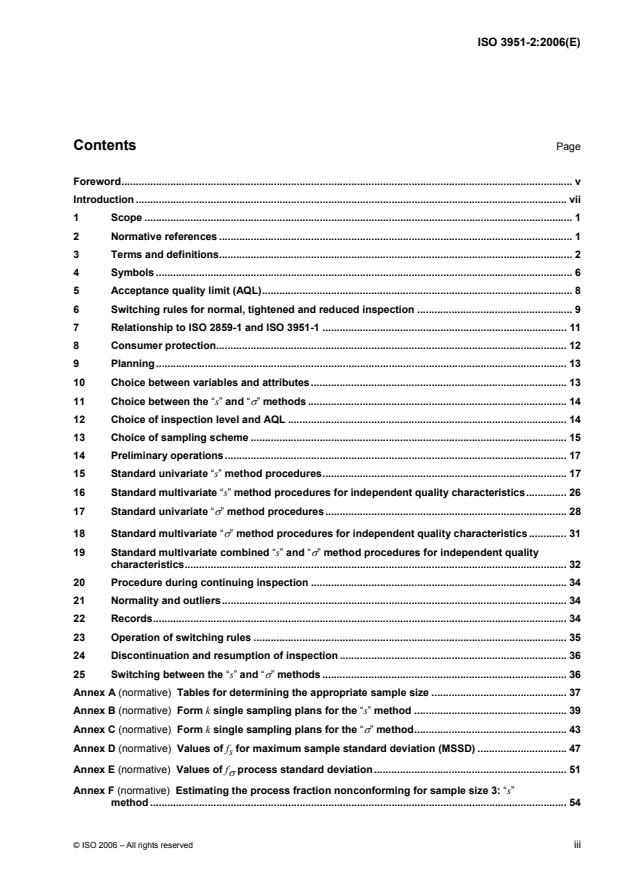
Contents Page
Foreword. v
Introduction . vii
1 Scope . 1
2 Normative references . 1
3 Terms and definitions. 2
4 Symbols . 6
5 Acceptance quality limit (AQL). 8
6 Switching rules for normal, tightened and reduced inspection . 9
7 Relationship to ISO 2859-1 and ISO 3951-1 . 11
8 Consumer protection. 12
9 Planning. 13
10 Choice between variables and attributes.13
11 Choice between the “s” and “σ” methods . 14
12 Choice of inspection level and AQL . 14
13 Choice of sampling scheme . 15
14 Preliminary operations. 17
15 Standard univariate “s” method procedures. 17
16 Standard multivariate “s” method procedures for independent quality characteristics. 26
17 Standard univariate “σ” method procedures. 28
18 Standard multivariate “σ” method procedures for independent quality characteristics . 31
19 Standard multivariate combined “s” and “σ” method procedures for independent quality
characteristics. 32
20 Procedure during continuing inspection . 34
21 Normality and outliers. 34
22 Records. 34
23 Operation of switching rules . 35
24 Discontinuation and resumption of inspection . 36
25 Switching between the “s” and “σ” methods . 36
Annex A (normative) Tables for determining the appropriate sample size . 37
Annex B (normative) Form k single sampling plans for the “s” method . 39
Annex C (normative) Form k single sampling plans for the “σ” method. 43
Annex D (normative) Values of f for maximum sample standard deviation (MSSD) . 47
s
Annex E (normative) Values of f process standard deviation. 51
σ
Annex F (normative) Estimating the process fraction nonconforming for sample size 3: “s”
method . 54
Annex G (normative) Form p* single sample plans. 57
Annex H (normative) Values of c for upper control limit on the sample standard deviation. 61
U
Annex I (normative) Supplementary acceptability constants for qualifying towards reduced
inspection . 62
Annex J (normative) Procedures for obtaining s or σ. 63
Annex K (normative) Estimating the process fraction nonconforming. 65
Annex L (informative) Consumer's risk qualities . 69
Annex M (informative) Producer's risks . 74
Annex N (informative) Operating characteristics for the “σ” method . 79
Bibliography . 80
iv © ISO 2006 – All rights reserved
Foreword
ISO (the International Organization for Standardization) is a worldwide federation of national standards bodies
(ISO member bodies). The work of preparing International Standards is normally carried out through ISO
technical committees. Each member body interested in a subject for which a technical committee has been
established has the right to be represented on that committee. International organizations, governmental and
non-governmental, in liaison with ISO, also take part in the work. ISO collaborates closely with the
International Electrotechnical Commission (IEC) on all matters of electrotechnical standardization.
International Standards are drafted in accordance with the rules given in the ISO/IEC Directives, Part 2.
The main task of technical committees is to prepare International Standards. Draft International Standards
adopted by the technical committees are circulated to the member bodies for voting. Publication as an
International Standard requires approval by at least 75 % of the member bodies casting a vote.
Attention is drawn to the possibility that some of the elements of this document may be the subject of patent
rights. ISO shall not be held responsible for identifying any or all such patent rights.
ISO 3951-2 was prepared by Technical Committee ISO/TC 69, Applications of statistical methods,
Subcommittee SC 5, Acceptance sampling.
This first edition of ISO 3951-2, together with ISO 3951, cancels and replaces ISO 3951:1989, of which it
constitutes a technical revision.
The most significant differences between ISO 3951-2:2006 and ISO 3951:1989 are as follows:
⎯ The acronym AQL now stands for Acceptance Quality Limit rather than Acceptable Quality Level, in order
to reflect more accurately its function.
⎯ ISO 3951-2:2006 not only covers the univariate procedures of ISO 3951:1989 but also includes separate
and complex control of double specification limits and multivariate procedures for independent
characteristics.
⎯ The plans have been modified so that their operating characteristic curves match those of the plans in
ISO 2859-1 more closely. The sample sizes for both the “s” method and the “σ” method are constant
along rows of the master tables.
⎯ The acceptability constants of Annexes B and C have been recalculated and tabulated to three decimal
places for an extended range of AQLs corresponding to ISO 2859-1:1999. A new master table of Form p*
acceptability constants is provided as Annex G, tabulated to four significant figures.
⎯ All tabulated values of operating characteristics have been recalculated and related directly to reduced
inspection as well as to normal and tightened inspection.
⎯ The annex containing statistical theory has been removed. It is planned ultimately to reintroduce this
within a guidance document to sampling procedures for inspection by variables.
⎯ Text and tables that are merely informative have been consigned to annexes wherever practicable.
⎯ The annex dealing with the “R” method has been eliminated, now that the availability of calculators with a
standard deviation function key is so widespread. Data for acceptance sampling by variables is often
substantially more expensive to acquire than data for sampling by attributes, and the “s” method makes
more efficient use of this data.
ISO 3951 currently consists of the following parts, under the general title Sampling procedures for inspection
by variables:
⎯ Part 1: Specification for single sampling plans indexed by acceptance quality limit (AQL) for lot-by-lot
inspection for a single quality characteristic and a single AQL
⎯ Part 2: General specification for single sampling plans indexed by acceptance quality limit (AQL) for
lot-by-lot inspection of independent quality characteristics
⎯ Part 5: Sequential sampling plans indexed by acceptance quality limit (AQL) for inspection by variables
(known standard deviation)
The following part is under preparation:
⎯ Part 3: Double sampling schemes indexed by acceptance quality limit (AQL) for lot-by-lot inspection
vi © ISO 2006 – All rights reserved
Introduction
This part of ISO 3951 specifies an acceptance sampling system of single sampling plans for inspection by
variables. It is indexed in terms of the Acceptance Quality Limit (AQL), and is of a technical nature, aimed at
users who are already familiar with sampling by variables or who have complicated requirements. (An
introductory treatment is given in ISO 3951-1.)
The objectives of the methods laid down in this part of ISO 3951 are to ensure that lots of an acceptable
quality have a high probability of acceptance and that the probability of not accepting inferior lots is as high as
practicable. This is achieved by means of the switching rules, which provide
a) automatic protection to the consumer (by means of a switch to tightened inspection or discontinuation of
sampling inspection) should a deterioration in quality be detected;
b) an incentive (at the discretion of the responsible authority) to reduce inspection costs (by means of a
switch to a smaller sample size) should consistently good quality be achieved.
In this part of ISO 3951, the acceptability of a lot is implicitly or explicitly determined from an estimate of the
percentage of nonconforming items in the process, based on a random sample of items from the lot.
This part of ISO 3951 is intended for application to a continuing series of lots of discrete products all supplied
by one producer using one production process. If there are different producers or production processes, this
part of ISO 3951 is applied to each one separately.
This part of ISO 3951 is complementary to ISO 2859-1. When specified by the responsible authority, both
ISO 3951-2 and ISO 2859-1 may be referenced in a product specification, contract, inspection instructions, or
other documents, and the provisions set forth therein shall govern. The “responsible authority” shall be
designated in one of the above documents.
It is assumed in this part of ISO 3951 that measurement uncertainty is negligible (see ISO 10576-1:2003). For
further information on allowing for measurement uncertainty in sampling by variables, see Reference [16] in
the Bibliography.
CAUTION — The procedures in this part of ISO 3951 are not suitable for application to lots that have
been screened previously for nonconforming items.
Inspection by variables for percent nonconforming items, as described in the present document, includes
several possible modes, the combination of which leads to a presentation that may appear quite complex to
the user:
⎯ unknown standard deviation, or originally unknown then estimated with fair precision, or known since the
start of inspection;
⎯ a single specification limit, or double specification limits with combined, separate or complex control;
⎯ univariate or multivariate cases;
⎯ normal inspection, tightened inspection or reduced inspection.
Fourteen annexes are provided.
⎯ Annexes A to I provide the tables needed to support the procedures.
⎯ Annex J indicates how the sample standard deviation, s, and the presumed known value of the process
standard deviation, σ, should be determined.
⎯ Annex K provides formulae for the estimation of the process fraction nonconforming, together with a
highly accurate approximation for use when the process standard deviation is unknown.
⎯ Annex L provides the statistical theory underlying the calculation of the consumer’s risk qualities, together
with tables showing these quality levels for normal, tightened and reduced inspection under the “s” and
“σ” methods.
⎯ Annex M provides similar information for the producer’s risks.
⎯ Annex N gives the general formula for the operating characteristic of the “σ” method.
Table 1 is intended to facilitate the use of this part of ISO 3951 by directing the user to the paragraphs and
tables concerning any situation with which he may be confronted. Table 1 only deals with Clauses 15, 16, 17,
18, 19, 23, 24 and 25; in every case, it is necessary first of all to have read the other clauses.
viii © ISO 2006 – All rights reserved
Table 1 — Summary
Inspection type Single specification limit Double specification limits with combined control
“s” method “s” method
“σ” method “σ” method
Clauses or Tables Clauses or Tables Clauses or Tables Clauses or Tables
sub-clauses sub-clauses sub-clauses sub-clauses
Normal inspection 15.1, 15.2, A.1, A.2, B.1 17.1, 17.2, A.1, A.2, C.1 15.1, 15.4, A.1, A.2, D.1, 17.1, 17.3, A.1, A.2, C.1,
15.3, 16.2, 18, 19, 23.1 16.2, 23.1 F.1 (for 18, 19, 23.1 E.1
23.1 n = 3), G.1
Switching between normal 23.2, 23.3 B.1, B.2 23.2, 23.3 C.1, C.2 23.2, 23.3 D.1, D.2 23.2, 23.3 E.1
and tightened inspection
G.1, G.2 G.1, G.2
Switching between normal 23.4, 23.5 B.1, B.3 23.4, 23.5 C.1, C.3 23.4, 23.5 D.1, D.3 23.4, 23.5 E.1
and reduced inspection
I.1 I.1 G.1, G.3 G.1, G.3
I.1 I.1
Switching between tightened 21, 24 B.2 24 C.2 21, 24 D.2 24 E.1
and discontinued inspection
G.2 G.2
Switching between the “s” 25 25 25 25
and “σ” methods
K.2.1 H.1 K.2.2 H.1 K.2.1 H.1 K.2.2 H.1
K.3, K.4, K.5 K.3, K.4, K.5
x © ISO 2006 – All rights reserved
Table 1 (continued)
Inspection type Double specification limits with separate control Double specification limits with complex control
“s” method “σ” method “s” method “σ” method
Clauses or Tables Clauses or Tables Clauses or Tables Clauses or Tables
sub-clauses sub-clauses sub-clauses sub-clauses
Normal inspection 15.1, 15.4, A.1, A.2, D.1, 17.1, 17.2, A.1, A.2, C.1, 15.1, 15.5, A.1, A.2, D.1, 17.1, 17.3, A.1, A.2, C.1,
16.2, 23.1 F.1 (for 17.3, 18, 19, E.2 16.2, 23.1 18, 19, 23.1 E.3
F (for n = 3),
23.1
n = 3), G.1 G.1
Switching between normal 23.2, 23.3 D.1, D.2 23.2, 23.3 E.1 23.2, 23.3 D.1, D.2 23.2, 23.3 E.1
and tightened inspection
G.1, G.2 G.1, G.2 G.1, G.2 G.1, G.2
Switching between normal 23.4, 23.5 D.1, D.3 23.4, 23.5 E.2 23.4, 23.5 D.1, D.3 23.4, 23.5 E.3
and reduced inspection
G.1, G.3 G.1, G.3 G.1, G.3 G.1, G.3
I.1 I.1 I.1 I.1
Switching between tightened 21, 24 D.2 24 E.1 21, 24 D.2 24 E.1
and discontinued inspection
G.2 G.2 G.2 G.2
Switching between the “s” 25 25 25 25
and “σ” methods
K.2.1 H.1 K.2.2 H.1 K.2.1 H.1 K.2.2 H.1
K.3, K.4, K.5 K.3, K.4, K.5
INTERNATIONAL STANDARD ISO 3951-2:2006(E)
Sampling procedures for inspection by variables —
Part 2:
General specification for single sampling plans indexed by
acceptance quality limit (AQL) for lot-by-lot inspection of
independent quality characteristics
1 Scope
This part of ISO 3951 specifies an acceptance sampling system of single sampling plans for inspection by
variables, indexed in terms of the Acceptance Quality Limit (AQL).
This part of ISO 3951 is primarily designed for use under the following conditions:
a) where the inspection procedure is to be applied to a continuing series of lots of discrete products all
supplied by one producer using one production process. If there are different producers or production
processes, apply this part of ISO 3951 to each one separately;
b) where the quality characteristics of the items of product are measurable on a continuous scale;
c) where the measurement error is negligible (i.e. with a standard deviation no more than 10 % of the
corresponding process standard deviation);
d) where production is stable (under statistical control) and the quality characteristics are distributed, at least
to a close approximation, according to normal distributions;
e) where, in the case of multiple quality characteristics, the characteristics are independent of one another,
at least approximately;
f) where a contract or standard defines an upper specification limit U, a lower specification limit L, or both
on each of the quality characteristics.
2 Normative references
The following referenced documents are indispensable for the application of this document. For dated
references, only the edition cited applies. For undated references, the latest edition of the referenced
document (including any amendments) applies.
ISO 2859-1:1999, Sampling procedures for inspection by attributes — Part 1: Sampling schemes indexed by
acceptance quality limit (AQL) for lot-by-lot inspection
ISO 3534-1, Statistics ― Vocabulary and symbols ― Part 1: Probability and general statistical terms
ISO 3534-2, Statistics ― Vocabulary and symbols ― Part 2: Applied statistics
ISO 9000, Quality management systems ― Fundamentals and vocabulary
3 Terms and definitions
For the purposes of this document, the terms and definitions given in ISO 3534-1, ISO 3534-2, ISO 2859-1
and ISO 9000 apply, except where redefined below. References are given in square brackets for definitions
that have been repeated here for convenience.
3.1
inspection by variables
inspection by measuring the magnitude(s) of a characteristic(s) of an item
[ISO 3534-2]
3.2
sampling inspection
inspection of selected items in the group under consideration
[ISO 3534-2]
3.3
acceptance sampling inspection
acceptance inspection where the acceptability is determined by means of sampling inspection (3.2)
[ISO 3534-2]
3.4
acceptance sampling inspection by variables
acceptance sampling inspection (3.3) in which the acceptability of the process is determined statistically
from measurements on specified quality characteristics of each item in a sample from a lot
3.5
process fraction nonconforming
rate at which nonconforming items are generated by a process, expressed as a proportion
3.6
acceptance quality limit
AQL
worst tolerable process fraction nonconforming (3.5) when a continuing series of lots is submitted for
acceptance sampling
NOTE See Clause 5.
3.7
quality level
quality expressed as a rate of occurrence of nonconforming items
3.8
consumer’s risk quality
CRQ
quality level (3.7) of a process which, in the acceptance sampling plan, corresponds to a specified
consumer’s risk
NOTE 1 In this part of ISO 3951, the quality level is the process fraction nonconforming.
NOTE 2 In this part of ISO 3951, the consumer’s risk quality is such that the consumer’s risk is 10 %.
3.9
producer’s risk
PR
probability of non-acceptance when the quality level (3.7) has a value stated by the plan as acceptable
NOTE Quality level relates to the process fraction nonconforming (3.5) and acceptable relates to the AQL (3.6).
2 © ISO 2006 – All rights reserved
3.10
nonconformity
non-fulfilment of a requirement
[ISO 9000]
NOTE Nonconformity will generally be classified by its degree of seriousness, such as:
⎯ Class A. Nonconformity of a type considered to be of the highest concern for the product or service. Such types of
nonconformity will typically be assigned very small AQL values.
⎯ Class B. Nonconformity of a type considered to have the next lower degree of concern; this is typically assigned a
larger AQL value than that in Class A and smaller than that in Class C if a third class exists, and so on.
The number of classes and the assignment into a class should be appropriate to the quality requirements of the specific
situation.
3.11
nonconforming unit
unit with one or more nonconformities
[ISO 3534-2]
3.12
“s” method acceptance sampling plan
s method
acceptance sampling plan by variables using the sample standard deviation
[ISO 3534-2]
NOTE See Clause 15.
3.13
“σ” method acceptance sampling plan
sigma method
acceptance sampling plan by variables using the presumed value of the process standard deviation(s)
[ISO 3534-2]
NOTE See Clause 16.
3.14
specification limit
limiting value stated for a characteristic
[ISO 3534-2]
3.15
lower specification limit
specification limit (3.14) that defines the lower limiting value
NOTE The preferred symbol for the lower specification limit is L.
[ISO 3534-2]
3.16
upper specification limit
specification limit (3.14) that defines the upper limiting value
NOTE The preferred symbol for the upper specification limit is U.
[ISO 3534-2]
3.17
combined control
requirement when nonconformity (3.10) beyond both the upper and the lower specification limits (3.16,
3.15) of a quality characteristic belongs to the same class, to which a single AQL is applied
NOTE 1 See 5.3, 15.3.2 and 17.3.
NOTE 2 The use of a combined AQL (3.6) requirement implies that nonconformities beyond either specification limit
(3.14) are believed to be of equal, or at least roughly equal, importance to the lack of integrity of the product.
3.18
separate control
requirement when nonconformity beyond the upper and the lower specification limits (3.16, 3.15) of a
quality characteristic belongs to different classes, to which separate AQLs (3.6) are applied
NOTE See 5.3, 15.3.3 and 17.2.
3.19
complex control
requirement when nonconformity beyond the upper specification limit (3.16) and the lower specification
limits (3.15) of a quality characteristic belongs to one class, and nonconformity beyond either the upper
specification limit or the lower specification limit belongs to a different class, with separate AQLs (3.6) being
applied to the two classes
NOTE See 5.3, 15.3.4 and 17.3.
3.20
acceptability constant
k, p*
constant depending on the specified value of the acceptance quality limit (3.6) and the sample size, used in
the criteria for accepting the lot in an acceptance sampling plan by variables
[ISO 3534-2]
NOTE See 15.2 and 16.2.
3.21
quality statistic
Q
function of the specification limit (3.14), the sample mean, and the sample or process standard deviation,
used in assessing the acceptability of a lot (see 4.1, symbols Q and Q )
L U
[ISO 3534-2]
NOTE 1 For the case of a single specification limit, the lot may be sentenced on the result of comparing Q with the
acceptability constant (3.20) k.
NOTE 2 See 15.2 and 16.2.
4 © ISO 2006 – All rights reserved
3.22
lower quality statistic
function of the lower specification limit (3.15), the sample mean, and the sample or process standard
deviation
[ISO 3534-2]
NOTE 1 For a single, lower specification limit, the lot is sentenced on the result of comparing Q with the acceptability
L
constant (3.20) k.
NOTE 2 See Clause 4, 15.2 and 16.2.
3.23
upper quality statistic
function of the upper specification limit (3.16), the sample mean, and the sample or process standard
deviation
[ISO 3534-2]
NOTE 1 For a single, upper specification limit, the lot is sentenced on the result of comparing Q with the acceptability
U
constant (3.20) k.
NOTE 2 See Clause 4, 15.2 and 16.2.
3.24
maximum sample standard deviation
MSSD
s
max
largest sample standard deviation for a given sample size code letter and acceptance quality limit (3.6) for
which it is possible to satisfy the acceptance criterion for double specification limits (3.14) with a combined
AQL (3.6) requirement and unknown process variability
NOTE See 15.3.
3.25
maximum process standard deviation
MPSD
σ
max
largest process standard deviation for a given sample size code letter and acceptance quality limit (3.6) for
which it is possible to satisfy the acceptance criterion for double specification limits with a combined AQL
(3.6) requirement under tightened inspection with known process variability
NOTE See 17.2 and 17.3.
3.26
switching rule
instruction within an acceptance sampling scheme for changing from one acceptance sampling plan to
another of greater or lesser severity of sampling based on demonstrated quality history
[ISO 3534-2]
NOTE 1 Normal, tightened or reduced inspection, or discontinuation of inspection, are examples of “greater or lesser
severity”.
NOTE 2 See Clauses 6 and 23.
3.27
measurement
set of operations having the object of determining a value of a quantity
[ISO 3534-2]
3.28
responsible authority
generic term used to maintain the neutrality of this part of ISO 3951 (primarily for specification purposes),
irrespective of whether it is being invoked or applied by the first, second or third party.
NOTE 1 The responsible authority may be
a) the quality department within a supplier's organization (first party);
b) the purchaser or procurement organization (second party);
c) an independent verification or certification authority (third party);
d) any of a), b) or c), differing according to function (see NOTE 2) as described in a written agreement between two of
the parties, for example a document between supplier and purchaser.
NOTE 2 The duties and functions of a responsible authority are outlined in ISO 2859-1:1999 (5.2, 6.2, Clause 7, 9.1,
9.3.3, 9.4, 10.1 and 10.3).
4 Symbols
4.1 Univariate symbols
The symbols used when there is only one quality characteristic in the class are as follows.
f factor that relates the maximum sample standard deviation (MSSD) to the difference between U and L
s
(see Annex D)
f factor that relates the maximum process standard deviation (MPSD) to the difference between U and L
σ
(see Annex E)
k Form k acceptability constant, for use with a single specification limit and a single quality characteristic
(see Annexes B and C)
L lower specification limit (as a suffix to a variable, denotes its value at L)
µ process mean
N lot size (number of items in a lot)
n sample size (number of items in a sample)
pˆ estimate of the process fraction nonconforming (see Annex K)
p process fraction nonconforming below the lower specification limit
L
pˆ estimate of the process fraction nonconforming below the lower specification limit
L
p process fraction nonconforming above the upper specification limit
U
pˆ estimate of the process fraction nonconforming above the upper specification limit
U
p* Form p* acceptability constant, the maximum acceptable value of the estimate of the process fraction
nonconforming (see Annex G)
P probability of acceptance
a
6 © ISO 2006 – All rights reserved
Q quality statistic
Q lower quality statistic
L
NOTE 1 Q is defined as xL− /s when the process standard deviation is unknown, and as xL− /σ
( ) ( )
L
when it is presumed to be known.
Q upper quality statistic
U
NOTE 2 Q is defined as ()Ux− /s when the process standard deviation is unknown, and as ()Ux−/σ
U
when it is presumed to be known.
s Sample standard deviation of the measured values of the quality characteristic (also an estimate of the
standard deviation of the process), i.e.
n
()xx−
∑ j
j=1
s= .
n− 1
(See also Annex J.)
s maximum sample standard deviation (MSSD)
max
σ standard deviation of a process that is under statistical control
NOTE 3 σ , the square of the process standard deviation, is known as the process variance.
σ maximum process standard deviation (MPSD).
max
U upper specification limit (as a suffix to a variable, denotes its value at U)
x measured value of the quality characteristic for the jth item of the sample
j
x arithmetic mean of the measured values of the quality characteristics in the sample, i.e.
n
x
∑ j
j=1
x=
n
x lower acceptance value for x
L
upper acceptance value for x
x
U
4.2 Multivariate symbols
Further symbols used when there are two or more quality characteristics in a class are as follows.
L lower specification limit for the ith quality characteristic
i
M number of quality characteristics in the class
pˆ estimate of the process fraction nonconforming for the ith quality characteristic
i
pˆ estimate of the process fraction nonconforming below the lower specification limit for the ith quality
iL,
characteristic
pˆ estimate of the process fraction nonconforming above the upper specification limit for the ith quality
iU,
characteristic
s sample standard deviation for the ith quality characteristic, i.e.
i
n
()xx−
∑ ij i
j=1
s =
i
n−1
σ process standard deviation for the ith quality characteristic
i
U upper specification limit for the ith quality characteristic
i
x measured value of the ith quality characteristic for the jth item in the sample
ij
x sample mean value of the ith quality characteristic, i.e.
i
n
x
∑ ij
j=1
x =
i
n
5 Acceptance quality limit (AQL)
5.1 Concept
The AQL is the quality level that is the worst tolerable process fraction nonconforming when a continuing
series of lots is submitted for acceptance sampling. Although individual lots with quality as bad as the
acceptance quality limit may be accepted with fairly high probability, the designation of an acceptance quality
limit does not suggest that this is a desirable quality level. The sampling schemes found in this part of
ISO 3951, with their rules for switching and for discontinuation of sampling inspection, are designed to
encourage suppliers to keep process fractions nonconforming consistently better than the respective AQLs.
Otherwise, there is a high risk that the inspection severity will be switched to tightened inspection, under which
the criteria for lot acceptance become more demanding. Once on tightened inspection, unless action is taken
to improve the process, it is very likely that the rule requiring discontinuation of sampling inspection will be
invoked pending such improvement.
5.2 Use
The AQL, together with the sample size code letter, is used to index the sampling plans in this part of
ISO 3951.
5.3 Specifying AQLs
The AQL to be used will be designated in the product specification, contract or by the responsible authority. In
all cases, one AQL shall be specified for each class of nonconformity (see 3.10).
Where both upper and lower specification limits are given for a quality characteristic, three cases may be
identified:
a) combined control of double specification limits, where nonconformity beyond both limits belongs to the
same class, to which a single AQL applies;
8 © ISO 2006 – All rights reserved
b) separate control, where nonconformity beyond both limits belongs to different classes, to which separate
AQLs apply;
c) complex control, where nonconformity beyond the limit that is of greater seriousness belongs to one class
to which one AQL applies, and nonconformity beyond both limits belongs to another class to which a
larger AQL applies.
In other words, for a single quality characteristic that has a lower specification L, an upper specification limit U,
an unknown process fraction nonconforming below L of p and an unknown process fraction nonconforming
L
above U of p :
U
⎯ combined control seeks simply to control the sum p + p within one class of nonconformity, to which a
L U
single AQL applies;
⎯ separate control seeks to control p within one class to which one AQL applies, and to separately control
L
p within another class to which a second AQL applies;
U
⎯ complex control seeks to control p + p within one class, to which one AQL applies, and to separately
L U
control either p or p within another class to which a lower AQL applies.
L U
Including the control of single upper and single lower specification limits, there are therefore five types of
control. A class may contain nonconformities under any number of these types of control.
An acceptance test shall be carried out according to the provisions of this part of ISO 3951 for each class of
nonconformity. The lot shall only be accepted if all classes of nonconformity satisfy their respective
acceptance tests.
5.4 Preferred AQLs
The sixteen AQLs given in this part of ISO 3951, ranging in value from 0,01 % to 10 % nonconforming, are
described as preferred AQLs. If, for any product or service, an AQL is designated other than a preferred AQL,
then this part of ISO 3951 is not applicable (see 13.2).
5.5 Caution
From the above definition of the AQL, it follows that the desired protection can only be assured when a
continuing series of lots is provided for inspection.
5.6 Limitation
The designation of an AQL shall not imply that the supplier has the right to supply knowingly any
nonconforming items of product.
6 Switching rules for normal, tightened and reduced inspection
Switching rules discourage the producer from operating at a quality level that is worse than the AQL. This part
of ISO 3951 prescribes a switch to tightened inspection when inspection results indicate that the AQL is being
exceeded. It further prescribes a discontinuation of sampling inspection altogether if tightened inspection fails
to stimulate the producer into rapidly improving his production process.
Tightened inspection and the discontinuation rule are integral, and therefore obligatory, procedures of this part
of ISO 3951 if the protection implied by the AQL is to be maintained.
This part of ISO 3951 also provides the possibility of switching to reduced inspection when inspection results
indicate that the quality level is stable and reliable at a level better than the AQL. This practice is, however,
optional (at the discretion of the responsible authority).
When there is sufficient evidence from the control charts (see 22.1) that the variability is in statistical control,
consideration should be given to switching to the “σ” method. If this appears advantageous, the consistent
value of s (the sample standard deviation) shall be taken as σ (see Clause 25).
When it has been necessary to discontinue acceptance sampling inspection, inspection under this part of
ISO 3951 shall not be resumed until action has been taken by the producer to improve the quality of the
submitted product.
Details of the operation of the switching rules are given in Clauses 23, 24 and 25 and are shown
diagrammatically in Figure 1.
Figure 1 — Outline of the switching rules
10 © ISO 2006 – All rights reserved
7 Relationship to ISO 2859-1 and ISO 3951-1
7.1 Relationship to ISO 2859-1
7.1.1 Similarities to ISO 2859-1
a) This part of ISO 3951 is complementary to ISO 2859-1; the two documents share a common philosophy
and, as far as possible, their procedures and vocabulary are the same.
b) Both use the AQL to index the sampling plans, and the preferred values used in this document are
identical with those given for percent nonconforming in ISO 2859-1 (i.e. from 0,01 % to 10 %).
c) In both International Standards, lot size and inspection level (inspection level II in default of other
instructions) determine a sample size code letter. Then general tables give the sample size to be taken
and the acceptability criterion, indexed by the sample size code letter and the AQL. Separate tables are
given for the “s” and “σ” methods, and for normal, tightened and reduced inspection.
d) The switching rules are essentially equivalent.
e) The classification of nonconformities by degree of seriousness into Class A, Class B, etc., remains
unchanged.
7.1.2 Differences from ISO 2859-1
a) Determination of acceptability: Acceptability for an ISO 2859-1 attributes sampling plan for percent
nonconforming is determined by the number of nonconforming items found in the sample. Acceptability
for a plan for inspection by variables is based on the distance of the estimated process mean from the
specification limit(s) in terms of the estimated process standard deviation. In this part of ISO 3951, two
methods are considered: the “s” method for use when the process standard deviation σ is unknown and
the “σ” method for use when σ is presumed to be known. In the case of a class containing a single quality
characteristic with a single specification limit, acceptability is determined most easily by comparing a
quality statistic with a “Form k“ acceptability constant (see 15.2 and 17.2). For more complicated classes
with multiple quality characteristics and/or combined or complex control of double specification limits,
acceptability is determined by comparing an estimate of the process fraction nonconforming for that class
with a “Form p*” acceptability constant.
b) Normality: In ISO 2859-1, there is no requirement relating to the distribution of the characteristics.
However, in this part of ISO 3951, it is necessary for the efficient operation of the plans that the
measurements on each quality characteristic should be distributed according to a normal distribution or at
least a close approximation to a normal distribution.
c) Independence: In ISO 2859-1, there is no requirement relating to independence of multiple quality
characteristics. However, in this part of ISO 3951, for the efficient operation of a plan, it is necessary that
the measurements for all quality characteristics in a class shall be independent, or at least approximately
so.
d) Operating characteristic curves (OC curves): The OC curves of the variables plans in this part of
ISO 3951 are not identical to those of the corresponding attributes plans in ISO 2859-1. The curves have
been matched as closely as possible subject to a number of pragmatic constraints, such as keeping the
sample size the same for a given code letter, severity of inspection and whether the “s” or “σ” method is
being used, regardless of the AQL.
e) Producer’s risk: For process quality precisely at the AQL, the producer’s risk that a lot will not be
accepted tends to decrease with one-step increases in sample size coupled with one-step decreases in
AQL, i.e. down diagonals of the master tables running from top right to bottom left. The progressions of
probabilities are similar, but not identical, to those in ISO 2859-1. (The producer’s risks of the plans are
given in Annex M.)
f) Sample sizes: The variables sample sizes corresponding to given code letters are usually smaller than
the attributes sample sizes for the same letters. This is particularly true for the “σ” method. (See
Table A.2.)
1)
g) Double sampling plans: Double sampling plans by variables are presented separately, in ISO 3951-3 .
h) Multiple sampling plans: No multiple sampling plans are given in this part of ISO 3951.
i) Average outgoing quality limit (AOQL): The AOQL concept applies when 100 percent inspection and
rectification is feasible for non-accepted lots. It follows that the AOQL concept cannot be applied under
destructive or expensive testing. As variables plans will generally be used under these circumstances, no
tables of AOQL have been included in this part of ISO 3951.
7.2 Relationship to ISO 3951-1
7.2.1 Similarities
a) This part of ISO 3951 is complementary to ISO 3951-1 and the two documents both present single
sampling procedures for inspection by variables.
b) The procedures in ISO 3951-1 are included in this part of ISO 3951 but referred to as of “Form k”.
7.2.2 Differences
a) ISO 3951-2 is more general than ISO 3951-1, as it includes multivariate procedures for independent
quality characteristics and also includes procedures for separate or combined control of double
specification
...
Questions, Comments and Discussion
Ask us and Technical Secretary will try to provide an answer. You can facilitate discussion about the standard in here.
Loading comments...