


ISO 14520-8:2016
(Main)Gaseous fire-extinguishing systems — Physical properties and system design — Part 8: HFC 125 extinguishant
Gaseous fire-extinguishing systems — Physical properties and system design — Part 8: HFC 125 extinguishant
ISO 14520-8:2016 contains specific requirements for gaseous fire-extinguishing systems, with respect to the HFC 125 extinguishant. It includes details of physical properties, specification, usage and safety aspects. ISO 14520-8:2016 covers systems operating at nominal pressures of 25 bar and 42 bar, superpressurized with nitrogen. This does not preclude the use of other systems.
Systèmes d'extinction d'incendie utilisant des agents gazeux — Propriétés physiques et conception des systèmes — Partie 8: Agent extincteur HCFC 125
General Information
- Status
- Withdrawn
- Publication Date
- 27-Sep-2016
- Withdrawal Date
- 27-Sep-2016
- Technical Committee
- ISO/TC 21/SC 8 - Gaseous media and firefighting systems using gas
- Current Stage
- 9599 - Withdrawal of International Standard
- Start Date
- 02-Jul-2019
- Completion Date
- 12-Feb-2026
Relations
- Effective Date
- 23-Sep-2017
- Effective Date
- 03-Oct-2009
Get Certified
Connect with accredited certification bodies for this standard

NSF International
Global independent organization facilitating standards development and certification.

CIS Institut d.o.o.
Personal Protective Equipment (PPE) certification body. Notified Body NB-2890 for EU Regulation 2016/425 PPE.

Kiwa BDA Testing
Building and construction product certification.
Sponsored listings
Frequently Asked Questions
ISO 14520-8:2016 is a standard published by the International Organization for Standardization (ISO). Its full title is "Gaseous fire-extinguishing systems — Physical properties and system design — Part 8: HFC 125 extinguishant". This standard covers: ISO 14520-8:2016 contains specific requirements for gaseous fire-extinguishing systems, with respect to the HFC 125 extinguishant. It includes details of physical properties, specification, usage and safety aspects. ISO 14520-8:2016 covers systems operating at nominal pressures of 25 bar and 42 bar, superpressurized with nitrogen. This does not preclude the use of other systems.
ISO 14520-8:2016 contains specific requirements for gaseous fire-extinguishing systems, with respect to the HFC 125 extinguishant. It includes details of physical properties, specification, usage and safety aspects. ISO 14520-8:2016 covers systems operating at nominal pressures of 25 bar and 42 bar, superpressurized with nitrogen. This does not preclude the use of other systems.
ISO 14520-8:2016 is classified under the following ICS (International Classification for Standards) categories: 13.220.10 - Fire-fighting. The ICS classification helps identify the subject area and facilitates finding related standards.
ISO 14520-8:2016 has the following relationships with other standards: It is inter standard links to ISO 14520-8:2019, ISO 14520-8:2006. Understanding these relationships helps ensure you are using the most current and applicable version of the standard.
ISO 14520-8:2016 is available in PDF format for immediate download after purchase. The document can be added to your cart and obtained through the secure checkout process. Digital delivery ensures instant access to the complete standard document.
Standards Content (Sample)
INTERNATIONAL ISO
STANDARD 14520-8
Third edition
2016-10-01
Gaseous fire-extinguishing systems —
Physical properties and system
design —
Part 8:
HFC 125 extinguishant
Systèmes d’extinction d’incendie utilisant des agents gazeux —
Propriétés physiques et conception des systèmes —
Partie 8: Agent extincteur HCFC 125
Reference number
©
ISO 2016
© ISO 2016, Published in Switzerland
All rights reserved. Unless otherwise specified, no part of this publication may be reproduced or utilized otherwise in any form
or by any means, electronic or mechanical, including photocopying, or posting on the internet or an intranet, without prior
written permission. Permission can be requested from either ISO at the address below or ISO’s member body in the country of
the requester.
ISO copyright office
Ch. de Blandonnet 8 • CP 401
CH-1214 Vernier, Geneva, Switzerland
Tel. +41 22 749 01 11
Fax +41 22 749 09 47
copyright@iso.org
www.iso.org
ii © ISO 2016 – All rights reserved
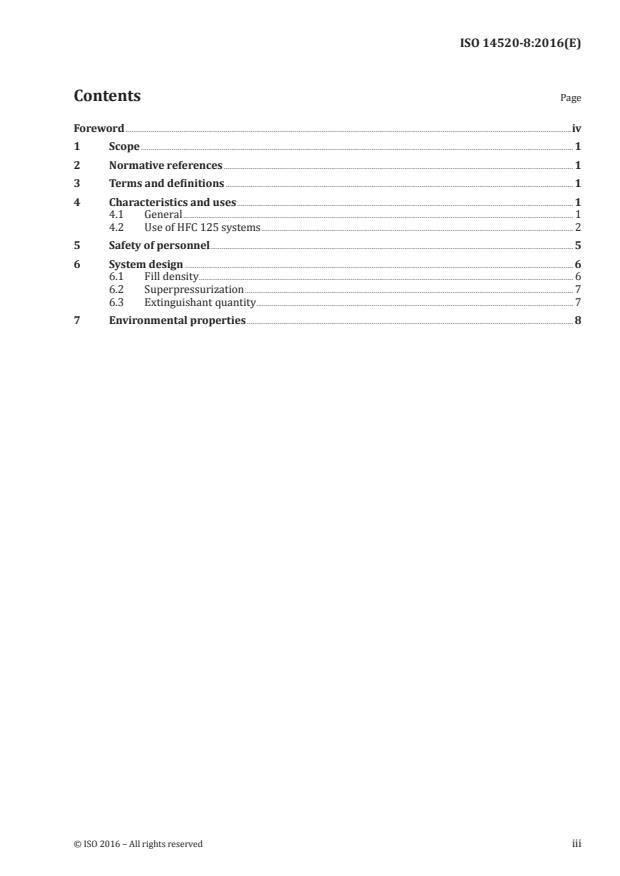
Contents Page
Foreword .iv
1 Scope . 1
2 Normative references . 1
3 Terms and definitions . 1
4 Characteristics and uses . 1
4.1 General . 1
4.2 Use of HFC 125 systems . 2
5 Safety of personnel . 5
6 System design . 6
6.1 Fill density. 6
6.2 Superpressurization . 7
6.3 Extinguishant quantity . 7
7 Environmental properties . 8
Foreword
ISO (the International Organization for Standardization) is a worldwide federation of national standards
bodies (ISO member bodies). The work of preparing International Standards is normally carried out
through ISO technical committees. Each member body interested in a subject for which a technical
committee has been established has the right to be represented on that committee. International
organizations, governmental and non-governmental, in liaison with ISO, also take part in the work.
ISO collaborates closely with the International Electrotechnical Commission (IEC) on all matters of
electrotechnical standardization.
The procedures used to develop this document and those intended for its further maintenance are
described in the ISO/IEC Directives, Part 1. In particular the different approval criteria needed for the
different types of ISO documents should be noted. This document was drafted in accordance with the
editorial rules of the ISO/IEC Directives, Part 2 (see www.iso.org/directives).
Attention is drawn to the possibility that some of the elements of this document may be the subject of
patent rights. ISO shall not be held responsible for identifying any or all such patent rights. Details of
any patent rights identified during the development of the document will be in the Introduction and/or
on the ISO list of patent declarations received (see www.iso.org/patents).
Any trade name used in this document is information given for the convenience of users and does not
constitute an endorsement.
For an explanation on the meaning of ISO specific terms and expressions related to conformity assessment,
as well as information about ISO’s adherence to the World Trade Organization (WTO) principles in the
Technical Barriers to Trade (TBT) see the following URL: www.iso.org/iso/foreword.html.
The committee responsible for this document is ISO/TC 21, Equipment for fire protection and fire fighting,
Subcommittee SC 8, Gaseous media and fire fighting systems using gas.
This third edition cancels and replaces the second edition (ISO 14520-8:2006), which has been
technically revised with the following change:
— added Clause 7.
A list of all parts in the ISO 14520 series can be found on the ISO website.
iv © ISO 2016 – All rights reserved
INTERNATIONAL STANDARD ISO 14520-8:2016(E)
Gaseous fire-extinguishing systems — Physical properties
and system design —
Part 8:
HFC 125 extinguishant
1 Scope
This document contains specific requirements for gaseous fire-extinguishing systems, with respect to
the HFC 125 extinguishant. It includes details of physical properties, specification, usage and safety
aspects.
This document covers systems operating at nominal pressures of 25 bar and 42 bar, superpressurized
with nitrogen. This does not preclude the use of other systems.
2 Normative references
The following documents are referred to in the text in such a way that some or all of their content
constitutes requirements of this document. For dated references, only the edition cited applies. For
undated references, the latest edition of the referenced document (including any amendments) applies.
ISO 14520-1:2015, Gaseous fire-extinguishing systems — Physical properties and system design —
Part 1: General requirements.
3 Terms and definitions
For the purposes of this document, the terms and definitions given in ISO 14520-1 apply.
ISO and IEC maintain terminological databases for use in standardization at the following addresses:
— IEC Electropedia: available at http://www.electropedia.org/
— ISO Online browsing platform: available at http://www.iso.org/obp
4 Characteristics and uses
4.1 General
Extinguishant HFC 125 shall comply with the specification shown in Table 1.
HFC 125 is a colourless, almost odourless, electrically non-conductive gas, with a density approximately
four times that of air.
The physical properties are shown in Table 2.
HFC 125 extinguishes fires mainly by physical means, but also by some chemical means.
Table 1 — Specification for HFC 125
Property Requirement
Purity 99,6 % by mass, min.
–4
Acidity 3 × 10 % by mass (3 parts per
million), max.
–4
Water content 10 × 10 % by mass (10 parts per
million), max.
Non-volatile residue 0,01 % by mass, max.
Suspended matter or sediment None visible
Table 2 — Physical properties of HFC 125
Property Units Value
Molecular mass — 120,02
Boiling point at 1,013 bar (absolute) °C −48,09
Freezing point °C −101
Critical temperature °C 66,02
Critical pressure bar abs 36,18
Critical volume cm /mol 210
Critical density kg/m 573,6
Vapour pressure 20 °C bar abs 12,05
Liquid density 20 °C kg/m 1 218,0
Saturated vapour density 20 °C kg/m 77,97
Specific volume of superheated m /kg 0,197 2
vapour at 1,013 bar and 20 °C
Chemical formula CF CHF
3 2
Chemical name
Pentafluoroethane
4.2 Use of HFC 125 systems
HFC 125 total flooding systems may be used for extinguishing fires of all classes within the limits
specified in ISO 14520-1:2015, Clause 4.
The extinguishant requirements per volume of protected space are shown in Table 3 for various levels
of concentration. These are based on methods shown in ISO 14520-1:2015, 7.6.
The extinguishing concentrations and design concentrations for n-heptane and surface class A hazards
are shown in Table 4. Concentrations for other fuels are shown in Table 5
2 © ISO 2016 – All rights reserved
Table 3 — HFC 125 total flooding quantity
Tempera- Specific HFC 125 mass requirements per unit volume of protected space, m/V (kg/m )
ture vapour
volume
Design concentration (by volume)
T
S
°C
m /kg 7 % 8 % 9 % 10 % 11 % 12 % 13 % 14 % 15 % 16 %
–45 0,1497 0,5028 0,5809 0,6607 0,7422 0,8256 0,9109 0,9982 1,0874 1,1788 1,2724
–40 0,1534 0,4907 0,5669 0,6447 0,7243 0,8057 0,8889 0,9741 1,0612 1,1504 1,2417
–35 0,1572 0,4788 0,5532 0,6291 0,7068 0,7862 0,8675 0,9505 1,0356 1,1226 1,2117
–30 0,1608 0,4681 0,5408 0,6151 0,6910 0,7686 0,8480 0,9293 1,0124 1,0975 1,1846
–25 0,1645 0,4576 0,5286 0,6012 0,6754 0,7513 0,8290 0,9084 0,9896 1,0728 1,1579
–20 0,1682 0,4475 0,5170 0,5880 0,6606 0,7348 0,8107 0,8884 0,9678 1,0492 1,1324
–15 0,1719 0,4379 0,5059 0,5753 0,6464 0,7190 0,7933 0,8693 0,9470 1,0266 1,1081
–10 0,1755 0,4289 0,4955 0,5635 0,6331 0,7042 0,7770 0,8514 0,9276 1,0055 1
...
Questions, Comments and Discussion
Ask us and Technical Secretary will try to provide an answer. You can facilitate discussion about the standard in here.
Loading comments...