

ISO 14520-10:2019
(Main)Gaseous fire-extinguishing systems — Physical properties and system design — Part 10: HFC 23 extinguishant
General Information
- Abstract
This document contains specific requirements for gaseous fire-extinguishing systems, with respect to the HFC 23 extinguishant. It includes details of physical properties, specifications, usage and safety aspects. It is applicable to systems operating at a nominal pressure of 41 bar without nitrogen superpressurization and 70 bar superpressurized with nitrogen.
- Status
- Published
- Publication Date
- 01-Jul-2019
- Technical Committee
- ISO/TC 21/SC 8 - Gaseous media and firefighting systems using gas
- Current Stage
- 9093 - International Standard confirmed
- Start Date
- 10-Mar-2025
- Completion Date
- 29-Aug-2026
Buy Documents


ISO 14520-10:2019 - Gaseous fire-extinguishing systems -- Physical properties and system design
REDLINE ISO 14520-10:2019 - Gaseous fire-extinguishing systems — Physical properties and system design — Part 10: HFC 23 extinguishant Released:7/2/2019


ISO 14520-10:2019 - Gaseous fire-extinguishing systems — Physical properties and system design — Part 10: HFC 23 extinguishant/2/2019
Overview
ISO 14520-10:2019 specifies the physical properties and system design requirements for HFC‑23 (trifluoromethane) gaseous fire‑extinguishing systems. It is a part of the ISO 14520 series and applies to HFC‑23 total‑flooding systems operating at a nominal pressure of 41 bar (non‑superpressurized) or 70 bar (nitrogen superpressurized). The standard covers extinguishant specification, physical and toxicological properties, storage container limits, fill density, required agent quantities, and personnel safety considerations.
Key topics and technical requirements
- Extinguishant specification: Minimum purity 99.6% (mol/mol); limits on acidity, water and non‑volatile residue; no visible suspended matter.
- Physical properties: Molecular mass 70, boiling point –82 °C, critical temperature 25.9 °C, vapour pressure ~41.80 bar at 20 °C. These properties feed into sizing and storage calculations.
- Agent quantity and design concentrations: Design and extinguishing concentrations for common fuels are listed (e.g., heptane extinguishment 12.6% → minimum design 16.4% by volume). A safety factor of 1.3 is applied to extinguishing concentrations to derive minimum design concentrations.
- Sizing methodology: Tabled mass‑per‑volume (m/V) data and formulas are provided to calculate agent mass required per protected volume as a function of temperature and specific volume. The specific volume S can be approximated by S = 0.3164 + 0.0012·T (T in °C).
- Storage and fill density: Maximum fill densities and container working pressures are specified (example: for 41 bar nominal, maximum fill density ~890 kg/m3; max working pressure at 50 °C ~148 bar). Exceeding fill density risks a “liquid‑full” condition and rapid pressure rise.
- Superpressurization: When used, nitrogen superpressurization requires nitrogen with moisture ≤ 60×10‑6 by mass and an equilibrium pressure of 70 (+3.5/‑0) bar at 20 °C.
- Safety and toxicology: Toxicological guidance is provided (NOAEL 30% by volume; ALC >65% for 4‑h rat exposure). Designers must assess hazards from the extinguishant, fire combustion products and breakdown products.
Practical applications
ISO 14520-10 is used to design and verify HFC‑23 total flooding systems for enclosed hazards where gaseous suppression is suitable: equipment rooms, electrical switchgear, industrial enclosures, laboratories and other spaces requiring rapid, non‑conductive suppression. The standard enables accurate agent quantity calculations, safe container selection, and compliance with personnel safety limits.
Who should use this standard
- Fire protection engineers and system designers
- Specifiers and facility safety managers
- Cylinder and system manufacturers
- Test laboratories and certification bodies
- Authorities having jurisdiction (AHJs)
Related standards
- ISO 14520‑1:2015 (General requirements) - normative reference and methodology for testing, concentrations and safety considerations.
- Other parts of the ISO 14520 series covering alternate agents and system components.
Keywords: ISO 14520-10, HFC‑23, gaseous fire‑extinguishing systems, fill density, superpressurization, design concentration, total flooding, fire protection design.
Relations
- Effective Date
- 23-Sep-2017
Buy Documents
ISO 14520-10:2019 - Gaseous fire-extinguishing systems -- Physical properties and system design
REDLINE ISO 14520-10:2019 - Gaseous fire-extinguishing systems — Physical properties and system design — Part 10: HFC 23 extinguishant Released:7/2/2019
ISO 14520-10:2019 - Gaseous fire-extinguishing systems — Physical properties and system design — Part 10: HFC 23 extinguishant/2/2019
Get Certified
Connect with accredited certification bodies for this standard

CIS Institut d.o.o.
Personal Protective Equipment (PPE) certification body. Notified Body NB-2890 for EU Regulation 2016/425 PPE.

Kiwa BDA Testing
Building and construction product certification.
Kmetijski inštitut Slovenije
Agricultural Institute of Slovenia. Soil testing, plant health, agricultural product analysis.
Sponsored listings
Frequently Asked Questions
ISO 14520-10:2019 is a standard published by the International Organization for Standardization (ISO). Its full title is "Gaseous fire-extinguishing systems — Physical properties and system design — Part 10: HFC 23 extinguishant". This standard covers: This document contains specific requirements for gaseous fire-extinguishing systems, with respect to the HFC 23 extinguishant. It includes details of physical properties, specifications, usage and safety aspects. It is applicable to systems operating at a nominal pressure of 41 bar without nitrogen superpressurization and 70 bar superpressurized with nitrogen.
This document contains specific requirements for gaseous fire-extinguishing systems, with respect to the HFC 23 extinguishant. It includes details of physical properties, specifications, usage and safety aspects. It is applicable to systems operating at a nominal pressure of 41 bar without nitrogen superpressurization and 70 bar superpressurized with nitrogen.
ISO 14520-10:2019 is classified under the following ICS (International Classification for Standards) categories: 13.220.10 - Fire-fighting. The ICS classification helps identify the subject area and facilitates finding related standards.
ISO 14520-10:2019 has the following relationships with other standards: It is inter standard links to ISO 14520-10:2016. Understanding these relationships helps ensure you are using the most current and applicable version of the standard.
ISO 14520-10:2019 is available in PDF format for immediate download after purchase. The document can be added to your cart and obtained through the secure checkout process. Digital delivery ensures instant access to the complete standard document.
Standards Content (Sample)
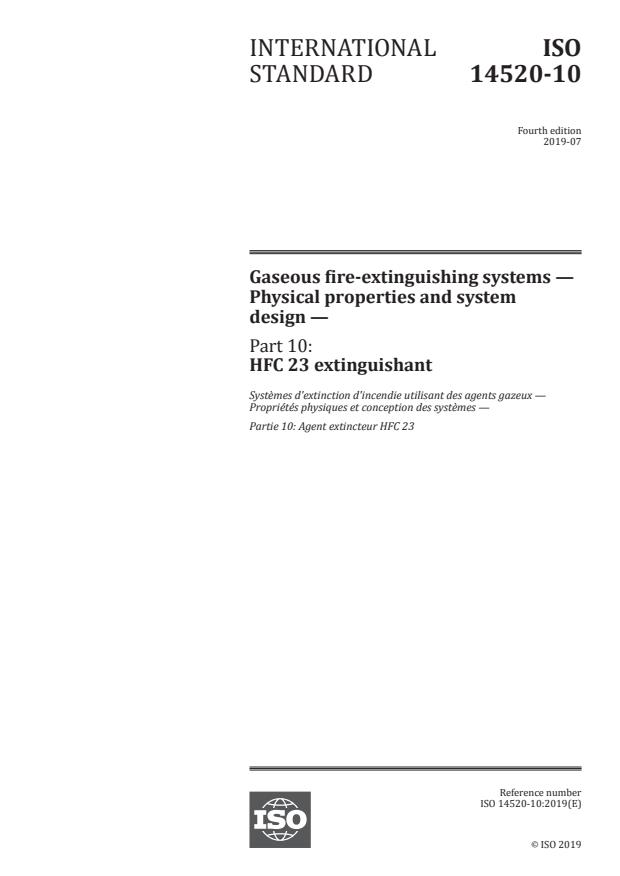
INTERNATIONAL ISO
STANDARD 14520-10
Fourth edition
2019-07
Gaseous fire-extinguishing systems —
Physical properties and system
design —
Part 10:
HFC 23 extinguishant
Systèmes d'extinction d'incendie utilisant des agents gazeux —
Propriétés physiques et conception des systèmes —
Partie 10: Agent extincteur HFC 23
Reference number
©
ISO 2019
© ISO 2019
All rights reserved. Unless otherwise specified, or required in the context of its implementation, no part of this publication may
be reproduced or utilized otherwise in any form or by any means, electronic or mechanical, including photocopying, or posting
on the internet or an intranet, without prior written permission. Permission can be requested from either ISO at the address
below or ISO’s member body in the country of the requester.
ISO copyright office
CP 401 • Ch. de Blandonnet 8
CH-1214 Vernier, Geneva
Phone: +41 22 749 01 11
Fax: +41 22 749 09 47
Email: copyright@iso.org
Website: www.iso.org
Published in Switzerland
ii © ISO 2019 – All rights reserved
Contents Page
Foreword .iv
1 Scope . 1
2 Normative references . 1
3 Terms and definitions . 1
4 Characteristics and uses . 1
4.1 General . 1
4.2 Use of HFC 23 systems. 2
5 Safety of personnel . 5
6 System design . 5
6.1 Fill density. 5
6.2 Superpressurization . 6
6.3 Extinguishant quantity . 6
6.4 Other fill density and superpressurization levels . 8
7 Environmental properties . 8
Bibliography .10
Foreword
ISO (the International Organization for Standardization) is a worldwide federation of national standards
bodies (ISO member bodies). The work of preparing International Standards is normally carried out
through ISO technical committees. Each member body interested in a subject for which a technical
committee has been established has the right to be represented on that committee. International
organizations, governmental and non-governmental, in liaison with ISO, also take part in the work.
ISO collaborates closely with the International Electrotechnical Commission (IEC) on all matters of
electrotechnical standardization.
The procedures used to develop this document and those intended for its further maintenance are
described in the ISO/IEC Directives, Part 1. In particular, the different approval criteria needed for the
different types of ISO documents should be noted. This document was drafted in accordance with the
editorial rules of the ISO/IEC Directives, Part 2 (see www .iso .org/directives).
Attention is drawn to the possibility that some of the elements of this document may be the subject of
patent rights. ISO shall not be held responsible for identifying any or all such patent rights. Details of
any patent rights identified during the development of the document will be in the Introduction and/or
on the ISO list of patent declarations received (see www .iso .org/patents).
Any trade name used in this document is information given for the convenience of users and does not
constitute an endorsement.
For an explanation of the voluntary nature of standards, the meaning of ISO specific terms and
expressions related to conformity assessment, as well as information about ISO's adherence to the
World Trade Organization (WTO) principles in the Technical Barriers to Trade (TBT) see www .iso
.org/iso/foreword .html.
This document was prepared by Technical Committee ISO/TC 21, Equipment for fire protection and fire
fighting, Subcommittee SC 8, Gaseous media and firefighting systems using gas.
This fourth edition cancels and replaces the third edition (ISO 14520-10:2016), which has been
technically revised. The main changes compared to the previous edition are as follows
— a new subclause 6.4 on fill density and superpressurization levels has been added.
A list of all parts in the ISO 14520 series can be found on the ISO website.
Any feedback or questions on this document should be directed to the user’s national standards body. A
complete listing of these bodies can be found at www .iso .org/members .html.
iv © ISO 2019 – All rights reserved
INTERNATIONAL STANDARD ISO 14520-10:2019(E)
Gaseous fire-extinguishing systems — Physical properties
and system design —
Part 10:
HFC 23 extinguishant
1 Scope
This document contains specific requirements for gaseous fire-extinguishing systems, with respect
to the HFC 23 extinguishant. It includes details of physical properties, specifications, usage and
safety aspects. It is applicable to systems operating at a nominal pressure of 41 bar without nitrogen
superpressurization and 70 bar superpressurized with nitrogen.
2 Normative references
The following documents are referred to in the text in such a way that some or all of their content
constitutes requirements of this document. For dated references, only the edition cited applies. For
undated references, the latest edition of the referenced document (including any amendments) applies.
ISO 14520-1:2015, Gaseous fire-extinguishing systems — Physical properties and system design — Part 1:
General requirements
3 Terms and definitions
For the purposes of this document, the terms and definitions given in ISO 14520-1 apply.
ISO and IEC maintain terminological databases for use in standardization at the following addresses:
— IEC Electropedia: available at http: //www .electropedia .org/
— ISO Online browsing platform: available at http: //www .iso .org/obp
4 Characteristics and uses
4.1 General
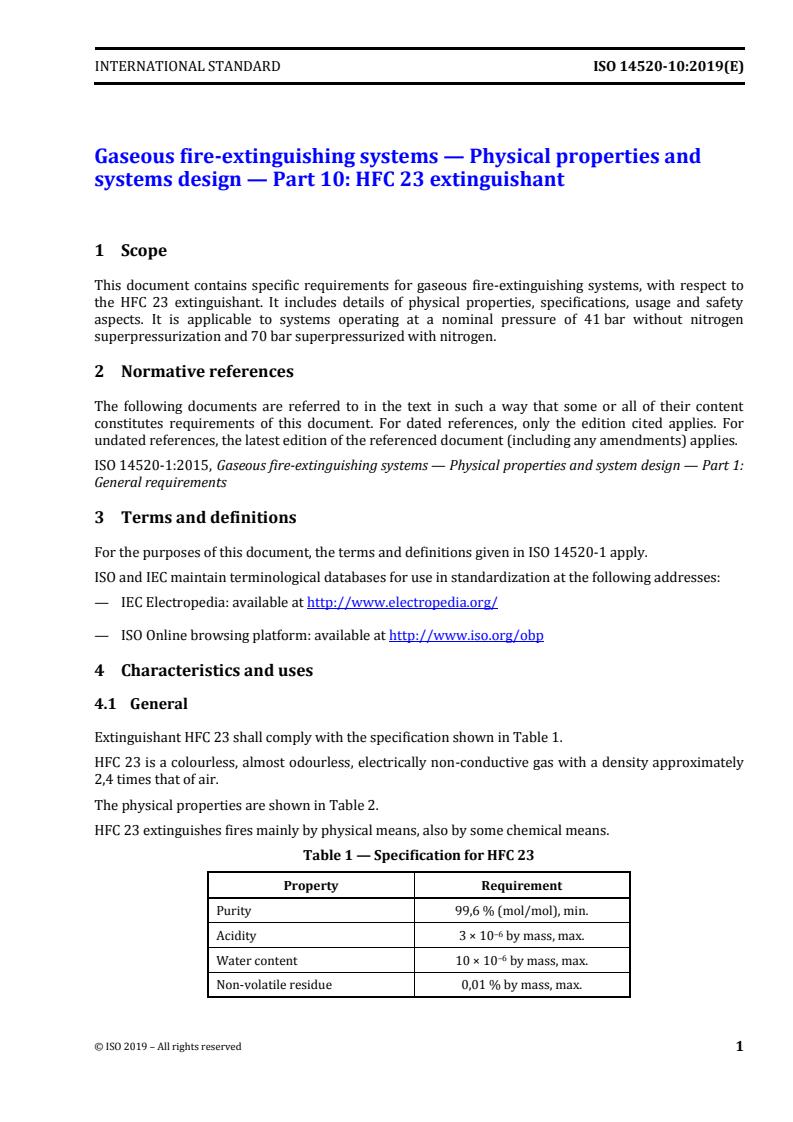
Extinguishant HFC 23 shall comply with the specification shown in Table 1.
HFC 23 is a colourless, almost odourless, electrically non-conductive gas with a density approximately
2,4 times that of air.
The physical properties are shown in Table 2.
HFC 23 extinguishes fires mainly by physical means, also by some chemical means.
Table 1 — Specification for HFC 23
Property Requirement
Purity 99,6 % (mol/mol), min.
–6
Acidity 3 × 10 by mass, max.
Table 1 (continued)
Property Requirement
–6
Water content 10 × 10 by mass, max.
Non-volatile residue 0,01 % by mass, max.
Suspended matter or sediment None visible
Table 2 — Physical properties of HFC 23
Property Units Value
Molecular mass — 70
Boiling point at 1,013 bar (absolute) °C –82,0
Freezing point °C –155,2
Critical temperature °C 25,9
Critical pressure bar abs 48,36
Critical volume cm /mol 133
Critical density kg/m 525
Vapour pressure 20 °C bar abs 41,80
Liquid density 20 °C kg/m 806,6
Saturated vapour density 20 °C kg/m 263,0
Specific volume of superheated m /kg 0,340 9
vapour at 1,013 bar and 20 °C
Chemical formula CHF
Chemical name
Trifluoromethane
4.2 Use of HFC 23 systems
HFC 23 total flooding systems may be used for extinguishing fires of all classes within the limits
specified in ISO 14520-1:2015, Clause 4.
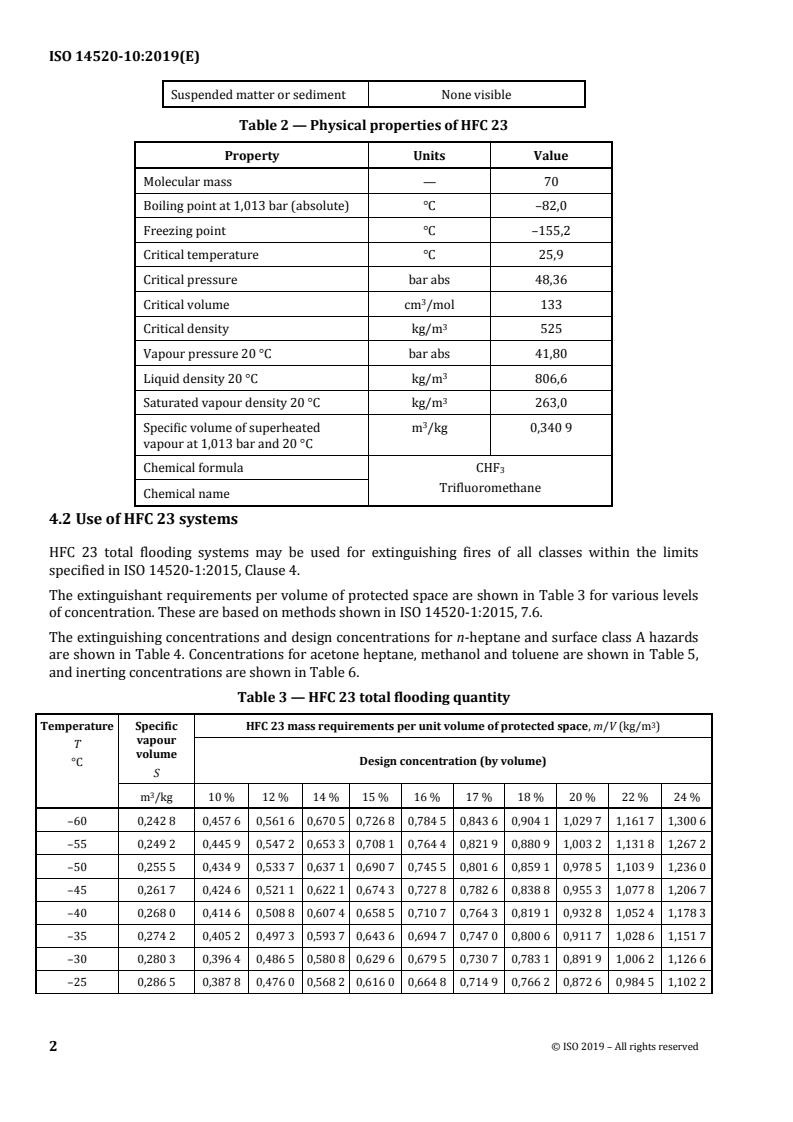
The extinguishant requirements per volume of protected space are shown in Table 3 for various levels
of concentration. These are based on methods shown in ISO 14520-1:2015, 7.6.
The extinguishing concentrations and design concentrations for n-heptane and surface class A hazards
are shown in Table 4. Concentrations for acetone heptane, methanol and toluene are shown in Table 5,
and inerting concentrations are shown in Table 6.
Table 3 — HFC 23 total flooding quantity
Temperature Specific HFC 23 mass requirements per unit volume of protected space, m/V (kg/m )
vapour
T
volume
Design concentration (by volume)
°C
S
m /kg 10 % 12 % 14 % 15 % 16 % 17 % 18 % 20 % 22 % 24 %
–60 0,242 8 0,457 6 0,561 6 0,670 5 0,726 8 0,784 5 0,843 6 0,904 1 1,029 7 1,161 7 1,300 6
–55 0,249 2 0,445 9 0,547 2 0,653 3 0,708 1 0,764 4 0,821 9 0,880 9 1,003 2 1,131 8 1,267 2
–50 0,255 5 0,434 9 0,533 7 0,637 1 0,690 7 0,745 5 0,801 6 0,859 1 0,978 5 1,103 9 1,236 0
–45 0,261 7 0,424 6 0,521 1 0,622 1 0,674 3 0,727 8 0,782 6 0,838 8 0,955 3 1,077 8 1,206 7
–40 0,268 0 0,414 6 0,508 8 0,607 4 0,658 5 0,710 7 0,764 3 0,819 1 0,932 8 1,052 4 1,178 3
–35 0,274 2 0,405 2 0,497 3 0,593 7 0,643 6 0,694 7 0,747 0 0,800 6 0,911 7 1,028 6 1,151 7
–30 0,280 3 0,396 4 0,486 5 0,580 8 0,629 6 0,679 5 0,730 7 0,783 1 0,891 9 1,006 2 1,126 6
–25 0,286 5 0,387 8 0,476 0 0,568 2 0,616 0 0,664 8 0,714 9 0,766 2 0,872 6 0,984 5 1,102 2
2 © ISO 2019 – All rights reserved
Table 3 (continued)
Temperature Specific HFC 23 mass requirements per unit volume of protected space, m/V (kg/m )
vapour
T
volume
Design concentration (by volume)
°C
S
m /kg 10 % 12 % 14 % 15 % 16 % 17 % 18 % 20 % 22 % 24 %
–20 0,292 6 0,379 7 0,466 0 0,556 4 0,603 1 0,651 0 0,700 0 0,750 2 0,854 4 0,963 9 1,079 3
–15 0,298 7 0,372 0 0,456 5 0,545 0 0,590 8 0,637 7 0,685 7 0,734 9 0,837 0 0,944 3 1,057 2
–10 0,304 7 0,364 7 0,447 5 0,534 3 0,579 2 0,625 1 0,672 2 0,720 4 0,820 5 0,925 7 1,036 4
–5 0,310 8 0,357 5 0,438 8 0,523 8 0,567 8 0,612 9 0,659 0 0,706 3 0,804 4 0,907 5 1,016 1
0 0,316 8 0,350 7 0,430 4 0,513 9 0,557 0 0,601 3 0,646 5 0,692 9
...
ISO TC 21/SC 8
Date: 2019-10-0107
ISO/PRF 14520-10:2019(E)
ISO TC 21/SC 8
Secretariat: SA
Gaseous fire-extinguishing systems — Physical properties and systems design —
Part 10: HFC 23 extinguishant
Systèmes d'extinction d'incendie utilisant des agents gazeux -- Propriétés physiques et
conception des systèmes -- Partie 10: Agent extincteur HFC 23
Document type: International Standard
Document subtype:
Document stage: (30) Committee
Document language: E
O:\Documents\TC021\SC008\055346 - ISO_NP 14520-10 (Ed
3)\60.00\320\C055346e_converted.doc STD Version 2.1c
Foreword
ISO (the International Organization for Standardization) is a worldwide federation of national
standards bodies (ISO member bodies). The work of preparing International Standards is normally
carried out through ISO technical committees. Each member body interested in a subject for which a
technical committee has been established has the right to be represented on that committee.
International organizations, governmental and non-governmental, in liaison with ISO, also take part in
the work. ISO collaborates closely with the International Electrotechnical Commission (IEC) on all
matters of electrotechnical standardization.
The procedures used to develop this document and those intended for its further maintenance are
described in the ISO/IEC Directives, Part 1. In particular, the different approval criteria needed for the
different types of ISO documents should be noted. This document was drafted in accordance with the
editorial rules of the ISO/IEC Directives, Part 2 (see www.iso.org/directives).
Attention is drawn to the possibility that some of the elements of this document may be the subject of
patent rights. ISO shall not be held responsible for identifying any or all such patent rights. Details of
any patent rights identified during the development of the document will be in the Introduction and/or
on the ISO list of patent declarations received (see www.iso.org/patents).
Any trade name used in this document is information given for the convenience of users and does not
constitute an endorsement.
For an explanation of the voluntary nature of standards, the meaning of ISO specific terms and
expressions related to conformity assessment, as well as information about ISO's adherence to the
World Trade Organization (WTO) principles in the Technical Barriers to Trade (TBT) see
www.iso.org/iso/foreword.html.
This document was prepared by Technical Committee ISO/TC 21, Equipment for fire protection and fire
fighting, Subcommittee SC 8, Gaseous media and firefighting systems using gas.
This fourth edition cancels and replaces the third edition (ISO 14520-10:2016), which has been
technically revised. The main changes compared to the previous edition are as follows
— a new subclause 6.4 on fill density and superpressurization levels has been added.
A list of all parts in the ISO 14520 series can be found on the ISO website.
Any feedback or questions on this document should be directed to the user’s national standards body. A
complete listing of these bodies can be found at www.iso.org/members.html.
ii © ISO 2019 – All rights reserved
INTERNATIONAL STANDARD ISO 14520-10:2019(E)
Gaseous fire-extinguishing systems — Physical properties and
systems design — Part 10: HFC 23 extinguishant
1 Scope
This document contains specific requirements for gaseous fire-extinguishing systems, with respect to
the HFC 23 extinguishant. It includes details of physical properties, specifications, usage and safety
aspects. It is applicable to systems operating at a nominal pressure of 41 bar without nitrogen
superpressurization and 70 bar superpressurized with nitrogen.
2 Normative references
The following documents are referred to in the text in such a way that some or all of their content
constitutes requirements of this document. For dated references, only the edition cited applies. For
undated references, the latest edition of the referenced document (including any amendments) applies.
ISO 14520-1:2015, Gaseous fire-extinguishing systems — Physical properties and system design — Part 1:
General requirements
3 Terms and definitions
For the purposes of this document, the terms and definitions given in ISO 14520-1 apply.
ISO and IEC maintain terminological databases for use in standardization at the following addresses:
— IEC Electropedia: available at http://www.electropedia.org/
— ISO Online browsing platform: available at http://www.iso.org/obp
4 Characteristics and uses
4.1 General
Extinguishant HFC 23 shall comply with the specification shown in Table 1.
HFC 23 is a colourless, almost odourless, electrically non-conductive gas with a density approximately
2,4 times that of air.
The physical properties are shown in Table 2.
HFC 23 extinguishes fires mainly by physical means, also by some chemical means.
Table 1 — Specification for HFC 23
Property Requirement
Purity 99,6 % (mol/mol), min.
–6
Acidity 3 × 10 by mass, max.
–6
Water content 10 × 10 by mass, max.
Non-volatile residue 0,01 % by mass, max.
Suspended matter or sediment None visible
Table 2 — Physical properties of HFC 23
Property Units Value
Molecular mass — 70
Boiling point at 1,013 bar (absolute) °C –82,0
Freezing point °C –155,2
Critical temperature °C 25,9
Critical pressure bar abs 48,36
Critical volume cm /mol 133
Critical density kg/m 525
Vapour pressure 20 °C bar abs 41,80
Liquid density 20 °C kg/m 806,6
Saturated vapour density 20 °C kg/m 263,0
Specific volume of superheated m /kg 0,340 9
vapour at 1,013 bar and 20 °C
Chemical formula CHF3
Trifluoromethane
Chemical name
4.2 Use of HFC 23 systems
HFC 23 total flooding systems may be used for extinguishing fires of all classes within the limits
specified in ISO 14520-1:2015, Clause 4.
The extinguishant requirements per volume of protected space are shown in Table 3 for various levels
of concentration. These are based on methods shown in ISO 14520-1:2015, 7.6.
The extinguishing concentrations and design concentrations for n-heptane and surface class A hazards
are shown in Table 4. Concentrations for acetone heptane, methanol and toluene are shown in Table 5,
and inerting concentrations are shown in Table 6.
Table 3 — HFC 23 total flooding quantity
Temperature Specific HFC 23 mass requirements per unit volume of protected space, m/V (kg/m )
vapour
T
volume
Design concentration (by volume)
°C
S
m /kg 10 % 12 % 14 % 15 % 16 % 17 % 18 % 20 % 22 % 24 %
–60 0,242 8 0,457 6 0,561 6 0,670 5 0,726 8 0,784 5 0,843 6 0,904 1 1,029 7 1,161 7 1,300 6
–55 0,249 2 0,445 9 0,547 2 0,653 3 0,708 1 0,764 4 0,821 9 0,880 9 1,003 2 1,131 8 1,267 2
–50 0,255 5 0,434 9 0,533 7 0,637 1 0,690 7 0,745 5 0,801 6 0,859 1 0,978 5 1,103 9 1,236 0
–45 0,261 7 0,424 6 0,521 1 0,622 1 0,674 3 0,727 8 0,782 6 0,838 8 0,955 3 1,077 8 1,206 7
–40 0,268 0 0,414 6 0,508 8 0,607 4 0,658 5 0,710 7 0,764 3 0,819 1 0,932 8 1,052 4 1,178 3
–35 0,274 2 0,405 2 0,497 3 0,593 7 0,643 6 0,694 7 0,747 0 0,800 6 0,911 7 1,028 6 1,151 7
–30 0,280 3 0,396 4 0,486 5 0,580 8 0,629 6 0,679 5 0,730 7 0,783 1 0,891 9 1,006 2 1,126 6
–25 0,286 5 0,387 8 0,476 0 0,568 2 0,616 0 0,664 8 0,714 9 0,766 2 0,872 6 0,984 5 1,102 2
2 © ISO 2019 – All rights reserved
ISO/PRF 14520-10:2019(E)
–20 0,292 6 0,379 7 0,466 0 0,556 4 0,603 1 0,651 0 0,700 0 0,750 2 0,854 4 0,963 9 1,079 3
–15 0,298 7 0,372 0 0,456 5 0,545 0 0,590 8 0,637 7 0,685 7 0,734 9 0,837 0 0,944 3 1,057 2
–10 0,304 7 0,364 7 0,447 5 0,534 3 0,579 2 0,625 1 0,672 2 0,720 4 0,820 5 0,925 7 1,036 4
–5 0,310 8 0,357 5 0,438 8 0,523 8 0,567 8 0,612 9 0,659 0 0,706 3 0,804 4 0,907 5 1,016 1
0 0,316 8 0,350 7 0,430 4 0,513 9 0,557 0 0,601 3 0,646 5 0,692 9 0,789 1 0,890 3 0,996 8
5 0,322 9 0,344 1 0,422 3 0,504 2 0,546 5 0,589 9 0,634 3 0,679 8 0,774 2 0,873 5 0,978 0
10 0,328 9 0,337 8 0,414 6 0,495 0 0,536 5 0,579 1 0,622 7 0,667 4 0,760 1 0,857 6 0,960 1
15 0,334 9 0,331 8 0,407 2 0,486 1 0,526 9 0,568 8 0,611 6 0,655 5 0,746 5 0,842 2 0,942 9
20 0,340 9 0,325 9 0,400 0 0,477 5 0,517 7 0,558 7 0,600 8 0,643 9 0,733 4 0,827 4 0,926 3
25 0,346 8 0,320 4 0,393 2 0,469 4 0,508 9 0,549 2 0,590 6 0,633 0 0,720 9 0,813 3 0,910 6
30 0,352 8 0,314 9 0,386 5 0,461 4 0,500 2 0,539 9 0,580 6 0,622 2 0,708 6 0,799 5 0,895 1
35 0,358 8 0,309 7 0,380 1 0,453 7 0,491 8 0,530 9 0,570 8 0,611 8 0,696 8 0,786 1 0,880 1
40 0,364 7 0,304 7 0,373 9 0,446 4 0,483 9 0,522 3 0,561 6 0,601 9 0,685 5 0,773 4 0,865 9
45 0,370 7 0,299 7 0,367 9 0,439 1 0,476 0 0,513 8 0,552 5 0,592 2 0,674 4 0,760 9 0,851 9
50 0,376 6 0,295 0 0,362 1 0,432 3 0,468 6 0,505 8 0,543 9 0,582 9 0,663 8 0,748 9 0,838 5
55 0,382 6 0,290 4 0,356 4 0,425 5 0,461 2 0,497 8 0,535 3 0,573 7 0,653 4 0,737 2 0,825 4
60 0,388 5 0,286 0 0,351 0 0,419 0 0,454 2 0,490 3 0,527 2 0,565 0 0,643 5 0,726 0 0,812 8
65 0,394 4 0,281 7 0,345 7 0,412 8 0,447 4 0,483 0 0,519 3 0,556 6 0,633 9 0,715 1 0,800 7
70 0,400 4 0,277 5 0,340 6 0,406 6 0,440 7 0,475 7 0,511 5 0,548 2 0,624 4 0,704 4 0,788 7
NOTE This information refers only to HFC-23 and does not represent any other products containing trifluoromethane as a
component.
Symbols:
m/V is the agent mass requirements (kg/m ), i.e. mass, m, in kilograms of agent required per cubic metre of protected volume, V, to
produce the indicated concentration at the temperature specified;
V is the net volume of hazard (m ), i.e. the enclosed volume minus the fixed structures impervious to extinguishant
cV
m=
100−cS
T is the temperature (°C), i.e. the design temperature in the hazard area;
S is the specific volume (m /kg), the specific volume of superhe
...
INTERNATIONAL ISO
STANDARD 14520-10
Fourth edition
2019-07
Gaseous fire-extinguishing systems —
Physical properties and system
design —
Part 10:
HFC 23 extinguishant
Systèmes d'extinction d'incendie utilisant des agents gazeux —
Propriétés physiques et conception des systèmes —
Partie 10: Agent extincteur HFC 23
Reference number
©
ISO 2019
© ISO 2019
All rights reserved. Unless otherwise specified, or required in the context of its implementation, no part of this publication may
be reproduced or utilized otherwise in any form or by any means, electronic or mechanical, including photocopying, or posting
on the internet or an intranet, without prior written permission. Permission can be requested from either ISO at the address
below or ISO’s member body in the country of the requester.
ISO copyright office
CP 401 • Ch. de Blandonnet 8
CH-1214 Vernier, Geneva
Phone: +41 22 749 01 11
Fax: +41 22 749 09 47
Email: copyright@iso.org
Website: www.iso.org
Published in Switzerland
ii © ISO 2019 – All rights reserved
Contents Page
Foreword .iv
1 Scope . 1
2 Normative references . 1
3 Terms and definitions . 1
4 Characteristics and uses . 1
4.1 General . 1
4.2 Use of HFC 23 systems. 2
5 Safety of personnel . 5
6 System design . 5
6.1 Fill density. 5
6.2 Superpressurization . 6
6.3 Extinguishant quantity . 6
6.4 Other fill density and superpressurization levels . 8
7 Environmental properties . 8
Bibliography .10
Foreword
ISO (the International Organization for Standardization) is a worldwide federation of national standards
bodies (ISO member bodies). The work of preparing International Standards is normally carried out
through ISO technical committees. Each member body interested in a subject for which a technical
committee has been established has the right to be represented on that committee. International
organizations, governmental and non-governmental, in liaison with ISO, also take part in the work.
ISO collaborates closely with the International Electrotechnical Commission (IEC) on all matters of
electrotechnical standardization.
The procedures used to develop this document and those intended for its further maintenance are
described in the ISO/IEC Directives, Part 1. In particular, the different approval criteria needed for the
different types of ISO documents should be noted. This document was drafted in accordance with the
editorial rules of the ISO/IEC Directives, Part 2 (see www .iso .org/directives).
Attention is drawn to the possibility that some of the elements of this document may be the subject of
patent rights. ISO shall not be held responsible for identifying any or all such patent rights. Details of
any patent rights identified during the development of the document will be in the Introduction and/or
on the ISO list of patent declarations received (see www .iso .org/patents).
Any trade name used in this document is information given for the convenience of users and does not
constitute an endorsement.
For an explanation of the voluntary nature of standards, the meaning of ISO specific terms and
expressions related to conformity assessment, as well as information about ISO's adherence to the
World Trade Organization (WTO) principles in the Technical Barriers to Trade (TBT) see www .iso
.org/iso/foreword .html.
This document was prepared by Technical Committee ISO/TC 21, Equipment for fire protection and fire
fighting, Subcommittee SC 8, Gaseous media and firefighting systems using gas.
This fourth edition cancels and replaces the third edition (ISO 14520-10:2016), which has been
technically revised. The main changes compared to the previous edition are as follows
— a new subclause 6.4 on fill density and superpressurization levels has been added.
A list of all parts in the ISO 14520 series can be found on the ISO website.
Any feedback or questions on this document should be directed to the user’s national standards body. A
complete listing of these bodies can be found at www .iso .org/members .html.
iv © ISO 2019 – All rights reserved
INTERNATIONAL STANDARD ISO 14520-10:2019(E)
Gaseous fire-extinguishing systems — Physical properties
and system design —
Part 10:
HFC 23 extinguishant
1 Scope
This document contains specific requirements for gaseous fire-extinguishing systems, with respect
to the HFC 23 extinguishant. It includes details of physical properties, specifications, usage and
safety aspects. It is applicable to systems operating at a nominal pressure of 41 bar without nitrogen
superpressurization and 70 bar superpressurized with nitrogen.
2 Normative references
The following documents are referred to in the text in such a way that some or all of their content
constitutes requirements of this document. For dated references, only the edition cited applies. For
undated references, the latest edition of the referenced document (including any amendments) applies.
ISO 14520-1:2015, Gaseous fire-extinguishing systems — Physical properties and system design — Part 1:
General requirements
3 Terms and definitions
For the purposes of this document, the terms and definitions given in ISO 14520-1 apply.
ISO and IEC maintain terminological databases for use in standardization at the following addresses:
— IEC Electropedia: available at http: //www .electropedia .org/
— ISO Online browsing platform: available at http: //www .iso .org/obp
4 Characteristics and uses
4.1 General
Extinguishant HFC 23 shall comply with the specification shown in Table 1.
HFC 23 is a colourless, almost odourless, electrically non-conductive gas with a density approximately
2,4 times that of air.
The physical properties are shown in Table 2.
HFC 23 extinguishes fires mainly by physical means, also by some chemical means.
Table 1 — Specification for HFC 23
Property Requirement
Purity 99,6 % (mol/mol), min.
–6
Acidity 3 × 10 by mass, max.
Table 1 (continued)
Property Requirement
–6
Water content 10 × 10 by mass, max.
Non-volatile residue 0,01 % by mass, max.
Suspended matter or sediment None visible
Table 2 — Physical properties of HFC 23
Property Units Value
Molecular mass — 70
Boiling point at 1,013 bar (absolute) °C –82,0
Freezing point °C –155,2
Critical temperature °C 25,9
Critical pressure bar abs 48,36
Critical volume cm /mol 133
Critical density kg/m 525
Vapour pressure 20 °C bar abs 41,80
Liquid density 20 °C kg/m 806,6
Saturated vapour density 20 °C kg/m 263,0
Specific volume of superheated m /kg 0,340 9
vapour at 1,013 bar and 20 °C
Chemical formula CHF
Chemical name
Trifluoromethane
4.2 Use of HFC 23 systems
HFC 23 total flooding systems may be used for extinguishing fires of all classes within the limits
specified in ISO 14520-1:2015, Clause 4.
The extinguishant requirements per volume of protected space are shown in Table 3 for various levels
of concentration. These are based on methods shown in ISO 14520-1:2015, 7.6.
The extinguishing concentrations and design concentrations for n-heptane and surface class A hazards
are shown in Table 4. Concentrations for acetone heptane, methanol and toluene are shown in Table 5,
and inerting concentrations are shown in Table 6.
Table 3 — HFC 23 total flooding quantity
Temperature Specific HFC 23 mass requirements per unit volume of protected space, m/V (kg/m )
vapour
T
volume
Design concentration (by volume)
°C
S
m /kg 10 % 12 % 14 % 15 % 16 % 17 % 18 % 20 % 22 % 24 %
–60 0,242 8 0,457 6 0,561 6 0,670 5 0,726 8 0,784 5 0,843 6 0,904 1 1,029 7 1,161 7 1,300 6
–55 0,249 2 0,445 9 0,547 2 0,653 3 0,708 1 0,764 4 0,821 9 0,880 9 1,003 2 1,131 8 1,267 2
–50 0,255 5 0,434 9 0,533 7 0,637 1 0,690 7 0,745 5 0,801 6 0,859 1 0,978 5 1,103 9 1,236 0
–45 0,261 7 0,424 6 0,521 1 0,622 1 0,674 3 0,727 8 0,782 6 0,838 8 0,955 3 1,077 8 1,206 7
–40 0,268 0 0,414 6 0,508 8 0,607 4 0,658 5 0,710 7 0,764 3 0,819 1 0,932 8 1,052 4 1,178 3
–35 0,274 2 0,405 2 0,497 3 0,593 7 0,643 6 0,694 7 0,747 0 0,800 6 0,911 7 1,028 6 1,151 7
–30 0,280 3 0,396 4 0,486 5 0,580 8 0,629 6 0,679 5 0,730 7 0,783 1 0,891 9 1,006 2 1,126 6
–25 0,286 5 0,387 8 0,476 0 0,568 2 0,616 0 0,664 8 0,714 9 0,766 2 0,872 6 0,984 5 1,102 2
2 © ISO 2019 – All rights reserved
Table 3 (continued)
Temperature Specific HFC 23 mass requirements per unit volume of protected space, m/V (kg/m )
vapour
T
volume
Design concentration (by volume)
°C
S
m /kg 10 % 12 % 14 % 15 % 16 % 17 % 18 % 20 % 22 % 24 %
–20 0,292 6 0,379 7 0,466 0 0,556 4 0,603 1 0,651 0 0,700 0 0,750 2 0,854 4 0,963 9 1,079 3
–15 0,298 7 0,372 0 0,456 5 0,545 0 0,590 8 0,637 7 0,685 7 0,734 9 0,837 0 0,944 3 1,057 2
–10 0,304 7 0,364 7 0,447 5 0,534 3 0,579 2 0,625 1 0,672 2 0,720 4 0,820 5 0,925 7 1,036 4
–5 0,310 8 0,357 5 0,438 8 0,523 8 0,567 8 0,612 9 0,659 0 0,706 3 0,804 4 0,907 5 1,016 1
0 0,316 8 0,350 7 0,430 4 0,513 9 0,557 0 0,601 3 0,646 5 0,692 9
...