

ISO/TS 24082:2021
(Main)Service excellence — Designing excellent service to achieve outstanding customer experiences
General Information
- Abstract
This document specifies principles and activities for designing excellent service that achieve outstanding customer experience. It applies to all organizations delivering services, such as commercial organizations, public services and not-for-profit organizations.
- Status
- Published
- Publication Date
- 09-Jun-2021
- Technical Committee
- ISO/TC 312 - Excellence in service
- Drafting Committee
- ISO/TC 312/WG 2 - Design of excellent services
- Current Stage
- 9092 - International Standard to be revised
- Start Date
- 13-Mar-2025
- Completion Date
- 29-Aug-2026
Buy Documents

ISO/TS 24082:2021 - Service excellence — Designing excellent service to achieve outstanding customer experiences Released:6/10/2021

ISO/TS 24082:2021 - Service excellence — Designing excellent service to achieve outstanding customer experiences/10/2021
Overview
ISO/TS 24082:2021 - "Service excellence - Designing excellent service to achieve outstanding customer experiences" specifies principles and activities for designing services that produce outstanding customer experience and customer delight. Applicable to all organizations that deliver services (commercial, public sector and not‑for‑profit), the technical specification links service design practices with measurable outcomes and a co‑creative approach to value creation.
Key topics and requirements
- Scope and terminology: Defines key terms such as excellent service, customer delight, design for excellent service (DfES), co‑creation, touchpoint and data point.
- Principles of design for excellent service: Emphasizes design that is emotional, adaptive, co‑creative with customers, and consistent with organizational and customer perspectives.
- Design activities: Sets out a structured design process including:
- Planning a design project for excellent service.
- Understanding and empathizing with customer needs, expectations and desires.
- Defining a design challenge and a unique value proposition.
- Designing customer experience using touchpoints and data points (documenting experiences to be delivered; deploying emotional touchpoints; developing effective data points).
- Designing a co‑creation environment to encourage customer participation and customer‑centric service delivery.
- Evaluating designs from the customer, capability and sustainability perspectives.
- Guidance material: Informative annexes provide service design thinking principles, the Kano model for prioritizing customer delight, customer journey mapping, and examples of co‑creation practices and leverage mechanisms.
Practical applications and users
ISO/TS 24082:2021 is practical for:
- Service designers, UX/CX teams and product managers designing or improving service offerings.
- Quality, operations and service excellence leaders seeking to embed customer delight into delivery processes.
- Public sector and not‑for‑profit program managers who want structured methods to design citizen‑centred services.
- Consultants and trainers implementing co‑creation workshops, customer journey mapping, touchpoint design, and measurement systems.
Typical uses:
- Creating or refining a unique value proposition and emotionally resonant services.
- Mapping customer journeys, identifying touchpoints and data points to monitor experience.
- Designing co‑creation environments that engage stakeholders and customers.
- Evaluating service designs against customer delight, organizational capability and sustainability goals.
Related standards
- ISO 23592:2021 - Service excellence (principles and model)
- ISO 9241‑210 / ISO 9241‑220 - Human‑centred design guidance
- ISO 9001, ISO 10002, ISO/IEC 20000‑1 - Quality, complaint handling and service management foundations
- ISO Guide 64 - Example of “design for X” methodology (design for environment)
Keywords: ISO/TS 24082:2021, service excellence, designing excellent service, customer experience, customer delight, service design, co‑creation, touchpoints, customer journey, unique value proposition.
Buy Documents
ISO/TS 24082:2021 - Service excellence — Designing excellent service to achieve outstanding customer experiences Released:6/10/2021
ISO/TS 24082:2021 - Service excellence — Designing excellent service to achieve outstanding customer experiences/10/2021
Get Certified
Connect with accredited certification bodies for this standard

Great Wall Tianjin Quality Assurance Center
Established 1993, first batch to receive national accreditation with IAF recognition.
Hong Kong Quality Assurance Agency (HKQAA)
Hong Kong's leading certification body.

Innovative Quality Certifications Pvt. Ltd. (IQCPL)
Known for integrity, providing ethical & impartial Assessment & Certification. CMMI Institute Partner.
Sponsored listings
Frequently Asked Questions
ISO/TS 24082:2021 is a technical specification published by the International Organization for Standardization (ISO). Its full title is "Service excellence — Designing excellent service to achieve outstanding customer experiences". This standard covers: This document specifies principles and activities for designing excellent service that achieve outstanding customer experience. It applies to all organizations delivering services, such as commercial organizations, public services and not-for-profit organizations.
This document specifies principles and activities for designing excellent service that achieve outstanding customer experience. It applies to all organizations delivering services, such as commercial organizations, public services and not-for-profit organizations.
ISO/TS 24082:2021 is classified under the following ICS (International Classification for Standards) categories: 03.080.01 - Services in general. The ICS classification helps identify the subject area and facilitates finding related standards.
ISO/TS 24082:2021 is available in PDF format for immediate download after purchase. The document can be added to your cart and obtained through the secure checkout process. Digital delivery ensures instant access to the complete standard document.
Standards Content (Sample)
TECHNICAL ISO/TS
SPECIFICATION 24082
First edition
2021-06
Service excellence — Designing
excellent service to achieve
outstanding customer experiences
Excellence de service — Concevoir un service d'excellence pour des
expériences clients exceptionnelles
Reference number
©
ISO 2021
© ISO 2021
All rights reserved. Unless otherwise specified, or required in the context of its implementation, no part of this publication may
be reproduced or utilized otherwise in any form or by any means, electronic or mechanical, including photocopying, or posting
on the internet or an intranet, without prior written permission. Permission can be requested from either ISO at the address
below or ISO’s member body in the country of the requester.
ISO copyright office
CP 401 • Ch. de Blandonnet 8
CH-1214 Vernier, Geneva
Phone: +41 22 749 01 11
Email: copyright@iso.org
Website: www.iso.org
Published in Switzerland
ii © ISO 2021 – All rights reserved
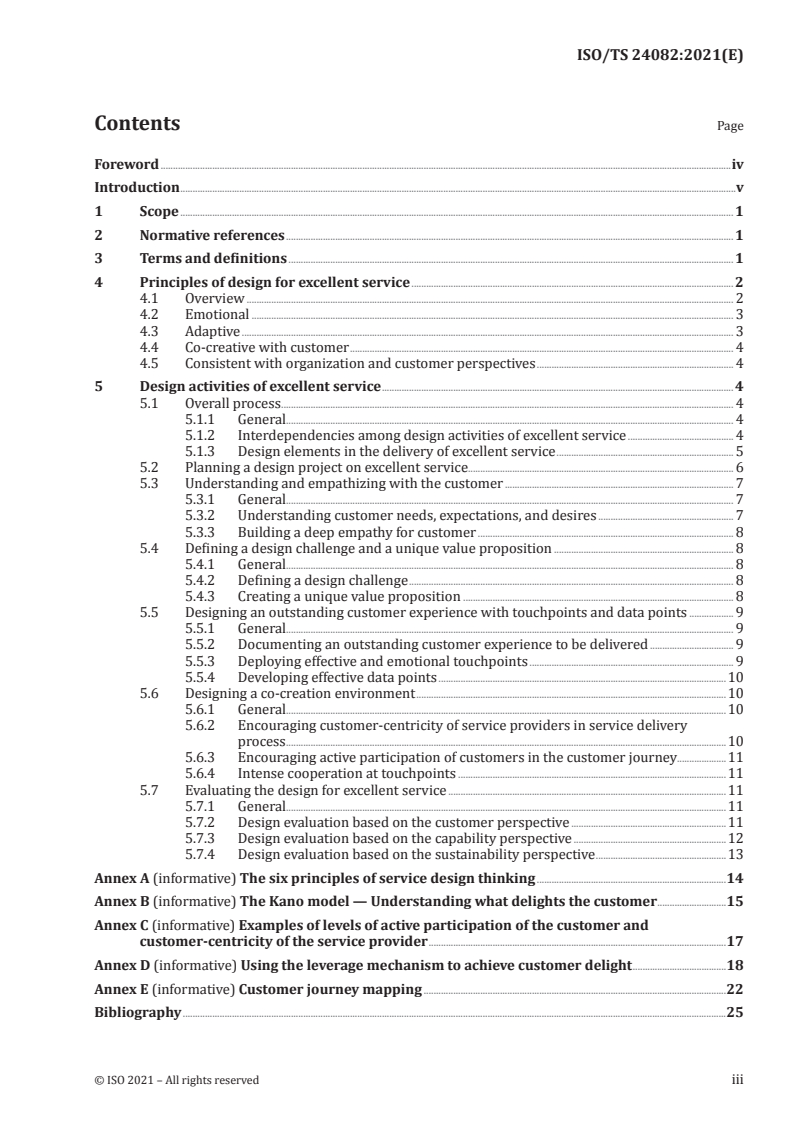
Contents Page
Foreword .iv
Introduction .v
1 Scope . 1
2 Normative references . 1
3 Terms and definitions . 1
4 Principles of design for excellent service . 2
4.1 Overview . 2
4.2 Emotional . 3
4.3 Adaptive . 3
4.4 Co-creative with customer . 4
4.5 Consistent with organization and customer perspectives . 4
5 Design activities of excellent service . 4
5.1 Overall process . 4
5.1.1 General. 4
5.1.2 Interdependencies among design activities of excellent service . 4
5.1.3 Design elements in the delivery of excellent service . 5
5.2 Planning a design pr oject on excellent service. 6
5.3 Understanding and empathizing with the customer . 7
5.3.1 General. 7
5.3.2 Understanding customer needs, expectations, and desires . 7
5.3.3 Building a deep empathy for customer . 8
5.4 Defining a design challenge and a unique value proposition . 8
5.4.1 General. 8
5.4.2 Defining a design challenge . 8
5.4.3 Creating a unique value proposition . 8
5.5 Designing an outstanding customer experience with touchpoints and data points . 9
5.5.1 General. 9
5.5.2 Documenting an outstanding customer experience to be delivered . 9
5.5.3 Deploying effective and emotional touchpoints . 9
5.5.4 Developing effective data points .10
5.6 Designing a co-creation environment .10
5.6.1 General.10
5.6.2 Encouraging customer-centricity of service providers in service delivery
process .10
5.6.3 Encouraging active participation of customers in the customer journey.11
5.6.4 Intense cooperation at touchpoints .11
5.7 Evaluating the design for excellent service .11
5.7.1 General.11
5.7.2 Design evaluation based on the customer perspective .11
5.7.3 Design evaluation based on the capability perspective .12
5.7.4 Design evaluation based on the sustainability perspective .13
Annex A (informative) The six principles of service design thinking .14
Annex B (informative) The Kano model — Understanding what delights the customer .15
Annex C (informative) Examples of levels of active participation of the customer and
customer-centricity of the service provider .17
Annex D (informative) Using the leverage mechanism to achieve customer delight .18
Annex E (informative) Customer journey mapping .22
Bibliography .25
Foreword
ISO (the International Organization for Standardization) is a worldwide federation of national standards
bodies (ISO member bodies). The work of preparing International Standards is normally carried out
through ISO technical committees. Each member body interested in a subject for which a technical
committee has been established has the right to be represented on that committee. International
organizations, governmental and non-governmental, in liaison with ISO, also take part in the work.
ISO collaborates closely with the International Electrotechnical Commission (IEC) on all matters of
electrotechnical standardization.
The procedures used to develop this document and those intended for its further maintenance are
described in the ISO/IEC Directives, Part 1. In particular, the different approval criteria needed for the
different types of ISO documents should be noted. This document was drafted in accordance with the
editorial rules of the ISO/IEC Directives, Part 2 (see www .iso .org/ directives).
Attention is drawn to the possibility that some of the elements of this document may be the subject of
patent rights. ISO shall not be held responsible for identifying any or all such patent rights. Details of
any patent rights identified during the development of the document will be in the Introduction and/or
on the ISO list of patent declarations received (see www .iso .org/ patents).
Any trade name used in this document is information given for the convenience of users and does not
constitute an endorsement.
For an explanation of the voluntary nature of standards, the meaning of ISO specific terms and
expressions related to conformity assessment, as well as information about ISO's adherence to the
World Trade Organization (WTO) principles in the Technical Barriers to Trade (TBT), see www .iso .org/
iso/ foreword .html.
This document was prepared by Technical Committee ISO/TC 312, Excellence in service.
Any feedback or questions on this document should be directed to the user’s national standards body. A
complete listing of these bodies can be found at www .iso .org/ members .html.
iv © ISO 2021 – All rights reserved
Introduction
Customer expectations in today’s competitive world have changed and are constantly evolving and
growing. In order to maintain and increase their customer base, organizations must create better
and more differentiated customer experiences. For this reason, it is essential for organizations to
understand customer expectations, needs, wishes, problems and experiences. These are used as inputs
for service design.
Excellent service is key to achieving outstanding customer experience, which leads to customer delight.
Building a better and continuous relationship with customers through excellent service differentiates
the organization from its competitors.
ISO 23592 defines service excellence as an organization’s capability that enables “individual excellent
service provision” (Level 3) and “surprisingly excellent service provision” (Level 4) in the service
excellence pyramid shown in Figure 1. Compared to “service excellence” as an organization’s capability,
this document describes “excellent service” as an offering with individual and surprisingly excellent
service performed between the organization and the customer. This facilitates the creation of
outstanding customer experiences by the organization to achieve customer delight. The delivery of
excellent service requires a foundation comprising a “core service proposition” (Level 1) and “customer
feedback management” (Level 2) to ensure customer satisfaction, as shown in Figure 1. These are
described in International Standards such as ISO 9001, ISO 10002 and ISO/IEC 20000-1.
Figure 1 — Interlinkage within the service excellence pyramid and design of excellent service
The organization should understand its role, importance and difference between customer delight and
customer satisfaction, in order to enhance its ability to provide that delight. It should also explore ways
of developing and maintaining customer delight.
A specific design standard to achieve excellent service is necessary for better business success. The
following design standards and methods have been adopted in many organizations but these do not
adequately cover how to create excellent service that leads to customer delight:
― human-centred design (HCD) described in ISO 9241-210 and ISO 9241-220;
[15]
― Design Thinking, promoted by IDEO and the Stanford d.school ;
[16]
― This is Service Design Thinking , which builds on the work of the above two design approaches.
The service provider makes value propositions intended to create valuable outcomes for the customer.
Value can be also co-created through customer experience and feedback, and the benefits are realized
by both the service provider and the customer. The increased use of the internet, sensory and digital
technologies encourages co-creation.
This document highlights designing excellent service with a co-creation mechanism for continuous
customer delight. As shown in Table 1, the clauses in this document specify the elements belonging
to the dimension “Creating outstanding customer experiences” of the service excellence model in
ISO 23592.
Table 1 — The relationship between the service excellence model (columns) and this document
(rows)
Creating outstanding customer experiences
Designing
Understanding
and renewing Service innova-
customer needs,
outstanding tion manage-
expectations and
customer expe- ment
desires
riences
Clause 4 Principles of design for excellent service
4.2 Emotional
4.3 Adaptive
4.4 Co-creative with customer
4.5 Consistent with organization and customer
perspectives
Clause 5 Design activities of excellent service
5.2 Planning a design project on excellent service
5.3 Understanding and empathizing with the
customer
5.4 Defining a design challenge and a unique value
proposition
5.5 Designing an outstanding customer experience
with touchpoints and data points
5.6 Designing a co-creation environment
5.7 Evaluating the design for excellent service
vi © ISO 2021 – All rights reserved
TECHNICAL SPECIFICATION ISO/TS 24082:2021(E)
Service excellence — Designing excellent service to achieve
outstanding customer experiences
1 Scope
This document specifies principles and activities for designing excellent service that achieve
outstanding customer experience. It applies to all organizations delivering services, such as commercial
organizations, public services and not-for-profit organizations.
2 Normative references
The following documents are referred to in the text in such a way that some or all of their content
constitutes requirements of this document. For dated references, only the edition cited applies. For
undated references, the latest edition of the referenced document (including any amendments) applies.
ISO 23592:2021, Service excellence — Principles and model
3 Terms and definitions
For the purposes of this document, the terms and definitions given in ISO 23592 and the following apply.
ISO and IEC maintain terminological databases for use in standardization at the following addresses:
— ISO Online browsing platform: available at https:// www .iso .org/ obp
— IEC Electropedia: available at http:// www .electropedia .org/
3.1
excellent service
output of an organization with high level of service provision performed between the organization and
the customer to achieve outstanding customer experiences that lead to customer delight (3.2)
Note 1 to entry: Examples of high level of service provision are individual excellent service provision (Level 3)
and surprisingly excellent service provision (Level 4) in the service excellence pyramid.
[SOURCE: ISO 23592:2021, 3.2]
3.2
customer delight
positive emotions experienced by the customer derived from either an intense feeling of being highly
valued or by expectations being exceeded, or both
Note 1 to entry: Further emotions like surprise can intensify felt customer delight.
[SOURCE: ISO 23592:2021, 3.5]
3.3
design for excellent service
DfES
systematic design and development approach to creating outstanding customer experiences via
individual and surprisingly excellent service (3.1) provision
Note 1 to entry: The underlying methodology behind such a design approach is known as “design for X” or “DfX”
methodology, see for example ISO Guide 64 for “design for environment” (DfE).
3.4
co-creation
active involvement of stakeholders in service design, delivery and innovation
Note 1 to entry: Stakeholders include organizations, personnel and customers.
[SOURCE: ISO 23592:2021, 3.3, modified — Note 1 to entry has been added.]
3.5
co-creation environment
surroundings that facilitate co-creation (3.4)
3.6
unique value proposition
clear statement of the benefits the organization offers, how it solves customer problems (relevance),
how it elicits a better emotional experience and what distinguishes it from its competitors
3.7
customer journey
series or sum of customer experiences when engaging with an organization, its products or services
Note 1 to entry: “Series” is based on processes; “sum” is based on results.
[SOURCE: ISO 23592:2021, 3.8]
3.8
touchpoint
point of customer contact or a medium through which a customer interacts with an organization, its
products or services
3.9
data point
occasion when and where the service provider (3.10) observes and collects information about the
customer or receives customer experience feedback
Note 1 to entry: Examples of the content of data points include information captured about behaviours and
responses of customers and information about delivery processes.
3.10
service provider
organization that manages and delivers a service or services to customers
Note 1 to entry: Organizations include sub-contractors and personnel, such as employees.
[SOURCE: ISO/IEC 20000-1:2018, 3.2.24, modified — Note 1 to entry has been added.]
3.11
customer-centricity
customer orientation with a special focus on value creation and value acquisition
4 Principles of design for excellent service
4.1 Overview
The service excellence effect chain in the upper part of Figure 2 shows how service excellence leads
to higher benefits for the organization by achieving customer delight. The following elements in the
service excellence effect chain play an important role in designing excellent service:
― implementation of service excellence, which supports design process and feasibility of excellent
services;
2 © ISO 2021 – All rights reserved
― excellent service, which is designed by organizations;
― outstanding customer experience and customer delight, which are targeted and incorporated into
design goals.
Figure 2 — Service excellence effect chain and designing excellent service
This document uses the term “design for excellent service (DfES)”. As shown in Figure 1, DfES addresses
the upper half of the service excellence pyramid. General service design for basic service is not specified
in this approach or in this document.
The principles of DfES described in this clause are:
a) emotional;
b) adaptive;
c) co-creative with the customer;
d) consistent with organization and customer perspectives.
[17]
NOTE See Annex A on the general principles of service design thinking , which differ from those of DfES in
this clause. Designing excellent service as a whole can adapt these general principles and their relevant tools to
ensure basic service.
4.2 Emotional
Excellent services should be designed to bring positive emotions to customers. Customer delight can
be achieved with such positive emotions so that customers feel that the service is being customized
to suit their individual situations, that they are highly valued or both. Surprise can be an emotion that
intensifies the delight felt by the customer. The organization should understand the importance and
role of customer delight in contrast to customer satisfaction in the delivery of excellent services and
seek ways to enhance further customer delight.
4.3 Adaptive
Excellent services should be designed to enable organizations to adapt and respond promptly to various
changes in customers, their circumstances and environment. This should be done both in the service
delivery process and through continual improvement.
NOTE Environment includes external factors such as regulatory, economic, political, social and globally
impacting changes affecting the organization.
4.4 Co-creative with customer
Excellent services should involve customers in the service design process, delivery process or both,
thus co-creating value. The organization should understand, facilitate and be prepared for the co-
creation process. The organization makes value propositions intended to create valuable outcomes for
the customer. Value can also be co-created through customer experience and feedback, and the benefits
are realized by both the organization and the customer. Co-created value can increase the likelihood of
creating customer delight and customer loyalty.
4.5 Consistent with organization and customer perspectives
Excellent services should be designed by utilizing the organization’s capability and by meeting the
customer’s perspective. To ensure excellent service, the organization should use the service excellence
pyramid (Figure 1) to define its current level. Then the organization should enhance its capabilities so
as to enhance the service so the customer can achieve a feeling of customer delight.
5 Design activities of excellent service
5.1 Overall process
5.1.1 General
This clause describes the key activities for DfES where organizations develop a new service, review an
existing service or both, with the aim of improving the services. Once the decision has been made to
create excellent service for customer delight, organizations should plan the service design project.
After the planning activity, organizations should execute the following DfES activities:
― understanding and empathizing with the customer;
― defining a design challenge and a unique value proposition;
― designing outstanding customer experience with touchpoints and data points;
― designing a co-creation environment to enhance outstanding customer experience;
― evaluate the design for excellent service.
Organizations should incorporate these DfES activities in the organization’s design approach(es) to
ensure and reinforce basic service. The activities can be repeated in cyclical fashion as needed, until the
desired outcomes are achieved.
[15]
NOTE Examples of design approaches are design thinking and human-centred design (e.g. ISO 9241-210
and ISO 9241-220). They represent collaborative and iterative processes. Among these, the five activities
(empathize, define, ideate, prototype, test) are well known.
5.1.2 Interdependencies among design activities of excellent service
Figure 3 illustrates the process of designing excellent service when all DfES activities are undertaken,
starting with the analysis of customer. The inner diagram illustrates interdependencies among DfES
activities, which show where necessary information is output and input. For example, 5.4 requires
information about targeted customer profile and customer insights, which is output by 5.3. A project
plan according to 5.2 is shared and refers to any activity in 5.3 to 5.7. These activities are also iterated
where appropriate, especially following on from the results of evaluation activity. Excellent services are
prepared as a result of these design activities. Delivering and managing the excellent service produces
field data that triggers a new evaluation activity. Field data includes operational data of the services
and how much the services achieve outstanding customer experience and customer delight, which are
depicted in the service excellence effect chain.
4 © ISO 2021 – All rights reserved
Key
interdependency (input-output)
iteration
NOTE 5.2 to 5.7 represent subclause numbers.
Figure 3 — The process of designing excellent service and interdependencies among design
activities
There is no required order in which to perform the DfES activities. The design focus and process
undertaken for the project should be determined by the results of the analysis conducted to learn why
the customer is not delighted. The starting point is not limited to 5.3. In such cases, necessary input for
a starting DfES activity can be prepared based on the existing service system and design information.
5.1.3 Design elements in the delivery of excellent service
Figure 4 represents elements of excellent service depicted from a customer’s standpoint, which are
detailed in 5.3 to 5.7. The inner circular arrow in the figure shows a customer journey and the outer
circular arrow depicts the service delivery process and the organizational activities of the service
provider that support it. Services are prepared and delivered through cooperation among service
providers, including subcontractors, within a customer-centred network. The customer and service
provider interact at touchpoints, which are shared by the two circular arrows. Customer delight can
be achieved when an outstanding customer experience is created through individual and surprisingly
excellent service provision in the customer journey. A customer journey continues as the customer
returns for repeat business, while the service provider continues with the next design and management
activities. Data points described in 5.5.4 are collected in the customer journey, the service delivery
process and during touchpoints interactions. The co-creation environment, as described in 5.6,
surrounds the excellent service to facilitate co-creation.
NOTE See Annex E for a method of customer journey mapping.
Key
1 customer journey
2 usual customer experience
3 outstanding customer experience
4 service provider’s organizational activities and service delivery process
5 touchpoint
6 data point
7 co-creation environment
a
A customer journey continues as the customer returns for repeat business, while the service provider continues
with the next design and management activities.
Figure 4 — Design elements in the delivery of excellent service
5.2 Planning a design pr oject on excellent service
The design project plan on excellent service should include the following steps that give prerequisites
for DfES activities:
― Determine the scope of designing for excellent service that includes target customers and relevant
stakeholders as well as risks and opportunities.
― Ensure participation of the service provider and customers in the service.
― Identify appropriate methods for the activities described in 5.3 to 5.7.
6 © ISO 2021 – All rights reserved
― Allocate an appropriate amount of time, resources and responsibilities to the activities described in
5.3 to 5.7.
NOTE The allocated project time includes time for iteration(s), time for incorporation of customer feedback
and adequate time required to evaluate whether the designed service achieves the outstanding customer
experience.
5.3 Understanding and empathizing with the customer
5.3.1 General
The organization should understand and empathize with the customer to develop a customer-centric
perspective.
NOTE 5.3.2 contains requirements and recommendations from ISO 23592.
5.3.2 Understanding customer needs, expectations, and desires
Organizations should undertake appropriate research and analysis to understand customers’ current
and future needs, expectations and desires adequately. Activities to be undertaken include the
following:
a) Scope and depth of listening to customers.
The organization should listen to customers to identify what is valued by the customer, including
expressed and unexpressed expectations, external factors, rational and emotional dimensions of
customer experiences, as well as existing and changing customer needs.
Appropriate practices for implementation can include:
― using methods like “voice of the customer” (VoC), the laddering technique or other forms of
observation and interviewing techniques (see ISO 16355-2);
― organizing the co-creation of services with customers (e.g. co-creation workshop).
b) Organization of data acquisition and use.
The organization should collect and use varied data (preferences, comments, expectations,
complaints, suggestions and compliments) on an individual customer basis. This should be from a
relationship perspective as well as through all customer journeys.
Appropriate practices for implementation can include:
― using information from a customer relationship management (CRM) tool and social media;
― using information from field research (e.g. customer shadowing and service safari).
c) Adapting to customer needs, expectations and desires.
The organization should anticipate changes that can occur within the marketplace and in customer
demands. The organization should use the results of the customer listening (see 5.3.2 a) and
translate expressed and unexpressed customer requirements into service requirements.
Appropriate practices for implementation can include:
― conducting trend studies; follow and anticipate on trends;
― using methods like gap analysis and customer voice table in order to translate VoC into critical
service requirements and prioritize them (see ISO 16355-1 and ISO 16355-3);
― understanding the relationship between fulfilment (or not) of customer requirement and
[18]
customer perceptions (see ISO 16355-5 and the Kano model in Annex B).
5.3.3 Building a deep empathy for customer
The organization should develop a sense of empathy towards customers to gain insights. Uncovering
differences between what customers actually do and what the organization assumed can increase the
possibility of outstanding customer experience.
Appropriate practices for implementation can include:
― conducting ethnographic research to obtain empathy for the customer and further understanding
of the emotional aspects and individual situation of customers;
― describing a typical day of the customer; obtaining customer insights to create a perfect day for the
customer (e.g. “perfect day of a customer”);
― articulating and sharing within the design team what they know about a particular type of customer
(e.g. empathy map and persona);
― obtaining rich, qualitative information about significant events or behaviours (either positive or
negative) from customers who have first-hand experience (e.g. critical incident technique).
5.4 Defining a design challenge and a unique value proposition
5.4.1 General
Organizations should define a design challenge and a unique value proposition towards outstanding
customer experience.
5.4.2 Defining a design challenge
A design challenge articulates the problem the organization tries to solve. This also helps the
organization set an adequate scope (i.e. neither too narrow nor too broad).
Appropriate practice for implementation can include, for example:
― setting up an adequate question to frame insights on customer experience [e.g. “How might we”
(HMW) statement];
― creating “customer problem statements” so that the design team agrees on problems to solve; these
[19]
are customers' problems, not the organization's .
5.4.3 Creating a unique value proposition
Organizations should create a unique value proposition while having a clear understanding of the
positive emotions brought to customers.
Appropriate practice for implementation can include, for example:
― identifying the quality, features or characteristics that appeal to or delight the customer (see
[18]
ISO 16355-5 and the Kano model ); idea generation techniques can be combined to create
[20]
attractive quality (e.g. applying SCAMPER and TRIZ to redefine quality elements );
― describing what relieves a customer’s pain and what creates a customer’s positive emotions, which
have not been imagined or realized; this is based on customer profile analysis (e.g. value proposition
canvas);
― creating “ideal state statements”, where an important customer problem or opportunity has been
[19]
solved to an extremely high degree ; brainstorm ideas based on one created ideal state.
8 © ISO 2021 – All rights reserved
5.5 Designing an outstanding customer experience with touchpoints and data points
5.5.1 General
Organizations should plan an outstanding customer experience with touchpoints and data points.
NOTE 5.5.2 contains requirements and recommendations from ISO 23592.
5.5.2 Documenting an outstanding customer experience to be delivered
Corresponding to the unique value proposition, an organization should document outstanding customer
experiences to be delivered through service delivery methods, touchpoints and contents of the services.
The targeted experiences should be planned from the customer perspective, including customer needs,
journeys and the emotional results for both customers and staff. The organization should document
efficiently and effectively the customer experiences. The document should be updated on a regular
basis to meet changing customer expectations, competitor activities, innovation trends and significant
changes to the external environment.
Appropriate practices for implementation can include:
― including customers in workshops to develop customer journeys leading to the targeted customer
experience;
― developing and using customer journey maps while researching emotions during customer journeys
(e.g. methods of customer journey mapping explained in Annex E);
― defining service attitudes aligned with brand values and translating them into service providers’
behaviour and requirements for customer journeys;
― developing and using service blueprints.
5.5.3 Deploying effective and emotional touchpoints
Organizations should design how services are delivered across multiple touchpoints between the service
provider and the customer. Interactions occur between the two and various customer experiences take
place during these touchpoints. To achieve excellent service, organizations should plan an effective set
of critical touchpoints that evoke positive emotions before, during and after the service delivery and
be prepared to manage interactions to ensure their excellent performance as a whole. Organizations
should perform a consistent design of touchpoints for their brand and the value proposition, so they
will elicit emotional experiences from customers. Organizations should consider virtual touchpoints as
well as physical touchpoints.
To deploy touchpoints that elicit an emotional response from the customer, the following four
approaches can be used:
― optimizing existing customer touchpoints; this is especially relevant for the critical customer
touchpoints (the so called “moments of truth”) that leave a lasting impression with customers;
― creating outstanding new customer touchpoints that provoke positive emotions;
― optimizing the flow between the customer touchpoints;
― eliminating unnecessary customer touchpoints.
Appropriate practices for implementation can include:
― creating a touchpoint map showing the relationships between the touchpoints (e.g. emotional
aspects) within the customer journey;
― exploring a variety of options to provide virtual interactions that create opportunities to engage
customers with the service provider using the internet, sensory and digital technologies;
― recognizing touchpoints other than those where the service provider and customers directly
interact by understanding various touchpoint classifications.
NOTE Types of touchpoints in the customer journey are brand-owned touchpoints, partner-owned
[21]
touchpoints, customer-owned touchpoints, and social or external touchpoints .
5.5.4 Developing effective data points
Organizations should identify data points to enable data utilization, including feedback provision,
service personalization, adoption, improvement and learning in service delivery process and
organizational management. Effective data points are essential for capturing customers’ emotional
experiences during the service delivery process. The analysis and proper use of this content is crucial
for the organization to achieve excellent service. To collect and provide sufficient data efficiently,
organizations should plan to process data points for the entire customer journey and in the service
delivery process.
Appropriate practice for implementation can include:
― clarifying data points based on the results of customer journey mapping, service blueprinting or
both, that include touchpoints;
― building data points and their observation methods properly so that the customer experience does
not deteriorate, especially at touchpoints;
― aligning data points that service providers frequently observe, the customer perceives or both, in
the customer journey;
― collecting data as digitally as possible by default for quick sharing and processing with lower cost;
― incorporating automated data collection to support customer needs (e.g. in reporting) and ongoing
monitoring or maintenance needs of the service provider;
― adopting a privacy-by-design approach as a default approach when handling personal identifiable
[22]
information .
NOTE The effect of data collection enabled by data points is integrated in the leverage mechanism of co-
creation environment for customer delight in Annex D.
5.6 Designing a co-creation environment
5.6.1 General
In order to make excellent service effective and sustainable, organizations should design and manage
[23]
a co-creation environment that is based on cooperation between customers and service providers .
A good co-creation environment consists of a high level of intense cooperation at touchpoints and
utilization of data points. Encouraging participation between the service provider and customers can
supplement the detail of delivery and management process of excellent service with flexibility.
5.6.2 Encouraging customer-centricity of service providers in service delivery process
Organizations should encourage the customer-centricity of service providers so that flexible and
individual services to customers are realized in the service delivery process. To achieve this, an
organization needs to promote empowerment and engagement among employees so they are motivated
to go above and beyond what they are normally expected to do for customers.
Appropriate practices for implementation can include:
― identifying the current level of customer-centricity demonstrated by service providers in customer
service settings and launching initiatives to improve it;
― supporting and enabling service providers by adequately delegating authority and duties;
10 © ISO 2021 – All rights reserved
― engaging service providers by requesting their input in decisions that affect the customer.
NOTE 1 See Annex C for examples of different levels of customer-centricity of service providers.
NOTE 2 See ISO 23592:2021, 7.1.2 c) for recommendations and appropriate practices on empowerment and
engagement among employees.
5.6.3 Encouraging active participation of customers in the customer journey
In order to reach the highest level of participation in the customer journey, organizations should
encourage the active participation of customers. This participation can be demonstrated in a variety
of customer behaviours toward the organization. Customer experiences depend on the degree to which
[24]
customers are ready to fulfil their role, e.g. customer role readiness .
Appropriate practices for implementation can include:
― identifying the current level of active participation demonstrated by customers at touchpoints
across service delivery and launch initiatives to improve it;
― giving customers adequate freedom of choice and action.
NOTE See Annex C for examples of different levels of active customer participation.
5.6.4 Intense cooperation at touchpoints
Organizations should identify and design crucial touchpoints within the customer journey where co-
creation takes place. Organizations should design a co-creation environment as a leverage mechanism
to enhance the delivery of better and sustained customer delight. Organizations should implement
measures to develop an intense cooperation with both customers and service providers, and consolidate
efforts as appropriate. The level of intense cooperation is determined by the customer-centricity of the
service provider and the active participation of the customer. Organizations should design and manage
touchpoints described in 5.5.3 so that the appropriateness of cooperation between the customer and
service provider is enhanced and kept. The higher a level of intense cooperation, the more likely it will
be that the service providers can produce outstanding customer experiences through co-creation.
Appropriate practices for implementation can include:
― creating a co-creation environment where service providers and customers can rapidly share
information with each other around touchpoints;
― investing in communication and guidance for customers so they feel ready to act as co-creators and
do not experience failure;
― creating a co-creation environment with high availability of tools and devices that aid in achieving
[24]
a co-creation task .
[25]
NOTE The leverage mechanism of the co-creation environment for customer delight is detailed in
Annex D, which includes the effect of data collection and organizational agility.
5.7 Evaluating the design for excellent service
5.7.1 General
This activity consists of evaluating the design for excellent service from several viewpoints: customer,
capability and sustainability perspectives.
5.7.2 Design evaluation based on the customer perspective
Organizations should conduct evaluations of the design based on the customer perspective. Since
customer delight is always unique and phenomenological to a customer, customers evaluating the
design is essential. However, evaluation by customers is not always practical or cost-effective in the
design process. In such circumstances, design solutions should also be prototyped and tested by
simulating a real interaction with one or more touchpoints, an entire customer journey, and/or how
the customer is participating in the service. These methods play an importan
...
TECHNICAL ISO/TS
SPECIFICATION 24082
First edition
2021-06
Service excellence — Designing
excellent service to achieve
outstanding customer experiences
Excellence de service — Concevoir un service d'excellence pour des
expériences clients exceptionnelles
Reference number
©
ISO 2021
© ISO 2021
All rights reserved. Unless otherwise specified, or required in the context of its implementation, no part of this publication may
be reproduced or utilized otherwise in any form or by any means, electronic or mechanical, including photocopying, or posting
on the internet or an intranet, without prior written permission. Permission can be requested from either ISO at the address
below or ISO’s member body in the country of the requester.
ISO copyright office
CP 401 • Ch. de Blandonnet 8
CH-1214 Vernier, Geneva
Phone: +41 22 749 01 11
Email: copyright@iso.org
Website: www.iso.org
Published in Switzerland
ii © ISO 2021 – All rights reserved
Contents Page
Foreword .iv
Introduction .v
1 Scope . 1
2 Normative references . 1
3 Terms and definitions . 1
4 Principles of design for excellent service . 2
4.1 Overview . 2
4.2 Emotional . 3
4.3 Adaptive . 3
4.4 Co-creative with customer . 4
4.5 Consistent with organization and customer perspectives . 4
5 Design activities of excellent service . 4
5.1 Overall process . 4
5.1.1 General. 4
5.1.2 Interdependencies among design activities of excellent service . 4
5.1.3 Design elements in the delivery of excellent service . 5
5.2 Planning a design pr oject on excellent service. 6
5.3 Understanding and empathizing with the customer . 7
5.3.1 General. 7
5.3.2 Understanding customer needs, expectations, and desires . 7
5.3.3 Building a deep empathy for customer . 8
5.4 Defining a design challenge and a unique value proposition . 8
5.4.1 General. 8
5.4.2 Defining a design challenge . 8
5.4.3 Creating a unique value proposition . 8
5.5 Designing an outstanding customer experience with touchpoints and data points . 9
5.5.1 General. 9
5.5.2 Documenting an outstanding customer experience to be delivered . 9
5.5.3 Deploying effective and emotional touchpoints . 9
5.5.4 Developing effective data points .10
5.6 Designing a co-creation environment .10
5.6.1 General.10
5.6.2 Encouraging customer-centricity of service providers in service delivery
process .10
5.6.3 Encouraging active participation of customers in the customer journey.11
5.6.4 Intense cooperation at touchpoints .11
5.7 Evaluating the design for excellent service .11
5.7.1 General.11
5.7.2 Design evaluation based on the customer perspective .11
5.7.3 Design evaluation based on the capability perspective .12
5.7.4 Design evaluation based on the sustainability perspective .13
Annex A (informative) The six principles of service design thinking .14
Annex B (informative) The Kano model — Understanding what delights the customer .15
Annex C (informative) Examples of levels of active participation of the customer and
customer-centricity of the service provider .17
Annex D (informative) Using the leverage mechanism to achieve customer delight .18
Annex E (informative) Customer journey mapping .22
Bibliography .25
Foreword
ISO (the International Organization for Standardization) is a worldwide federation of national standards
bodies (ISO member bodies). The work of preparing International Standards is normally carried out
through ISO technical committees. Each member body interested in a subject for which a technical
committee has been established has the right to be represented on that committee. International
organizations, governmental and non-governmental, in liaison with ISO, also take part in the work.
ISO collaborates closely with the International Electrotechnical Commission (IEC) on all matters of
electrotechnical standardization.
The procedures used to develop this document and those intended for its further maintenance are
described in the ISO/IEC Directives, Part 1. In particular, the different approval criteria needed for the
different types of ISO documents should be noted. This document was drafted in accordance with the
editorial rules of the ISO/IEC Directives, Part 2 (see www .iso .org/ directives).
Attention is drawn to the possibility that some of the elements of this document may be the subject of
patent rights. ISO shall not be held responsible for identifying any or all such patent rights. Details of
any patent rights identified during the development of the document will be in the Introduction and/or
on the ISO list of patent declarations received (see www .iso .org/ patents).
Any trade name used in this document is information given for the convenience of users and does not
constitute an endorsement.
For an explanation of the voluntary nature of standards, the meaning of ISO specific terms and
expressions related to conformity assessment, as well as information about ISO's adherence to the
World Trade Organization (WTO) principles in the Technical Barriers to Trade (TBT), see www .iso .org/
iso/ foreword .html.
This document was prepared by Technical Committee ISO/TC 312, Excellence in service.
Any feedback or questions on this document should be directed to the user’s national standards body. A
complete listing of these bodies can be found at www .iso .org/ members .html.
iv © ISO 2021 – All rights reserved
Introduction
Customer expectations in today’s competitive world have changed and are constantly evolving and
growing. In order to maintain and increase their customer base, organizations must create better
and more differentiated customer experiences. For this reason, it is essential for organizations to
understand customer expectations, needs, wishes, problems and experiences. These are used as inputs
for service design.
Excellent service is key to achieving outstanding customer experience, which leads to customer delight.
Building a better and continuous relationship with customers through excellent service differentiates
the organization from its competitors.
ISO 23592 defines service excellence as an organization’s capability that enables “individual excellent
service provision” (Level 3) and “surprisingly excellent service provision” (Level 4) in the service
excellence pyramid shown in Figure 1. Compared to “service excellence” as an organization’s capability,
this document describes “excellent service” as an offering with individual and surprisingly excellent
service performed between the organization and the customer. This facilitates the creation of
outstanding customer experiences by the organization to achieve customer delight. The delivery of
excellent service requires a foundation comprising a “core service proposition” (Level 1) and “customer
feedback management” (Level 2) to ensure customer satisfaction, as shown in Figure 1. These are
described in International Standards such as ISO 9001, ISO 10002 and ISO/IEC 20000-1.
Figure 1 — Interlinkage within the service excellence pyramid and design of excellent service
The organization should understand its role, importance and difference between customer delight and
customer satisfaction, in order to enhance its ability to provide that delight. It should also explore ways
of developing and maintaining customer delight.
A specific design standard to achieve excellent service is necessary for better business success. The
following design standards and methods have been adopted in many organizations but these do not
adequately cover how to create excellent service that leads to customer delight:
― human-centred design (HCD) described in ISO 9241-210 and ISO 9241-220;
[15]
― Design Thinking, promoted by IDEO and the Stanford d.school ;
[16]
― This is Service Design Thinking , which builds on the work of the above two design approaches.
The service provider makes value propositions intended to create valuable outcomes for the customer.
Value can be also co-created through customer experience and feedback, and the benefits are realized
by both the service provider and the customer. The increased use of the internet, sensory and digital
technologies encourages co-creation.
This document highlights designing excellent service with a co-creation mechanism for continuous
customer delight. As shown in Table 1, the clauses in this document specify the elements belonging
to the dimension “Creating outstanding customer experiences” of the service excellence model in
ISO 23592.
Table 1 — The relationship between the service excellence model (columns) and this document
(rows)
Creating outstanding customer experiences
Designing
Understanding
and renewing Service innova-
customer needs,
outstanding tion manage-
expectations and
customer expe- ment
desires
riences
Clause 4 Principles of design for excellent service
4.2 Emotional
4.3 Adaptive
4.4 Co-creative with customer
4.5 Consistent with organization and customer
perspectives
Clause 5 Design activities of excellent service
5.2 Planning a design project on excellent service
5.3 Understanding and empathizing with the
customer
5.4 Defining a design challenge and a unique value
proposition
5.5 Designing an outstanding customer experience
with touchpoints and data points
5.6 Designing a co-creation environment
5.7 Evaluating the design for excellent service
vi © ISO 2021 – All rights reserved
TECHNICAL SPECIFICATION ISO/TS 24082:2021(E)
Service excellence — Designing excellent service to achieve
outstanding customer experiences
1 Scope
This document specifies principles and activities for designing excellent service that achieve
outstanding customer experience. It applies to all organizations delivering services, such as commercial
organizations, public services and not-for-profit organizations.
2 Normative references
The following documents are referred to in the text in such a way that some or all of their content
constitutes requirements of this document. For dated references, only the edition cited applies. For
undated references, the latest edition of the referenced document (including any amendments) applies.
ISO 23592:2021, Service excellence — Principles and model
3 Terms and definitions
For the purposes of this document, the terms and definitions given in ISO 23592 and the following apply.
ISO and IEC maintain terminological databases for use in standardization at the following addresses:
— ISO Online browsing platform: available at https:// www .iso .org/ obp
— IEC Electropedia: available at http:// www .electropedia .org/
3.1
excellent service
output of an organization with high level of service provision performed between the organization and
the customer to achieve outstanding customer experiences that lead to customer delight (3.2)
Note 1 to entry: Examples of high level of service provision are individual excellent service provision (Level 3)
and surprisingly excellent service provision (Level 4) in the service excellence pyramid.
[SOURCE: ISO 23592:2021, 3.2]
3.2
customer delight
positive emotions experienced by the customer derived from either an intense feeling of being highly
valued or by expectations being exceeded, or both
Note 1 to entry: Further emotions like surprise can intensify felt customer delight.
[SOURCE: ISO 23592:2021, 3.5]
3.3
design for excellent service
DfES
systematic design and development approach to creating outstanding customer experiences via
individual and surprisingly excellent service (3.1) provision
Note 1 to entry: The underlying methodology behind such a design approach is known as “design for X” or “DfX”
methodology, see for example ISO Guide 64 for “design for environment” (DfE).
3.4
co-creation
active involvement of stakeholders in service design, delivery and innovation
Note 1 to entry: Stakeholders include organizations, personnel and customers.
[SOURCE: ISO 23592:2021, 3.3, modified — Note 1 to entry has been added.]
3.5
co-creation environment
surroundings that facilitate co-creation (3.4)
3.6
unique value proposition
clear statement of the benefits the organization offers, how it solves customer problems (relevance),
how it elicits a better emotional experience and what distinguishes it from its competitors
3.7
customer journey
series or sum of customer experiences when engaging with an organization, its products or services
Note 1 to entry: “Series” is based on processes; “sum” is based on results.
[SOURCE: ISO 23592:2021, 3.8]
3.8
touchpoint
point of customer contact or a medium through which a customer interacts with an organization, its
products or services
3.9
data point
occasion when and where the service provider (3.10) observes and collects information about the
customer or receives customer experience feedback
Note 1 to entry: Examples of the content of data points include information captured about behaviours and
responses of customers and information about delivery processes.
3.10
service provider
organization that manages and delivers a service or services to customers
Note 1 to entry: Organizations include sub-contractors and personnel, such as employees.
[SOURCE: ISO/IEC 20000-1:2018, 3.2.24, modified — Note 1 to entry has been added.]
3.11
customer-centricity
customer orientation with a special focus on value creation and value acquisition
4 Principles of design for excellent service
4.1 Overview
The service excellence effect chain in the upper part of Figure 2 shows how service excellence leads
to higher benefits for the organization by achieving customer delight. The following elements in the
service excellence effect chain play an important role in designing excellent service:
― implementation of service excellence, which supports design process and feasibility of excellent
services;
2 © ISO 2021 – All rights reserved
― excellent service, which is designed by organizations;
― outstanding customer experience and customer delight, which are targeted and incorporated into
design goals.
Figure 2 — Service excellence effect chain and designing excellent service
This document uses the term “design for excellent service (DfES)”. As shown in Figure 1, DfES addresses
the upper half of the service excellence pyramid. General service design for basic service is not specified
in this approach or in this document.
The principles of DfES described in this clause are:
a) emotional;
b) adaptive;
c) co-creative with the customer;
d) consistent with organization and customer perspectives.
[17]
NOTE See Annex A on the general principles of service design thinking , which differ from those of DfES in
this clause. Designing excellent service as a whole can adapt these general principles and their relevant tools to
ensure basic service.
4.2 Emotional
Excellent services should be designed to bring positive emotions to customers. Customer delight can
be achieved with such positive emotions so that customers feel that the service is being customized
to suit their individual situations, that they are highly valued or both. Surprise can be an emotion that
intensifies the delight felt by the customer. The organization should understand the importance and
role of customer delight in contrast to customer satisfaction in the delivery of excellent services and
seek ways to enhance further customer delight.
4.3 Adaptive
Excellent services should be designed to enable organizations to adapt and respond promptly to various
changes in customers, their circumstances and environment. This should be done both in the service
delivery process and through continual improvement.
NOTE Environment includes external factors such as regulatory, economic, political, social and globally
impacting changes affecting the organization.
4.4 Co-creative with customer
Excellent services should involve customers in the service design process, delivery process or both,
thus co-creating value. The organization should understand, facilitate and be prepared for the co-
creation process. The organization makes value propositions intended to create valuable outcomes for
the customer. Value can also be co-created through customer experience and feedback, and the benefits
are realized by both the organization and the customer. Co-created value can increase the likelihood of
creating customer delight and customer loyalty.
4.5 Consistent with organization and customer perspectives
Excellent services should be designed by utilizing the organization’s capability and by meeting the
customer’s perspective. To ensure excellent service, the organization should use the service excellence
pyramid (Figure 1) to define its current level. Then the organization should enhance its capabilities so
as to enhance the service so the customer can achieve a feeling of customer delight.
5 Design activities of excellent service
5.1 Overall process
5.1.1 General
This clause describes the key activities for DfES where organizations develop a new service, review an
existing service or both, with the aim of improving the services. Once the decision has been made to
create excellent service for customer delight, organizations should plan the service design project.
After the planning activity, organizations should execute the following DfES activities:
― understanding and empathizing with the customer;
― defining a design challenge and a unique value proposition;
― designing outstanding customer experience with touchpoints and data points;
― designing a co-creation environment to enhance outstanding customer experience;
― evaluate the design for excellent service.
Organizations should incorporate these DfES activities in the organization’s design approach(es) to
ensure and reinforce basic service. The activities can be repeated in cyclical fashion as needed, until the
desired outcomes are achieved.
[15]
NOTE Examples of design approaches are design thinking and human-centred design (e.g. ISO 9241-210
and ISO 9241-220). They represent collaborative and iterative processes. Among these, the five activities
(empathize, define, ideate, prototype, test) are well known.
5.1.2 Interdependencies among design activities of excellent service
Figure 3 illustrates the process of designing excellent service when all DfES activities are undertaken,
starting with the analysis of customer. The inner diagram illustrates interdependencies among DfES
activities, which show where necessary information is output and input. For example, 5.4 requires
information about targeted customer profile and customer insights, which is output by 5.3. A project
plan according to 5.2 is shared and refers to any activity in 5.3 to 5.7. These activities are also iterated
where appropriate, especially following on from the results of evaluation activity. Excellent services are
prepared as a result of these design activities. Delivering and managing the excellent service produces
field data that triggers a new evaluation activity. Field data includes operational data of the services
and how much the services achieve outstanding customer experience and customer delight, which are
depicted in the service excellence effect chain.
4 © ISO 2021 – All rights reserved
Key
interdependency (input-output)
iteration
NOTE 5.2 to 5.7 represent subclause numbers.
Figure 3 — The process of designing excellent service and interdependencies among design
activities
There is no required order in which to perform the DfES activities. The design focus and process
undertaken for the project should be determined by the results of the analysis conducted to learn why
the customer is not delighted. The starting point is not limited to 5.3. In such cases, necessary input for
a starting DfES activity can be prepared based on the existing service system and design information.
5.1.3 Design elements in the delivery of excellent service
Figure 4 represents elements of excellent service depicted from a customer’s standpoint, which are
detailed in 5.3 to 5.7. The inner circular arrow in the figure shows a customer journey and the outer
circular arrow depicts the service delivery process and the organizational activities of the service
provider that support it. Services are prepared and delivered through cooperation among service
providers, including subcontractors, within a customer-centred network. The customer and service
provider interact at touchpoints, which are shared by the two circular arrows. Customer delight can
be achieved when an outstanding customer experience is created through individual and surprisingly
excellent service provision in the customer journey. A customer journey continues as the customer
returns for repeat business, while the service provider continues with the next design and management
activities. Data points described in 5.5.4 are collected in the customer journey, the service delivery
process and during touchpoints interactions. The co-creation environment, as described in 5.6,
surrounds the excellent service to facilitate co-creation.
NOTE See Annex E for a method of customer journey mapping.
Key
1 customer journey
2 usual customer experience
3 outstanding customer experience
4 service provider’s organizational activities and service delivery process
5 touchpoint
6 data point
7 co-creation environment
a
A customer journey continues as the customer returns for repeat business, while the service provider continues
with the next design and management activities.
Figure 4 — Design elements in the delivery of excellent service
5.2 Planning a design pr oject on excellent service
The design project plan on excellent service should include the following steps that give prerequisites
for DfES activities:
― Determine the scope of designing for excellent service that includes target customers and relevant
stakeholders as well as risks and opportunities.
― Ensure participation of the service provider and customers in the service.
― Identify appropriate methods for the activities described in 5.3 to 5.7.
6 © ISO 2021 – All rights reserved
― Allocate an appropriate amount of time, resources and responsibilities to the activities described in
5.3 to 5.7.
NOTE The allocated project time includes time for iteration(s), time for incorporation of customer feedback
and adequate time required to evaluate whether the designed service achieves the outstanding customer
experience.
5.3 Understanding and empathizing with the customer
5.3.1 General
The organization should understand and empathize with the customer to develop a customer-centric
perspective.
NOTE 5.3.2 contains requirements and recommendations from ISO 23592.
5.3.2 Understanding customer needs, expectations, and desires
Organizations should undertake appropriate research and analysis to understand customers’ current
and future needs, expectations and desires adequately. Activities to be undertaken include the
following:
a) Scope and depth of listening to customers.
The organization should listen to customers to identify what is valued by the customer, including
expressed and unexpressed expectations, external factors, rational and emotional dimensions of
customer experiences, as well as existing and changing customer needs.
Appropriate practices for implementation can include:
― using methods like “voice of the customer” (VoC), the laddering technique or other forms of
observation and interviewing techniques (see ISO 16355-2);
― organizing the co-creation of services with customers (e.g. co-creation workshop).
b) Organization of data acquisition and use.
The organization should collect and use varied data (preferences, comments, expectations,
complaints, suggestions and compliments) on an individual customer basis. This should be from a
relationship perspective as well as through all customer journeys.
Appropriate practices for implementation can include:
― using information from a customer relationship management (CRM) tool and social media;
― using information from field research (e.g. customer shadowing and service safari).
c) Adapting to customer needs, expectations and desires.
The organization should anticipate changes that can occur within the marketplace and in customer
demands. The organization should use the results of the customer listening (see 5.3.2 a) and
translate expressed and unexpressed customer requirements into service requirements.
Appropriate practices for implementation can include:
― conducting trend studies; follow and anticipate on trends;
― using methods like gap analysis and customer voice table in order to translate VoC into critical
service requirements and prioritize them (see ISO 16355-1 and ISO 16355-3);
― understanding the relationship between fulfilment (or not) of customer requirement and
[18]
customer perceptions (see ISO 16355-5 and the Kano model in Annex B).
5.3.3 Building a deep empathy for customer
The organization should develop a sense of empathy towards customers to gain insights. Uncovering
differences between what customers actually do and what the organization assumed can increase the
possibility of outstanding customer experience.
Appropriate practices for implementation can include:
― conducting ethnographic research to obtain empathy for the customer and further understanding
of the emotional aspects and individual situation of customers;
― describing a typical day of the customer; obtaining customer insights to create a perfect day for the
customer (e.g. “perfect day of a customer”);
― articulating and sharing within the design team what they know about a particular type of customer
(e.g. empathy map and persona);
― obtaining rich, qualitative information about significant events or behaviours (either positive or
negative) from customers who have first-hand experience (e.g. critical incident technique).
5.4 Defining a design challenge and a unique value proposition
5.4.1 General
Organizations should define a design challenge and a unique value proposition towards outstanding
customer experience.
5.4.2 Defining a design challenge
A design challenge articulates the problem the organization tries to solve. This also helps the
organization set an adequate scope (i.e. neither too narrow nor too broad).
Appropriate practice for implementation can include, for example:
― setting up an adequate question to frame insights on customer experience [e.g. “How might we”
(HMW) statement];
― creating “customer problem statements” so that the design team agrees on problems to solve; these
[19]
are customers' problems, not the organization's .
5.4.3 Creating a unique value proposition
Organizations should create a unique value proposition while having a clear understanding of the
positive emotions brought to customers.
Appropriate practice for implementation can include, for example:
― identifying the quality, features or characteristics that appeal to or delight the customer (see
[18]
ISO 16355-5 and the Kano model ); idea generation techniques can be combined to create
[20]
attractive quality (e.g. applying SCAMPER and TRIZ to redefine quality elements );
― describing what relieves a customer’s pain and what creates a customer’s positive emotions, which
have not been imagined or realized; this is based on customer profile analysis (e.g. value proposition
canvas);
― creating “ideal state statements”, where an important customer problem or opportunity has been
[19]
solved to an extremely high degree ; brainstorm ideas based on one created ideal state.
8 © ISO 2021 – All rights reserved
5.5 Designing an outstanding customer experience with touchpoints and data points
5.5.1 General
Organizations should plan an outstanding customer experience with touchpoints and data points.
NOTE 5.5.2 contains requirements and recommendations from ISO 23592.
5.5.2 Documenting an outstanding customer experience to be delivered
Corresponding to the unique value proposition, an organization should document outstanding customer
experiences to be delivered through service delivery methods, touchpoints and contents of the services.
The targeted experiences should be planned from the customer perspective, including customer needs,
journeys and the emotional results for both customers and staff. The organization should document
efficiently and effectively the customer experiences. The document should be updated on a regular
basis to meet changing customer expectations, competitor activities, innovation trends and significant
changes to the external environment.
Appropriate practices for implementation can include:
― including customers in workshops to develop customer journeys leading to the targeted customer
experience;
― developing and using customer journey maps while researching emotions during customer journeys
(e.g. methods of customer journey mapping explained in Annex E);
― defining service attitudes aligned with brand values and translating them into service providers’
behaviour and requirements for customer journeys;
― developing and using service blueprints.
5.5.3 Deploying effective and emotional touchpoints
Organizations should design how services are delivered across multiple touchpoints between the service
provider and the customer. Interactions occur between the two and various customer experiences take
place during these touchpoints. To achieve excellent service, organizations should plan an effective set
of critical touchpoints that evoke positive emotions before, during and after the service delivery and
be prepared to manage interactions to ensure their excellent performance as a whole. Organizations
should perform a consistent design of touchpoints for their brand and the value proposition, so they
will elicit emotional experiences from customers. Organizations should consider virtual touchpoints as
well as physical touchpoints.
To deploy touchpoints that elicit an emotional response from the customer, the following four
approaches can be used:
― optimizing existing customer touchpoints; this is especially relevant for the critical customer
touchpoints (the so called “moments of truth”) that leave a lasting impression with customers;
― creating outstanding new customer touchpoints that provoke positive emotions;
― optimizing the flow between the customer touchpoints;
― eliminating unnecessary customer touchpoints.
Appropriate practices for implementation can include:
― creating a touchpoint map showing the relationships between the touchpoints (e.g. emotional
aspects) within the customer journey;
― exploring a variety of options to provide virtual interactions that create opportunities to engage
customers with the service provider using the internet, sensory and digital technologies;
― recognizing touchpoints other than those where the service provider and customers directly
interact by understanding various touchpoint classifications.
NOTE Types of touchpoints in the customer journey are brand-owned touchpoints, partner-owned
[21]
touchpoints, customer-owned touchpoints, and social or external touchpoints .
5.5.4 Developing effective data points
Organizations should identify data points to enable data utilization, including feedback provision,
service personalization, adoption, improvement and learning in service delivery process and
organizational management. Effective data points are essential for capturing customers’ emotional
experiences during the service delivery process. The analysis and proper use of this content is crucial
for the organization to achieve excellent service. To collect and provide sufficient data efficiently,
organizations should plan to process data points for the entire customer journey and in the service
delivery process.
Appropriate practice for implementation can include:
― clarifying data points based on the results of customer journey mapping, service blueprinting or
both, that include touchpoints;
― building data points and their observation methods properly so that the customer experience does
not deteriorate, especially at touchpoints;
― aligning data points that service providers frequently observe, the customer perceives or both, in
the customer journey;
― collecting data as digitally as possible by default for quick sharing and processing with lower cost;
― incorporating automated data collection to support customer needs (e.g. in reporting) and ongoing
monitoring or maintenance needs of the service provider;
― adopting a privacy-by-design approach as a default approach when handling personal identifiable
[22]
information .
NOTE The effect of data collection enabled by data points is integrated in the leverage mechanism of co-
creation environment for customer delight in Annex D.
5.6 Designing a co-creation environment
5.6.1 General
In order to make excellent service effective and sustainable, organizations should design and manage
[23]
a co-creation environment that is based on cooperation between customers and service providers .
A good co-creation environment consists of a high level of intense cooperation at touchpoints and
utilization of data points. Encouraging participation between the service provider and customers can
supplement the detail of delivery and management process of excellent service with flexibility.
5.6.2 Encouraging customer-centricity of service providers in service delivery process
Organizations should encourage the customer-centricity of service providers so that flexible and
individual services to customers are realized in the service delivery process. To achieve this, an
organization needs to promote empowerment and engagement among employees so they are motivated
to go above and beyond what they are normally expected to do for customers.
Appropriate practices for implementation can include:
― identifying the current level of customer-centricity demonstrated by service providers in customer
service settings and launching initiatives to improve it;
― supporting and enabling service providers by adequately delegating authority and duties;
10 © ISO 2021 – All rights reserved
― engaging service providers by requesting their input in decisions that affect the customer.
NOTE 1 See Annex C for examples of different levels of customer-centricity of service providers.
NOTE 2 See ISO 23592:2021, 7.1.2 c) for recommendations and appropriate practices on empowerment and
engagement among employees.
5.6.3 Encouraging active participation of customers in the customer journey
In order to reach the highest level of participation in the customer journey, organizations should
encourage the active participation of customers. This participation can be demonstrated in a variety
of customer behaviours toward the organization. Customer experiences depend on the degree to which
[24]
customers are ready to fulfil their role, e.g. customer role readiness .
Appropriate practices for implementation can include:
― identifying the current level of active participation demonstrated by customers at touchpoints
across service delivery and launch initiatives to improve it;
― giving customers adequate freedom of choice and action.
NOTE See Annex C for examples of different levels of active customer participation.
5.6.4 Intense cooperation at touchpoints
Organizations should identify and design crucial touchpoints within the customer journey where co-
creation takes place. Organizations should design a co-creation environment as a leverage mechanism
to enhance the delivery of better and sustained customer delight. Organizations should implement
measures to develop an intense cooperation with both customers and service providers, and consolidate
efforts as appropriate. The level of intense cooperation is determined by the customer-centricity of the
service provider and the active participation of the customer. Organizations should design and manage
touchpoints described in 5.5.3 so that the appropriateness of cooperation between the customer and
service provider is enhanced and kept. The higher a level of intense cooperation, the more likely it will
be that the service providers can produce outstanding customer experiences through co-creation.
Appropriate practices for implementation can include:
― creating a co-creation environment where service providers and customers can rapidly share
information with each other around touchpoints;
― investing in communication and guidance for customers so they feel ready to act as co-creators and
do not experience failure;
― creating a co-creation environment with high availability of tools and devices that aid in achieving
[24]
a co-creation task .
[25]
NOTE The leverage mechanism of the co-creation environment for customer delight is detailed in
Annex D, which includes the effect of data collection and organizational agility.
5.7 Evaluating the design for excellent service
5.7.1 General
This activity consists of evaluating the design for excellent service from several viewpoints: customer,
capability and sustainability perspectives.
5.7.2 Design evaluation based on the customer perspective
Organizations should conduct evaluations of the design based on the customer perspective. Since
customer delight is always unique and phenomenological to a customer, customers evaluating the
design is essential. However, evaluation by customers is not always practical or cost-effective in the
design process. In such circumstances, design solutions should also be prototyped and tested by
simulating a real interaction with one or more touchpoints, an entire customer journey, and/or how
the customer is participating in the service. These methods play an importan
...