

ISO 12091:1995
(Main)Structured-wall thermoplastics pipes — Oven test
General Information
- Abstract
Describes a method for assessing the pipe wall homogeneity of structured-wall thermoplastics by inspection of the effects of heating in an oven.
- Status
- Published
- Publication Date
- 22-Nov-1995
- Current Stage
- 9060 - Close of review
- Completion Date
- 02-Dec-2031
Buy Documents
ISO 12091:1995 - Structured-wall thermoplastics pipes — Oven test Released:11/23/1995
ISO 12091:1995 - Tubes en matieres thermoplastiques a parois structurées — Essai a l'étuve Released:11/23/1995
ISO 12091:1995 - Tubes en matieres thermoplastiques a parois structurées — Essai a l'étuve Released:11/23/1995
Overview
ISO 12091:1995 is an international standard specifying a standardized oven test method for assessing the wall homogeneity of structured-wall thermoplastic pipes. Developed by the International Organization for Standardization (ISO), this test evaluates structural integrity by examining the effects of controlled heating on the pipe wall, focusing on detecting defects such as delamination, blistering, and cracking. The standard applies exclusively to structured-wall pipes with non-smooth external surfaces, excluding continuously smooth-surfaced pipes.
This test method is crucial for quality control and material verification in the manufacture and use of thermoplastic pipes made of materials like PVC and polyethylene. By identifying potential weaknesses in pipe wall layers under heat exposure, stakeholders ensure reliability in plumbing, fluid transport, and industrial applications.
Key Topics
Scope and Application
ISO 12091 evaluates the homogeneity of multi-layered structured walls by heating pipe samples in a thermostatically controlled air oven. The test simulates thermal stress to reveal potential structural delamination or defects that could impact pipe performance.Test Equipment
The oven (étuve) must maintain specified temperatures with a precision of ±2°C and provide uniform heating. It should reach the target temperature within 15 minutes after sample insertion.Specimen Preparation and Sampling
Samples are typically 300 mm in length and may be longitudinally segmented depending on pipe diameter. The sampling method aligns with applicable product-specific standards. At least three specimens are recommended for reliable testing.Testing Procedure
Specimens are conditioned at ambient temperature, then exposed to specified temperatures and durations outlined in Annex A of ISO 12091. The pipe samples are observed for physical defects like cracks, blisters (cloques), or delamination expressed in percentage terms relative to wall thickness or pipe circumference.Assessment and Reporting
Upon completion of the test, measurements of defect sizes and their extent are recorded. The test report must include specific details such as temperature, duration, specimen identification, and qualitative defect descriptions.Acceptance Criteria
Recommended limits include wall delamination not exceeding 30% of the initial wall thickness and circumferential delamination under 20%, as outlined in Annex B. Special applications may impose stricter requirements.
Applications
Quality Control in Pipe Manufacturing
Pipe manufacturers use ISO 12091 to verify that structured-wall thermoplastic pipes meet homogeneity and durability standards, ensuring safe performance under thermal stress.Material Certification and Compliance
Regulatory bodies and certification agencies reference this test method to validate compliance of plastic pipes for fluid transport systems across residential, commercial, and industrial sectors.Product Development and R&D
Material scientists and engineers apply the oven test during development to optimize polymer blends and layering techniques that enhance structural integrity.Predictive Maintenance and Failure Analysis
Pipelines in service can be assessed using this method to preemptively detect potential structural failures due to thermal exposure or aging.
Related Standards
ISO 12091:1995 complements and references other key international standards that provide symbols, test parameters, and material properties relevant to thermoplastic pipes, including:
- ISO 1043-1: Symbols for plastics materials – essential for identifying material grades used in pipes.
- ISO 2505-1 and ISO 2505-2: Standards covering longitudinal hot shrinkage tests of thermoplastic pipes, supporting characterization of thermal behavior.
- Other ISO standards on plastic pipes and fittings: Relevant for evaluating mechanical properties, dimensions, and testing methods ensuring comprehensive quality assurance.
Keywords: ISO 12091, thermoplastic pipes, structured-wall pipes, oven test, pipe wall homogeneity, delamination test, blistering in pipes, thermal stress testing, PVC pipes, polyethylene pipes, pipe quality control, plastic pipe standards, ISO pipe testing, thermal durability of pipes.
Relations
- Effective Date
- 09-Feb-2026
- Effective Date
- 09-Feb-2026
- Effective Date
- 09-Feb-2026
- Effective Date
- 09-Feb-2026
- Effective Date
- 09-Feb-2026
Buy Documents
ISO 12091:1995 - Structured-wall thermoplastics pipes — Oven test Released:11/23/1995
ISO 12091:1995 - Tubes en matieres thermoplastiques a parois structurées — Essai a l'étuve Released:11/23/1995
ISO 12091:1995 - Tubes en matieres thermoplastiques a parois structurées — Essai a l'étuve Released:11/23/1995
Get Certified
Connect with accredited certification bodies for this standard

Institut za varilstvo d.o.o. (Welding Institute)
Slovenia's leading welding institute since 1952. ISO 3834, EN 1090, pressure equipment certification, NDT personnel, welder qualification. Only IIW Au
Sponsored listings
Frequently Asked Questions
ISO 12091:1995 is a standard published by the International Organization for Standardization (ISO). Its full title is "Structured-wall thermoplastics pipes — Oven test". This standard covers: Describes a method for assessing the pipe wall homogeneity of structured-wall thermoplastics by inspection of the effects of heating in an oven.
Describes a method for assessing the pipe wall homogeneity of structured-wall thermoplastics by inspection of the effects of heating in an oven.
ISO 12091:1995 is classified under the following ICS (International Classification for Standards) categories: 23.040.20 - Plastics pipes. The ICS classification helps identify the subject area and facilitates finding related standards.
ISO 12091:1995 has the following relationships with other standards: It is inter standard links to EN 13476-3:2007+A1:2009, EN 13476-3:2025, EN 13476-1:2025, EN 13476-3:2018+A1:2020, EN 13476-3:2018. Understanding these relationships helps ensure you are using the most current and applicable version of the standard.
ISO 12091:1995 is available in PDF format for immediate download after purchase. The document can be added to your cart and obtained through the secure checkout process. Digital delivery ensures instant access to the complete standard document.
Standards Content (Sample)
INTERNATIONAL ISO
STANDARD 12091
First edition
1995-12-01
Structured-wall thermoplastics pipes -
Oven test
Tubes en mati&es thermoplastiques a parois structdes - Essai a Mtuve
Reference number
ISO 12091 :1995(E)
Foreword
ISO (the International Organization for Standardization) is a worldwide
federation of national Standards bodies (ISO member bodies). The work of
preparing International Standards is normally carried out through ISO
technical committees. Esch member body interested in a subject for
which a technical committee has been established has the right to be
represented on that committee. International organizations, governmental
and non-governmental, in liaison with ISO, also take part in the work. ISO
collaborates closely with the International Electrotechnical Commission
(IEC) on all matters of electrotechnical standardization.
Draft International Standards adopted by the technical committees are
circulated to the member bodies for voting. Publication as an International
Standard requires approval by at least 75 % of the member bodies casting
a vote.
International Standard ISO 12091 was prepared by Technical Committee
ISO/TC 138, Plastics pipes, fittings and valves for the transport of fluids,
Subcommittee SC 5, General properties of pipes, fittings and valves of
plastic materials and their accessories - Test methods and basic specifi-
ca tions.
Annex A forms an integral pa rt of this International Standard. Annexes B
and C are for information only.
0 ISO 1995
All rights reserved. Unless otherwise specified, no part of this publication may be
reproduced or utilized in any form or by any means, electronie or mechanical, including
photocopying and microfilm, without Permission in writing from the publisher.
International Organization for Standardization
Case Postale 56 l CH-l 211 Geneve 20 l Switzerland
Printed in Switzerland
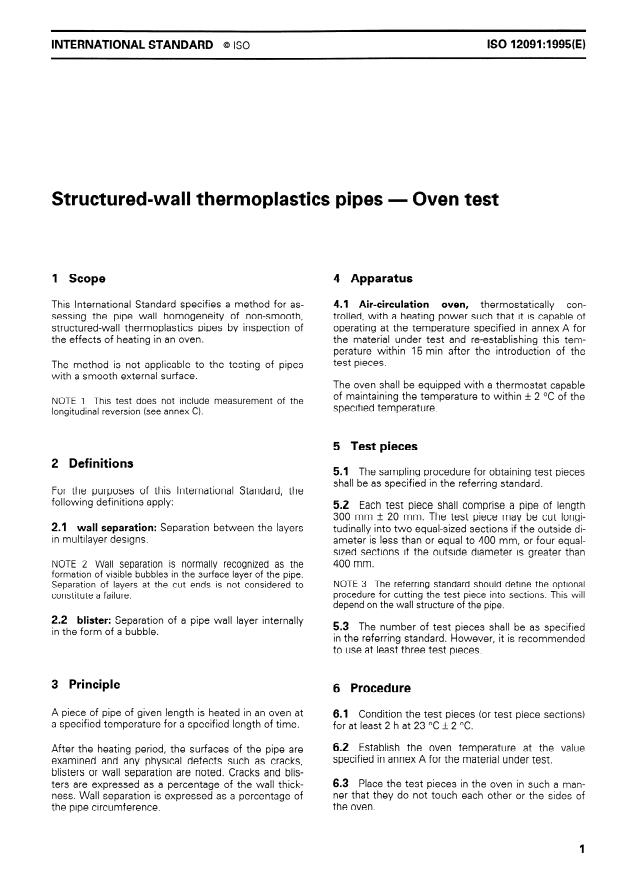
INTERNATIONAL STANDARD @ 1% ISO 12091:1995(E)
Structured-wall thermoplastics pipes - Oven test
1 Scope 4 Apparatus
This International Standard specifies a method for as- 4.1 Air-circulation oven, thermostatically con-
sessing the pipe wall homogeneity of non-smooth, trolled, with a heating power such that it is capable of
structured-wall thermoplastics pipes by inspection of operating at the temperature specified in annex A for
the material under test and re-establishing this tem-
the effects of heating in an oven.
perature within 15 min after the introduction of the
test pieces.
The method is not applicable to the testing of pipes
with a smooth external surface.
The oven shall be equipped with a thermostat capable
of maintaining the temperature to within + 2 “C of the
NOTE 1 This test does not include measurement of the
specified temperature.
longitudinal reversion (see annex C).
5 Test pieces
2 Definitions
5.1 The sampling procedure for obtaining test pieces
shall be as specified in the referring Standard.
For the purposes of this International Standard, the
following definitions apply:
5.2 Esch test piece shall comprise a pipe of length
300 mm & 20 mm. The test piece may be tut longi-
2.1 wall Separation: Separation between the layers
tudinally into two equal-sized sections if the outside di-
in multilayer designs.
ameter is less than or equal to 400 mm, or four equal-
sized sections if the outside diameter is greater than
NOTE 2 Wall Separation is normally recognized as the 400 mm.
formation of visible bubbles in the surface layer of the Pipe.
NOTE 3 The referring Standard should define the optional
Separation of layers at the tut ends is not considered to
procedure for cutting the test piece into sections. This will
constitute a failure.
depend on the wall structure of the Pipe.
2.2 blister: Separation of a pipe wall layer internally
5.3 The number of test pieces shall be as specified
in the form of a bubble.
in the referring Standard. However, it is recommended
to use at least three test pi
...
NORME
ISO
INTERNATIONALE 12091
Première édition
1995-I 2-01
Tubes en matières thermoplastiques à
parois structurées - Essai à l’étuve
Structured-wall thermoplastics pipes - Oven test
Numéro de référence
ISO 12091 :1995(F)
Avant-propos
L’ISO (Organisation internationale de normalisation) est une fedération
mondiale d’organismes nationaux de normalisation (comités membres de
I’ISO). L’élaboration des Normes internationales est en général confiée aux
comités techniques de I’ISO. Chaque comité membre intéressé par une
étude a le droit de faire partie du comité technique créé a cet effet. Les
organisations internationales, gouvernementales et non gouvernemen-
tales, en liaison avec I’ISO participent également aux travaux. L’ISO colla-
bore étroitement avec la Commission électrotechnique internationale (CEI)
en ce qui concerne la normalisation électrotechnique.
Les projets de Normes internationales adoptés par les comités techniques
sont soumis aux comités membres pour vote. Leur publication comme
Normes internationales requiert l’approbation de 75 % au moins des co-
mités membres votants.
La Norme internationale ISO 12091 a été élaborée par le comité technique
ISOf’K 138, Tubes, raccords et robinetterie en matières plastiques pour le
transport des fluides, sous-comité SC 5, Propriétés générales des tubes,
raccords et robinetteries en matières plastiques et leurs accessoires -
Méthodes d’essais et spécifications de base.
L’annexe A fait partie intégrante de la présente Norme internationale. Les
annexes B et C sont données uniquement à titre d’information.
0 ISO 1995
Droits de reproduction réservés. Sauf prescription différente, aucune partie de cette publi-
cation ne peut être reproduite ni utilisée sous quelque forme que ce soit et par aucun pro-
cédé, électronique ou mécanique, y compris la photocopie et les microfilms, sans l’accord
écrit de l’éditeur.
Organisation internationale de normalisation
Case postale 56. CH-121 1 Geneve 20 l Suisse
Imprimé en Suisse
ii
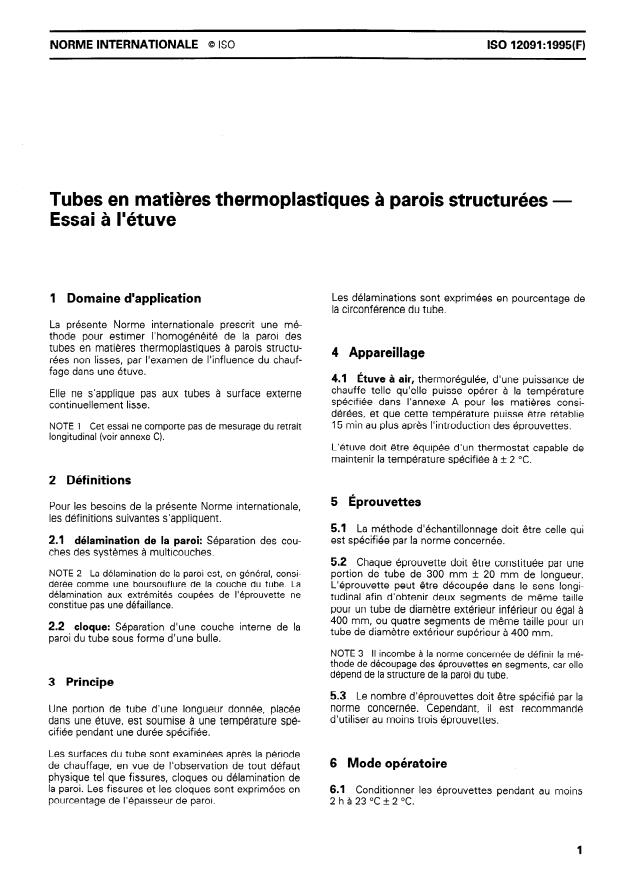
NORME INTERNATIONALE @ ISO
Tubes en matières thermoplastiques à parois structurées -
Essai à l’étuve
Les délaminations sont exprimées en pourcentage de
1 Domaine d’application
la circonférence du tube.
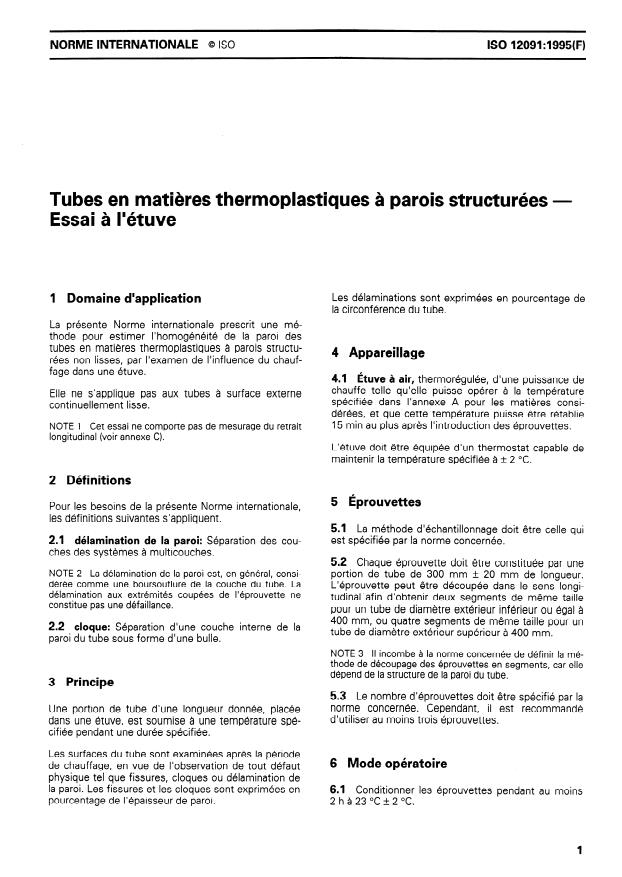
La présente Norme internationale prescrit une mé-
thode pour estimer l’homogénéité de la paroi des
tubes en matières thermoplastiques a parois structu-
4 Appareillage
rées non lisses, par l’examen de l’influence du chauf-
fage dans une étuve.
4.1 Étuve à air, thermorégulée, d’une puissance de
chauffe telle qu’elle puisse opérer à la température
Elle ne s’applique pas aux tubes a surface externe
spécifiée dans l’annexe A pour les matières consi-
continuellement lisse.
dérées, et que cette température puisse être rétablie
15 min au plus après l’introduction des éprouvettes.
NOTE 1 Cet essai ne comporte pas de mesurage du retrait
longitudinal (voir annexe C).
L’étuve doit être équipée d’un thermostat capable de
maintenir la température spécifiée à + 2 OC.
2 Définitions
5 Éprouvettes
Pour les besoins de la présente Norme internationale,
les définitions suivantes s’appliquent.
5.1 La méthode d’échantillonnage doit être celle qui
est spécifiée par la norme concernée.
2.1 délamination de la paroi: Séparation des cou-
ches des systèmes à multicouches.
5.2 Chaque éprouvette doit être constituée par une
portion de tube de 300 mm k 20 mm de longueur.
NOTE 2 La délamination de la paroi est, en général, consi-
dérée comme une boursouflure de la couche du tube. La
L’éprouvette peut être découpée dans le sens longi-
délamination aux extrémités coupees de I’eprouvette ne
tudinal’afin d’obtenir deux segments de même taille
constitue pas une défaillance.
pour un tube de diamètre extérieur inférieur ou égal à
400 mm, ou quatre segments de même taille pour un
2.2 cloque: Séparation d’une couche interne de la
tube de diamètre extérieur supérieur à 400 mm.
paroi du tube sous forme d’une bulle.
NOTE 3 II incombe à la norme concernée de définir la mé-
thode de découpage des éprouvettes en segments, car elle
dépend de la structure de la paroi du tube.
3 Principe
5.3 Le nombre d’éprouvettes doit être spécifié par la
norme concernée. Cependant, il est recommandé
Une portion de tube d’une longueur donnée, placée
d’utiliser au moins trois
...
NORME
ISO
INTERNATIONALE 12091
Première édition
1995-I 2-01
Tubes en matières thermoplastiques à
parois structurées - Essai à l’étuve
Structured-wall thermoplastics pipes - Oven test
Numéro de référence
ISO 12091 :1995(F)
Avant-propos
L’ISO (Organisation internationale de normalisation) est une fedération
mondiale d’organismes nationaux de normalisation (comités membres de
I’ISO). L’élaboration des Normes internationales est en général confiée aux
comités techniques de I’ISO. Chaque comité membre intéressé par une
étude a le droit de faire partie du comité technique créé a cet effet. Les
organisations internationales, gouvernementales et non gouvernemen-
tales, en liaison avec I’ISO participent également aux travaux. L’ISO colla-
bore étroitement avec la Commission électrotechnique internationale (CEI)
en ce qui concerne la normalisation électrotechnique.
Les projets de Normes internationales adoptés par les comités techniques
sont soumis aux comités membres pour vote. Leur publication comme
Normes internationales requiert l’approbation de 75 % au moins des co-
mités membres votants.
La Norme internationale ISO 12091 a été élaborée par le comité technique
ISOf’K 138, Tubes, raccords et robinetterie en matières plastiques pour le
transport des fluides, sous-comité SC 5, Propriétés générales des tubes,
raccords et robinetteries en matières plastiques et leurs accessoires -
Méthodes d’essais et spécifications de base.
L’annexe A fait partie intégrante de la présente Norme internationale. Les
annexes B et C sont données uniquement à titre d’information.
0 ISO 1995
Droits de reproduction réservés. Sauf prescription différente, aucune partie de cette publi-
cation ne peut être reproduite ni utilisée sous quelque forme que ce soit et par aucun pro-
cédé, électronique ou mécanique, y compris la photocopie et les microfilms, sans l’accord
écrit de l’éditeur.
Organisation internationale de normalisation
Case postale 56. CH-121 1 Geneve 20 l Suisse
Imprimé en Suisse
ii
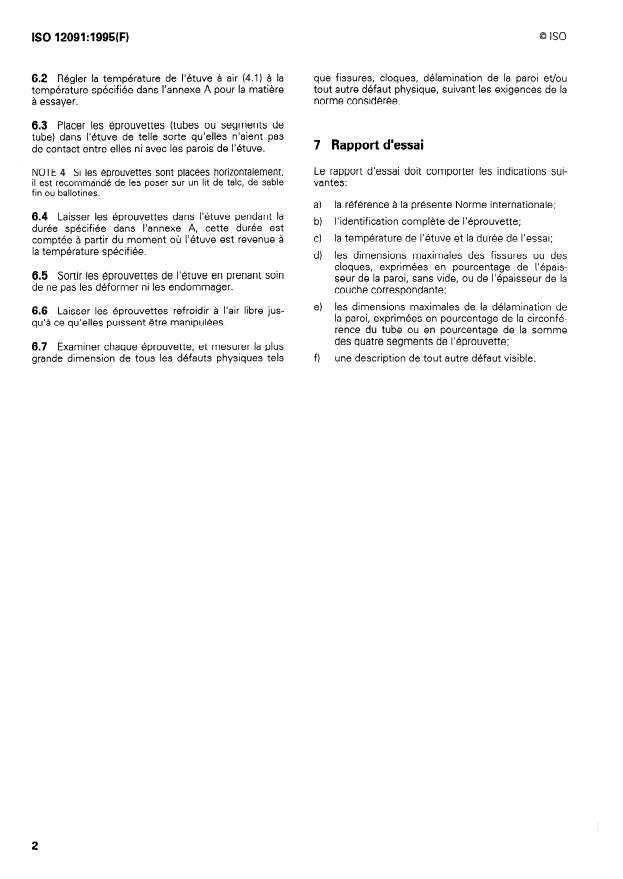
NORME INTERNATIONALE @ ISO
Tubes en matières thermoplastiques à parois structurées -
Essai à l’étuve
Les délaminations sont exprimées en pourcentage de
1 Domaine d’application
la circonférence du tube.
La présente Norme internationale prescrit une mé-
thode pour estimer l’homogénéité de la paroi des
tubes en matières thermoplastiques a parois structu-
4 Appareillage
rées non lisses, par l’examen de l’influence du chauf-
fage dans une étuve.
4.1 Étuve à air, thermorégulée, d’une puissance de
chauffe telle qu’elle puisse opérer à la température
Elle ne s’applique pas aux tubes a surface externe
spécifiée dans l’annexe A pour les matières consi-
continuellement lisse.
dérées, et que cette température puisse être rétablie
15 min au plus après l’introduction des éprouvettes.
NOTE 1 Cet essai ne comporte pas de mesurage du retrait
longitudinal (voir annexe C).
L’étuve doit être équipée d’un thermostat capable de
maintenir la température spécifiée à + 2 OC.
2 Définitions
5 Éprouvettes
Pour les besoins de la présente Norme internationale,
les définitions suivantes s’appliquent.
5.1 La méthode d’échantillonnage doit être celle qui
est spécifiée par la norme concernée.
2.1 délamination de la paroi: Séparation des cou-
ches des systèmes à multicouches.
5.2 Chaque éprouvette doit être constituée par une
portion de tube de 300 mm k 20 mm de longueur.
NOTE 2 La délamination de la paroi est, en général, consi-
dérée comme une boursouflure de la couche du tube. La
L’éprouvette peut être découpée dans le sens longi-
délamination aux extrémités coupees de I’eprouvette ne
tudinal’afin d’obtenir deux segments de même taille
constitue pas une défaillance.
pour un tube de diamètre extérieur inférieur ou égal à
400 mm, ou quatre segments de même taille pour un
2.2 cloque: Séparation d’une couche interne de la
tube de diamètre extérieur supérieur à 400 mm.
paroi du tube sous forme d’une bulle.
NOTE 3 II incombe à la norme concernée de définir la mé-
thode de découpage des éprouvettes en segments, car elle
dépend de la structure de la paroi du tube.
3 Principe
5.3 Le nombre d’éprouvettes doit être spécifié par la
norme concernée. Cependant, il est recommandé
Une portion de tube d’une longueur donnée, placée
d’utiliser au moins trois
...