

ISO/DTS 13399-90
(Main)Cutting tool data representation and exchange — Part 90: Package structure with reference file for exchange of product data and documents
- Abstract
This document specifies the package structure with reference files using a predefined schema for exchange of product data and documents. The usage covers but not limited to a set of products with related data, documents and defined product classification.
- Status
- Not Published
- Technical Committee
- ISO/TC 29 - Small tools
- Drafting Committee
- ISO/TC 29/WG 34 - Cutting tool data representation and exchange
- Current Stage
- 5092 - FDIS or proof referred back to TC or SC - 50 Approval
- Start Date
- 07-Oct-2026
Buy Documents
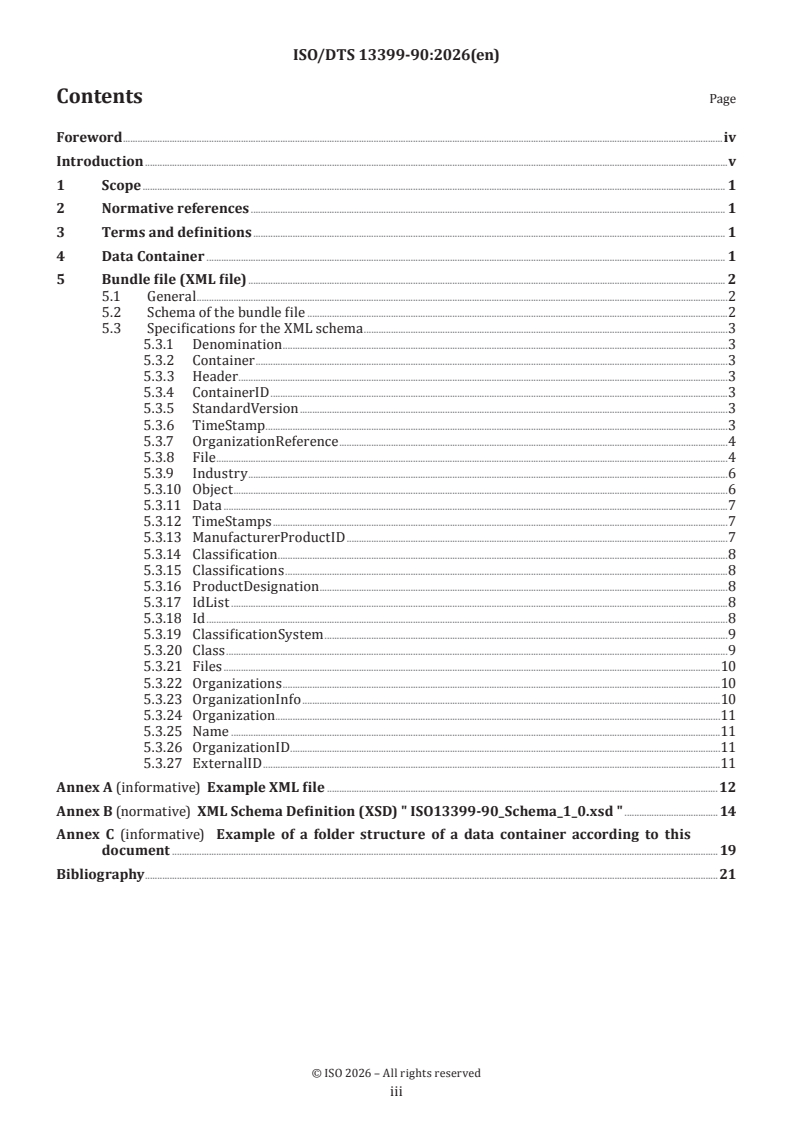
ISO/DTS 13399-90 - Cutting tool data representation and exchange — Part 90: Package structure with reference file for exchange of product data and documents
REDLINE ISO/DTS 13399-90 - Cutting tool data representation and exchange — Part 90: Package structure with reference file for exchange of product data and documents
ISO/DTS 13399-90 - Représentation et échange des données relatives aux outils coupants — Partie 90: Fichier conteneur pour l'échange de propriétés, de données et de modèles 3D
ISO/DTS 13399-90 is an ISO draft technical specification for the package structure with reference files used to exchange product data and documents in the ISO 13399 series. It defines how to bundle machining-related product information in a ZIP container with a reference XML file so different systems can interpret the package in the same way.
What does ISO/DTS 13399-90 specify?
ISO/DTS 13399-90 specifies a predefined package structure for exchanging product data and documents, including a reference file that points to the files in the package. The document is aimed at packages that contain a set of products, related documents, and defined product classification.
The document is organized into:
- Scope
- Normative references
- Terms and definitions
- Data Container
- Bundle file (XML file)
- Annex A with an example XML file
- Annex B with the normative XML Schema Definition (XSD)
- Annex C with an example folder structure
| Annex | What it covers |
|---|---|
| Annex A | Example XML file for a container |
| Annex B | Normative XML Schema Definition (XSD) for ISO13399-90_Schema_1_0.xsd |
| Annex C | Example folder structure for a data container |
What are the key requirements of ISO/DTS 13399-90?
ISO/DTS 13399-90 builds its exchange model around a ZIP-based data container and a root-level XML bundle file named data_export_container. The package structure and XML metadata are what make the files traceable, so the receiver can match documents, models, and product records to the correct object.
Data container and folder structure
The data container is a compressed ZIP file that contains subdirectories for the different file types. Files referenced in the XML and stored locally shall be placed in subdirectories that correspond to the defined type values, and empty folders are not created.
This matters in practice because the folder structure is part of the exchange logic. A receiver can use the folder name, file name, and XML reference together to locate the correct content without guessing.
Bundle file and XML structure
The bundle file describes the package content and where each file is stored. Its root element is Container, and it contains the mandatory elements Header, Industry, and Organizations.
The XML elements and attributes are named in English. That helps international exchange and keeps file parsing consistent across systems.
Header information and timestamps
The Header element contains administrative data such as StandardVersion, TimeStamp, ContainerID, and the optional OrganizationReference and File. TimeStamp uses the ISO 8601-1 date-time format, and the document also defines modified value and modified structure attributes for change tracking.
In practice, this gives each package a unique identity and a generation time, which is useful for version control, traceability, and automated import checks.
File description and file types
Each File entry identifies one file in the container or a direct online reference. The type attribute is mandatory, repository can be container or online, and optional attributes include index, lang, unit, standard, and version.
This is important because the same package can carry local files and online references, language-specific versions, and alternate files of the same type. The document also requires unique file names within a folder.
Object, Data, and Files
An Object represents one exchanged item such as ToolComponent, ToolAssembly, SparePart, MachineTool, Accessory, Workpiece, Process, Gauge, or Jig. Each Object has exactly one Data element and one Files element.
Data contains the mandatory ManufacturerProductID and optional TimeStamps, Classifications, and ProductDesignation. In practice, that means every object is tied to a unique product identifier and can be linked to its technical descriptions, classifications, and associated documents.
Product identification and classifications
ManufacturerProductID identifies the product within the manufacturing organization and is used to reference additional documents. Classifications can include one or more Classification entries with type, version, and ClassReference.
This matters when the same product must be identified in more than one classification system, such as ISO 13399 or DIN 4000. It lets a supplier and a customer exchange the same object while keeping their own classification logic.
Classification systems and organization data
ClassificationSystem describes the full hierarchy of a classification system and includes Class elements with ClassId, optional ClassName, ClassDescription, and parent-child relations. Organizations contains OrganizationInfo, which carries Organization, optional Logo, and identification data such as OrganizationID, Name, and ExternalID.
This makes the package self-describing: the receiver can see which organization created the file, which organization a product reference belongs to, and how a custom classification hierarchy is structured.
What terms does ISO/DTS 13399-90 define?
ISO/DTS 13399-90 uses a small set of core XML and packaging terms to describe the exchange structure.
- Data Container - A compressed ZIP package that holds the exchanged files in subdirectories and includes the XML container file.
- Bundle file - The XML file that describes the package content and the locations of the files inside or outside the container.
- ContainerID - The unique identifier of the container, used together with the package creator.
- ManufacturerProductID - The unique product identifier used by the manufacturing organization to identify the product and link related documents.
- Object - A package item such as a tool component, tool assembly, spare part, machine tool, accessory, workpiece, process, gauge, or jig.
- ClassificationSystem - The element that defines the structure and hierarchy of a classification scheme used in the package.
- OrganizationID - The unique identifier of an organization within the document scope.
Who uses ISO/DTS 13399-90?
ISO/DTS 13399-90 is used by organizations that exchange machining-related product data and documents. That includes tool manufacturers, suppliers, customers, and software providers that generate or read standardized product packages.
It is relevant for:
- preparing product data packages for exchange
- linking documents to specific tool components or assemblies
- organizing photos, 2D drawings, 3D models, setup sheets, and process data
- managing product classification across different systems
- importing or validating exchanged data in engineering and catalog systems
In practice, this helps anyone who has to send or receive a structured product package for machining products and their related documents.
Which standards are used with ISO/DTS 13399-90?
ISO/DTS 13399-90 names a small set of standards that support its file structure and metadata.
- ISO 8601-1 - Provides the date and time representation used for
TimeStamp. - ISO 639-1 - Provides the two-letter language codes used for the
langattribute. - ISO/TS 13399-70 - Used for
2D_Graphicand2D_Contourfile types. - ISO/TS 13399-71 - Used for
2D_Documentationfile types. - ISO/TS 13399-72 - Used for
DocumentationData. - ISO/TS 13399-80 - Used for
3D_Detailedand3D_Basicfile types. - ISO 13399 series - Provides the broader cutting tool data representation framework used throughout the document.
- DIN 4000 and DIN 4003 series - Are named as allowed standards for some file types and classification-related content.
- ISO 13399-61 - Is referenced for company code information in
ExternalID.
What does the ISO/DTS 13399-90 document contain?
ISO/DTS 13399-90 contains the XML model for a package container, the allowed file-type structure, and the rules for describing objects, organizations, classifications, and file references. It also includes an informative example XML file in Annex A and an informative example folder structure in Annex C.
Annex B provides the normative XML Schema Definition (XSD), so implementers can validate the container file against the expected structure. Table 1 in the body of the document links each file type to its typical content, permitted extensions, and related standard or version, which is the part most readers use when building or checking an exchange package.
Buy Documents
ISO/DTS 13399-90 - Cutting tool data representation and exchange — Part 90: Package structure with reference file for exchange of product data and documents
REDLINE ISO/DTS 13399-90 - Cutting tool data representation and exchange — Part 90: Package structure with reference file for exchange of product data and documents
ISO/DTS 13399-90 - Représentation et échange des données relatives aux outils coupants — Partie 90: Fichier conteneur pour l'échange de propriétés, de données et de modèles 3D
Get Certified
Connect with accredited certification bodies for this standard

BSI Group
BSI (British Standards Institution) is the business standards company that helps organizations make excellence a habit.

DVS-ZERT GmbH
German welding certification society.

CARES (UK Certification Authority for Reinforcing Steels)
UK certification for reinforcing steels and construction.
Sponsored listings
Frequently Asked Questions
ISO/DTS 13399-90 is a draft published by the International Organization for Standardization (ISO). Its full title is "Cutting tool data representation and exchange — Part 90: Package structure with reference file for exchange of product data and documents". This standard covers: This document specifies the package structure with reference files using a predefined schema for exchange of product data and documents. The usage covers but not limited to a set of products with related data, documents and defined product classification.
This document specifies the package structure with reference files using a predefined schema for exchange of product data and documents. The usage covers but not limited to a set of products with related data, documents and defined product classification.
ISO/DTS 13399-90 is classified under the following ICS (International Classification for Standards) categories: 25.100.01 - Cutting tools in general; 35.240.50 - IT applications in industry. The ICS classification helps identify the subject area and facilitates finding related standards.
ISO/DTS 13399-90 is available in PDF format for immediate download after purchase. The document can be added to your cart and obtained through the secure checkout process. Digital delivery ensures instant access to the complete standard document.
Standards Content (Sample)
Contents
- Introduction
- 1 Scope
- 2 Normative references
- 3 Terms and definitions
- 4 Data Container
- 5 Bundle file (XML file)
- 5.1 General
- 5.2 Schema of the bundle file
- 5.3 Specifications for the XML schema
- Annex A
- Annex B
- Annex C
- Bibliography
Introduction
Product information today is distributed through several separate files which are not organized in a standardized way, making it difficult for the receiver to interpret how they relate to each other. This document specifies a standardized way to organize a package of product data and documents. It aims to faciliate the exchange of product information between systems. This document standardizes the format with the capability of carrying contents based on different classification systems.
FINAL DRAFT Technical Specification ISO/DTS 13399-90:2026(en) Cutting tool data representation and exchange — Part 90:
Package structure with reference file for exchange of product data and documents
1 Scope
This document specifies the package structure with reference files using a predefined schema for exchange of product data and documents. The usage covers, but is not limited to, a set of products with related data, documents and defined product classification.
2 Normative references
The following documents are referred to in the text in such a way that some or all of their content constitutes requirements of this document. For dated references, only the edition cited applies. For undated references, the latest edition of the referenced document (including any amendments) applies. ISO 8601-1, Date and time — Representations for information interchange — Part 1: Basic rules ISO 639, Code for individual languages and language groups
3 Terms and definitions
No terms and definitions are listed in this document.
ISO and IEC maintain terminology databases for use in standardization at the following addresses:
- ISO Online browsing platform: available at https:// www .iso .org/ obp
- IEC Electropedia: available at https:// www .electropedia .org/
4 Data Container
A data container is a compressed file in ZIP (*.zip) format. It contains subdirectories with files containing product or component information. The affiliation of the individual files is described using a container file (XML file, "delivery note"). See Figure C.2.
The descriptions of the products or components shall be stored either directly in the container file or refer to external sources, according to 5.3.8.
All files referenced in the XML file, whose references do not refer to online sources, shall be stored in subdirectories of a ZIP container. The names of the subdirectories correspond to those in 5.2.19 defined expressions of the attribute "type". Below these subdirectories any other subfolders may be created. Empty directories are not to be created. The container contains a bundle file (an XML file, or 'delivery note'), which shall be stored at root level in the ZIP container, see Figure C.1. The name of the Bundle file is “data_export_ container”.
Level does not otherwise contain individual files.
ISO/DTS 13399-90:2026(en)
5 Bundle file (XML file)
5.1 General
The Bundle file describes the content of the package and its locations. An example of XML file is given in Annex A.
5.2 Schema of the bundle file
Figure 1 shows the schematic structure of the XML file.
Figure 1 — Schema of the bundle file (XML file)
ISO/DTS 13399-90:2026(en) The corresponding XSD file required for the XML structure shall be as defined in Annex B. An example of a folder structure of a data container according to this document is given in Annex C.
5.3 Specifications for the XML schema
5.3.1 Denomination
Because of the possible exchange of data on an international level, the elements and attributes are named in English.
5.3.2 Container
The mandatory element "Container" forms the root of the XML document. It contains the attribute Container ID and has the mandatory elements “Header”, “Industry” and “Organizations”.
5.3.3 Header
The mandatory element “Header” contains the administrative elements "StandardVersion", "TimeStamp", “ContainerID” and the optional elements “OrganizationReference” and “File”. These are allowed to occur only once in the element “Header”.
5.3.4 ContainerID
The mandatory attribute "ContainerID" is part of the element “Container”. It has to be unique in combination with the package creator. The length of the element shall not exceed 128 Characters. EXAMPLE <Container ContainerID="54d38c62-99d5-448d-b982-f8eb54b1ee82">.
5.3.5 StandardVersion
The mandatory element "StandardVersion" indicates the version number of this document on which the file is based.
EXAMPLE <StandardVersion>2024-xx</StandardVersion>
5.3.6 TimeStamp
The mandatory element "TimeStamp" specifies the time of generation of the XML file in the header. This shall be given as the complete calendar date in the extended format YYYY -MM -DDThh: mm: ss±hh: mm, in accordance with ISO 8601-1, and contains the optional attributes “modified value” and “modified structure”. EXAMPLE <TimeStamp>2020-04-20T12:38:30+02:00</TimeStamp> xs: element ref="TimeStamp" minOccurs="0" maxOccurs="unbounded"/> <xs: complexType> <xs: attribute name="modified value"/> <xs: attribute name="modified structure"/> </xs: complexType> </xs: element> The attribute “modified value” indicates that only the content of an element or attribute has been changed, but not the structure of the XML document. The attribute “modified structure” indicates that the structure of the XML has changed.
ISO/DTS 13399-90:2026(en)
5.3.7 OrganizationReference
The element "OrganizationReference" points the "Organization“, which is the Organization responsible for generating the file.
5.3.8 File
The mandatory element "File" contains the elements “FilePath” and “TimeStamps” and defines a file contained in the container for the respective object or a reference to a corresponding file available online. The parent element "Files" may contain several elements of the type "File". In the mandatory attribute "type", the type of the respective file shall be indicated. The following file types for the attribute "type" are permitted, see Table 1.
The optional attribute “standard” defines the standard according to which the file was generated. The following standards are permitted:
- ISO 13399 series;
- DIN 4000 and DIN 4003 series;
- StOB;
- eClass;
- Customer specific.
The optional attribute “version” refers to the attribute “standard” and defines the version of the standard document according to which the file was generated. If there is no entry for the version, the last published version of the used standard is adopted. The standard is indicated by the date of publication of the respective document. The spelling used in the document is specified. With ISO there is the special case that the PLib version has to be specified.
- PLib version : ISO13399 dictionary 2020-07-05 - DIN version : DIN 4000-89:2025-07, DIN 4003-89:2025-07 - eClass version : …, 10.0.1, 10.1, 11.0 Table 1 — Permitted file types in the container file Attribute values of Version (option- Standard (optional) File extension Kind "type" al) a c Property ISO 13399 2020-07-05 xml, p21 Parameters DIN 4000 2020-08 Standard Open Base 2022 eClass 11.0 customer specific Photo — — jpg, png, gif, tif Photo of the component Sketch — — jpg, png, gif, tif 2D_Grapic_Pictures_BW, 2D_ GraphicPicture_Colour Multimedia — — avi, pdf, jpg, png, Movie, advertisement, marketing, b gif, tif description CatalogPage — — pdf Contains the catalog page that shows the tool 2D_Documentation ISO/TS 13399-71 07/2016 dxf, pdf Tool sheet with frame and other views 2D_Graphic ISO/TS 13399-70 07/2016 dxf tool only
ISO/DTS 13399-90:2026(en) TTabablele 1 1 ((ccoonnttiinnueuedd)) Attribute values of Version (option- Standard (optional) File extension Kind "type" al) 2D_Contour ISO/TS 13399-70 07/2016 dxf Contains only layer CUT and NOCUT 3D_Detailed ISO/TS 13399-80, 05/2017 stp, stl, jt solids showing the stationary state of the geometry DIN 4003 recommendation file type: stp 10/2017 3D_Basic ISO/TS 13399-80 05/2017 stp, stl, jt showing the rotated geometry of a tool around a spindle axis DIN 4003 recommendation file type: stp 10/2017 ApplicationData ISO — xml Application of Speed & Feed, only xml DIN 4000-103 03/2021 eClass GTC ClassDocument — — jpg, png, pdf, svg Class drawing ClassIcon — — jpg, png, ico Class icon ClassHierarchy — — json, xml Hierarchy structure of the classification system DocumentationData ISO/TS 13399-72 07/2016 xml In agreement between data sender and receiver DIN 4000 eClass MM/YYYY GTC 11.0 ProcessData — — xml CNCProgram — — nc, h, i, tap, hnc CNC program, format in agreement between data sender and receiver AdditionalDescription — — txt, io, xml, IO-Link, Profibus, Profinet gsd AdditionalData — — txt, io, xml, gsd Additional data, Information in agreement between data sender and receiver ProcurementData — Version 1.0 xml Procurement, Schema http:// E-procurement www .w3 .org/ 2001/ XMLSchema Logo — png, jpg, gif, tif Logo of the manufacturer ReadMe — txt, pdf Description of the content of the package Disclaimer — txt, pdf Gives information about the contribution allowances SetupSheet — avi, pdf, dxf, jpg, Gives information about the tool png, gif, tif, txt, list of the machining process b xml a Dependent of the data exchange process one of these files is mandatory. b Examples of file extensions .divx, .m4v, .mp4, .mov.
PLib 2.4 with ISO 13399 dictionary 2021-11-11.
The defined attribute values of "type" (see Table 1) are the names of the respective folders in the ZIP file for data exchange. The columns “File extension” and “Kind” are just for information. They are not part of the tag file.
ISO/DTS 13399-90:2026(en) In the optional attribute "repository" the user can specify whether the file is part of the container or available online. The following attribute values are possible:
- container;
- online.
If the attribute is not specified, the file is considered a container file. The optional attribute “index” is used if there is more than one file available for a specific file type. The file with the index 1 has the highest priority.
The optional attribute "lang" can be used to specify a language-dependent version of a file. In accordance with ISO 639, the coding shall consist of two small letters.
The optional attribute “unit” can be used to specify the unit of a file. This can be either “M” for metric or “N” for imperial.
Unique filenames shall be used for all files of the same type. Empty optional attributes do not have to be created in the tag “File”. The value of the "FilePath" element itself shall be the absolute path of the file in the file type specific folder within the container including the file name or an URL that represents a direct reference to a file available online. Examples of this are shown below.
The following example shows the structure of the element “File”:
EXAMPLE <Files> <File type="property" standard="ISO13399" repository="container" version="08/2020" unit="M" lang="en"> <FilePath>property\1B230-0700-XA1630.p21</FilePath> <TimeStamp>2023-02-20T16:37:00+00:00</TimeStamp> </File> <File type="property" standard="DIN4000" repository="container" version="03/2020" unit="M" lang="de"> <FilePath>property\DIN4000.xml</FilePath> <TimeStamp>2023-02-20T16:37:00+00:00</TimeStamp> </File> </Files> All filenames in a folder shall be unique.
5.3.9 Industry
The schema is open for different industries. In context of the ISO 13399 series, it is always "Machining".
5.3.10 Object
The optional element "Object" contains the elements “Data” and “Files” and the mandatory attribute "type". This element is allowed to occur more than once in the data_export_container. The following values of the attribute “type” are allowed:
- ToolComponent (e. g. according to ISO/TS 13399-2, ISO/TS 13399-3, ISO/TS 13399-4);
ISO/DTS 13399-90:2026(en) - ToolAssembly (e. g. according to ISO/TS 13399-6); - SparePart (Built-in parts, e.g. according to DIN 4000-180); - MachineTool (e. g. according to DIN 4000-210); - Accessory (e. g. according to ISO/TS 13399-5); - Workpiece (Documentation of a workpiece); - Process (process data, technology data); - Gauge (Measuring and teaching aids) (e. g. according to DIN 4000-164, -165, -166, -167, -168, -178); - Jig (workpiece clamping devices and fixtures) (e. g. according to DIN 4000-190, 191, 192). EXAMPLE <Object type="Machine tool "> <Data>... </Data> <Files>...</Files> </Object> NOTE The container file contains at least one element “Object” or one element “ClassificationSystem”. Container files with only the element “Header” are not allowed.
...
Contents
- Introduction
- 1 Scope
- 2 Normative references
- 3 Terms and definitions
- 4 Data Container
- 5 Bundle file (XML file)
- 5.1 General
- 5.2 Schema of the bundle file
- 5.3 Specifications for the XML schema
- Annex A
- Annex B
- Annex C
- Bibliography
Introduction
Product information today is distributed through several separate files which are not organized in a standardized way. Making, making it difficult for the receiver to interpret how they are relatedrelate to each other. This document specifies a standardized way to organize a package of product data and documents. It aims to faciliate the exchange of product information between systems. This document specifies a standardized way to organize a package of product data and documents which aims to easier exchange product information between systems.
This document standardizes the format with the capability of carrying contents based on different classification systems.
ISO/DTS 13399-90:(en) Cutting tool data representation and exchange — — Part 90:
Package structure with reference file for exchange of product data and documents
1 Scope
This document specifies the package structure with reference files using a predefined schema for exchange of product data and documents. The usage covers, but is not limited to, a set of products with related data, documents and defined product classification.
2 Normative references
The following documents are referred to in the text in such a way that some or all of their content constitutes requirements of this document. For dated references, only the edition cited applies. For undated references, the latest edition of the referenced document (including any amendments) applies. ISO 8601-1, Date and time — Representations for information interchange — Part 1: Basic rules ISO 639-1, Codes, Code for the representation of names ofindividual languages — Part 1: Alpha 2 codeand language groups
3 Terms and definitions
No terms and definitions are listed in this document.
ISO and IEC maintain terminologicalterminology databases for use in standardization at the following addresses:
- IEC Electropedia: available at ISO Online browsing platform: available at https://www.iso.org/obp
- IEC Electropedia: available at https://www.electropedia.org/
4 Data Container
A data container is a compressed file in ZIP (*.zip) format. It contains subdirectories with files containing product or component information. The affiliation of the individual files is described using a container file (XML file, "delivery note"). See Figure C.2.
The descriptions of the products or components shall be stored either directly in the container file or refer to external sources, according to 5.3.85.3.8..
All files referenced in the XML file, whose references do not refer to online sources, shall be stored in subdirectories of a ZIP container. The names of the subdirectories correspond to those in 5.2.19 defined expressions of the attribute "type". Below these subdirectories any other subfolders may be created. Empty directories are not to be created. The container contains a bundle file (an XML file, or 'delivery note'), which shall be stored at root level in the ZIP container, see Figure C.1Figure C.1.. The name of the Bundle file is “data_export_container”.
Level does not otherwise contain individual files.
ISO/DTS 13399-90:(en)
5 Bundle file (XML file)
5.1 General
The Bundle file describes the content of the package and its locations. An example of XML file is given in Annex AAnnex A..
5.2 Schema of the bundle file
Figure 1Figure 1 shows the schematic structure of the XML file.
ISO/DTS 13399-90:(en)
ISO/DTS 13399-90:(en)
Figure 1 — Schema of the bundle file (XML file) The corresponding XSD file required for the XML structure shall be as defined in Annex BAnnex B.. An example of a folder structure of a data container according to this document is given in Annex CAnnex C..
5.3 Specifications for the XML schema
5.3.1 Denomination
Because of the possible exchange of data on an international level, the elements and attributes are named in English.
5.3.2 Container
The mandatory element "Container" forms the root of the XML document. It contains the attribute Container ID and has the mandatory elements “Header”, “Industry” and “Organizations”.
ISO/DTS 13399-90:(en)
5.3.3 Header
The mandatory element “Header” contains the administrative elements "StandardVersion", "TimeStamp", “ContainerID” and the optional elements “OrganizationReference” and “File”. These are allowed to occur only once in the element “Header”.
5.3.4 ContainerID
The mandatory attribute "ContainerID" is part of the element “Container”. It has to be unique in combination with the package creator. The length of the element shall not exceed 128 Characters. EXAMPLE <Container ContainerID="54d38c62-99d5-448d-b982-f8eb54b1ee82">.
5.3.5 StandardVersion
The mandatory element "StandardVersion" indicates the version number of this document on which the file is based.
EXAMPLE <StandardVersion>2024-xx</StandardVersion>
5.3.6 TimeStamp
The mandatory element "TimeStamp" specifies the time of generation of the XML file in the header. This shall be given as the complete calendar date in the extended format YYYY-MM-DDThh:mm:ss±hh:mm (, in accordance with ISO 8601-1), and contains the optional attributes “modified value” and “modified structure”. EXAMPLE <TimeStamp>2020-04-20T12:38:30+02:00</TimeStamp> xs:element ref="TimeStamp" minOccurs="0" maxOccurs="unbounded"/> <xs:complexType> <xs:attribute name="modified value"/> <xs:attribute name="modified structure"/> </xs:complexType> </xs:element> The attribute “modified value” indicates that only the content of an element or attribute has been changed, but not the structure of the XML document. The attribute “modified structure” indicates that the structure of the XML has changed.
5.3.7 OrganizationReference
The element „"OrganizationReference“" points the „"Organization“. The “, which is the Organization responsible for generating the file.
5.3.8 File
The mandatory element "File" contains the elements “FilePath” and “TimeStamps” and defines a file contained in the container for the respective object or a reference to a corresponding file available online. The parent element "Files" may contain several elements of the type "File". In the mandatory attribute "type", the type of the respective file shall be indicated. The following file types for the attribute "type" are permitted, see Table 1Table 1..
ISO/DTS 13399-90:(en) The optional attribute “standard” defines the standard according to which the file was generated. The following Standardsstandards are permitted:
- ISO 13399 series;
- DIN 4000 and DIN 4003 series;
- StOB;
- eClass;
- Customer specific.
The optional attribute “version” refers to the attribute “standard” and defines the version of the standard document according to which the file was generated. If there is no entry for the version, the last published version of the used standard is adopted. The standard is indicated by the date of publication of the respective document. The spelling used in the document is specified. With ISO there is the special case that the PLib version has to be specified.
- PLib version : ISO13399 dictionary 2020-07-05 - DIN version : DIN4000DIN 4000-89:2025-07, DIN4003DIN 4003-89:2025-07 - eClass version : …, 10.0.1, 10.1, 11.0 Table 1 — Permitted file types in the container file Attribute values Standard Version File Kind of "type" (optional) (optional) extension a c Property ISO 13399 2020-07-05 xml, p21 Parameters DIN 4000 2020-08 Standard Open Base 2022 eClass 11.0 customer specific Photo — — jpg, png, gif, tif Photo of the component Sketch — — jpg, png, gif, tif 2D_Grapic_Pictures_BW, 2D_GraphicPicture_Colour Multimedia — — avi, pdf, jpg, Movie, advertisement, b png, gif, tif marketing, description CatalogPage — — pdf Contains the catalog page that shows the tool 2D_Documentation ISO/TS 13399-71 07/2016 dxf, pdf Tool sheet with frame and other views 2D_Graphic ISO/TS 13399-70 07/2016 dxf tool only 2D_Contour ISO/TS 13399-70 07/2016 dxf Contains only layer CUT and NOCUT 3D_Detailed ISO/TS 13399-80, 05/2017 stp, stl, jt solids showing the stationary state of the geometry DIN 4003 recommendation file type: stp 10/2017
ISO/DTS 13399-90:(en) Attribute values Standard Version File Kind of "type" (optional) (optional) extension 3D_Basic ISO/TS 13399-80 05/2017 stp, stl, jt showing the rotated geometry of a tool around a spindle axis DIN 4003 recommendation file type: stp 10/2017 ApplicationData ISO — xml Application of Speed & Feed, only xml DIN 4000-103 03/2021 eClass GTC ClassDocument — — jpg, png, pdf, Class drawing svg ClassIcon — — jpg, png, ico Class icon ClassHierarchy — — json, xml Hierarchy structure of the classification system DocumentationDat ISO/TS 13399-72 07/2016 xml In agreement between data a sender and receiver DIN 4000 eClass MM/YYYY GTC 11.0 ProcessData — — xml CNCProgram — — nc, h, i, tap, hnc CNC program, format in agreement between data sender and receiver AdditionalDescripti — — txt, io, xml, IO-Link, Profibus, Profinet on gsd AdditionalData — — txt, io, xml, gsd Additional data, Information in agreement between data sender and receiver ProcurementData — Version 1.0 xml Procurement, Schema E-procurement http://www.w3 .org/2001/XML Schema Logo — png, jpg, gif, tif Logo of the manufacturer ReadMe — txt, pdf Description of the content of the package Disclaimer — txt, pdf Gives information about the contribution allowances SetupSheet — avi, pdf, dxf, Gives information about the jpg, png, gif, tif, tool list of the machining b txt, xml process a Dependent of the data exchange process one of these files is mandatory. b Examples of file extensions .divx, .m4v, .mp4, .mov.
PLib 2.4 with ISO 13399 dictionary 2021-11-11.
ISO/DTS 13399-90:(en) The defined attribute values of "type" (see Table 1Table 1)) are the names of the respective folders in the ZIP file for data exchange. The columns “File extension” and “Kind” are just for information. They are not part of the tag file.
In the optional attribute "repository" the user can specify whether the file is part of the container or available online. The following attribute values are possible:
- container;
- online.
If the attribute is not specified, the file is considered a container file. The optional attribute “index” is used if there is more than one file available for a specific file type. The file with the index 1 has the highest priority.
The optional attribute "lang" can be used to specify a language-dependent version of a file. In accordance with ISO 639-1, the coding shall consist of two small letters.
The optional attribute “unit” can be used to specify the unit of a file. This can be either “M” for metric or “N” for imperial.
Unique filenames shall be used for all files of the same type. Empty optional attributes do not have to be created in the tag “File”. The value of the "FilePath" element itself shall be the absolute path of the file in the file type specific folder within the container including the file name or an URL that represents a direct reference to a file available online. Examples of this are shown below.
The following example shows the structure of the element “File”:
EXAMPLE :
<Files> <File type="property" standard="ISO13399" repository="container" version="08/2020" unit="M" lang="en"> <FilePath>property\1B230-0700-XA1630.p21</FilePath> <TimeStamp>2023-02-20T16:37:00+00:00</TimeStamp> </File> <File type="property" standard="DIN4000" repository="container" version="03/2020" unit="M" lang="de"> <FilePath>property\DIN4000.xml</FilePath> <TimeStamp>2023-02-20T16:37:00+00:00</TimeStamp> </File> </Files> All filenames in a folder shall be unique.
ISO/DTS 13399-90:(en)
5.3.9 Industry
The schema is open for different industries. In context of the ISO 13399 series, it is always ‘Machining’. "Machining".
5.3.10 Object
The optional element "Object" contains the elements “Data” and “Files” and the mandatory attribute "type". This element is allowed to occur more than once in the data_export_container. The following values of the attribute “type” are allowed:
- ToolComponent (e. g. according to ISO/TS 13399-2, ISO/TS 13399-3, ISO/TS 13399-4); - ToolAssembly (e. g. according to ISO/TS 13399-6); - SparePart (Built-in parts, e.g. according to DIN 4000-180); - MachineTool (e. g. according to DIN 4000-210); - Accessory (e. g. according to ISO/TS 13399-5); - Workpiece (Documentation of a workpiece); - Process (process data, technology data); - Gauge (Measuring and teaching aids) (e. g. according to DIN 4000-164, -165, -166, -167, -168, -178); - Jig (workpiece clamping devices and fixtures) (e. g. according to DIN 4000-190, 191, 192). EXAMPLE <Object type="Machine tool "> <Data>... </Data> <Files>...</Files> </Object> Note: NOTE The container file contains at least one element “Object” or one element “ClassificationSystem”. Container files with only the element “Header” are not allowed.
...
Contents
- Introduction
- 1 Domaine d’application
- 2 Références normatives
- 3 Termes et définitions
- 4 Conteneur de données
- 5 Ensemble des fichiers (fichier XML)
- 5.1 Généralités
- 5.2 Schéma de l'ensemble des fichiers
- 5.3 Spécifications du schéma XML
- 11.0 eClass
- Annexe A
- Annexe B
- Annexe C
- Bibliographie
Introduction
Aujourd'hui, les informations sur les produits sont diffusées sous la forme de plusieurs fichiers distincts qui ne sont pas organisés de manière normalisée, rendant difficile pour le destinataire d’interpréter la manière dont ils sont liés entre eux. Le présent document définit une méthode normalisée pour organiser un ensemble de données et de documents relatifs aux produits. Il a pour but de faciliter l'échange d'informations sur les produits entre les systèmes.
Le présent document normalise le format de manière à permettre la prise en charge de contenus basés sur différents systèmes de classification.
PROJET FINAL Spécification technique ISO/DTS 13399-90:2026(fr) Représentation et échange des données relatives aux outils coupants — Partie 90:
Fichier conteneur pour l'échange de propriétés, de données et de modèles 3D
1 Domaine d’application
Le présent document définit la structure des dossiers contenant des fichiers de référence, en utilisant un schéma prédéfini pour l'échange de données et de documents relatifs aux produits. Son champ d'application couvre, sans s'y limiter, un ensemble de produits accompagnés des données et documents associés, ainsi qu'une classification définie des produits.
2 Références normatives
Les documents suivants sont cités dans le texte de sorte qu’ils constituent, pour tout ou partie de leur contenu, des exigences du présent document. Pour les références datées, seule l’édition citée s’applique. Pour les références non datées, la dernière édition du document de référence s'applique (y compris les éventuels amendements).
ISO 8601-1, Date et heure — Représentations pour l'échange d'information — Partie 1: Règles de base ISO 639, Code pour les langues individuelles et les groupes de langues
3 Termes et définitions
Aucun terme n'est défini dans le présent document.
L'ISO et l'IEC tiennent à jour des bases de données terminologiques destinées à être utilisées en normalisation, consultables aux adresses suivantes:
- ISO Online browsing platform: disponible à l'adresse https:// www .iso .org/ obp
- IEC Electropedia: disponible à l'adresse https:// www .electropedia .org/
4 Conteneur de données
Un conteneur de données est un fichier compressé au format ZIP (*.zip). Il contient des sous-répertoires avec des fichiers contenant des informations sur les produits ou les composants. L'appartenance des différents fichiers est décrite à l'aide d'un fichier conteneur (fichier XML, «bon de livraison »). Voir la Figure C.2. Les descriptions des produits ou des composants doivent être stockées soit directement dans le fichier conteneur, soit faire référence à des sources externes, conformément au 5.3.8. Tous les fichiers référencés dans le fichier XML, dont les références ne renvoient pas à des sources en ligne, doivent être stockés dans des sous-répertoires d’un conteneur ZIP. Les noms des sous-répertoires correspondent à ceux définis au 5.2.19 pour l’attribut «type». D'autres sous-dossiers peuvent être créés sous ces sous-répertoires. Il ne faut pas créer de répertoires vides. Le conteneur contient l'ensemble des
ISO/DTS 13399-90:2026(fr) fichiers (un fichier XML, ou «bon de livraison »), qui doit être stocké au niveau racine du conteneur ZIP, voir la Figure C.1. Le nom de l'ensemble des fichiers est «data_export_container». Ce niveau ne contient pas d'autres fichiers individuels.
5 Ensemble des fichiers (fichier XML)
5.1 Généralités
L'ensemble des fichiers décrit le contenu du paquet et l'emplacement de ses éléments. Un exemple de fichier XML est présenté à l'Annexe A.
5.2 Schéma de l'ensemble des fichiers
La Figure 1 présente la structure schématique du fichier XML.
ISO/DTS 13399-90:2026(fr) Figure 1 — Schéma de l'ensemble des fichiers (fichier XML) Le fichier XSD correspondant requis pour la structure XML doit être conforme à la définition figurant à l'Annexe B. Un exemple de structure de dossiers d'un conteneur de données conforme au présent document est présenté à l'Annexe C.
5.3 Spécifications du schéma XML
5.3.1 Dénomination
En raison des échanges de données potentiels à l'échelle internationale, les éléments et attributs sont désignés en anglais.
ISO/DTS 13399-90:2026(fr)
5.3.2 Container (conteneur)
L'élément obligatoire «Container» constitue la racine du document XML. Il contient l'attribut «Container ID» et comprend les éléments obligatoires «Header», «Industry» et «Organizations».
5.3.3 Header (en-tête)
L'élément obligatoire «Header» contient les éléments administratifs «StandardVersion», «TimeStamp», «ContainerID» et les éléments facultatifs «OrganizationReference» et «File». Ceux-ci ne peuvent apparaître qu'une seule fois dans l'élément «Header».
5.3.4 ContainerID (ID du conteneur)
L'attribut obligatoire «ContainerID» fait partie de l'élément «Container». Il est unique en combinaison avec le créateur du paquet. La longueur de l'élément ne doit pas dépasser 128 caractères. EXEMPLE < Container ContainerID = ”54d38c62-99d5-448d-b982-f8eb54b1ee82” > .
5.3.5 StandardVersion (version de la norme)
L'élément obligatoire «StandardVersion» indique le numéro de version du présent document sur lequel le fichier est basé.
EXEMPLE <StandardVersion>2024-xx</StandardVersion>
5.3.6 TimeStamp (horodatage)
L'élément obligatoire «TimeStamp» précise l'heure de création du fichier XML dans l'en-tête. Celle-ci doit être indiquée sous la forme d'une date calendaire complète au format étendu AAAA -MM -JJThh: mm: ss ± hh:mm (conformément à l’ISO 8601-1) et contient les attributs facultatifs «modified value» (valeur modifiée) et «modified structure» (structure modifiée).
EXEMPLE <TimeStamp>2020-04-20T12:38:30+02:00</TimeStamp> xs: element ref = ”TimeStamp” minOccurs = ”0” maxOccurs = ”unbounded”/ > <xs: complexType> < xs: attribute name = ”modified value”/ > < xs: attribute name = ”modified structure”/ > </xs: complexType> </xs: element> L'attribut «valeur modifiée» indique que seul le contenu d'un élément ou d'un attribut a été modifié, mais pas la structure du document XML. L'attribut «structure modifiée» indique que la structure du document XML a été modifiée.
5.3.7 OrganizationReference (référence de l'organisation)
L'élément «OrganizationReference» désigne l'« Organization », qui est l'organisation responsable de la génération du fichier.
5.3.8 File (fichier)
L'élément obligatoire «File» contient les éléments «FilePath» et «TimeStamps» et définit un fichier contenu dans le conteneur de l'objet concerné ou une référence à un fichier correspondant, disponible en ligne. L'élément parent «Files» peut contenir plusieurs éléments de type «File».
ISO/DTS 13399-90:2026(fr) Dans l'attribut obligatoire «type», le type du fichier correspondant doit être indiqué. Les types de fichiers suivants sont autorisés pour l'attribut «type»; voir le Tableau 1. L'attribut facultatif «standard» définit la norme selon laquelle le fichier a été généré. Les normes suivantes sont autorisées:
- Série ISO 13399;
- Série DIN 4000 et DIN 4003;
- StOB;
- eClass;
- Spécifique au client.
L'attribut facultatif «version» se rapporte à l'attribut «standard» et définit la version du document normatif selon laquelle le fichier a été généré. En l'absence d'entrée pour la version, c'est la dernière version publiée de la norme utilisée qui est retenue. La norme est identifiée par la date de publication du document correspondant. L'orthographe utilisée dans le document est précisée. Dans le cas de l'ISO, il existe une particularité: la version PLib doit être spécifiée.
- Version PLib: ISO13399 dictionary 2020-07-05
- Version DIN: DIN 4000-89:2025-07, DIN 4003-89:2025-07
- Version eClass: …, 10.0.1, 10.1, 11.0 Tableau 1 — Types de fichiers autorisés dans le fichier conteneur Attribute values of Standard (facul- Version (facultatif) File exten- Kind “type” tatif) sion (valeur des attributs (norme) (version) (extension (type) «type ») de fichier) a c Property (propriété) ISO 13399 2020-07-05 xml, p21 Paramètres DIN 4000 2020-08 Standard Open 2022 Base
11.0 eClass
Spécifique au client Photo (photo) — — jpg, png, Photo du composant gif, tif Sketch (croquis) — — jpg, png, 2D_Grapic_Pictures_BW, gif, tif 2D_GraphicPicture_Colour Multimedia (multimé- — — avi, pdf, Vidéo, publicité, markedia) jpg, png, ting, description b gif, tif CatalogPage (page de — — pdf Contient la page du catacatalogue) logue présentant l'outil 2D_Documentation ISO/TS 13399-71 07/2016 dxf, pdf Fiche d'outil avec vue en (documentation 2D) plan et autres vues 2D_Graphic (graphique ISO/TS 13399-70 07/2016 dxf Outil uniquement 2D) 2D_Contour (contour ISO/TS 13399-70 07/2016 dxf Contient uniquement les 2D) calques CUT et NOCUT
ISO/DTS 13399-90:2026(fr) TTabableleaauu 1 1 ((ssuuiitte)e) Attribute values of Standard (facul- Version (facultatif) File exten- Kind “type” tatif) sion (valeur des attributs (norme) (version) (extension (type) «type ») de fichier) 3D_Detailed (détail ISO/TS 13399-80, 05/2017 stp, stl, jt Solides représentant l'état 3D) stationnaire de la géomé- DIN 4003 10/2017 trie Type de fichier recommandé: stp 3D_Basic (base 3D) ISO/TS 13399-80 05/2017 stp, stl, jt Représentation de la géométrie d'un outil en DIN 4003 10/2017 rotation autour de l'axe de la broche, Type de fichier recommandé: stp ApplicationData (don- ISO — xml Application de la vitesse nées d’application) et de l'avance, xml unique- DIN 4000-103 03/2021 ment eClass GTC ClassDocument (docu- — — jpg, png, Dessin de classe ment de classe) pdf, svg ClassIcon (icône de — — jpg, png, Icône de classe classe) ico ClassHierarchy (hié- — — json, xml Structure hiérarchique du rarchie de classes) système de classification DocumentationData ISO/TS 13399-72 07/2016 xml Conformément à l'accord (données de documen- entre l'expéditeur et le DIN 4000 MM/YYYY tation) destinataire des données eClass 11.0 GTC ProcessData (données — — xml de processus) CNCProgram (logiciel — — nc, h, i, tap, Logiciel CNC, format CNC) hnc conforme à l'accord entre l'expéditeur et le destinataire des données AdditionalDescription — — txt, io, xml, IO-Link, Profibus, Profinet (description supplégsd mentaire) AdditionalData (don- — — txt, io, xml, Données supplémentaires, nées supplémentaires) gsd informations conformes à l'accord entre l'expéditeur et le destinataire des données ProcurementData — Version 1.0 xml Approvisionnement, (données d’approvi- Schema http:// www .w3 .org/ Approvisionnement élecsionnement) 2001/ XMLSchema tronique Logo (logo) — png, jpg, Logo du fabricant gif, tif ReadMe (fichier Lisez- — txt, pdf Description du contenu du moi) paquet
ISO/DTS 13399-90:2026(fr) TTabableleaauu 1 1 ((ssuuiitte)e) Attribute values of Standard (facul- Version (facultatif) File exten- Kind “type” tatif) sion (valeur des attributs (norme) (version) (extension (type) «type ») de fichier) Disclaimer (clause de — txt, pdf Fournit des informations non-responsabilité) sur les tolérances de contribution SetupSheet (fiche de — avi, pdf, Fournit des informations configuration) dxf, jpg, sur la liste d'outils du png, gif, tif, processus d'usinage b txt, xml a L'un de ces fichiers est obligatoire dans le cadre du processus d'échange de données. b Exemples d'extensions de fichiers: .divx, .m4v, .mp4, .mov.
PLib 2.4 avec le dictionnaire ISO 13399 du 11 novembre 2021.
Les valeurs d'attribut définies pour «type» (voir le Tableau 1) correspondent aux noms des dossiers respectifs dans le fichier ZIP destiné à l'échange de données. Les colonnes «File extension» et «Kind» sont fournies à titre indicatif uniquement. Elles ne font pas partie du fichier de balises. Dans l'attribut facultatif «repository» (répertoire), l'utilisateur peut préciser si le fichier fait partie du conteneur ou s'il est disponible en ligne. Les valeurs d'attribut suivantes sont possibles:
- container (conteneur);
- online (en ligne).
Si l'attribut n'est pas spécifié, le fichier est considéré comme un fichier conteneur. L'attribut facultatif «index» est utilisé s'il existe plusieurs fichiers disponibles pour un type de fichier spécifique. Le fichier portant l'index 1 a la priorité la plus élevée. L'attribut facultatif «lang» peut être utilisé pour spécifier une version d'un fichier dépendante de la langue. Le code doit être composé de deux lettres minuscules, conformément à l’ISO 639. L'attribut facultatif «unit» peut être utilisé pour spécifier l'unité d'un fichier. Il peut s'agir soit de «M» pour le système métrique, soit de «N» pour le système impérial.
Des noms de fichiers uniques doivent être utilisés pour tous les fichiers du même type. Il n'est pas nécessaire de créer des attributs facultatifs vides dans la balise «File». La valeur de l'élément «FilePath» (chemin d’accès au fichier) doit correspondre au chemin d'accès absolu du fichier dans le dossier spécifique au type de fichier au sein du conteneur, y compris le nom du fichier, ou à une URL renvoyant directement à un fichier disponible en ligne. Des exemples sont indiqués ci-dessous. L'exemple suivant illustre la structure de l'élément «File»:
EXEMPLE <Files> < File type = ”property” standard = ”ISO13399” repository = ”container” version = ”08/2020” unit = ”M” lang = ”en” > <FilePath>property\1B230-0700-XA1630.p21</FilePath> <TimeStamp>2023-02-20T16:37:00+00:00</TimeStamp> </File> < File type = ”property” standard = ”DIN4000” repository = ”container” version = ”03/2020” unit = ”M” lang = ”de” > <FilePath>property\DIN4000.xml</FilePath>
ISO/DTS 13399-90:2026(fr) <TimeStamp>2023-02-20T16:37:00+00:00</TimeStamp> </File> </Files> Tous les noms de fichiers d'un dossier doivent être uniques.
5.3.9 Industry (secteur d'activité)
Le schéma est ouvert à différents secteurs d'activité. Dans le cadre de la série ISO 13399, il s'agit toujours de «Machining» (usinage).
5.3.10 Object (objet)
L'élément facultatif «Object» contient les éléments «Data» et «Files» ainsi que l'attribut obligatoire «type». Cet élément peut apparaître plusieurs fois dans le data_export_container. Les valeurs suivantes de l'attribut «type» sont autorisées:
...