


ISO/IEC 24800-2:2011
(Main)Information technology — JPSearch — Part 2: Registration, identification and management of schema and ontology
Information technology — JPSearch — Part 2: Registration, identification and management of schema and ontology
ISO/IEC 24800-2:2011 specifies a series of interfaces to allow disparate systems an interoperable management of image repositories. It also specifies the general rules which govern the usage of metadata in JPSearch and provides a specification which provides rules for the representation of image metadata descriptions, consisting of the definition of the JPSearch Core Metadata Schema, provides rules for the publication of machine-readable translations between metadata terms belonging to proprietary metadata schemas and metadata terms in the JPSearch Core Metadata Schema, and provides rules for the registration and request of metadata schemas and its translation rules or links to them. JPSearch is an extensible standard. The normative method of extending the structures and rules beyond the JPSearch Core Metadata Schema is provided in ISO/IEC 24800-2:2011.
Technologies de l'information — JPSearch — Partie 2: Enregistrement, identification et gestion des schémas et de l'ontologie
General Information
- Status
- Withdrawn
- Publication Date
- 16-Jun-2011
- Withdrawal Date
- 16-Jun-2011
- Current Stage
- 9599 - Withdrawal of International Standard
- Start Date
- 13-Apr-2021
- Completion Date
- 12-Feb-2026
Relations
- Effective Date
- 25-Dec-2021
- Effective Date
- 23-Apr-2020

Get Certified
Connect with accredited certification bodies for this standard

BSI Group
BSI (British Standards Institution) is the business standards company that helps organizations make excellence a habit.

NYCE
Mexican standards and certification body.
Sponsored listings
Frequently Asked Questions
ISO/IEC 24800-2:2011 is a standard published by the International Organization for Standardization (ISO). Its full title is "Information technology — JPSearch — Part 2: Registration, identification and management of schema and ontology". This standard covers: ISO/IEC 24800-2:2011 specifies a series of interfaces to allow disparate systems an interoperable management of image repositories. It also specifies the general rules which govern the usage of metadata in JPSearch and provides a specification which provides rules for the representation of image metadata descriptions, consisting of the definition of the JPSearch Core Metadata Schema, provides rules for the publication of machine-readable translations between metadata terms belonging to proprietary metadata schemas and metadata terms in the JPSearch Core Metadata Schema, and provides rules for the registration and request of metadata schemas and its translation rules or links to them. JPSearch is an extensible standard. The normative method of extending the structures and rules beyond the JPSearch Core Metadata Schema is provided in ISO/IEC 24800-2:2011.
ISO/IEC 24800-2:2011 specifies a series of interfaces to allow disparate systems an interoperable management of image repositories. It also specifies the general rules which govern the usage of metadata in JPSearch and provides a specification which provides rules for the representation of image metadata descriptions, consisting of the definition of the JPSearch Core Metadata Schema, provides rules for the publication of machine-readable translations between metadata terms belonging to proprietary metadata schemas and metadata terms in the JPSearch Core Metadata Schema, and provides rules for the registration and request of metadata schemas and its translation rules or links to them. JPSearch is an extensible standard. The normative method of extending the structures and rules beyond the JPSearch Core Metadata Schema is provided in ISO/IEC 24800-2:2011.
ISO/IEC 24800-2:2011 is classified under the following ICS (International Classification for Standards) categories: 35.040 - Information coding; 35.040.30 - Coding of graphical and photographical information. The ICS classification helps identify the subject area and facilitates finding related standards.
ISO/IEC 24800-2:2011 has the following relationships with other standards: It is inter standard links to ISO/IEC 24800-2:2011/Amd 1:2015, ISO/IEC 24800-2:2021. Understanding these relationships helps ensure you are using the most current and applicable version of the standard.
ISO/IEC 24800-2:2011 is available in PDF format for immediate download after purchase. The document can be added to your cart and obtained through the secure checkout process. Digital delivery ensures instant access to the complete standard document.
Standards Content (Sample)
INTERNATIONAL ISO/IEC
STANDARD 24800-2
First edition
2011-07-01
Information technology — JPSearch —
Part 2:
Registration, identification and
management of schema and ontology
Technologies de l'information — JPSearch —
Partie 2: Enregistrement, identification et gestion des schémas et de
l'ontologie
Reference number
©
ISO/IEC 2011
© ISO/IEC 2011
All rights reserved. Unless otherwise specified, no part of this publication may be reproduced or utilized in any form or by any means,
electronic or mechanical, including photocopying and microfilm, without permission in writing from either ISO at the address below or
ISO's member body in the country of the requester.
ISO copyright office
Case postale 56 • CH-1211 Geneva 20
Tel. + 41 22 749 01 11
Fax + 41 22 749 09 47
E-mail copyright@iso.org
Web www.iso.org
Published in Switzerland
ii © ISO/IEC 2011 – All rights reserved
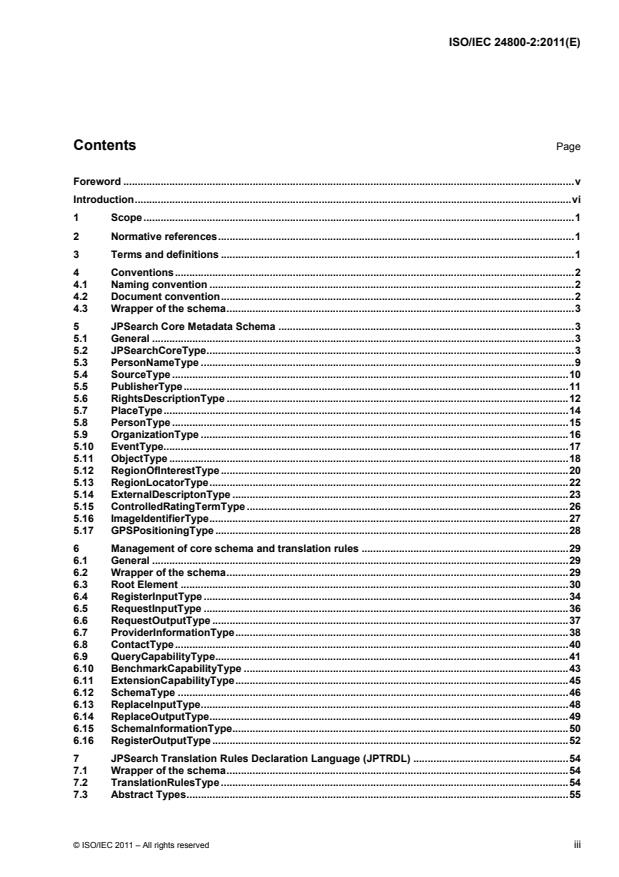
Contents Page
Foreword .v
Introduction.vi
1 Scope.1
2 Normative references.1
3 Terms and definitions .1
4 Conventions.2
4.1 Naming convention .2
4.2 Document convention.2
4.3 Wrapper of the schema.3
5 JPSearch Core Metadata Schema .3
5.1 General .3
5.2 JPSearchCoreType.3
5.3 PersonNameType .9
5.4 SourceType .10
5.5 PublisherType.11
5.6 RightsDescriptionType .12
5.7 PlaceType.14
5.8 PersonType .15
5.9 OrganizationType .16
5.10 EventType.17
5.11 ObjectType .18
5.12 RegionOfInterestType.20
5.13 RegionLocatorType.22
5.14 ExternalDescriptonType .23
5.15 ControlledRatingTermType .26
5.16 ImageIdentifierType.27
5.17 GPSPositioningType .28
6 Management of core schema and translation rules .29
6.1 General .29
6.2 Wrapper of the schema.29
6.3 Root Element .30
6.4 RegisterInputType .34
6.5 RequestInputType .36
6.6 RequestOutputType .37
6.7 ProviderInformationType.38
6.8 ContactType.40
6.9 QueryCapabilityType.41
6.10 BenchmarkCapabilityType .43
6.11 ExtensionCapabilityType.45
6.12 SchemaType .46
6.13 ReplaceInputType.48
6.14 ReplaceOutputType.49
6.15 SchemaInformationType.50
6.16 RegisterOutputType .52
7 JPSearch Translation Rules Declaration Language (JPTRDL) .54
7.1 Wrapper of the schema.54
7.2 TranslationRulesType.54
7.3 Abstract Types.55
© ISO/IEC 2011 – All rights reserved iii
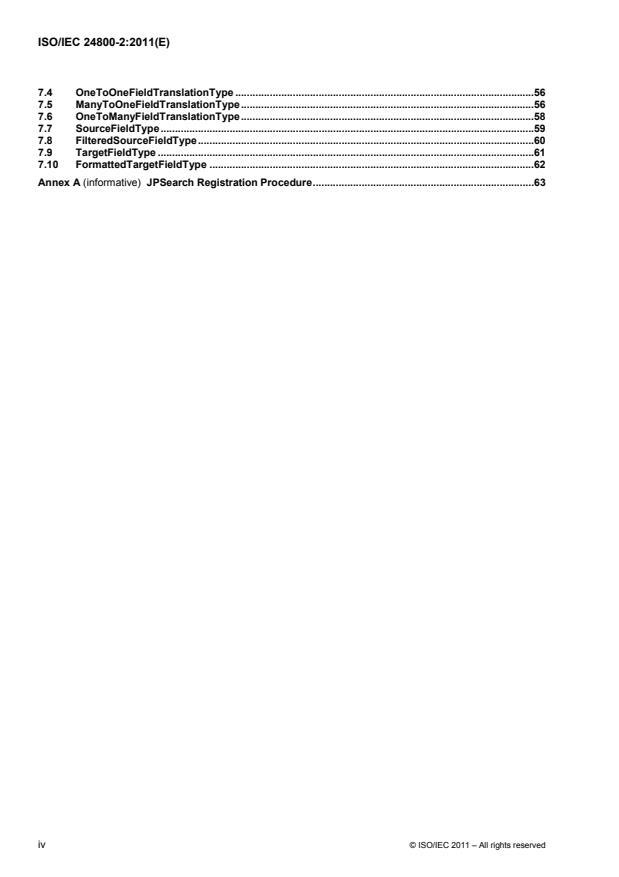
7.4 OneToOneFieldTranslationType .56
7.5 ManyToOneFieldTranslationType.56
7.6 OneToManyFieldTranslationType.58
7.7 SourceFieldType.59
7.8 FilteredSourceFieldType.60
7.9 TargetFieldType .61
7.10 FormattedTargetFieldType .62
Annex A (informative) JPSearch Registration Procedure.63
iv © ISO/IEC 2011 – All rights reserved
Foreword
ISO (the International Organization for Standardization) and IEC (the International Electrotechnical
Commission) form the specialized system for worldwide standardization. National bodies that are members of
ISO or IEC participate in the development of International Standards through technical committees
established by the respective organization to deal with particular fields of technical activity. ISO and IEC
technical committees collaborate in fields of mutual interest. Other international organizations, governmental
and non-governmental, in liaison with ISO and IEC, also take part in the work. In the field of information
technology, ISO and IEC have established a joint technical committee, ISO/IEC JTC 1.
International Standards are drafted in accordance with the rules given in the ISO/IEC Directives, Part 2.
The main task of the joint technical committee is to prepare International Standards. Draft International
Standards adopted by the joint technical committee are circulated to national bodies for voting. Publication as
an International Standard requires approval by at least 75 % of the national bodies casting a vote.
Attention is drawn to the possibility that some of the elements of this document may be the subject of patent
rights. ISO and IEC shall not be held responsible for identifying any or all such patent rights.
ISO/IEC 24800-2 was prepared by Joint Technical Committee ISO/IEC JTC 1, Information technology,
Subcommittee SC 29, Coding of audio, picture, multimedia and hypermedia information.
ISO/IEC 24800 consists of the following parts, under the general title Information technology — JPSearch:
⎯ Part 1: System framework and components
⎯ Part 2: Registration, identification and management of schema and ontology
⎯ Part 3: Query format
⎯ Part 4: File format for metadata embedded in image data (JPEG and JPEG 2000)
⎯ Part 5: Data interchange format between image repositories
⎯ Part 6: Reference software
© ISO/IEC 2011 – All rights reserved v
Introduction
This part of ISO/IEC 24800 provides a standardized set of technologies for metadata representation, querying
and management of images. It specifies the JPSearch’s Core Metadata Schema as the cornerstone of
metadata interoperability in ISO/IEC 24800. It also specifies the structure and rules to which any metadata
annotation of images must conform in order to be considered valid within a JPSearch compliant system.
In addition to the definition of JPSearch Core Metadata Schema, ISO/IEC 24800 provides a mechanism which
allows a JPSearch compliant system taking profit from proprietary or community-specific metadata schemas.
A translation rules language is defined, allowing the publication of machine-readable translations between
metadata terms belonging to proprietary metadata schemas and metadata terms in the JPSearch Core
Metadata Schema. Users can choose which metadata language to use in a JPSearch-based interaction
(annotation, querying, etc.) if the proper translations are available.
In order to specify the issues in a detailed manner in this document, this part of ISO/IEC 24800 first provides
the fundamental information including scope definition, description of terms and definitions, and conventions
that are necessary to understand this document. The definition of JPSearch Core Metadata Schema is
described in the context of XML structure. Management of information regarding other metadata schema is
also described in respect of registration, maintenance, and translation rules.
vi © ISO/IEC 2011 – All rights reserved
INTERNATIONAL STANDARD ISO/IEC 24800-2:2011(E)
Information technology — JPSearch —
Part 2:
Registration, identification and management of schema and
ontology
1 Scope
This part of ISO/IEC 24800 specifies a series of interfaces to allow disparate systems an interoperable
management of image repositories. It also specifies the general rules which govern the usage of metadata in
JPSearch and provides a specification which
⎯ provides rules for the representation of image metadata descriptions, consisting of the definition of the
JPSearch Core Metadata Schema,
⎯ provides rules for the publication of machine-readable translations between metadata terms belonging to
proprietary metadata schemas and metadata terms in the JPSearch Core Metadata Schema, and
⎯ provides rules for the registration and request of metadata schemas and its translation rules or links to
them.
JPSearch is an extensible standard. The normative method of extending the structures and rules beyond the
JPSearch Core Metadata Schema is provided in this part of ISO/IEC 24800.
2 Normative references
The following referenced documents are indispensable for the application of this document. For dated
references, only the edition cited applies. For undated references, the latest edition of the referenced
document (including any amendments) applies.
XML, Extensible Markup Language (XML) 1.0 (Fifth Edition), 26 November 2008, available at
http://www.w3.org/TR/xml/
XML Schema Part 1: Structures Second Edition, W3C Recommendation, 28 October 2004, available at
http://www.w3.org/TR/xmlschema-1/
XML Schema Part 2: Datatypes Second Edition, W3C Recommendation, 28 October 2004, available at
http://www.w3.org/TR/xmlschema-2/
XPath, XML Path Language, W3C Recommendation, 16 November 1999, available at
http://www.w3.org/TR/xpath
NOTE These documents are maintained by the W3C (http://www.w3.org).
3 Terms and definitions
For the purposes of this document, the following terms and definitions apply.
© ISO/IEC 2011 – All rights reserved 1
3.1
Core schema
metadata basis supporting interoperability during search among multiple image retrieval systems
NOTE The core schema is used by clients to formulate in combination with the JPEG Query Format search requests
to JPSearch compliant search systems. Note, that only metadata described by the core schema is guaranteed to be
processed by JPSearch compliant systems.
3.2
Translation rules
machine-readable declaration of the semantic and syntactic mappings between a proprietary metadata
schema and the JPSearch’s core metadata schema
3.3
JPSearch registration authority
Organization that supports the registration and request of metadata schemas and its translation rules or links
to them
NOTE It is necessary that every participating content provider registers their schema and translation rules or a link to
them at this authority. In case the JPSearch compliant retrieval system is operated in offline mode, the necessary
information (target schema, translation rules, etc.) should be available at the respective system itself.
4 Conventions
4.1 Naming convention
In order to specify the JPSearch Core metadata description scheme, this Part of ISO/IEC 24800 uses
constructs provided by XML such as "element" and "complexType." The names associated to these
constructs are created on the basis of the following conventions:
If the name is composed of multiple words, the first letter of each word is capitalized, with the exception that
the capitalization of the first word depends on the type of construct and is described below.
z Element naming: the first letter of the first word is capitalized (e.g. Identifier element of
JPSearchCoreType).
z Attribute naming: the first letter of the first word is not capitalized (e.g. jpsearchID attribute of
ManagementType type).
z complexType naming: the first letter of the first word is capitalized, and the suffix "Type" is used at the
end of the name (e.g. JPSearchCoreType).
z simpleType naming: the first letter of the first word is not capitalized, the suffix "Type" may be used at the
end of the name (e.g. xPathType).
4.2 Document convention
The syntax of each description is specified using the constructs provided by XML as defined in XML, XML
Schema Part 1, and XML Schema Part 2, and is presented in this document using a specific font and
background as shown in the following example:
2 © ISO/IEC 2011 – All rights reserved
The semantics of each description tool is specified in text using a table format, where each row contains the
name and a definition of a type, element or attribute as shown in the following example:
Name Definition
ExampleType Specifies an …
element1 Describes the …
attribute1 Describes the …
4.3 Wrapper of the schema
The description examples and syntax of description tools specified in this document assume that a schema
wrapper is provided which identifies the XML Schema namespace (XML Schema) and JPSearch namespace:
xmlns:JPCore="JPSearch:schema:coremetadata"
targetNamespace="JPSearch:schema:coremetadata"
elementFormDefault="qualified"
attributeFormDefault="unqualified">
The following tag is used to close the schema:
5 JPSearch Core Metadata Schema
5.1 General
This clause targets on the definition of the complex types for the registration process of the schema, its
translation rules and contact information. The process of registration is mandatory for all schemas that can be
addressed within a retrieval operation. The standard supports two scenarios. First, a global authority for
schemas and their translation rules will be established where all JPSearch compliant retrieval applications can
obtain the necessary information. The list of ISO registration authorities is listed at
http://www.iso.org/iso/maintenance_agencies. Second, in case the retrieval application operates in offline
mode, the schema and their translation rules shall be located at the application itself.
JPSearch Core Metadata Schema contains four types: PersonNameType, SourceType,
PublisherType and JPSearchCoreType. Moreover, in order to support JPSearchCoreType,
several types are defined: RightsDescriptionType, PlaceType, PersonType,
OrganizationType, EventType, ObjectType, RegionOfInterestType, RegionLocatorType,
ExternalDescriptionType, ControlledRatingTermType, ImageIdentifierType and
GPSPositionType.
5.2 JPSearchCoreType
5.2.1 Introduction
The JPSearchCoreType type is devised in order to describe the information about an image in metadata
layer. At the same time, as JPSearch core metadata is utilized for image search among the set of images that
are described by using heterogeneous metadata schemes, JPSearchCoreType contains the most
important fields in JPSearch core metadata.
© ISO/IEC 2011 – All rights reserved 3
Figure 1 — Diagram representing the JPSearchCoreType
5.2.2 Syntax
minOccurs="0"/>
minOccurs="0" maxOccurs="unbounded"/>
minOccurs="0" maxOccurs="unbounded"/>
minOccurs="0" maxOccurs="unbounded"/>
4 © ISO/IEC 2011 – All rights reserved
minOccurs="0"/>
minOccurs="0"/>
minOccurs="0"/>
type="JPCore:RightsDescriptionType"
minOccurs="0"/>
minOccurs="0" maxOccurs="unbounded"/>
maxOccurs="unbounded"/>
maxOccurs="unbounded"/>
minOccurs="0"/>
type="JPCore:ControlledRatingTermType"
minOccurs="0"/>
type="JPCore:ImageIdentifierType" minOccurs="0"/>
type="JPCore:GPSPositioningType" minOccurs="0"/>
type="JPCore:RegionOfInterestType" minOccurs="0"
maxOccurs="unbounded"/>
5.2.3 Semantic
Semantics of the JPSearchCoreType type:
Name Definition
JPSearchCoreType Specifies information for an image.
Identifier
Describes an identifier of the image in the form of a URI. The
identifier must be unique.
Modifiers Describes a modifier’s name or a list of names who changed
the original image resulting in the creation of the image
(optional).
Creators
Describes a person’s name or a list of the names who created
the image or made contributions in the creation of the image
(optional).
Publisher Describes information about the publishing people or
organization of the image
© ISO/IEC 2011 – All rights reserved 5
CreationDate
Describes the date when the image is created.
ModifiedDate
Describes the date when the image is modified.
Description
Specifies the content of the image in the form of text.
RightsDescription
Describes the right related information by providing
information about existing rights description standard,
explanation concerning the standard in free text, and rights
description in the form of external information or string value.
Source
Describes a source of the image. It can be another image or
an object in the form of such as painting, book and so on.
Keyword
Describes a list of keywords that characterize the image
(optional).
Title
Describes the title of the image (optional).
CollectionLabel
Describes user provided labels that can be used for the
purpose of collection and categorization of images (optional).
PreferenceValue
Describes the value of the preference of the image in the form
of integer value.
Rating
Describes the rating results that should be one of the
corresponding controlled terms. The definition of the terms is
provided by JPSearch.
OriginalImageIdentifier
Describes the identifier of the original image from which the
image is created. Moreover, it can be used for the identifiers
that can be created by a particular organization or method.
GPSPositioning Describes the location of the place shown in the image
RegionOfInterest
Describes the information (e.g., content description, keywords,
etc.) of a certain region within the image. Note, the whole
image itself can also be described by one
RegionOfInterest.
5.2.4 Example
This example shows a complete description of an imaginary image. It has a unique ID, some modifier, creator
and publisher information. In addition, the creation and modification date have been annotated. Please note,
that subparts of this example are reused at the corresponding type definitions and explained in detail there.
xmlns:xsi="http://www.w3.org/2001/XMLSchema-instance"
xsi:schemaLocation="JPSearch:schema:coremetadata jpcore.xsd">
urn:unique:identifier:1:2:3
6 © ISO/IEC 2011 – All rights reserved
Jonh
Smith
Jonh
Smith
Jonh
Smith
University of Passau
Innstrasse 43, 94034 Passau, Germany
Small city at the border to Austria surrounded
by three rivers
2001-12-17T09:30:47.0Z
2001-12-17T09:30:47.0Z
This is a sample description and this part can contain
an arbitrary unstructured text according to the image
http://www.rdstandard.org
Provides a standard for rights description.
http://www.rdstandard.org/particulaValueRD
Oil Painting
Monna Lisa
Leonardo da Vinci, Louvre, France
Photographing
CN 450D
Sardinia
Italy
50th JPEG meeting
Example Instance document of the JPSearch core schema
JPEG Meetings
1
urn:ratingtable:quality
urn:ratingtable:perfect
© ISO/IEC 2011 – All rights reserved 7
0 0 100 100
A short description about the selected region
plenary meeting
plenary meeting
Jonh
Smith
Laptop
running laptop of UoP
meeting room xyz
meeting room at the sardinia JPEG meeting
writing some document
fromNamespacePrefix="mpeg7">mpeg7:ColorLayout
xsi:schemaLocation="urn:mpeg:mpeg7:schema:2004 M7v2schema.xsd">
1
2
3
1 2
1 2
1 2
640
480
8 © ISO/IEC 2011 – All rights reserved
5.3 PersonNameType
5.3.1 Introduction
The PersonNameType type support the description of human beings within images or image regions. The
information that can be provided is simplified to GivenName and FamilyName.
5.3.2 Syntax
/>
5.3.3 Semantic
Semantics of the PersonNameType type:
Name Definition
PersonNameType Specifies a list of names that consist of given names or family
names. The constituent names for a person’s name should be
described by using the same language.
GivenName
Describes a given name. A number of given names can be
defined, if necessary.
FamilyName
Describes a family name(optional). A number of family names
can be defined, if necessary.
xml:lang Describes the language used for defined names(optional).
5.3.4 Example
Instances of the PersonNameType are used on several places within the core schema. The following
example shows its use by the Modifiers tag. In general the PersonNameType allows the description of
family- and given names of human beings.
xmlns:xsi="http://www.w3.org/2001/XMLSchema-instance"
xsi:schemaLocation="JPSearch:schema:coremetadata jpcore.xsd">
urn:unique:identifier:1:2:3
Jonh
Smith
© ISO/IEC 2011 – All rights reserved 9
5.4 SourceType
5.4.1 Introduction
The SourceType type specifies the source of the image when the image is created from a pre-existing
artificial work or product such as painting, book, video and so on.
5.4.2 Syntax
minOccurs="0"/>
5.4.3 Semantic
Semantics of the SourceType type:
Name Definition
SourceType
Specifies the SourceType type that is
used for describing the source that is used
for the image.
SourceElementType
Specifies a type of image source that can
be an original image or an object in the
form such as painting, book, image and so
on.
SourceElementObject
Describes the source element(s) that is
used for creation of the image. In the case
that the image is created by using multiple
source elements, each source element is
described in a SourceElement field.
SourceElementTitle
Specifies a title for the source element
being used.
10 © ISO/IEC 2011 – All rights reserved
SourceElementDescription
Describes information for the source
element that is used for creation of the
image such as location, contact point, and
so on.
SourceElementIdentifier
Specifies the identifier for the source
element if exists.
CreationMethod Specifies the method that is used for
creation of the image. Recommended
values for this field are Photographing, Film
Scanning, Reflection Print Scanning, Video
Still Capturing, and Computer Graphic
Editing.
CreationDescription
Describes the information about the
creation of the image. Or it can describe the
technical information that is necessary for
the production work of the image such as
workflow parameters.
5.4.4 Example
This example shows the image created from an oil painting ‘Monna Lisa’ by photographing. The painting is
created by ‘Leonardo da Vinci’ and is kept in ‘Louvre, France’. The camera used for the production is ‘CN
450D’.
xmlns:xsi="http://www.w3.org/2001/XMLSchema-instance"
xsi:schemaLocation="JPSearch:schema:coremetadata jpcore.xsd">
urn:unique:identifier:1:2:3
Jonh
Smith
5.5 PublisherType
5.5.1 Introduction
The PublisherType type supports the description of information about the publisher which can be any
public or private organization or person.
5.5.2 Syntax
type="JPCore:OrganizationType"/>
© ISO/IEC 2011 – All rights reserved 11
5.5.3 Semantic
Semantics of the PublisherType type:
Name Definition
PublisherType
Specifies information of the publisher for the image. No
information can be defined. The publisher information can be
either in the form of person’s name or organization’s
description.
PersonName
Describes a publisher in the form of a person’s name.
OrganizationInformation
Describes a publishing organization.
5.5.4 Example
This example describes the information given for the publisher of an image. It supports the annotation of an
organization and/or a human being.
xmlns:xsi="http://www.w3.org/2001/XMLSchema-instance"
xsi:schemaLocation="JPSearch:schema:coremetadata jpcore.xsd">
urn:unique:identifier:1:2:3
Jonh
Smith
University of Passau
Innstrasse 43, 94034 Passau, Germany
Small city at the border to Austria surrounded
by three rivers
5.6 RightsDescriptionType
5.6.1 Introduction
The RightsDescriptionType type is used to provide information about rights description standard and
corresponding rights description. Among the information, a URN value is necessary for the existing rights
description standard. In addition, free text to describe the standard might be provided. Actual rights description
based on the specified standard would be provided using either reference external file or embedding the
description itself as a string. Existence of the rights description itself might be optional.
12 © ISO/IEC 2011 – All rights reserved
5.6.2 Syntax
minOccurs="1" maxOccurs="1"/>
minOccurs="1" maxOccurs="1"/>
5.6.3 Semantics
Semantics of the RightsDescriptionType type:
5.6.4 Example
Name Definition
RightsDescriptionInform Specifies the location where the rights description standard is
ation provided.
Description
Describes the rights description standard in the form of free text.
Specifies an external file that includes the actual rights description.
ActualRightsDescription
Reference
ActualRightsDescription Specifies the actual rights description.
This example shows the description of a rights description providing the location where the actual rights
description exists.
urn:unique:identifier:1:2:3
http://www.rdstandard.org
Provides a standard for rights description.
http://www.rdstandard.org/particulaValueRD
© ISO/IEC 2011 – All rights reserved 13
5.7 PlaceType
5.7.1 Introduction
The PlaceType type supports the description of locations that are shown in the image or certain regions
thereof.
5.7.2 Syntax
maxOccurs="unbounded"/>
maxOccurs="unbounded"/>
5.7.3 Semantics
Semantics of the PlaceType type:
Name Definition
PlaceType
Specifies the definition of a place description.
Name Specifies the name of the place.
Description
Specifies a description about the place.
5.7.4 Example
This example shows the description of a certain location shown in the image. The PlaceType type is
embedded in the ContentDescription tag which supports the annotation of region specific information.
xmlns:xsi="http://www.w3.org/2001/XMLSchema-instance"
xsi:schemaLocation="JPSearch:schema:coremetadata jpcore.xsd">
0 0 100 100
A short description about the selected region
plenary meeting
plenary meeting
meeting room xyz
meeting room at the sardinia JPEG meeting
14 © ISO/IEC 2011 – All rights reserved
5.8 PersonType
5.8.1 Introduction
The PersonType type describes information about a certain human being shown within an image or a certain
region.
5.8.2 Syntax
minOccurs="0" maxOccurs="unbounded"/>
5.8.3 Semantics
Semantics of the PersonType type:
Name Definition
PersonType Specifies the definition of a person description.
Name Specifies the name of the person.
Affiliation Specifies a description about the affiliation of the person.
Address Specifies the address of the person.
Description Specifies a description of the person.
Nationality Specifies the nationality of the person.
© ISO/IEC 2011 – All rights reserved 15
5.8.4 Example
The following example demonstrates the description of a human being. Information about human beings can
be given within annotated regions by using the ContentDescription tag.
xmlns:xsi="http://www.w3.org/2001/XMLSchema-instance"
xsi:schemaLocation="JPSearch:schema:coremetadata jpcore.xsd">
urn:unique:identifier:1:2:3
0 0 100 100
Jonh
Smith
Innstrasse 43, 94034 Passau, Germany
Small city at the border to Austria
surrounded by three rivers
this is a description of the person
AUT
5.9 OrganizationType
5.9.1 Introduction
The OrganizationType type describes information about a certain organization (e.g., political, cultural,
industry, etc.).
5.9.2 Syntax
minOccurs="0"/>
16 © ISO/IEC 2011 – All rights reserved
5.9.3 Semantics
Semantics of the OrganizationType type:
Name Definition
OrganizationType Specifies the definition of an organization description.
Name
Specifies the name of the organization.
Address Specifies the address of the organization.
5.9.4 Example
The OrganizationType type supports the description of i
...
Questions, Comments and Discussion
Ask us and Technical Secretary will try to provide an answer. You can facilitate discussion about the standard in here.
Loading comments...