

ISO 5194:1981
(Main)Aluminium and aluminium alloys — Determination of zinc content — Flame atomic absorption spectrometric method
General Information
- Abstract
The method is applicable to products having zinc contents between 0,002 and 6 % (m/m). Specifies principle, reagents, apparatus, sampling, procedure, expression of results and test report.
- Status
- Published
- Publication Date
- 31-Oct-1981
- Technical Committee
- ISO/TC 79 - Light metals and their alloys
- Drafting Committee
- ISO/TC 79 - Light metals and their alloys
- Current Stage
- 9093 - International Standard confirmed
- Start Date
- 19-Oct-2022
- Completion Date
- 29-Aug-2026
Buy Documents
ISO 5194:1981 - Aluminium and aluminium alloys — Determination of zinc content — Flame atomic absorption spectrometric method Released:11/1/1981
ISO 5194:1981 - Aluminium et alliages d'aluminium — Dosage du zinc — Méthode par spectrométrie d'absorption atomique dans la flamme Released:11/1/1981
ISO 5194:1981 - Aluminium et alliages d'aluminium — Dosage du zinc — Méthode par spectrométrie d'absorption atomique dans la flamme Released:11/1/1981
Overview
ISO 5194:1981, published by the International Organization for Standardization (ISO), defines a precise method for determining zinc content in aluminium and aluminium alloys using the flame atomic absorption spectrometric method. Applicable to a wide range of products where zinc concentrations fall between 0.002% and 6% (m/m), this standard establishes uniform guidelines for laboratory analysis. The document outlines key steps, including sample preparation, use of specific reagents, analytical procedures, result expression, and reporting requirements. Adhering to ISO 5194 ensures accurate and internationally comparable assessments of zinc in aluminium products.
Key Topics
Scope and Applicability
- Analysis for zinc levels between 0.002% and 6% (m/m) in aluminium and its alloys.
- Covers solid product forms produced by milling or drilling.
Principle of the Method
- Dissolution of a test sample in hydrochloric acid and hydrogen peroxide.
- Aspiration of the solution into an air-acetylene flame, followed by zinc quantification using atomic absorption spectrometry at ~213.9 nm.
Required Materials and Equipment
- Pure reagents (hydrochloric acid, hydrogen peroxide, sulphuric acid, hydrofluoric acid, and nitric acid).
- Atomic absorption spectrometer with an air-acetylene burner and a zinc hollow-cathode lamp.
Sampling and Calibration
- Guidelines for preparing laboratory and test samples ensuring reliability and repeatability.
- Preparation and use of calibration curves with standard zinc solutions to ensure measurement accuracy across different zinc concentrations.
Analytical Procedure
- Detailed steps for dissolving the test portion, handling potential undissolved residues (e.g., silicon), and preparing solutions for analysis.
- Use of blank tests to account for possible contamination or reagent-based zinc content.
Expression and Reporting of Results
- Prescribed formulas for calculating zinc content, including considerations for dilution and blanks.
- Comprehensive requirements for documenting and reporting results to maintain traceability and transparency.
Applications
Quality Control in Aluminium Production
- Ensures that the zinc content in aluminium alloys meets product specifications for strength, corrosion resistance, or other performance criteria.
- Used routinely in primary aluminum production, recycling, and downstream manufacturing quality assurance.
Research and Development
- Enables material scientists and engineers to evaluate zinc's effects on aluminium alloy properties.
- Critical in developing new aluminium alloys with specific mechanical or chemical characteristics.
Regulatory Compliance and Certification
- Supports manufacturers and laboratories in meeting national and international standards for chemical composition.
- Facilitates third-party certification, harmonization of trade, and global market access for aluminum products.
Failure Analysis and Remediation
- Assists in investigating product failures where zinc content may play a role, supporting root-cause analysis.
Related Standards
- ISO 209: Aluminium and aluminium alloys - Chemical composition
- ISO 1553: Aluminium and aluminium alloys - Determination of magnesium content - Flame atomic absorption spectrometric method
- ISO 806: Aluminium and aluminium alloys - Determination of copper content
- ISO 5721: Aluminium and aluminium alloys - Determination of titanium content - Flame atomic absorption spectrometric method
Following ISO 5194:1981 is essential for analytical laboratories, quality assurance teams, and manufacturers working with aluminium alloys, providing a robust, internationally recognized protocol for zinc determination using atomic absorption spectrometry. This supports precision, reliability, and comparability in aluminium industry practices worldwide.
Relations
- Effective Date
- 15-Apr-2008
Buy Documents
ISO 5194:1981 - Aluminium and aluminium alloys — Determination of zinc content — Flame atomic absorption spectrometric method Released:11/1/1981
ISO 5194:1981 - Aluminium et alliages d'aluminium — Dosage du zinc — Méthode par spectrométrie d'absorption atomique dans la flamme Released:11/1/1981
ISO 5194:1981 - Aluminium et alliages d'aluminium — Dosage du zinc — Méthode par spectrométrie d'absorption atomique dans la flamme Released:11/1/1981
Get Certified
Connect with accredited certification bodies for this standard

Element Materials Technology
Materials testing and product certification.

Inštitut za kovinske materiale in tehnologije
Institute of Metals and Technology. Materials testing, metallurgical analysis, NDT.
Sponsored listings
Frequently Asked Questions
ISO 5194:1981 is a standard published by the International Organization for Standardization (ISO). Its full title is "Aluminium and aluminium alloys — Determination of zinc content — Flame atomic absorption spectrometric method". This standard covers: The method is applicable to products having zinc contents between 0,002 and 6 % (m/m). Specifies principle, reagents, apparatus, sampling, procedure, expression of results and test report.
The method is applicable to products having zinc contents between 0,002 and 6 % (m/m). Specifies principle, reagents, apparatus, sampling, procedure, expression of results and test report.
ISO 5194:1981 is classified under the following ICS (International Classification for Standards) categories: 77.120.10 - Aluminium and aluminium alloys. The ICS classification helps identify the subject area and facilitates finding related standards.
ISO 5194:1981 has the following relationships with other standards: It is inter standard links to ISO 2637:1973. Understanding these relationships helps ensure you are using the most current and applicable version of the standard.
ISO 5194:1981 is available in PDF format for immediate download after purchase. The document can be added to your cart and obtained through the secure checkout process. Digital delivery ensures instant access to the complete standard document.
Standards Content (Sample)
International Standard
INTERNATIONAL ORGANIZATION FOR STANDARDIZATION.ME~YHAPO,IJHAR OPl-AHMJALWlfl fl0 CTAH~APTM3Al.&lM@ORGANISATION INTERNATIONALE DE NORMALISATION
Aluminium and aluminium alloys >- Determination of zinc
- Flame atomic absorption spectrometric
content
method
Aluminium et alliages d’aluminium - Dosage du zinc - M&hode par spectromhie d’absorption atomique dans Ia flamme
First edition - 1981-11-15
Ref. No. ISO 5194-1981 (E)
UDC 669.71 : 543.422 : 546.47
w
-
atomic absorption spectroscopic method.
Descriptors : aluminium, aluminium alloys, Chemical analysis, determination of content, zinc,
Price based on 4 pages’
Foreword
ISO (the International Organization for Standardization) is a worldwide federation of
national Standards institutes (ISO member bedies). The work of developing Inter-
national Standards is carried out through ISO technical committees. Every member
body interested in a subject for which a technical committee has been set up has the
right to be represented on that committee. International organizations, governmental
and non-governmental, in liaison with ISO, also take part in the work.
Draft International Standards adopted by the technical committees are circulated to
the member bodies for approval before their acceptance as International Standards by
the ISO Council.
International Standard ISO 5194 was developed by Technical Committee ISO/TC 79,
Light metals and their alloys, and was circulated to the member bodies in December
1980.
lt has been approved by the member bodies of the following countries :
Australia Hungary South Africa, Rep. of
India Spain
Austria
Italy Sweden
Brazil
Canada Japan Switzerland
Korea, Rep. of United Kingdom
China
Czechoslovakia Norway USA
France Poland USSR
Germany, F. R. Romania
The member body of the following country expressed disapproval of the document on
technical grounds
Netherlands
0 International Organization for Standardization, 1981
Printed in Switzerland
ISO 5194-1981 (EI
INTERNATIONALSTANDARD
Aluminium and aluminium alloys - Determination of zinc
Flame atomic absorption spectrometric
content -
method
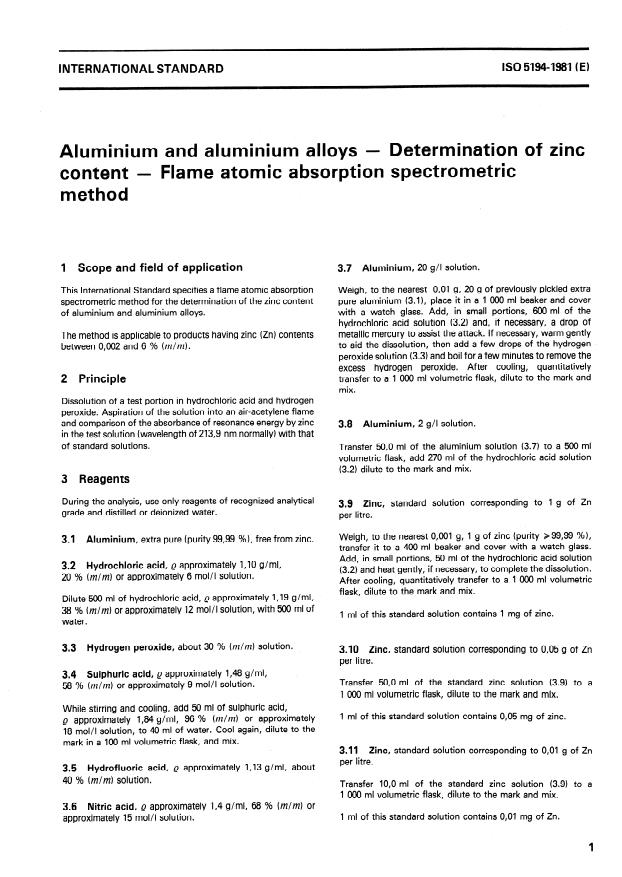
1 Scope and field of application 3.7 Aluminium, 20 g/l Solution.
This International Standard specifies a flame atomic absorption Weigh, to the nearest 0,Ol g, 20 g of previously pickled extra
spectrometric method for the determination of the zinc content pure aluminium (3.1), place it in a 1 000 ml beaker and cover
of aluminium and aluminium alloys. with a watch glass. Add, in small portions, 600 ml of the
hydrochloric acid Solution (3.2) and, if necessary, a drop of
The method is applicable to products having zinc (Zn) contents metallic mercury to assist the attack. lf necessary, warm gently
to aid the dissolution, then add a few drops of the hydrogen
between 0,002 and 6 % (mlm).
peroxide Solution (3.3) and boil for a few minutes to remove the
excess hydrogen Peroxide. After cooling, quantitatively
2 Principle transfer to a 1 000 ml volumetric flask, dilute to the mark and
mix.
Dissolution of a test Portion in hydrochloric acid and hydrogen
Peroxide. Aspiration of the Solution into an air-acetylene flame
and comparison of the absorbance of resonance energy by zinc
3.8 Aluminium, 2 g/l solution.
in the test Solution (wavelength of 213,9 nm normally) with that
of Standard solutions.
Transfer 50,O ml of the aluminium Solution (3.7) to a 500 ml
volumetric flask, add 270 ml of the hydrochloric acid Solution
(3.2) dilute to the mark and mix.
3 Reagents
During the analysis, use only reagents of recognized analytical
3.9 Zinc, Standard Solution corresponding to 1 g of Zn
grade and distilled or deionized water.
per litre.
Weigh, to the nearest 0,001 g, 1 g of zinc (purity 29999 %),
3.1 Aluminium, extra pure (purity 99,99 %), free from zinc.
transfer it to a 400 ml beaker and cover with a watch glass.
Add, in small portions, 50 ml of the hydrochloric acid Solution
3.2 Hydrochlorit acid, Q approximately IJ0 g/ml,
(3.2) and heat gently, if necessary, to complete the dissolution.
20 % (mlm) or approximately 6 mol/1 Solution.
After cooling, quantitatively transfer to a 1 000 ml volumetric
flask, dilute to the mark and mix.
Dilute 500 ml of hydrochloric acid, ,Q approximately 1,19 g/ml,
38 % (mlm) or approximately 12 mol/1 Solution, with 500 ml of
1 ml of this Standard Solution contains 1 mg of zinc.
water.
3.3 Hydrogen Peroxide, about 30 % (mlm) Solution.
3.10 Zinc, Standard Solution corresponding to 0,05 g of Zn
per litre.
3.4 Sulphuric acid, Q approximately 148 g/ml,
Transfer 50,O ml of the Standard zinc Solution (3.9) to a
58 % (mlm) or approximately 9 mol/1 Solution.
1 000 ml volumetric flask, dilute to the mark and mix.
While stirring and cooling, add 50 ml of sulphuric acid,
1 ml of this Standard Solution contains 0,05 mg of zinc.
,Q approximately 1,84 g/ml, 96 % (mlm) or approximately
18 mol/1 Solution, to 40 ml of water. Cool again, dilute to the
mark in a 100 ml volumetric flask, and mix.
3.11 Zinc, Standard Solution corresponding to 0,Ol g of Zn
per litre.
3.5 Hydrofluoric acid, Q approximately 1,13 g/ml, about
40 % (mlm) solution.
Transfer IO,0 ml of the Standard zins solution (3.9) to a
1 000 ml volumetric flask, dilute to the mark and mix.
3.6 Nitrit acid, Q approximately 1,4 g/ml, 68 % (mlm) or
1 ml of this Standard Solution contains 0,Ol mg of Zn.
approximately 15 mol/i Solution.
ISO 5194-1981 (E)
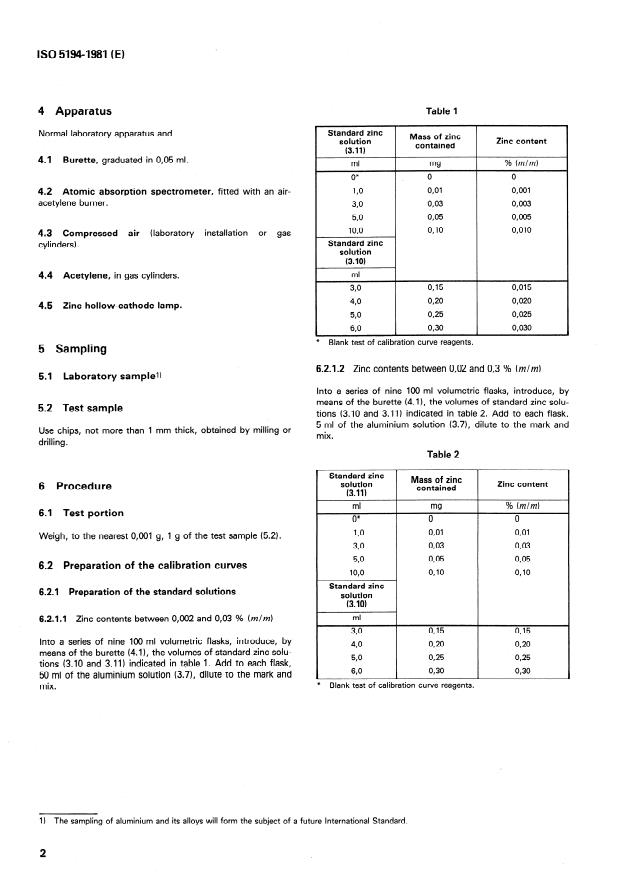
4 Apparatus Table 1
Standard zinc
Normal laboratory apparatus and
Mass of zinc
solution Zinc content
contained
(3.11)
4.1 Burette, graduated in 0,05 ml.
ml % Mm)
mg
0” 0 0
Ir0 0,Ol 0,001
4.2 Atomic absorption spectrometer, fitted with an air-
acetylene burner.
3,o 0,03 0,003
5,o 0,05 0,005
IO,0 0,lO 0,010
4.3 Compressed air (laboratory installation or gas
Standard zinc
cylinders).
solution
(3.10)
ml
4.4 Acetylene, in gas cylinders.
310 0,15 0,015
410 0,20 0,020
4.5 Zinc hollow-cathode lamp.
5,O 0,25 0,025
6,Ci 0,30 0,030
* Blank test of calibration curve reagents.
5 Sampling
6.2.1.2 Zinc contents between 0,02 and 0,3 % (mlm)
5.1 Laboratory samplel)
Into a series of nine 100 ml volumetric flasks, introduce, by
means of the burette (4.1), the volumes of Standard zinc solu-
5.2 Test Sample
tions (3.10 and 3.11) indicated in table 2. Add to each flask,
5 ml of the aluminium Solution (3.7), dilute to the mark and
Use Chips, not more than 1 mm thick, obtained by milling or
mix.
drilling .
Table 2
Zinc content
6 Procedure
ml % bnlm)
I I I
6.1 Test Portion
1,o
Weigh, to the nearest 0,001 g, 1 g of the test Sample (5.2).
3,O
5,O
6.2 Preparation of the calibration curves
Standard zinc
6.2.1 Reparation of the Standard solutions
Solution
(3. IO)
ml
6.2.1.1 Zinc contents between 0,002 and 0,03 % (mlm)
3,O 0,15 0,15
Into a series of nine 100 ml volumetric flasks, introduce, by
4,O 0,20 0,20
means of the burette (4.1), the volumes of Standard zinc solu-
5,O 0,25 0,25
tions (3.10 and 3.11) indicated in table 1. Add to each flask
...
Norme internationale
INTERNATIONAL ORGANIZATION FOR STANDARDIZATION.ME~YHAPOAHAR OPl-AHM3Al.WI IlO CTAH~APTbl3A~l4bWORGANISATION INTERNATIONALE DE NORMALISATION
Aluminium et alliages d’aluminium - Dosage du zinc -
Méthode par spectrométrie d’absorption atomique dans la
flamme
De termina tion of zinc content - Flame atomic absorption spectrometric method
Aluminium and aluminium allo ys -
Première édition - 1981-11-15
CDU 669.71 : 543.422 : 546.47
Réf. no : ISO 5194-1981 (F)
û
Y
Descripteurs : aluminium, alliage d’aluminium, analyse chimique, dosage, zinc, méthode spectroscopique d’absorption atomique.
Prix basé sur 4 pages
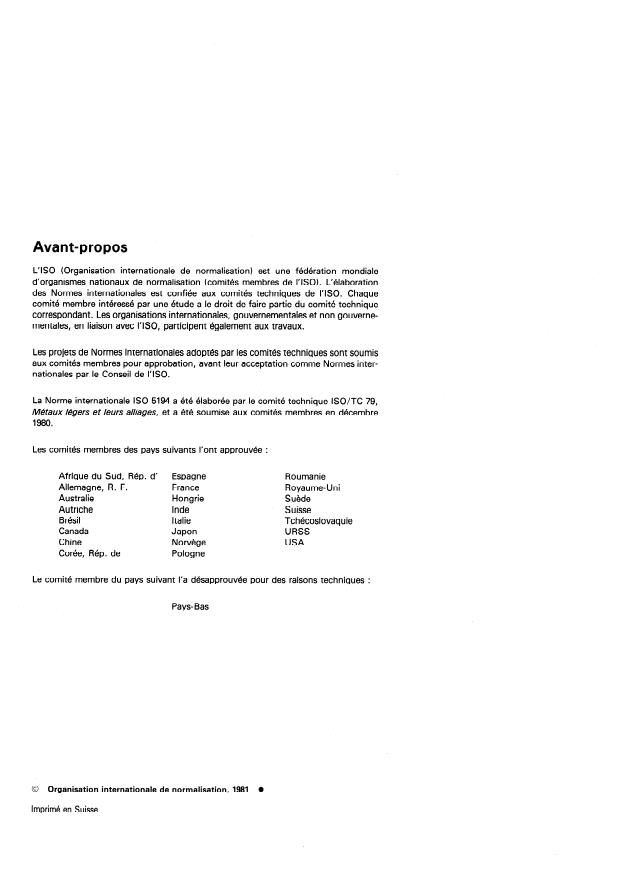
Avant-propos
L’ISO (Organisation internationale de normalisation) est une fédération mondiale
d’organismes nationaux de normalisation (comités membres de I’ISO). L’élaboration
des Normes internationales est confiée aux comités techniques de I’ISO. Chaque
comité membre intéressé par une étude a le droit de faire partie du comité technique
correspondant. Les organisations internationales, gouvernementales et non gouverne-
mentales, en liaison avec I’ISO, participent également aux travaux.
Les projets de Normes internationales adoptés par les comités techniques sont soumis
aux comités membres pour approbation, avant leur acceptation comme Normes inter-
nationales par le Conseil de I’ISO.
La Norme internationale ISO 5194 a été élaborée par le comité technique ISO/TC 79,
M&aux Mgers et leurs alliages, et a été soumise aux comités membres en décembre
1980.
Les comités membres des pays suivants l’ont approuvée :
Roumanie
Afrique du Sud, Rép. d’ Espagne
Allemagne, R. F. France Royaume-Uni
Australie Hongrie Suède
Suisse
Autriche Inde
Brésil Italie Tchécoslovaquie
URSS
Canada Japon
Chine Norvège USA
Corée, Rép. de Pologne
Le comité membre du pays suivant l’a désapprouvée pour des raisons techniques :
Pays- Bas
0 Organisation internationale de normalisation, 1981
imprimé en Suisse
ISO 5194-1981 (F)
NORME INTERNATIONALE
Aluminium et alliages d’aluminium - Dosage du zinc -
Méthode par spectrométrie d’absorption atomique dans la
flamme
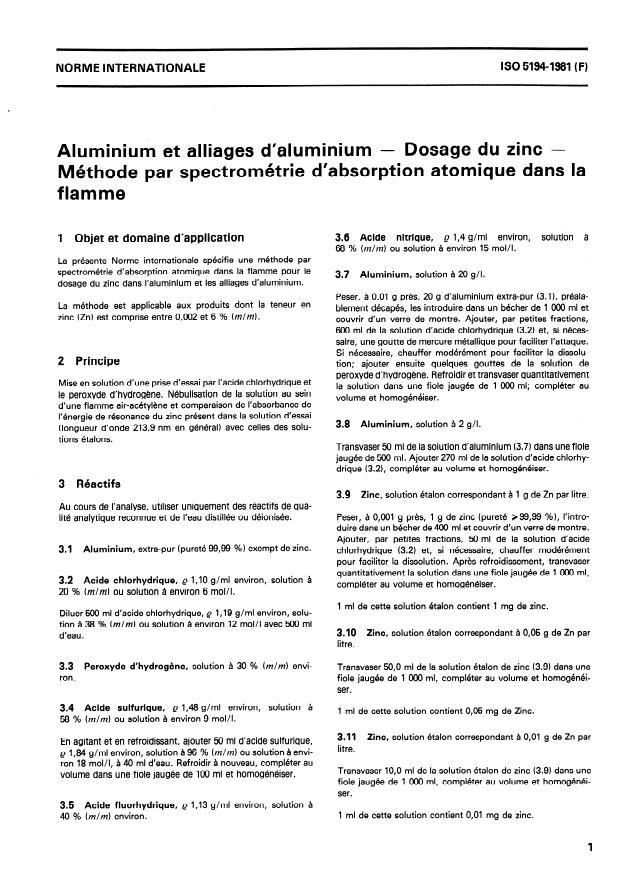
3.6 Acide nitrique, ,Q 1,4 g/ml environ, solution à
1 Objet et domaine d’application
68 % (mlm) ou solution à environ 15 mol/l.
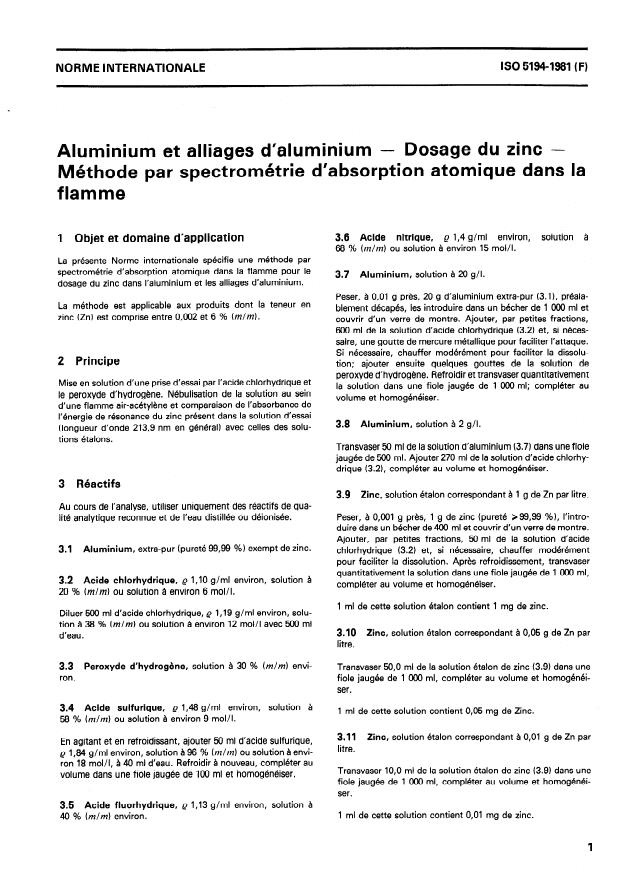
La présente Norme internationale spécifie une méthode par
spectrométrie d’absorption atomique dans la flamme pour le
3.7 Aluminium, solution à 20 g/l.
dosage du zinc dans l’aluminium et les alliages d’aluminium.
Peser, à 0,Ol g près, 20 g d’aluminium extra-pur (3.11, préala-
La méthode est applicable aux produits dont la teneur en
blement décapés, les introduire dans un bécher de 1 000 ml et
zinc (Zn) est comprise entre 0,002 et 6 % (mlm).
couvrir d’un verre de montre. Ajouter, par petites fractions,
600 ml de la solution d’acide chlorhydrique (3.2) et, si néces-
saire, une goutte de mercure métallique pour faciliter l’attaque.
Si nécessaire, chauffer modérément pour faciliter la dissolu-
2 Principe
tion; ajouter ensuite quelques gouttes de la solution de
peroxyde d’hydrogène. Refroidir et transvaser quantitativement
Mise en solution d’une prise d’essai par l’acide chlorhydrique et
la solution dans une fiole jaugée de 1 000 ml; compléter au
le peroxyde d’hydrogène. Nébulisation de la solution au sein
volume et homogénéiser.
d’une flamme air-acétyléne et comparaison de I’absorbance de
l’énergie de résonance du zinc présent dans la solution d’essai
3.8 Aluminium, solution à 2 g/l.
(longueur d’onde 213,9 nm en général) avec celles des solu-
tions étalons.
Transvaser 50 ml de la solution d’aluminium (3.7) dans une fiole
jaugée de 500 ml. Ajouter 270 ml de la solution d’acide chlorhy-
drique (3.2), compléter au volume et homogénéiser.
3 Réactifs
3.9 Zinc, solution étalon correspondant à 1 g de Zn par litre.
Au cours de l’analyse, utiliser uniquement des réactifs de qua-
Peser, à 0,001 g prés, 1 g de zinc (pureté >99,99 %), I’intro-
lité analytique reconnue et de l’eau distillée ou déionisée.
duire dans un bécher de 400 ml et couvrir d’un verre de montre.
Ajouter, par petites fractions, 50 ml de la solution d’acide
3.1 Aluminium, extra-pur (pureté 9999 %) exempt de zinc.
chlorhydrique (3.2) et, si nécessaire, chauffer modérement
pour faciliter la dissolution. Après refroidissement, transvaser
quantitativement la solution dans une fiole jaugée de 1 000 ml,
3.2 Acide chlorhydrique, Q 1,lO g/ml environ, solution à
compléter au volume et homogénéiser.
20 % (mlm) ou solution à environ 6 mol/l.
1 ml de cette solution etalon contient 1 mg de zinc.
Diluer 500 ml d’acide chlorhydrique, Q 1,19 g/ml environ, solu-
tion a 38 % (mlm) ou solution à environ 12 mol/1 avec 500 ml
3.10 Zinc, solution étalon correspondant à 0,05 g de Zn par
d’eau.
litre.
3.3 Peroxyde d’hydrogène, solution à 30 % (mlm) envi- Transvaser 50,O ml de la solution étalon de zinc (3.9) dans une
ron.
fiole jaugée de 1 000 ml, compléter au volume et homogénéi-
ser.
3.4 Acide sulfurique, ,Q 1,48 g/ml environ, solution à
1 ml de cette solution contient 0,05 mg de Zinc.
58 % (mlm) ou solution à environ 9 mol/l.
3.11 Zinc, solution étalon correspondant à 0,Ol g de Zn par
En agitant et en refroidissant, ajouter 50 ml d’acide sulfurique,
litre.
e 1,84 g/ml environ, solution à 96 % (mlm) ou solution à envi-
ron 18 mol/l, à 40 ml d’eau. Refroidir à nouveau, compléter au
Transvaser 10,O ml de la solution étalon de zinc (3.9) dans une
volume dans une fiole jaugée de 100 ml et homogénéiser.
fiole jaugée de 1 000 ml, compléter au volume et homogénéi-
ser.
3.5 Acide fluorhydrique, ,Q 1,13 g/ml environ, solution à
1 ml de cette solution contient 0,Ol mg de zinc.
40 % (mlm) environ.
ISO 5194-1981 (FI
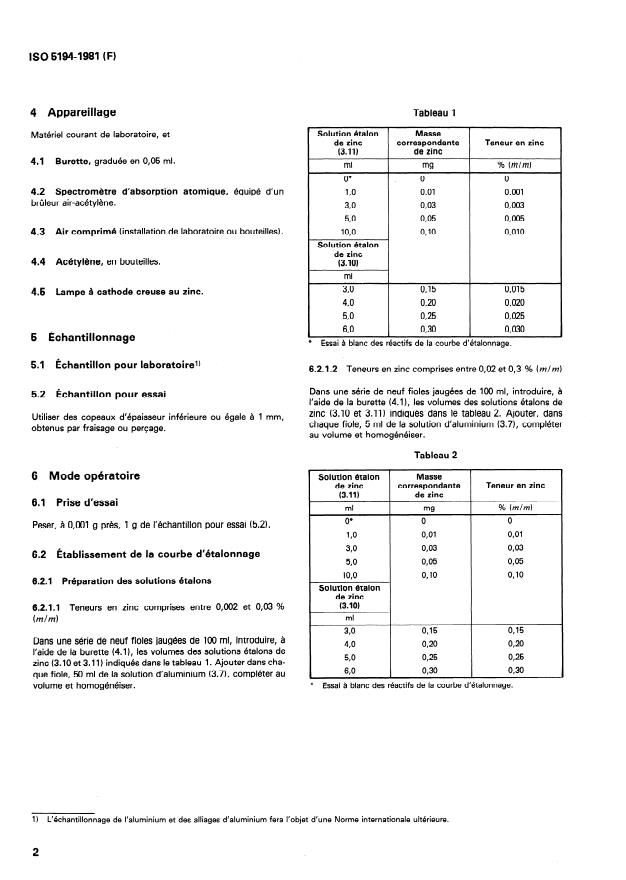
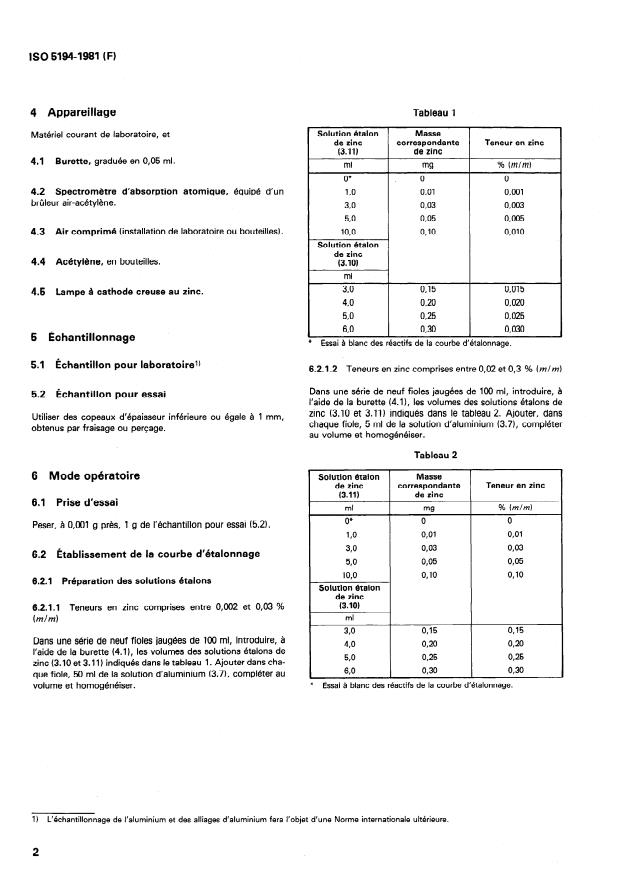
4 Appareillage Tableau 1
Solution étalon Masse
Matériel courant de laboratoire, et
de zinc correspondante Teneur en zinc
(3.11) de zinc
4.1 Burette, graduée en 0,05 ml.
ml % b?7lm)
mg
0” 0 0
4.2 Spectromètre d’absorption atomique, équipé d’un LO 0,Ol 0,001
brûleur air-acétylène.
310 0,03 0,003
5,O 0,05 0,005
4.3 Air comprimé (installation de laboratoire ou bouteilles).
10,o 0,lO 0,010
Solution etalon
de zinc
4.4 Acétylène, en bouteilles.
(3.10)
ml
3,O 0,15 0,015
4.5 Lampe à cathode creuse au zinc.
410 0,20 0,020
5,O 0,25 0,025
60 0,30 0,030
5 Échantillonnage
* Essai à blanc des réactifs de la courbe d’étalonnage.
5.1 Échantillon pour laboratoirel)
6.2.1.2 Teneurs en zinc comprises entre 0,02 et 0,3 % (mlm)
Dans une série de neuf fioles jaugées de 100 ml, introduire, à
5.2 Échantillon pour essai
l’aide de la burette (4.11, les volumes des solutions étalons de
zinc (3.10 et 3.11) indiqués dans le tableau 2. Ajouter, dans
Utiliser des copeaux d’épaisseur inférieure ou égale à 1 mm,
chaque fiole, 5 ml de la solution d’aluminium (3.71, compléter
obtenus par fraisage ou perçage.
au volume et homogénéiser.
Tableau 2
,
6 Mode opératoire Solution étalon Masse
correspondante Teneur en zinc
de zinc
de zinc
(3.11)
6.1 Prise d’essai
ml % hzlm)
mg
0” 0 0
Peser, à 0,001 g près, 1 g de l’échantillon pour essai (5.2).
0,Ol 0,Ol
1,o
0,03 0,03
3,O
6.2 Établissement de la courbe d’étalonnage
0,05 0,05
5,O
0,lO
10,o 0,lO
6.2.1 Préparation des solutions étalons
Solution 6talon
de zinc
(3.10)
6.2.1.1 Teneurs en zinc comprises entre 0,002 et 0,03 %
ml
(mlm)
m
0,15 0,15
3,O
Dans une série de neuf fioles jaugées de 100 ml, introduire, à
0,20 0,20
4,O
l’aide de la burette (4.11, les volumes des solutions étalons de
0,25 0,25
5,O
zinc (3.10 et 3.11) indiqués dans le tableau 1. Ajouter dans cha-
0,30
0,30
que fiole, 50 ml de la solution d’aluminium (3.71, compléter au
* Essai à
...
Norme internationale
INTERNATIONAL ORGANIZATION FOR STANDARDIZATION.ME~YHAPOAHAR OPl-AHM3Al.WI IlO CTAH~APTbl3A~l4bWORGANISATION INTERNATIONALE DE NORMALISATION
Aluminium et alliages d’aluminium - Dosage du zinc -
Méthode par spectrométrie d’absorption atomique dans la
flamme
De termina tion of zinc content - Flame atomic absorption spectrometric method
Aluminium and aluminium allo ys -
Première édition - 1981-11-15
CDU 669.71 : 543.422 : 546.47
Réf. no : ISO 5194-1981 (F)
û
Y
Descripteurs : aluminium, alliage d’aluminium, analyse chimique, dosage, zinc, méthode spectroscopique d’absorption atomique.
Prix basé sur 4 pages
Avant-propos
L’ISO (Organisation internationale de normalisation) est une fédération mondiale
d’organismes nationaux de normalisation (comités membres de I’ISO). L’élaboration
des Normes internationales est confiée aux comités techniques de I’ISO. Chaque
comité membre intéressé par une étude a le droit de faire partie du comité technique
correspondant. Les organisations internationales, gouvernementales et non gouverne-
mentales, en liaison avec I’ISO, participent également aux travaux.
Les projets de Normes internationales adoptés par les comités techniques sont soumis
aux comités membres pour approbation, avant leur acceptation comme Normes inter-
nationales par le Conseil de I’ISO.
La Norme internationale ISO 5194 a été élaborée par le comité technique ISO/TC 79,
M&aux Mgers et leurs alliages, et a été soumise aux comités membres en décembre
1980.
Les comités membres des pays suivants l’ont approuvée :
Roumanie
Afrique du Sud, Rép. d’ Espagne
Allemagne, R. F. France Royaume-Uni
Australie Hongrie Suède
Suisse
Autriche Inde
Brésil Italie Tchécoslovaquie
URSS
Canada Japon
Chine Norvège USA
Corée, Rép. de Pologne
Le comité membre du pays suivant l’a désapprouvée pour des raisons techniques :
Pays- Bas
0 Organisation internationale de normalisation, 1981
imprimé en Suisse
ISO 5194-1981 (F)
NORME INTERNATIONALE
Aluminium et alliages d’aluminium - Dosage du zinc -
Méthode par spectrométrie d’absorption atomique dans la
flamme
3.6 Acide nitrique, ,Q 1,4 g/ml environ, solution à
1 Objet et domaine d’application
68 % (mlm) ou solution à environ 15 mol/l.
La présente Norme internationale spécifie une méthode par
spectrométrie d’absorption atomique dans la flamme pour le
3.7 Aluminium, solution à 20 g/l.
dosage du zinc dans l’aluminium et les alliages d’aluminium.
Peser, à 0,Ol g près, 20 g d’aluminium extra-pur (3.11, préala-
La méthode est applicable aux produits dont la teneur en
blement décapés, les introduire dans un bécher de 1 000 ml et
zinc (Zn) est comprise entre 0,002 et 6 % (mlm).
couvrir d’un verre de montre. Ajouter, par petites fractions,
600 ml de la solution d’acide chlorhydrique (3.2) et, si néces-
saire, une goutte de mercure métallique pour faciliter l’attaque.
Si nécessaire, chauffer modérément pour faciliter la dissolu-
2 Principe
tion; ajouter ensuite quelques gouttes de la solution de
peroxyde d’hydrogène. Refroidir et transvaser quantitativement
Mise en solution d’une prise d’essai par l’acide chlorhydrique et
la solution dans une fiole jaugée de 1 000 ml; compléter au
le peroxyde d’hydrogène. Nébulisation de la solution au sein
volume et homogénéiser.
d’une flamme air-acétyléne et comparaison de I’absorbance de
l’énergie de résonance du zinc présent dans la solution d’essai
3.8 Aluminium, solution à 2 g/l.
(longueur d’onde 213,9 nm en général) avec celles des solu-
tions étalons.
Transvaser 50 ml de la solution d’aluminium (3.7) dans une fiole
jaugée de 500 ml. Ajouter 270 ml de la solution d’acide chlorhy-
drique (3.2), compléter au volume et homogénéiser.
3 Réactifs
3.9 Zinc, solution étalon correspondant à 1 g de Zn par litre.
Au cours de l’analyse, utiliser uniquement des réactifs de qua-
Peser, à 0,001 g prés, 1 g de zinc (pureté >99,99 %), I’intro-
lité analytique reconnue et de l’eau distillée ou déionisée.
duire dans un bécher de 400 ml et couvrir d’un verre de montre.
Ajouter, par petites fractions, 50 ml de la solution d’acide
3.1 Aluminium, extra-pur (pureté 9999 %) exempt de zinc.
chlorhydrique (3.2) et, si nécessaire, chauffer modérement
pour faciliter la dissolution. Après refroidissement, transvaser
quantitativement la solution dans une fiole jaugée de 1 000 ml,
3.2 Acide chlorhydrique, Q 1,lO g/ml environ, solution à
compléter au volume et homogénéiser.
20 % (mlm) ou solution à environ 6 mol/l.
1 ml de cette solution etalon contient 1 mg de zinc.
Diluer 500 ml d’acide chlorhydrique, Q 1,19 g/ml environ, solu-
tion a 38 % (mlm) ou solution à environ 12 mol/1 avec 500 ml
3.10 Zinc, solution étalon correspondant à 0,05 g de Zn par
d’eau.
litre.
3.3 Peroxyde d’hydrogène, solution à 30 % (mlm) envi- Transvaser 50,O ml de la solution étalon de zinc (3.9) dans une
ron.
fiole jaugée de 1 000 ml, compléter au volume et homogénéi-
ser.
3.4 Acide sulfurique, ,Q 1,48 g/ml environ, solution à
1 ml de cette solution contient 0,05 mg de Zinc.
58 % (mlm) ou solution à environ 9 mol/l.
3.11 Zinc, solution étalon correspondant à 0,Ol g de Zn par
En agitant et en refroidissant, ajouter 50 ml d’acide sulfurique,
litre.
e 1,84 g/ml environ, solution à 96 % (mlm) ou solution à envi-
ron 18 mol/l, à 40 ml d’eau. Refroidir à nouveau, compléter au
Transvaser 10,O ml de la solution étalon de zinc (3.9) dans une
volume dans une fiole jaugée de 100 ml et homogénéiser.
fiole jaugée de 1 000 ml, compléter au volume et homogénéi-
ser.
3.5 Acide fluorhydrique, ,Q 1,13 g/ml environ, solution à
1 ml de cette solution contient 0,Ol mg de zinc.
40 % (mlm) environ.
ISO 5194-1981 (FI
4 Appareillage Tableau 1
Solution étalon Masse
Matériel courant de laboratoire, et
de zinc correspondante Teneur en zinc
(3.11) de zinc
4.1 Burette, graduée en 0,05 ml.
ml % b?7lm)
mg
0” 0 0
4.2 Spectromètre d’absorption atomique, équipé d’un LO 0,Ol 0,001
brûleur air-acétylène.
310 0,03 0,003
5,O 0,05 0,005
4.3 Air comprimé (installation de laboratoire ou bouteilles).
10,o 0,lO 0,010
Solution etalon
de zinc
4.4 Acétylène, en bouteilles.
(3.10)
ml
3,O 0,15 0,015
4.5 Lampe à cathode creuse au zinc.
410 0,20 0,020
5,O 0,25 0,025
60 0,30 0,030
5 Échantillonnage
* Essai à blanc des réactifs de la courbe d’étalonnage.
5.1 Échantillon pour laboratoirel)
6.2.1.2 Teneurs en zinc comprises entre 0,02 et 0,3 % (mlm)
Dans une série de neuf fioles jaugées de 100 ml, introduire, à
5.2 Échantillon pour essai
l’aide de la burette (4.11, les volumes des solutions étalons de
zinc (3.10 et 3.11) indiqués dans le tableau 2. Ajouter, dans
Utiliser des copeaux d’épaisseur inférieure ou égale à 1 mm,
chaque fiole, 5 ml de la solution d’aluminium (3.71, compléter
obtenus par fraisage ou perçage.
au volume et homogénéiser.
Tableau 2
,
6 Mode opératoire Solution étalon Masse
correspondante Teneur en zinc
de zinc
de zinc
(3.11)
6.1 Prise d’essai
ml % hzlm)
mg
0” 0 0
Peser, à 0,001 g près, 1 g de l’échantillon pour essai (5.2).
0,Ol 0,Ol
1,o
0,03 0,03
3,O
6.2 Établissement de la courbe d’étalonnage
0,05 0,05
5,O
0,lO
10,o 0,lO
6.2.1 Préparation des solutions étalons
Solution 6talon
de zinc
(3.10)
6.2.1.1 Teneurs en zinc comprises entre 0,002 et 0,03 %
ml
(mlm)
m
0,15 0,15
3,O
Dans une série de neuf fioles jaugées de 100 ml, introduire, à
0,20 0,20
4,O
l’aide de la burette (4.11, les volumes des solutions étalons de
0,25 0,25
5,O
zinc (3.10 et 3.11) indiqués dans le tableau 1. Ajouter dans cha-
0,30
0,30
que fiole, 50 ml de la solution d’aluminium (3.71, compléter au
* Essai à
...