


ISO/TR 20659-2:2024
(Main)Rheological test methods — Fundamentals and interlaboratory comparisons — Part 2: Determination of the time-dependent structural change (thixotropy)
Rheological test methods — Fundamentals and interlaboratory comparisons — Part 2: Determination of the time-dependent structural change (thixotropy)
This document gives information on an interlaboratory comparison for the determination of the time-dependent structural change (thixotropy) using rheological test methods. Thixotropy is the reversible, time-dependent decrease of shear viscosity η at a constant shear rate γ or shear stress τ. This document provides examples of fields of application, in which important material properties can be characterized by the thixotropy. These fields of application include: — effectiveness of rheological additives and thixotropic agents, respectively; — stability of the structure at rest (e.g. behaviour when starting to pump); — wet film thickness after processing; — levelling and sagging behaviour (e.g. without brushmarks or sag formation); — orientation of effect pigments.
Méthodes d'essai rhéologiques — Principes fondamentaux et comparaisons interlaboratoires — Partie 2: Détermination de la variation structurelle dans le temps (thixotropie)
General Information
- Status
- Published
- Publication Date
- 11-Mar-2024
- Technical Committee
- ISO/TC 35/SC 9 - General test methods for paints and varnishes
- Drafting Committee
- ISO/TC 35/SC 9 - General test methods for paints and varnishes
- Current Stage
- 6060 - International Standard published
- Start Date
- 12-Mar-2024
- Completion Date
- 12-Mar-2024
Overview
ISO/TR 20659-2:2024 - Rheological test methods - Fundamentals and interlaboratory comparisons - Part 2: Determination of the time-dependent structural change (thixotropy) is a Technical Report from ISO that describes how to determine thixotropy (the reversible, time-dependent decrease of shear viscosity at constant shear rate or shear stress) and how to perform interlaboratory comparisons for these measurements. The report focuses on measurement techniques, standardized measuring profiles, instrument verification and comparative testing to ensure reproducible, comparable rheological data for complex fluids such as paints, coatings and suspensions.
Key topics and technical requirements
- Measuring technique and conditions
- Detailed specification of measuring profiles (shear rate, shear stress, shear strain, durations, number of points).
- Control of boundary conditions: temperature, pressure, sample history, evaporation, sample filling and waiting time.
- Use of appropriate measuring geometries and instruments (rotational viscometers, rheometers with air bearings); absolute geometries per ISO 3219-2 are required for geometry-independent results.
- Verification and reference checks
- Verification with Newtonian reference samples across the expected viscosity range (multiple reference fluids if viscosity spans decades).
- Monitoring torque range, torque resolution and rotational speed limits of instruments.
- Measurement methods covered
- Flow curves with evaluation of the hysteresis area (rotational tests).
- Step tests with recovery (rotational tests controlled by shear rate or alternating shear stress/rate).
- Combined oscillatory and rotational tests (controlled shear strain and shear rate).
- Example measuring programmes (Method A - linear ramp; Method B - logarithmic ramp) with prescribed segments and measuring points.
- Interlaboratory comparison framework
- Guidance on preliminary tests, comparative testing programme, data evaluation and reporting to establish reproducibility and repeatability across laboratories.
Practical applications and users
ISO/TR 20659-2:2024 is directly applicable to industries and labs that need reliable characterization of time-dependent rheological behavior:
- Paints and coatings manufacturers (levelling, sagging, wet film thickness, pigment orientation)
- Additive and thixotropic agent suppliers (effectiveness evaluation)
- Quality control and R&D laboratories performing rheological testing
- Rheometer and viscometer manufacturers (instrument verification and compliance)
- Standards bodies and interlaboratory study organizers
Practical benefits include improved product formulation (pumpability, application behaviour), consistent QC across facilities, and validated methods for regulatory or customer specifications.
Related standards
- ISO 3219-1 - Rheology vocabulary and symbols for rotational and oscillatory rheometry (normative reference).
- ISO 3219-2 (absolute measurement geometries) and other parts of the ISO 20659 series for complementary guidance on rheological testing and interlaboratory comparisons.
Keywords: ISO/TR 20659-2:2024, thixotropy, rheological test methods, interlaboratory comparison, flow curves, hysteresis area, rheometer, paints and varnishes, thixotropic agents.



Frequently Asked Questions
ISO/TR 20659-2:2024 is a technical report published by the International Organization for Standardization (ISO). Its full title is "Rheological test methods — Fundamentals and interlaboratory comparisons — Part 2: Determination of the time-dependent structural change (thixotropy)". This standard covers: This document gives information on an interlaboratory comparison for the determination of the time-dependent structural change (thixotropy) using rheological test methods. Thixotropy is the reversible, time-dependent decrease of shear viscosity η at a constant shear rate γ or shear stress τ. This document provides examples of fields of application, in which important material properties can be characterized by the thixotropy. These fields of application include: — effectiveness of rheological additives and thixotropic agents, respectively; — stability of the structure at rest (e.g. behaviour when starting to pump); — wet film thickness after processing; — levelling and sagging behaviour (e.g. without brushmarks or sag formation); — orientation of effect pigments.
This document gives information on an interlaboratory comparison for the determination of the time-dependent structural change (thixotropy) using rheological test methods. Thixotropy is the reversible, time-dependent decrease of shear viscosity η at a constant shear rate γ or shear stress τ. This document provides examples of fields of application, in which important material properties can be characterized by the thixotropy. These fields of application include: — effectiveness of rheological additives and thixotropic agents, respectively; — stability of the structure at rest (e.g. behaviour when starting to pump); — wet film thickness after processing; — levelling and sagging behaviour (e.g. without brushmarks or sag formation); — orientation of effect pigments.
ISO/TR 20659-2:2024 is classified under the following ICS (International Classification for Standards) categories: 87.040 - Paints and varnishes. The ICS classification helps identify the subject area and facilitates finding related standards.
ISO/TR 20659-2:2024 is available in PDF format for immediate download after purchase. The document can be added to your cart and obtained through the secure checkout process. Digital delivery ensures instant access to the complete standard document.
Standards Content (Sample)
Technical
Report
ISO/TR 20659-2
First edition
Rheological test methods —
2024-03
Fundamentals and interlaboratory
comparisons —
Part 2:
Determination of the time-
dependent structural change
(thixotropy)
Méthodes d'essai rhéologiques — Principes fondamentaux et
comparaisons interlaboratoires —
Partie 2: Détermination de la variation structurelle dans le temps
(thixotropie)
Reference number
© ISO 2024
All rights reserved. Unless otherwise specified, or required in the context of its implementation, no part of this publication may
be reproduced or utilized otherwise in any form or by any means, electronic or mechanical, including photocopying, or posting on
the internet or an intranet, without prior written permission. Permission can be requested from either ISO at the address below
or ISO’s member body in the country of the requester.
ISO copyright office
CP 401 • Ch. de Blandonnet 8
CH-1214 Vernier, Geneva
Phone: +41 22 749 01 11
Email: copyright@iso.org
Website: www.iso.org
Published in Switzerland
ii
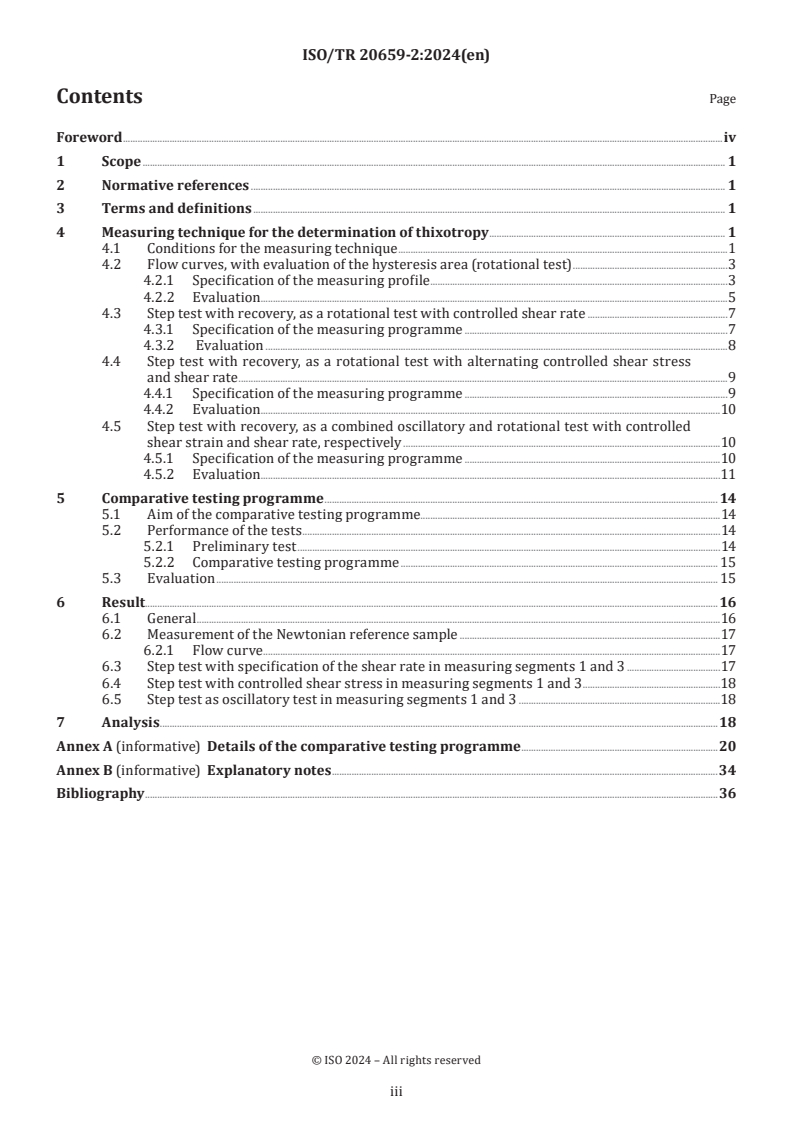
Contents Page
Foreword .iv
1 Scope . 1
2 Normative references . 1
3 Terms and definitions . 1
4 Measuring technique for the determination of thixotropy . 1
4.1 Conditions for the measuring technique .1
4.2 Flow curves, with evaluation of the hysteresis area (rotational test) .3
4.2.1 Specification of the measuring profile .3
4.2.2 Evaluation .5
4.3 Step test with recovery, as a rotational test with controlled shear rate .7
4.3.1 Specification of the measuring programme .7
4.3.2 Evaluation .8
4.4 Step test with recovery, as a rotational test with alternating controlled shear stress
and shear rate .9
4.4.1 Specification of the measuring programme .9
4.4.2 Evaluation .10
4.5 Step test with recovery, as a combined oscillatory and rotational test with controlled
shear strain and shear rate, respectively .10
4.5.1 Specification of the measuring programme .10
4.5.2 Evaluation . .11
5 Comparative testing programme . 14
5.1 Aim of the comparative testing programme.14
5.2 Performance of the tests .14
5.2.1 Preliminary test .14
5.2.2 Comparative testing programme . 15
5.3 Evaluation . 15
6 Result.16
6.1 General .16
6.2 Measurement of the Newtonian reference sample .17
6.2.1 Flow curve .17
6.3 Step test with specification of the shear rate in measuring segments 1 and 3 .17
6.4 Step test with controlled shear stress in measuring segments 1 and 3 .18
6.5 Step test as oscillatory test in measuring segments 1 and 3 .18
7 Analysis . .18
Annex A (informative) Details of the comparative testing programme .20
Annex B (informative) Explanatory notes .34
Bibliography .36
iii
Foreword
ISO (the International Organization for Standardization) is a worldwide federation of national standards
bodies (ISO member bodies). The work of preparing International Standards is normally carried out through
ISO technical committees. Each member body interested in a subject for which a technical committee
has been established has the right to be represented on that committee. International organizations,
governmental and non-governmental, in liaison with ISO, also take part in the work. ISO collaborates closely
with the International Electrotechnical Commission (IEC) on all matters of electrotechnical standardization.
The procedures used to develop this document and those intended for its further maintenance are described
in the ISO/IEC Directives, Part 1. In particular, the different approval criteria needed for the different types
of ISO document should be noted. This document was drafted in accordance with the editorial rules of the
ISO/IEC Directives, Part 2 (see www.iso.org/directives).
ISO draws attention to the possibility that the implementation of this document may involve the use of (a)
patent(s). ISO takes no position concerning the evidence, validity or applicability of any claimed patent
rights in respect thereof. As of the date of publication of this document, ISO had not received notice of (a)
patent(s) which may be required to implement this document. However, implementers are cautioned that
this may not represent the latest information, which may be obtained from the patent database available at
www.iso.org/patents. ISO shall not be held responsible for identifying any or all such patent rights.
Any trade name used in this document is information given for the convenience of users and does not
constitute an endorsement.
For an explanation of the voluntary nature of standards, the meaning of ISO specific terms and expressions
related to conformity assessment, as well as information about ISO's adherence to the World Trade
Organization (WTO) principles in the Technical Barriers to Trade (TBT), see www.iso.org/iso/foreword.html.
This document was prepared by Technical Committee ISO/TC 35, Paints and varnishes, Subcommittee SC 9,
General test methods for paints and varnishes.
A list of all parts in the ISO 20659 series can be found on the ISO website.
Any feedback or questions on this document should be directed to the user’s national standards body. A
complete listing of these bodies can be found at www.iso.org/members.html
iv
Technical Report ISO/TR 20659-2:2024(en)
Rheological test methods — Fundamentals and
interlaboratory comparisons —
Part 2:
Determination of the time-dependent structural change
(thixotropy)
1 Scope
This document gives information on an interlaboratory comparison for the determination of the time-
dependent structural change (thixotropy) using rheological test methods. Thixotropy is the reversible, time-
dependent decrease of shear viscosity η at a constant shear rate γ or shear stress τ.
This document provides examples of fields of application, in which important material properties can be
characterized by the thixotropy. These fields of application include:
— effectiveness of rheological additives and thixotropic agents, respectively;
— stability of the structure at rest (e.g. behaviour when starting to pump);
— wet film thickness after processing;
— levelling and sagging behaviour (e.g. without brushmarks or sag formation);
— orientation of effect pigments.
2 Normative references
The following documents are referred to in the text in such a way that some or all of their content constitutes
requirements of this document. For dated references, only the edition cited applies. For undated references,
the latest edition of the referenced document (including any amendments) applies.
ISO 3219-1, Rheology — Part 1: Vocabulary and symbols for rotational and oscillatory rheometry
3 Terms and definitions
For the purposes of this document, the terms and definitions given in ISO 3219-1 apply.
ISO and IEC maintain terminology databases for use in standardization at the following addresses:
— ISO Online browsing platform: available at https:// www .iso .org/ obp
— IEC Electropedia: available at https:// www .electropedia .org/
4 Measuring technique for the determination of thixotropy
4.1 Conditions for the measuring technique
Clause 4 briefly describes methods that are currently in use. In principle, the thixotropy depends on the
temperature, the pressure, and the thermal and mechanical history of the material. A detailed specification
of the measuring profile is therefore a precondition for reproducible measurements and comparable
evaluation; this applies especially for the level of shear load (shear rates, shear stresses, shear strain,
oscillation frequencies), the duration of the individual measuring segments and the number of measuring
points.
Thixotropy can be determined by rotational as well as by oscillatory tests. Measuring devices equipped
with a mechanical bearing or air bearing are suitable for rotational tests. For oscillatory tests, a rheometer
with air bearing is used. It is essential to ensure that the measuring device is used in combination with
the suitable measuring geometry, i.e. in accordance with the torque range, the torque resolution and the
rotational speed range. Typically, rotational viscometers and rheometers that are subject to test equipment
monitoring and are regularly calibrated and verified (if necessary), are used. Measuring results that are
independent of geometry can only be obtained by using absolute measurement geometries according to
ISO 3219-2.
If, independently of the measuring device and the measuring method used, no time-stable measuring results
are obtained during the measurement of Newtonian standard samples, then the measuring device, the
measuring geometry or the measuring method is unsuitable. If the functional course of these time-stable
measured values meets the reference values within the used measuring range, it is guaranteed that the
measuring device, the measuring geometry and the measuring method are suitable for the investigation of
the sample. Typically, this inspection is carried out under isothermal conditions in the expected viscosity
range of the sample by using several Newtonian standard samples. If preliminary tests reveal that the
viscosity of the measuring sample varies over three decades, then the verification of the measuring device
and measuring geometry are performed with three Newtonian standard samples. This is carried out for all
measuring temperatures. The influences due to application, e.g. sample filling, evaporation, shear heating,
wrong choice of method and the sample material coming out of the gap, are mostly discernible and detected
by this kind of verification.
Upon measurement, the possibility of evaporation is considered. A reduction of this influence can be
reached, e.g. by using a sample area coverage. All boundary conditions of the measurement are documented
in the record, especially the usage of a coverage, the kind of sample trimming and the adjustment of the gap
distance. According to the specifications of the measuring methods described in Clause 4, the methods are
changed if influences on the measuring results occur. Another parameter is checking whether the duration
of the load is shorter than the medium time scale of the structural changes of the sample. This is determined
for each measuring method and its specifications by preliminary tests. However, the duration of the load
is selected in consideration of situations where conditions of application of the sample are longer. If this
duration is longer than the time scale of structural change of the sample, then a thixotropic behaviour will
not be detected; nevertheless, the sample can be still thixotropic. In order to determine the thixotropy in a
correct and reproducible manner, when filling the measuring geometry, the influence that the time between
filling and the start of the measurement has on the measuring result is taken into consideration. This time
is distinctly longer than the time scale of the structural change. This can be determined by preliminary
measurements in which the waiting time is varied. The waiting time is sufficiently high if the thixotropy
of the sample is comparable for two measurements running after a fresh filling within the limits of the
requested precision in accordance with the measuring method chosen.
Measuring points can only be recorded if each single measuring point is controlled by the instrument
according to the specification. At every change of the specified value, a transient process of the entire
measuring equipment occurs towards the new specified value. This transient process can be different (see
Figure 1).
Key
X time, t
Y
shear stress, τ, or shear rate, γ
1 specified function
2, 3, 4 different adjustment behaviours
Figure 1 — Different transient behaviour during the controlling of each individual measuring point
The measuring point is not detected until the deviation between the specified value and the desired value is
small enough. The integration time (time per measuring point minus adjustment time), which is considered
for calculating the average of a data point, influences the measuring result. This condition is valid for
constant shear load as well as for a time-dependent change of the load.
4.2 Flow curves, with evaluation of the hysteresis area (rotational test)
4.2.1 Specification of the measuring profile
The specification is provided in the form of three measuring segments comprising a continuous or a step-
like discontinuous upward ramp, a holding time and a downward ramp (see Figures 2 and 3). The shear rate
γ is specified as a function of time. Both ramp types can be used with linear and logarithmic distribution.
This is valid for the shear rate and for the time duration of the measuring points. At the beginning, this can
also be preceded by a segment with defined pre-shear and/or a waiting time without shear (e.g. 5 min).
Key
shear rate
γ
t time
Figure 2 — Specified profile: shear rate and time function with the three measuring segments:
continuous upward ramp, holding time and continuous downward ramp
Key
shear rate
γ
t time
Figure 3 — Specified profile: shear rate/time function with the three measuring segments: stepped
upward ramp, holding time and stepped downward ramp
Proposals for a typical measuring programme include Method A and Method B.
Method A, with a linear ramp for the shear rate, includes:
−1 −1
1) upward ramp withγ = 0 s to 1 000 s , duration 3 min, with 45 measuring points;
−1
2) holding time withγ = 1 000 s = constant, duration 1 min, with 15 measuring points;
−1 −1
3) downward ramp withγ = 1 000 s to 0 s , duration 3 min, with 45 measuring points.
The period of time for the up- and down-ramps is the same. Moreover, it is defined whether the test is carried
out with continuous or step-like ramp.
Method B, with a logarithmic ramp for the shear rate, includes:
−1 −1
4) upward ramp with γ = 0,1 s to 1 000 s , duration 3 min, with 61 measuring points. If a viscometer
−1
with a mechanical bearing is used, then 10 s can be used as the minimum shear rate;
−1
5) holding time withγ = 1 000 s = constant, duration 1 min, with 15 measuring points;
−1 −1
6) downward ramp withγ = 1 000 s to 0,1 s , duration 3 min, with 61 measuring points.
The period of time for the up- and down-ramps is the same. Moreover, it is defined whether the test is carried
out with continuous or step-like ramp.
4.2.2 Evaluation
If the measuring sample displays behaviour that varies with shear load and time, a so-called hysteresis area
is generated between the upward and downward flow curves. Here, hysteresis means curve loop. Flow
−1
curves are usually presented as shear stress τ (in Pa) against shear rate γ (in s ) (see Figure 4).
Key
shear stress
τ
shear rate
γ
1 hysteresis area with reduction of structural strength under shear load
2 hysteresis area with increase in structural strength under shear load
Figure 4 — Measuring result: flow curves with hysteresis area
When the shear rate increases from zero to a maximum value and then decreases to zero following a defined
time programme, the hysteresis curve is generated from the two resulting flow curves, which do not overlap.
A larger area is an indication for a stronger change in structure. The structural strength can decrease or
increase.
The duration of the upward ramp and downward ramp depends on the material. If it is too long, the
superstructure of the measuring sample is reduced too much already during the upward ramp. As a result,
the hysteresis area can become too small for a meaningful evaluation.
−1
This evaluation is performed by calculating the hysteresis area in Pa·s .
Figure 5 and Figure 6 show typical measuring results for a waterborne coating material obtained with the
two measuring methods, A and B.
With a linear ramp, the shear load is higher overall across the entire shear rate range compared to the
logarithmic ramp. This results in a smaller calculated hysteresis area. The advantage of Method B is that
more measuring points are recorded in the lower shear rate range.
This measuring method provides information about the behaviour of the measuring sample in a continuous
shear process, but not about what happens when the shear load occurs at rest, for example whether and to
what extent recovery of the structure takes place. The method yields a first overview of the behaviour of the
investigated material.
Key
τ shear stress
shear rate
γ
−1
NOTE The calculated hysteresis area for this method is 7 167 Pa·s .
Figure 5 — Flow curves measured using a linear ramp, with evaluation according to Method A
Key
shear stress
τ
γ shear rate
−1
NOTE The calculated hysteresis area for this method is 16 810 Pa·s .
Figure 6 — Flow curves measured using a logarithmic ramp, with evaluation according to Method B
4.3 Step test with recovery, as a rotational test with controlled shear rate
4.3.1 Specification of the measuring programme
The shear load is specified in the form of three measuring segments, first with a constant low shear rate,
then with a constant high shear rate, and finally again with a constant low shear rate γ (see Figure 7). At the
beginning, this can also be preceded by a segment with defined pre-shear and/or a waiting time without
shear (e.g. 5 min).
Key
shear rate
γ
t time
1 low shear rate
2 high shear rate
3 low shear rate
Figure 7 — Specified profile: three measuring segments with a low shear rate, high shear rate and
then low shear rate again
Key
shear viscosity
η
t time
1 low shear load
2 high shear load with reduction of structural strength
3 low shear load with structural recovery
Figure 8 — Measuring result of time-dependent viscosity function of a thixotropic material
Proposals for a typical measuring programme are as follows:
−1
1) low shear rate withγ = 0,1 s = constant, duration 2 min, with 30 measuring points. If a viscometer
−1
with a mechanical bearing is used, then 10 s can be used as the minimum shear rate;
−1
2) high shear rate withγ = 1 000 s = constant, duration 2 min, with 30 measuring points;
−1
3) low shear rate withγ = 0,1 s = constant, duration 5 min, with 100 measuring points.
The shear rate for the measuring segments 1 and 3 is the same.
4.3.2 Evaluation
As a preparatory step, the average of the last 5 measuring points is formed for each of the three measuring
segments. Proposals for evaluation programmes are as follows (see also Figure 8):
1) Percentage structural recovery, expressed as a viscosity value at the end of measuring segment 3 in
comparison to the reference value of the end of measuring segment 1, with the result stated in per cent;
EXAMPLE 1 Reference value η = 10 Pa·s; and at the end of measuring segment 3 η = 8 Pa·s. Calculation:
1 3
(8 Pa·s/10 Pa·s) × 100 % = 80 %. See Figure 9.
Key
shear viscosity
η
t time
Figure 9 — Evaluation of the percentage structural recovery
2) Time points for 25 % and 50 % structural recovery in measuring segment 3 in comparison with the
reference value from the end of measuring segment 1, data in s;
EXAMPLE 2 Reference value η = 10 Pa·s; from the diagram or from the table of measuring data, the two time
points are determined at 25 % of the reference value on the one hand, therefore η = 2,5 Pa·s, and at 50 % of the
reference value on the other hand, therefore η = 5 Pa·s, is reached. See Figure 10.
Key
η shear viscosity
t time
Figure 10 — Time points for 25 % and 50 % structural recovery
3) Slope of the curve during structural recovery in the first 60 s of measuring segment 3, data in Pa·s/s;
EXAMPLE 3 Between the two viscosity values at the end of measuring segment 2 and after 60 s in measuring
segment 3, the slope of the connecting line is determined; this can be done by means of the diagram or with the
table of measuring data (see Figure 11).
Key
η shear viscosity
t time
Figure 11 — Slope of the curve during structural recovery
4) Structure-recovery index (SRI) calculated as logarithm of the viscosity value after the beginning of
measuring segment 3 (e.g. after 30 s), minus the logarithm of the viscosity value at the end of measuring
segment 2;
5) Thixotropy index (TI) calculated as logarithm of the viscosity value at the end of measuring segment 3
(e.g. after 300 s) minus the logarithm of the viscosity value at the end of measuring segment 2.
4.4 Step test with recovery, as a rotational test with alternating controlled shear stress and
shear rate
4.4.1 Specification of the measuring programme
The shear load is specified in the form of three measuring segments, first with a constant low shear stress τ,
then with a constant high shear rate, and finally again with a constant low shear stress τ (see Figure 12). At
the beginning, this can also be preceded by a segment with defined pre-shear and/or a waiting time without
shear (e.g. 5 min).
In order to determine a meaningful specification value for the shear stress in measuring segments 1 and 3,
preliminary tests for determination of the yield point are performed (see ISO/TR 20659-1). The specified
value lies above the yield point value.
Key
τ shear stress
shear rate
γ
t time
1 low shear stress
2 high shear rate
3 low shear stress
Figure 12 — Specified profile: three measuring segments with low shear stress, high shear rate, and
again with low shear stress
Proposals for a typical measuring programme are as follows:
1) low shear stress with τ = constant (the specified value for τ is dependent upon the preliminary test),
duration 2 min, with 30 measuring points;
−1
2) high shear rate withγ = 1 000 s = constant, duration 2 min, with 30 measuring points;
3) low shear stress with τ = constant, duration 5 min, with 100 measuring points.
The shear stress for the measuring segments 1 and 3 is the same.
4.4.2 Evaluation
With this measuring method, the evaluation is performed in the same way as described in 4.3 and shown in
Figure 8 to Figure 11.
NOTE A disadvantage of this method is that preliminary tests are crucial in order to find meaningful specification
values for the shear stress in measuring segments 1 and 3.
4.5 Step test with recovery, as a combined oscillatory and rotational test with controlled
shear strain and shear rate, respectively
4.5.1 Specification of the measuring programme
For carrying out the step tests, a rheometer with air bearing can be used.
The shear load is specified in the form of three measuring segments, the first with a constant low shear
strain γ and constant frequency in the form of an oscillatory test, then with a constant high shear rate γ as a
rotational test, and finally again with a constant low shear strain γ and constant frequency as an oscillatory
test (see Figure 13).
−1
The speed of oscillation can be stated both as a frequency f (in Hz) and as an angular frequency ω (in s )
(the following applies: ω = 2 π · f ).
A shear strain value is deemed to be low enough, and therefore suitable, if it lies in the linear viscoelastic
region. This specification is examined in advance with an amplitude sweep.
At the beginning, this can also be preceded by a segment with defined pre-shear and/or a waiting time
without shear (e.g. 5 min).
Key
γ shear strain
shear rate
γ
t time
1 low shear strain (as an oscillation)
2 high shear rate (as a rotation)
3 low shear stress (as an oscillation)
Figure 13 — Specified profile: step function with the three measuring segments
Proposals for a typical measuring programme are as follows:
1) low shear strain as an oscillation with f = 1 Hz and γ = constant (the specified value for γ is dependent
upon the preliminary test, e.g. γ = 1 %), duration 2 min, with 30 measuring points;
−1
2) high shear rate withγ = 1 000 s = constant, duration 2 min, with 30 measuring points;
3) low shear strain as an oscillation with f = 1 Hz and γ = constant [as in 1) above, the specified value for γ
is dependent upon the preliminary test], duration 5 min, with 100 measuring points. The frequency and
the shear strain for the measuring segments 1 and 3 are the same.
4.5.2 Evaluation
When using oscillatory tests, the following measured parameters can be evaluated:
— the shear storage modulus G' (in Pa) describes the elastic part of the viscoelastic behaviour of the
measuring sample;
— the shear loss modulus G” (in Pa) describes the viscous part;
— the absolute value of the complex shear viscosity |η*| (in Pa·s);
— the loss angle δ (in °, i.e. degrees) represents the time delay (phase shift) between the specified measured
value and the resulting measured value;
— the loss factor tanδ = G”/G' is the ratio of G” to G'.
In the following, proposals for evaluation programmes are shown (see also Figure 14). Instead of the
G’ values, the values for the absolute value of the complex shear viscosity |η*| can be chosen as an alternative
(see Figure 15).
Key
G‘ shear storage modulus
G“ shear loss modulus
η shear viscosity
t time
1 low shear load
2 high shear load with reduction of structural strength
3 low shear load with structural recovery
Figure 14 — Measuring result: time-dependent functions of a thixotropic material as shear storage
modulus G' and shear loss modulus G”
Key
|η*| complex shear viscosity
η shear viscosity
t time
1 low shear load
2 high shear load with reduction of structural strength
3 low shear load with structural recovery
Figure 15 — Measuring result: time-dependent functions of a thixotropic material as the absolute
value of complex shear viscosity |η*|
1) Percentage structural recovery expressed as the value of the shear storage modulus G' at the end of
measuring segment 3 in comparison with the reference value from the end of measuring segment 1,
data in %;
EXAMPLE 1 Reference value G' = 20 Pa, and at the end of measuring segment 3 G' = 16 Pa. Calculation:
1 3
(16 Pa/20 Pa) · 100 % = 80 %. See Figure 16.
Key
G‘ shear storage modulus
t time
Figure 16 — Evaluation of the percentage structural recovery
2) Time points for 25 % and 50 % structural recovery in measuring segment 3 in comparison with the
reference value from the end of measuring segment 1, data in s;
EXAMPLE 2 Reference value G' = 20 Pa. From the diagram or from the table of measuring data, the two time
points are determined at which:
a) on the one hand 25 % of the reference value, here therefore G' = 5 Pa is reached;
b) on the other hand 50 % of the reference value, here therefore G' = 10 Pa, is reached.
See Figure 17.
Key
G‘ shear storage modulus
t time
Figure 17 — Time points for 25 % and 50 % structural recovery
−1
3) Slope of the curve during structural recovery in the first 60 s of measuring segment 3, data in Pa·s ;
EXAMPLE 3 Th
...
Questions, Comments and Discussion
Ask us and Technical Secretary will try to provide an answer. You can facilitate discussion about the standard in here.
Loading comments...