

ISO 9455-8:1991
(Main)Soft soldering fluxes — Test methods — Part 8: Determination of zinc content
General Information
- Abstract
Describes the principle, the reagents and materials, the apparatus, the test procedure, the calculation of results, the precision and the contents of the test report.
- Status
- Published
- Publication Date
- 11-Dec-1991
- Technical Committee
- ISO/TC 44/SC 12 - Soldering materials
- Drafting Committee
- ISO/TC 44/SC 12 - Soldering materials
- Current Stage
- 9092 - International Standard to be revised
- Start Date
- 06-Aug-2025
- Completion Date
- 29-Aug-2026
Buy Documents
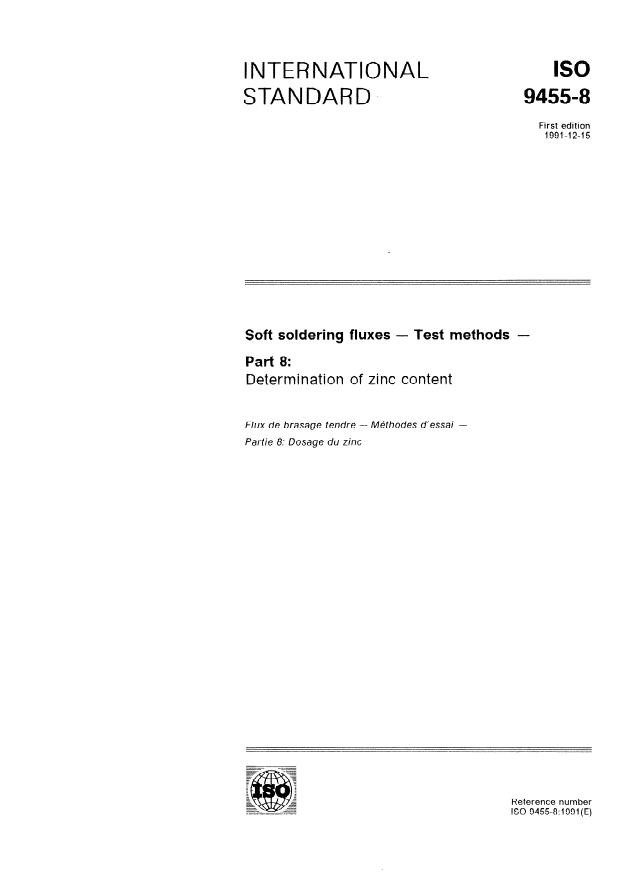

ISO 9455-8:1991 - Soft soldering fluxes — Test methods — Part 8: Determination of zinc content Released:12/12/1991
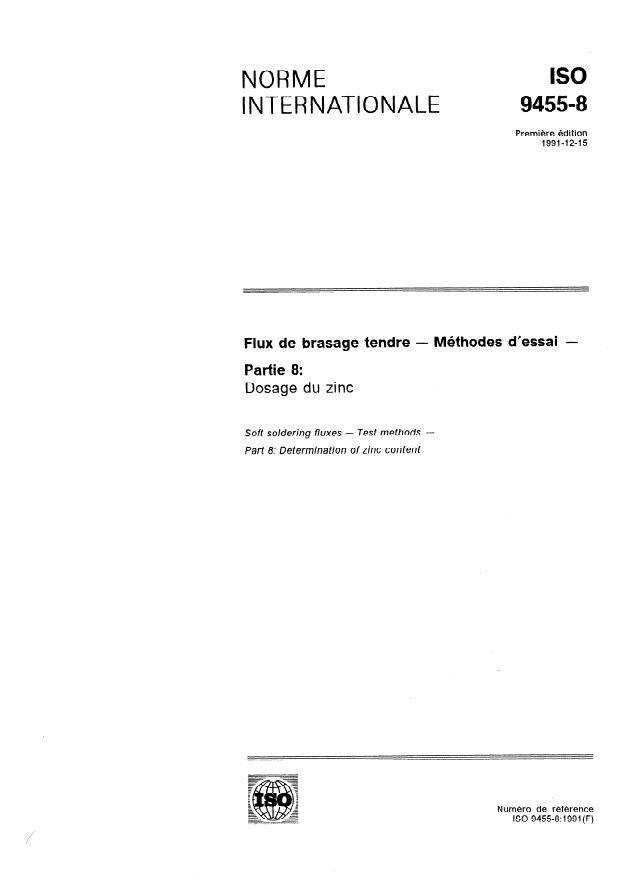
ISO 9455-8:1991 - Flux de brasage tendre — Méthodes d'essai — Partie 8: Dosage du zinc Released:12/12/1991
ISO 9455-8:1991 - Flux de brasage tendre — Méthodes d'essai — Partie 8: Dosage du zinc Released:12/12/1991
Overview
ISO 9455-8:1991 is an international standard developed by the International Organization for Standardization (ISO) that specifies a test method for the determination of zinc content in soft soldering fluxes. This part of the ISO 9455 series focuses on quantifying zinc in water-soluble fluxes, particularly type 3 fluxes containing approximately 25% zinc expressed as zinc chloride (ZnCl₂). The method involves a chemical titration process using standard reagents and is essential for ensuring consistent quality and performance in soldering applications.
Key Topics
Scope and Purpose
Defines the procedure for accurately measuring zinc content in soft soldering fluxes to ensure compliance with material specifications and quality control.Principle of the Method
The zinc in an aqueous flux solution is determined by complexometric titration using Ethylenediaminetetraacetic acid (EDTA) after appropriate sample preparation and pH adjustment.Required Materials and Reagents
Uses specific analytical-grade reagents including:- Standard EDTA solution (0.1 mol/L)
- Buffer solution (pH 10)
- Sulfuric acid (20%)
- Eriochrome Black T mixture as an indicator
- Ammonium chloride and ammonia solution for pH adjustment
- Ascorbic acid for reducing interference
Apparatus
Standard laboratory glassware including volumetric flasks, pipettes, burettes, beakers, and a hydrometer for density determination.Test Procedure
Involves dissolving flux samples, acidification, precipitation of interfering metals, filtration, addition of buffer and indicator, and titration with EDTA to a color endpoint.Calculation of Results
The zinc content is calculated in terms of zinc chloride (%) using the volume of EDTA consumed and the density of the sample.Precision and Accuracy
The method has been rigorously tested among multiple laboratories, demonstrating repeatability within 0.24% and reproducibility up to 0.84% zinc chloride content.Test Reporting
Reports must include sample identification, method reference, titration results, observations, and any deviations or optional procedures used.
Applications
Quality Control in Solder Manufacturing
Ensures solder fluxes meet chemical composition requirements critical for solder joint reliability.Material Certification and Compliance
Provides reliable zinc content data for certification and adherence to industry standards during production or purchasing.R&D and Process Optimization
Enables manufacturers and laboratories to monitor and optimize flux formulations for enhanced soldering performance.Failure Analysis and Troubleshooting
Assists in diagnosing soldering defects by verifying accurate flux chemical content, including zinc.Regulatory and Environmental Monitoring
Supports compliance with chemical safety regulations by standardized quantification of flux components.
Related Standards
ISO 9455 is a multi-part series covering various test methods for soft soldering fluxes:
- ISO 9455-1: Determination of non-volatile matter, gravimetric method
- ISO 9455-2: Determination of non-volatile matter, ebulliometric method
- ISO 9455-3: Determination of acid value, potentiometric and visual titration methods
- ISO 9455-6: Determination of halide content
- ISO 9455-9: Determination of ammonia content
- ISO 9455-10: Flux efficacy tests, solder spread method
- ISO 9455-12: Steel tube corrosion test
- ISO 9455-16: Flux efficacy tests, wetting balance method
These standards collectively address the comprehensive chemical and functional characterization of soldering fluxes, ensuring consistency and performance across electronic manufacturing processes.
Keywords: ISO 9455-8, zinc content determination, soft soldering fluxes, solder flux testing, flux chemical analysis, EDTA titration, solder manufacturing, quality control, soldering standards, flux composition analysis.
Relations
- Effective Date
- 25-Aug-2026
- Revised
ISO/FDIS 9455-8 - Soft soldering fluxes — Test methods — Part 8: Determination of zinc content - Effective Date
- 09-Aug-2025
Buy Documents
ISO 9455-8:1991 - Soft soldering fluxes — Test methods — Part 8: Determination of zinc content Released:12/12/1991
ISO 9455-8:1991 - Flux de brasage tendre — Méthodes d'essai — Partie 8: Dosage du zinc Released:12/12/1991
ISO 9455-8:1991 - Flux de brasage tendre — Méthodes d'essai — Partie 8: Dosage du zinc Released:12/12/1991
Get Certified
Connect with accredited certification bodies for this standard

DVS-ZERT GmbH
German welding certification society.
CARES (UK Certification Authority for Reinforcing Steels)
UK certification for reinforcing steels and construction.
EWF/IIW (European/International Welding Federation)
International welding personnel certification.
Sponsored listings
Frequently Asked Questions
ISO 9455-8:1991 is a standard published by the International Organization for Standardization (ISO). Its full title is "Soft soldering fluxes — Test methods — Part 8: Determination of zinc content". This standard covers: Describes the principle, the reagents and materials, the apparatus, the test procedure, the calculation of results, the precision and the contents of the test report.
Describes the principle, the reagents and materials, the apparatus, the test procedure, the calculation of results, the precision and the contents of the test report.
ISO 9455-8:1991 is classified under the following ICS (International Classification for Standards) categories: 25.160.50 - Brazing and soldering. The ICS classification helps identify the subject area and facilitates finding related standards.
ISO 9455-8:1991 has the following relationships with other standards: It is inter standard links to EN ISO 9454-2:2000, ISO/FDIS 9455-8. Understanding these relationships helps ensure you are using the most current and applicable version of the standard.
ISO 9455-8:1991 is available in PDF format for immediate download after purchase. The document can be added to your cart and obtained through the secure checkout process. Digital delivery ensures instant access to the complete standard document.
Standards Content (Sample)
INTERNATIONAL
STANDARD.
First edition
1991-12-15
.
Soft soldering fluxes - Test methods -
Part 8:
Determination of zinc content
Fhx de brasage tendre - Metbodes d’essai -
Par-tie 8: Dosage dir zinc
e-
m-
----
Reference number
----______ IS0 94554: 1991 (E)
--. __ __._ ___-- . _ _. _
IS0 94558:1991(E)
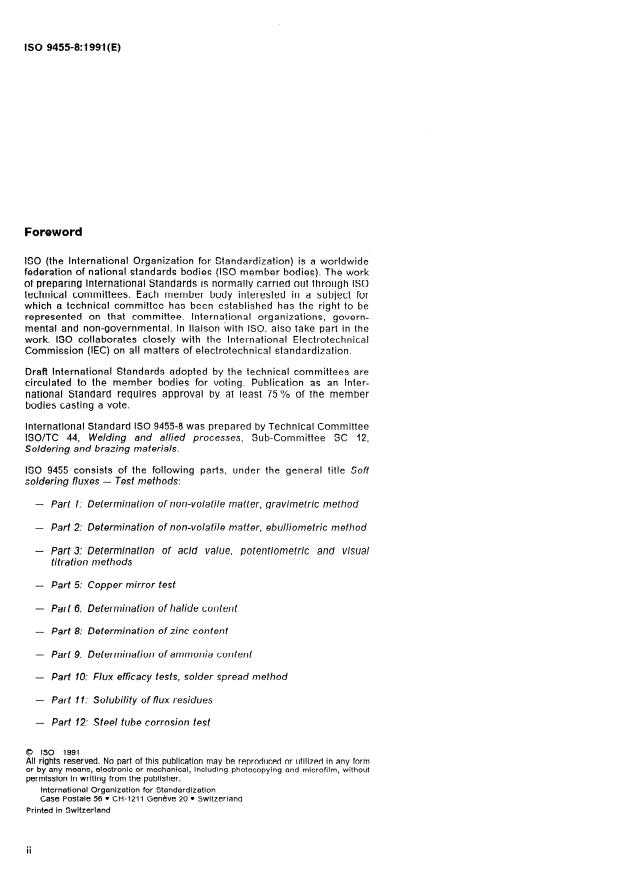
Foreword
IS0 (the International Organization for Standardization) is a worldwide
federation of national standards bodies (IS0 member bodies). The work
of preparing International Standards is normally carried out through IS0
technical committees. Each member body interested in a subject for
which a technical committee has been established has the right to be
represented on that committee. International organizations, govern-
mental and non-governmental, in liaison with ISO, also take part in the
work. ISO collaborates closely with the International Electrotechnical
Commission (IEC) on all matters of electrotechnical standardization.
Draft International Standards adopted by the technical committees are
circulated to the member bodies for voting. Publication as an lnter-
national Standard requires approval by at least 75 % of the member
bodies casting a vote.
International Standard IS0 9455-8 was prepared by Technical Committee
ISO/TC 44, Welding and allied Processes, Sub-Committee SC 12,
Soldering and brazing materials.
IS0 9455 consists of the following parts, under the general title Soft
soldering fluxes - Test methods:
- Part 1: Determination of non-volatile matter, gravimetric method
- Part 2: Determination of non-volatile matter, ebulliometric method
- Part 3: Determination of acid value, potentiometric and visual
titration methods
- Part 5: Copper mirror test
- Part 6: Determination of halide content
- Part 8: Determination of zinc content
- Part 9: Determination of ammonia content
- Part IO: Flux efficacy tests, solder spread method
- Part 11: Solubility of #ux residues
- Part 12: Steel tube corrosion test
0 IS0 1991
All rights reserved. No part of this publication may be reproduced or utilized in any form
or by any means, electronic or mechanical, including photocopying and microfilm, without
permission in writing from the publisher.
International Organization for Standardization
Case Postale 56 l CH-1211 Genkve 20 l Switzerland
Printed in Switzerland
ii
IS0 9455=8:1991(E)
- Part 13: Determination of f7ux spattering
- Part 14: Assessment of tackiness of f7ux residues
- Part 15: Copper corrosion test
-
Part 16: Flux efficacy tests, wetting balance method
- Part 17: Determination of surface insulation resistance of f7ux resi-
dues (Comb test}
This page intentionally leff blank
INTERNATIONAL STANDARD IS0 94558:1991 (E)
Soft soldering fluxes - Test methods -
Part 8:
Determination of zinc content
1 Scope 4 Reagents
During the test use only reagents of recognized
This part of IS0 9455 specifies a method for the de-
termination of the zinc content of water soluble analytical quality and only distilled, or deionized,
ftuxes of type 3, as defined in IS0 9454-l. The water.
method is intended to apply to an aqueous solution
of flux containing approximately 25 % of zinc, ex-
4.1 Disodium dihydrogen ethylenediaminetetra-
pressed as zinc chloride (ZnCI,). For solid fluxes and
acetate solution (EDTA) standard volumetric sol-
for solutions whose concentrations differ ap-
ution, c(EDTA) = 0,l mol/l.
preciably from those stated above, an appropriate
adjustment should be made to the amount of sample
Dry approximately 10 g of disodium dihydrogen
taken for the test. ethylenediaminetetra-acetate (C,,H,,N,Na,0,.2H,O)
for 2 h at 80 “C. Dissolve 9,308 g of the dried salt in
water, transfer to a 250 ml volumetric flask, dilute to
the mark and mix well.
2 Normative reference
NOTE 1 1 ml of 0,l mot/l EDTA solution is equivalent to
The following standard contains provisions which,
0,006 54 g of zinc, or 0,013 63 g of zinc chloride.
through reference in this text, constitute provisions
of this part of IS0 9455. At the time of publication,
4.2 Buffer solution (pH 10).
the edition indicated was valid. All standards are
Dissolve 7 g of ammonium chloride (NH&I) in 20 ml
subject to revision, and parties to agreements based
of water. Add 57 ml of ammonia solution
on this part of IS0 9455 are encouraged to investi-
gate the possibility of applying the most recent edi- (Q 0,
...
NORME
INTERNATIONALE
Première édition
1991-12-15
Flux de brasage tendre - Méthodes d’essai -
Partie 8:
Dosage du zinc
Soft soldering f7uxes - Test methods -
Part 8: Defermination of zinc content
Numéro de référence
--
-------- --
_._ -- .-- - -- . ._ - - ISO 9455-8: 199 1 (F)
” _-.-
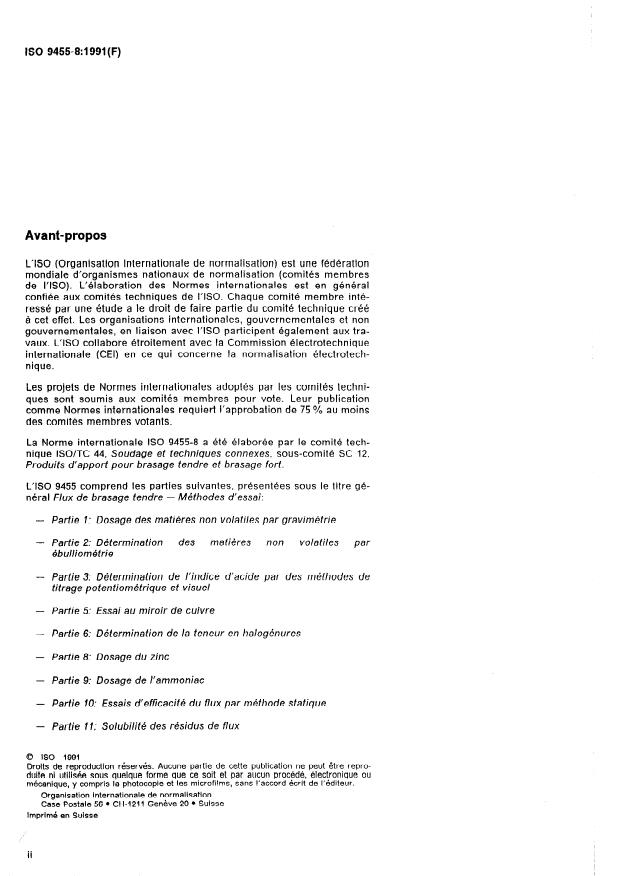
Avant-propos
L’ISO (Organisation internationale de normalisation) est une fédération
mondiale d’organismes nationaux de normalisation (comités membres
de I’ISO). L’élaboration des Normes internationales est en général
confiée aux comités techniques de I’ISO. Chaque comité membre inté-
ressé par une étude a le droit de faire partie du comité technique créé
à cet effet. Les organisations internationales, gouvernementales et non
gouvernementales, en liaison avec I’ISO participent également aux tra-
vaux. L’ISO collabore étroitement avec la Commission électrotechnique
internationale (CEI) en ce qui concerne la normalisation électrotech-
nique.
Les projets de Normes internationales adoptés par les comités techni-
ques sont soumis aux comités membres pour vote. Leur publication
comme Normes internationales requiert l’approbation de 75 % au moins
des comités membres votants.
La Norme internationale ISO 9455-8 a été élaborée par le comité tech-
nique ISO/TC 44, Soudage et techniques connexes, sous-comité SC 12,
Produits d’apport pour brasage tendre et brasage fort.
L’ISO 9455 comprend les parties suivantes, présentées sous le titre gé-
néral Flux de brasage tendre - Méthodes d’essai:
- Partie 1: Dosage des matières non volatiles par gravimétrie
- Partie 2: Détermination des matières non volatiles
Par
ébulliométrie
- Partie 3s Détermination de l’indice d’acide par des méthodes de
titrage potentiométrique et visuel
- Partie 5: Essai au miroir de cuivre
- Partie 6: Détermination de la teneur en halogénures
- Partie 8: Dosage du zinc
- Partie 9: Dosage de l’ammoniac
- Partie 10: Essais d’efficacité du flux par méthode statique
- Partie Il: Solubilité des résidus de f7ux
6 ISO 1991
Droits de reproduction réservés. Aucune partie de cette publication ne peut être repro-
duite ni utilisée sous quelque forme que ce soit et par aucun procédé, électronique ou
mécanique, y compris la photocopie et les microfilms, sans l’accord écrit de l’éditeur.
Organisation internationale de normalisation
Case Postale 56 l CH-121 1 Genève 20 l Suisse
Imprimé en Suisse
-
Partie 12: Essai de corrosion des tubes d’acier
-
Partie 13: Détermination des éclaboussures de f7ux
- Partie 14: Détermination du pouvoir collant des résidus de f7ux
- Partie 15: Essai de corrosion du cuivre
- Partie 16: Essais d’efficacité du flux par la méthode de la balance
de mouillage (méniscographe)
la résistance d’isolement de surface
-- Partie 17: Détermination de
peigne)
des résidus de f7ux (Essai au
. . .
Ill
Page blanche
NORME INTERNATIONALE ISO 9455-8:1991 (F)
Flux de brasage tendre - Méthodes d’essai -
Partie 8:
Dosage du zinc
zinc est déterminée par titrage de la solution à
1 Domaine d’application
l’aide d’EOTA.
La présente partie de I’ISO 9455 prescrit une mé-
thode de détermination de la teneur en zinc des flux
4 Réactifs
solubles à l’eau du type 3 défini dans I’ISO 9454-l.
La méthode est applicable à une solution aqueuse
Utiliser uniquement des réactifs de qualité analyti-
de flux contenant environ 25 % de zinc sous forme
que reconnue et de l’eau distillée ou désionisée.
de chlorure de zinc (ZnCI,). Pour les flux solides et
les solutions dont la concentration diffère de facon
4.1 EDTA (sel disodique de l’acide éthylène
notable de celle qui est indiquée ci-dessus, il ‘est
diamine-tétracétique), solution titrée,
nécessaire d’apporter une correction appropriée à
c(EDTA) = 0,l mol/1
la quantité d’échantillon prélevée pour l’essai.
Sécher environ 10 g d’EDTA (C,,H,4N2Na20B, 2H,O)
pendant 2 h à 80 “C. Mettre en solution 9,308 g du
2 Référence normative
sel séché dans de l’eau, transvaser dans une fiole
jaugée de 250 ml, diluer au trait de jauge et bien
La norme suivante contient des dispositions qui, par
homogénéiser.
suite de la référence qui en est faite, constituent des
dispositions valables pour la présente partie de
1 ml d’EDTA à 0,l mol/1 équivaut à 0,006 54 g
NOTE 1
I’ISO 9455. Au moment de la publication, l’édition
de zinc ou à 0,013 63 g de chlorure de zinc.
indiquée était en vigueur. Toute norme est sujette 21
révision et les parties prenantes des accords fondés
4.2 Solution tampon (pH 10).
sur la présente partie de I’ISO 9455 sont invitées à
rechercher la possibilité d’appliquer l’édition la plus
Mettre en solution 7 g de chlorure d’ammonium
récente de la norme indiqu
...
NORME
INTERNATIONALE
Première édition
1991-12-15
Flux de brasage tendre - Méthodes d’essai -
Partie 8:
Dosage du zinc
Soft soldering f7uxes - Test methods -
Part 8: Defermination of zinc content
Numéro de référence
--
-------- --
_._ -- .-- - -- . ._ - - ISO 9455-8: 199 1 (F)
” _-.-
Avant-propos
L’ISO (Organisation internationale de normalisation) est une fédération
mondiale d’organismes nationaux de normalisation (comités membres
de I’ISO). L’élaboration des Normes internationales est en général
confiée aux comités techniques de I’ISO. Chaque comité membre inté-
ressé par une étude a le droit de faire partie du comité technique créé
à cet effet. Les organisations internationales, gouvernementales et non
gouvernementales, en liaison avec I’ISO participent également aux tra-
vaux. L’ISO collabore étroitement avec la Commission électrotechnique
internationale (CEI) en ce qui concerne la normalisation électrotech-
nique.
Les projets de Normes internationales adoptés par les comités techni-
ques sont soumis aux comités membres pour vote. Leur publication
comme Normes internationales requiert l’approbation de 75 % au moins
des comités membres votants.
La Norme internationale ISO 9455-8 a été élaborée par le comité tech-
nique ISO/TC 44, Soudage et techniques connexes, sous-comité SC 12,
Produits d’apport pour brasage tendre et brasage fort.
L’ISO 9455 comprend les parties suivantes, présentées sous le titre gé-
néral Flux de brasage tendre - Méthodes d’essai:
- Partie 1: Dosage des matières non volatiles par gravimétrie
- Partie 2: Détermination des matières non volatiles
Par
ébulliométrie
- Partie 3s Détermination de l’indice d’acide par des méthodes de
titrage potentiométrique et visuel
- Partie 5: Essai au miroir de cuivre
- Partie 6: Détermination de la teneur en halogénures
- Partie 8: Dosage du zinc
- Partie 9: Dosage de l’ammoniac
- Partie 10: Essais d’efficacité du flux par méthode statique
- Partie Il: Solubilité des résidus de f7ux
6 ISO 1991
Droits de reproduction réservés. Aucune partie de cette publication ne peut être repro-
duite ni utilisée sous quelque forme que ce soit et par aucun procédé, électronique ou
mécanique, y compris la photocopie et les microfilms, sans l’accord écrit de l’éditeur.
Organisation internationale de normalisation
Case Postale 56 l CH-121 1 Genève 20 l Suisse
Imprimé en Suisse
-
Partie 12: Essai de corrosion des tubes d’acier
-
Partie 13: Détermination des éclaboussures de f7ux
- Partie 14: Détermination du pouvoir collant des résidus de f7ux
- Partie 15: Essai de corrosion du cuivre
- Partie 16: Essais d’efficacité du flux par la méthode de la balance
de mouillage (méniscographe)
la résistance d’isolement de surface
-- Partie 17: Détermination de
peigne)
des résidus de f7ux (Essai au
. . .
Ill
Page blanche
NORME INTERNATIONALE ISO 9455-8:1991 (F)
Flux de brasage tendre - Méthodes d’essai -
Partie 8:
Dosage du zinc
zinc est déterminée par titrage de la solution à
1 Domaine d’application
l’aide d’EOTA.
La présente partie de I’ISO 9455 prescrit une mé-
thode de détermination de la teneur en zinc des flux
4 Réactifs
solubles à l’eau du type 3 défini dans I’ISO 9454-l.
La méthode est applicable à une solution aqueuse
Utiliser uniquement des réactifs de qualité analyti-
de flux contenant environ 25 % de zinc sous forme
que reconnue et de l’eau distillée ou désionisée.
de chlorure de zinc (ZnCI,). Pour les flux solides et
les solutions dont la concentration diffère de facon
4.1 EDTA (sel disodique de l’acide éthylène
notable de celle qui est indiquée ci-dessus, il ‘est
diamine-tétracétique), solution titrée,
nécessaire d’apporter une correction appropriée à
c(EDTA) = 0,l mol/1
la quantité d’échantillon prélevée pour l’essai.
Sécher environ 10 g d’EDTA (C,,H,4N2Na20B, 2H,O)
pendant 2 h à 80 “C. Mettre en solution 9,308 g du
2 Référence normative
sel séché dans de l’eau, transvaser dans une fiole
jaugée de 250 ml, diluer au trait de jauge et bien
La norme suivante contient des dispositions qui, par
homogénéiser.
suite de la référence qui en est faite, constituent des
dispositions valables pour la présente partie de
1 ml d’EDTA à 0,l mol/1 équivaut à 0,006 54 g
NOTE 1
I’ISO 9455. Au moment de la publication, l’édition
de zinc ou à 0,013 63 g de chlorure de zinc.
indiquée était en vigueur. Toute norme est sujette 21
révision et les parties prenantes des accords fondés
4.2 Solution tampon (pH 10).
sur la présente partie de I’ISO 9455 sont invitées à
rechercher la possibilité d’appliquer l’édition la plus
Mettre en solution 7 g de chlorure d’ammonium
récente de la norme indiqu
...