


ISO 16003:2008
(Main)Components for fire-extinguishing systems using gas— Requirements and test methods — Container valve assemblies and their actuators; selector valves and their actuators; nozzles; flexible and rigid connectors; and check valves and non-return valves
Components for fire-extinguishing systems using gas— Requirements and test methods — Container valve assemblies and their actuators; selector valves and their actuators; nozzles; flexible and rigid connectors; and check valves and non-return valves
ISO 16003:2008 specifies requirements and describes test methods for the following components used in gaseous fire-extinguishing systems: container valve assemblies, which include container valve, actuator and, if applicable, a diptube; selector valves and their actuators; agent distribution nozzles; flexible connectors; and check and non-return valves. Container valve assemblies are designed to control the extinguishant flow from the container to the distribution pipe work. They are normally in the closed position. The automatic control device triggers the actuator and the valve opens. Where applicable, the requirements contained in the test methods also apply to separate container valves. The design of the nozzles influences the area coverage, the height limitations, the discharge rate and the flow rate. ISO 16003:2008 is applicable to check valves installed between container valve and manifold and non-return valves installed in pilot lines, except those valves that are tested in combination with non-electrical control devices. It is required that non-return and check valves allow the passage in the direction of flow and prevent flow in the reverse direction.
Composants pour les systèmes d'extinction d'incendie utilisant des agents gazeux — Exigences et méthodes d'essai — Vannes de réservoir et leurs dispositifs d'asservissement; vannes de sélection et leurs dispositifs d'asservissement; diffuseurs; connecteurs flexibles et rigides; et vannes d'arrêt et clapets de retenue
General Information
- Status
- Withdrawn
- Publication Date
- 17-Aug-2008
- Technical Committee
- ISO/TC 21/SC 8 - Gaseous media and firefighting systems using gas
- Drafting Committee
- ISO/TC 21/SC 8 - Gaseous media and firefighting systems using gas
- Current Stage
- 9599 - Withdrawal of International Standard
- Start Date
- 22-Mar-2024
- Completion Date
- 12-Feb-2026
ISO 16003:2008 - Components for fire-extinguishing systems using gas— Requirements and test methods -- Container valve assemblies and their actuators; selector valves and their actuators; nozzles; flexible and rigid connectors; and check valves and non-return valves
Get Certified
Connect with accredited certification bodies for this standard

NSF International
Global independent organization facilitating standards development and certification.

CIS Institut d.o.o.
Personal Protective Equipment (PPE) certification body. Notified Body NB-2890 for EU Regulation 2016/425 PPE.

Kiwa BDA Testing
Building and construction product certification.
Sponsored listings
Frequently Asked Questions
ISO 16003:2008 is a standard published by the International Organization for Standardization (ISO). Its full title is "Components for fire-extinguishing systems using gas— Requirements and test methods — Container valve assemblies and their actuators; selector valves and their actuators; nozzles; flexible and rigid connectors; and check valves and non-return valves". This standard covers: ISO 16003:2008 specifies requirements and describes test methods for the following components used in gaseous fire-extinguishing systems: container valve assemblies, which include container valve, actuator and, if applicable, a diptube; selector valves and their actuators; agent distribution nozzles; flexible connectors; and check and non-return valves. Container valve assemblies are designed to control the extinguishant flow from the container to the distribution pipe work. They are normally in the closed position. The automatic control device triggers the actuator and the valve opens. Where applicable, the requirements contained in the test methods also apply to separate container valves. The design of the nozzles influences the area coverage, the height limitations, the discharge rate and the flow rate. ISO 16003:2008 is applicable to check valves installed between container valve and manifold and non-return valves installed in pilot lines, except those valves that are tested in combination with non-electrical control devices. It is required that non-return and check valves allow the passage in the direction of flow and prevent flow in the reverse direction.
ISO 16003:2008 specifies requirements and describes test methods for the following components used in gaseous fire-extinguishing systems: container valve assemblies, which include container valve, actuator and, if applicable, a diptube; selector valves and their actuators; agent distribution nozzles; flexible connectors; and check and non-return valves. Container valve assemblies are designed to control the extinguishant flow from the container to the distribution pipe work. They are normally in the closed position. The automatic control device triggers the actuator and the valve opens. Where applicable, the requirements contained in the test methods also apply to separate container valves. The design of the nozzles influences the area coverage, the height limitations, the discharge rate and the flow rate. ISO 16003:2008 is applicable to check valves installed between container valve and manifold and non-return valves installed in pilot lines, except those valves that are tested in combination with non-electrical control devices. It is required that non-return and check valves allow the passage in the direction of flow and prevent flow in the reverse direction.
ISO 16003:2008 is classified under the following ICS (International Classification for Standards) categories: 13.220.10 - Fire-fighting. The ICS classification helps identify the subject area and facilitates finding related standards.
ISO 16003:2008 is available in PDF format for immediate download after purchase. The document can be added to your cart and obtained through the secure checkout process. Digital delivery ensures instant access to the complete standard document.
Standards Content (Sample)
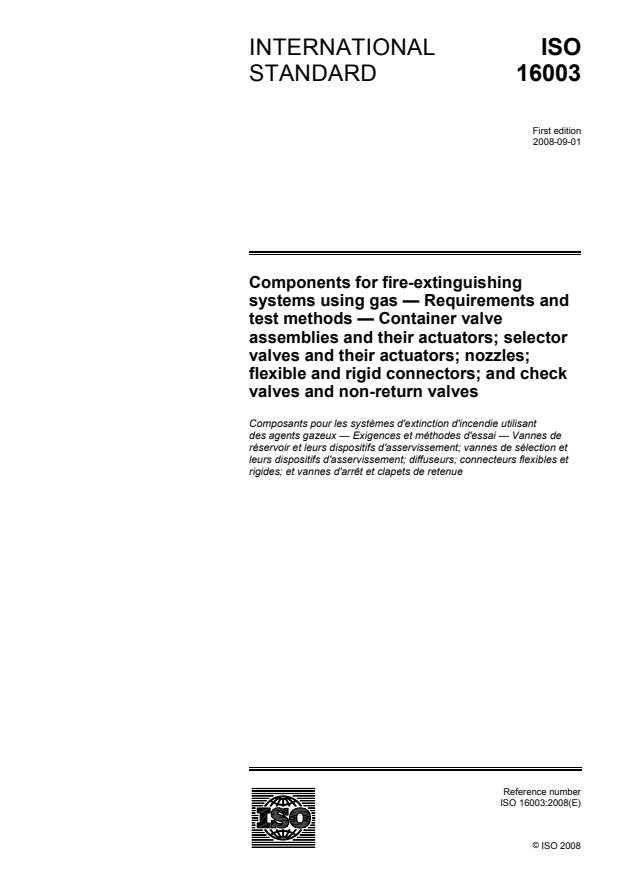
INTERNATIONAL ISO
STANDARD 16003
First edition
2008-09-01
Components for fire-extinguishing
systems using gas — Requirements and
test methods — Container valve
assemblies and their actuators; selector
valves and their actuators; nozzles;
flexible and rigid connectors; and check
valves and non-return valves
Composants pour les systèmes d'extinction d'incendie utilisant
des agents gazeux — Exigences et méthodes d'essai — Vannes de
réservoir et leurs dispositifs d'asservissement; vannes de sélection et
leurs dispositifs d'asservissement; diffuseurs; connecteurs flexibles et
rigides; et vannes d'arrêt et clapets de retenue
Reference number
©
ISO 2008
PDF disclaimer
This PDF file may contain embedded typefaces. In accordance with Adobe's licensing policy, this file may be printed or viewed but
shall not be edited unless the typefaces which are embedded are licensed to and installed on the computer performing the editing. In
downloading this file, parties accept therein the responsibility of not infringing Adobe's licensing policy. The ISO Central Secretariat
accepts no liability in this area.
Adobe is a trademark of Adobe Systems Incorporated.
Details of the software products used to create this PDF file can be found in the General Info relative to the file; the PDF-creation
parameters were optimized for printing. Every care has been taken to ensure that the file is suitable for use by ISO member bodies. In
the unlikely event that a problem relating to it is found, please inform the Central Secretariat at the address given below.
© ISO 2008
All rights reserved. Unless otherwise specified, no part of this publication may be reproduced or utilized in any form or by any means,
electronic or mechanical, including photocopying and microfilm, without permission in writing from either ISO at the address below or
ISO's member body in the country of the requester.
ISO copyright office
Case postale 56 • CH-1211 Geneva 20
Tel. + 41 22 749 01 11
Fax + 41 22 749 09 47
E-mail copyright@iso.org
Web www.iso.org
Published in Switzerland
ii © ISO 2008 – All rights reserved
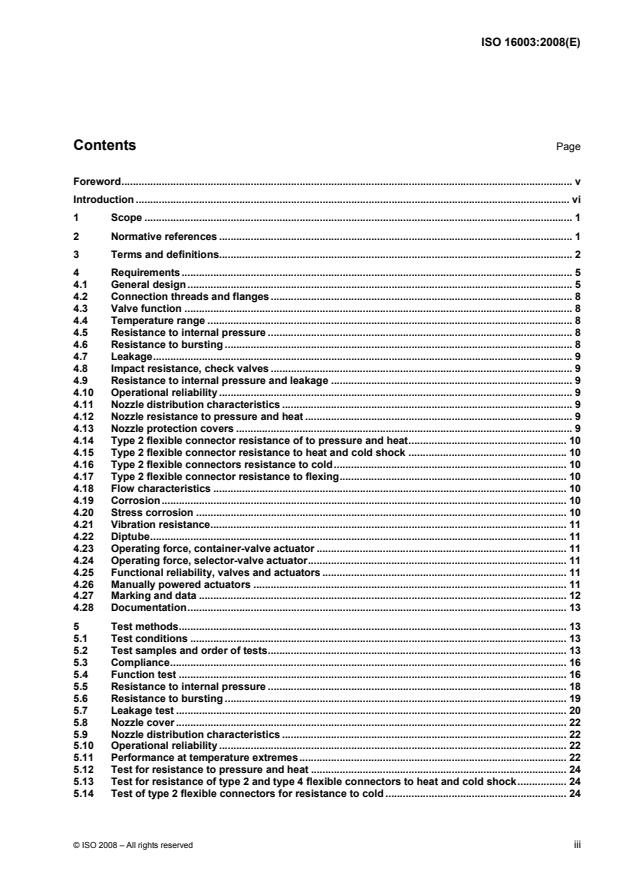
Contents Page
Foreword. v
Introduction . vi
1 Scope. 1
2 Normative references. 1
3 Terms and definitions. 2
4 Requirements. 5
4.1 General design. 5
4.2 Connection threads and flanges . 8
4.3 Valve function. 8
4.4 Temperature range. 8
4.5 Resistance to internal pressure . 8
4.6 Resistance to bursting . 8
4.7 Leakage. 9
4.8 Impact resistance, check valves . 9
4.9 Resistance to internal pressure and leakage . 9
4.10 Operational reliability. 9
4.11 Nozzle distribution characteristics . 9
4.12 Nozzle resistance to pressure and heat . 9
4.13 Nozzle protection covers . 9
4.14 Type 2 flexible connector resistance of to pressure and heat. 10
4.15 Type 2 flexible connector resistance to heat and cold shock . 10
4.16 Type 2 flexible connectors resistance to cold. 10
4.17 Type 2 flexible connector resistance to flexing. 10
4.18 Flow characteristics. 10
4.19 Corrosion. 10
4.20 Stress corrosion. 10
4.21 Vibration resistance. 11
4.22 Diptube. 11
4.23 Operating force, container-valve actuator . 11
4.24 Operating force, selector-valve actuator. 11
4.25 Functional reliability, valves and actuators . 11
4.26 Manually powered actuators . 11
4.27 Marking and data . 12
4.28 Documentation. 13
5 Test methods. 13
5.1 Test conditions . 13
5.2 Test samples and order of tests. 13
5.3 Compliance. 16
5.4 Function test . 16
5.5 Resistance to internal pressure . 18
5.6 Resistance to bursting . 19
5.7 Leakage test. 20
5.8 Nozzle cover. 22
5.9 Nozzle distribution characteristics . 22
5.10 Operational reliability. 22
5.11 Performance at temperature extremes. 22
5.12 Test for resistance to pressure and heat . 24
5.13 Test for resistance of type 2 and type 4 flexible connectors to heat and cold shock. 24
5.14 Test of type 2 flexible connectors for resistance to cold . 24
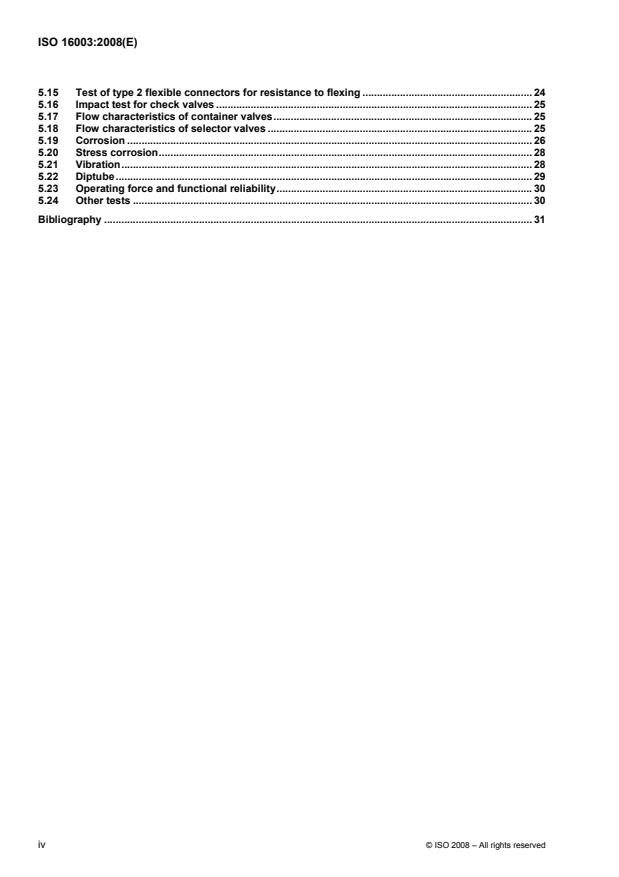
5.15 Test of type 2 flexible connectors for resistance to flexing . 24
5.16 Impact test for check valves . 25
5.17 Flow characteristics of container valves. 25
5.18 Flow characteristics of selector valves . 25
5.19 Corrosion. 26
5.20 Stress corrosion. 28
5.21 Vibration. 28
5.22 Diptube. 29
5.23 Operating force and functional reliability. 30
5.24 Other tests. 30
Bibliography . 31
iv © ISO 2008 – All rights reserved
Foreword
ISO (the International Organization for Standardization) is a worldwide federation of national standards bodies
(ISO member bodies). The work of preparing International Standards is normally carried out through ISO
technical committees. Each member body interested in a subject for which a technical committee has been
established has the right to be represented on that committee. International organizations, governmental and
non-governmental, in liaison with ISO, also take part in the work. ISO collaborates closely with the
International Electrotechnical Commission (IEC) on all matters of electrotechnical standardization.
International Standards are drafted in accordance with the rules given in the ISO/IEC Directives, Part 2.
The main task of technical committees is to prepare International Standards. Draft International Standards
adopted by the technical committees are circulated to the member bodies for voting. Publication as an
International Standard requires approval by at least 75 % of the member bodies casting a vote.
Attention is drawn to the possibility that some of the elements of this document may be the subject of patent
rights. ISO shall not be held responsible for identifying any or all such patent rights.
ISO 16003 was prepared by Technical Committee ISO/TC 21, Equipment for fire protection and fire fighting,
Subcommittee SC 8, Gaseous media and firefighting systems using gas.
Introduction
This International Standard has been prepared by a specialist working group of ISO/TC 21/SC 8 as a
companion document to ISO 14520 (all parts) and is compatible with corresponding documents prepared by
CEN. It does not cover all components incorporated in gaseous fire extinguishing systems dealt with in
ISO 14520 (all parts); rather, it is restricted to key components only, viz., container valve assemblies, flexible
connectors, check valves and non-return valves, selector valves and associated actuators and discharge
nozzles.
CO system components are also covered by this International Standard (see ISO 6183).
NOTE The components requirements of this International Standard are also satisfied by the requirements of
EN 12094 (all parts).
vi © ISO 2008 – All rights reserved
INTERNATIONAL STANDARD ISO 16003:2008(E)
Components for fire-extinguishing systems using gas —
Requirements and test methods — Container valve assemblies
and their actuators; selector valves and their actuators;
nozzles; flexible and rigid connectors; and check valves and
non-return valves
1 Scope
This International Standard specifies requirements and describes test methods for the following components
used in gaseous fire-extinguishing systems: container valve assemblies, which include container valve,
actuator and, if applicable, a diptube; selector valves and their actuators; agent distribution nozzles; flexible
connectors; and check and non-return valves.
Container valve assemblies are designed to control the extinguishant flow from the container to the
distribution pipe work. They are normally in the closed position. The automatic control device triggers the
actuator and the valve opens. Where applicable, the requirements contained in the test methods also apply to
separate container valves.
The design of the nozzles influences the area coverage, the height limitations, the discharge rate and the flow
rate.
This International Standard is applicable to check valves installed between container valve and manifold and
non-return valves installed in pilot lines, except those valves that are tested in combination with non-electrical
control devices. It is required that non-return and check valves allow the passage in the direction of flow and
prevent flow in the reverse direction.
NOTE For the purpose of this International Standard, the pressure in megapascals (bars) means gauge pressure,
unless otherwise indicated.
2 Normative references
The following referenced documents are indispensable for the application of this document. For dated
references, only the edition cited applies. For undated references, the latest edition of the referenced
document (including any amendments) applies.
ISO 7-1, Pipe threads where pressure-tight joints are made on the threads — Part 1: Dimensions, tolerances
and designation
ISO 228-1, Pipe threads where pressure-tight joints are not made on the threads — Part 1: Dimensions,
tolerances and designation
ISO 7005 (all parts), Metallic flanges
ISO 14520-1:2006, Gaseous fire-extinguishing systems — Physical properties and system design — Part 1:
General requirements
IEC 60068-2-6, Environmental testing — Part 2-6: Tests — Test Fc: Vibration (sinusoidal)
IEC 60730-2-14, Automatic electrical controls for household and similar use — Part 2-14: Particular
requirements for electric actuators
ASTM B117, Standard Practice for Operating Salt Spray (Fog) Apparatus
3 Terms and definitions
For the purpose of this document, the following terms and definitions apply.
3.1
actuator
component that causes a valve to operate
3.2
check valve
valve that is installed between container and manifold and that permits flow in only one direction
3.3
container valve
valve that retains the extinguishing agent in a container, releasing it when actuated
3.4
CO high-pressure installation
fire-extinguishing installation in which the CO is stored at ambient temperature
NOTE At 21 °C, the vapour pressure of CO is 5,88 MPa (58,8 bar) absolute, or 5,88 MPa (57,8 bar) gauge.
3.5
CO low-pressure installation
fire-extinguishing installation in which the CO is stored at low temperature, normally −18 °C, at which the
nominal pressure is 2,07 MPa (20,7 bar)
3.6
diptube
pipe connected to a container valve inlet that allows the discharge of a liquid extinguishing medium out of a
vertical container with the valve at the top
3.7
distribution characteristics
limitations of enclosure dimensions within which a nozzle is approved for use
3.8
fill ratio
mass of extinguishing medium related to the net capacity of a container
NOTE The fill ratio is expressed in units of kilograms per litre.
3.9
filter
component to prevent blockage of nozzles or other operating components by foreign materials
3.10
flexible connector
link between two parts employed to compensate for installation spacing tolerances or to provide allowance for
relative movement
2 © ISO 2008 – All rights reserved
3.10.1
type 1 flexible connector
flexible connector for connecting a container to a manifold
3.10.2
type 2 flexible connector
flexible connector for use in distribution pipe work downstream of the manifold
3.10.3
type 3 flexible connector
flexible connector for use in a pneumatic pilot line
3.10.4
type 4 flexible connector
flexible connector for use in distribution pipework downstream of the manifold/selector valve for the connection
of moving parts, which allow for dimensional adjustments
3.10.5
type 5 rigid connector
rigid connector for connecting a container to a manifold
3.11
flow rate
mass flow of extinguishing agent per unit of time
3.12
functional reliability
ability to function under different working conditions
3.13
halocarbon gas
extinguishing agent that contains as primary components one or more organic compounds containing one or
more of the agent's fluorine, chlorine, bromine or iodine
EXAMPLES Include, but are not limited to, halons, hydrofluorocarbons (HFCs), hydrochlorofluorocarbons (HCFCs),
perfluorocarbons (PFCs) and fluoroketones (FKs).
3.14
halocarbon gas installation
fire-extinguishing installation in which the halocarbon gas is stored at ambient temperature
3.15
high-pressure container
container having a working pressure greater than 3,5 MPa (35 bar)
3.16
inert gas
non-liquefied gas or mixture of gases, such as argon, nitrogen, CO or mixtures of these gases, that
extinguishes fire mainly by reducing the oxygen-concentration in the protected space
3.17
inert gas installation
fire-extinguishing installation in which the inert gas is stored at ambient temperature
3.18
local application nozzle
nozzle from which the extinguishing agent is discharged onto the surface of a partially enclosed or open
hazard
3.19
low-pressure container
container having a working pressure not greater than 3,5 MPa (35 bar)
NOTE For the purpose of this International Standard, the pressure in megapascals (bars) means gauge pressure,
unless otherwise indicated.
3.20
manifold
pipe section connected to two or more extinguishing agent containers
3.21
non-return valve
component that permits flow in one direction only
NOTE This component is intended for installation in pilot lines.
3.22
nozzle
component to achieve a predetermined flow rate and a uniform distribution characteristic of the extinguishing
agent into or onto a protected hazard
3.23
nozzle cover
component to prevent entry of foreign matter into a nozzle
3.24
pressure-relief device
device, such as a rupture disk, that protects an agent container against dangerous overpressure
3.25
pressure-relief valve
valve that protects a closed part of a pipe work against dangerous overpressure
3.26
resistance coefficient
factor used in calculating the pressure drop due to fluid flow through a component
3.27
selector valve
valve used to admit extinguishing agent into a section of a pipe system permitting the agent to flow to a
specific hazard in a multi-hazard application
NOTE Also called a “directional” valve.
3.28 Valve
3.28.1
type 1 valve
valve without a pressure-relief device
3.28.2
type 2 valve
valve with a pressure-relief device relieving other than into the valve discharge outlet
3.28.3
type 3 valve
valve with a pressure-relief device relieving into the valve discharge outlet
4 © ISO 2008 – All rights reserved
3.29
working pressure
maximum pressure at which the component is used in the system
NOTE See Table 1.
4 Requirements
4.1 General design
4.1.1 Test samples
4.1.1.1 The test sample shall comply to the technical description (drawings, parts list, description of
functions, operating and installation instructions) when checked in accordance with 5.3.
The body and internal parts of the component shall be made of materials of suitable strength and of corrosion
resistance sufficient to satisfy the performance requirements of this International Standard.
4.1.1.2 All materials shall be chemically compatible with the agent(s) with which they come into contact.
4.1.1.3 The operation of a component shall not be adversely affected by ageing or environmental
influences.
4.1.1.4 Non-metallic materials and elastomers shall not be altered, such that the operation of the
component is impaired, after any of the tests or over the working life recommended by the manufacturer.
4.1.2 Maximum rated working pressure
Components subject to pressure, including flexible connectors of Type 1, shall be specified by the
manufacturer for working pressure according to Table 1 or as otherwise specified by national standards.
Table 1 — Working pressure for components
Component CO high pressure CO low pressure Inert gas Halocarbon gas
2 2
component component component component
MPa bar MPa bar
c a b b
Container valve , selector 14,0 140
valve, non-return valve, check
valve, type 1 flexible connector
a a
Type 2 and type 4 flexible 6,0 60 2,5 25
connectors
a a
Type 5 connector 14,0 140 Not applicable
c
Pneumatic actuator , type 3 As specified by the manufacturer
flexible connector
a
To be determined.
b
This value is given as the pressure developed in a container at its maximum fill ratio and developed pressure at 50 °C, where
applicable.
c
Actuators may have a different working pressure than container valves.
4.1.3 Selector valves
The operating positions of selector valves of the bimodal type (i.e. open or closed) shall be closed prior to
actuation. The operating position of three-way fluid-flow directing ball valves, where used, shall be set to direct
flow to the hazard to receive the fire-extinguishing agent prior to system actuation.
4.1.3.1 Valve operation
Selector valves shall be designed so that they change from the closed to the open position, only on operation
of an actuator or by manual means. The design of three-way ball valves used to direct agent flow shall be
such that the valve ball position occurs only on operation of an actuator or by manual means.
4.1.3.1.1 The closed position of a low-pressure valve shall not be maintained only by friction.
4.1.3.1.2 Selector valves shall be designed to operate over the approved operating pressure range and
temperature range of the system.
NOTE A selector valve actuator can have a working pressure different from that of the selector valve it operates.
4.1.3.1.3 The open and closed position of a selector valve, or the operating position of a ball valve, shall be
indicated at the valve and shall be defined by mechanical means at the valve actuator.
4.1.3.1.4 The pressure of the housing of a selector valve or a three-way flow-directing ball valve shall not
exceed the working pressure in any operating condition.
NOTE Cold liquid CO trapped in a closed, low-pressure CO selector valve after flooding can cause pressures
2 2
exceeding the working pressure when the temperature of the CO and the valve increases.
4.1.4 Container-valve assemblies
4.1.4.1 Container
The system manufacturer shall specify the container sizes, the related minimum and maximum fill ratios or
quantities and, for super-pressurized containers, the super-pressurization value at standard conditions.
4.1.4.2 Diptube
If the component incorporates a diptube, the diptube shall be made of materials of suitable strength, corrosion
resistance and other performance requirements of this International Standard, and shall be fixed to the
container valve by a threaded connection, using a suitable chemical sealant, or other mechanical means.
Torque, sealant, geometry of the inlet of the diptube and the length of the diptube related to the container shall
be specified by the manufacturer. Rigid, curved diptubes intended for use in containers not in the vertical
position shall be provided with a means of alignment with a mark on the valve, indicating the correct attitude
for installation.
Where cylinders intended for mounting in attitudes other than vertical are fitted with a curved rigid diptube,
mounting instructions shall be affixed to the cylinder to indicate the correct attitude for installation.
4.1.4.3 Container-valve actuator
4.1.4.3.1 Pneumatic actuator
If the component incorporates a pneumatically powered actuator, the manufacturer shall specify nominal
maximum and minimum values for the pressure supply.
6 © ISO 2008 – All rights reserved
4.1.4.3.2 Mechanical actuator
If the component incorporates a mechanical actuator, the manufacturer shall specify the force required for
hand-operated actuators and the mass and the drop distance for gravity-powered actuators.
4.1.4.3.3 Electric actuator
If the component incorporates an electric powered actuator, the manufacturer shall specify
a) the minimum and maximum voltage,
b) the minimum current.
4.1.4.3.4 Pyrotechnic actuator
If the component incorporates a pyrotechnically powered actuator, the manufacturer shall specify
⎯ the minimum all-fire current, minimum current duration and the wave form of the signal,
⎯ the maximum monitoring current,
⎯ the minimum voltage,
⎯ the maximum storage time under specified storage conditions,
⎯ the maximum lifetime under stand-by conditions (50 °C and 70 % relative humidity).
In addition, data shall be provided by the manufacturer to show the following:
a) that the failure rate of the device in the energy-transfer path does not exceed 1 in 10 000 at the
recommended firing current; firing probability of the device shall be at least 99,9 % with 95 % confidence
limits when supplied with the recommended firing current;
b) that the actuators achieve the required power output after being subjected to a 90 day ageing test at a
test temperature of (90 ± 2) °C;
c) that the power output of the actuator at the end of its service life, as recommended by the manufacturer,
is not less than three times that required to operate the valve under the most disadvantageous operating
conditions.
4.1.4.3.5 Electric parts
The electric parts of an actuator shall be engineered in accordance with the requirements of IEC 60730-2-14.
4.1.4.3.6 Testing
Provision should be made for testing the actuator without actually releasing the extinguishing agent.
If the components do not include such a test facility, the system shall include a test facility that can be used to
separately test each group of containers actuated at the same time to verify that the necessary type and level
of power is provided.
4.1.5 Pressure-relief device
Where a pressure-relief device is incorporated as part of a container valve, it shall be rated in accordance with
the relevant ISO International Standards or national requirements for pressure-relief devices. The integrity of
the device shall be maintained throughout the following tests:
a) high temperature;
b) low temperature;
c) vibration (marine applications or where otherwise specified);
d) corrosion.
The operating pressure shall be verified in accordance with relevant national regulations.
4.2 Connection threads and flanges
Connection threads shall be in accordance with either ISO 7-1 or ISO 228-1. Pipe flanges shall be in
accordance with ISO 7005 (all parts).
NOTE References to certain national standards such as ANSI/ASME B1.20.1 and ANSI/ASME B16.5 can also be
acceptable; see Annex A for details.
4.3 Valve function
Container valves, selector valves, check valves and non-return valves in the design flow path shall remain in
the open position until the end of the required discharge.
4.4 Temperature range
The components shall operate in the temperature range for which the system was approved. See 5.13.
4.5 Resistance to internal pressure
A component shall not suffer any permanent deformation when tested in accordance with the requirements of
the relevant section of this International Standard (see Table 2). A rupture disc may deform but shall not
rupture.
Table 2 — Pressure-resistance test reference
Component type Reference for test procedure
Container-valve casing, closure mechanism and pressurized accessories 5.5.2
Selector-valve casing and pressurized actuator, resistance to pressure and leakage 5.5.3
Check valve and non-return valve 5.5 4
Flexible connector 5.5.5
A component under test shall not leak during the pressure-resistance test procedure.
4.6 Resistance to bursting
A component shall not burst when subjected to a test pressure of three times the working pressure, or twice
the maximum relief pressure of the agent container pressure-relief device, whichever is less, when tested as
described in 5.6.
8 © ISO 2008 – All rights reserved
4.7 Leakage
4.7.1 Container valves
The loss of content from a container valve assembly shall not exceed 0,5 % of the actual net charge mass of
the specified smallest appropriate container, when tested in accordance with the requirements of 5.7.1.
4.7.2 Check valves and non-return valves
Check valves and non-return valves shall meet the requirements of 5.7.2.
4.7.3 Selector valve
Selector valves shall meet the requirements of 5.7.3.
4.7.4 Connectors
Connectors shall meet the requirements of 5.7.4.
4.8 Impact resistance, check valves
Check valves shall not be damaged, when tested in accordance with 5.16.
4.9 Resistance to internal pressure and leakage
This requirement applies to components that are not normally pressurized, except upon system discharge, to
include:
a) selector valves;
b) check valves and non-return valves;
c) flexible connectors.
Components shall not leak or suffer any permanent deformation when tested in accordance with 5.5.
4.10 Operational reliability
There shall be no deterioration of performance, when a component is tested as described in 5.10. During
operation no part of the component shall be ejected outside the confines of the component or into the
discharge pipe work.
4.11 Nozzle distribution characteristics
Nozzle distribution characteristics shall be determined in accordance with 5.9.
4.12 Nozzle resistance to pressure and heat
The extinguishing nozzles shall be able to withstand the test pressures and temperatures given in Table 3.
4.13 Nozzle protection covers
If a protective cap or cover is used to prevent exterior dirt or foreign matter from entering the nozzle, the cover
shall be ejected free and clear of the nozzle when the extinguishant pressure at the nozzle is between
0,01 MPa (0,1 bar) and 0,3 MPa (3 bar) when tested in accordance with 5.8. The ejected cover shall not
adversely affect distribution of extinguishant.
Table 3 — Test pressure and temperature
Type of system Test pressure Test temperature
°C
MPa bar
High-pressure CO 6,0 60 600
Low-pressure CO 2,5 25 600
Other As specified by the manufacturer 600
Nozzles shall show no signs of deterioration that can impair proper performance when tested in accordance
with 5.12.2.
4.14 Type 2 flexible connector resistance of to pressure and heat
Type 2 flexible connectors shall not leak, and shall show no sign of damage that can impair proper function
when tested at the appropriate pressure and temperature given in Table 3, when tested in accordance with
5.12.
4.15 Type 2 flexible connector resistance to heat and cold shock
Type 2 flexible connectors shall not leak, and shall show no sign of damage that can impair proper function
when tested in accordance with 5.13.
4.16 Type 2 flexible connectors resistance to cold
Type 2 flexible connectors shall show no visible sign of damage when tested in accordance with 5.14.
4.17 Type 2 flexible connector resistance to flexing
Type 2 connectors shall not leak when tested in accordance with 5.15.
4.18 Flow characteristics
The flow characteristics of any component in the flow path shall be specified by the manufacturer either as an
equivalent length or as a flow-resistance coefficient consistent with the requirements of ISO 14520-1:2006, 7.3,
and shall be determined in accordance with 5.17 or 5.18, as appropriate.
Determination of the flow characteristics of an individual component may be omitted if flow characteristics are
determined for an assembly containing that component.
EXAMPLE Flow characteristics can be determined for an assembly consisting of a diptube, a container valve and a
flexible connector. Test results are valid only for combination tested.
4.19 Corrosion
A component shall operate satisfactorily after being subjected to the corrosion test in accordance with 5.19.
4.20 Stress corrosion
Any part used in a component that is made of copper alloy containing more than 15 % zinc shall not crack,
when tested in accordance with 5.20.
10 © ISO 2008 – All rights reserved
4.21 Vibration resistance
Where applicable, the component shall not operate or be damaged when tested in accordance with 5.21. If the
component incorporates a diptube, the diptube shall not fracture, become loosened or detached during the test.
NOTE The vibration test does not apply for single-piece nozzles.
4.22 Diptube
Where the component incorporates a diptube, the length and configuration of the diptube shall be such that
the volume of water remaining in the cylinder at the end of the discharge is less than 5 % of the internal
volume of the cylinder when tested in accordance with 5.23.
For containers in a vertical position with the valve at the top, the above requirement is fulfilled without testing
when the highest point of the inlet of the diptube is not more than two times the internal diameter of the
diptube above the base of the container, measured straight below the diptube inlet, and the flow to the inlet of
the diptube is not hindered.
4.23 Operating force, container-valve actuator
The effective operating force of a mechanical actuator shall be at least two times, and in the case of a
pyrotechnic actuator at least three times, the force necessary to open a container valve in at most 2 s under
the most severe conditions, when tested in accordance with 5.23.
4.24 Operating force, selector-valve actuator
The effective force of a selector-valve actuator shall be sufficient to open the selector valve in at most 3 s
when tested at the minimum and maximum operating temperatures in accordance with 5.24.
4.25 Functional reliability, valves and actuators
4.25.1 There shall be no deterioration of performance when a component incorporating an electric powered
actuator is tested as described in 5.23. The valve shall operate within 2 s and open fully at the nominal,
maximum and minimum specified voltage.
4.25.2 There shall be no deterioration of performance when a pneumatically powered actuator is tested in
accordance with 5.23. The valve shall operate within 2 s and open fully at the nominal, maximum and
minimum specified pressure.
4.25.3 There shall be no deterioration of performance when a gravity-powered actuator is tested in
accordance with 5.23. The free travel of the falling mass shall not be inhibited and there shall be at least
50 mm clearance beyond the fully operated position. Account should be taken of factors such as cable
stretching, elongation due to temperature variation and other relevant factors.
4.25.4 There shall be no deterioration of performance when a pyrotechnic actuator is tested in accordance
with 5.23.
4.26 Manually powered actuators
NOTE The provisions of this subclause apply only to manually operated actuators where the power to operate the
valve is provided directly by a person employing a mechanical mechanism, e.g. lever at the valve.
The force required to operate a manually powered actuator shall not exceed
a) 180 N for hand operation,
b) 50 N for finger-pull operation, or
c) 10 N for finger-push operation.
The actuator shall not require a movement of more than 360 mm to achieve actuation when tested as
described in 5.23.
4.27 Marking and data
The marking of data for a component shall be in accordance with Table 4.
The marking on the product shall be permanent and legible.
Table 4 — Component marking
Valve or
Selector-
valve- Selector Flexible Check
Element Actuator valve Nozzle
cylinder valve connector valve
actuator
assembly
On the On the On the On the On the On the
On valve or component or component or component or component or component or component or
Location of valve – in a parts list in a parts list in a parts list in a parts list in a parts list in a parts list
marking cylinder incorporated incorporated incorporated incorporated incorporated incorporated
assembly in the user's in the user's in the user's in the user's in the user's in the user's
manual manual manual manual manual manual
Applicable
International
X X X — X
or National
Standard
Manufacturer's
or supplier's
X X X X X X X
name or
trademark
Nominal
diameter, size
X X X X X X X
or model
designation
X for
Working
X pneumatic X X — X X
pressure
types
Serial or batch X for electric,
number or mechanical,
X X — — — —
date of & pneumatic
manufacture types
X for
Date of
— pyrotechnic — — — — —
manufacture
types
Nominal
X for electric X for electric
voltage and — — — — —
types types
current
Installation
— — X — — — X
position
Direction of
— — X — — — X
flow
12 © ISO 2008 – All rights reserved
4.28 Documentation
4.28.1 The manufacturer shall prepare and maintain documentation that specifies the installation, operation,
routine testing and maintenance procedures applicable to the component and all other information relating to
its incorporation within a fire-extinguishing system.
4.28.2 The manufacturer shall prepare installation and user documentation, which shall be submitted to the
testing authority together with the sample(s). This documentation shall be comprised of at least the following:
a) general description of the component, including a list of its features and functions;
b) technical specification including
⎯ the information specified in 4.1,
⎯ sufficient information to permit an assessment of the compatibility with other components of the
system (if applicable, e.g. mechanical, electric or software compatibility);
c) installation instructions including
⎯ the suitability for use in different environments,
⎯ mounting instructions,
⎯ operating instructions,
⎯ maintenance instructions.
4.28.3 The manufacturer shall prepare design documentation, which shall be submitted to the testing
authority together with the sample(s). This documentation shall include drawings, parts lists, block diagrams
(if applicable), circuit diagrams (if applicable) and a functional description in sufficient detail that compliance
with this International Standard can be checked and that a general assessment of the design is possible.
4.28.4 An installation, operation and maintenance manual and a design manual (when applicable) shall
either be provided with each automatic extinguisher or extinguishing system unit or be made available upon
request. When these manuals are not included with each system, an owner's manual shall be shipped with
each system.
5 Test methods
5.1 Test conditions
The components shall be assembled for test as specified in the technical description. The tests shall be
carried out at a temperature of (25 ± 10) °C, except when otherwise specified for a particular test. The
tolerance for all test parameters is ± 5 %, unless otherwise specified.
5.2 Test samples and order of tests
The number of samples of each component type and the order of testing of each component are given in the
relevant table as follows:
⎯ container valves and their actuators: Table 5;
⎯ selector valves and their actuators: Table 6;
⎯ nozzles: Table 7;
⎯ flexible connectors: Table 8;
⎯ check valves and non-return valves: Table 9.
Table 5 — Order of tests for container valves and their actuators
a,b
Test and reference Order of tests for test sample
A B C D E
5.3 Compliance 1 1 1 1 1
5.4 Function 3 and 9 — — — 4
5.5 Internal pressure 2 — — — —
5.6 Strength 10 — — — —
5.7 Leakage — — 2 2 —
5.10 Operational reliability 7 — — — —
5.11 Temperature 5 — — — —
5.17 Flow characteristics 4 — — — —
5.19 Corrosion (method 1 or 2) 8 — — — —
5.20 Stress corrosion — 2 — — —
5.21 Vibration — — — — 3
5.22 Diptube — — — — 2
5.23 Operating force and functional reliability 6 — — — —
a
Number of samples: Mechanical components: 5, identified as A to E; pyrotechnic actuators: 151.
b
The replacement of parts as set out in the manufacturer's operation and maintenance manual shall be carried out during testing.
Such parts shall be provided with the test samples.
Table 6 — Order of tests for selector valves and their actuators
a
Test and reference Order of tests for test sample
A B C
5.3 Compliance 1 1 1
5.4 Function 3/9/14 3 3
5.5 Internal pressure 2 2 2
5.7 Leakage 10/12/15 — —
5.6 Strength 16 — —
5.10 Operational reliability 11 — —
5.11.2 Temperature conditions — — —
[1] [1]
5.11.2.1 Low-temperature, including leakage 6 6 6
[1] [1]
5.11.2.2 High-temperature, including leakage 5 5 5
5.17 Flow characteristics 4 4 4
5.19 Corrosion (method 1 or 2) 13 — —
5.20 Stress corrosion — 8 —
5.21 Vibration 8 — —
b b
5.23.2 Operating force and functional reliability 7 7 7
a
Number of samples: 3, designated A to C. If there is a design series, three different diameters are chosen and designated as follows:
A largest cross-section
B medium cross-section
C smallest-cross section.
b
Whether or not these tests are necessary depends on the construction.
14 © ISO 2008 – All rights reserved
Table 7
...
Questions, Comments and Discussion
Ask us and Technical Secretary will try to provide an answer. You can facilitate discussion about the standard in here.
Loading comments...