


ISO/IEC TR 24732:2009
(Main)Information technology — Programming languages, their environments and system software interfaces — Extension for the programming language C to support decimal floating-point arithmetic
Information technology — Programming languages, their environments and system software interfaces — Extension for the programming language C to support decimal floating-point arithmetic
ISO/IEC TR 24732:2009 specifies an extension to the programming language C, specified by the International Standard ISO/IEC 9899:1999. The extension provides support for decimal floating-point arithmetic that is intended to be consistent with the specification in IEEE 754-2008. Any conflict between the requirements described here and that specification is unintentional. ISO/IEC TR 24732:2009 defers to IEEE 754-2008. The binary floating-point arithmetic as specified in IEEE 754-2008 is not considered in ISO/IEC TR 24732:2009.
Technologies de l'information — Langages de programmation, leur environnement et interfaces des logiciels de systèmes — Extension pour que le langage de programmation C supporte l'arithmétique du point flottant décimal
General Information
- Status
- Withdrawn
- Publication Date
- 04-Jan-2009
- Withdrawal Date
- 04-Jan-2009
- Technical Committee
- ISO/IEC JTC 1/SC 22 - Programming languages, their environments and system software interfaces
- Drafting Committee
- ISO/IEC JTC 1/SC 22/WG 14 - C
- Current Stage
- 9599 - Withdrawal of International Standard
- Start Date
- 18-May-2015
- Completion Date
- 14-Feb-2026
Relations
- Effective Date
- 01-Jan-2022
Buy Documents
ISO/IEC TR 24732:2009 - Information technology -- Programming languages, their environments and system software interfaces -- Extension for the programming language C to support decimal floating-point arithmetic
Get Certified
Connect with accredited certification bodies for this standard

BSI Group
BSI (British Standards Institution) is the business standards company that helps organizations make excellence a habit.

NYCE
Mexican standards and certification body.
Sponsored listings
Frequently Asked Questions
ISO/IEC TR 24732:2009 is a technical report published by the International Organization for Standardization (ISO). Its full title is "Information technology — Programming languages, their environments and system software interfaces — Extension for the programming language C to support decimal floating-point arithmetic". This standard covers: ISO/IEC TR 24732:2009 specifies an extension to the programming language C, specified by the International Standard ISO/IEC 9899:1999. The extension provides support for decimal floating-point arithmetic that is intended to be consistent with the specification in IEEE 754-2008. Any conflict between the requirements described here and that specification is unintentional. ISO/IEC TR 24732:2009 defers to IEEE 754-2008. The binary floating-point arithmetic as specified in IEEE 754-2008 is not considered in ISO/IEC TR 24732:2009.
ISO/IEC TR 24732:2009 specifies an extension to the programming language C, specified by the International Standard ISO/IEC 9899:1999. The extension provides support for decimal floating-point arithmetic that is intended to be consistent with the specification in IEEE 754-2008. Any conflict between the requirements described here and that specification is unintentional. ISO/IEC TR 24732:2009 defers to IEEE 754-2008. The binary floating-point arithmetic as specified in IEEE 754-2008 is not considered in ISO/IEC TR 24732:2009.
ISO/IEC TR 24732:2009 is classified under the following ICS (International Classification for Standards) categories: 35.060 - Languages used in information technology. The ICS classification helps identify the subject area and facilitates finding related standards.
ISO/IEC TR 24732:2009 has the following relationships with other standards: It is inter standard links to ISO/IEC TS 18661-2:2015. Understanding these relationships helps ensure you are using the most current and applicable version of the standard.
ISO/IEC TR 24732:2009 is available in PDF format for immediate download after purchase. The document can be added to your cart and obtained through the secure checkout process. Digital delivery ensures instant access to the complete standard document.
Standards Content (Sample)
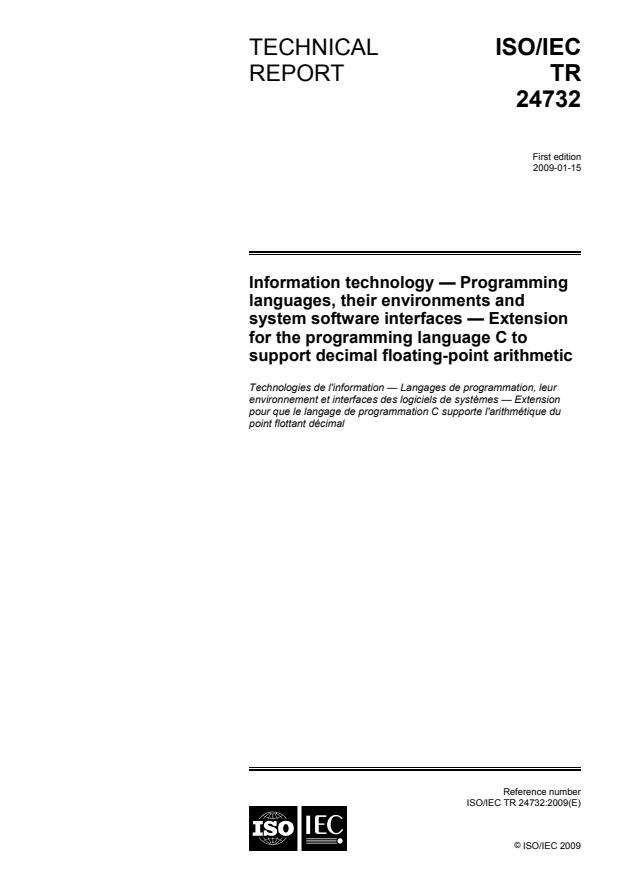
TECHNICAL ISO/IEC
REPORT TR
First edition
2009-01-15
Information technology — Programming
languages, their environments and
system software interfaces — Extension
for the programming language C to
support decimal floating-point arithmetic
Technologies de l'information — Langages de programmation, leur
environnement et interfaces des logiciels de systèmes — Extension
pour que le langage de programmation C supporte l'arithmétique du
point flottant décimal
Reference number
©
ISO/IEC 2009
PDF disclaimer
This PDF file may contain embedded typefaces. In accordance with Adobe's licensing policy, this file may be printed or viewed but
shall not be edited unless the typefaces which are embedded are licensed to and installed on the computer performing the editing. In
downloading this file, parties accept therein the responsibility of not infringing Adobe's licensing policy. The ISO Central Secretariat
accepts no liability in this area.
Adobe is a trademark of Adobe Systems Incorporated.
Details of the software products used to create this PDF file can be found in the General Info relative to the file; the PDF-creation
parameters were optimized for printing. Every care has been taken to ensure that the file is suitable for use by ISO member bodies. In
the unlikely event that a problem relating to it is found, please inform the Central Secretariat at the address given below.
© ISO/IEC 2009
All rights reserved. Unless otherwise specified, no part of this publication may be reproduced or utilized in any form or by any means,
electronic or mechanical, including photocopying and microfilm, without permission in writing from either ISO at the address below or
ISO's member body in the country of the requester.
ISO copyright office
Case postale 56 • CH-1211 Geneva 20
Tel. + 41 22 749 01 11
Fax + 41 22 749 09 47
E-mail copyright@iso.org
Web www.iso.org
Published in Switzerland
ii © ISO/IEC 2009 – All rights reserved
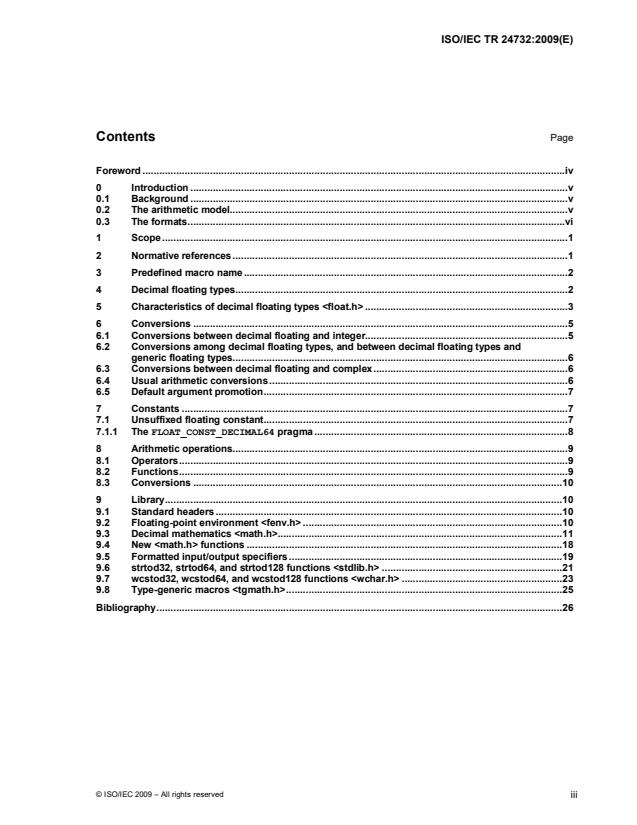
Contents Page
Foreword .iv
0 Introduction .v
0.1 Background .v
0.2 The arithmetic model.v
0.3 The formats.vi
1 Scope.1
2 Normative references.1
3 Predefined macro name .2
4 Decimal floating types.2
5 Characteristics of decimal floating types .3
6 Conversions .5
6.1 Conversions between decimal floating and integer.5
6.2 Conversions among decimal floating types, and between decimal floating types and
generic floating types.6
6.3 Conversions between decimal floating and complex.6
6.4 Usual arithmetic conversions.6
6.5 Default argument promotion.7
7 Constants .7
7.1 Unsuffixed floating constant.7
7.1.1 The FLOAT_CONST_DECIMAL64 pragma .8
8 Arithmetic operations.9
8.1 Operators.9
8.2 Functions.9
8.3 Conversions .10
9 Library.10
9.1 Standard headers .10
9.2 Floating-point environment .10
9.3 Decimal mathematics .11
9.4 New functions .18
9.5 Formatted input/output specifiers.19
9.6 strtod32, strtod64, and strtod128 functions .21
9.7 wcstod32, wcstod64, and wcstod128 functions .23
9.8 Type-generic macros .25
Bibliography.26
© ISO/IEC 2009 – All rights reserved iii
Foreword
ISO (the International Organization for Standardization) and IEC (the International Electrotechnical
Commission) form the specialized system for worldwide standardization. National bodies that are members of
ISO or IEC participate in the development of International Standards through technical committees
established by the respective organization to deal with particular fields of technical activity. ISO and IEC
technical committees collaborate in fields of mutual interest. Other international organizations, governmental
and non-governmental, in liaison with ISO and IEC, also take part in the work. In the field of information
technology, ISO and IEC have established a joint technical committee, ISO/IEC JTC 1.
International Standards are drafted in accordance with the rules given in the ISO/IEC Directives, Part 2.
The main task of the joint technical committee is to prepare International Standards. Draft International
Standards adopted by the joint technical committee are circulated to national bodies for voting. Publication as
an International Standard requires approval by at least 75 % of the national bodies casting a vote.
In exceptional circumstances, the joint technical committee may propose the publication of a Technical Report
of one of the following types:
— type 1, when the required support cannot be obtained for the publication of an International Standard,
despite repeated efforts;
— type 2, when the subject is still under technical development or where for any other reason there is the
future but not immediate possibility of an agreement on an International Standard;
— type 3, when the joint technical committee has collected data of a different kind from that which is
normally published as an International Standard (“state of the art”, for example).
Technical Reports of types 1 and 2 are subject to review within three years of publication, to decide whether
they can be transformed into International Standards. Technical Reports of type 3 do not necessarily have to
be reviewed until the data they provide are considered to be no longer valid or useful.
ISO/IEC TR 24732, which is a Technical Report of type 2, was prepared by Joint Technical Committee
ISO/IEC JTC 1, Information technology, Subcommittee SC 22, Programming languages, their environments
and system software interfaces.
iv © ISO/IEC 2009 – All rights reserved
0 Introduction
0.1 Background
Most of today's general purpose computing architectures provide binary floating-point arithmetic in hardware.
Binary floating-point is an efficient representation which minimizes memory use, and is simpler to implement
than floating-point arithmetic using other bases. It has therefore become the norm for scientific computations,
with almost all implementations following the IEEE 754 standard for binary floating-point arithmetic.
However, human computation and communication of numeric values almost always uses decimal arithmetic
and decimal notations. Laboratory notes, scientific papers, legal documents, business reports and financial
statements all record numeric values in decimal form. When numeric data are given to a program or are
displayed to a user, binary to-and-from decimal conversion is required. There are inherent rounding errors
involved in such conversions; decimal fractions cannot, in general, be represented exactly by binary floating-
point values. These errors often cause usability and efficiency problems, depending on the application.
These problems are minor when the application domain accepts, or requires results to have, associated error
estimates (as is the case with scientific applications). However, in business and financial applications,
computations are either required to be exact (with no rounding errors) unless explicitly rounded, or be
supported by detailed analyses that are auditable to be correct. Such applications therefore have to take
special care in handling any rounding errors introduced by the computations.
The most efficient way to avoid conversion error is to use decimal arithmetic. Currently, the IBM zArchitecture
(and its predecessors since System/360) is a widely used system that supports built-in decimal arithmetic.
This, however, provides integer arithmetic only, meaning that every number and computation has to have
separate scale information preserved and computed in order to maintain the required precision and value
range. Such scaling is difficult to code and is error-prone; it affects execution time significantly, and the
resulting program is often difficult to maintain and enhance.
Even though the hardware may not provide decimal arithmetic operations, the support can still be emulated by
software. Programming languages used for business applications either have native decimal types (such as
PL/I, COBOL, C#, or Visual Basic) or provide decimal arithmetic libraries (such as the BigDecimal class in
Java). The arithmetic used in business applications, nowadays, is almost invariably decimal floating-point; the
COBOL 2002 ISO standard, for example, requires that all standard decimal arithmetic calculations use 32-
digit decimal floating-point.
Arguably, the C language hits a sweet spot within the wide range of programming languages available today –
it strikes an optimal balance between usability and performance. Its simple and expressive syntax makes it
easy to program; and its close-to-the-hardware semantics makes it efficient. Despite the advent of newer
programming languages, C is still often used together with other languages to code the computationally
intensive part of an application. In many cases, entire business applications are written in C/C++. To maintain
the vitality of C, the need for decimal arithmetic by the business and financial community cannot be ignored.
The importance of this has been recognized by the IEEE. The IEEE 754 standard is currently being revised,
and the major change in that revision is the addition of decimal floating-point formats and arithmetic.
Historically there has been a close tie between IEEE 754 and C with respect to floating-point specification.
This Technical Report proposes to add decimal floating types and arithmetic to the C programming language
specification.
0.2 The arithmetic model
This Technical Report proposes to add support for the decimal formats for floating-point data specified in IEEE
754-2008, with operations and behaviors consistent with that specification. IEEE 754-2008 provides a unified
specification for floating-point arithmetic using both binary radix and decimal radix representations. For binary
radix, it specifies upwardly-compatible extensions to the previous version, IEEE 754-1985 (equivalently IEC
60559:1989, which is already supported by C99 implementations that define the macro __STDC_IEC_559__).
© ISO/IEC 2009 – All rights reserved v
Those extensions are not considered in this proposal. Instead, this proposal confines itself to supporting the
decimal radix formats, which are new in this revision of IEEE 754.
The model of floating-point arithmetic used in IEEE 754-2008 has three components:
data - numbers and NaNs, which can be manipulated by, or be the results of, the operations it
specifies
operations - (addition, multiplication, conversions, etc) which can be carried out on data
context - the status of operations (namely, exceptions flags), and controls to govern the results of
operations (for example, rounding modes). (IEEE 754-2008 does not use a single term to refer to
these collectively.)
The model defines these components in the abstract. It neither defines the way in which operations are
expressed (which might vary depending on the computer language or other interface being used), nor does it
define the concrete representation (specific layout in storage, or in a processor's register, for example) of data
or context, except that it does define specific encodings that are to be used for data that may be exchanged
between different implementations that conform to the specification.
From the perspective of the C language, data are represented by data types, operations are defined within
expressions, and context is the floating environment specified in . This Technical Report specifies
how the C language implements these components.
0.3 The formats
IEEE 754-2008 specifies formats, in terms of their radix, exponent range, and precision (significand length), to
support general purpose decimal floating-point arithmetic. It specifies operation semantics in terms of values
and abstract representations of data (format members). It also specifies bit-level encodings for formats
intended for data interchange.
C99 specifies floating-point arithmetic using a two-layer organization. The first layer provides a specification
using an abstract model. The representation of a floating-point number is specified in an abstract form where
the constituent components of the representation are defined (sign, exponent, significand) but not the internals
of these components. In particular, the exponent range, significand size, and the base (or radix) are
implementation defined. This allows flexibility for an implementation to take advantage of its underlying
hardware architecture. Furthermore, certain behaviors of operations are also implementation defined, for
example in the area of handling of special numbers and in exceptions.
The reason for this approach is historical. At the time when C was first standardized, there were already
various hardware implementations of floating-point arithmetic in common use. Specifying the exact details of a
representation would make most of the existing implementations at the time not conforming.
C99 provides a binding to IEEE 754 by specifying an Annex F, IEC 60559 floating point arithmetic, and
adopting that standard by reference. An implementation may choose not to conform to IEEE 754 and indicates
that by not defining the macro __STDC_IEC_559__.This means not all implementations need to support
IEEE 754, and the floating-point arithmetic need not be binary.
This Technical Report specifies decimal floating-point arithmetic according to IEEE 754-2008, with the
constituent components of the representation defined. This is more stringent than the existing C99 approach
for the floating types. Since it is expected that all decimal floating-point hardware implementations will conform
to the revised IEEE 754, binding to this standard directly benefits both implementers and programmers.
vi © ISO/IEC 2009 – All rights reserved
TECHNICAL REPORT ISO/IEC TR 24732:2009(E)
Information technology — Programming languages, their
environments and system software interfaces — Extension for
the programming language C to support decimal floating-point
arithmetic
1 Scope
This Technical Report specifies an extension to the programming language C, specified by the International
Standard ISO/IEC 9899:1999. The extension provides support for decimal floating-point arithmetic that is
intended to be consistent with the specification in IEEE 754-2008. Any conflict between the requirements
described here and that specification is unintentional. This Technical Report defers to IEEE 754-2008.
The binary floating-point arithmetic as specified in IEEE 754-2008 is not considered in this Technical Report.
2 Normative references
The following referenced documents are indispensable for the application of this document. For dated
references, only the edition cited applies. For undated references, the latest edition of the referenced
document (including any amendments) applies.
ISO/IEC 9899:1999, Programming languages — C
ISO/IEC 9899:1999/Cor.1:2001, Programming languages — C — Technical Corrigendum 1
ISO/IEC 9899:1999/Cor.2;2004, Programming languages — C — Technical Corrigendum 2
ISO/IEC TR 18037, Programming languages — C — Extensions to support embedded processors
1)
IEC 60559:1989, Binary floating-point arithmetic for microprocessor systems
IEEE 754-1985, IEEE Standard for Binary Floating-Point Arithmetic
IEEE 754-2008, IEEE Standard for Floating-Point Arithmetic
IEEE 854-1987, IEEE Standard for Radix-Independent Floating-Point Arithmetic
A Decimal Floating-Point Specification, Schwarz, Cowlishaw, Smith, and Webb, in the Proceedings of the 15th
IEEE Symposium on Computer Arithmetic (Arith 15), IEEE, June 2001
NOTE For reference materials relating to IEEE 754-2008 see [3].
1)
Previously designated IEC 559:1989.
© ISO/IEC 2009 – All rights reserved 1
3 Predefined macro name
The following macro name is conditionally defined by the implementation:
__STDC_DEC_FP__ The integer constant 200805L, intended to indicate conformance to this technical
report.
4 Decimal floating types
This Technical Report introduces three decimal floating types, designated as _Decimal32, _Decimal64 and
_Decimal128. The set of values of type _Decimal32 is a subset of the set of values of the type
_Decimal64; the set of values of the type _Decimal64 is a subset of the set of values of the type
_Decimal128.
Within the type hierarchy, decimal floating types are base types, real types and arithmetic types.
The types float, double, and long double are also called generic floating types for the purpose of this
Technical Report.
Note: C does not specify a radix for float, double and long double. An implementation can choose the
representation of float, double and long double to be the same as the decimal floating types. In any
case, the decimal floating types are distinct from float, double and long double regardless of the
representation.
Note: This Technical Report does not define decimal complex types or decimal imaginary types. The three
complex types remain as float _Complex, double _Complex and long double _Complex, and the
three imaginary types remain as float _Imaginary, double _Imaginary and long double
_Imaginary.
Suggested changes to C99:
Change the first sentence of 6.2.5#10:
[10] There are three generic floating types, designated as float, double and long double.
Add the following paragraphs after 6.2.5#10:
[10a] There are three decimal floating types, designated as _Decimal32, _Decimal64 and _Decimal128.
2)
The set of values of the type _Decimal32 is a subset of the set of values of the type _Decimal64; the
set of values of the type _Decimal64 is a subset of the set of values of the type _Decimal128. Decimal
floating types are real floating types.
2) The 32-bit format is a storage only format in IEEE 754-2008.
2 © ISO/IEC 2009 – All rights reserved
[10b] Together, the generic floating types and the decimal floating types comprise the real floating types.
Add the following to 6.7.2 Type specifiers:
type-specifier:
_Decimal32
_Decimal64
_Decimal128
Add the following paragraph after 6.5#8:
[8a] Expressions involving decimal floating-point operands are evaluated according to the semantics of IEEE
754-2008, including production of results with the preferred exponent as specified in IEEE 754-2008.
5 Characteristics of decimal floating types
The characteristics of decimal floating types are defined in terms of a model specifying general decimal
arithmetic (0.2). The formats are specified in IEEE 754-2008 (0.3).
The three decimal formats defined in IEEE 754-2008 correspond to the three decimal floating types as follows:
_Decimal32 is a decimal32 number, which is encoded in four consecutive octets (32 bits)
_Decimal64 is a decimal64 number, which is encoded in eight consecutive octets (64 bits)
_Decimal128 is a decimal128 number, which is encoded in 16 consecutive octets (128 bits)
sign exponent
The value of a finite number is given by (-1) x coefficient x 10 . Refer to IEEE 754-2008 for details of
the format.
These formats are characterized by the length of the coefficient, and the maximum and minimum exponent.
The coefficient is not normalized, so trailing zeros are significant; i.e., 1.0 is equal to but can be distinguished
from 1.00. The table below shows these characteristics by format:
_Decimal32 _Decimal64 _Decimal128
Format
Coefficient length in digits 7 16 34
Maximum Exponent (E ) 97 385 6145
max
Minimum Exponent (E ) -94 -382 -6142
min
If the macro __STDC_WANT_DEC_FP__ is defined at the point in the source file where the header
is included, the header shall define several macros that expand to various limits and parameters
of the decimal floating types. The names and meaning of these macros are similar to the corresponding
macros for generic floating types.
Suggested change to C99:
Add the following after 5.2.4.2.2:
5.2.4.2.2a Characteristics of decimal floating types
[1] Macros in provide characteristics of floating types in terms of the model presented in 5.2.4.2.2.
The prefixes DEC32_, DEC64_, and DEC128_ denote the types _Decimal32, _Decimal64, and
_Decimal128 respectively.
© ISO/IEC 2009 – All rights reserved 3
[2] For decimal floating-point, it is often convenient to consider an alternate equivalent model where the
significand is represented with integer rather than fraction digits: a floating-point number (x) is defined by the
model
p
( e− p ) ( p− k )
x=
f
∑
sb b
k
k=1
where s, b, e, p, and f are as defined in 5.2.4.2.2, and b = 10.
k
p
[3] The term quantum exponent refers to q = e - p and coefficient to c = f f .f , an integer between 0 and b -
1 2 p
q
1 inclusive. Thus, x = s * c * b is represented by the triple of integers (s, c, q).
[4] For binary floating-point following IEC 60559 (and IEEE 754-2008), representations in the model described
in 5.2.4.2.2 that have the same numerical value are indistinguishable in the arithmetic. However, for decimal
floating-point, representations that have the same numerical value but different quantum exponents, e.g., (1,
10, -1) representing 1.0 and (1, 100, -2) representing 1.00, are distinguishable. To facilitate exact fixed-point
calculation, standard decimal floating-point operations and functions have a preferred quantum exponent, as
specified in IEEE 754-2008, which is determined by the quantum exponents of the operands if they have
decimal floating-point types (or by specific rules for conversions from other types), and they produce a result
with that preferred quantum exponent, or as close to it as possible within the limitations of the type. For
example, the preferred quantum exponent for addition is the minimum of the quantum exponents of the
operands. Hence (1, 123, - 2) + (1, 4000, -3) = (1, 5230, -3) or 1.23 + 4.000 = 5.230.
[5] Except for assignment and casts, the values of operations with decimal floating operands and values
subject to the usual arithmetic conversions and of decimal floating constants are evaluated to a format whose
range and precision may be greater than required by the type. The use of evaluation formats is characterized
by the implementation-defined value of DEC_EVAL_METHOD:
-1 indeterminable;
0 evaluate all operations and constants just to the range and precision of the type;
1 evaluate operations and constants of type _Decimal32 and _Decimal64 to the range and
precision of the _Decimal64 type, evaluate _Decimal128 operations and constants to the
range and precision of the _Decimal128 type;
2 evaluate all operations and constants to the range and precision of the _Decimal128 type.
[6] The integer values given in the following lists shall be replaced by constant expressions suitable for use in
#if preprocessing directives:
• radix of exponent representation, b(=10)
For the generic floating-point types, this value is implementation-defined and is specified by the macro
FLT_RADIX. For the decimal floating-point types there is no corresponding macro, since the value 10
is an inherent property of the types. Wherever FLT_RADIX appears in a description of a function that
has versions that operate on decimal floating-point types, it is noted that for the decimal floating-point
versions the value used is implicitly 10, rather than FLT_RADIX.
• number of digits in the coefficient
DEC32_MANT_DIG 7
DEC64_MANT_DIG 16
DEC128_MANT_DIG 34
• minimum exponent
DEC32_MIN_EXP -94
DEC64_MIN_EXP -382
DEC128_MIN_EXP -6142
4 © ISO/IEC 2009 – All rights reserved
• maximum exponent
DEC32_MAX_EXP 97
DEC64_MAX_EXP 385
DEC128_MAX_EXP 6145
• maximum representable finite decimal floating number (there are 6, 15 and 33 9's after the decimal
points respectively)
DEC32_MAX 9.999999E96DF
DEC64_MAX 9.999999999999999E384DD
DEC128_MAX 9.999999999999999999999999999999999E6144DL
• the difference between 1 and the least value greater than 1 that is representable in the given floating
point type
DEC32_EPSILON 1E-6DF
DEC64_EPSILON 1E-15DD
DEC128_EPSILON 1E-33DL
• minimum normalized positive decimal floating number
DEC32_MIN 1E-95DF
DEC64_MIN 1E-383DD
DEC128_MIN 1E-6143DL
• minimum positive subnormal decimal floating number
DEC32_SUBNORMAL_MIN 0.000001E-95DF
DEC62_SUBNORMAL_MIN 0.000000000000001E-383DD
DEC128_SUBNORMAL_MIN 0.000000000000000000000000000000001E-6143DL
6 Conversions
6.1 Conversions between decimal floating and integer
For conversions between real floating and integer types, C99 6.3.1.4 leaves the behavior undefined if the
conversion result cannot be represented (Annex F.4 tightened up the behavior.) To help writing portable code,
this Technical Report provides defined behavior for decimal floating type. Furthermore, it is useful to allow
program execution to continue without interruption unless the program needs to check the condition.
Suggested changes to C99:
Change the first sentence of 6.3.1.4 paragraph 1:
[1] When a finite value of generic floating type is converted to an integer type …
Add the follow paragraph after 6.3.1.4 paragraph 1:
[1a] When a finite value of decimal floating type is converted to an integer type other than _Bool, the
fractional part is discarded (i.e., the value is truncated toward zero). If the value of the integral part cannot be
represented by the integer type, the “invalid” floating-point exception shall be raised and the result of the
conversion is unspecified.
Change the first sentence of 6.3.1.4 paragraph 2:
[2] When a value of integer type is converted to a generic floating type, …
© ISO/IEC 2009 – All rights reserved 5
Add the following paragraph after 6.3.1.4 paragraph 2:
[2a] When a value of integer type is converted to a decimal floating type, if the value being converted can be
represented exactly in the new type, it is unchanged. If the value being converted is in the range of values that
can be represented but cannot be represented exactly, the result shall be correctly rounded with exceptions
raised as specified in IEEE 754-2008.
6.2 Conversions among decimal floating types, and between decimal floating types and
generic floating types
The specification is similar to the existing ones for float, double and long double, except that when the
result cannot be represented exactly, the behavior is tightened to become correctly rounded.
Suggested change to C99:
Add after 6.3.1.5#2.
[3] When a _Decimal32 is promoted to _Decimal64 or _Decimal128, or a _Decimal64 is promoted to
_Decimal128, the value is converted to the type being promoted to. All extra precision and/or range (for the
converted to type) are removed.
[4] When a _Decimal64 is demoted to _Decimal32, a _Decimal128 is demoted to _Decimal64 or
_Decimal32, or conversion is performed among decimal and generic floating types other than the above, if
the value being converted can be represented exactly in the new type, it is unchanged. If the value being
converted is in the range of values that can be represented but cannot be represented exactly, the result is
correctly rounded with exceptions raised as specified in IEEE 754-2008.
6.3 Conversions between decimal floating and complex
This is covered by C99 6.3.1.7.
6.4 Usual arithmetic conversions
In an application that is written using decimal arithmetic, mixed operations between decimal and other real
types are likely to occur only when interfacing with other languages, calling existing libraries written for binary
floating point arithmetic, or accessing existing data. Determining the common type for mixed operations is
difficult because ranges overlap; therefore, mixed mode operations are not allowed and the programmer must
use explicit casts. Implicit conversions are allowed only for simple assignment, return statement, and in
argument passing involving prototyped functions.
Following are suggested changes to C99:
Insert the following to 6.3.1.8#1, after "This pattern is called the usual arithmetic conversions:"
6.3.1.8[1]
... This pattern is called the usual arithmetic conversions:
If one operand is a decimal floating type, all other operands shall not be generic floating type, complex type, or
imaginary type:
First if either operand is _Decimal128, the other operand is converted to _Decimal128.
Otherwise, if either operand is _Decimal64, the other operand is converted to _Decimal64.
Otherwise, if either operand is _Decimal32, the other operand is converted to _Decimal32.
6 © ISO/IEC 2009 – All rights reserved
If there are no decimal floating types in the operands:
First, if the corresponding real type of either operand is long double, the other operand is
converted, without .
6.5 Default argument promotion
There is no default argument promotion specified for the decimal floating types. Default argument promotion
covered in C99 6.5.2.2 [6] and [7] remains unchanged, and applies to generic floating types only.
7 Constants
New suffixes are added to denote decimal floating constants: DF for _Decimal32, DD for _Decimal64, and
DL for _Decimal128.
Suggested changes to C99:
Change floating-suffix in 6.4.4.2 to:
floating-suffix: one of
f d l F D L df dd dl DF DD DL
Add the following paragraph after 6.4.4.2#2:
[2a] Constraints
The floating-suffix df, dd, dl, DF, DD and DL shall not be used in a hexadecimal-floating-constant.
Change 6.4.4.2#4 to:
[4] An unsuffixed floating constant has type double, unless modified by the standard pragma
FLOAT_CONST_DECIMAL64. If suffixed by the letter f or F, it has type float. If suffixed by the letter d or D, it
has type double. If suffixed by the letter l or L, it has type long double.
Add the following paragraph after 6.4.4.2#4:
[4a] If a floating constant is suffixed by df or DF, it has type _Decimal32. If suffixed by dd or DD, it has type
_Decimal64. If suffixed by dl or DL, it has type _Decimal128.
Add the following paragraph after 6.4.4.2#5:
[5a] For decimal floating-point constants, representations that have the same numerical value but different
quantum exponents have distinguishable internal formats. The quantum exponent is specified to be the same
as strtodxx for the same representation string.
Add the following paragraph after 6.4.4.2#7:
Forward references: the FLOAT_CONST_DECIMAL64 pragma (6.4.4.2a).
7.1 Unsuffixed floating constant
The above introduces new suffixes for the decimal floating constants. It would help usability if unsuffixed
floating constant could be used. The issue can be illustrated by the following example:
_Decimal64 rate = 0.1;
© ISO/IEC 2009 – All rights reserved 7
The constant 0.1 has type double. In an implementation where binary representation is used for the floating
types, the internal representation of 0.1 cannot be exact. The variable rate will get a value slightly different
from 0.1. This defeats the purpose of decimal floating types. On the other hand, requiring programmers to
write:
_Decimal64 rate = 0.1dd;
can be inconvenient and affect readability of the program.
7.1.1 The FLOAT_CONST_DECIMAL64 pragma
Source code that uses both generic and decimal floating point values in close proximity ought to use the
suffixed forms of floating-point constants for clarity. However, it may be expected that a typical usage pattern
would be that within significant portions of source code, all of the floating-point usage would be purely generic
or purely decimal. The FLOAT_CONST_DECIMAL64 pragma allows programmers to establish a context in
which unsuffixed floating-point constants would be uniformly interpreted as having either type double (as
they do in C99) or type _Decimal64.
Note that as a practical matter, especially with early implementations, this pragma could have unintended
effects on floating-point constants defined in header files, as C99 does not have a suffix to specify that a
constant is of type double explicitly; all such constants will be unsuffixed in pre-existing C99 header files. If
this pragma is in the “on” state when such a header is included, unsuffixed constants it uses outside of macro
definitions (e.g. in initializers or inline functions) will be given type _Decimal64. Similarly, if the pragma is in
the “on” state when a macro defined in such a header is expanded, the constant in the macro expansion will
be given type _Decimal64. Existing C header files containing constants of type double can be made safe
from this kind of misinterpretation by adding an explicit d or D suffix to each such constant conditionally, when
the preprocessor expression:
(__STDC_DEC_FP__ >= 200805L)
is true. But unless and until it is known that all the headers used by a program have been modified to use an
explicit d or D suffix on constants of type double, setting this pragma to the “on” state requires extreme
caution.
Suggested changes to C99:
Add the following paragraphs after 6.4.4.2:
6.4.4.2a The FLOAT_CONST_DECIMAL64 pragma
The type given to an unsuffixed floating-point constant is normally type double. However, the following
pragma may be used to change this behavior:
#pragma STDC FLOAT_CONST_DECIMAL64 on-off-switch
This pragma directs the implementation to treat unsuffixed floating-point constants as having type double
(where the state is “off”) or type _Decimal64 (where the state is “on”). The pragma shall occur either outside
external declarations or preceding all explicit declarations and statements inside a compound statement.
When outside external declarations, the pragma takes effect from its occurrence until another
FLOAT_CONST_DECIMAL64 pragma is encountered, or until the end of the translation unit. When inside a
compound statement, the pragma takes effect from its occurrence until another FLOAT_CONST_DECIMAL64
pragma is encountered (including within a nested compound statement), or until the end of the compound
statement; at the end of a compound statement the state for the pragma is restored to its condition just before
the compound statement. If this pragma is used in any other context, the behavior is undefined. The default
state for the pragma is “off”.
8 © ISO/IEC 2009 – All rights reserved
Add the following to the list of STDC pragmas in 6.10.6:
#pragma STDC FLOAT_CONST_DECIMAL64 on-off-switch
8 Arithmetic operations
8.1 Operators
The operators Add (C99 6.5.6), Subtract (C99 6.5.6), Multiply (C99 6.5.5), Divide (C99 6.5.5), Relational
operators (C99 6.5.8), Equality operators (C99 6.5.9), Unary Arithmetic operators (C99 6.5.3.3), and
Compound Assignment operators (C99 6.5.16.2) when applied to decimal floating type operands shall follow
the semantics as defined in IEEE 754-2008.
Suggested changes to C99:
Add the following after 6.5.5 paragraph 2:
[2a] If either operand has decimal floating type, the other operand shall not have generic floating type,
complex type, nor imaginary type.
Add the following after 6.5.6 paragraph 3:
[3a] If either operand has decimal floating type, the other operand shall not have generic floating type,
complex type, nor imaginary type.
Add the following after 6.5.8 paragraph 2:
[2a] If either operand has decimal floating type, the other operand shall not have generic floating type.
Add the following after 6.5.9 paragraph 2:
[2a] If either operand has decimal floating type, the other operand shall not have generic floating type,
complex type, nor imaginary type.
Add the following bullet to 6.5.15 paragraph 3:
• one operand has decimal floating type, and the other has arithmetic type other than generic floating
type, complex type, or imaginary type;
Add the following after 6.5.16.2 paragraph 2:
[2a] If either operand has decimal floating type, the other operand shall not have generic floating type,
complex type, nor imaginary type.
8.2 Functions
The headers and library supply a number of functions and macros that implement support for decimal floating
point data with the semantics specified in IEEE 754-2008, including producing results with the preferred
exponent where appropriate. That support is provided by the following:
From , the decimal floating-point type versions of:
sqrt, fma, fabs, fmax, fmin, ceil, floor, trunc, round, rint, lround, llround, ldexp,
frexp, ilogb, logb, scalbn, scalbln, copysign, nextafter, remainder, isnan, isinf,
isfinite, isnormal, signbit, fpclassify, isunordered, isgreater, isgreaterequal,
isless, islessequal, quantize, and samequantum.
© ISO/IEC 2009 – All rights reserved 9
From , facilities dealing with decimal context:
feraiseexcept, feclearexcept, fetestexcept, fesetexceptflag, fegetexceptflag,
fe_dec_getround, fe_dec_setround, fesetenv, fegetenv, feupdateenv, and
feholdexcept.
From , decimal floating-point modified format specifiers for:
The printf/scanf family of functions.
From and , the decimal floating-point type versions of:
strtod and wcstod.
From , decimal floating-point modified format specifiers for:
The wide printf/scanf family of functions.
8.3 Conversions
Conversions between different formats and to/from integer formats are covered in section 6.
9 Library
9.1 Standard headers
The functions, macros, and types declared or defined in Clause 9 and its subclauses are only declared or
defined by their respective headers if the macro __STDC_WANT_DEC_FP__ is defined at the point in the
source file where the appropriate header is included.
9.2 Floating-point environment
The floating point environment specified in C99 7.6 applies to both generic floating types and decimal floating
types. This is to implement the context defined in IEEE 754-2008. The existing C99 specification gives
flexibility to an implementation on which part of the environment is accessible to programs. The decimal
floating-point arithmetic specifies a more stringent requirement. All the rounding directions and flags are
supported.
DEC Macros Existing C99 macros for generic IEEE 754
floating types
FE_DEC_TOWARDZERO FE_TOWARDZERO Toward zero
FE_DEC_TONEAREST FE_TONEAREST
To nearest, ties even
FE_DEC_UPWARD FE_UPWARD
Toward plus infinity
FE_DEC_DOWNWARD FE_DOWNWARD
Toward minus infinity
FE_DEC_TONEARESTFROMZERO n/a To nearest, ties away from zero
Suggested changes to C99:
Add the following after 7.6 paragraph 7:
[7a] Each of the macros
FE_DEC_DOWNWARD
FE_DEC_TONEAREST
FE_DEC_TONEARESTFROMZERO
FE_DEC_TOWARDZERO
FE_DEC_UPWARD
10 © ISO/IEC 2009 – All rights reserved
is defined and used by fe_dec_getround and fe_dec_setround functions for getting and setting the
rounding direction of decimal floating-point operations. The default rounding direction for decimal floating-point
operations shall be FE_DEC_TONEAREST.
Add the following after 7.6.3.2:
7.6.3.3 The fe_dec_getround function
Synopsis
#define __STDC_WANT_DEC_FP__
#include
int fe_dec_getround(void);
Description
The fe_dec_getround function gets the current rounding direction for decimal floating-point operations.
Returns
The fe_dec_getround function returns the value of the rounding direction macro representing the current
rounding direction for decimal floating-point operations, or a negative value if there is no such rounding macro
or the current rounding direction is not determinable.
7.6.3.4 The fe_dec_setround function
Synopsis
#define __STDC_WANT_DEC_FP__
#include
int fe_dec_setround(int round);
Description
The fe_dec_setround function establishes the rounding direction for decimal floating-point operations
represented by its argument round. If the argument is not equal to the value of a rounding
...
Questions, Comments and Discussion
Ask us and Technical Secretary will try to provide an answer. You can facilitate discussion about the standard in here.
Loading comments...