


ISO 11638:2012
(Main)Resilient floor coverings — Heterogeneous poly(vinyl chloride) flooring on foam — Specification
Resilient floor coverings — Heterogeneous poly(vinyl chloride) flooring on foam — Specification
ISO 11638:2012 specifies the characteristics of heterogeneous poly(vinyl chloride) flooring on foam, based on poly(vinyl chloride), and supplied in roll form or tile. Such products can contain a transparent, non-PVC factory finish. To encourage the consumer to make an informed choice, ISO 11638:2012 includes a classification system, based on intensity of use, which shows where these floor coverings can be expected to give satisfactory service. ISO 11638:2012 also specifies requirements for marking.
Revêtements de sol résilients — Revêtements de sol hétérogènes sur mousse à base de poly(chlorure de vinyle) — Spécification
General Information
- Status
- Withdrawn
- Publication Date
- 08-Aug-2012
- Withdrawal Date
- 08-Aug-2012
- Technical Committee
- ISO/TC 219 - Floor coverings
- Drafting Committee
- ISO/TC 219/WG 2 - Resilient floor coverings
- Current Stage
- 9599 - Withdrawal of International Standard
- Start Date
- 02-Apr-2020
- Completion Date
- 14-Feb-2026
Relations
- Effective Date
- 31-Mar-2018
Frequently Asked Questions
ISO 11638:2012 is a standard published by the International Organization for Standardization (ISO). Its full title is "Resilient floor coverings — Heterogeneous poly(vinyl chloride) flooring on foam — Specification". This standard covers: ISO 11638:2012 specifies the characteristics of heterogeneous poly(vinyl chloride) flooring on foam, based on poly(vinyl chloride), and supplied in roll form or tile. Such products can contain a transparent, non-PVC factory finish. To encourage the consumer to make an informed choice, ISO 11638:2012 includes a classification system, based on intensity of use, which shows where these floor coverings can be expected to give satisfactory service. ISO 11638:2012 also specifies requirements for marking.
ISO 11638:2012 specifies the characteristics of heterogeneous poly(vinyl chloride) flooring on foam, based on poly(vinyl chloride), and supplied in roll form or tile. Such products can contain a transparent, non-PVC factory finish. To encourage the consumer to make an informed choice, ISO 11638:2012 includes a classification system, based on intensity of use, which shows where these floor coverings can be expected to give satisfactory service. ISO 11638:2012 also specifies requirements for marking.
ISO 11638:2012 is classified under the following ICS (International Classification for Standards) categories: 97.150 - Floor coverings. The ICS classification helps identify the subject area and facilitates finding related standards.
ISO 11638:2012 has the following relationships with other standards: It is inter standard links to ISO 11638:2020. Understanding these relationships helps ensure you are using the most current and applicable version of the standard.
ISO 11638:2012 is available in PDF format for immediate download after purchase. The document can be added to your cart and obtained through the secure checkout process. Digital delivery ensures instant access to the complete standard document.
Standards Content (Sample)
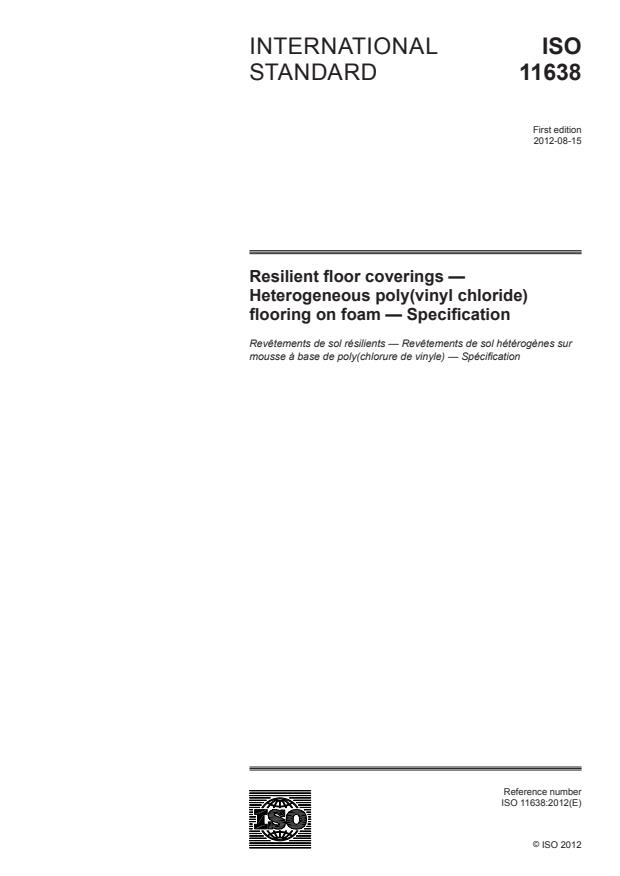
INTERNATIONAL ISO
STANDARD 11638
First edition
2012-08-15
Resilient floor coverings —
Heterogeneous poly(vinyl chloride)
flooring on foam — Specification
Revêtements de sol résilients — Revêtements de sol hétérogènes sur
mousse à base de poly(chlorure de vinyle) — Spécification
Reference number
©
ISO 2012
All rights reserved. Unless otherwise specified, no part of this publication may be reproduced or utilized in any form or by any means,
electronic or mechanical, including photocopying and microfilm, without permission in writing from either ISO at the address below or ISO’s
member body in the country of the requester.
ISO copyright office
Case postale 56 • CH-1211 Geneva 20
Tel. + 41 22 749 01 11
Fax + 41 22 749 09 47
E-mail copyright@iso.org
Web www.iso.org
Published in Switzerland
ii © ISO 2012 – All rights reserved
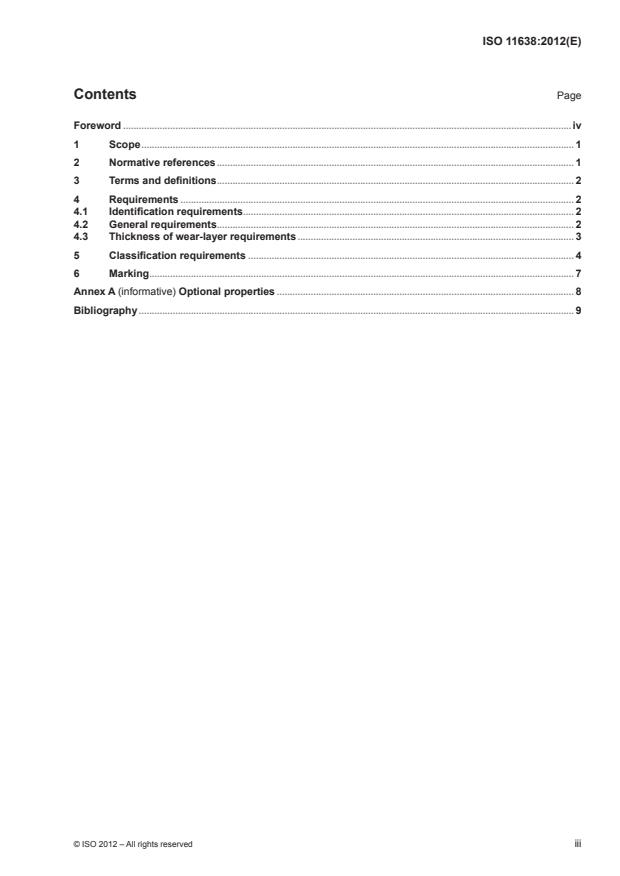
Contents Page
Foreword .iv
1 Scope . 1
2 Normative references . 1
3 Terms and definitions . 2
4 Requirements . 2
4.1 Identification requirements . 2
4.2 General requirements . 2
4.3 Thickness of wear-layer requirements . 3
5 Classification requirements . 4
6 Marking . 7
Annex A (informative) Optional properties . 8
Bibliography . 9
Foreword
ISO (the International Organization for Standardization) is a worldwide federation of national standards bodies
(ISO member bodies). The work of preparing International Standards is normally carried out through ISO
technical committees. Each member body interested in a subject for which a technical committee has been
established has the right to be represented on that committee. International organizations, governmental and
non-governmental, in liaison with ISO, also take part in the work. ISO collaborates closely with the International
Electrotechnical Commission (IEC) on all matters of electrotechnical standardization.
International Standards are drafted in accordance with the rules given in the ISO/IEC Directives, Part 2.
The main task of technical committees is to prepare International Standards. Draft International Standards
adopted by the technical committees are circulated to the member bodies for voting. Publication as an
International Standard requires approval by at least 75 % of the member bodies casting a vote.
Attention is drawn to the possibility that some of the elements of this document may be the subject of patent
rights. ISO shall not be held responsible for identifying any or all such patent rights.
ISO 11638 was prepared by Technical Committee ISO/TC 219, Floor coverings.
iv © ISO 2012 – All rights reserved
INTERNATIONAL STANDARD ISO 11638:2012(E)
Resilient floor coverings — Heterogeneous poly(vinyl chloride)
flooring on foam — Specification
1 Scope
This International Standard specifies the characteristics of heterogeneous poly(vinyl chloride) flooring on
foam, based on poly(vinyl chloride), and supplied in roll form or tile. Such products can contain a transparent,
non-PVC factory finish.
To encourage the consumer to make an informed choice, this International Standard includes a classification system,
based on intensity of use, which shows where these floor coverings can be expected to give satisfactory service.
It also specifies requirements for marking.
2 Normative references
The following referenced documents are indispensable for the application of this document. For dated
references, only the edition cited applies. For undated references, the latest edition of the referenced document
(including any amendments) applies.
1)
ISO 105-B02:— , Textiles — Tests for colour fastness — Part B02: Colour fastness to artificial light: Xenon
arc fading lamp test
ISO 4918, Resilient, textile and laminate floor coverings — Castor chair test
ISO 10874, Resilient, textile-and laminate floor covering — Classification.
ISO 23997, Resilient floor coverings — Determination of mass per unit area
ISO 23999, Resilient floor coverings — Determination of dimensional stability and curling after exposure to heat
ISO 24340, Resilient floor coverings — Determination of thickness of layers
ISO 24341, Resilient and textile floor coverings — Determination of length, width, and straightness of sheet
ISO 24342, Resilient and textile floor coverings — Determination of side length, edge straightness and
squareness of tiles
ISO 24343-1, Resilient and laminate floor coverings — Determination of indentation and residual indentation —
Part 1: Residual indentation
ISO 24343-2, Resilient and laminate floor coverings — Determination of indentation and residual indentation —
Part 2: Short-term residual indentation of resilient floor covering
ISO 24344, Resilient floor coverings — Determination of flexibility and deflection
ISO 24345, Resilient floor coverings — Determination of peel resistance
ISO 24346, Resilient floor coverings — Determination of overall thickness
EN 424, Resilient floor coverings — Determination of the effect of simulated movement of a furniture leg
EN 684, Resilient floor coverings — Determination of seam strength
EN 1372, Adhesives — Test method for adhesives for floor and wall coverings — Peel test
1) To be published. (Revision of ISO 105-B02:1994)
ASTM F1515, Standard test method for measuring light stability of resilient flooring by color change
3 Terms and definitions
For the purposes of this document, the following terms and definitions apply.
3.1
heterogeneous floor covering on foam
floor covering consisting of a wear layer and other solid layers on a foam backing
3.2
poly(vinyl chloride) floor coverings on foam
floor covering with surface layers which are produced using poly(vinyl chloride) as the binder
3.3
wear layer
layer of the floor covering directly exposed to wear
3.4
factory finish
transparent coating applied during the manufacture, usually not thicker than 0,05 mm
3.5
binder content
portion of the flooring composition consisting of poly(vinyl chloride) (PVC) resin, plasticizers and stabilizers
NOTE It is expressed as a percentage mass fraction of the total composition.
3.6
seam strength
maximum tensile force recorded, for a defined width, when a floor covering is tested under a constant rate
of separation
3.7
plank
planks satisfy both less than 250 mm in width and a width-to-length ratio of more than 1:3
4 Requirements
4.1 Identification requirements
Products described in this International Standard are identified by wear-layer binder content and shall be in
accordance with Table 1.
Table 1 — Identification requirements
Type Wear-layer binder content
I ≥ 80
II ≥ 30
4.2 General requirements
Floor coverings shall conform to the appropriate general requirements specified in Table 2 when t
...
Questions, Comments and Discussion
Ask us and Technical Secretary will try to provide an answer. You can facilitate discussion about the standard in here.
Loading comments...