

ISO 16763:2016
(Main)Graphic technology — Post-press — Requirements for bound products
General Information
- Abstract
ISO 16763:2016 specifies quality requirements and tolerances of bound products and intermediate components. It is applicable to products requiring industrial binding, for example, books, magazines, catalogues and brochures.
- Status
- Published
- Publication Date
- 08-Mar-2016
- Technical Committee
- ISO/TC 130 - Graphic technology
- Drafting Committee
- ISO/TC 130/WG 12 - Postpress
- Current Stage
- 9060 - Close of review
- Completion Date
- 02-Dec-2031


Overview
ISO 16763:2016 - Graphic technology - Post-press - Requirements for bound products defines quality requirements and tolerances for industrially bound printed products. Applicable to books, magazines, catalogues, brochures and other products requiring industrial binding, the standard covers the post-press conversion chain from cutting and folding through assembling, binding and trimming. ISO 16763:2016 is produced by ISO/TC 130 (Graphic technology) and is intended to improve post-press process control, product durability and transparency between manufacturers and customers.
Key topics and technical requirements
ISO 16763:2016 focuses on the main stages and quality elements of post-press production without prescribing material specifications (except where normative references apply). Key technical topics include:
- Terms and definitions for conversion processes and binding methods (e.g., adhesive binding, perfect binding, saddle-stitching, thread sewing, single-sheet binding).
- Process requirements for sequential post-press operations:
- Cutting (preparation and cutting accuracy)
- Folding (fold types, folding control and quality)
- Assembling into blocks (gathering, inserting, pasting on endpapers)
- Binding methods (adhesive binding, thread sewing/sealing, lock-stitching, saddle-stitching, spiral/wire-o/comb)
- Trimming and finishing
- Case-bound and paper-bound book production (rounding, backing, casing-in, joint forming)
- Quality control requirements: sampling, inspection of final products and tolerances to avoid defects.
- Measurement guidance, including a normative Annex A method to measure degree of warping of finished products.
- Referenced test methods (e.g., ISO 534 and ISO 536 for paper thickness and grammage).
Note: The standard does not cover special effects or surface decoration and does not set specific material lifetimes (ISO 9706 is recommended where long life is required).
Practical applications and who uses it
ISO 16763:2016 is practical for:
- Post-press finishers and binders - to standardize work methods, control tolerances and reduce rework.
- Commercial printers and publishers - to specify binding quality in procurement and production requirements.
- Quality managers and inspectors - to design sampling and inspection routines for bound products.
- Product buyers and procurement teams - to set clear acceptance criteria for books, brochures and catalogues.
- Developers of production equipment and software - to align machine settings and workflows with recognized tolerances.
Benefits include improved production efficiency, consistent product appearance and durability, fewer remakes, and transparent communication of quality expectations.
Related standards
- ISO 534 - Paper and board: determination of thickness, density and specific volume
- ISO 536 - Paper and board: determination of grammage
- ISO 9706 - Information and documentation: paper for documents intended to have a long life (recommended for long-life bound products)
Keywords: ISO 16763:2016, post-press, graphic technology, binding requirements, bound products, adhesive binding, perfect binding, saddle-stitching, trimming, quality control.
Frequently Asked Questions
ISO 16763:2016 is a standard published by the International Organization for Standardization (ISO). Its full title is "Graphic technology — Post-press — Requirements for bound products". This standard covers: ISO 16763:2016 specifies quality requirements and tolerances of bound products and intermediate components. It is applicable to products requiring industrial binding, for example, books, magazines, catalogues and brochures.
ISO 16763:2016 specifies quality requirements and tolerances of bound products and intermediate components. It is applicable to products requiring industrial binding, for example, books, magazines, catalogues and brochures.
ISO 16763:2016 is classified under the following ICS (International Classification for Standards) categories: 37.100.01 - Graphic technology in general. The ICS classification helps identify the subject area and facilitates finding related standards.
ISO 16763:2016 is available in PDF format for immediate download after purchase. The document can be added to your cart and obtained through the secure checkout process. Digital delivery ensures instant access to the complete standard document.
Standards Content (Sample)
INTERNATIONAL ISO
STANDARD 16763
First edition
2016-03-01
Graphic technology — Post-press —
Requirements for bound products
Technologie graphique — Exigences pour la finition — Produits reliés
Reference number
©
ISO 2016
© ISO 2016, Published in Switzerland
All rights reserved. Unless otherwise specified, no part of this publication may be reproduced or utilized otherwise in any form
or by any means, electronic or mechanical, including photocopying, or posting on the internet or an intranet, without prior
written permission. Permission can be requested from either ISO at the address below or ISO’s member body in the country of
the requester.
ISO copyright office
Ch. de Blandonnet 8 • CP 401
CH-1214 Vernier, Geneva, Switzerland
Tel. +41 22 749 01 11
Fax +41 22 749 09 47
copyright@iso.org
www.iso.org
ii © ISO 2016 – All rights reserved
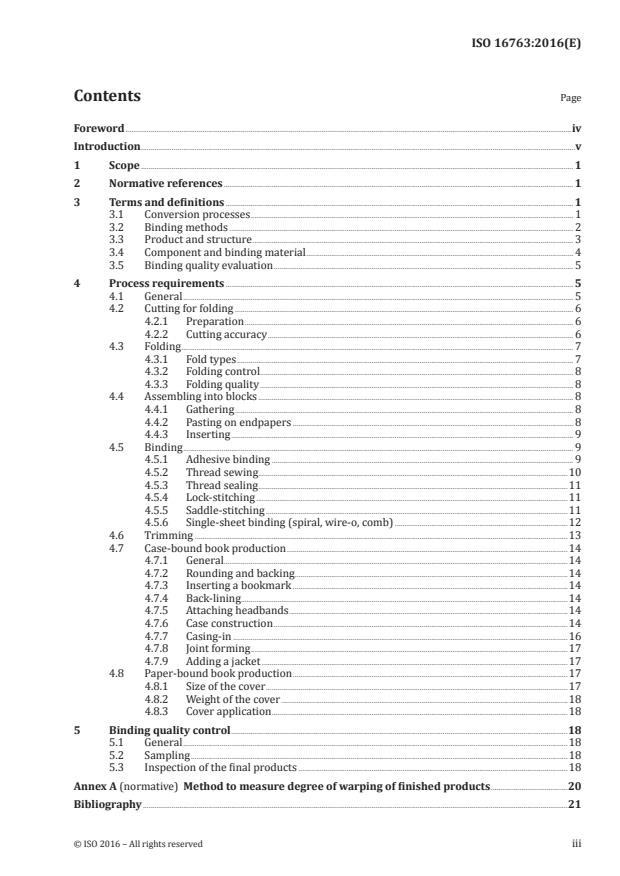
Contents Page
Foreword .iv
Introduction .v
1 Scope . 1
2 Normative references . 1
3 Terms and definitions . 1
3.1 Conversion processes . 1
3.2 Binding methods . 2
3.3 Product and structure . 3
3.4 Component and binding material . 4
3.5 Binding quality evaluation . 5
4 Process requirements . 5
4.1 General . 5
4.2 Cutting for folding . 6
4.2.1 Preparation . 6
4.2.2 Cutting accuracy . 6
4.3 Folding . 7
4.3.1 Fold types . 7
4.3.2 Folding control . 8
4.3.3 Folding quality . 8
4.4 Assembling into blocks . 8
4.4.1 Gathering . 8
4.4.2 Pasting on endpapers . 8
4.4.3 Inserting . 9
4.5 Binding . 9
4.5.1 Adhesive binding . 9
4.5.2 Thread sewing.10
4.5.3 Thread sealing .11
4.5.4 Lock-stitching .11
4.5.5 Saddle-stitching .11
4.5.6 Single-sheet binding (spiral, wire-o, comb) .12
4.6 Trimming .13
4.7 Case-bound book production .14
4.7.1 General.14
4.7.2 Rounding and backing . . .14
4.7.3 Inserting a bookmark .14
4.7.4 Back-lining . .14
4.7.5 Attaching headbands .14
4.7.6 Case construction .14
4.7.7 Casing-in .16
4.7.8 Joint forming .17
4.7.9 Adding a jacket .17
4.8 Paper-bound book production .17
4.8.1 Size of the cover .17
4.8.2 Weight of the cover .18
4.8.3 Cover application .18
5 Binding quality control .18
5.1 General .18
5.2 Sampling .18
5.3 Inspection of the final products .18
Annex A (normative) Method to measure degree of warping of finished products .20
Bibliography .21
Foreword
ISO (the International Organization for Standardization) is a worldwide federation of national standards
bodies (ISO member bodies). The work of preparing International Standards is normally carried out
through ISO technical committees. Each member body interested in a subject for which a technical
committee has been established has the right to be represented on that committee. International
organizations, governmental and non-governmental, in liaison with ISO, also take part in the work.
ISO collaborates closely with the International Electrotechnical Commission (IEC) on all matters of
electrotechnical standardization.
The procedures used to develop this document and those intended for its further maintenance are
described in the ISO/IEC Directives, Part 1. In particular the different approval criteria needed for the
different types of ISO documents should be noted. This document was drafted in accordance with the
editorial rules of the ISO/IEC Directives, Part 2. www.iso.org/directives
Attention is drawn to the possibility that some of the elements of this document may be the subject of
patent rights. ISO shall not be held responsible for identifying any or all such patent rights. Details of
any patent rights identified during the development of the document will be in the Introduction and/or
on the ISO list of patent declarations received. www.iso.org/patents
Any trade name used in this document is information given for the convenience of users and does not
constitute an endorsement.
For an explanation on the meaning of ISO specific terms and expressions related to conformity
assessment, as well as information about ISO’s adherence to the WTO principles in the Technical
Barriers to Trade (TBT) see the following URL: Foreword - Supplementary information
The committee responsible for this document is ISO/TC 130, Graphic technology.
iv © ISO 2016 – All rights reserved
Introduction
Bound products, such as booklets, brochures, case-bound or paper-bound books, etc., are commonly
used in daily life across countries. Post-press is the last but not the least process in the production
flow of bound products, which includes pre-press, printing and post-press. This International Standard
introduces the use of the standardization approach to accomplish the conversion of printed sheets into
end products and to achieve the desired result.
Post-press production has a significant effect on the appearance, usability and durability of bound
products. The aim of this International Standard is to address the major quality elements in post-press
production of such products.
Post-press production of bound products involves four major processes: cutting, folding, assembling
and binding. As the process steps are interrelated and sequential, any deviations from current practice
can lead to deficiencies in the end product. Accordingly, this International Standard specifies technical
requirements and tolerances for the outcomes of processing operations in order to avoid quality
deficiencies. Although material specification is not covered in this International Standard because this
is not normally the responsibility of the finisher, it is recommended that, if a long life is required for the
bound product, ISO 9706 gives guidance.
This International Standard is expected to benefit both manufacturers and customers in the printing
and publishing industries in terms of the production and assessment of bound products.
The use of this International Standard is intended to
— enhance overall process control of the production of bound products,
— enhance production efficiency and accuracy in post-press processes,
— reduce occurrence of remakes resulting from inadequate working methods, and
— promote transparency of the quality requirements of post-press operations in a universally
understood manner.
This International Standard does not cover special effect or surface decorations.
INTERNATIONAL STANDARD ISO 16763:2016(E)
Graphic technology — Post-press — Requirements for
bound products
1 Scope
This International Standard specifies quality requirements and tolerances of bound products and
intermediate components. It is applicable to products requiring industrial binding, for example, books,
magazines, catalogues and brochures.
2 Normative references
The following documents, in whole or in part, are normatively referenced in this document and are
indispensable for its application. For dated references, only the edition cited applies. For undated
references, the latest edition of the referenced document (including any amendments) applies.
ISO 534, Paper and board — Determination of thickness, density and specific volume
ISO 536, Paper and board — Determination of grammage
3 Terms and definitions
For the purposes of this document, the following terms and definitions apply.
3.1 Conversion processes
3.1.1
backing
shaping a ridge or shoulder on each side of the spine of a book block after rounding, ideally complemented
by gluing a material stripe on the spine with the same width as the spine
3.1.2
binding
holding signatures or sheets together along one edge by means of staples, adhesives, thread, wire
or other means
Note 1 to entry: Most of the time, the binding process also includes attaching a cover to the bound block.
3.1.3
casing in
gluing endpapers to the inside of the case to anchor the bound and trimmed book block into the case
3.1.4
cutting
using a mechanical device (e.g. blade) to reduce sheets to a size that is suitable for further processing
3.1.5
creasing
indenting lines into substrates, such as cardboard or paper, to guide subsequent folding operations and
to prevent cracking
3.1.6
folding
bending a printed or blank substrate upon itself in order to achieve specified dimensions and
folding layouts
Note 1 to entry: It is important that the correct imposition is used at the printing stage in order to obtain the
sequence of pages in a bound product, as well as to compensate the creep.
3.1.7
gathering
assembling either by collating of signatures to form a multi-layer block or by inserting one signature
inside another signature to form a single-layer block
3.1.8
gluing-off
applying glue on the spine of a thread sewn or thread sealed book block
3.1.9
inserting
assembling signatures one inside another or putting loose inserts into print products
3.1.10
back-lining
covering the glued spine by a material stripe with an extension on front and back side of the book block
3.1.11
rounding
forming, by mechanical or manual manipulation, the spine of a book block into a convex shape prior to
backing
3.1.12
trimming
cutting off the edges of a blank or printed substrate or book block to achieve the required format
3.2 Binding methods
3.2.1
adhesive binding
converting process used to join, by gluing individual pages or signatures and covers into a final product
Note 1 to entry: There are different types of adhesive binding that result from the different processes of spine
preparation prior to the application of adhesive; commonly used types are notch binding and perfect binding.
3.2.2
lock-stitching
sewing method where two threads, an upper and a lower, are used to link together in stitching
Note 1 to entry: This method is used mainly for identity cards and passports.
3.2.3
notch binding
type of adhesive binding where slots are cut into the spine edges of the gathered signatures to facilitate
the penetration of adhesive
3.2.4
perfect binding
type of adhesive binding in which gathered signatures or sheets are connected to a book block by
applying glue on the binding edge after executing spine preparation techniques
Note 1 to entry: In the broad sense, perfect binding is also used as an alternate term for adhesive binding.
2 © ISO 2016 – All rights reserved
3.2.5
saddle-stitching
binding method where a set of folded and inserted signatures is bound with stitches or staples driven
down through the centre fold of the spine
Note 1 to entry: This method is used mainly for menus, brochures and magazines.
3.2.6
single-sheet binding
type of non-adhesive binding in which the single sheets are held together by a plastic or metal binding
tool (spiral, wire-o and comb), showing a particular good lay-flat behaviour.
Note 1 to entry: This method is used mainly for products that need to lay flat when opened, such as board books,
cookbooks, notebooks, calendars and manuals.
3.2.7
thread sealing
sealing method used as an economical alternative to thread sewing, where the signatures are bound
with single thread staples containing a thermoplastic coating during the folding process
3.2.8
thread sewing
binding method where the gathered signatures are sewn together with thread before being inserted
into a cover or book case
Note 1 to entry: There are two thread sewing methods: sewing with stitches on a straight line and sewing with
stitches on a staggered line.
3.3 Product and structure
3.3.1
binding edge
edge of a book block along which signatures or pages are bound by means of staples, adhesives, thread,
wire or other means
3.3.2
binding margin
white space that is left blank between the binding edge and the printed area of a page
3.3.3
case-bound book
set of blank, written or printed pages bound in a case made of solid boards glued onto the end paper
of a book block
3.3.4
bound product
book or book block, made up of one or more folded sheets or single sheets, held together by a particular
binding method, with or without a cover
3.3.5
brochure
set of blank, written or printed pages bound together in a cover made of cardboard (soft-cover)
3.3.6
fore edge
front edge of a book or book block that is opposite, and parallel, to its binding edge
3.3.7
head
top edge of a book or a book block
3.3.8
joint
one of two grooves that run head to tail on the outside of the case, front and back, in the gap between
spine inlay and case boards
3.3.9
Omega staples
variant of wire staples with shaped eyelets to be used as file holes
Note 1 to entry: Loop stitch is same as Omega staple.
3.3.10
shoulder
outer edge on each side of the rounded spine of a book block that is formed by the backing process
3.3.11
spine
back of a book block or outer portion of a book where the pages are held together, opposite to the fore edge
3.3.12
squares
edges of the book case extending beyond the book block at the head, tail and fore edges
3.3.13
tail
bottom edge of a book or a book block
3.4 Component and binding material
3.4.1
book block
part of a case-bound book or brochure, consisting of a trimmed or untrimmed bound block of sheets,
prior to the application of the book case or cover
3.4.2
bookmark
fabric ribbon, one end of which is normally glued onto the top of the spine, inserted between the pages
of a book to mark the reader’s place
3.4.3
case
hardcover of a book composed of front and rear boards, spine inlay and covering material
3.4.4
cover
flexible or rigid cardboard connected to the book block to protect and strengthen it
3.4.5
covering material
flexible material, which can be paper or fabric, attached to the case boards and the spine inlay of a case
3.4.6
end paper
folded sheet used at the front and back of a book block to connect it with the case using glue
3.4.7
headband
decorative fabric band glued onto the upper and lower edges of the spine of a book block
4 © ISO 2016 – All rights reserved
3.4.8
multi-layer block
book block assembled by collation of signatures in page order
3.4.9
overhang
part of the covering material that extends beyond the edges of the case boards and spine inlay
before turning-in
3.4.10
signature
printed sheet, single or multiple folded to be used as part of a book block
3.4.11
single-layer block
book block consisting of a single signature or assembled by inserting signatures into one another, which
can be bound to form a thin magazine, a booklet or document with a limited number of pages
3.4.12
spine inlay
stripe of cardboard or solid board attached with gaps between the front and rear boards of a case
3.4.13
turn-in
overhang that is turned over the edges of the case boards and spine inlay onto their inside surface of
the case
3.5 Binding quality evaluation
3.5.1
glue penetration
uncontrolled and inhomogeneous penetration of glue between the sheets of a book block
3.5.2
grain direction
direction in which the majority of the fibres in a piece of paper, cardboard or solid board are aligned
and the direction in which the warp threads run in cloth
Note 1 to entry: The grain direction in a sheet of machine-made paper is also referred to as the machine direction.
Note 2 to entry: The sheet is called long grain if the larger dimension is parallel to the machine direction (MD).
The sheet is called short grain if the larger dimension is parallel to the cross direction (CD).
Note 3 to entry: In book binding, the right grain direction is preferentially parallel to the binding edge.
4 Process requirements
4.1 General
Post-press production of bound products is carried out in a series of process operations. A typical
workflow is shown in Figure 1 and, for each operation, the number of the clause describing it is given
in parentheses.
Key
a
For some lock-stitched blocks, cover application (if necessary) takes place before trimming.
b
For single-sheet binding, trimming (if necessary) takes place before binding.
NOTE The number in parentheses in each box refers to the number of the relevant clause in this
International Standard.
Figure 1 — Workflow chart for bound products
All processes shall be performed in a way that no markings, ink transfer, wrinkles, cracks, etc. occur.
There shall be prior information exchange between parties on all aspects of quality of the end or final
product. This includes information on the standardized climatic condition of the region of use.
4.2 Cutting for folding
4.2.1 Preparation
Prior to the cutting operation, tests for cutting pressure shall be performed to ensure the avoidance of
marking in subsequent processes.
4.2.2 Cutting accuracy
4.2.2.1 Piles of sheets
A first master edge (usually identifiable by the printed register mark) shall be defined, either parallel
or perpendicular to the printed content, and a second master edge shall be defined; the angle between
them shall be 90° ± 0,2°. If the angle between the master edges cannot be guaranteed, the following
edge and squareness tolerances shall apply.
6 © ISO 2016 – All rights reserved
The squareness and dimensions of a cut pile shall be determined by taking the measurement of two
sample sheets (one from the top and one from the bottom of the pile). The squareness of the sheet shall
be determined by measuring both the horizontal and vertical edges (W1, W2, H1, H2) and the diagonal
lines (X, Y) as shown in Figure 2, where the squareness tolerance is given by the values of W1 – W2,
H1 – H2 and X – Y, each value shall be ±0,5 mm. For dimensional accuracy tolerance, the va
...