


ISO/TS 22692:2020
(Main)Genomics informatics— Quality control metrics for DNA sequencing
Genomics informatics— Quality control metrics for DNA sequencing
This document identifies quality metrics for the detection of DNA variants using next generation sequencing (NGS) technology. It also defines the data types, relationships, optionality, cardinalities and terminology bindings of the data. This document provides a basis for sharing and for the application of "high quality" genomic data and contributes to the realization of the precision medicine and the development of relevant industries. This document is intended to serve as a catalogue of sequencing data elements used to address quality metrics for various clinical, industrial and commercial applications. The exchange of these data allows researchers, commercial entities, and regulatory bodies to assess for the purpose of selective utilization of the data by setting application-specific quality criteria This document is not intended for — sequencing methods other than NGS, such as the Sanger sequencing, — targets other than genome, such as transcriptome or proteome, or — specimens of species other than humans.
Informatique génomique — Mesures de contrôle de la qualité pour le séquençage de l'ADN
General Information
- Status
- Published
- Publication Date
- 04-Oct-2020
- Technical Committee
- ISO/TC 215/SC 1 - Genomics Informatics
- Drafting Committee
- ISO/TC 215/SC 1/WG 1 - Genomics data sharing
- Current Stage
- 9092 - International Standard to be revised
- Start Date
- 04-Jul-2024
- Completion Date
- 14-Feb-2026
Overview
ISO/TS 22692:2020 - "Genomics informatics - Quality control metrics for DNA sequencing" is an ISO Technical Specification that defines a standardized catalogue of quality metrics and data elements for detecting DNA variants using next generation sequencing (NGS). Published in 2020, the specification describes the data types, relationships, optionality, cardinalities and terminology bindings needed to record and share NGS quality information. It is designed to support the exchange of “high quality” genomic data for research, clinical and industrial applications and to advance precision medicine and genomics industry development.
Key Topics and Requirements
The standard focuses on quality control metrics across the NGS workflow and specifies the types of metadata to be captured:
Scope & exclusions
- Applies to human DNA variant detection using NGS.
- Excludes Sanger sequencing, non-genome targets (transcriptome/proteome), and non-human specimens.
Sample preparation metrics
- Sample sequencing type, target gene, specimen type, sampling date and origin.
- Summary elements to support traceability and quality assessment.
Library preparation metrics
- DNA extraction method and kit, DNA purity and integrity.
- Library input amount, insert size, and library construction kit.
Sequencing run metrics
- Sequencing instrument, read length, read direction, running mode.
- Running quality measures such as error rate and percent data > Q30.
Data processing and bioinformatics metrics
- Total reads, mean coverage, uniformity, duplication rate, on‑target rate, Q30 rate.
- Alignment (mapping algorithm, local realignment), variant calling (software/version, call quality score), allelic read percentage/ratio.
- Variant filtering and annotation, germline filter criteria, mutation and annotation database references.
Data modeling
- Defines data element relationships, optionality and cardinalities to enable interoperable data exchange and selective utilization according to application-specific quality criteria.
Applications and Users
ISO/TS 22692:2020 is practical for organizations that generate, process or regulate genomic data:
- Clinical laboratories applying NGS for diagnostics and reporting variant calls.
- Research consortia and biobanks sharing large-scale reference datasets.
- Commercial sequencing providers and biotech companies standardizing QC for product development.
- Regulatory agencies and assessors evaluating data quality for submissions.
- Bioinformatics teams implementing pipelines and provenance tracking to meet application-specific quality thresholds.
By standardizing QC metrics and metadata, the specification helps ensure reproducibility, supports selective data sharing, and facilitates precision medicine workflows.
Related Standards (examples)
- ISO/TS 20428:2017 (genomic data elements)
- ISO/IEC 23092-2:2019 (genomic information representation)
- ISO/TS 17822-1:2014 (sequencing terminology)
Buy Documents

ISO/TS 22692:2020 - Genomics informatics— Quality control metrics for DNA sequencing Released:5. 10. 2020

ISO/TS 22692:2020 - Genomics informatics— Quality control metrics for DNA sequencing Released:10/5/2020
Get Certified
Connect with accredited certification bodies for this standard

BSI Group
BSI (British Standards Institution) is the business standards company that helps organizations make excellence a habit.

NYCE
Mexican standards and certification body.
Sponsored listings
Frequently Asked Questions
ISO/TS 22692:2020 is a technical specification published by the International Organization for Standardization (ISO). Its full title is "Genomics informatics— Quality control metrics for DNA sequencing". This standard covers: This document identifies quality metrics for the detection of DNA variants using next generation sequencing (NGS) technology. It also defines the data types, relationships, optionality, cardinalities and terminology bindings of the data. This document provides a basis for sharing and for the application of "high quality" genomic data and contributes to the realization of the precision medicine and the development of relevant industries. This document is intended to serve as a catalogue of sequencing data elements used to address quality metrics for various clinical, industrial and commercial applications. The exchange of these data allows researchers, commercial entities, and regulatory bodies to assess for the purpose of selective utilization of the data by setting application-specific quality criteria This document is not intended for — sequencing methods other than NGS, such as the Sanger sequencing, — targets other than genome, such as transcriptome or proteome, or — specimens of species other than humans.
This document identifies quality metrics for the detection of DNA variants using next generation sequencing (NGS) technology. It also defines the data types, relationships, optionality, cardinalities and terminology bindings of the data. This document provides a basis for sharing and for the application of "high quality" genomic data and contributes to the realization of the precision medicine and the development of relevant industries. This document is intended to serve as a catalogue of sequencing data elements used to address quality metrics for various clinical, industrial and commercial applications. The exchange of these data allows researchers, commercial entities, and regulatory bodies to assess for the purpose of selective utilization of the data by setting application-specific quality criteria This document is not intended for — sequencing methods other than NGS, such as the Sanger sequencing, — targets other than genome, such as transcriptome or proteome, or — specimens of species other than humans.
ISO/TS 22692:2020 is classified under the following ICS (International Classification for Standards) categories: 35.240.80 - IT applications in health care technology. The ICS classification helps identify the subject area and facilitates finding related standards.
ISO/TS 22692:2020 is available in PDF format for immediate download after purchase. The document can be added to your cart and obtained through the secure checkout process. Digital delivery ensures instant access to the complete standard document.
Standards Content (Sample)
TECHNICAL ISO/TS
SPECIFICATION 22692
First edition
2020-10
Genomics informatic — Quality
control metrics for DNA sequencing
Informatique génomique — Mesures de contrôle de la qualité pour le
séquençage de l'ADN
Reference number
©
ISO 2020
© ISO 2020
All rights reserved. Unless otherwise specified, or required in the context of its implementation, no part of this publication may
be reproduced or utilized otherwise in any form or by any means, electronic or mechanical, including photocopying, or posting
on the internet or an intranet, without prior written permission. Permission can be requested from either ISO at the address
below or ISO’s member body in the country of the requester.
ISO copyright office
CP 401 • Ch. de Blandonnet 8
CH-1214 Vernier, Geneva
Phone: +41 22 749 01 11
Email: copyright@iso.org
Website: www.iso.org
Published in Switzerland
ii © ISO 2020 – All rights reserved
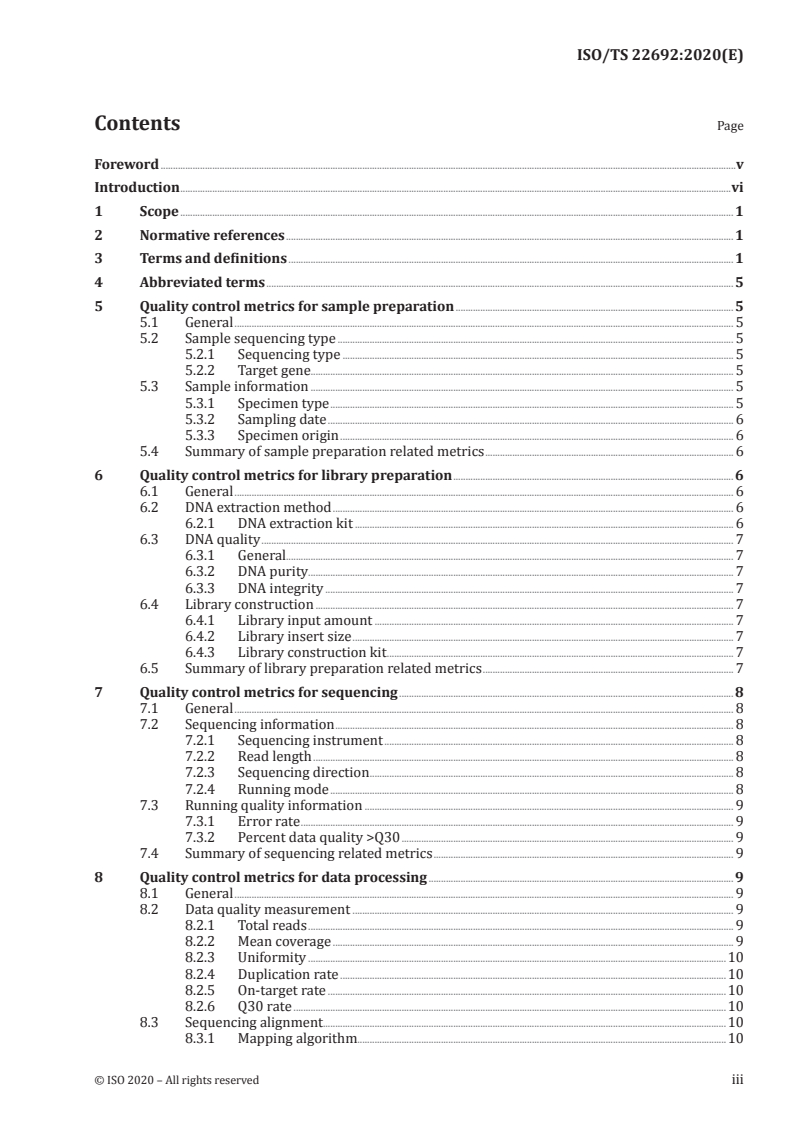
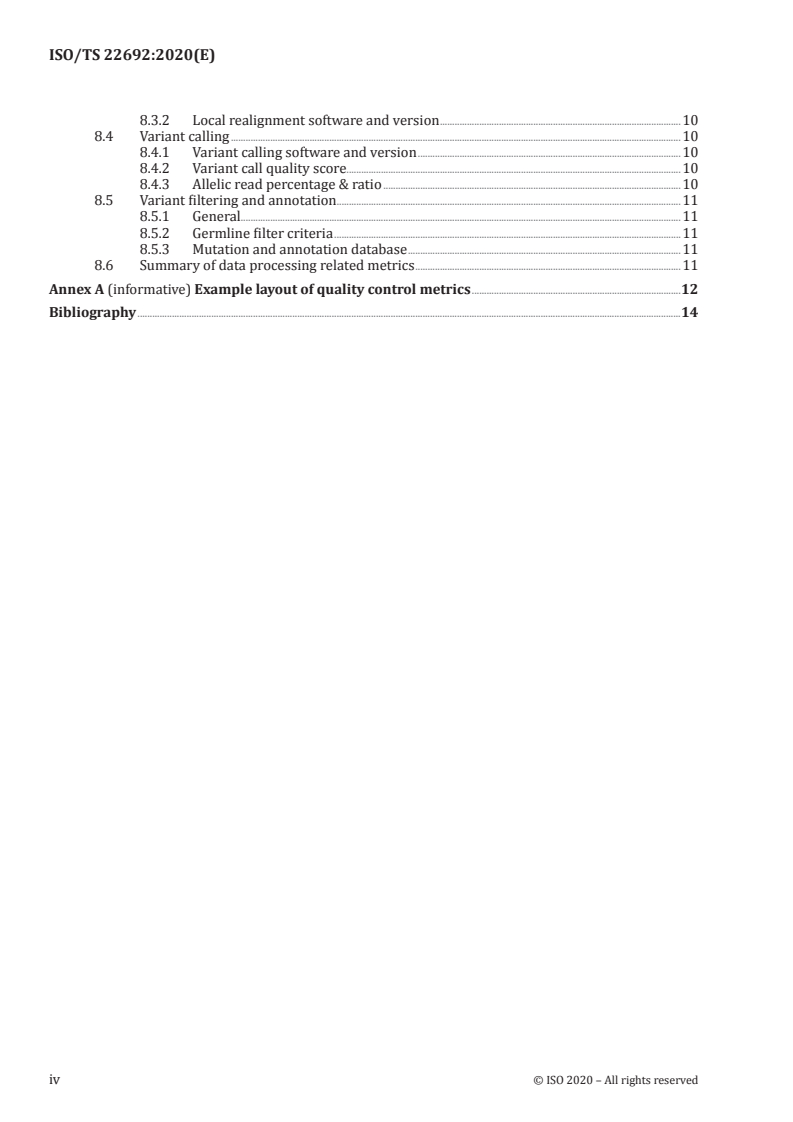
Contents Page
Foreword .v
Introduction .vi
1 Scope . 1
2 Normative references . 1
3 Terms and definitions . 1
4 Abbreviated terms . 5
5 Quality control metrics for sample preparation . 5
5.1 General . 5
5.2 Sample sequencing type . 5
5.2.1 Sequencing type . 5
5.2.2 Target gene. 5
5.3 Sample information . 5
5.3.1 Specimen type . 5
5.3.2 Sampling date . 6
5.3.3 Specimen origin . 6
5.4 Summary of sample preparation related metrics . 6
6 Quality control metrics for library preparation . 6
6.1 General . 6
6.2 DNA extraction method . 6
6.2.1 DNA extraction kit . 6
6.3 DNA quality . 7
6.3.1 General. 7
6.3.2 DNA purity. 7
6.3.3 DNA integrity . 7
6.4 Library construction . 7
6.4.1 Library input amount . 7
6.4.2 Library insert size . 7
6.4.3 Library construction kit . 7
6.5 Summary of library preparation related metrics . 7
7 Quality control metrics for sequencing . 8
7.1 General . 8
7.2 Sequencing information . 8
7.2.1 Sequencing instrument . 8
7.2.2 Read length . 8
7.2.3 Sequencing direction . . 8
7.2.4 Running mode . 8
7.3 Running quality information . 9
7.3.1 Error rate . 9
7.3.2 Percent data quality >Q30 . 9
7.4 Summary of sequencing related metrics . 9
8 Quality control metrics for data processing . 9
8.1 General . 9
8.2 Data quality measurement . 9
8.2.1 Total reads . 9
8.2.2 Mean coverage . 9
8.2.3 Uniformity .10
8.2.4 Duplication rate .10
8.2.5 On-target rate .10
8.2.6 Q30 rate .10
8.3 Sequencing alignment.10
8.3.1 Mapping algorithm.10
8.3.2 Local realignment software and version .10
8.4 Variant calling .10
8.4.1 Variant calling software and version .10
8.4.2 Variant call quality score . .10
8.4.3 Allelic read percentage & ratio .10
8.5 Variant filtering and annotation.11
8.5.1 General.11
8.5.2 Germline filter criteria .11
8.5.3 Mutation and annotation database .11
8.6 Summary of data processing related metrics .11
Annex A (informative) Example layout of quality control metrics .12
Bibliography .14
iv © ISO 2020 – All rights reserved
Foreword
ISO (the International Organization for Standardization) is a worldwide federation of national standards
bodies (ISO member bodies). The work of preparing International Standards is normally carried out
through ISO technical committees. Each member body interested in a subject for which a technical
committee has been established has the right to be represented on that committee. International
organizations, governmental and non-governmental, in liaison with ISO, also take part in the work.
ISO collaborates closely with the International Electrotechnical Commission (IEC) on all matters of
electrotechnical standardization.
The procedures used to develop this document and those intended for its further maintenance are
described in the ISO/IEC Directives, Part 1. In particular, the different approval criteria needed for the
different types of ISO documents should be noted. This document was drafted in accordance with the
editorial rules of the ISO/IEC Directives, Part 2 (see www .iso .org/ directives).
Attention is drawn to the possibility that some of the elements of this document may be the subject of
patent rights. ISO shall not be held responsible for identifying any or all such patent rights. Details of
any patent rights identified during the development of the document will be in the Introduction and/or
on the ISO list of patent declarations received (see www .iso .org/ patents).
Any trade name used in this document is information given for the convenience of users and does not
constitute an endorsement.
For an explanation of the voluntary nature of standards, the meaning of ISO specific terms and
expressions related to conformity assessment, as well as information about ISO's adherence to the
World Trade Organization (WTO) principles in the Technical Barriers to Trade (TBT), see www .iso .org/
iso/ foreword .html.
This document was prepared by Technical Committee ISO/TC 215, Health informatics, Subcommittee
SC 1, Genomics informatics.
Any feedback or questions on this document should be directed to the user’s national standards body. A
complete listing of these bodies can be found at www .iso .org/ members .html.
Introduction
The rapid progress in Next Generation Sequencing (NGS) technology has drastically reduced the
cost and time for genomic analysis. A number of research institutions, corporations, and government
agencies are competitively collecting a large volume of genomic data through multi-national, multi-
[9] [10] [11]
institutional projects such as “DiscovEHR” , “gnomAD” and “UK Biobank” . The demand for
sharing of “high quality” genomic data is growing because large-scale reference data is required for
reliable detection of mutation for both industrial and clinical applications.
However, the quality of available genomic data is less than desirable. To establish consistent quality
control metrics, details of each stage of NGS process need to be recorded, shared and standardized
(processes and data elements collected and coded for each stage and sub-stage). These processes
include sample preparation, library preparation, sequencing, and data processing, among others, as
shown in Figure 1.
Figure 1 — NGS process
vi © ISO 2020 – All rights reserved
TECHNICAL SPECIFICATION ISO/TS 22692:2020(E)
Genomics informatic — Quality control metrics for DNA
sequencing
1 Scope
This document identifies quality metrics for the detection of DNA variants using next generation
sequencing (NGS) technology. It also defines the data types, relationships, optionality, cardinalities and
terminology bindings of the data.
This document provides a basis for sharing and for the application of “high quality” genomic data and
contributes to the realization of the precision medicine and the development of relevant industries.
This document is intended to serve as a catalogue of sequencing data elements used to address quality
metrics for various clinical, industrial and commercial applications. The exchange of these data allows
researchers, commercial entities, and regulatory bodies to assess for the purpose of selective utilization
of the data by setting application-specific quality criteria
This document is not intended for
— sequencing methods other than NGS, such as the Sanger sequencing,
— targets other than genome, such as transcriptome or proteome, or
— specimens of species other than humans.
2 Normative references
There are no normative references in this document.
3 Terms and definitions
For the purposes of this document, the following terms and definitions apply.
ISO and IEC maintain terminological databases for use in standardization at the following addresses:
— ISO Online browsing platform: available at https:// www .iso .org/ obp
— IEC Electropedia: available at http:// www .electropedia .org/
3.1
copy number variation
CNV
variation (3.18) in the number of copies of one or more sections of the DNA (3.3)
[SOURCE: ISO/TS 20428:2017, 3.7]
3.2
deletion
contiguous removal of one or more bases from a genomic sequence
[SOURCE: ISO/IEC 23092-2:2019, 3.4]
3.3
DNA
deoxyribonucleic acid
molecule that exists in nuclei and in mitochondria of human cells and is composed of a linear array of 4
bases (Adenine: A, Thymine: T, Guanine: G and Cytosine: C)
[SOURCE: ISO 18074:2015, 4.1, modified — Note 1 to entry deleted.]
3.4
DNA sequencing
determining the order of nucleotide bases (adenine, guanine, cytosine and thymine) in a molecule of
DNA (3.3)
Note 1 to entry: Sequence is generally described from the 5’ end.
[SOURCE: ISO/TS 17822-1:2014, 3.20]
3.5
exome
part of the genome formed by exons
[SOURCE: ISO/TS 20428:2017, 3.13]
3.6
FASTA
genomic information representation that includes a name and a nucleotide sequence for each sequence
read (3.17)
[SOURCE: ISO/IEC 23092-2:2019, 3.7, modified]
3.7
FASTQ
genomic information representation that includes FASTA (3.6) and quality values
[SOURCE: ISO/IEC 23092-2:2019, 3.8]
3.8
gene
basic unit of hereditary information composed of chains of nucleotide base pairs in specific sequences
that encodes a protein or protein subunit
[SOURCE: ISO 11238:2018, 3.29]
3.9
germline
series of germ cells each descended or developed from earlier cells in the series, regarded as continuing
through successive generations of an organism
[SOURCE: ISO/TS 20428:2017, 3.17]
3.10
indel
insertion (3.11) or/and deletion (3.2)
[SOURCE: ISO/TS 20428:2017, 3.18]
3.11
insertion
contiguous addition of one or more bases into a genomic sequence
[SOURCE: ISO/IEC 23092-2:2019, 3.18]
2 © ISO 2020 – All rights reserved
3.12
large indel
insertion (3.11) or deletion (3.2) up to around 1 kb
[SOURCE: ISO/TS 20428:2017, 3.21]
3.13
nucleotide
monomer of a nucleic acid polymer such as DNA (3.3) or RNA
Note 1 to entry: Nucleotides are denoted as letters (‘A’ for adenine; ‘C’ for cytosine; ‘G’ for guanine; ‘T’ for thymine
which only occurs in DNA; and ‘U’ for uracil which only occurs in RNA). The chemical formula for a specific
DNA or RNA molecule is given by the sequence of its nucleotides, which can be represented as a string over the
alphabet (‘A’, ’C’, ’G’, ‘T’) in the case of DNA, and a string over the alphabet (‘A’, ‘C’, ‘G’, ‘U’) in the case of RNA. Bases
with unknown molecular composition are denoted with ‘N’.
[SOURCE: ISO/IEC 23092-2:2019, 3.20]
3.14
polymerase chain reaction
PCR
in vitro enzymatic technique to increase the number of copies of a specific DNA fragment by several
orders of magnitude
[SOURCE: ISO 16577:2016, 3.148]
3.15
quality score
Phred quality score
Q score
quality measure used to assess the accuracy of a sequencing reaction
Note 1 to entry: This quality measure indicates the probability that a given base is called incorrectly by the
sequencer. Phred scores are on a logarithmic scale. Therefore, if Phred assigns a Q score of 30 (Q30) to a base, this
is equivalent to the probability of an incorrect base call 1 in 1 000 times. A lower base call accuracy of 99 % (Q20)
will have an incorrect base call probability of 1 in 100, meaning that every 100 base pairs sequencing read will
likely contain an error.
[SOURCE: ISO 21286:2019, 3.4]
3.16
reference sequence
nucleic acid sequence with biological relevance
Note 1 to entry: Each reference sequence is indexed by a one-dimensional integer coordinate system whereby
each integer within range identifies a single nucleotide. Coordinate values can only be equal to or larger than
zero. The coordinate system in the context of this standard is zero-based (i.e. the first nucleotide has coordinate
0 and it is said to be at position 0) and linearly increasing within the string from left to right.
[SOURCE: ISO/IEC 23092-1:2019, 3.22]
3.17
sequence read
read
fragmented nucleotide sequences that are used to reconstruct the original sequence for next generation
sequencing technologies
[SOURCE: ISO/TS 20428:2017, 3.26]
3.18
sequence variation
DNA sequence variation
variation
differences of DNA sequence among individuals in a population
Note 1 to entry: Variation implies copy number variation (3.1), deletion (3.2), insertion (3.11), indel (3.10), small
indel (3.20), large indel (3.12), or single nucleotide variant (3.19).
[SOURCE: ISO/TS 20428:2017, 3.30]
3.19
single nucleotide variant
SNV
DNA sequence variation (3.18) that occurs when a single nucleotide, A, T, C, or G, in the genome (or other
target sequence) differs between templates
[SOURCE: ISO 20395:2019, 3.35]
3.20
small indel
insertion (3.11) or deletion (3.2) of 2 nucleotides to 100 nucleotides
[SOURCE: ISO/TS 20428:2017, 3.32]
3.21
specimen
biospecimen
biological specimen
sample of tissue, body fluid, food, or other substance that is collected or acquired to support the
assessment, diagnosis, treatment, mitigation or prevention of a disease, disorder or abnormal physical
state, or its symptoms
[SOURCE: ISO/TS 20428:2017, 3.34]
3.22
targeted sequencing
disease-targeted gene panel
technique used for sequencing only selected/targeted genomic regions of interest from a DNA sample
Note 1 to entry: For further details, see Reference [12].
3.23
whole exome sequencing
WES
technique for sequencing the exomes (3.5) of the protein-coding genes (3.8) in a genome
[SOURCE: ISO/TS 20428:2017, 3.38]
3.24
whole genome sequencing
WGS
technique that determines the complete DNA sequence of an organism’s genome at a single time
[SOURCE: ISO/TS 20428:2017, 3.39]
4 © ISO 2020 – All rights reserved
4 Abbreviated terms
BAM Binary Alignment/Map
BED Browser Extensible Data
FMA Foundational Model of Anatomy
HGNC HUGO Gene Nomenclature Committee
HUGO Human
...
TECHNICAL ISO/TS
SPECIFICATION 22692
First edition
2020-10
Genomics informatic — Quality
control metrics for DNA sequencing
Informatique génomique — Mesures de contrôle de la qualité pour le
séquençage de l'ADN
Reference number
©
ISO 2020
© ISO 2020
All rights reserved. Unless otherwise specified, or required in the context of its implementation, no part of this publication may
be reproduced or utilized otherwise in any form or by any means, electronic or mechanical, including photocopying, or posting
on the internet or an intranet, without prior written permission. Permission can be requested from either ISO at the address
below or ISO’s member body in the country of the requester.
ISO copyright office
CP 401 • Ch. de Blandonnet 8
CH-1214 Vernier, Geneva
Phone: +41 22 749 01 11
Email: copyright@iso.org
Website: www.iso.org
Published in Switzerland
ii © ISO 2020 – All rights reserved
Contents Page
Foreword .v
Introduction .vi
1 Scope . 1
2 Normative references . 1
3 Terms and definitions . 1
4 Abbreviated terms . 5
5 Quality control metrics for sample preparation . 5
5.1 General . 5
5.2 Sample sequencing type . 5
5.2.1 Sequencing type . 5
5.2.2 Target gene. 5
5.3 Sample information . 5
5.3.1 Specimen type . 5
5.3.2 Sampling date . 6
5.3.3 Specimen origin . 6
5.4 Summary of sample preparation related metrics . 6
6 Quality control metrics for library preparation . 6
6.1 General . 6
6.2 DNA extraction method . 6
6.2.1 DNA extraction kit . 6
6.3 DNA quality . 7
6.3.1 General. 7
6.3.2 DNA purity. 7
6.3.3 DNA integrity . 7
6.4 Library construction . 7
6.4.1 Library input amount . 7
6.4.2 Library insert size . 7
6.4.3 Library construction kit . 7
6.5 Summary of library preparation related metrics . 7
7 Quality control metrics for sequencing . 8
7.1 General . 8
7.2 Sequencing information . 8
7.2.1 Sequencing instrument . 8
7.2.2 Read length . 8
7.2.3 Sequencing direction . . 8
7.2.4 Running mode . 8
7.3 Running quality information . 9
7.3.1 Error rate . 9
7.3.2 Percent data quality >Q30 . 9
7.4 Summary of sequencing related metrics . 9
8 Quality control metrics for data processing . 9
8.1 General . 9
8.2 Data quality measurement . 9
8.2.1 Total reads . 9
8.2.2 Mean coverage . 9
8.2.3 Uniformity .10
8.2.4 Duplication rate .10
8.2.5 On-target rate .10
8.2.6 Q30 rate .10
8.3 Sequencing alignment.10
8.3.1 Mapping algorithm.10
8.3.2 Local realignment software and version .10
8.4 Variant calling .10
8.4.1 Variant calling software and version .10
8.4.2 Variant call quality score . .10
8.4.3 Allelic read percentage & ratio .10
8.5 Variant filtering and annotation.11
8.5.1 General.11
8.5.2 Germline filter criteria .11
8.5.3 Mutation and annotation database .11
8.6 Summary of data processing related metrics .11
Annex A (informative) Example layout of quality control metrics .12
Bibliography .14
iv © ISO 2020 – All rights reserved
Foreword
ISO (the International Organization for Standardization) is a worldwide federation of national standards
bodies (ISO member bodies). The work of preparing International Standards is normally carried out
through ISO technical committees. Each member body interested in a subject for which a technical
committee has been established has the right to be represented on that committee. International
organizations, governmental and non-governmental, in liaison with ISO, also take part in the work.
ISO collaborates closely with the International Electrotechnical Commission (IEC) on all matters of
electrotechnical standardization.
The procedures used to develop this document and those intended for its further maintenance are
described in the ISO/IEC Directives, Part 1. In particular, the different approval criteria needed for the
different types of ISO documents should be noted. This document was drafted in accordance with the
editorial rules of the ISO/IEC Directives, Part 2 (see www .iso .org/ directives).
Attention is drawn to the possibility that some of the elements of this document may be the subject of
patent rights. ISO shall not be held responsible for identifying any or all such patent rights. Details of
any patent rights identified during the development of the document will be in the Introduction and/or
on the ISO list of patent declarations received (see www .iso .org/ patents).
Any trade name used in this document is information given for the convenience of users and does not
constitute an endorsement.
For an explanation of the voluntary nature of standards, the meaning of ISO specific terms and
expressions related to conformity assessment, as well as information about ISO's adherence to the
World Trade Organization (WTO) principles in the Technical Barriers to Trade (TBT), see www .iso .org/
iso/ foreword .html.
This document was prepared by Technical Committee ISO/TC 215, Health informatics, Subcommittee
SC 1, Genomics informatics.
Any feedback or questions on this document should be directed to the user’s national standards body. A
complete listing of these bodies can be found at www .iso .org/ members .html.
Introduction
The rapid progress in Next Generation Sequencing (NGS) technology has drastically reduced the
cost and time for genomic analysis. A number of research institutions, corporations, and government
agencies are competitively collecting a large volume of genomic data through multi-national, multi-
[9] [10] [11]
institutional projects such as “DiscovEHR” , “gnomAD” and “UK Biobank” . The demand for
sharing of “high quality” genomic data is growing because large-scale reference data is required for
reliable detection of mutation for both industrial and clinical applications.
However, the quality of available genomic data is less than desirable. To establish consistent quality
control metrics, details of each stage of NGS process need to be recorded, shared and standardized
(processes and data elements collected and coded for each stage and sub-stage). These processes
include sample preparation, library preparation, sequencing, and data processing, among others, as
shown in Figure 1.
Figure 1 — NGS process
vi © ISO 2020 – All rights reserved
TECHNICAL SPECIFICATION ISO/TS 22692:2020(E)
Genomics informatic — Quality control metrics for DNA
sequencing
1 Scope
This document identifies quality metrics for the detection of DNA variants using next generation
sequencing (NGS) technology. It also defines the data types, relationships, optionality, cardinalities and
terminology bindings of the data.
This document provides a basis for sharing and for the application of “high quality” genomic data and
contributes to the realization of the precision medicine and the development of relevant industries.
This document is intended to serve as a catalogue of sequencing data elements used to address quality
metrics for various clinical, industrial and commercial applications. The exchange of these data allows
researchers, commercial entities, and regulatory bodies to assess for the purpose of selective utilization
of the data by setting application-specific quality criteria
This document is not intended for
— sequencing methods other than NGS, such as the Sanger sequencing,
— targets other than genome, such as transcriptome or proteome, or
— specimens of species other than humans.
2 Normative references
There are no normative references in this document.
3 Terms and definitions
For the purposes of this document, the following terms and definitions apply.
ISO and IEC maintain terminological databases for use in standardization at the following addresses:
— ISO Online browsing platform: available at https:// www .iso .org/ obp
— IEC Electropedia: available at http:// www .electropedia .org/
3.1
copy number variation
CNV
variation (3.18) in the number of copies of one or more sections of the DNA (3.3)
[SOURCE: ISO/TS 20428:2017, 3.7]
3.2
deletion
contiguous removal of one or more bases from a genomic sequence
[SOURCE: ISO/IEC 23092-2:2019, 3.4]
3.3
DNA
deoxyribonucleic acid
molecule that exists in nuclei and in mitochondria of human cells and is composed of a linear array of 4
bases (Adenine: A, Thymine: T, Guanine: G and Cytosine: C)
[SOURCE: ISO 18074:2015, 4.1, modified — Note 1 to entry deleted.]
3.4
DNA sequencing
determining the order of nucleotide bases (adenine, guanine, cytosine and thymine) in a molecule of
DNA (3.3)
Note 1 to entry: Sequence is generally described from the 5’ end.
[SOURCE: ISO/TS 17822-1:2014, 3.20]
3.5
exome
part of the genome formed by exons
[SOURCE: ISO/TS 20428:2017, 3.13]
3.6
FASTA
genomic information representation that includes a name and a nucleotide sequence for each sequence
read (3.17)
[SOURCE: ISO/IEC 23092-2:2019, 3.7, modified]
3.7
FASTQ
genomic information representation that includes FASTA (3.6) and quality values
[SOURCE: ISO/IEC 23092-2:2019, 3.8]
3.8
gene
basic unit of hereditary information composed of chains of nucleotide base pairs in specific sequences
that encodes a protein or protein subunit
[SOURCE: ISO 11238:2018, 3.29]
3.9
germline
series of germ cells each descended or developed from earlier cells in the series, regarded as continuing
through successive generations of an organism
[SOURCE: ISO/TS 20428:2017, 3.17]
3.10
indel
insertion (3.11) or/and deletion (3.2)
[SOURCE: ISO/TS 20428:2017, 3.18]
3.11
insertion
contiguous addition of one or more bases into a genomic sequence
[SOURCE: ISO/IEC 23092-2:2019, 3.18]
2 © ISO 2020 – All rights reserved
3.12
large indel
insertion (3.11) or deletion (3.2) up to around 1 kb
[SOURCE: ISO/TS 20428:2017, 3.21]
3.13
nucleotide
monomer of a nucleic acid polymer such as DNA (3.3) or RNA
Note 1 to entry: Nucleotides are denoted as letters (‘A’ for adenine; ‘C’ for cytosine; ‘G’ for guanine; ‘T’ for thymine
which only occurs in DNA; and ‘U’ for uracil which only occurs in RNA). The chemical formula for a specific
DNA or RNA molecule is given by the sequence of its nucleotides, which can be represented as a string over the
alphabet (‘A’, ’C’, ’G’, ‘T’) in the case of DNA, and a string over the alphabet (‘A’, ‘C’, ‘G’, ‘U’) in the case of RNA. Bases
with unknown molecular composition are denoted with ‘N’.
[SOURCE: ISO/IEC 23092-2:2019, 3.20]
3.14
polymerase chain reaction
PCR
in vitro enzymatic technique to increase the number of copies of a specific DNA fragment by several
orders of magnitude
[SOURCE: ISO 16577:2016, 3.148]
3.15
quality score
Phred quality score
Q score
quality measure used to assess the accuracy of a sequencing reaction
Note 1 to entry: This quality measure indicates the probability that a given base is called incorrectly by the
sequencer. Phred scores are on a logarithmic scale. Therefore, if Phred assigns a Q score of 30 (Q30) to a base, this
is equivalent to the probability of an incorrect base call 1 in 1 000 times. A lower base call accuracy of 99 % (Q20)
will have an incorrect base call probability of 1 in 100, meaning that every 100 base pairs sequencing read will
likely contain an error.
[SOURCE: ISO 21286:2019, 3.4]
3.16
reference sequence
nucleic acid sequence with biological relevance
Note 1 to entry: Each reference sequence is indexed by a one-dimensional integer coordinate system whereby
each integer within range identifies a single nucleotide. Coordinate values can only be equal to or larger than
zero. The coordinate system in the context of this standard is zero-based (i.e. the first nucleotide has coordinate
0 and it is said to be at position 0) and linearly increasing within the string from left to right.
[SOURCE: ISO/IEC 23092-1:2019, 3.22]
3.17
sequence read
read
fragmented nucleotide sequences that are used to reconstruct the original sequence for next generation
sequencing technologies
[SOURCE: ISO/TS 20428:2017, 3.26]
3.18
sequence variation
DNA sequence variation
variation
differences of DNA sequence among individuals in a population
Note 1 to entry: Variation implies copy number variation (3.1), deletion (3.2), insertion (3.11), indel (3.10), small
indel (3.20), large indel (3.12), or single nucleotide variant (3.19).
[SOURCE: ISO/TS 20428:2017, 3.30]
3.19
single nucleotide variant
SNV
DNA sequence variation (3.18) that occurs when a single nucleotide, A, T, C, or G, in the genome (or other
target sequence) differs between templates
[SOURCE: ISO 20395:2019, 3.35]
3.20
small indel
insertion (3.11) or deletion (3.2) of 2 nucleotides to 100 nucleotides
[SOURCE: ISO/TS 20428:2017, 3.32]
3.21
specimen
biospecimen
biological specimen
sample of tissue, body fluid, food, or other substance that is collected or acquired to support the
assessment, diagnosis, treatment, mitigation or prevention of a disease, disorder or abnormal physical
state, or its symptoms
[SOURCE: ISO/TS 20428:2017, 3.34]
3.22
targeted sequencing
disease-targeted gene panel
technique used for sequencing only selected/targeted genomic regions of interest from a DNA sample
Note 1 to entry: For further details, see Reference [12].
3.23
whole exome sequencing
WES
technique for sequencing the exomes (3.5) of the protein-coding genes (3.8) in a genome
[SOURCE: ISO/TS 20428:2017, 3.38]
3.24
whole genome sequencing
WGS
technique that determines the complete DNA sequence of an organism’s genome at a single time
[SOURCE: ISO/TS 20428:2017, 3.39]
4 © ISO 2020 – All rights reserved
4 Abbreviated terms
BAM Binary Alignment/Map
BED Browser Extensible Data
FMA Foundational Model of Anatomy
HGNC HUGO Gene Nomenclature Committee
HUGO Human
...
Questions, Comments and Discussion
Ask us and Technical Secretary will try to provide an answer. You can facilitate discussion about the standard in here.
Loading comments...