


ISO 7721-2:1990
(Main)Countersunk flat head screws — Part 2: Penetration depth of cross recesses
Countersunk flat head screws — Part 2: Penetration depth of cross recesses
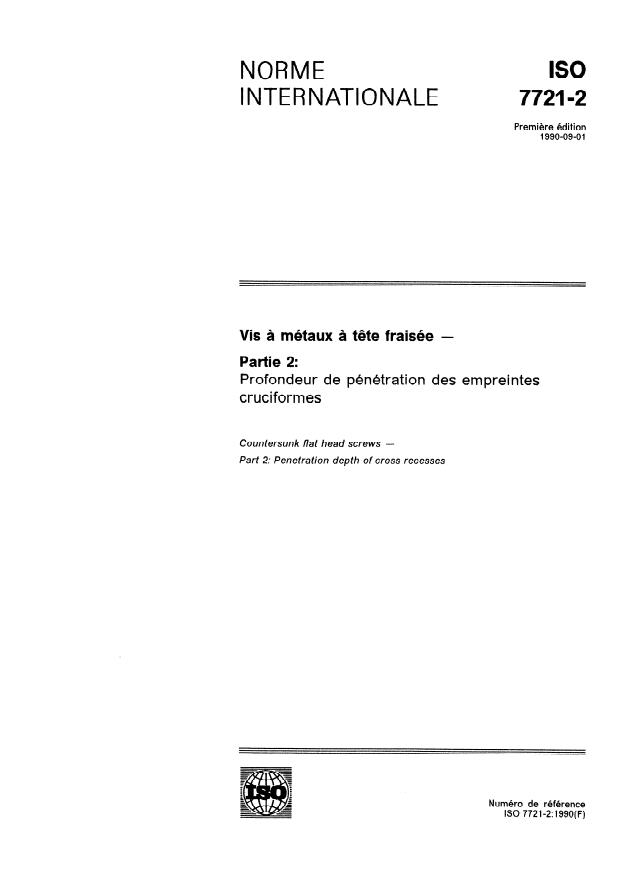
Vis à métaux à tête fraisée — Partie 2: Profondeur de pénétration des empreintes cruciformes
La présente partie de l'ISO 7721 prescrit la profondeur de pénétration des empreintes cruciformes des vis à métaux à tête fraisée pour les séries 1 et 2, profonde et basse, respectivement.
General Information
- Status
- Published
- Publication Date
- 22-Aug-1990
- Technical Committee
- ISO/TC 2/SC 11 - Fasteners with metric external thread
- Drafting Committee
- ISO/TC 2/SC 11 - Fasteners with metric external thread
- Current Stage
- 9093 - International Standard confirmed
- Start Date
- 10-Jul-2024
- Completion Date
- 14-Feb-2026
Overview
ISO 7721-2:1990 is an international standard developed by the International Organization for Standardization (ISO) that specifies the penetration depth of cross recesses in countersunk flat head screws. This part 2 of the ISO 7721 series focuses exclusively on defining the optimal depth for the cross-shaped recess on screw heads to balance two critical requirements: head strength and wrenchability.
The standard was prepared by ISO Technical Committee ISO/TC 2, which specializes in fasteners. It complements ISO 7721-1, which covers head configuration and gauging. ISO 7721-2 ensures that the penetration depth of cross recesses allows for sufficient mechanical robustness of the screw head while enabling effective engagement with screwdrivers or bit drivers.
Key Topics
Penetration Depth of Cross Recesses
Defines two series of cross recess penetration depth for countersunk flat head screws:- Series 1: Deep cross recess for enhanced wrenchability and adequate head strength (mainly for low-strength screws).
- Series 2: Shallow cross recess to increase head strength, requiring additional design considerations (such as an underhead shoulder) for higher-strength screws.
Balance Between Strength and Wrenchability
Shallower recesses provide stronger screw heads but reduce grip with the driver. Conversely, deeper recesses improve wrenchability but may weaken the head. The standard presents a compromise to meet both demands.Underhead Shoulder Configurations
To maintain sufficient head strength with deeper recesses on high-strength screws, an underhead shoulder is incorporated. This assures the mechanical integrity of the screw head under load.Dimensional Specifications
The standard provides precise dimensional values for penetration depths relative to screw size and type, ensuring compatibility and interchangeability across manufacturers and applications.Normative References
ISO 7721-2 refers to related standards such as:- ISO 225 for fastener symbols and dimension designations
- ISO 4757 for cross recess specifications
- ISO 7721-1 for head configuration and gauging
Applications
ISO 7721-2:1990 is critical for manufacturers and users of countersunk flat head screws featuring cross recesses. Its practical applications include:
Fastener Manufacturing
Enables consistent production of screws with standardized cross recess depths, ensuring interchangeability and quality compliance.Mechanical Assembly and Maintenance
Provides guidelines for screw design to optimize assembly efficiency and reduce the risk of cam-out or damage during fastening.Product Design in Engineering
Assists designers in selecting appropriate screw types based on strength requirements and ease of driving, particularly in the automotive, aerospace, electronics, and construction industries.Quality Assurance and Testing
Helps inspectors verify that screw products meet international standards for head strength and recess penetration, contributing to overall product reliability.
Related Standards
ISO 7721-1: Countersunk flat head screws - Head configuration and gauging
Defines the geometric parameters and inspection methods for screw heads, complementary to the recess depth specifications of ISO 7721-2.ISO 4757: Cross recesses for screws
Details dimensions and tolerances for cross recess shapes, supporting the correct interpretation of recess depth requirements.ISO 7046 Series: Cross recessed countersunk flat head screws
Applies results of ISO 7721-2 for practical use in screw grades and property classes such as 4.8 and 8.8, establishing a link between recess depth and mechanical performance.
Summary
ISO 7721-2:1990 plays a pivotal role in standardizing the penetration depths of cross recesses in countersunk flat head screws to optimize the interplay between head strength and wrenchability. Adhering to this standard ensures fastener reliability, compatibility, and ease of use across diverse industrial applications. By following ISO 7721-2 specifications, manufacturers and engineers can achieve superior mechanical performance and facilitate efficient, damage-free assembly processes.
Keywords: ISO 7721-2, countersunk flat head screws, cross recess penetration depth, screw head strength, wrenchability, fastener standards, screw dimensions, ISO fasteners, screw manufacturing, mechanical assembly.

Frequently Asked Questions
ISO 7721-2:1990 is a standard published by the International Organization for Standardization (ISO). Its full title is "Countersunk flat head screws — Part 2: Penetration depth of cross recesses". This standard covers: La présente partie de l'ISO 7721 prescrit la profondeur de pénétration des empreintes cruciformes des vis à métaux à tête fraisée pour les séries 1 et 2, profonde et basse, respectivement.
La présente partie de l'ISO 7721 prescrit la profondeur de pénétration des empreintes cruciformes des vis à métaux à tête fraisée pour les séries 1 et 2, profonde et basse, respectivement.
ISO 7721-2:1990 is classified under the following ICS (International Classification for Standards) categories: 21.060.10 - Bolts, screws, studs. The ICS classification helps identify the subject area and facilitates finding related standards.
ISO 7721-2:1990 is available in PDF format for immediate download after purchase. The document can be added to your cart and obtained through the secure checkout process. Digital delivery ensures instant access to the complete standard document.
Standards Content (Sample)
INTERNATIONAL
STANDARD 7721~2
First edition
1990-09-o 1
Countersunk flat head screws -
Part 2:
Penetration depth of cross recesses
l/is ZI m&faux A f&fe fraiske -
Partie 2: Profondeur de p&nBfrafion des empreintes cruciformes
Reference number
IS0 772&2:1990(E)
IS0 7721-2:1990(E)
Foreword
IS0 (the International Organization for Standardization) is a worldwide
federation of national standards bodies (IS0 member bodies). The work
of preparing International Standards is normally carried out through IS0
technical committees. Each member body interested in a subject for
which a technical committee has been established has the right to be
represented on that committee. International organizations, govern-
mental and non-governmental, in liaison with ISO, also take part in the
work. IS0 collaborates closely with the International Electrotechnical
Commission (IEC) on all matters of electrotechnical standardization.
Draft International Standards adopted by the technical committees are
circulated to the member bodies for voting. Publication as an Interna-
tional Standard requires approval by at least 75 % of the member bodies
casting a vote.
International Standard IS0 7721-2 was prepared by Technical Committee
ISO/TC 2, Fasteners.
IS0 7721 consists of the following parts, under the general title
Countersunk flat head screws:
- Part I: Head configuration and gauging
- Part 2: Penetration depth of cross recesses
Annex A of this part of IS0 7721 is for information only.
0 IS0 1990
All rights reserved. No part of this publication may be reproduced or utillzed in any form
or by any means, electronic or mechanical, including photocopying and microfilm, without
permission in writing from the publisher.
International Organization for Standardization
Case Postale 56 l Cl-i-121 1 Geneve 20 l Switzerland
Printed in Switzerland
ii
IS0 7721-2:1990(E)
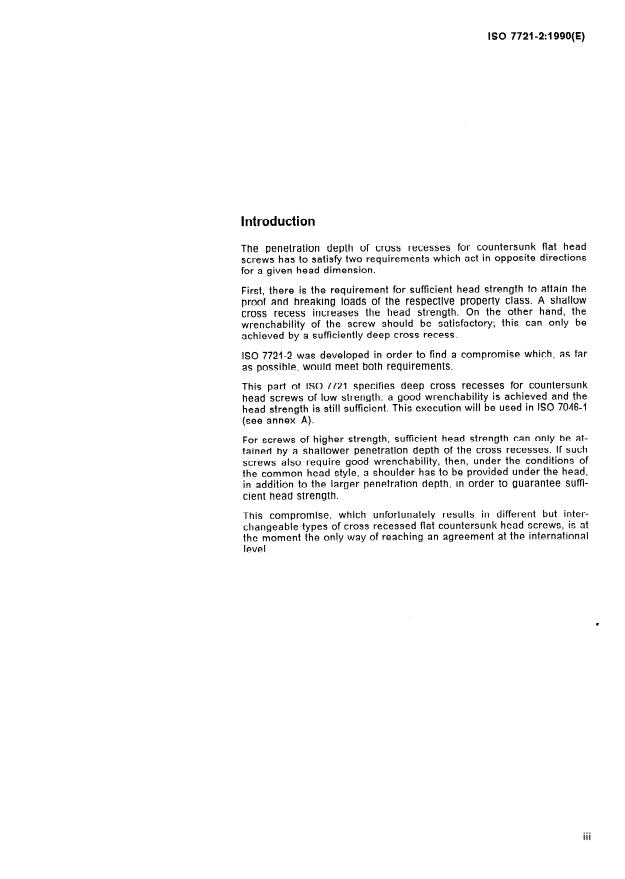
Introduction
The penetration depth of cross recesses for countersunk flat head
screws has to satisfy two requirements which act in opposite directions
for a given head dimension.
First, there is the requirement for sufficient head strength to attain the
proof and breaking loads of the respective property class. A shallow
cross recess increases the head strength. On the other hand, the
wrenchability of the screw should be satisfactory; this can only be
achieved by a sufficiently deep cross recess.
IS0 7721-2 was developed in order to find a compromise which, as far
as possible, would meet both requirements.
This part of IS0 7721 specifies deep cross recesses for countersunk
head screws of low strength: a good wrenchability is achieved and the
head strength is still sufficient. This execution will be used in IS0 7046-I
(see annex A).
For screws of higher strength, sufficient head strength can only be at-
tained by a shallower penetration depth of the cross recesses. If such
screws also require good wrenchability, then, under the conditions of
the common head style, a shoulder has to be provided under the head,
in addition to the larger penetration depth, in order to guarantee suffi-
cient head strength.
This compromise, which unfortunately results in different but inter-
changeable types of cross recessed flat countersunk head screws, is at
the moment the only way of reaching an agreement at the international
level.
. . .
Ill
This page intentionally left blank
INTERNATIONAL STANDARD
IS0 772%2:1990(E
...
NORME
INTERNATIONALE 7721-2
Première édition
1990-09-O 1
Vis à métaux à tête fraisée -
Partie 2:
Profondeur de pénétration des empreintes
cruciformes
Countersunk f7at head screws -
Part 2: Penetration depth of cross recesses
Numéro de référence
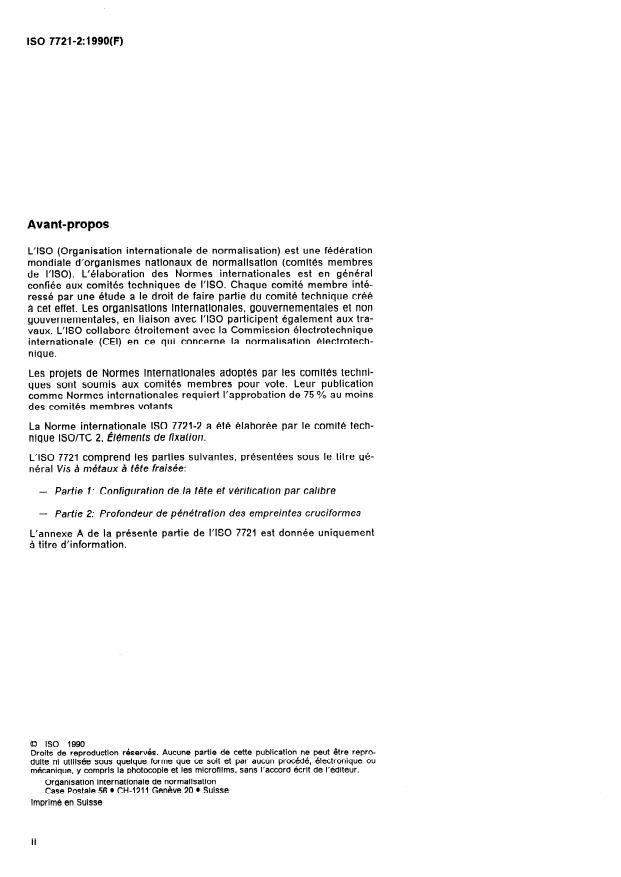
Avant-propos
L’ISO (Organisation internationale de normalisation) est une fédération
mondiale d’organismes nationaux de normalisation (comités membres
de I’ISO). L’élaboration des Normes internationales est en général
confiée aux comités techniques de I’ISO. Chaque comité membre inté-
ressé par une étude a le droit de faire partie du comité technique créé
à cet effet. Les organisations internationales, gouvernementales et non
gouvernementales, en liaison avec I’ISO participent également aux tra-
vaux. L’ISO collabore étroitement avec la Commission électrotechnique
internationale (CEI) en ce qui concerne la normalisation électrotech-
nique.
Les projets de Normes internationales adoptés par les comités techni-
ques sont soumis aux comités membres pour vote. Leur publication
comme Normes internationales requiert l’approbation de 75 */o au moins
des comités membres votants.
La Norme internationale ISO 7721-2 a été élaborée par le comité tech-
nique ISO/TC 2, Éléments de fixation.
L’ISO 7721 comprend les parties suivantes, présentées sous le titre gé-
néral Vis B métaux à @te fraisée:
-
Partie I: Configuration de la tête et vérification par calibre
-
Partie 2: Profondeur de pénétration des empreintes cruciformes
L’annexe A de la présente partie de I’ISO 7721 est donnée uniquement
à titre d’information.
8 ISO 1990
Droits de reproduction réservés. Aucune partie de cette publication ne peut être repro-
duite ni utilisée sous quelque forme que ce soit et par aucun procédé, électronique ou
mécanique, y compris la photocopie et les microfilms, sans l’accord écrit de l’éditeur.
Organisation Inter nationale de normalisation
Case Postale 56 l CH-121 1 Geneve 20 l Suisse
Imprimé en Suisse
ii
ISO 7721=2:1990(F)
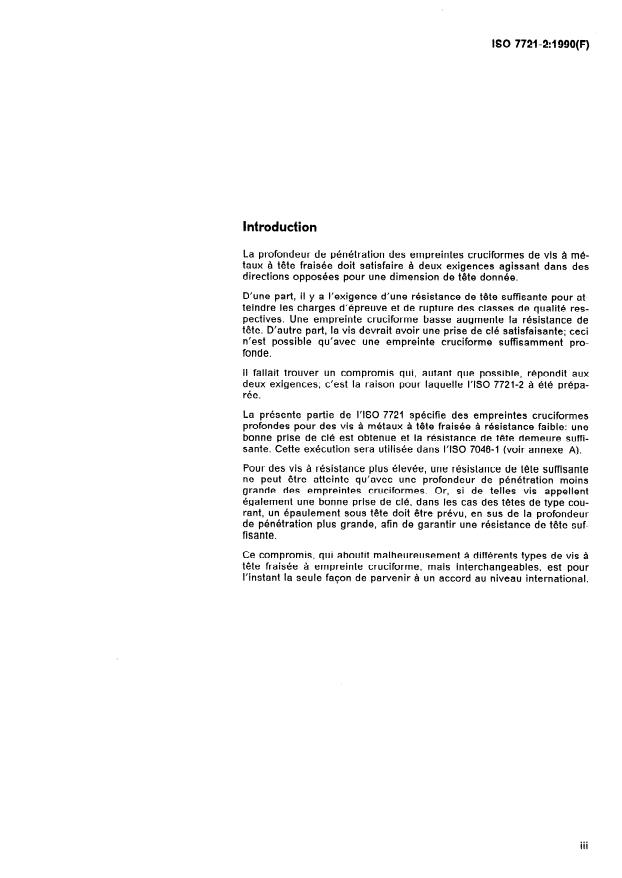
Introduction
La profondeur de pénétration des empreintes cruciformes de vis à mé-
taux à tête fraisée doit satisfaire à deux exigences agissant dans des
directions opposées pour une dimension de tête donnée.
D’une part, il y a l’exigence d’une résistance de tête suffisante pour at-
teindre les charges d’épreuve et de rupture des classes de qualité res-
pectives. Une empreinte cruciforme basse augmente la résistance de
tête. D’autre part, la vis devrait avoir une prise de clé satisfaisante; ceci
n’est possible qu’avec une empreinte cruciforme suffisamment pro-
fonde.
II fallait trouver un compromis qui, autant que possible, répondit aux
deux exigences; c’est la raison pour laquelle I’ISO 7721-2 à été prépa-
rée.
La présente partie de I’ISO 7721 spécifie des empreintes cruciformes
profondes pour des vis à métaux à tête fraisée à résistance faible: une
bonne prise de clé est obtenue et la résistance de tête demeure suffi-
sante. Cette exécution sera utilisée dans I’ISO 7046-l (voir annexe A).
Pour des vis à résistance plus élevée, une résistance de tête suffisante
ne peut être atteinte qu’avec une profondeur de pénétration moins
grande des empreintes cruciformes. Or, si de telles vis appellent
également une bonne prise de clé, dans les cas des têtes de type COU-
rant, un épaulement sous tête doit être prévu, en sus de la profondeur
de pénétration plus grande, afin de garantir une résistance de tête suf-
fisante.
Ce compromis, qui aboutit malheureusement à différents types de vis à
tête fraisée à empreinte cruciforme, mais interchangeables, est pour
l’instant la seule facon de parvenir à un accord au niveau international.
. . .
III
Page blanche
NORME INTERNATIONALE ISO 7721-2:1990(F)
Vis à métaux à tête fraisée -
Partie 2:
Profondeur de pénétratio
...
NORME
INTERNATIONALE 7721-2
Première édition
1990-09-O 1
Vis à métaux à tête fraisée -
Partie 2:
Profondeur de pénétration des empreintes
cruciformes
Countersunk f7at head screws -
Part 2: Penetration depth of cross recesses
Numéro de référence
Avant-propos
L’ISO (Organisation internationale de normalisation) est une fédération
mondiale d’organismes nationaux de normalisation (comités membres
de I’ISO). L’élaboration des Normes internationales est en général
confiée aux comités techniques de I’ISO. Chaque comité membre inté-
ressé par une étude a le droit de faire partie du comité technique créé
à cet effet. Les organisations internationales, gouvernementales et non
gouvernementales, en liaison avec I’ISO participent également aux tra-
vaux. L’ISO collabore étroitement avec la Commission électrotechnique
internationale (CEI) en ce qui concerne la normalisation électrotech-
nique.
Les projets de Normes internationales adoptés par les comités techni-
ques sont soumis aux comités membres pour vote. Leur publication
comme Normes internationales requiert l’approbation de 75 */o au moins
des comités membres votants.
La Norme internationale ISO 7721-2 a été élaborée par le comité tech-
nique ISO/TC 2, Éléments de fixation.
L’ISO 7721 comprend les parties suivantes, présentées sous le titre gé-
néral Vis B métaux à @te fraisée:
-
Partie I: Configuration de la tête et vérification par calibre
-
Partie 2: Profondeur de pénétration des empreintes cruciformes
L’annexe A de la présente partie de I’ISO 7721 est donnée uniquement
à titre d’information.
8 ISO 1990
Droits de reproduction réservés. Aucune partie de cette publication ne peut être repro-
duite ni utilisée sous quelque forme que ce soit et par aucun procédé, électronique ou
mécanique, y compris la photocopie et les microfilms, sans l’accord écrit de l’éditeur.
Organisation Inter nationale de normalisation
Case Postale 56 l CH-121 1 Geneve 20 l Suisse
Imprimé en Suisse
ii
ISO 7721=2:1990(F)
Introduction
La profondeur de pénétration des empreintes cruciformes de vis à mé-
taux à tête fraisée doit satisfaire à deux exigences agissant dans des
directions opposées pour une dimension de tête donnée.
D’une part, il y a l’exigence d’une résistance de tête suffisante pour at-
teindre les charges d’épreuve et de rupture des classes de qualité res-
pectives. Une empreinte cruciforme basse augmente la résistance de
tête. D’autre part, la vis devrait avoir une prise de clé satisfaisante; ceci
n’est possible qu’avec une empreinte cruciforme suffisamment pro-
fonde.
II fallait trouver un compromis qui, autant que possible, répondit aux
deux exigences; c’est la raison pour laquelle I’ISO 7721-2 à été prépa-
rée.
La présente partie de I’ISO 7721 spécifie des empreintes cruciformes
profondes pour des vis à métaux à tête fraisée à résistance faible: une
bonne prise de clé est obtenue et la résistance de tête demeure suffi-
sante. Cette exécution sera utilisée dans I’ISO 7046-l (voir annexe A).
Pour des vis à résistance plus élevée, une résistance de tête suffisante
ne peut être atteinte qu’avec une profondeur de pénétration moins
grande des empreintes cruciformes. Or, si de telles vis appellent
également une bonne prise de clé, dans les cas des têtes de type COU-
rant, un épaulement sous tête doit être prévu, en sus de la profondeur
de pénétration plus grande, afin de garantir une résistance de tête suf-
fisante.
Ce compromis, qui aboutit malheureusement à différents types de vis à
tête fraisée à empreinte cruciforme, mais interchangeables, est pour
l’instant la seule facon de parvenir à un accord au niveau international.
. . .
III
Page blanche
NORME INTERNATIONALE ISO 7721-2:1990(F)
Vis à métaux à tête fraisée -
Partie 2:
Profondeur de pénétratio
...
Questions, Comments and Discussion
Ask us and Technical Secretary will try to provide an answer. You can facilitate discussion about the standard in here.
Loading comments...