


ISO 2122:1972
(Main)Sodium and potassium silicates for industrial use - Preparation of solution of products not easily soluble in boiling water and determination of matter insoluble in water
Sodium and potassium silicates for industrial use - Preparation of solution of products not easily soluble in boiling water and determination of matter insoluble in water
The method is applicable to products corresponding to the general formula M2O . xSiO2, where the values of x lie between 1,5 and 3,5 in the case of sodium silicates and 1,9 and 3,9 in the case of potassium silicates. Because of the difficulty ancountered in dissolving fine particles of these products, the sample is first sieved to remove these fines. The procedure consists in dissolution of the test portion in carbon dioxide-free water, by treatment in an autoclave. Filtration and weighing of the insoluble matter on a tared filter crucible. Dilution of the filtrate to a given volume, from which aliquot samples are taken in order to carry out the different determinations.
Silicates de sodium et de potassium à usage industriel — Mise en solution des produits difficilement solubles dans l'eau bouillante et détermination de l'insoluble dans l'eau
General Information
- Status
- Published
- Publication Date
- 31-May-1972
- Technical Committee
- ISO/TC 47 - Chemistry
- Drafting Committee
- ISO/TC 47 - Chemistry
- Current Stage
- 9093 - International Standard confirmed
- Start Date
- 20-Oct-2023
- Completion Date
- 13-Dec-2025
Overview
ISO 2122:1972 is an international standard developed by the International Organization for Standardization (ISO) that specifies a precise method for the preparation of sodium and potassium silicate solutions, particularly focusing on products that are not easily soluble in boiling water. The standard details the procedures for dissolving such silicates and accurately determining the matter insoluble in water. This ensures reliable and consistent quality control of silicate products used in various industrial applications.
This method applies to sodium silicates with the general formula M₂O · xSiO₂ where x ranges between 1.5 and 3.5, and potassium silicates where x ranges between 1.9 and 3.9. The process involves sample sieving, dissolution under controlled pressure and temperature conditions using an autoclave, filtration, and subsequent gravimetric analysis of insoluble matter. The standard is essential for laboratories and industries dealing with silicate products requiring standardized testing methods.
Key Topics
Scope of Application
The standard is designed for sodium and potassium silicates used industrially, with specific ranges of silica modulus (x values). It addresses the challenge of dissolving fine particles that are difficult to solubilize in boiling water.Sample Preparation
Samples must be sieved to remove fine particles before dissolution, ensuring uniformity and accuracy in testing.Dissolution Procedure
The silicate sample is dissolved in carbon dioxide-free water inside a stainless steel autoclave heated to specific temperatures (135–160 °C for sodium silicates, 150 °C for potassium silicates) under approximately 6 bars pressure.Filtration and Insoluble Matter Determination
After dissolution, the solution is vacuum-filtered through a tared filter crucible with defined porosity. The insoluble residue is washed, dried, and weighed to calculate the percentage of insoluble matter by mass.Preparation of Test Solutions
The filtrate is diluted to a predetermined volume, forming a uniform solution for further chemical analyses or tests.Reagents and Apparatus
- Carbon dioxide-free water, prepared by boiling or bubbling inert gas
- pH indicator paper for monitoring neutrality
- Stainless steel autoclave suited for 6-bar pressure
- Porous fritted crucibles and ashless filter paper for filtration
Special Cases
Adaptations of the dissolution method are included for silicates with silica moduli exceeding the specified ranges, using alternative filtering methods and varying autoclave parameters.Expression and Reporting of Results
The standard provides formulas and guidelines to express the insoluble content quantitatively and mandates detailed test reports documenting procedures, results, and any deviations.
Applications
ISO 2122:1972 is critical in industries and laboratories where precise quality evaluation of sodium and potassium silicates is required. Practical applications include:
Industrial Quality Control
Ensuring raw materials and products meet solubility and purity specifications essential for manufacturing processes.Research and Development
Supporting formulation and testing of silicate-based materials with consistent and reproducible analytical methods.Chemical Analysis Laboratories
Serving as a standardized reference method for determining insoluble matter content, which influences product performance and safety.Process Optimization
Helping manufacturers adjust production parameters to minimize insoluble residues, enhancing product consistency.
Related Standards
For comprehensive analysis and testing of sodium and potassium silicates, ISO 2122:1972 should be considered alongside:
- ISO/R 1686 – Sampling and general test methods for sodium and potassium silicates
- ISO/R 1690 – Gravimetric determination of silica content by insolubilization
- ISO/R 1691 – Gasometric determination of carbon dioxide content expressed as sodium or potassium carbonate
These related standards complement ISO 2122 by covering broader aspects of silicate composition analysis and sampling techniques.
Keywords: ISO 2122:1972, sodium silicates, potassium silicates, industrial silicates, solution preparation, insoluble matter determination, autoclave dissolution, silicate solubility testing, chemical analysis, quality control of silicates, standard test method, filtration, gravimetric analysis.
ISO 2122:1972 - Sodium and potassium silicates for industrial use -- Preparation of solution of products not easily soluble in boiling water and determination of matter insoluble in water
ISO 2122:1972 - Silicates de sodium et de potassium a usage industriel -- Mise en solution des produits difficilement solubles dans l'eau bouillante et détermination de l'insoluble dans l'eau
ISO 2122:1972 - Silicates de sodium et de potassium a usage industriel -- Mise en solution des produits difficilement solubles dans l'eau bouillante et détermination de l'insoluble dans l'eau
Frequently Asked Questions
ISO 2122:1972 is a standard published by the International Organization for Standardization (ISO). Its full title is "Sodium and potassium silicates for industrial use - Preparation of solution of products not easily soluble in boiling water and determination of matter insoluble in water". This standard covers: The method is applicable to products corresponding to the general formula M2O . xSiO2, where the values of x lie between 1,5 and 3,5 in the case of sodium silicates and 1,9 and 3,9 in the case of potassium silicates. Because of the difficulty ancountered in dissolving fine particles of these products, the sample is first sieved to remove these fines. The procedure consists in dissolution of the test portion in carbon dioxide-free water, by treatment in an autoclave. Filtration and weighing of the insoluble matter on a tared filter crucible. Dilution of the filtrate to a given volume, from which aliquot samples are taken in order to carry out the different determinations.
The method is applicable to products corresponding to the general formula M2O . xSiO2, where the values of x lie between 1,5 and 3,5 in the case of sodium silicates and 1,9 and 3,9 in the case of potassium silicates. Because of the difficulty ancountered in dissolving fine particles of these products, the sample is first sieved to remove these fines. The procedure consists in dissolution of the test portion in carbon dioxide-free water, by treatment in an autoclave. Filtration and weighing of the insoluble matter on a tared filter crucible. Dilution of the filtrate to a given volume, from which aliquot samples are taken in order to carry out the different determinations.
ISO 2122:1972 is classified under the following ICS (International Classification for Standards) categories: 71.060.50 - Salts. The ICS classification helps identify the subject area and facilitates finding related standards.
You can purchase ISO 2122:1972 directly from iTeh Standards. The document is available in PDF format and is delivered instantly after payment. Add the standard to your cart and complete the secure checkout process. iTeh Standards is an authorized distributor of ISO standards.
Standards Content (Sample)
INTERNATIONAL STANDARD
INTERNATIONAL ORGANIZATION FOR STANDARDIZATION l MEXRYHAPOL1HAR OPTAHM3AUL-l~ IlO CTAHLlAPTM3AUMM .ORGANISATION INTERNATIONALE DE NORMALISATION
Sodium and potassium silicates for industrial use -
Preparation of solution of products not easily soluble in
boiling water and determination of matter insoluble in water
First edition - 1972-06-01
Ref. No. IS0 2122-1972 (E)
UDC 661.31/32 : 54-165
Descriptors : chemical tests, dissolving, potassium silicates, sodium silicates, solubility, solutions.
Price based on 3 pages
FOREWORD
IS0 (the International Organization for Standardization) is a worldwide federation
of national standards institutes (IS0 Member Bodies). The work of developing
International Standards is carried out through IS0 Technical Committees. Every
Member Body interested in a subject for which a Technical Committee has been set
up has the right to be represented on that Committee. International organizations,
governmental and non-governmental, in liaison with ISO, also take part in the work.
Draft International Standards adopted by the Technical Committees are circulated
to the Member Bodies for approval before their acceptance as International
Standards by the IS0 Council.
International Standard IS0 2122 was drawn up by Technical Committee
I SO/TC 47, Chemistry.
It was approved in March 1971 by the Member Bodies of the following countries:
Austria India South Africa, Rep. of
Belgium Ireland Spain
Chile Israel Switzerland
Czechoslovakia Italy Thailand
Egypt, Arab Rep. of Netherlands Turkey
France New Zealand United Kingdom
Germany Poland U.S.A.
Hungary Portugal U.S.S.R.
No Member Body expressed disapproval of the document.
0 International Organization for Standardization, 1972 l
Printed in Switzerland
_ IS0 21224972 (E)
INTERNATIONAL STANDARD
Sodium and potassium silicates for industrial use -
Preparation of solution of products not easily soluble in
boiling water and determination of matter hisoluble in water
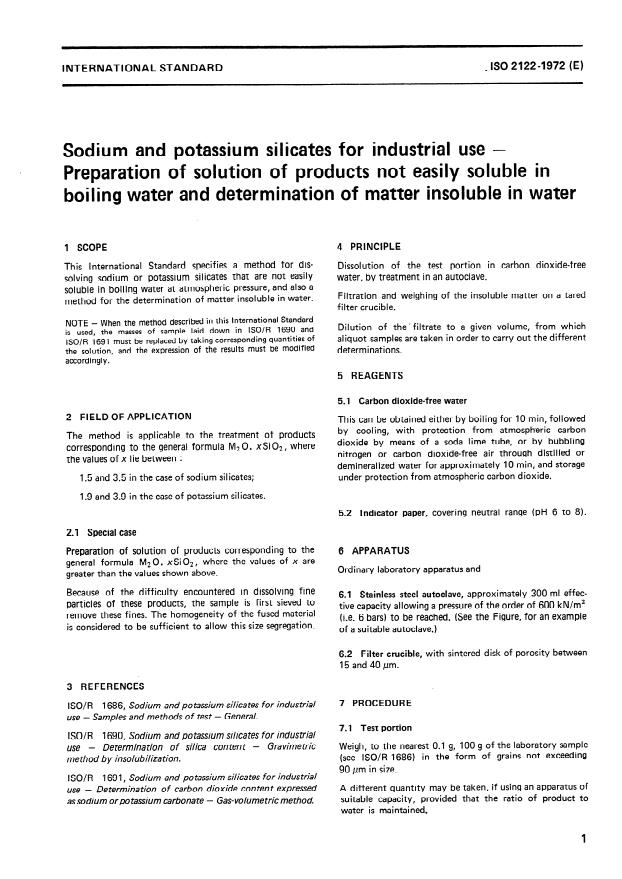
1 SCQPE 4 PRINCIPLE
This International Standard specifies a method for dis- Dissolution of the test portion in carbon dioxide-free
solving sodium or potassium silicates that are not easily water, by treatment in an autoclave.
soluble in boiling water at atmospheric pressure, and also a
Filtration and weighing of the insoluble matter on a tared
method for the determination of matter insoluble in water.
filter crucible.
When the method described in this International Standard
NOTE -
Dilution of the ‘filtrate to a given volume, from which
is used, the masses of sample laid down in ISO/R 1690 and
aliquot samples are taken in order to carry out the different
ISO/R 1691 must be replaced by taking corresponding quantities of
the solution, and the expression of the results must be modified determinations.
accordingly.
5 REAGENTS
5.1 Carbon dioxide-free water
2 FIELD OF APPLICATION
This can be obtained either by boiling for 10 min, followed
by cooling, with protection from atmospheric carbon
The method is applicable to the treatment of products
dioxide by means of a soda lime tube, or by ‘bubbling
corresponding to the general formula M2 0. xSi 02, where
nitrogen or carbon dioxide-free air through distilled or
the values of x lie between :
demineralized water for approximately IO min, and storage
1.5 and 3.5 in the case of sodium silicates; under protection from atmospheric carbon dioxide.
1.9 and 3.9 in the case of potassium silicates.
5.2 Indicator paper, covering neutral range (pH 6 to 8).
2.1 Special case
Preparation of solution of products corresponding to the 6 APPARATUS
general formula M2 0. xSi02, where the values of x are
Ordinary laboratory apparatus and
greater than the values shown above.
Because of the difficulty encountered in dissolving fine
6.1 Stainless steel autoclave, approximately 300 ml effec-
particles of these products, the sample is first sieved to
tive capacity allowing a pressure of the order of 600 kN/m2
remove these fines. The homogeneity of the fused material
(i.e. 6 bars) to be reached. (See the Figure, for an example
is considered to be sufficient to allow this size segregation.
of a suitable autoclave.)
6.2 Filter crucible, with sintered disk of porosity between
15 and 40 pm.
3 REFERENCES
7 PROCEDURE
IS01 R 1686, Sodium and potassium silicates for industrial
use - Samples and methods of test - General.
7.1 Test portion
ISOf R 1690, Sodium and potassium silicates for industrial
use - Determination of silica con tent - Gravime tric Weigh, to the nearest 0.1 g, 100 g of the laboratory sample
method by insolubilization. (see lSO/R 1686) in the form of grains not exceeding
90 pm in size.
IS01 R 169 1, Sodium and potassium silicates for industrial
A different quantity may be taken, if using an apparatus of
use - Determination of carbon dioxide con tent expressed
suitable capacity, provided that the ratio of product to
as sodium or po tassium carbonate - Gas-volumetric method.
water is maintained.
ISO2122=1972(E)
9 SPECIAL CASE
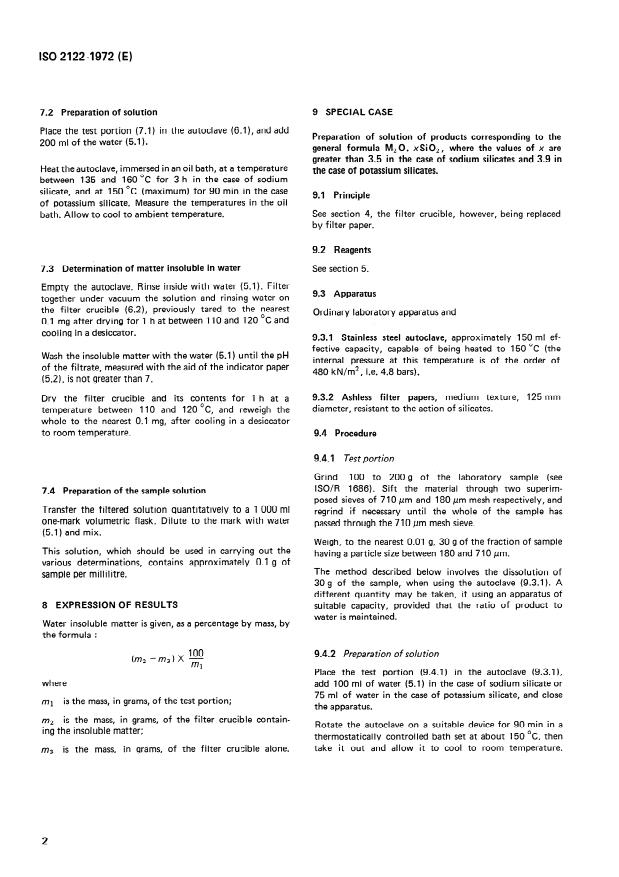
7.2 Preparation of solution
Place the test portion (7.1) in the autoclave (6.1), and add
Preparation of solution of products corresponding to the
200 ml of the water (5.1).
general f
...
ISO 2122-1972 (FI
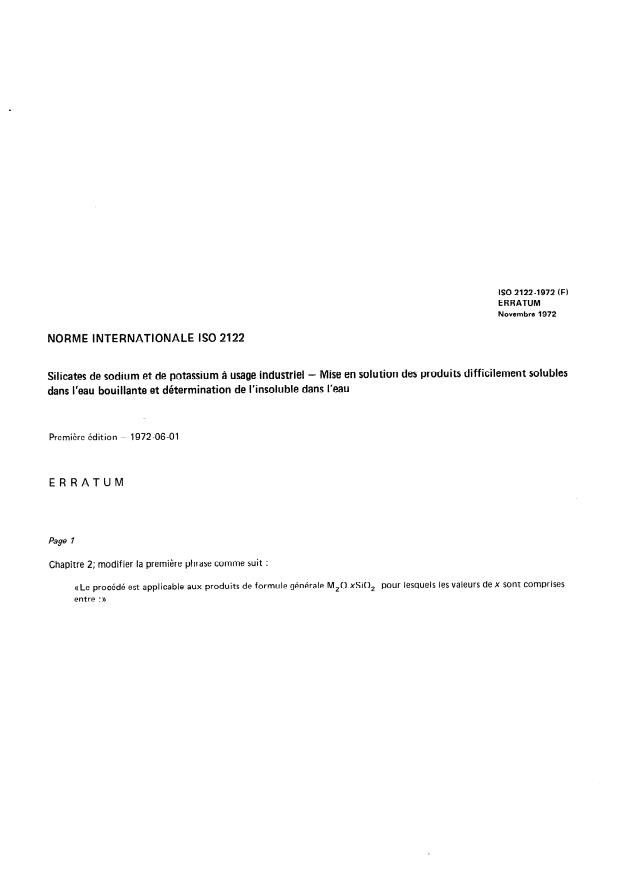
ERRATUM
Novembre 1972
NORME INTERNATIONALE ISO 2122
Mise en solution des produits difficilement solubles
Silicates de sodium et de potassium à usage industriel -
dans l’eau bouillante et détermination de l’insoluble dans l’eau
Première édition - 1972-06-01
ERRATUM
Page 7
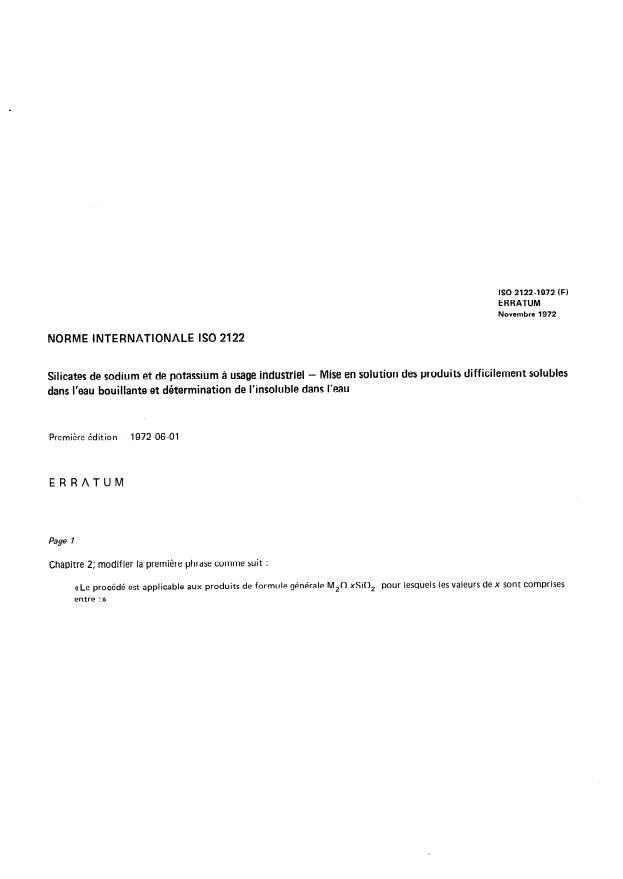
Chapitre 2; modifier la première phrase comme suit :
p our lesquels les valeurs de x sont comprises
aLe procédé est applicable aux produits de formule générale M,O.xSiO,
entre 3
Page blanche
~_~~ ~~
NORME INTERNATIONALE
INTERNATIONAL ORGANIZATION FOR STANDARDIZATION .MEX,lJYHAI’O~HAII OPPAHM3ALlMfi Il0 CTAHAAPTM3AWM -ORGANISATION INTERNATIONALE DE NORMALISATION
Silicates de sodium et de potassium à usage industriel -
,
Mise en solution des produits difficilement solubles dans
l’eau bouillante et détermination de l’insoluble dans l’eau
Première édition - 1972-06-01
Réf. No : ISO 2122-1972 (F)
CDU 661.31/32 : 54-165
Descripteurs : essai chimique, dissolution, silicate de potassium, silicate de sodium, solubilité, solution.
Prix basé sur 3 pages
AVANT-PROPOS
ISO (Organisation Internationale de Normalisation) est une fédération mondiale
d’organismes nationaux de normalisation (Comités Membres ISO). L’élaboration de
Normes Internationales est confiée aux Comités Techniques ISO. Chaque Comité
Membre intéressé par une étude a le droit de faire partie du Comité Technique
correspondant. Les organisations internationales, gouvernementales et non
gouvernementales, en liaison avec I’ISO, participent également aux travaux.
Les Projets de Normes Internationales adoptés par les Comités Techniques sont
soumis aux Comités Membres pour approbation, avant leur acceptation comme
Normes Internationales par le Conseil de I’ISO.
La Norme Internationale ISO 2122 a été établie par le Comité Technique
lSO/TC 47, Chimie.
Elle fut approuvée en mars 1971 par les Comités Membres des pays suivants :
Afrique du Sud, Rép. d’ Hongrie Portugal
Allemagne Inde Royaume-Uni
Autriche I rlande Suisse
Belgique Israël Tchécoslovaquie
Chili Italie Thaïlande
Egypte, Rép. arabe d’ Nouvelle-Zélande Turquie
Espagne Pays-Bas U.R.S.S.
France Pologne U.S.A.
Aucun Comité Membre n’a désapprouvé le document.
0 Organisation Internationale de Normalisation, 1972 l
Imprimé en Suisse
NORME INTERNATIONALE . ISO 21224972 (F)
.Silicates de sodium et de potassium à usage industriel -
Mise en solution des produits difficilement solubles dans
l’eau bouillante et détermination de l’insoluble dans l’eau
4 PRINCIPE
1 OBJET
La présente Norme Internationale spécifie un procédé de Mise en solution de la prise d’essai dans de l’eau exempte
dissolution des silicates de sodium ou de potassium dif- de dioxyde de carbone, par traitement en autoclave.
ficilement solubles dans l’eau bouillante à la pression am-
Filtration et pesée de l’insoluble sur un creuset filtrant
biante, ainsi qu‘une méthode de détermination de I’inso-
taré.
lubie dans l’eau.
Dilution du filtrat à un volume déterminé, dont on prélè-
NOTE - Lorsque la méthode de mise en solution décrite ci-après
vera des parties aliquotes pour effectuer les différentes dé-
est utilisée, les prélèvements par pesée qui sont prescrits en
ISO/R 1690 et ISO/R 1691 doivent être remplacés par des prises terminations.
de solution de même importance et l’expression des résultats doit
être modifiée en conséquence.
5 RÉACTIFS
5.1 Eau exempte de dioxyde de carbone
2 DOMAINE D’APPLICATION
Elle peut être obtenue, soit par ébullition pendant 10 min,
suivie de refroidissement à l’abri du dioxyde de carbone
Le procédé est applicable aux produits de formule géné-
atmosphérique au moyen d’une colonne à chaux sodée,
rale M2 0 , xSi O2 pour lesquels les valeurs de x sont :
soit par barbotage d’azote ou d’air exempt de dioxyde
de carbone dans de l’eau distillée ou déminéralisée pendant
1,5 et 3,5 dans le cas des silicates de sodium; 10 min environ, et conservation à l’abri du dioxyde de
carbone atmosphérique.
1,9 et 3,9 dans le cas des silicates de potassium.
5.2
Papier indicateur, virant dans la zone neutre (pH 6 à 8).
2.1 Cas particulier
Mise en solution des produits de formule générale
6 APPAREILLAGE
M2 0 * xSi02 pour lesquels les valeurs de x sont supérieures
aux valeurs maximales indiquées ci-dessus.
Matériel courant de laboratoire, et
La difficulté rencontrée pour mettre les fines particules de
ces produits en solution conduit à éliminer celles-ci par un
6.1 Autoclave en acier inoxydable, d’environ 300 ml de ca-
calibrage granulométrique préalable de l’échantillon. Les
pacité utile, permettant d’atteindre une pression de l’ordre
produits fabriqués par fusion sont supposés suffisamment
de 600 kN/m2, soit 6 bars (voir à la Figure un exemple
homogènes pour autoriser cette élimination.
d’autoclave approprié).
6.2 Creuset filtrant, à plaque frittée de porosité comprise,
entre 15 et 40 ,um.
3 RÉFÉRENCES
ISOIR 1686, Silicates de sodium et de potassium à usage
7 MODE OPÉRATOIRE
indus trie1 - Echantillons et techniques des essais - Généra-
/i tés.
7.1 Prise d’essai
ISO/R 1690, Silicates de sodium et de potassium à usage
industriel - Dosage de la silice - Méthode gravimétrique Peser, à 0,l g près, 100 g de l’échantillon pour laboratoire
par insolubilisa tion. (voir ISO/R 1686) sous forme de grains dont les dimensions
ne dépassent pas 90 ,um.
ISOIR 169 1, Silicates de sodium et de potassium à usage
indus trie1 - Dosage du dioxyde de carbone, exprimé en II est possible d’effectuer un prélèvement différent, en utili-
sant un appareil de capacité appropriée, à la condition de
carbonate de sodium ou de potassium - Méthode gazomé-
trique. respecter la proportion de produit et d’eau.
ISO 21224972 (F)
7.2 Mise en solution 9 CAS PARTICULIER
...
ISO 2122-1972 (FI
ERRATUM
Novembre 1972
NORME INTERNATIONALE ISO 2122
Mise en solution des produits difficilement solubles
Silicates de sodium et de potassium à usage industriel -
dans l’eau bouillante et détermination de l’insoluble dans l’eau
Première édition - 1972-06-01
ERRATUM
Page 7
Chapitre 2; modifier la première phrase comme suit :
p our lesquels les valeurs de x sont comprises
aLe procédé est applicable aux produits de formule générale M,O.xSiO,
entre 3
Page blanche
~_~~ ~~
NORME INTERNATIONALE
INTERNATIONAL ORGANIZATION FOR STANDARDIZATION .MEX,lJYHAI’O~HAII OPPAHM3ALlMfi Il0 CTAHAAPTM3AWM -ORGANISATION INTERNATIONALE DE NORMALISATION
Silicates de sodium et de potassium à usage industriel -
,
Mise en solution des produits difficilement solubles dans
l’eau bouillante et détermination de l’insoluble dans l’eau
Première édition - 1972-06-01
Réf. No : ISO 2122-1972 (F)
CDU 661.31/32 : 54-165
Descripteurs : essai chimique, dissolution, silicate de potassium, silicate de sodium, solubilité, solution.
Prix basé sur 3 pages
AVANT-PROPOS
ISO (Organisation Internationale de Normalisation) est une fédération mondiale
d’organismes nationaux de normalisation (Comités Membres ISO). L’élaboration de
Normes Internationales est confiée aux Comités Techniques ISO. Chaque Comité
Membre intéressé par une étude a le droit de faire partie du Comité Technique
correspondant. Les organisations internationales, gouvernementales et non
gouvernementales, en liaison avec I’ISO, participent également aux travaux.
Les Projets de Normes Internationales adoptés par les Comités Techniques sont
soumis aux Comités Membres pour approbation, avant leur acceptation comme
Normes Internationales par le Conseil de I’ISO.
La Norme Internationale ISO 2122 a été établie par le Comité Technique
lSO/TC 47, Chimie.
Elle fut approuvée en mars 1971 par les Comités Membres des pays suivants :
Afrique du Sud, Rép. d’ Hongrie Portugal
Allemagne Inde Royaume-Uni
Autriche I rlande Suisse
Belgique Israël Tchécoslovaquie
Chili Italie Thaïlande
Egypte, Rép. arabe d’ Nouvelle-Zélande Turquie
Espagne Pays-Bas U.R.S.S.
France Pologne U.S.A.
Aucun Comité Membre n’a désapprouvé le document.
0 Organisation Internationale de Normalisation, 1972 l
Imprimé en Suisse
NORME INTERNATIONALE . ISO 21224972 (F)
.Silicates de sodium et de potassium à usage industriel -
Mise en solution des produits difficilement solubles dans
l’eau bouillante et détermination de l’insoluble dans l’eau
4 PRINCIPE
1 OBJET
La présente Norme Internationale spécifie un procédé de Mise en solution de la prise d’essai dans de l’eau exempte
dissolution des silicates de sodium ou de potassium dif- de dioxyde de carbone, par traitement en autoclave.
ficilement solubles dans l’eau bouillante à la pression am-
Filtration et pesée de l’insoluble sur un creuset filtrant
biante, ainsi qu‘une méthode de détermination de I’inso-
taré.
lubie dans l’eau.
Dilution du filtrat à un volume déterminé, dont on prélè-
NOTE - Lorsque la méthode de mise en solution décrite ci-après
vera des parties aliquotes pour effectuer les différentes dé-
est utilisée, les prélèvements par pesée qui sont prescrits en
ISO/R 1690 et ISO/R 1691 doivent être remplacés par des prises terminations.
de solution de même importance et l’expression des résultats doit
être modifiée en conséquence.
5 RÉACTIFS
5.1 Eau exempte de dioxyde de carbone
2 DOMAINE D’APPLICATION
Elle peut être obtenue, soit par ébullition pendant 10 min,
suivie de refroidissement à l’abri du dioxyde de carbone
Le procédé est applicable aux produits de formule géné-
atmosphérique au moyen d’une colonne à chaux sodée,
rale M2 0 , xSi O2 pour lesquels les valeurs de x sont :
soit par barbotage d’azote ou d’air exempt de dioxyde
de carbone dans de l’eau distillée ou déminéralisée pendant
1,5 et 3,5 dans le cas des silicates de sodium; 10 min environ, et conservation à l’abri du dioxyde de
carbone atmosphérique.
1,9 et 3,9 dans le cas des silicates de potassium.
5.2
Papier indicateur, virant dans la zone neutre (pH 6 à 8).
2.1 Cas particulier
Mise en solution des produits de formule générale
6 APPAREILLAGE
M2 0 * xSi02 pour lesquels les valeurs de x sont supérieures
aux valeurs maximales indiquées ci-dessus.
Matériel courant de laboratoire, et
La difficulté rencontrée pour mettre les fines particules de
ces produits en solution conduit à éliminer celles-ci par un
6.1 Autoclave en acier inoxydable, d’environ 300 ml de ca-
calibrage granulométrique préalable de l’échantillon. Les
pacité utile, permettant d’atteindre une pression de l’ordre
produits fabriqués par fusion sont supposés suffisamment
de 600 kN/m2, soit 6 bars (voir à la Figure un exemple
homogènes pour autoriser cette élimination.
d’autoclave approprié).
6.2 Creuset filtrant, à plaque frittée de porosité comprise,
entre 15 et 40 ,um.
3 RÉFÉRENCES
ISOIR 1686, Silicates de sodium et de potassium à usage
7 MODE OPÉRATOIRE
indus trie1 - Echantillons et techniques des essais - Généra-
/i tés.
7.1 Prise d’essai
ISO/R 1690, Silicates de sodium et de potassium à usage
industriel - Dosage de la silice - Méthode gravimétrique Peser, à 0,l g près, 100 g de l’échantillon pour laboratoire
par insolubilisa tion. (voir ISO/R 1686) sous forme de grains dont les dimensions
ne dépassent pas 90 ,um.
ISOIR 169 1, Silicates de sodium et de potassium à usage
indus trie1 - Dosage du dioxyde de carbone, exprimé en II est possible d’effectuer un prélèvement différent, en utili-
sant un appareil de capacité appropriée, à la condition de
carbonate de sodium ou de potassium - Méthode gazomé-
trique. respecter la proportion de produit et d’eau.
ISO 21224972 (F)
7.2 Mise en solution 9 CAS PARTICULIER
...
Questions, Comments and Discussion
Ask us and Technical Secretary will try to provide an answer. You can facilitate discussion about the standard in here.
Loading comments...