


ISO/IEC 2382-14:1997
(Main)Information technology — Vocabulary — Part 14: Reliability, maintainability and availability
Information technology — Vocabulary — Part 14: Reliability, maintainability and availability
Technologies de l'information — Vocabulaire — Partie 14: Fiabilité, maintenabilité et disponibilité
La présente partie de l'ISO/CEI 2382 a pour objet de faciliter les échanges internationaux dans le domaine des technologies de l'information. À cet effet, elle présente un ensemble bilingue de termes et de définitions ayant trait à des notions choisies dans ce domaine, et définit les relations pouvant exister entre les différentes notions. Les définitions ont été établies de manière à éviter les particularismes propres à une langue donnée, en vue de faciliter leur transposition dans les langues autres que celles ayant servi à la rédaction initiale. La présente partie de l'ISO/CEI 2382 définit les différentes notions relatives à la fiabilité, à la maintenabilité et à la disponibilité.
General Information
- Status
- Withdrawn
- Publication Date
- 03-Dec-1997
- Withdrawal Date
- 03-Dec-1997
- Technical Committee
- ISO/IEC JTC 1 - Information technology
- Drafting Committee
- ISO/IEC JTC 1 - Information technology
- Current Stage
- 9599 - Withdrawal of International Standard
- Start Date
- 29-Apr-2015
- Completion Date
- 14-Feb-2026
Relations
- Effective Date
- 16-Feb-2013
- Revises
ISO 2382-14:1978 - Data processing — Vocabulary — Part 14: Reliability, maintenance and availability - Effective Date
- 15-Apr-2008
Get Certified
Connect with accredited certification bodies for this standard

BSI Group
BSI (British Standards Institution) is the business standards company that helps organizations make excellence a habit.

NYCE
Mexican standards and certification body.
Sponsored listings
Frequently Asked Questions
ISO/IEC 2382-14:1997 is a standard published by the International Organization for Standardization (ISO). Its full title is "Information technology — Vocabulary — Part 14: Reliability, maintainability and availability". This standard covers: La présente partie de l'ISO/CEI 2382 a pour objet de faciliter les échanges internationaux dans le domaine des technologies de l'information. À cet effet, elle présente un ensemble bilingue de termes et de définitions ayant trait à des notions choisies dans ce domaine, et définit les relations pouvant exister entre les différentes notions. Les définitions ont été établies de manière à éviter les particularismes propres à une langue donnée, en vue de faciliter leur transposition dans les langues autres que celles ayant servi à la rédaction initiale. La présente partie de l'ISO/CEI 2382 définit les différentes notions relatives à la fiabilité, à la maintenabilité et à la disponibilité.
La présente partie de l'ISO/CEI 2382 a pour objet de faciliter les échanges internationaux dans le domaine des technologies de l'information. À cet effet, elle présente un ensemble bilingue de termes et de définitions ayant trait à des notions choisies dans ce domaine, et définit les relations pouvant exister entre les différentes notions. Les définitions ont été établies de manière à éviter les particularismes propres à une langue donnée, en vue de faciliter leur transposition dans les langues autres que celles ayant servi à la rédaction initiale. La présente partie de l'ISO/CEI 2382 définit les différentes notions relatives à la fiabilité, à la maintenabilité et à la disponibilité.
ISO/IEC 2382-14:1997 is classified under the following ICS (International Classification for Standards) categories: 01.040.35 - Information technology (Vocabularies); 35.020 - Information technology (IT) in general. The ICS classification helps identify the subject area and facilitates finding related standards.
ISO/IEC 2382-14:1997 has the following relationships with other standards: It is inter standard links to ISO/IEC 2382:2015, ISO 2382-14:1978. Understanding these relationships helps ensure you are using the most current and applicable version of the standard.
ISO/IEC 2382-14:1997 is available in PDF format for immediate download after purchase. The document can be added to your cart and obtained through the secure checkout process. Digital delivery ensures instant access to the complete standard document.
Standards Content (Sample)
INTERNATIONAL ISOAEC
2382-l 4
STANDARD
Second edition
Deuxkme kdition
NORME
1997-l 2-01
INTERNATIONALE
Information technology - Vocabulary -
Part 14:
Reliability, maintainability and availability
Technologies de I’information -
Vocabulaire -
Partie 14:
Fiabilite, maintenabilite et disponibilite
Reference number
Numb0 de r6f&-ence
ISO/I EC 2382-l 4: 1997( E/F)
SSO/IEC 238244 : 1997 (E/F)
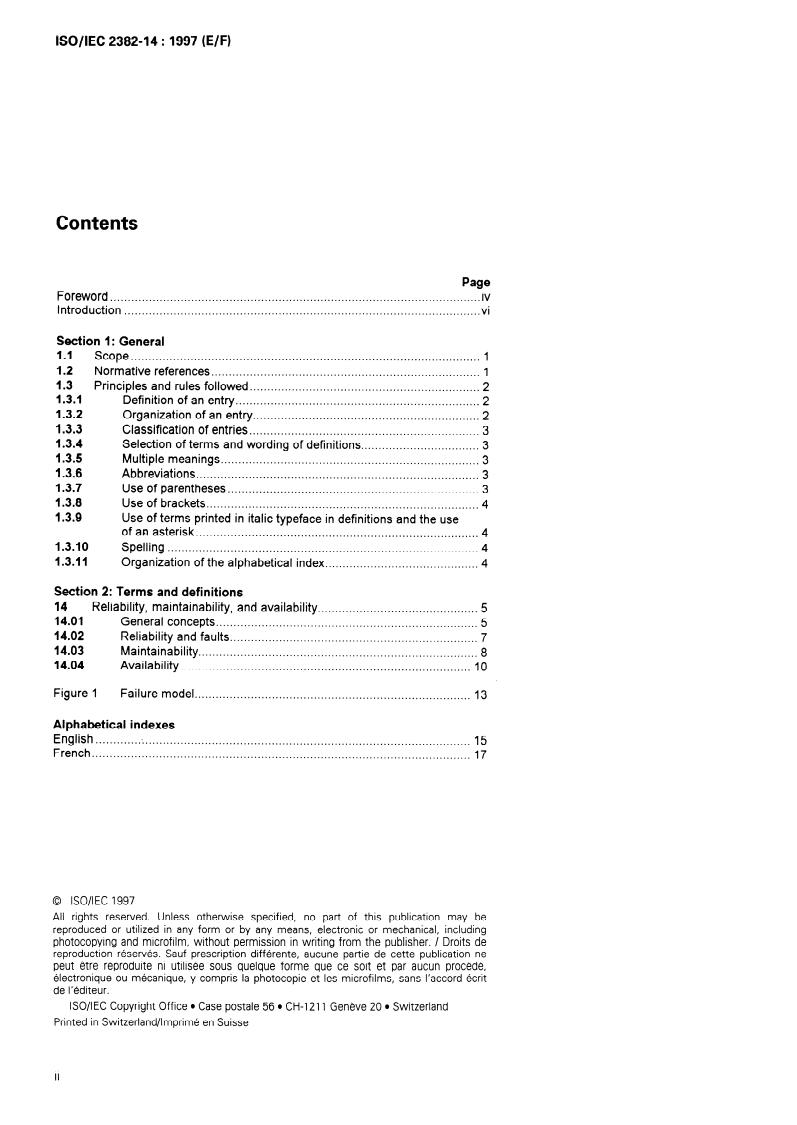
Contents
Page
Foreword . . . . . . . . . . . . . . . . . . . . . . . . . . . . . . . . . . . . . . . . . . . . . . . . . . . . . . . . . . . . . . . . . . . . . . . . . . . . . . . . . . . . . . . . . . . . . . . . . . . . . . . . . . iv
vi
Introduction . . . . . . . . . . . . . . . . . . . . . . . . . . . . . . . . . . . . . . . . . . . . . . . . . . . . . . . . . . . . . . . . . . . . . . . . . . . . . . . . . . . . . . . . . . . . . . . . . . . . . .
Section 1: General
1.1 Scope .
1.2 Normative references .
1.3 Principles and rules followed . . 2
1.3.1 Definition of an entry . 2
1.3.2 Organization of an entry .
1.3.3 Classification of entries .
1.3.4 Selection of terms and wording of definitions 3
..................................
1.3.5 Multiple meanings 3
..........................................................................
1.3.6 Abbreviations . .
1.3.7 Use of parentheses 3
........................................................................
1.3.8 Use of brackets . 4
1.3.9 Use of terms printed in italic typeface in definitions and the use
of an asterisk . 4
1.3.10 Spelling . . 4
1.3.11 Organization of the alphabetical index . 4
Section 2: Terms and definitions
and availability. 5
14 Reliability, maintainability, .
14.01 General concepts . 5
14.02 Reliability and faults .
14.03 Maintainability . . 8
Availability 10
14.04 .
Figure 1 Failure model . . . . . . . . . . . . . . . . . . . . . . . . . . . . . . . . . . . . . . . . . . . . . . . . . . . . . . . . . . . . . . . . . . . . . . . . . . . . . . . 13
Alphabetical indexes
English . .-. 15
.......................................................................... ...................
French . . . 17
0 ISO/IEC 1997
All rights reserved. Unless otherwise specified, no part of this publication may be
reproduced or utilized in any form or by any means, electronic or mechanical, including
photocopying and microfilm, without permission in writing from the publisher. / Droits de
reproduction reserves. Sauf prescription differente, aucune par-tie de cette publication ne
peut etre reproduite ni utilisee sous quelque forme que ce soit et par aucun procede,
electronique ou mecanique, y compris la photocopie et les microfilms, sans I’accord ecrit
de I’editeur.
lSO/IEC Copyright Office l Case postale 56 l CH-1211 Geneve 20 l Switzerland
Printed in Switzerland/lmprime en Suisse
ii
ISO/IEC 2382-14 : 1997 (E/F)
0 lSO/IEC
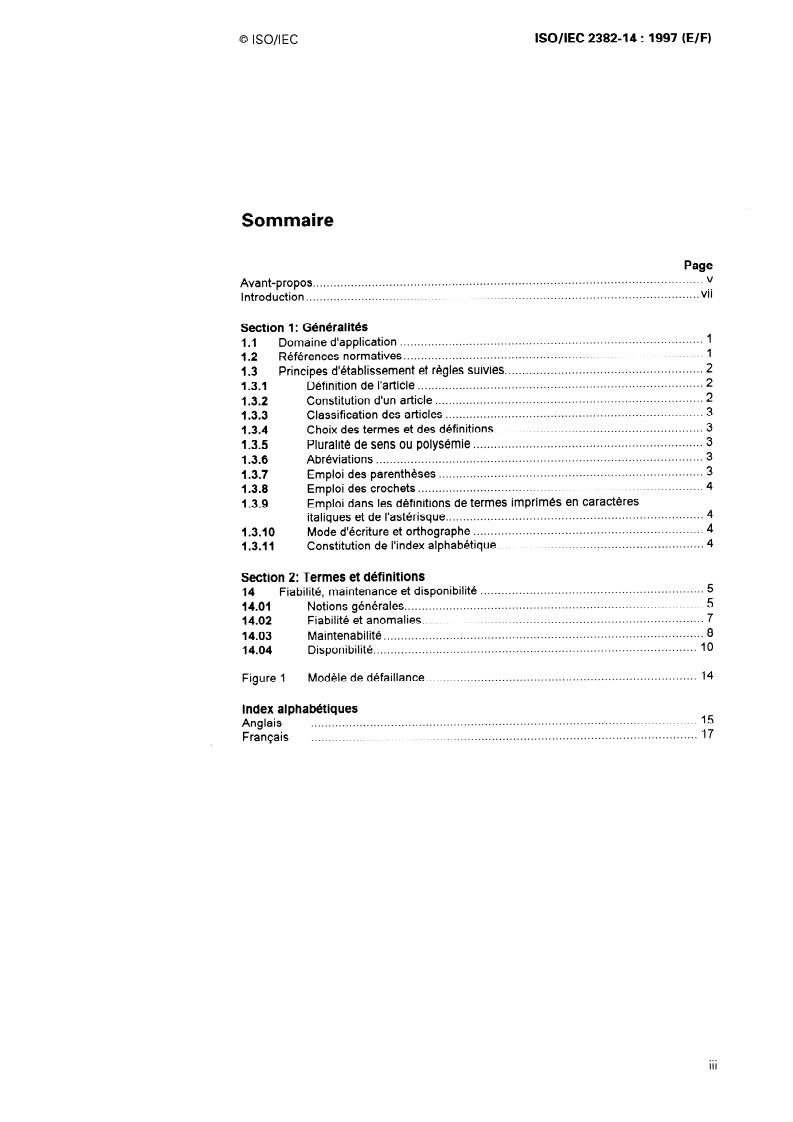
Sommaire
Page
. . . . . . . . . . . V
Avant-propos . . . . . . . . . . . . . . . . . . . . . . . . . . . . . . . . . . . . . . . . . . . . . . . . . . . . . . . . . . . . . . . . . . . . . . . . . . . . . . . . . . . . . . . . . . . . . . . . . . . .
Introduction . . . . . . . . . . . . . . . . . . . . . . . . . . . . . . . . . . . . . . . . . . . . . . . . . . . . . . . . . . . . . . . . . . . . . . . . . . . . . . . . . . . . . . . . . . . . . . . . . . . . . . . . . . . . . . . . vii
Section 1: G6n&aIitks
...................................................................................... 1
1.1 Domaine d’application
.....................................................................................
References normatives
1.2
......................................................
Principes d’etablissement et regles suivies.
1.3
................................................................................. 2
Definition de I’article
1.3.1
............................................................................ 2
Constitution d’un article
1.3.2
.........................................................................
1.3.3 Classification des articles
........................................................... 3
Choix des termes et des definitions
1.3.4
.................................................................
Pluralite de sens ou polysemie
1.3.5
.............................................................. 3
Abreviations .
1.3.6
........................................................................... 3
Emploi des parentheses
1.3.7
.................................................................................
Emploi des crochets
1.3.8
Emploi dans les definitions de termes imprimes en caracteres
1.3.9
......................................................................... 4
italiques et de I’asterisque
................................................................... 4
1.3.10 Mode d’ecriture et orthographe
.......................................................... 4
1.3.11 Constitution de I’index alphabetique
Section 2: Termes et dhfinitions
...............................................................
maintenance et disponibilite
14 Fiabilite,
................................................................................... 5
Notions g&&ales.
14.01
.............................................................................. 7
Fiabilite et anomalies.
14.02
...........................................................................................
Maintenabilite
14.03
............................................................................................ 10
Disponibilite
14.04
Figure 1 Modele de defaillance. . . . . . . . . . . . . . . . . . . . . . . . . . . . . . . . . . . . . . . . . . . . . . . . . . . . . . . . . . . . . . . . . . . . . . . . . . . . .
Index alphabktiques
....................................................................................................... ....... 15
Anglais
..............................................................................................................
Francais
SSO/IEC 2382-14 : 1997 (E/F) @ lSO/IEC
Foreword
IS0 (the International Organization for Standardization) and IEC (the International
Electrotechnical Commission) form the specialized system for worldwide
standardization. National bodies that are members of IS0 and IEC participate in the
development of International Standards through technical committees established by
the respective organization to deal with particular fields of technical activity. IS0 and
IEC technical committees collaborate in fields of mutual interest. Other international
organizations, governmental and non-governmental, in liaison with IS0 and IEC, also
take part in the work.
In the field of information technology, IS0 and IEC have established a joint technical
committee, ISOAEC JTC 1. Draft International Standards adopted by the joint technical
committee are circulated to national bodies for voting. Publication as an International
Standard requires approval by at least 75% of the national bodies casting a vote.
International Standard ISOAEC 2382-14 was prepared by Joint Technical Committee
ISOAEC JTC 1, Information technology, Subcommittee SC 1, Vocabulary.
This second edition cancels and replaces the first edition (IS0 2382-14:1978), which
has been technically revised.
ISOAEC 2382 will consist of some 35 parts, under the general title Information
technology - Vocabulary.
0 lSO/IEC ISO/IEC 2382-14 : 1997 (E/F)
Avant-propos
L’ISO (Organisation internationale de normalisation) et la CEI (Commission
electrotechnique internationale) forment le systeme specialise de normalisation
mondiale. Les organismes nationaux membres de I’ISO ou de la CEI participent au
developpement de Normes internationales par I’intermediaire des comites techniques
trees par I’organisation concernee afin de s’occuper des differents domaines
particuliers de I’activite technique. Les comites techniques de I’ISO et de la CEI
collaborent dans des domaines d’interet commun. D’autres organisations
internationales, gouvernementales ou non gouvernementales, en liaison avec I’ISO et la
CEI participent egalement aux travaux.
Dans le domaine des technologies de I’information, I’ISO et la CEI ont tree un comite
technique mixte, l’ISO/CEI JTC 1. Les projets de Normes internationales adopt& par le
comite technique mixte sont soumis aux organismes nationaux pour vote. Leur
publication comme Normes internationales requiert I’approbation de 75% au moins des
organismes nationaux votants.
La Norme internationale ISO/CEl 2382-14 a ete elaboree par le comite technique mixte
ISO/CEI JTC 1, Technologies de /‘information, sous-comite SC 1, Vocabulaire.
Cette deuxieme edition annule et remplace la premiere edition (IS0 2382-14: 1976)’
dont elle constitue une revision technique.
L’ISO/CEI 2382 comprendra environ 35 parties, presentees sous le titre general
Technologies de /‘information - Vocabulake.
ISO/IEC 2382-14 : 1997 (E/F)
0 lSO/IEC
Introduction
Information technology gives rise to numerous international exchanges of both an
intellectual and a material nature. These exchanges often become difficult, either
because of the great variety of terms used in various fields or languages to express the
same concept, or because of the absence or imprecision of the definitions of useful
concepts.
To avoid misunderstandings and to facilitate such exchanges it is essential to clarify the
concepts, to select terms to be used in various languages or in various countries to
express the same concept, and to establish definitions providing satisfactory
equivalents for the various terms in different languages.
IS0 2382 was initially based mainly on the usage to be found in the Vocabulary of
Information Processing which was established and published by the International
Federation for Information Processing and the International Computation Centre, and in
the Ametican National Dictionary for Information Processing Systems and its earlier
editions published by the American National Standards Institute (formerly known as the
American Standards Association). Published and Draft International Standards relating
to information technology of other international organizations (such as the International
Telecommunication Union and the International Electrotechnical Commission) as well
as published and draft national standards have also been considered.
The purpose of ISO/IEC 2382 is to provide definitions that are rigorous, uncomplicated
and which can be understood by all concerned. The scope of each concept defined has
been chosen to provide a definition that is suitable for general application. In those
circumstances, where a restricted application is concerned, the definition may need to
be more specific.
However, while it is possible to maintain the self-consistency of individual parts, the
reader is warned that the dynamics of language and the problems associated with the
standardization and maintenance of vocabularies may introduce duplications and
inconsistencies among parts.
@ lSO/IEC
ISO/IEC 2382-14 : 1997 (E/F)
Introduction
Les technologies de I’information sont a I’origine de multiples echanges intellectuels et
materiels sur le plan international. Ceux-ci souffrent souvent de difficult& provoquees
par la diversite des termes utilises pour exprimer la meme notion dans des langues ou
des domaines differents, ou encore de I’absence ou de I’imprecision des definitions
pour les notions les plus utiles.
Pour eviter des malentendus et faciliter de tels echanges, il paraiit essentiel de preciser
les notions, de choisir les termes 8 employer dans les differentes langues et dans les
divers pays pour exprimer la meme notion, et d’etablir pour ces termes des definitions
equivalentes dans chaque langue.
L’ISO 2382 a ete basee a I’origine principalement sur I’usage tel qu’il a ete releve, d’une
part, dans le Vocabulary of Information Processing etabli et publie par I’lnternational
Federation for Information Processing et le Centre international de calcul et, d’autre
part, dans I’American National Dictionary for information Processing Systems y compris
ses editions precedentes publiees par I’American National Standards Institute (connu
auparavant sous I’appellation d’American Standards Association). Les Normes
internationales publiees ou au stade de projets concernant les technologies de
I’information emanant d’autres organisations internationales (telles que I’Union
internationale des telecommunications et la Commission electrotechnique
internationa.le) ainsi que les normes nationales publiees ou au stade de projets, ont
egalement ete prises en compte.
Le but de l’ISO/CEI 2382 est de procurer des definitions rigoureuses, simples et
compkhensibles pour tous les interesses. La portee de chaque notion a ete choisie de
facon que sa definition puisse avoir la valeur la plus g&&ale. Cependant, il est parfois
necessaire de restreindre une notion a un domaine plus etroit et de lui donner alors une
definition plus specifique.
D’autre part, si I’on peut assurer la coherence interne de chaque partie prise
individuellement, la coherence des diverses parties entre elles est plus difficile a
atteindre. Le lecteur ne doit pas s’en etonner : la dynamique des langues et les
problemes de I’etablissement et de la revision des normes de vocabulaire peuvent etre
a I’origine de quelques repetitions ou contradictions entre des parties qui ne sont pas
toutes preparees et publiees simultanement.
VII
This page intentionally left blank
INTERNATIONAL STANDARD
0 ISOAEC lSO/IEC 2382-14 : 1997 (E/F)
NORME INTERNATIONALE
Information technology - Technologies de
I’information - Vocabulaire
Vocabulary
Part 14: Partie 14 :
Fiabilit6, maintenabiliti, et
Reliability, maintainability and
disponibilit6
availability
Section 1 : Gh&alit&
Section 1 : General
1 .l Domaine d’application
1.1 Scope
This part of ISO/IEC 2382 is intended to facilitate La presente partie de l’ISO/CEI 2382 a pour objet de
international communication in information technology. It faciliter les echanges internationaux dans le domaine des
technologies de I’information. A cet effet, elle presente un
presents, in two languages, terms and definitions of selected
ensemble bilingue de termes et de definitions ayant trait 8
concepts relevant to the field of information technology and
identifies relationships among the entries. des notions choisies dans ce domaine, et definit les
relations pouvant exister entre les differentes notions.
Les definitions ont ete etablies de maniere a eviter les
In order to facilitate their translation into other languages, the
particularismes propres a une langue donnee, en vue de
definitions are drafted so as to avoid, as far as possible, any
peculiarity attached to a language. faciliter leur transposition dans les langues autres que
celles ayant servi a la redaction initiale.
This part of ISO/IEC 2382 defines concepts related to La presente partie de l’ISO/CEI 2382 definit les differentes
reliability, mai,ntainability, and availability notions relatives 8 la fiabi!ite, a la maintenabilite et a la
disponibilite.
1.2 Normative references 1.2 Rbfkrences normatives
The following standards contain provisions which, through Les normes suivantes contiennent des dispositions qui, par
reference in this text, constitute provisions of this part of suite de la reference qui en est faite, constituent des
ISO/IEC 2382. At the time of publication, the editions dispositions valables pour la presente partie de l’ISO/CEI
indicated were valid. All standards are subject to revision, 2382. Au moment de la publication, les editions indiquees
and parties to agreements based on this part of ISO/IEC etaient en vigueur. Toute norme est sujette a revision et les
2382 are encouraged to investigate the possibility of applying parties prenantes des accords fond& sur la presente partie
the most recent editions of the standards indicated below. de l’ISO/CEI 2382 sont invitees a rechercher la possibilite
Members of IEC and IS0 maintain registers of currently valid d’appliquer les editions les plus recentes des normes
International Standards. indiquees ci-apres. Les membres de la CEI et de I’ISO
possedent le registre des Normes internationales en
vigueur 8 un moment donne.
ISOICEI 2382-l : 1993, Technologies de /‘information -
ISO/IEC 2382-l : 1993, Information technology - Vocabulary -
Vocabulalre - Partie ? : Termes fondamentaux.
Part I: Fundamental terms.
IS0 2382-2: 1976, Traitement de /‘information - Vocabulaire
IS0 2382-2:1976, Data processing - Vocabulary - Part 02:
Arifhmetic and logic operations. - Partie 02 : Op&ations arifhm&iques et logiques.
IS0 8402: 1994, Management de la qualite et assurance de
IS0 8402: 1994, Quality management and quality assurance
la qua/t6 - Vocabulaire.
- Vocabulary.
ISO/IEC 9126: 1991, Information technology - Software ISO/CEI 9126: 1991, Technologies de l’informafion -
- Quality characteristic and guidelines for lkaluation des produifs logiciels - Carackistiques de
product evaluation
their use. qua/it6 et directives d’utjlkation.
IEC 50 (191): 1990, International Electrotechnical Vocabulary CEI 50 (19’l):l990, Vocabulaire &ectrotechnique
- Chapter 191: Dependability and qualify of service. International - Chapitre I97 : S&et6 de fonctionnemenf et
qua/it6 de service.
ISO/IEC 2382-14 : 1997 (E/F) 0 ISOAEC
1.3 Principes d%tablissement et rltgles
1.3 Principles and rules followed
suivies
1.3.1 Definition of an entry 1.3.1 Dbfinition de I’article
La section 2 est composee d’un certain nombre d’articles.
Section 2 comprises a number of entries. Each entry consists
of a set of essential elements that includes an index number, Chaque article est compose d’un ensemble d’elements
one term or several synonymous terms, and a phrase essentiels comprenant le numero de reference, le terme ou
defining one concept. In addition, an entry may include plusieurs termes synonymes et la definition de la notion
examples, notes or illustrations to facilitate understanding of couverte par ces termes. Cet ensemble peut etre complete
the concept. par des exemples, des notes, des schemas ou des
tableaux destines 8 faciliter la comprehension de la notion.
Occasionally, the same term may be defined in different Parfois, le meme terme peut etre defini dans des articles
entries, or two or more concepts may be covered by one differents, ou bien deux notions ou davantage peuvent etre
entry, as described in 1.35 and 1.3.8 respectively. couvertes par un seul article : voir respectivement en 1.3.5
et 1.3.8.
Other terms such as vocabulary, concept, term, and
D’autres termes tels que vocabulaire, notion, terme,
definition are used in this part of ISOAEC 2382 with the
dhfinition, sont employ& dans la presente partie de
meaning defined in IS0 1087. l’ISO/CEI 2382 avec le sens qui leur est donne dans I’ISO
1087.
1.3.2 Organization of an entry 1.3.2 Constitution d’un article
Each entry contains the essential elements defined in 1.3.1 Chaque article contient des elements essentiels definis en
and, if necessary, additional elements. The entry may 1.3.1 et, si necessaire, des elements supplementaires.
contain the following elements in the following order:
L’article peut done comprendre dans I’ordre les elements
suivants :
a) an index number (common for all languages in which this
a) un numero de reference (le meme, quelle que soit la
part of ISOAEC 2382 is published);
langue de publication de la presente par-tie de l’ISO/CEI
2382) ;
b) the term or the generally preferred term in the language.
b) le terme, ou le terme prefere en general dans la langue.
The absence of a generally preferred term for the concept in L’absence, dans une langue, de terme consacre ou a
the language is indicated by a symbol consisting of five dots
conseiller pour exprimer une notion est indiquee par un
(.); a row of dots may be used to indicate, in a term, a symbole consistant en cinq points de suspension (.) ; les
word to be chosen in each particular case; points de suspension peuvent W-e employ& pour designer,
dans un terme, un mot a choisir dans un cas particulier ;
c) the preferred term in a particular country (identified
c) le terme prefere dans un certain pays (identifie selon les
according to the rules of IS0 3166); regles de I’ISO 3166) ;
d) the abbreviation for the term;
d) I’abreviation pouvant etre employee a la place du terme ;
e) permitted synonymous term(s); e) le terme ou les termes admis comme synonymes ;
f) the text of the definition (see 1.3.4); f) le texte de la definition (voir 1.3.4) ;
g) one or more examples with the heading “Example(s)“; ou plusieurs exemples precedes du titre
9) un
(< Exemple(s) )) ;
h) one or more notes specifying particular cases in the field h) une ou plusieurs notes precisant le domaine
of application of the concepts with the heading “NOTE(S)“; d’application de la notion, precedees du titre << NOTE(S) )) ;
i) a picture, a diagram, or a table which could be common to
i) une figure, un schema ou un tableau, pouvant etre
several entries.
communs a plusieurs articles.
ISO/IEC 2382-14 : 1997 (E/F)
o ISOAEC
Classification of entries I .3.3 Classification des articles
1.3.3
A two-digit serial number is assigned to each part of Chaque partie de I’ISO/CEI 2382 recoit un numero d’ordre
& deux chiffres, en commencant par 01 pour la partie
lSO/lEC 2382, beginning with 01 for “Fundamental terms”.
((Termes fondamentaux)).
The entries are classified in groups to each of which is Les articles sont repattis en groupes qui recoivent chacun
assigned a four-digit serial number; the first two digits un numero d’ordre a quatre chiffres, les deux premiers
being those of the part of ISO/IEC 2382. chiffres etant ceux du numero de la pat-tie de
I’ISO/CEI 2382.
Each entry is assigned a six-digit index number; the first Chaque article est rep&e par un numero de reference B
four digits being those of the part of lSO/lEC 2382 and the six chiffres, les quatre premiers chiffres etant ceux du
group. numero de pat-tie de I’ISO/CEI 2382 et de groupe.
To show the relationship between versions of lSO/lEC 2382 Les numeros des parties, des groupes et des articles sont
in various languages, the numbers assigned to parts, les memes pour toutes les langues, afin de mettre en
groups, and entries are the same for all languages. evidence les correspondances des versions de
I’ISO/CEI 2382.
1.3.4 Selection of terms and wording of 1.3.4 Choix des termes et des definitions
definitions
Les choix qui ont et6 faits pour les termes et leurs
The selection of terms and the wording of definitions have,
definitions sont, dans toute la mesure du possible,
as far as possible, followed established usage. Where there
compatibles avec les usages etablis. Lorsque certains
were contradictions, solutions agreeable to the majority have
usages apparaissent contradictoires, des solutions de
been sought.
compromis ont ete retenues.
1.3.5 Multiple meanings 1.3.5 Pluralit de sens ou polysbmie
When, in one of the working languages, a given term has Lorsque, dans I’une des langues de travail, un meme terme
peut prendre plusieurs sens, ces sens sont definis dans
several meanings, each meaning is given a separate entry to
facilitate translation into other languages. des articles differents, pour faciliter I’adaptation du
vocabulaire dans d’autres langues.
1.3.6 Abbreviations 1.3.6 Abrbviations
Comme indique en 1.3.2, des abreviations d’usage
As indicated in 1.3.2, abbreviations in current use are given
for some terms. Such abbreviations are not used in the texts courant, au moins en anglais, sont indiquees pour certains
of the definitions, examples or notes. termes. De telles abreviations ne sont pas employees dans
le corps des definitions, exemples ou notes.
1.3.7 Emploi des parentheses
1.3.7 Use of parentheses
In some terms, one or more words printed in bold typeface Dans certains termes, un ou plusieurs mots imprimes en
are placed between parentheses. These words are part of the caracteres gras sont places entre parentheses. Ces mots
complete term’ but they may be omitted when use of the font partie integrante du terme complet, mais peuvent etre
abridged term in a technical context does not introduce omis lorsque le terme ainsi abrege peut etre employ6 dans
un contexte technique determine sans que cette omission
ambiguity. In the text of another definition, example, or note
ne tree d’ambiguite. Un tel terme nest employ6 dans le
of ISO/IEC 2382, such a term is used only in its complete
texte d’une autre definition, d’un exemple ou d’une note de
form.
l’ISO/CEI 2382, que sous sa forme complete.
Dans certains articles, les termes definis sont suivis par
In some entries, the terms are followed by words in
des expressions imprimees en caracteres normaux et
parentheses in normal typeface. These words are not a part
of the term but indicate directives for the use of the term, its placees entre parentheses. Ces expressions ne font pas
particular field of application, or its grammatical form. partie du terme mais indiquent des prescriptions d’emploi,
precisent un domaine d’application particulier ou indiquent
une forme grammaticale.
0 ISOAEC
ISOAEC 2382-l 4 : 1997 (E/F)
1.3.8 Emploi des crochets
1.3.3 Use of brackets
Lorsque plusieurs termes etroitement apparent& peuvent
When several closely related terms can be defined by texts
etre definis par des textes presque identiques, a quelques
that differ only in a few words, the terms and their definitions
mots pres, les termes et leurs definitions ont ete group&
are grouped in a single entry. The words to be substituted in
en un seul article. Les mots a substituer a ceux qui les
order to obtain the different meanings are placed in brackets,
precedent pour obtenir les differents sens sont places entre
i.e. [ 1, in the same order in the term and in the definition.
crochets (c’est-a-dire [ 1) dans le meme ordre dans le
To clearly identify the words to be substituted, the last word
terme et la definition. En vue d’eviter toute incertitude sur
that according to the above rule could be placed in front of
les mots a remplacer, le dernier mot qui, suivant la regle ci-
the opening bracket is, wherever possible, placed inside the
dessus, pourrait etre place devant le crochet d’ouverture,
bracket and repeated for each alternative.
est place, si possible, 8 l’interieur des crochets et rep& a
chaque occasion.
1.3.9 Emploi dans les definitions de termes
1.3.9 Use of terms printed in italic typeface in
definitions and the use of an asterisk imprimes en caracteres italiques et de
I’asterisque
A term printed in italic typeface in a definition, an example, or Dans le texte d’une definition, d’un exemple ou d’une note,
a note is defined in another entry in ISO/IEC 2382, which tout terme imprime en caracteres italiques a le sens defini
dans un autre article de l’ISO/CEI 2382, qui peut se trouver
may be in another part. However, the term is printed in italic
dans une autre partie. Cependant le terme est imprime en
typeface only the first time it occurs in each entry.
caracteres italiques uniquement la premiere fois qu’il
apparait dans chaque article.
Italic typeface is also used for other grammatical forms of a Les caracteres italiques sont egalement utilises pour les
autres formes grammaticales du terme, par exemple, les
term, for example, plurals of nouns and participles of verbs.
noms au pluriel et les verbes au participe.
The basic forms of all terms printed in italic typeface which La liste des formes de base des termes imprimes en
are defined in this part of ISO/IEC 2382 are listed in the caracteres italiques qui sont definis dans cette partie de
index at the end of the part (see 1.3.11). l’ISO/CEI 2382 est fournie dans I’index a la fin de la partie
(voir 1.3.11).
An asterisk is used to separate terms printed in italic L’asterisque sert a &parer les termes imprimes en
typeface when two such terms are referred to in separate caracteres italiques quand deux termes se rapportent a des
entries and directly follow each other (or are separated only articles &pares et se suivent directement (ou bien sont
&pares simplement par un signe de ponctuation).
by a punctuation mark).
Words or terms that are printed in normal typeface are to be Les mots ou termes imprimes en caracteres normaux
understood as defined in current dictionaries or authoritative doivent etre compris dans le sens qui leur est donne dans
technical vocabularies. les dictionnaires courants ou vocabulaires techniques
faisant autorite.
1.3.10 Spelling 1.3.10 Mode d’ecriture et orthographe
In the English language version of this part of ISO/IEC 2382, Dans la version anglaise de la presente partie de l’ISO/CEI
terms, definitions, examples, and notes are given in the 2382, les termes, definitions, exemples et notes sont ecrits
spelling preferred in the USA. Other correct spellings may be suivant I’orthographe prevalant aux ctats-Unis. D’autres
used without violating this part of ISO/IEC 2382. orthographes correctes peuvent etre utilisees sans violer la
presente partie de l’ISO/CEI 2382.
1.3.11 Organization of the alphabetical index 1.3.11 Constitution de I’index alphabetique
For each language used, an alphabetical index is provided at
Pour chaque langue de travail, un index alphabetique est
the end of each part. The index includes all terms defined in
fourni a la fin de chaque partie. L’index comprend tous les
the part. Multiple-word terms appear in alphabetical order
termes definis dans la pat-tie. Les termes composes de
under each of their key words.
plusieurs mots sont repertories alphabetiquement suivant
chacun des mots cl&.
ISOAEC 2382-l 4 : 1997 (E/F)
o l$iO/lEC
Section 2 : Termes et definitions
Section 2 : Terms and definitions
14 Fiabilite, maintenabilite et
14 Reliability, maintainability, and
disponibilit6
availability
14.01 General concepts 14.01 Notions g&&ales
14.01 .Ol (01 .01.40)
14.01.01 (01.01.40)
functional unit unit6 fonctionnelle
Entiti! mat6rielle ou logicielle ou les deux 8 la fois, capable
An entity of hardware or so/Ware, or both, capable of
accomplishing a specified purpose. de remplir une fonction d&erminee.
NOTE - In IEC 50 (191), the more general term “item” is used in place of NOTE - Dans CEI 50 (191), le terme G entit6 >) est employ6 g la place
functional unit. An item may sometimes include people. d’unitk fonctionnelle. Une entit6 peut dans certains cas comprendre du
personnel.
14.01.02 14.01.02
product assurance assurance produit
Ensemble de dispositions et d’activit6s qui garantit que les
Provisions and activities for ensuring that the prescribed
requirements have been taken into account starting with the exigences de production ont 6th prises en compte d& I’irtape
de la conception et que le produit Galis posshde bien les
design stage and that the final product holds the
corresponding qualities throughout its life. qualit& correspondantes pendant toute sa dur4e de vie.
14.01.03 14.01.03
reliability fiabilit6
Aptitude d’une unit6 fonctionnelle a accomplir une fonction
The ability of a functional unif to perform a required function
under given conditions for a given time interval. requise, dans des conditions donnbes, pendant un intervalle
de temps donn&
NOTE - The term used in IEV 191-02-06 is “reliability performance” and
the definition is the same with additional notes. NOTE - La dbfinition de la fiabilitb dans VEI 191-02-06 est la meme avec
des notes en plus.
14.01.04
14.01.04
durabilitb
durability
Aptitude d’une unit6 foncfionnelle 8 accomplir une fonction
The ability of a functional unit to perform a required function
under given conditions of use and maintenance, until a requise dans des conditions donn6es d’emploi et de
maintenance jusqu% ce qu’un 6tat limite soit atteint.
limiting state is reached.
NOTES
NOTES
1 L%tat limite d’une unit6 fonctionnelle peut &tre d6termin6 par la fin de
1 A limiting state of a functional unit may be characterized by the end of
the useful life, unsuitability for any economic or technological reasons, or la vie utile, par I’inadaptation pour des raisons konomiques ou
techniques, ou par d’autres facteurs.
other relevant factors.
2 La d&inition et la note sont les mgmes dans VEI 191-02-02.
2 The definition and the note are the same in IEV 191-02-02.
14.01.05
14.01.05
maintenance
maintenance
Ensemble des activit6s destin6es a maintenir ou a remettre
A set of activities intended to keep a functional unit in, or to
une unit6 fonctionnelle dans un 6tat qui lui permet
restore it to, a state in which it can perform a required
function. d’accomplir une fonction requise.
NOTES NOTES
1 Maintenance includes activities such as monitoring, tests, 1 La maintenance comprend des activitbs telles que surveillance, essai,
measurements, replacements, adjustments, repairs, and in some cases mesure, remplacement, kglage et kparation, et dans certains cas des
actions administratives.
administrative actions.
2 Voir aussi VEI 191-07-01, oti la rkdaction est Ibgkrement diffgrente.
2 See also IEV 191-07-01 where a slightly different wording is used.
0 ISO/IEC
ISO/IEC 2382-l 4 : 1997 (E/F)
14.01.06
14.01.06
maintainability maintenabilite
The ability of a functional unif, under given conditions of use, Aptitude d’une unit6 fonctionnelle, dans des conditions
to be retained in, or restored to, a state in which it can donnees d’utilisation, 8 etre maintenue ou retablie dans un
Hat dans lequel elle peut accomplir une fonction requise,
perform a required function when maintenance is performed
under given conditions and using stated procedures and lorsque la mainfenance est accomplie dans des conditions
resources. determinees, avec des procedures et des moyens prescrits.
NOTE - The term used in IEV 191-02-07 is “maintainability NOTE - La dbfinition de la maintenabilitk dans VEI 191-02-07 est
performance“ and the definition is the same. fondamentalement la m&me.
14.01.07 14.01.07
availability disponibilitrS
The ability of a functional unit to be in a state to perform a Aptitude d’une unit6 fonctionnelle a etre en &at d’accomplir
required function under given conditions at a given instant of une fonction requise dans des conditions determinees, a un
time or over a given time interval, assuming that the required instant donne, ou quelconque dans un intervalle de temps
external resources are provided. donne, en supposant que la fourniture des moyens exterieurs
necessaires est assuree.
NOTES NOTES
1 The term used in IEV 1 91-02-0s is “availability performance” and the 1 La definition de la disponibilite dans VEI 191-02-05 est
definition is the same, with additional notes. fondamentalement la m&me avec des notes en plus.
2 The availability defined here is an intrinsic availability where external
2 La disponibilite definie ici est une disponibilite intrinseque, ou les
resources other than mainfenance resources do not affect the availability
ressources exterieures autres que les ressources de maintenance
of the functional unit. Operational availability, on the other hand, requires
n’influencent pas la disponibilite de I’unite fonctionnelle. La disponibilite
that the external resources be provided.
op&ationnelle, par contre, exige que les ressources exterieures soient
fournies.
14.01.08 (0206.04)
14.01.08 (0206.04)
error
erreur
A discrepancy between a computed, observed or measured
kart ou discordance entre une valeur ou une condition
value or condition and the true, specified or theoretically
calculee, observee ou mesuree et la valeur ou la condition
correct value or condition. vraie, prescrite ou theoriquement correcte.
NOTES
NOTES
1 A slightly different wording is used in IEV 191-05-24.
1 La redaction est la meme dans VEI 191-05-24.
2 The definition in IS0 2382-2 is the same. 2 La redaction est legerement differente dans IS0 2382-2.
14.01.09
14.01.09
mistake
erreur humaine
human error
erreur (a eviter dans ce sens)
error (deprecated in this sense) Action humaine, ou absence d’intervention, qui peut produire
A human action or inaction that can produce an unintended
un resultat non recherche.
result.
Iegerement
NOTE - Voir aussi la definition VEI 191-05-25, qui est
differente
NOTE - See also the definition in IEV 191-05-25, which is slightly
different.
14.01 .lO
14.01.10
fault
anomalie
An abnormal condition that may cause a reduction in, or loss
Condition anormale qui peut entraTner une reduction de
of, the capability of a funcfiona/ unit to perform a required
capacite ou la perte de capacite d’une unit6 fonctionnelle a
function.
accomplir une fonction requise.
NOTE - IEV 191-05-01 defines “fault” as a state characterized by the
NOTE - Le VEI 191-05-01 definit (< fault >) (en francais (< panne D)
inability to perform a required function, excluding the inability during
comme un &at d’inaptitude a accomplir une fonction requise, en excluant
preventive mainfenance or other planned actions, or due to lack of
I’inaptitude due a la malnfenance p&venfive, a d’autres actions
external resources. See figure 1 for an illustration of these two points of
programmees ou 8 un manque de ressources exterieures. Le terme
view.
<< fault )) a done deux sens differents rendus par deux termes francais
differents. Voir la figure 1 pour une illustration de ces deux points de
vue.
ISOAEC 2382-14 : 1997 (E/F)
o ISOAEC
14.01.11 14.01.11
dbfaillance
failure
Cessation de I’aptitude d’une unit6 foncfionnelle $I accomplir
The termination of the ability of a functional unif to perform a
required function. une fonction requise.
NOTE - La definition VEI 191-04-01 est la meme avec des notes en
NOTE - The definition in IEV 191-04-01 is the same, with additional
plus, qui relient la notion 9 celle de panne. Voir la figure 1.
notes referring to a different meaning of the term “fault”. See figure 1.
14.01.12
14.01.12
redondance (en fiabilite, maintenabilite et disponibilite)
redundancy (in reliability, maintainability, and availability)
Existence de plus de moyens que strictement necessaire
The existence of a means in addition to the means which
pour accomplir une fonction requise dans une unifQ
would be sufficient for a functional unit to perform a required
function or for dafa to represent information. foncfionnelie ou pour rep&enter des informafions par des
don&es.
Examples - The use of duplicate functional components, the
Exemples - Utilisation d’elements fonctionnels en double,
addition of parify bifs.
adjonction de bits de parif
NOTES
NOTES
1 Redundancy is used primarily to improve reliability or availabilitpl.
1 La redondance set-t essentiellement a ameliorer la fiabi/M ou la
disponibilit6.
191-I 5-01 is less complete.
2 The definition in IEV
2 La definition VEI 191-l 5-01 est moins complete.
14.02 Reliabi I ity and faults 14.02 Fiabilit6 et anomalies
14.02.01
14.02.01
temps moyen entre dkfaillances
mean time between failures
The mean duration between consecutive fatures of a Duke moyenne entre des dhfai//ances consecutives d’une
unite foncfionneh’e, dans des conditions donkes.
functional unit under given conditions.
NOTES
NOTES
can be from a theoretical model or 1 Le temps moyen entre defaillances peut etre calcule a pattir d’un
1 Mean time between
from observations. modele thkorique ou d’apres les observations effect&es.
2 This definition combines those found in IEV 191-10-03, which refers 2 Cette definition combine celle de VEI 191-10-03, qui se refere
explicitement a des entites reparees, et celle de VEI 191-I 2-08.
explicitly to repaired items, and in IEV 191-l 2-08.
14.02.02 14.02.02
mean operating time between failures moyenne des temps de bon fonctionnement
The mean duration of operation between consecutive fahres Duree moyenne de fonctionnement entre des dhfai//ances
consecutives d’une unit6 foncfionnelle, dans des conditions
of a functional unit under given conditions.
donnees.
NOTES
NOTES
1 This definition combines those found in IEV 191-10-04, which refers
explicitly to repaired items, and in IEV 191-I 2-09.
1 Cette definition combine celle de VEI 191-10-04, qui se refere
explicitement a des entites repark, et celle de VEI 191-l 2-09.
2 IEV 191-12-09 also uses the abbreviation “MTBF” for this term.
2 Le VEI 191-l 2-09 mentionne aussi I’abreviation << MTBF n du terme.
14.02.03 14.02.03
program-sensitive fault anomalie d&ect& par le programme
A faulf that may be detected as a result of the execution of anomalie mise en evidence par le programme
some particular sequence of instructions.
Anomalie qui peut etre detectee a la suite de I’exkcufion
d’une sequence particuliere d’insfrucfions.
NOTE - The definition in IEV 191-05-l 2 has a slightly different meaning
with the difference in view of “fault” (see 14.01 .lO).
NOTE - Le VEI 191-05-I 2 se r&f&e a la notion de panne au lieu de celle
d’anomalie (voir 14.01 .I 0).
0 ISOAEC
ISOAEC 2382-14 : 1997 (E/F)
14.02.04
14.02.04
anomalie d&e&& par les donndes
data-sensitive fault
A fauit that may be detected as a result of the processing of a anomalie mise en kvidence par les donnhes
particular pattern of data. Anomalie qui peut etre detectee a la suite du traitement d’une
combinaison particuliere de don&es.
NOTE - The definition in IEV 191-05-l 3 has a slightly different meaning
with the difference in view of “fault” (see 14.01 .I 0).
NOTE - Le VEI 191-05-l 3 se refere 8 la notion de panne au lieu de celle
d’anomalie (voir 14.01 .I 0).
14.03 Maintainability 14.03 Maintenabilitb
14.03.01
14.03.01
maintenance corrective
corrective maintenance
Maintenance carried out after occurrence of a failure, or Mainfenance effect&e apres une dbfaillance ou apr&
detection of a fau/f, in order to restore a functional unit to a detection d’une anomalie, dans le but de remettre une unif6
state in which it can perform a required function. foncfionnelle dans un etat qui lui permet d’accomplir une
fonction requise.
NOTE - The definition in IEV 191-07-08 is essentially the same, with the
difference in view of “fault” (see 14.01.10).
NOTE - La definition VEI 191-07-08 est fondamentalement la meme, la
difference s’expliquant par le sens different du terme anglais G fault B
(voir 14.01 .l 0).
14.03.02 14.03.02
deferred maintenance maintenance diffbrbe
Correcfive maintenance which is not immediately initiated intervention diffkrde
after occurrence of a failure or detection o
...
Questions, Comments and Discussion
Ask us and Technical Secretary will try to provide an answer. You can facilitate discussion about the standard in here.
Loading comments...