

ISO/IEC 22989:2022
(Main)Information technology — Artificial intelligence — Artificial intelligence concepts and terminology
General Information
- Abstract
This document establishes terminology for AI and describes concepts in the field of AI. This document can be used in the development of other standards and in support of communications among diverse, interested parties or stakeholders. This document is applicable to all types of organizations (e.g. commercial enterprises, government agencies, not-for-profit organizations).
- Status
- Published
- Publication Date
- 18-Jul-2022
- Technical Committee
- ISO/IEC JTC 1/SC 42 - Artificial intelligence
- Drafting Committee
- ISO/IEC JTC 1/SC 42/WG 1 - Foundational standards
- Current Stage
- 6060 - International Standard published
- Start Date
- 19-Jul-2022
- Due Date
- 07-Mar-2022
- Completion Date
- 19-Jul-2022
Buy Documents



ISO/IEC 22989:2022 - Information technology — Artificial intelligence — Artificial intelligence concepts and terminology Released:7/19/2022

ISO/IEC 22989:2022 - Technologies de l'information — Intelligence artificielle — Concepts et terminologie relatifs à l'intelligence artificielle/5/2025
Overview
ISO/IEC 22989:2022 - "Information technology - Artificial intelligence - Artificial intelligence concepts and terminology" - defines a common vocabulary and explains core concepts across the AI domain. The standard establishes terminology for AI and describes concepts used by standards bodies, developers, regulators and stakeholders to improve clarity, consistency and interoperability. It is applicable to all types of organizations (commercial, government, not-for-profit) and is intended to support the development of other standards and facilitate communication among diverse interested parties.
Key topics
This standard systematically covers concepts and terms, including:
- Core AI terminology and high-level AI concepts (agents, knowledge, cognition)
- Data-related terms and roles (training, validation, test data)
- Machine learning concepts and subtypes (supervised, unsupervised, semi-supervised, reinforcement, transfer learning)
- Neural networks and example algorithms (neural nets, Bayesian networks, decision trees, SVM)
- Trustworthiness taxonomy (robustness, reliability, resilience, controllability, explainability, bias/fairness, transparency)
- Domain-specific terminology (natural language processing, computer vision)
- AI system lifecycle (inception, design & development, verification & validation, deployment, operation & monitoring, continuous validation, retirement)
- Stakeholder roles (AI provider/producer/customer/partner/subject, authorities)
- AI ecosystem and functional overview (data, learning, prediction → decision → action), plus IoT, cyber-physical systems, big data, cloud/edge concerns
Practical applications
ISO/IEC 22989 is a foundational reference for:
- Creating consistent technical documentation, specifications and API contracts
- Drafting policy, procurement requirements and contractual clauses that reference standardized AI terms
- Developing AI governance, risk and compliance (GRC) frameworks and audit checklists
- Aligning multidisciplinary teams (engineers, legal, product, ethics reviewers) around shared definitions
- Designing curricula and training materials on AI concepts and lifecycle
- Assisting standards writers and regulators when producing domain-specific AI standards
Who should use this standard
- AI system architects and ML engineers seeking common vocabulary
- Standards developers and technical committees drafting AI-related norms
- Policy makers, regulators and procurement officers writing requirements or guidance
- Legal, compliance and risk teams assessing AI governance and accountability
- Educators and trainers developing AI courses or certification programs
Related standards
ISO/IEC 22989 is part of the broader ISO/IEC AI standards landscape and is intended to be used alongside other AI-specific standards addressing trustworthiness, safety, data practices and evaluation methods to ensure consistent interpretation and application of AI concepts.
Keywords: ISO/IEC 22989, AI terminology, artificial intelligence concepts, AI lifecycle, machine learning, trustworthiness, neural networks, NLP, computer vision.
Relations
- Effective Date
- 25-Aug-2026
- Effective Date
- 25-Aug-2026
- Effective Date
- 25-Aug-2026
- Effective Date
- 25-Aug-2026
- Effective Date
- 27-May-2026
- Effective Date
- 15-Apr-2026
- Effective Date
- 08-Apr-2026
- Effective Date
- 08-Apr-2026
- Effective Date
- 08-Apr-2026
- Effective Date
- 08-Apr-2026
- Effective Date
- 08-Apr-2026
- Effective Date
- 10-Feb-2026
Buy Documents
ISO/IEC 22989:2022 - Information technology — Artificial intelligence — Artificial intelligence concepts and terminology Released:7/19/2022
ISO/IEC 22989:2022 - Technologies de l'information — Intelligence artificielle — Concepts et terminologie relatifs à l'intelligence artificielle/5/2025
Get Certified
Connect with accredited certification bodies for this standard

BSI Group
BSI (British Standards Institution) is the business standards company that helps organizations make excellence a habit.

NYCE
Mexican standards and certification body.
Sponsored listings
Frequently Asked Questions
ISO/IEC 22989:2022 is a standard published by the International Organization for Standardization (ISO). Its full title is "Information technology — Artificial intelligence — Artificial intelligence concepts and terminology". This standard covers: This document establishes terminology for AI and describes concepts in the field of AI. This document can be used in the development of other standards and in support of communications among diverse, interested parties or stakeholders. This document is applicable to all types of organizations (e.g. commercial enterprises, government agencies, not-for-profit organizations).
This document establishes terminology for AI and describes concepts in the field of AI. This document can be used in the development of other standards and in support of communications among diverse, interested parties or stakeholders. This document is applicable to all types of organizations (e.g. commercial enterprises, government agencies, not-for-profit organizations).
ISO/IEC 22989:2022 is classified under the following ICS (International Classification for Standards) categories: 01.040.35 - Information technology (Vocabularies); 35.020 - Information technology (IT) in general. The ICS classification helps identify the subject area and facilitates finding related standards.
ISO/IEC 22989:2022 has the following relationships with other standards: It is inter standard links to EN ISO/IEC 8183:2024, EN ISO/IEC 5259-3:2025, EN ISO/IEC 23053:2023, EN ISO/IEC 23894:2024, EN ISO/IEC 12792:2025, EN ISO/IEC 42001:2026, EN ISO/IEC 25059:2024, EN ISO/IEC 5259-2:2025, EN ISO/IEC 5259-4:2025, CEN/CLC ISO/IEC/TS 12791:2024, EN ISO/IEC 5259-1:2025, EN ISO/IEC 23053:2023. Understanding these relationships helps ensure you are using the most current and applicable version of the standard.
ISO/IEC 22989:2022 is available in PDF format for immediate download after purchase. The document can be added to your cart and obtained through the secure checkout process. Digital delivery ensures instant access to the complete standard document.
Standards Content (Sample)
INTERNATIONAL ISO/IEC
STANDARD 22989
First edition
2022-07
Information technology — Artificial
intelligence — Artificial intelligence
concepts and terminology
Technologies de l'information — Intelligence artificielle — Concepts
et terminologie relatifs à l'intelligence artificielle
Reference number
© ISO/IEC 2022
© ISO/IEC 2022
All rights reserved. Unless otherwise specified, or required in the context of its implementation, no part of this publication may
be reproduced or utilized otherwise in any form or by any means, electronic or mechanical, including photocopying, or posting on
the internet or an intranet, without prior written permission. Permission can be requested from either ISO at the address below
or ISO’s member body in the country of the requester.
ISO copyright office
CP 401 • Ch. de Blandonnet 8
CH-1214 Vernier, Geneva
Phone: +41 22 749 01 11
Email: copyright@iso.org
Website: www.iso.org
Published in Switzerland
ii
© ISO/IEC 2022 – All rights reserved
Contents Page
Foreword . vi
Introduction .vii
1 Scope . 1
2 Normative references . 1
3 Terms and definitions . 1
3.1 Terms related to AI . 1
3.2 Terms related to data. 6
3.3 Terms related to machine learning . 8
3.4 Terms related to neural networks . 10
3.5 Terms related to trustworthiness . 11
3.6 Terms related to natural language processing . 13
3.7 Terms related to computer vision . 16
4 Abbreviated terms .16
5 AI concepts .17
5.1 General . 17
5.2 From strong and weak AI to general and narrow AI . 17
5.3 Agent . 17
5.4 Knowledge . 18
5.5 Cognition and cognitive computing . 19
5.6 Semantic computing . 19
5.7 Soft computing . 19
5.8 Genetic algorithms . 19
5.9 Symbolic and subsymbolic approaches for AI . 19
5.10 Data . 20
5.11 Machine learning concepts . 21
5.11.1 Supervised machine learning . 21
5.11.2 Unsupervised machine learning . 21
5.11.3 Semi-supervised machine learning . 22
5.11.4 Reinforcement learning .22
5.11.5 Transfer learning . 22
5.11.6 Training data . .22
5.11.7 Trained model .22
5.11.8 Validation and test data . 22
5.11.9 Retraining .23
5.12 Examples of machine learning algorithms . 24
5.12.1 Neural networks . 24
5.12.2 Bayesian networks . 25
5.12.3 Decision trees . 25
5.12.4 Support vector machine .25
5.13 Autonomy, heteronomy and automation . 26
5.14 Internet of things and cyber-physical systems . 27
5.14.1 General . 27
5.14.2 Internet of things . 27
5.14.3 Cyber-physical systems . 27
5.15 Trustworthiness .28
5.15.1 General .28
5.15.2 AI robustness . .28
5.15.3 AI reliability .29
5.15.4 AI resilience . 29
5.15.5 AI controllability .29
5.15.6 AI explainability . .29
5.15.7 AI predictability .30
iii
© ISO/IEC 2022 – All rights reserved
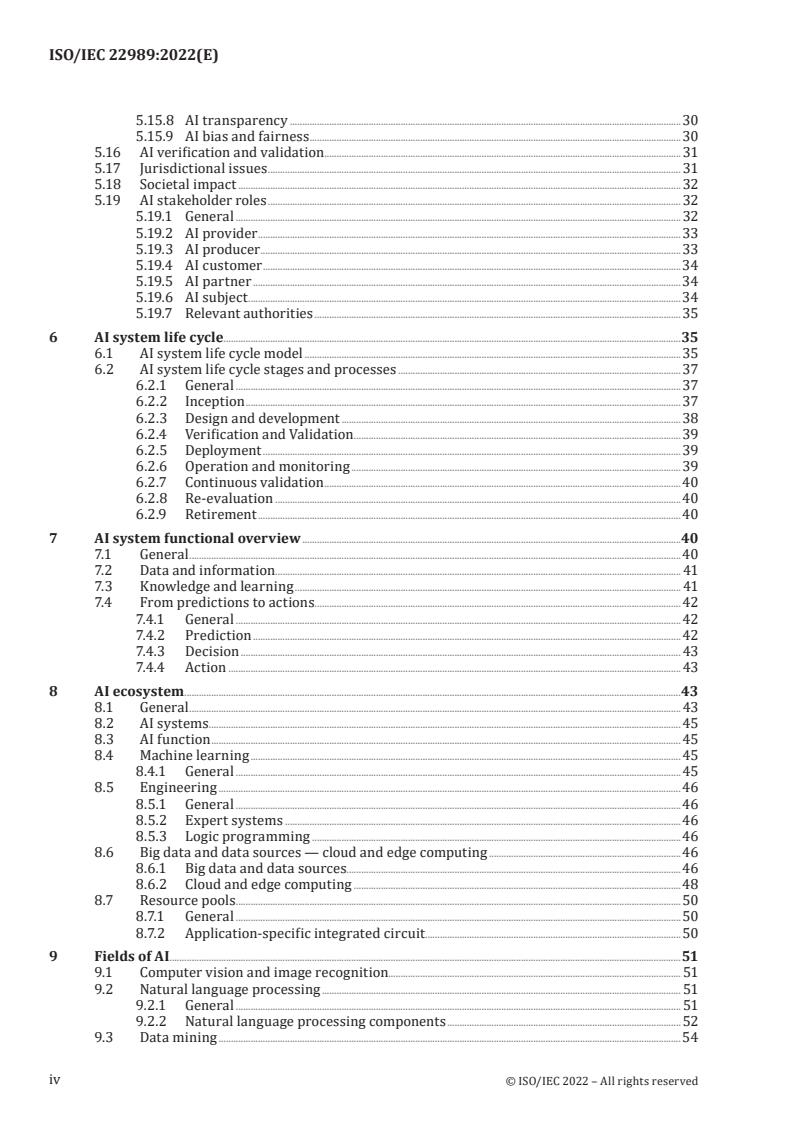
5.15.8 AI transparency .30
5.15.9 AI bias and fairness .30
5.16 AI verification and validation . . 31
5.17 Jurisdictional issues . 31
5.18 Societal impact . 32
5.19 AI stakeholder roles . 32
5.19.1 General . 32
5.19.2 AI provider . 33
5.19.3 AI producer . 33
5.19.4 AI customer .34
5.19.5 AI partner .34
5.19.6 AI subject .34
5.19.7 Relevant authorities . 35
6 AI system life cycle .35
6.1 AI system life cycle model . 35
6.2 AI system life cycle stages and processes . 37
6.2.1 General . 37
6.2.2 Inception . 37
6.2.3 Design and development .38
6.2.4 Verification and Validation . 39
6.2.5 Deployment . 39
6.2.6 Operation and monitoring . 39
6.2.7 Continuous validation .40
6.2.8 Re-evaluation .40
6.2.9 Retirement .40
7 AI system functional overview .40
7.1 General .40
7.2 Data and information . . 41
7.3 Knowledge and learning . 41
7.4 From predictions to actions . . 42
7.4.1 General . 42
7.4.2 Prediction . 42
7.4.3 Decision . 43
7.4.4 Action . 43
8 AI ecosystem .43
8.1 General . 43
8.2 AI systems. 45
8.3 AI function . 45
8.4 Machine learning . 45
8.4.1 General . 45
8.5 Engineering .46
8.5.1 General .46
8.5.2 Expert systems .46
8.5.3 Logic programming .46
8.6 Big data and data sources — cloud and edge computing .46
8.6.1 Big data and data sources.46
8.6.2 Cloud and edge computing .48
8.7 Resource pools .50
8.7.1 General .50
8.7.2 Application-specific integrated circuit .50
9 Fields of AI.51
9.1 Computer vision and image recognition. 51
9.2 Natural language processing . 51
9.2.1 General . 51
9.2.2 Natural language processing components . 52
9.3 Data mining .54
iv
© ISO/IEC 2022 – All rights reserved
9.4 Planning .54
10 Applications of AI systems .54
10.1 General .54
10.2 Fraud detection . 55
10.3 Automated vehicles .55
10.4 Predictive maintenance.56
Annex A (informative) Mapping of the AI system life cycle with the OECD’s definition of an
AI system life cycle .57
Bibliography .59
v
© ISO/IEC 2022 – All rights reserved
Foreword
ISO (the International Organization for Standardization) and IEC (the International Electrotechnical
Commission) form the specialized system for worldwide standardization. National bodies that are
members of ISO or IEC participate in the development of International Standards through technical
committees established by the respective organization to deal with particular fields of technical
activity. ISO and IEC technical committees collaborate in fields of mutual interest. Other international
organizations, governmental and non-governmental, in liaison with ISO and IEC, also take part in the
work.
The procedures used to develop this document and those intended for its further maintenance are
described in the ISO/IEC Directives, Part 1. In particular, the different approval criteria needed for
the different types of document should be noted. This document was drafted in accordance with the
editorial rules of the ISO/IEC Directives, Part 2 (see www.iso.org/directives or www.iec.ch/members_
experts/refdocs).
Attention is drawn to the possibility that some of the elements of this document may be the subject
of patent rights. ISO and IEC shall not be held responsible for identifying any or all such patent
rights. Details of any patent rights identified during the development of the document will be in the
Introduction and/or on the ISO list of patent declarations received (see www.iso.org/patents) or the IEC
list of patent declarations received (see patents.iec.ch).
Any trade name used in this document is information given for the convenience of users and does not
constitute an endorsement.
For an explanation of the voluntary nature of standards, the meaning of ISO specific terms and
expressions related to conformity assessment, as well as information about ISO's adherence to the
World Trade Organization (WTO) principles in the Technical Barriers to Trade (TBT) see www.iso.org/
iso/foreword.html. In the IEC, see www.iec.ch/understanding-standards.
This document was prepared by Joint Technical Committee ISO/IEC JTC 1, Information technology,
Subcommittee SC 42, Artificial Intelligence.
Any feedback or questions on this document should be directed to the user’s national standards body. A
complete listing of these bodies can be found at www.iso.org/members.html and www.iec.ch/national-
committees.
vi
© ISO/IEC 2022 – All rights reserved
Introduction
Advancements in computing capacity, reduction of costs of computation, availability of large amounts
of data from many sources, inexpensive online learning curricula and algorithms capable of meeting or
exceeding human level performance in particular tasks for speed and accuracy have enabled practical
applications of AI, making it an increasingly important branch of information technology.
AI is a highly interdisciplinary field broadly based on computer science, data science, natural sciences,
humanities, mathematics, social sciences and others. Terms such as “intelligent”, “intelligence”,
“understanding”, “knowledge”, “learning”, “decisions”, “skills”, etc. are used throughout this document.
However, it is not the intention to anthropomorphize AI systems, but to describe the fact that some AI
systems can rudimentarily simulate such characteristics.
There are many areas of AI technology. These areas are intricately linked and developing rapidly so it is
difficult to fit the relevance of all technical fields into a single map. Research of AI includes aspects such
as aspects including “learning, recognition and prediction”, “inference, knowledge and language” and
[23]
“discovery, search and creation”. Research also addresses interdependencies among these aspects .
The concept of AI as an input and output process flow is shared by many AI researchers, and research on
each step of this process is ongoing. Standardized concepts and terminology are needed by stakeholders
of the technology to be better understood and adopted by a broader audience. Furthermore, concepts
and categories of AI allow for a comparison and classification of different solutions with respect
to properties like trustworthiness, robustness, resilience, reliability, accuracy, safety, security and
privacy. This enables stakeholders to select appropriate solutions for their applications and to compare
the quality of available solutions on the market.
As this document does provide a definition for the term AI in the sense of a discipline only, the context
for its usage can be described as follows: AI is a technical and scientific field devoted to the engineered
system that generates outputs such as content, forecasts, recommendations or decisions for a given set
of human-defined objectives.
This document provides standardized concepts and terminology to help AI technology to be better
understood and used by a broader set of stakeholders. It is intended for a wide audience including
experts and non-practitioners. The reading of some specific clauses can however be easier with a
stronger background in computer science. These concerns are described primarily Clauses 5.10, 5.11
and 8, which are more technical than the rest of the document.
vii
© ISO/IEC 2022 – All rights reserved
INTERNATIONAL STANDARD ISO/IEC 22989:2022(E)
Information technology — Artificial intelligence —
Artificial intelligence concepts and terminology
1 Scope
This document establishes terminology for AI and describes concepts in the field of AI.
This document can be used in the development of other standards and in support of communications
among diverse, interested parties or stakeholders.
This document is applicable to all types of organizations (e.g. commercial enterprises, government
agencies, not-for-profit organizations).
2 Normative references
There are no normative references in this document.
3 Terms and definitions
For the purposes of this document, the following terms and definitions apply.
ISO and IEC maintain terminology databases for use in standardization at the following addresses:
— ISO Online browsing platform: available at https:// www .iso .org/ obp
— IEC Electropedia: available at https:// www .electropedia .org/
3.1 Terms related to AI
3.1.1
AI agent
automated (3.1.7) entity that senses and responds to its environment and takes actions to achieve its
goals
3.1.2
AI component
functional element that constructs an AI system (3.1.4)
3.1.3
artificial intelligence
AI
research and development of mechanisms and applications of AI systems (3.1.4)
Note 1 to entry: Research and development can take place across any number of fields such as computer science,
data science, humanities, mathematics and natural sciences.
3.1.4
artificial intelligence system
AI system
engineered system that generates outputs such as content, forecasts, recommendations or decisions for
a given set of human-defined objectives
Note 1 to entry: The engineered system can use various techniques and approaches related to artificial intelligence
(3.1.3) to develop a model (3.1.23) to represent data, knowledge (3.1.21), processes, etc. which can be used to
conduct tasks (3.1.35).
© ISO/IEC 2022 – All rights reserved
Note 2 to entry: AI systems are designed to operate with varying levels of automation (3.1.7).
3.1.5
autonomy
autonomous
characteristic of a system that is capable of modifying its intended domain of use or goal without
external intervention, control or oversight
3.1.6
application specific integrated circuit
ASIC
integrated circuit customized for a particular use
[SOURCE: ISO/IEC/IEEE 24765:2017, 3.193, modified — Acronym has been moved to separate line.]
3.1.7
automatic
automation
automated
pertaining to a process or system that, under specified conditions, functions without human
intervention
[SOURCE: ISO/IEC 2382:2015, 2121282, modified — In the definition, “a process or equipment” has
been replaced by “a process or system” and preferred terms of “automated and automation” are added.]
3.1.8
cognitive computing
category of AI systems (3.1.4) that enables people and machines to interact more naturally
Note 1 to entry: Cognitive computing tasks are associated with machine learning (3.3.5), speech processing,
natural language processing (3.6.9), computer vision (3.7.1) and human-machine interfaces.
3.1.9
continuous learning
continual learning
lifelong learning
incremental training of an AI system (3.1.4) that takes place on an ongoing basis during the operation
phase of the AI system life cycle
3.1.10
connectionism
connectionist paradigm
connectionist model
connectionist approach
form of cognitive modelling that uses a network of interconnected units that generally are simple
computational units
3.1.11
data mining
computational process that extracts patterns by analysing quantitative data from different perspectives
and dimensions, categorizing them, and summarizing potential relationships and impacts
[SOURCE: ISO 16439:2014, 3.13, modified — replace “categorizing it” with “categorizing them” because
data is plural.]
3.1.12
declarative knowledge
knowledge represented by facts, rules and theorems
Note 1 to entry: Usually, declarative knowledge cannot be processed without first being translated into procedural
knowledge (3.1.28).
© ISO/IEC 2022 – All rights reserved
[SOURCE: ISO/IEC 2382-28:1995, 28.02.22, modified — Remove comma after “rules” in the definition.]
3.1.13
expert system
AI system (3.1.4) that accumulates, combines and encapsulates knowledge (3.1.21) provided by a human
expert or experts in a specific domain to infer solutions to problems
3.1.14
general AI
AGI
artificial general intelligence
type of AI system (3.1.4) that addresses a broad range of tasks (3.1.35) with a satisfactory level of
performance
Note 1 to entry: Compared to narrow AI (3.1.24).
Note 2 to entry: AGI is often used in a stronger sense, meaning systems that not only can perform a wide variety
of tasks, but all tasks that a human can perform.
3.1.15
genetic algorithm
GA
algorithm which simulates natural selection by creating and evolving a population of individuals
(solutions) for optimization problems
3.1.16
heteronomy
heteronomous
characteristic of a system operating under the constraint of external intervention, control or oversight
3.1.17
inference
reasoning by which conclusions are derived from known premises
Note 1 to entry: In AI, a premise is either a fact, a rule, a model, a feature or raw data.
Note 2 to entry: The term "inference" refers both to the process and its result.
[SOURCE: ISO/IEC 2382:2015, 2123830, modified – Model, feature and raw data have been added.
Remove “Note 4 to entry: 28.03.01 (2382)”. Remove “Note 3 to entry: inference: term and definition
standardized by ISO/IEC 2382-28:1995”.]
3.1.18
internet of things
IoT
infrastructure of interconnected entities, people, systems and information resources together with
services that process and react to information from the physical world and virtual world
[SOURCE: ISO/IEC 20924:2021, 3.2.4, modified – “…services which processes and reacts to…” has been
replaced with “…services that process and react to…” and acronym has been moved to separate line.]
3.1.19
IoT device
entity of an IoT system (3.1.20) that interacts and communicates with the physical world through
sensing or actuating
Note 1 to entry: An IoT device can be a sensor or an actuator.
[SOURCE: ISO/IEC 20924:2021, 3.2.6]
© ISO/IEC 2022 – All rights reserved
3.1.20
IoT system
system providing functionalities of IoT (3.1.18)
Note 1 to entry: An IoT system can include, but not be limited to, IoT devices, IoT gateways, sensors and actuators.
[SOURCE: ISO/IEC 20924:2021, 3.2.9]
3.1.21
knowledge
abstracted information about objects, events, concepts or rules, their
relationships and properties, organized for goal-oriented systematic use
Note 1 to entry: Knowledge in the AI domain does not imply a cognitive capability, contrary to usage of the term
in some other domains. In particular, knowledge does not imply the cognitive act of understanding.
Note 2 to entry: Information can exist in numeric or symbolic form.
Note 3 to entry: Information is data that has been contextualized, so that it is interpretable. Data is created
through abstraction or measurement from the world.
3.1.22
life cycle
evolution of a system, product, service, project or other human-made entity, from conception through
retirement
[SOURCE: ISO/IEC/IEEE 15288:2015, 4.1.23]
3.1.23
model
physical, mathematical or otherwise logical representation of a system, entity, phenomenon, process or
data
[SOURCE: ISO/IEC 18023-1:2006, 3.1.11, modified – Remove comma after “mathematical” in the
definition. "or data" is added at the end.]
3.1.24
narrow AI
type of AI system (3.1.4) that is focused on defined tasks (3.1.35) to address a specific problem
Note 1 to entry: Compared to general AI (3.1.14).
3.1.25
performance
measurable result
Note 1 to entry: Performance can relate either to quantitative or qualitative findings.
Note 2 to entry: Performance can relate to managing activities, processes, products (including services), systems
or organizations.
3.1.26
planning
computational processes that compose a workflow out of a set of actions,
aiming at reaching a specified goal
Note 1 to entry: The meaning of the “planning” used in AI life cycle or AI management standards can be also
actions taken by human beings.
© ISO/IEC 2022 – All rights reserved
3.1.27
prediction
primary output of an AI system (3.1.4) when provided with input data (3.2.9) or information
Note 1 to entry: Predictions can be followed by additional outputs, such as recommendations, decisions and
actions.
Note 2 to entry: Prediction does not necessarily refer to predicting something in the future.
Note 3 to entry: Predictions can refer to various kinds of data analysis or production applied to new data or
historical data (including translating text, creating synthetic images or diagnosing a previous power failure).
3.1.28
procedural knowledge
knowledge which explicitly indicates the steps to be taken in order to solve a problem or to reach a goal
[SOURCE: ISO/IEC 2382-28:1995, 28.02.23]
3.1.29
robot
automation system with actuators that performs intended tasks (3.1.35) in the physical world, by
means of sensing its environment and a software control system
Note 1 to entry: A robot includes the control system and interface of a control system.
Note 2 to entry: The classification of a robot as industrial robot or service robot is done according to its intended
application.
Note 3 to entry: In order to properly perform its tasks (3.1.35), a robot makes use of different kinds of sensors to
confirm its current state and perceive the elements composing the environment in which it operates.
3.1.30
robotics
science and practice of designing, manufacturing and applying robots
[SOURCE: ISO 8373:2012, 2.16]
3.1.31
semantic computing
field of computing that aims to identify the meanings of computational content and user intentions and
to express them in a machine-processable form
3.1.32
soft computing
field of computing that is tolerant of and exploits imprecision, uncertainty and partial truth to make
problem-solving more tractable and robust
Note 1 to entry: Soft computing encompasses various techniques such as fuzzy logic, machine learning and
probabilistic reasoning.
3.1.33
symbolic AI
AI (3.1.3) based on techniques and models (3.1.23) that manipulate symbols and structures according
to explicitly defined rules to obtain inferences
Note 1 to entry: Compared to subsymbolic AI (3.1.34), symbolic AI produces declarative outputs, whereas
subsymbolic AI is based on statistical approaches and produces outputs with a given probability of error.
© ISO/IEC 2022 – All rights reserved
3.1.34
subsymbolic AI
AI (3.1.3) based on techniques and models (3.1.23) that use an implicit encoding of information, that can
be derived from experience or raw data.
Note 1 to entry: Compared to symbolic AI (3.1.33). Whereas symbolic AI produces declarative outputs,
subsymbolic AI is based on statistical approaches and produces outputs with a given probability of error.
3.1.35
task
action required to achieve a specific goal
Note 1 to entry: Actions can be physical or cognitive. For instance, computing or creation of predictions (3.1.27),
translations, synthetic data or artefacts or navigating through a physical space.
Note 2 to entry: Examples of tasks include classification, regression, ranking, clustering and dimensionality
reduction.
3.2 Terms related to data
3.2.1
data annotation
process of attaching a set of descriptive information to data without any change to that data
Note 1 to entry: The descriptive information can take the form of metadata, labels and anchors.
3.2.2
data quality checking
process in which data is examined for completeness, bias and other factors which affect its usefulness
for an AI system (3.1.4)
3.2.3
data augmentation
process of creating synthetic samples by modifying or utilizing the existing data
3.2.4
data sampling
process to select a subset of data samples intended to present patterns and trends similar to that of the
larger dataset (3.2.5) being analysed
Note 1 to entry: Ideally, the subset of data samples will be representative of the larger dataset (3.2.5).
3.2.5
dataset
collection of data with a shared format
EXAMPLE 1 Micro-blogging posts from June 2020 associated with hashtags #rugby and #football.
EXAMPLE 2 Macro photographs of flowers in 256x256 pixels.
Note 1 to entry: Datasets can be used for validating or testing an AI model (3.1.23). In a machine learning (3.3.5)
context, datasets can also be used to train a machine learning algorithm (3.3.6).
3.2.6
exploratory data analysis
EDA
initial examination of data to determine its salient characteristics and assess its quality
Note 1 to entry: EDA can include identification of missing values, outliers, representativeness for the task at hand
– see data quality checking (3.2.2).
© ISO/IEC 2022 – All rights reserved
3.2.7
ground truth
value of the target variable for a particular item of labelled input data
Note 1 to entry: The term ground truth does not imply that the labelled input data consistently corresponds to
the real-world value of the target variables.
3.2.8
imputation
procedure where missing data are replaced by estimated or modelled data
[SOURCE: ISO 20252:2019, 3.45]
3.2.9
input data
data for which an AI system (3.1.4) calculates a predicted output or inference
3.2.10
label
target variable assigned to a sample
3.2.11
personally identifiable information
PII
personal data
any information that (a) can be used to establish a link between the information and the natural person
to whom such information relates, or (b) is or can be directly or indirectly linked to a natural person
Note 1 to entry: The “natural person” in the definition is the PII principal. To determine whether a PII principal
is identifiable, account should be taken of all the means which can reasonably be used by the privacy stakeholder
holding the data, or by any other party, to establish the link between the set of PII and the natural person.
Note 2 to entry: This definition is included to define the term PII as used in this document. A public cloud PII
processor is typically not in a position to know explicitly whether information it processes falls into any specified
category unless this is made transparent by the cloud service customer.
[SOURCE: ISO/IEC 29100:2011/Amd1: 2018, 2.9]
3.2.12
production data
data acquired during the operation phase of an AI system (3.1.4), for which a deployed AI system (3.1.4)
calculates a predicted output or inference (3.1.17)
3.2.13
sample
atomic data element processed in quantities by a machine learning algorithm (3.3.6) or an AI system
(3.1.4)
3.2.14
test data
evaluation data
data used to assess the performance of a final model (3.1.23)
Note 1 to entry: Test data is disjoint from training data (3.3.16) and validation data (3.2.15).
© ISO/IEC 2022 – All rights reserved
3.2.15
validation data
development data
data used to compare the performance of different candidate models (3.1.23)
Note 1 to entry: Validation data is disjoint from test data (3.2.14) and generally also from training data (3.3.16).
However, in cases where there is insufficient data for a three-way training, validation and test set s
...
Norme
internationale
ISO/IEC 22989
Première édition
Technologies de l'information —
2022-07
Intelligence artificielle —
Concepts et terminologie relatifs à
Version corrigée
l'intelligence artificielle
2025-12
Information technology — Artificial intelligence — Artificial
intelligence concepts and terminology
Document horizontal
Numéro de référence
DOCUMENT PROTÉGÉ PAR COPYRIGHT
© ISO/IEC 2022
Tous droits réservés. Sauf prescription différente ou nécessité dans le contexte de sa mise en œuvre, aucune partie de cette
publication ne peut être reproduite ni utilisée sous quelque forme que ce soit et par aucun procédé, électronique ou mécanique,
y compris la photocopie, ou la diffusion sur l’internet ou sur un intranet, sans autorisation écrite préalable. Une autorisation peut
être demandée à l’ISO à l’adresse ci-après ou au comité membre de l’ISO dans le pays du demandeur.
ISO copyright office
Case postale 401 • Ch. de Blandonnet 8
CH-1214 Vernier, Genève
Tél.: +41 22 749 01 11
E-mail: copyright@iso.org
Web: www.iso.org
Publié en Suisse
© ISO/IEC 2022 – Tous droits réservés
ii
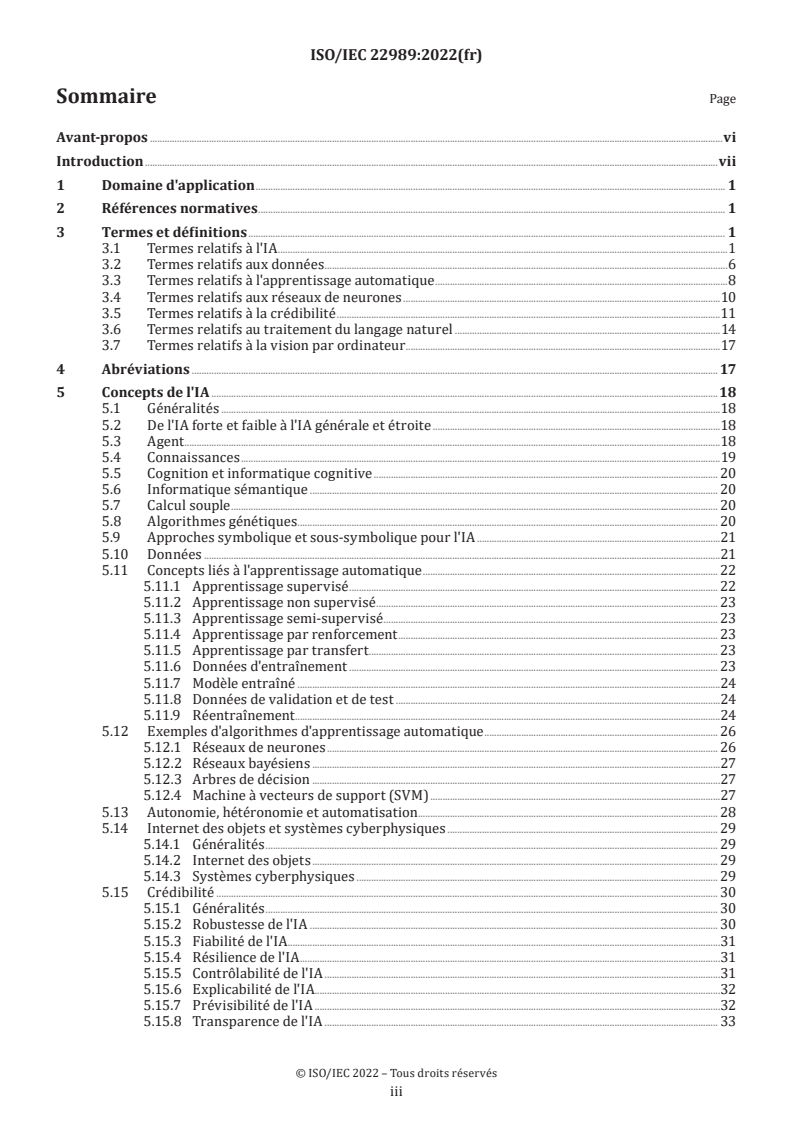
Sommaire Page
Avant-propos .vi
Introduction .vii
1 Domaine d'application . 1
2 Références normatives . 1
3 Termes et définitions . 1
3.1 Termes relatifs à l'IA .1
3.2 Termes relatifs aux données . .6
3.3 Termes relatifs à l'apprentissage automatique .8
3.4 Termes relatifs aux réseaux de neurones .10
3.5 Termes relatifs à la crédibilité .11
3.6 Termes relatifs au traitement du langage naturel .14
3.7 Termes relatifs à la vision par ordinateur .17
4 Abréviations . 17
5 Concepts de l'IA .18
5.1 Généralités .18
5.2 De l'IA forte et faible à l'IA générale et étroite .18
5.3 Agent .18
5.4 Connaissances .19
5.5 Cognition et informatique cognitive . 20
5.6 Informatique sémantique . 20
5.7 Calcul souple . 20
5.8 Algorithmes génétiques . 20
5.9 Approches symbolique et sous-symbolique pour l'IA .21
5.10 Données .21
5.11 Concepts liés à l'apprentissage automatique . 22
5.11.1 Apprentissage supervisé . 22
5.11.2 Apprentissage non supervisé . 23
5.11.3 Apprentissage semi-supervisé . 23
5.11.4 Apprentissage par renforcement . 23
5.11.5 Apprentissage par transfert . 23
5.11.6 Données d'entraînement . 23
5.11.7 Modèle entraîné .24
5.11.8 Données de validation et de test .24
5.11.9 Réentraînement .24
5.12 Exemples d'algorithmes d'apprentissage automatique . 26
5.12.1 Réseaux de neurones . 26
5.12.2 Réseaux bayésiens .27
5.12.3 Arbres de décision .27
5.12.4 Machine à vecteurs de support (SVM) .27
5.13 Autonomie, hétéronomie et automatisation . 28
5.14 Internet des objets et systèmes cyberphysiques . 29
5.14.1 Généralités . 29
5.14.2 Internet des objets . 29
5.14.3 Systèmes cyberphysiques . 29
5.15 Crédibilité . 30
5.15.1 Généralités . 30
5.15.2 Robustesse de l'IA . 30
5.15.3 Fiabilité de l'IA . .31
5.15.4 Résilience de l'IA .31
5.15.5 Contrôlabilité de l'IA .31
5.15.6 Explicabilité de l'IA . . .32
5.15.7 Prévisibilité de l'IA .32
5.15.8 Transparence de l'IA . 33
© ISO/IEC 2022 – Tous droits réservés
iii
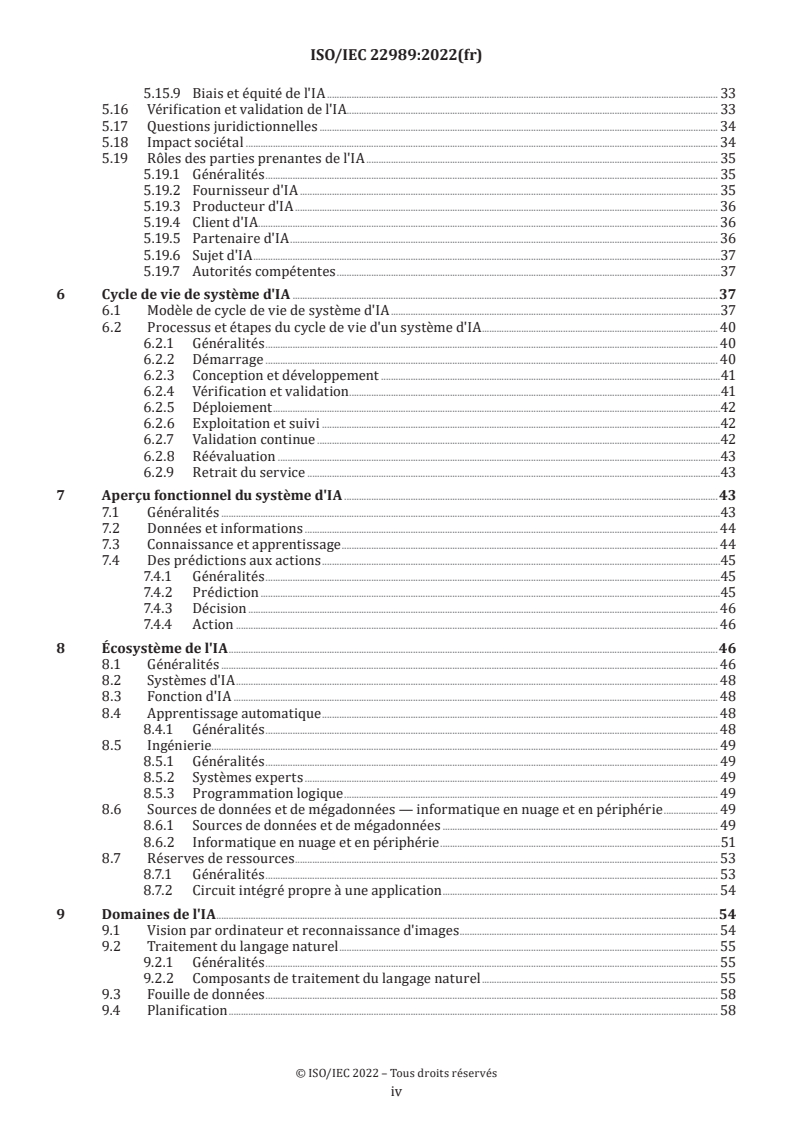
5.15.9 Biais et équité de l'IA . 33
5.16 Vérification et validation de l'IA. 33
5.17 Questions juridictionnelles . 34
5.18 Impact sociétal . 34
5.19 Rôles des parties prenantes de l'IA . 35
5.19.1 Généralités . 35
5.19.2 Fournisseur d'IA . 35
5.19.3 Producteur d'IA . 36
5.19.4 Client d'IA . 36
5.19.5 Partenaire d'IA . 36
5.19.6 Sujet d'IA .37
5.19.7 Autorités compétentes .37
6 Cycle de vie de système d'IA .37
6.1 Modèle de cycle de vie de système d'IA .37
6.2 Processus et étapes du cycle de vie d'un système d'IA . 40
6.2.1 Généralités . 40
6.2.2 Démarrage . 40
6.2.3 Conception et développement .41
6.2.4 Vérification et validation . .41
6.2.5 Déploiement .42
6.2.6 Exploitation et suivi .42
6.2.7 Validation continue .42
6.2.8 Réévaluation .43
6.2.9 Retrait du service .43
7 Aperçu fonctionnel du système d'IA .43
7.1 Généralités .43
7.2 Données et informations . 44
7.3 Connaissance et apprentissage . 44
7.4 Des prédictions aux actions .45
7.4.1 Généralités .45
7.4.2 Prédiction .45
7.4.3 Décision . 46
7.4.4 Action . 46
8 Écosystème de l'IA .46
8.1 Généralités . 46
8.2 Systèmes d'IA . 48
8.3 Fonction d'IA . 48
8.4 Apprentissage automatique . 48
8.4.1 Généralités . 48
8.5 Ingénierie. 49
8.5.1 Généralités . 49
8.5.2 Systèmes experts . 49
8.5.3 Programmation logique . 49
8.6 Sources de données et de mégadonnées — informatique en nuage et en périphérie . 49
8.6.1 Sources de données et de mégadonnées . 49
8.6.2 Informatique en nuage et en périphérie .51
8.7 Réserves de ressources . 53
8.7.1 Généralités . 53
8.7.2 Circuit intégré propre à une application . 54
9 Domaines de l'IA .54
9.1 Vision par ordinateur et reconnaissance d'images . 54
9.2 Traitement du langage naturel . 55
9.2.1 Généralités . 55
9.2.2 Composants de traitement du langage naturel . 55
9.3 Fouille de données . 58
9.4 Planification . 58
© ISO/IEC 2022 – Tous droits réservés
iv
10 Applications des systèmes d'IA .58
10.1 Généralités . 58
10.2 Détection de la fraude .59
10.3 Véhicules automatisés .59
10.4 Maintenance prédictive .59
Annexe A (informative) Correspondance entre le cycle de vie d'un système d'IA et la définition
du cycle de vie d'un système d'IA de l'OCDE . 61
Bibliographie .63
© ISO/IEC 2022 – Tous droits réservés
v
Avant-propos
L'ISO (Organisation internationale de normalisation) et l'IEC (Commission électrotechnique internationale)
forment le système spécialisé de la normalisation mondiale. Les organismes nationaux membres de l'ISO ou
de l'IEC participent au développement de Normes internationales par l'intermédiaire des comités techniques
créés par l'organisation concernée afin de s'occuper des domaines particuliers de l'activité technique.
Les comités techniques de l'ISO et de l'IEC collaborent dans des domaines d'intérêt commun. D'autres
organisations internationales, gouvernementales et non gouvernementales, en liaison avec l'ISO et l'IEC
participent également aux travaux.
Les procédures utilisées pour élaborer le présent document et celles destinées à sa mise à jour sont
décrites dans les Directives ISO/IEC, Partie 1. Il convient, en particulier, de prendre note des différents
critères d'approbation requis pour les différents types de documents. Le présent document a été rédigé
selon les règles de rédaction données dans les Directives ISO/IEC, Partie 2 (voir www.iso.org/directives
ou www.iec.ch/members_experts/refdocs).
L'attention est attirée sur le fait que certains des éléments du présent document peuvent faire l'objet de droits
de propriété intellectuelle ou de droits analogues. L'ISO et l'IEC ne sauraient être tenues pour responsables
de ne pas avoir identifié de tels droits de propriété et averti de leur existence. Les détails concernant les
références aux droits de propriété intellectuelle ou autres droits analogues identifiés lors de l'élaboration du
document sont indiqués dans l'Introduction et/ou dans la liste des déclarations de brevets reçues par l'ISO
(voir www.iso.org/brevets) ou dans la liste des déclarations de brevets reçues par l'IEC (voir patents.iec.ch).
Les appellations commerciales éventuellement mentionnées dans le présent document sont données pour
information, par souci de commodité, à l'intention des utilisateurs et ne sauraient constituer un engagement.
Pour une explication de la nature volontaire des normes, la signification des termes et expressions spécifiques
de l'ISO liés à l'évaluation de la conformité, ou pour toute information au sujet de l'adhésion de l'ISO aux
principes de l'Organisation mondiale du commerce (OMC) concernant les obstacles techniques au commerce
(OTC), voir www.iso.org/iso/fr/avant-propos. Pour l'IEC, voir www.iec.ch/understanding-standards.
Le présent document a été élaboré par le comité technique mixte ISO/IEC JTC 1, Technologies de l'information,
sous-comité SC 42, Intelligence artificielle.
Il convient que l'utilisateur adresse tout retour d'information ou toute question concernant le présent
document à l'organisme national de normalisation de son pays. Une liste exhaustive desdits organismes se
trouve aux adresses www.iso.org/fr/members.html et www.iec.ch/national-committees.
La présente version française de l'ISO/IEC 22989:2022(fr) inclut les corrections suivantes:
— corrections de traduction de l’anglais vers le français.
© ISO/IEC 2022 – Tous droits réservés
vi
Introduction
Les progrès réalisés en matière de capacité de calcul, la réduction des coûts de calcul, la disponibilité de
grandes quantités de données provenant de nombreuses sources, les programmes d'apprentissage en ligne
peu coûteux et les algorithmes capables d'atteindre ou de dépasser les performances humaines dans des
tâches particulières en termes de rapidité et d'exactitude ont permis des applications pratiques de l'IA, qui
en font une branche de plus en plus importante des technologies de l'information.
L'IA est un domaine fortement interdisciplinaire qui s'appuie largement sur l'informatique, la science des
données, les sciences naturelles, les sciences humaines, les mathématiques, les sciences sociales et autres.
Des termes tels que «intelligent», «intelligence», «compréhension», «connaissances», «apprentissage»,
«décisions», «compétences», etc., sont utilisés tout au long du présent document. Toutefois, l'intention n'est
pas d'anthropomorphiser les systèmes d'IA, mais de décrire le fait que certains systèmes d'IA peuvent
simuler de manière rudimentaire ces caractéristiques.
La technologie de l'IA comporte de nombreux domaines. Ces domaines sont étroitement liés et se développent
rapidement, c'est pourquoi il est difficile de conjuguer la pertinence de tous les domaines techniques dans
un même espace. La recherche sur l'IA inclut des aspects tels que «l'apprentissage, la reconnaissance et la
prédiction», «l'inférence, les connaissances et le langage» et «la découverte, la recherche et la création». La
[23]
recherche traite également les interdépendances entre ces aspects .
Le concept de l'IA en tant que flux de processus d'entrée et de sortie est partagé par de nombreux
chercheurs en IA, et les recherches relatives à chaque étape de ce processus sont en cours. Des concepts et
une terminologie normalisés sont nécessaires aux parties prenantes de cette technologie afin d'être mieux
comprises et adoptées par un public plus large. En outre, les concepts et les catégories de l'IA permettent de
comparer et de classer les différentes solutions en ce qui concerne les propriétés telles que la crédibilité, la
robustesse, la résilience, la fiabilité, l'exactitude, la sûreté, la sécurité et la protection de la vie privée. Cela
permet aux parties prenantes de choisir des solutions appropriées pour leurs applications et de comparer la
qualité des solutions disponibles sur le marché.
Étant donné que le présent document fournit une définition du terme «IA» au sens d'une discipline
uniquement, le contexte de son utilisation peut être décrit comme suit: l'IA est un domaine technique et
scientifique consacré aux systèmes techniques qui génèrent des sorties telles que du contenu, des prévisions,
des recommandations ou des décisions pour un ensemble donné d'objectifs définis par l'homme.
Le présent document fournit des concepts et une terminologie normalisés afin de contribuer à une meilleure
compréhension de la technologie de l'IA et à son utilisation par un plus large éventail de parties prenantes. Il
est destiné à un large public, qui réunit experts et néophytes. La lecture de certains articles ou paragraphes
spécifiques peut toutefois être plus facile pour qui possède des connaissances plus approfondies dans le
domaine de l'informatique. Ces préoccupations sont décrites principalement aux paragraphes 5.10 et 5.11 et
à l'Article 8, qui sont de nature plus technique que le reste du document.
© ISO/IEC 2022 – Tous droits réservés
vii
Norme internationale ISO/IEC 22989:2022(fr)
Technologies de l'information — Intelligence artificielle —
Concepts et terminologie relatifs à l'intelligence artificielle
1 Domaine d'application
Le présent document établit la terminologie relative à l'IA et décrit les concepts dans le domaine de l'IA.
Le présent document peut être utilisé dans le cadre de l'élaboration d'autres normes et à l'appui de
communications entre parties intéressées ou parties prenantes diverses.
Le présent document est applicable à tous les types d'organismes (par exemple: les entreprises commerciales,
les organismes publics, les organismes à but non lucratif).
2 Références normatives
Le présent document ne contient aucune référence normative.
3 Termes et définitions
Pour les besoins du présent document, les termes et définitions suivants s'appliquent.
L'ISO et l'IEC tiennent à jour des bases de données terminologiques destinées à être utilisées en normalisation,
consultables aux adresses suivantes:
— ISO Online browsing platform: disponible à l'adresse https:// www .iso .org/ obp
— IEC Electropedia: disponible à l'adresse https:// www .electropedia .org/
3.1 Termes relatifs à l'IA
3.1.1
agent intelligent
entité automatisée (3.1.7) qui détecte son environnement, y réagit, et effectue des actions pour atteindre ses
objectifs
3.1.2
composant intelligent
élément fonctionnel qui compose un système d'IA (3.1.4)
3.1.3
intelligence artificielle
IA
recherche et développement de mécanismes et d'applications de systèmes d'IA (3.1.4)
Note 1 à l'article: La recherche et le développement peuvent s'opérer dans un grand nombre de domaines tels que
l'informatique, la science des données, les sciences humaines, les mathématiques et les sciences naturelles.
© ISO/IEC 2022 – Tous droits réservés
3.1.4
système d'intelligence artificielle
système d'IA
système technique qui génère des sorties telles que du contenu, des prévisions, des recommandations ou des
décisions pour un ensemble donné d'objectifs définis par l'homme
Note 1 à l'article: Le système technique peut utiliser diverses techniques et approches liées à l'intelligence artificielle
(3.1.3) pour élaborer un modèle (3.1.23) afin de représenter des données, des connaissances (3.1.21), des processus,
etc., qui peuvent être utilisés pour réaliser des tâches (3.1.35).
Note 2 à l'article: Les systèmes d'IA sont conçus pour fonctionner à des niveaux variables d'automatisation (3.1.7).
3.1.5
autonomie
autonome
caractéristique d'un système qui est capable de modifier son domaine d'utilisation ou son objectif prévu
sans intervention, contrôle ou supervision externe
3.1.6
circuit intégré propre à une application
ASIC (application specific integrated circuit)
circuit intégré personnalisé pour une utilisation particulière
[SOURCE: ISO/IEC IEEE 24765:2017, 3.193, modifié — L'acronyme a été déplacé sur une ligne séparée]
3.1.7
automatique
automatisation
automatisé
qualifie un processus ou un système qui, dans des conditions déterminées, se déroule ou fonctionne sans
intervention humaine
[SOURCE: ISO/IEC 2382:2015, 2121282, modifié — Dans la définition, «un processus ou un appareil» a été
remplacé par «un processus ou un système» et les termes préférentiels «automatisé et automatisation» ont
été ajoutés.]
3.1.8
informatique cognitive
catégorie de systèmes d'IA (3.1.4) qui permet aux personnes et aux machines d'interagir de façon plus
naturelle
Note 1 à l'article: Les tâches d'informatique cognitive sont associées à l'apprentissage automatique (3.3.5), au traitement
de la parole, au traitement du langage naturel (3.6.9), à la vision par ordinateur (3.7.1) et aux interfaces homme-machine.
3.1.9
apprentissage continu
apprentissage permanent
apprentissage tout au long de la vie
entraînement progressif d'un système d'IA (3.1.4) qui a lieu de façon continue pendant la phase d'exploitation
du cycle de vie du système d'IA
3.1.10
connexionnisme
paradigme connexionniste
modèle connexionniste
approche connexionniste
forme de modélisation cognitive qui utilise un réseau d'unités interconnectées qui sont généralement des
unités de calcul simples
© ISO/IEC 2022 – Tous droits réservés
3.1.11
fouille de données
processus informatique qui extrait des tendances en analysant des données quantitatives selon des
perspectives et dimensions différentes, les classe par catégories et en récapitule les relations et impacts
potentiels
[SOURCE: ISO 16439:2014, 3.13, modifié.]
3.1.12
connaissance déclarative
connaissance représentée par des faits, des règles ou des théorèmes
Note 1 à l'article: Normalement, la connaissance déclarative ne peut être traitée qu'après avoir été traduite en
connaissance procédurale (3.1.28).
[SOURCE: ISO/IEC 2382‑28:1995, 28.02.22, modifié — Suppression de la virgule après «règles» dans la
version anglaise de la définition.]
3.1.13
système expert
système d'IA (3.1.4) qui accumule, associe et encapsule des connaissances (3.1.21) fournies par un ou plusieurs
expert(s) humain(s) dans un domaine spécifique afin de déduire des solutions à des problèmes
3.1.14
IA générale
IAG
intelligence artificielle générale
type de système d'IA (3.1.4) qui traite un large éventail de tâches (3.1.35) en affichant un niveau de
performances satisfaisant
Note 1 à l'article: Par rapport à une IA étroite (3.1.24).
Note 2 à l'article: L'IAG est souvent utilisée dans un sens plus large, c'est-à-dire des systèmes qui peuvent non seulement
effectuer un large éventail de tâches, mais aussi toutes les tâches qu'un humain peut effectuer.
3.1.15
algorithme génétique
GA (genetic algorithm)
algorithme qui simule la sélection naturelle en créant et en faisant évoluer une population d'individus
(solutions) pour les problèmes d'optimisation
3.1.16
hétéronomie
hétéronome
caractéristique d'un système fonctionnant sous la contrainte d'une intervention, d'un contrôle ou d'une
supervision externes
3.1.17
inférence
raisonnement qui consiste à dériver une conclusion d'une prémisse connue
Note 1 à l'article: En IA, une prémisse est un fait, une règle, un modèle, une caractéristique ou des données brutes.
Note 2 à l'article: Le terme «inférence» désigne à la fois le processus et son résultat.
[SOURCE: ISO/IEC 2382:2015, 2123830, modifié – ajout de «un modèle, une caractéristique ou des données
brutes». La «Note 4 à l'article: 28.03.01 (2382)» a été supprimée. La «Note 3 à l'article: inférence: terme et
définition normalisés par l'ISO/IEC 2382‑28:1995» a été supprimée.]
© ISO/IEC 2022 – Tous droits réservés
3.1.18
internet des objets
IdO
infrastructure composée d'entités, de personnes, de systèmes et de ressources informationnelles
interconnectés, ainsi que de services qui traitent les informations provenant du monde physique et du
monde virtuel et y réagissent
[SOURCE: ISO/IEC 20924:2021, 3.2.4, modifié – l'acronyme a été déplacé sur une ligne distincte.]
3.1.19
dispositif de l'IdO
entité d'un système de l'IdO (3.1.20) qui interagit et communique avec le monde physique par la détection ou
l'actionnement
Note 1 à l'article: Un dispositif de l'IdO peut être un capteur ou un actionneur.
[SOURCE: ISO/IEC 20924:2021, 3.2.6]
3.1.20
système de l'IdO
système fournissant les fonctionnalités de l'IdO (3.1.18)
Note 1 à l'article: Un système de l'IdO peut inclure, sans que cela s'y limite, des dispositifs de l'IdO, des passerelles de
l'IdO, des capteurs et des actionneurs.
[SOURCE: ISO/IEC 20924:2021, 3.2.9]
3.1.21
connaissances
informations résumées relatives à des objets, des événements, des concepts ou des
règles, leurs relations et leurs propriétés, organisées en vue d'une utilisation systématique orientée vers un but
Note 1 à l'article: Dans le domaine de l'IA, le terme «connaissances» n'implique pas de capacité cognitive, contrairement
à l'usage qui en est fait dans d'autres domaines. Plus particulièrement, les connaissances n'impliquent pas l'action
cognitive de compréhension.
Note 2 à l'article: Les informations peuvent exister sous une forme numérique ou symbolique.
Note 3 à l'article: Les informations sont des données qui ont été contextualisées, afin d'être interprétables. Les données
sont créées par abstraction ou mesure par rapport au monde réel.
3.1.22
cycle de vie
évolution d'un système, d'un produit, d'un service, d'un projet ou d'une autre entité créée par l'homme, de la
conception jusqu'au retrait du service
[SOURCE: ISO/IEC IEEE 15288:2015, 4.1.23]
3.1.23
modèle
représentation physique, mathématique ou logique d'un système, d'une entité, d'un phénomène, d'un
processus ou de données
[SOURCE: ISO/IEC 18023‑1:2006, 3.1.11, modifié – Suppression de la virgule après «mathématique» dans la
version anglaise de la définition. Ajout de «ou de données» à la fin.]
3.1.24
IA étroite
type de système d'IA (3.1.4) qui se concentre sur des tâches (3.1.35) définies pour traiter un problème
spécifique
Note 1 à l'article: Par rapport à une IA générale (3.1.14).
© ISO/IEC 2022 – Tous droits réservés
3.1.25
performances
résultat mesurable
Note 1 à l'article: Les performances peuvent se rapporter à des résultats quantitatifs ou qualitatifs.
Note 2 à l'article: Les performances peuvent concerner la gestion d'activités, de processus, de produits (y compris de
services), de systèmes ou d'organismes.
3.1.26
planification
processus informatiques qui composent un flux de travail à partir d'un ensemble
d'actions, en vue d'atteindre un objectif spécifié
Note 1 à l'article: Le terme «planification» utilisé dans le cycle de vie de l'IA ou dans les normes de gestion de l'IA peut
également désigner des actions effectuées par des êtres humains.
3.1.27
prédiction
sortie principale d'un système d'IA (3.1.4) lorsque lui sont fournies des données d'entrée (3.2.9) ou des
informations
Note 1 à l'article: Les prédictions peuvent être suivies de sorties supplémentaires, telles que des recommandations,
des décisions et des actions.
Note 2 à l'article: Le terme «prédiction» ne se rapporte pas nécessairement au fait de prédire un événement futur.
Note 3 à l'article: Les prédictions peuvent se référer à différents types d'analyse ou de production de données
appliquées à de nouvelles données ou à des données historiques (y compris la traduction de textes, la création d'images
de synthèse ou le diagnostic d'une panne d'électricité antérieure).
3.1.28
connaissance procédurale
connaissance qui indique de façon explicite la suite d'actions à entreprendre pour résoudre un problème ou
atteindre un but
[SOURCE: ISO/IEC 2382-28:1995, 28.02.23]
3.1.29
robot
système d'automatisation doté d'actionneurs qui effectue les tâches (3.1.35) prévues dans le monde physique,
en détectant son environnement et en utilisant un système de commande logiciel
Note 1 à l'article: Un robot inclut le système de commande et l'interface d'un système de commande.
Note 2 à l'article: En fonction de son application prévue, un robot est classé comme robot industriel ou comme robot
de service.
Note 3 à l'article: Pour effectuer correctement ses tâches (3.1.35), un robot utilise différents types de capteurs pour
confirmer son état actuel et percevoir les éléments qui composent l'environnement dans lequel il opère.
3.1.30
robotique
science et pratique de la conception, de la fabrication et de la mise en œuvre de robots
[SOURCE: ISO 8373:2012, 2.16]
3.1.31
informatique sémantique
domaine de l'informatique qui vise à identifier les significations du contenu informatique et les intentions de
l'utilisateur et à les exprimer sous une forme exploitable par machine
© ISO/IEC 2022 – Tous droits réservés
3.1.32
calcul souple
domaine de l'informatique qui tolère et exploite l'imprécision, l'incertitude et la vérité partielle pour rendre
la résolution de problèmes plus maniable et robuste
Note 1 à l'article: Le calcul souple englobe diverses techniques telles que la logique floue, l'apprentissage automatique
et le raisonnement probabiliste.
3.1.33
IA symbolique
IA (3.1.3) fondée sur des techniques et des modèles (3.1.23) qui manipulent des symboles et des structures
conformément à des règles définies explicitement afin d'obtenir des inférences
Note 1 à l'article: Par rapport à l'IA sous-symbolique (3.1.34), l'IA symbolique produit des résultats déclaratifs, tandis que
l'IA sous-symbolique se fonde sur des approches statistiques et produit des résultats avec une probabilité d'erreur donnée.
3.1.34
IA sous-symbolique
IA (3.1.3) fondée sur des techniques et des modèles (3.1.23) qui utilisent un encodage implicite des
informations, qui peuvent être dérivées de l'expérience ou de données brutes
Note 1 à l'article: À distinguer de l'IA symbolique (3.1.33). Tandis que l'IA symbolique produit des résultats déclaratifs, l'IA
sous-symbolique se fonde sur des approches statistiques et produit des résultats avec une probabilité d'erreur donnée.
3.1.35
tâche
action exigée pour atteindre un but spécifique
Note 1 à l'article: Les actions peuvent être physiques ou cognitives. Pour exemple, le calcul ou la création de prédictions
(3.1.27), de traductions, de données ou artéfacts de synthèse ou la navigatio
...