

ISO/IEC 2382-36:2019
(Main)Information technology — Vocabulary — Part 36: Learning, education and training
General Information
- Abstract
This document provides terms and definitions for vocabulary used in the field of learning, education and training (LET) to facilitate international communication in the field. This document also identifies and provides the relationships among the vocabulary ensuring a cohesive and harmonized approach.
- Status
- Published
- Publication Date
- 06-Jun-2019
- Current Stage
- 9093 - International Standard confirmed
- Start Date
- 02-Oct-2024
- Completion Date
- 29-Aug-2026
Buy Documents
ISO/IEC 2382-36:2019 - Information technology — Vocabulary — Part 36: Learning, education and training Released:6/7/2019
ISO/IEC 2382-36:2019 - Information technology — Vocabulary — Part 36: Learning, education and training Released:2/24/2020
Overview
ISO/IEC 2382-36:2019 - Information technology - Vocabulary - Part 36: Learning, education and training (LET) - is an international vocabulary standard that defines terms and relationships used in the field of learning, education and training. Its purpose is to harmonize terminology across languages, organizations and technical communities so that LET technologies, policy and practice can be discussed and implemented consistently worldwide. This third edition updates and expands earlier editions with many new terms and a restructured layout.
Key topics
The standard organizes vocabulary into focused technical topics, including:
- General LET terms and high‑level concepts used in educational technology.
- Users, organizations and roles (learners, instructors, administrators, vendors).
- Systems and tools such as learning management systems (LMS), authoring tools and assessment systems.
- Supportive processes for administration, learner support and course management.
- Resources and content terminology covering learning objects and digital resources.
- Teaching and learning concepts and pedagogical terminology.
- Learner information (profiles, records and privacy‑related terms).
- Individualized adaptability and accessibility, addressing personalization and inclusive design vocabulary.
- Metadata for learning resources (descriptive terms that support discovery and interoperability).
- Collaborative technology and interaction concepts used in online learning.
- Content packaging terms for exchange and deployment of learning materials.
- Quality management, assurance and metrics related to evaluation and benchmarking.
- Delivery of assessments, covering assessment delivery, scoring and reporting vocabulary.
Note: ISO/IEC 2382-36:2019 is a vocabulary standard - it defines and relates terms rather than prescribing technical implementations.
Applications
Practical uses of this vocabulary standard include:
- Ensuring consistent terminology in procurement documents, contracts and specifications for LMS and LET solutions.
- Assisting standards developers, software vendors and interoperability initiatives to align metadata, packaging and API concepts.
- Supporting instructional designers, educators and institutional IT teams in writing clear, unambiguous documentation and learning‑resource descriptions.
- Aiding quality assurance teams and accreditation bodies to communicate metrics, assessment delivery and quality terms consistently.
- Facilitating international research, policy work and cross‑border collaboration in education and training.
Who should use it
- Standards developers and committee members (ISO/IEC JTC 1, SC 36 stakeholders)
- EdTech vendors and system architects
- Learning designers, curriculum developers and assessment specialists
- Institutional IT, procurement and compliance teams
- Researchers and policymakers working on LET interoperability, accessibility and quality
Related standards
- Part of the ISO/IEC 2382 series (consolidated vocabulary for information technology)
- Published by ISO/IEC JTC 1/SC 36 (Information technology for learning, education and training)
Keywords: ISO/IEC 2382-36:2019, LET vocabulary, learning metadata, content packaging, learning management systems, accessibility, assessment delivery, educational technology.
Relations
- Effective Date
- 31-May-2014
Buy Documents
ISO/IEC 2382-36:2019 - Information technology — Vocabulary — Part 36: Learning, education and training Released:6/7/2019
ISO/IEC 2382-36:2019 - Information technology — Vocabulary — Part 36: Learning, education and training Released:2/24/2020
Get Certified
Connect with accredited certification bodies for this standard

BSI Group
BSI (British Standards Institution) is the business standards company that helps organizations make excellence a habit.

NYCE
Mexican standards and certification body.
Sponsored listings
Frequently Asked Questions
ISO/IEC 2382-36:2019 is a standard published by the International Organization for Standardization (ISO). Its full title is "Information technology — Vocabulary — Part 36: Learning, education and training". This standard covers: This document provides terms and definitions for vocabulary used in the field of learning, education and training (LET) to facilitate international communication in the field. This document also identifies and provides the relationships among the vocabulary ensuring a cohesive and harmonized approach.
This document provides terms and definitions for vocabulary used in the field of learning, education and training (LET) to facilitate international communication in the field. This document also identifies and provides the relationships among the vocabulary ensuring a cohesive and harmonized approach.
ISO/IEC 2382-36:2019 is classified under the following ICS (International Classification for Standards) categories: 01.040.35 - Information technology (Vocabularies); 35.020 - Information technology (IT) in general. The ICS classification helps identify the subject area and facilitates finding related standards.
ISO/IEC 2382-36:2019 has the following relationships with other standards: It is inter standard links to ISO/IEC 2382-36:2013. Understanding these relationships helps ensure you are using the most current and applicable version of the standard.
ISO/IEC 2382-36:2019 is available in PDF format for immediate download after purchase. The document can be added to your cart and obtained through the secure checkout process. Digital delivery ensures instant access to the complete standard document.
Standards Content (Sample)
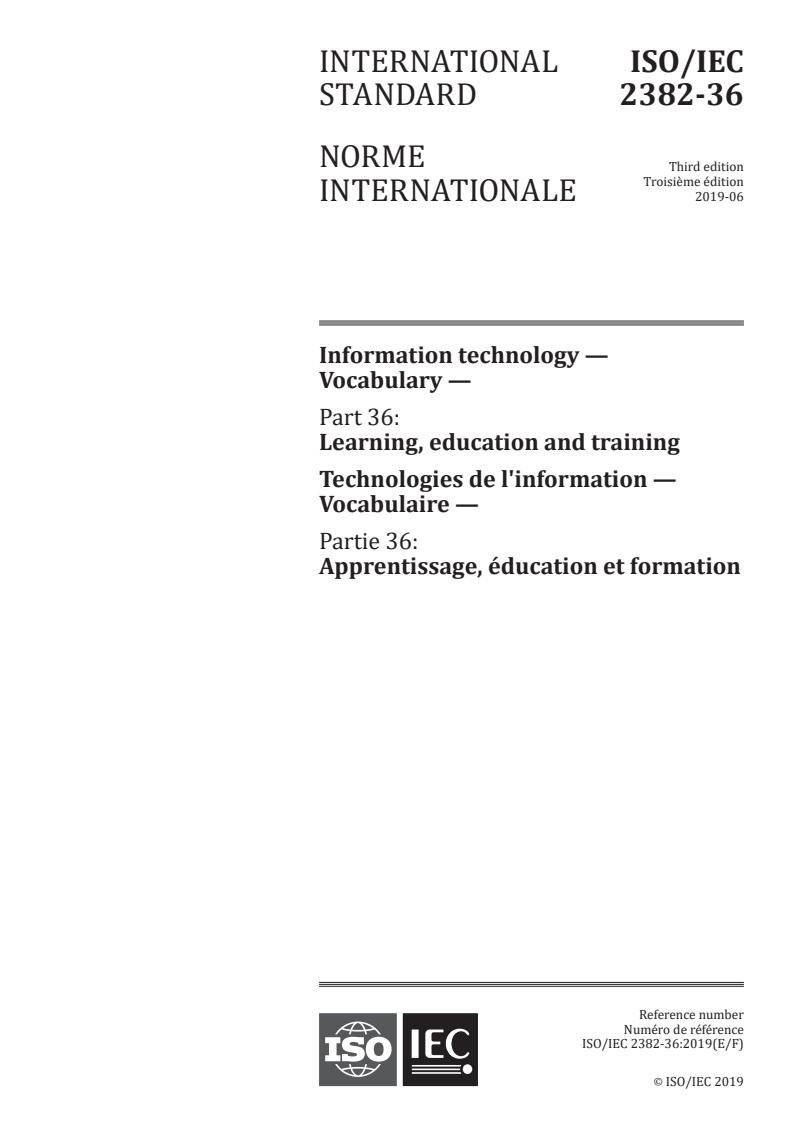
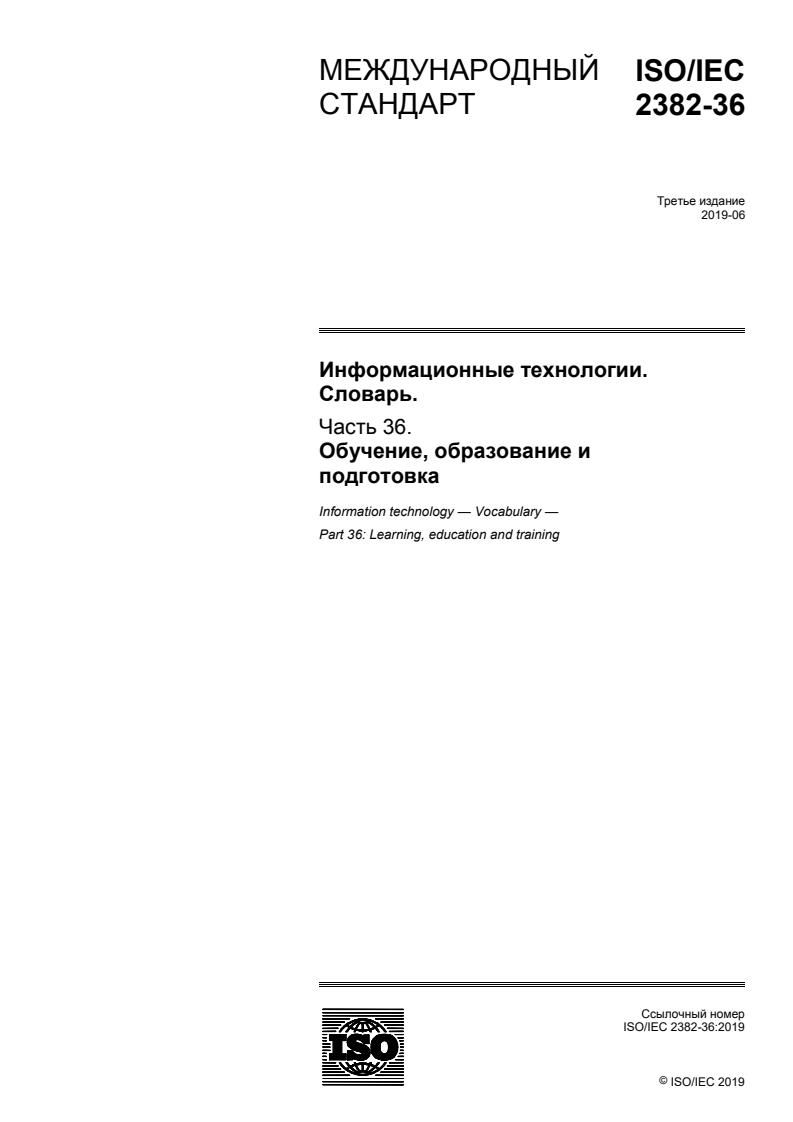
INTERNATIONAL ISO/IEC
STANDARD 2382-36
NORME
Third edition
Troisième édition
INTERNATIONALE 2019-06
Information technology —
Vocabulary —
Part 36:
Learning, education and training
Technologies de l'information —
Vocabulaire —
Partie 36:
Apprentissage, éducation et formation
Reference number
Numéro de référence
©
ISO/IEC 2019
DOCUMENT PROTÉGÉ PAR COPYRIGHT
© ISO/IEC 2019
All rights reserved. Unless otherwise specified, or required in the context of its implementation, no part of this publication may
be reproduced or utilized otherwise in any form or by any means, electronic or mechanical, including photocopying, or posting
on the internet or an intranet, without prior written permission. Permission can be requested from either ISO at the address
below or ISO’s member body in the country of the requester.
Tous droits réservés. Sauf prescription différente ou nécessité dans le contexte de sa mise en oeuvre, aucune partie de cette
publication ne peut être reproduite ni utilisée sous quelque forme que ce soit et par aucun procédé, électronique ou mécanique,
y compris la photocopie, ou la diffusion sur l’internet ou sur un intranet, sans autorisation écrite préalable. Une autorisation peut
être demandée à l’ISO à l’adresse ci-après ou au comité membre de l’ISO dans le pays du demandeur.
ISO copyright office
CP 401 • Ch. de Blandonnet 8
CH-1214 Vernier, Geneva
Phone: +41 22 749 01 11
Fax: +41 22 749 09 47
Email: copyright@iso.org
Website: www.iso.org
Published in Switzerland/Publié en Suisse
ii © ISO/IEC 2019 – All rights reserved/Tous droits réservés
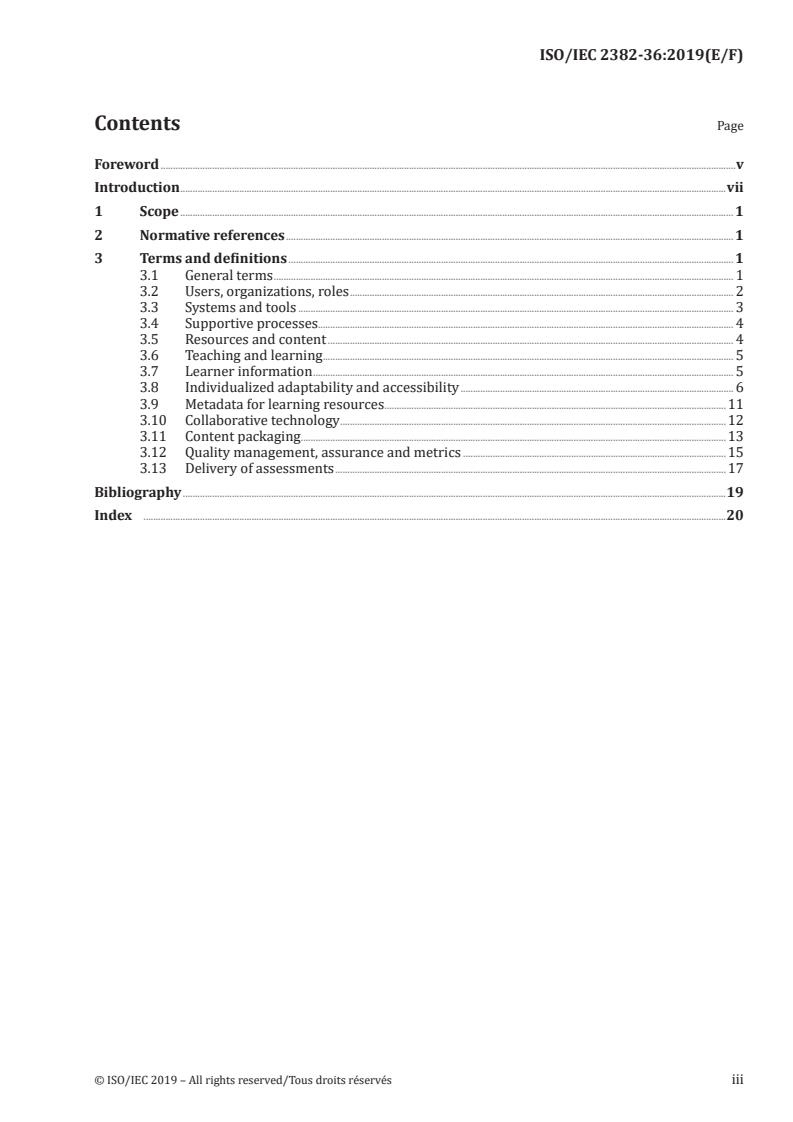
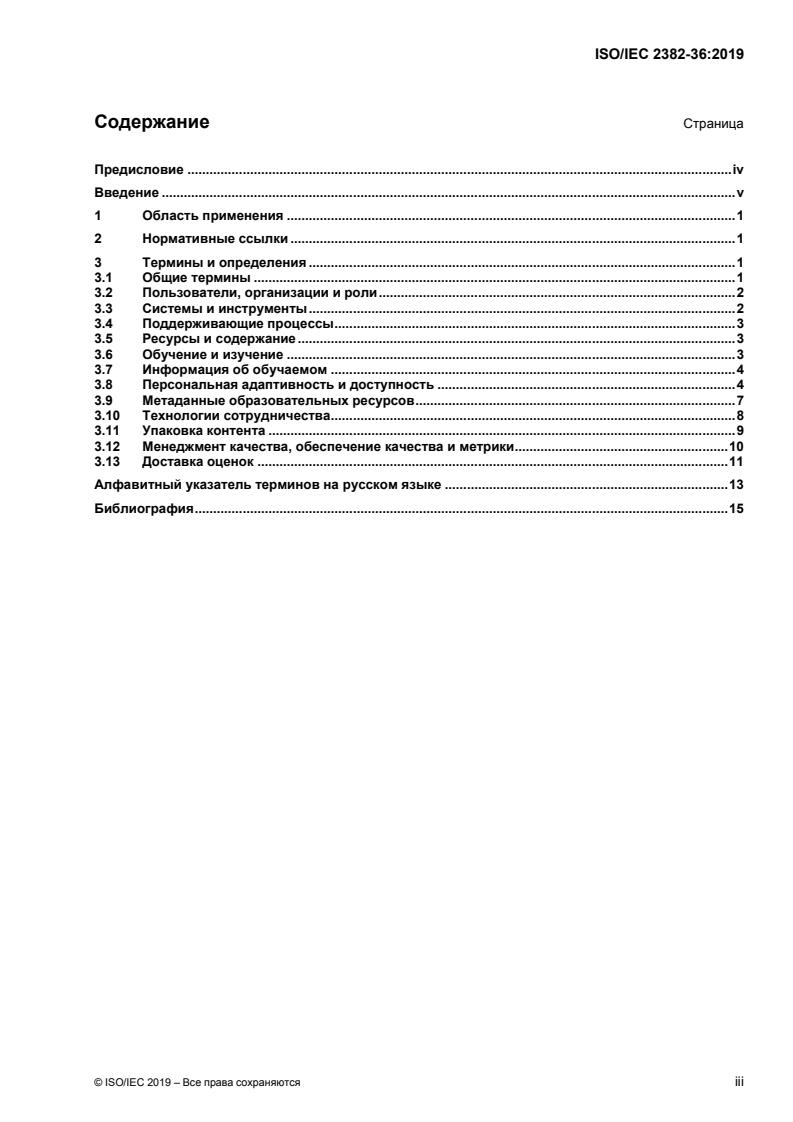
Contents Page
Foreword .v
Introduction .vii
1 Scope . 1
2 Normative references . 1
3 Terms and definitions . 1
3.1 General terms . 1
3.2 Users, organizations, roles . 2
3.3 Systems and tools . 3
3.4 Supportive processes. 4
3.5 Resources and content . 4
3.6 Teaching and learning . 5
3.7 Learner information . 5
3.8 Individualized adaptability and accessibility . 6
3.9 Metadata for learning resources .11
3.10 Collaborative technology .12
3.11 Content packaging .13
3.12 Quality management, assurance and metrics .15
3.13 Delivery of assessments .17
Bibliography .19
Index .20
© ISO/IEC 2019 – All rights reserved/Tous droits réservés iii
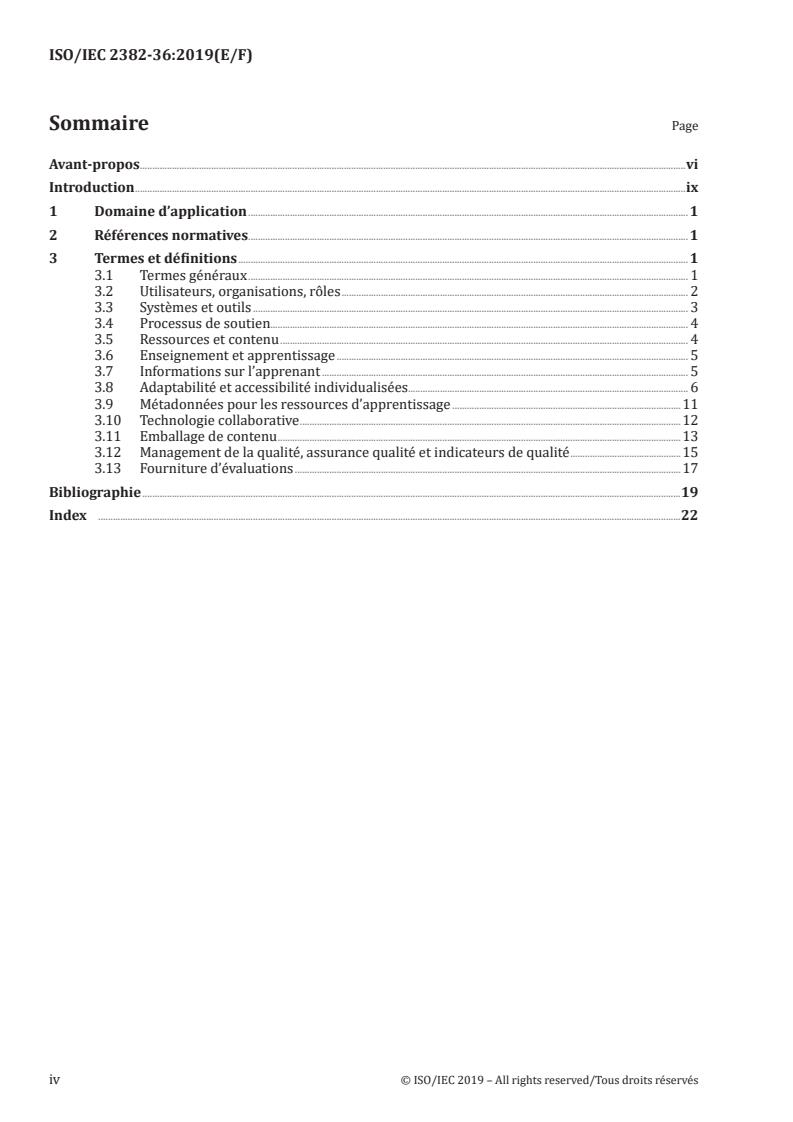
Sommaire Page
Avant-propos .vi
Introduction .ix
1 Domaine d’application . 1
2 Références normatives . 1
3 Termes et définitions . 1
3.1 Termes généraux . 1
3.2 Utilisateurs, organisations, rôles . 2
3.3 Systèmes et outils . 3
3.4 Processus de soutien. 4
3.5 Ressources et contenu . 4
3.6 Enseignement et apprentissage . 5
3.7 Informations sur l’apprenant . 5
3.8 Adaptabilité et accessibilité individualisées. 6
3.9 Métadonnées pour les ressources d’apprentissage .11
3.10 Technologie collaborative .12
3.11 Emballage de contenu .13
3.12 Management de la qualité, assurance qualité et indicateurs de qualité .15
3.13 Fourniture d’évaluations .17
Bibliographie .19
Index .22
iv © ISO/IEC 2019 – All rights reserved/Tous droits réservés
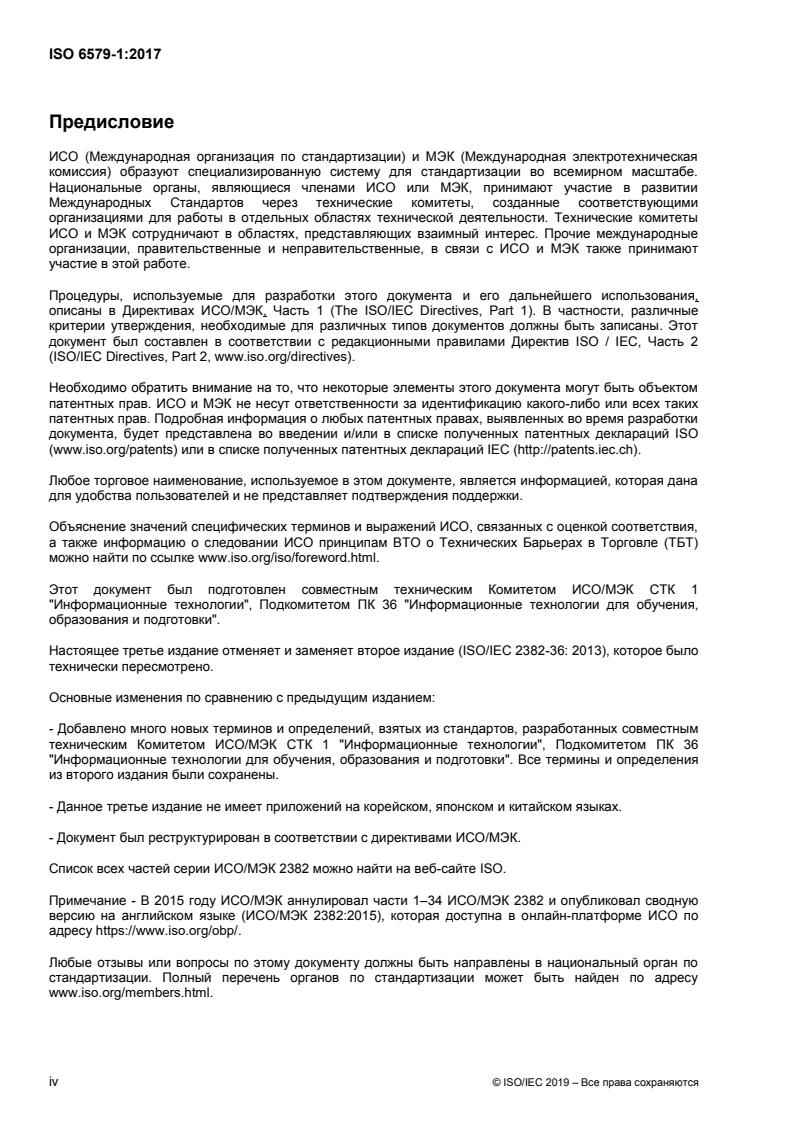
Foreword
ISO (the International Organization for Standardization) and IEC (the International Electrotechnical
Commission) form the specialized system for worldwide standardization. National bodies that
are members of ISO or IEC participate in the development of International Standards through
technical committees established by the respective organization to deal with particular fields of
technical activity. ISO and IEC technical committees collaborate in fields of mutual interest. Other
international organizations, governmental and non-governmental, in liaison with ISO and IEC, also
take part in the work.
The procedures used to develop this document and those intended for its further maintenance are
described in the ISO/IEC Directives, Part 1. In particular, the different approval criteria needed for
the different types of document should be noted. This document was drafted in accordance with the
editorial rules of the ISO/IEC Directives, Part 2 (see www.iso.org/directives).
Attention is drawn to the possibility that some of the elements of this document may be the subject
of patent rights. ISO and IEC shall not be held responsible for identifying any or all such patent
rights. Details of any patent rights identified during the development of the document will be in the
Introduction and/or on the ISO list of patent declarations received (see www.iso.org/patents) or the IEC
list of patent declarations received (see http://patents.iec.ch).
Any trade name used in this document is information given for the convenience of users and does not
constitute an endorsement.
For an explanation of the voluntary nature of standards, the meaning of ISO specific terms and
expressions related to conformity assessment, as well as information about ISO's adherence to the
World Trade Organization (WTO) principles in the Technical Barriers to Trade (TBT) see www.iso.org/
iso/foreword.html.
This document was prepared by Joint Technical Committee ISO/IEC JTC 1, Information technology,
Subcommittee SC 36, Information technology for learning, education and training.
This third edition cancels and replaces the second edition (ISO/IEC 2382-36:2013), which has been
technically revised.
The main changes compared to the previous edition are as follows:
— Many new terms and definitions, originating from documents developed by Joint Technical
Committee ISO/IEC JTC 1, Information technology, Subcommittee SC 36, Information technology
for learning, education and training, have been added. None of the terms and definitions from the
second edition have been removed.
— This third edition does not have annexes in Russian, Korean, Japanese and Chinese.
— The document has been restructured as per ISO/IEC Directives.
A list of all parts in the ISO/IEC 2382 series can be found on the ISO website.
NOTE In 2015, ISO/IEC withdrew Parts 1–34 of ISO/IEC 2382 and published an English language
consolidated version (ISO/IEC 2382:2015), which is available on the ISO Online Browsing Platform at
https://www.iso.org/obp/.
Any feedback or questions on this document should be directed to the user’s national standards body. A
complete listing of these bodies can be found at www.iso.org/members.html.
© ISO/IEC 2019 – All rights reserved/Tous droits réservés v
Avant-propos
L'ISO (Organisation internationale de normalisation) et l'IEC (Commission électrotechnique
internationale) forment le système spécialisé de la normalisation mondiale. Les organismes
nationaux membres de l'ISO ou de l'IEC participent au développement de Normes internationales
par l'intermédiaire des comités techniques créés par l'organisation concernée afin de s'occuper des
domaines particuliers de l'activité technique. Les comités techniques de l'ISO et de l'IEC collaborent
dans des domaines d'intérêt commun. D'autres organismes internationaux, gouvernementaux et non
gouvernementaux, en liaison avec l'ISO et l'IEC participent également aux travaux.
Les procédures utilisées pour élaborer le présent document et celles destinées à sa mise à jour sont
décrites dans les Directives ISO/IEC, Partie 1. Il convient, en particulier, de prendre note des différents
critères d'approbation requis pour les différents types de document. Le présent document a été rédigé
conformément aux règles de rédaction données dans les Directives ISO/IEC, Partie 2 (voir www.iso.
org/directives).
L'attention est attirée sur le fait que certains des éléments du présent document peuvent faire l'objet
de droits de propriété intellectuelle ou de droits analogues. L’ISO et l’IEC ne sauraient être tenues pour
responsables de ne pas avoir identifié de tels droits de propriété et averti de leur existence. Les détails
concernant les références aux droits de propriété intellectuelle ou autres droits analogues identifiés
lors de l’élaboration du document sont indiqués dans l’Introduction et/ou dans la liste des déclarations
de brevets reçues par l’ISO (voir www.iso.org/brevets) ou dans la liste des déclarations de brevets
reçues par l’IEC (voir http://patents.iec.ch).
Les éventuelles appellations commerciales utilisées dans le présent document sont données pour
information à l'intention des utilisateurs et ne constituent pas une approbation ou une recommandation.
Pour une explication de la nature volontaire des normes, la signification des termes et expressions
spécifiques de l'ISO liés à l'évaluation de la conformité, ou pour toute information au sujet de l'adhésion
de l'ISO aux principes de l'Organisation mondiale du commerce (OMC) concernant les obstacles
techniques au commerce (OTC), voir le lien suivant: www.iso.org/iso/fr/avant-propos.
Le présent document a été élaboré par le comité technique mixte ISO/IEC JTC 1, Technologies de
l'information, sous-comité SC 36, Technologies de l'information pour l’apprentissage, l’éducation et la
formation.
Cette troisième édition annule et remplace la deuxième édition (ISO/IEC 2382-36:2013), qui a fait l’objet
d’une révision technique.
Les principales modifications par rapport à l'édition précédente sont les suivantes:
— de nombreux nouveaux termes et définitions issus de documents élaborés par le comité technique
mixte ISO/IEC JTC 1, Technologies de l’information, sous-comité SC 36, Technologies de l’information
pour l’apprentissage, l’éducation et la formation, ont été ajoutés. Aucun des termes et définitions de
la deuxième édition n’a été supprimé;
— cette troisième édition ne comporte aucune annexe en russe, en coréen, en japonais ou en chinois;
— le document a été restructuré conformément aux Directives ISO/IEC.
Une liste de toutes les parties de la série ISO/IEC 2382 peut être consultée sur le site web de l'ISO.
NOTE En 2015, l’ISO/IEC a retiré les Parties 1–34 de l’ISO/IEC 2382 et publié une version consolidée en
langue anglaise (ISO/IEC 2382:2015), disponible sur l’ISO Online Browsing Platform à l’adresse https://www.iso.
org/obp/.
Il convient à tout utilisateur d’adresser tout retour d'information ou toute question concernant le
présent document à l'organisme national de normalisation de son pays. Une liste exhaustive desdits
organismes se trouve à l’adresse www.iso.org/fr/members.html.
vi © ISO/IEC 2019 – All rights reserved/Tous droits réservés
Introduction
Information technology gives rise to numerous international exchanges of both an intellectual and a
material nature. These exchanges often become difficult, either because of the great variety of terms
used in various fields or languages to express the same concept, or because of the absence or imprecision
of the definitions of useful concepts.
To avoid misunderstandings and to facilitate such exchanges it is essential to clarify the concepts, to
select terms to be used in various languages or in various countries to express the same concept, and
to establish definitions providing satisfactory equivalents for the various terms in different languages.
The ISO/IEC 2382 series was initially based mainly on the usage in the Vocabulary of Information
Processing which was established and published by the International Federation for Information
Processing and the International Computation Centre, and in the American National Dictionary for
Information Processing Systems and its earlier editions published by the American National Standards
Institute (formerly known as the American Standards Association). Published and Draft International
Standards relating to information technology of other international organizations (such as the
International Telecommunication Union and the International Electrotechnical Commission) as well as
published and draft national standards have also been considered.
The purpose of the ISO/IEC 2382 series is to provide definitions that are rigorous, uncomplicated
and which can be understood by all concerned. The scope of each concept defined has been chosen to
provide a definition that is suitable for general application. In those circumstances where a restricted
application is concerned, the definition may need to be more specific.
Within current practice, diverse terms are commonly used in spite of the fact that no precise definitions
are agreed upon. Definitions of terms of this kind are highly dependent on the context in which these
terms are used and in such cases a spectrum of definitions will be provided instead of a rigorous and
uncomplicated definition.
While it is possible to maintain the self-consistency of individual parts of the ISO/IEC 2382 series, it is
recognized that the dynamics of language and the problems associated with the standardization and
maintenance of vocabularies can introduce duplications and inconsistencies among parts.
This document is intended to facilitate international communication in information technology for
learning, education and training.
It is noted that the terms learning, education and training (LET) are used broadly and in quite
different contexts worldwide. As a result, and for the purposes of this document which deals with LET
in the context of IT, this restraint of global applicability is evident in the defining of the characteristics
and concepts for the definition provided.
Terms defined in this document apply to the subject field of learning, education and training. When
terms exist in various subject fields, the applicable subject field is indicated in angle brackets at the start
of the definition. In the definitions, examples and notes, words in italics are defined in this document.
Terms defined in this document are italicized and cross-reference as per ISO 10241-1:2011.
Words which are not defined are used in their normal sense of the word as found in authoritative
dictionaries of each language (e.g., The Shorter Oxford English Dictionary, The Concise Oxford
Dictionary, The Collins Concise English Dictionary, Webster’s New World College Dictionary or
Chambers Concise dictionary for English; Dictionnaire Le Robert or Dictionnaire Larousse for French).
Natural language use of these words is outside the scope of this document.
The terms in this document are listed in a mixed order reflecting the underlying concept system.
The layout follows the directions given in ISO 10241-1. Thus, the elements (when present) of an entry
appear in the following order:
— Entry number
© ISO/IEC 2019 – All rights reserved/Tous droits réservés vii
— Terms
— Preferred term(s)
— Admitted term(s)
— Deprecated term(s)
— Definition, specification of domain or subject
— Example(s)
— Note(s)
If needed, for disambiguation, the grammatical context of a term can be defined using the following
indicators: noun, verb, adj (for an adjective) and adv (for adverb).
The alphabetical indexes include preferred, admitted terms, and abbreviations.
viii © ISO/IEC 2019 – All rights reserved/Tous droits réservés
Introduction
Les technologies de l'information sont à l'origine de multiples échanges intellectuels et matériels sur
le plan international. Les échanges souffrent souvent de difficultés provoquées par la diversité des
termes utilisés pour exprimer la même notion dans des langues ou des domaines différents, ou encore
de l'absence ou de l'imprécision des définitions pour les notions les plus utiles.
Pour éviter des malentendus et faciliter de tels échanges, il paraît essentiel de préciser les notions,
de choisir les termes à employer dans les différentes langues et dans les divers pays pour exprimer la
même notion et d'établir pour ces termes des définitions équivalentes dans chaque langue.
La série ISO/IEC 2382 a été basée à l'origine principalement sur l'usage tel qu'il a été relevé, d'une
part, dans le Vocabulary of Information Processing établi et publié par l'International Federation for
Information Processing et le Centre international de calcul et, d'autre part, dans l'American National
Dictionary for Information Processing Systems, y compris ses éditions précédentes publiées par
l'American National Standards Institute (connu auparavant sous l'appellation d'American Standards
Association). Les Normes internationales publiées ou au stade de projets concernant le traitement de
l'information émanant d'autres organisations internationales (telles que l'Union internationale des
télécommunications et la Commission électrotechnique internationale) ainsi que les normes nationales
publiées ou au stade de projets, ont également été prises en compte.
Le but de la série ISO/IEC 2382 est de procurer des définitions rigoureuses, simples et compréhensibles
pour tous les intéressés. La portée de chaque notion a été choisie de façon que sa définition puisse avoir
la valeur la plus générale. Cependant, il est parfois nécessaire de restreindre une notion à un domaine
plus étroit et de lui donner alors une définition plus spécifique.
Dans la pratique courante, divers termes sont communément employés en dépit du fait que l’exactitude
de leurs définitions n’ait fait l’objet d’aucun consensus. Ces définitions sont intimement reliées aux
contextes dans lesquels les termes sont utilisés. Dans de tels cas, un éventail de définitions remplacera
une simple définition rigoureuse.
Même s'il est possible d'assurer la cohérence interne de chaque partie de la série ISO/IEC 2382 prise
individuellement, la cohérence des diverses parties entre elles est plus difficile à atteindre. Il est
reconnu que la dynamique des langues et les problèmes de l'établissement et de la révision des normes
de vocabulaire peuvent être à l'origine de quelques répétitions ou contradictions entre des parties qui
ne sont pas toutes préparées et publiées simultanément.
Le présent document a pour objet de faciliter les échanges internationaux dans le domaine des
technologies de l'information pour l’apprentissage, l’éducation et la formation.
Il est à noter que les termes apprentissage, éducation et formation sont utilisés largement et dans
des contextes bien différents à l’échelle mondiale. Par conséquent, et aux fins du présent document
qui traite de l’apprentissage, de l’éducation et de la formation dans le contexte des technologies de
l’information, cette applicabilité globale limitée restreint l’établissement des caractéristiques et des
concepts pour la définition fournie.
Les termes définis dans le présent document s’appliquent au domaine de l'apprentissage, de l'éducation
et de la formation. Lorsqu'un terme existe dans plusieurs domaines, le domaine applicable est indiqué
entre chevrons simples en début de définition. Dans les définitions, exemples et notes, les mots en
italique sont définis dans le présent document. Les termes définis dans le présent document sont
indiqués en italique et font l’objet de références croisées conformément à l’ISO 10241-1:2011.
Les termes qui ne sont pas définis sont utilisés au sens classique trouvé dans les dictionnaires de
référence de chaque langue (par exemple, The Shorter Oxford English Dictionary, The Concise Oxford
Dictionary, The Collins Concise English Dictionary, Webster's New World College Dictionary ou
Chambers Concise Dictionary pour l’anglais; Dictionnaire Le Robert ou Dictionnaire Larousse pour
le français). L’emploi de ces termes en langage naturel n’entre pas dans le domaine d’application du
présent document.
© ISO/IEC 2019 – All rights reserved/Tous droits réservés ix
Les termes contenus dans le présent document sont énumérés selon un ordre mixte reflétant le système
de concepts sous-jacent.
La disposition des éléments des articles terminologiques suit les instructions de la norme ISO 10241-
1. Ainsi, les éléments d'un article terminologique (quand ils sont présents) apparaissent selon l'ordre
suivant:
— Numéro d'entrée
— Termes
— Terme(s) privilégié(s)
— Terme(s) toléré(s)
— Terme(s) déconseillé(s)
— Définition, spécification du domaine ou sujet
— Exemple(s)
— Note(s)
Si nécessaire, afin d’éviter toute ambigüité, le contexte grammatical d'un terme peut être défini à l’aide
des indicateurs suivants: nom, verbe, adj (pour un adjectif) et adv (pour un adverbe).
Les index alphabétiques comprennent les termes privilégiés, les termes tolérés et les abréviations.
x © ISO/IEC 2019 – All rights reserved/Tous droits réservés
INTERNATIONAL STANDARD ISO/IEC 2382-36:2019(E/F)
NORME INTERNATIONALE
Information technology — Technologies de
Vocabulary — l’information —
Vocabulaire —
Part 36:
Learning, education and Partie 36:
training Apprentissage, éducation et
formation
1 Scope 1 Domaine d'application
This document provides terms and definitions for Le présent document fournit des termes et
vocabulary used in the field of learning, education définitions relatifs au vocabulaire utilisé dans
and training (LET) to facilitate international le domaine de l’apprentissage, de l’éducation
communication in the field. This document et de la formation afin de faciliter les échanges
also identifies and provides the relationships internationaux dans ce domaine. Le présent
among the vocabulary ensuring a cohesive and document identifie et établit également les
harmonized approach. relations entre les vocabulaires pour proposer
une approche cohérente et harmonisée.
2 Normative references 2 Références normatives
There are no normative references in this Le présent document ne contient aucune
document. référence normative.
3 Terms and definitions 3 Termes et définitions
ISO and IEC maintain terminological databases L'ISO et l'IEC tiennent à jour des bases de données
for use in standardization at the following terminologiques destinées à être utilisées
addresses: en normalisation, consultables aux adresses
suivantes:
— ISO Online browsing platform: available at
https://www.iso.org/obp — ISO Online browsing platform: disponible à
l'adresse https://www.iso.org/obp
— IEC Electropedia: available at http://www.
electropedia.org/ — IEC Electropedia: disponible à l'adresse
http://www.electropedia.org/
3.1 General terms 3.1 Termes généraux
3.1.1 3.1.1
learning apprentissage
acquisition of knowledge, skills or attitudes acquisition de connaissances, d’habiletés ou
d’attitudes
© ISO/IEC 2019 – All rights reserved/Tous droits réservés 1
3.1.2 3.1.2
training formation
development of skills and/or understanding développement d’habiletés ou de connaissances à
through procedurally defined learning activities l’aide d’activités d’apprentissage (3.5.3) procédu-
(3.5.3) focused on a specific application rales centrées sur une application spécifique
3.1.3 3.1.3
web-based learning apprentissage sur le Web
online learning (3.1.4) that uses web and inter- apprentissage en ligne (3.1.4) utilisant les techno-
net-based technologies logies Web et internet
3.1.4 3.1.4
online learning apprentissage en ligne
learning (3.1.1) enabled via connection to an IT apprentissage (3.1.1) réalisé à l’aide d’un système
system (3.8.8) TI (3.8.8)
3.1.5 3.1.5
blended learning apprentissage hybride
combination of online learning (3.1.4) with face- combinaison de l’apprentissage en ligne (3.1.4)
to-face or offline learning (3.8.20) avec l’apprentissage en face à face (présentiel) ou
l’apprentissage hors ligne (3.8.20)
3.1.6 3.1.6
computer-supported collaborative learning apprentissage collaboratif en ligne
CSCL apprentissage collaboratif assisté par ordina-
activities involving resources, tasks or support teur
systems (human or otherwise), facilitated by activités comportant des ressources, des tâches
information and communication technologies et des systèmes de support (humains ou autres),
(ICT), that contribute to the effect of collaborative facilitées par l'utilisation des technologies de
learning l’information et de la communication (TIC) et
contribuant à l'apprentissage collaboratif
3.1.7 3.1.7
computer-based learning apprentissage assisté par ordinateur
use of information processing systems as learning utilisation de systèmes de traitement de l’infor-
(3.1.1) tools mation comme outils d’apprentissage (3.1.1)
3.1.8 3.1.8
computer managed learning apprentissage géré par ordinateur
learning (3.1.1) where administrative processes gestion informatisée de l'apprentissage
(such as registration, scheduling, control, guiding, apprentissage (3.1.1) où des processus adminis-
analysing and reporting) are facilitated by infor- tratifs (tels que l'inscription, la programmation
mation processing systems des activités, l’évaluation, la production de bulle-
tins) sont facilités par l'utilisation de systèmes de
traitement de l’information
3.2 Users, organizations, roles 3.2 Utilisateurs, organisations, rôles
3.2.1 3.2.1
learner apprenant
entity (3.9.5) that learns entité (3.9.5) qui apprend
2 © ISO/IEC 2019 – All rights reserved/Tous droits réservés
3.2.2 3.2.2
teacher enseignant
entity (3.9.5) that teaches entité (3.9.5) qui enseigne
Note 1 to entry: Within a specific context (e.g., collab- Note 1 à l'article: Dans certains contextes (par
orative learning) the same person can play the roles of exemple apprentissage collaboratif), une même per-
learner (3.2.1) and teacher. sonne peut jouer le rôle d'apprenant (3.2.1) et d'ensei-
gnant.
3.2.3 3.2.3
trainer formateur
entity (3.9.5) that supports, facilitates or mediates agent de formation
training (3.1.2) entité (3.9.5) qui supporte la formation (3.1.2) et
facilite les interactions
3.2.4 3.2.4
tutor tuteur
person or IT system (3.8.8) that helps a learner personne ou système TI (3.8.8) qui aide un appre-
(3.2.1) nant (3.2.1)
3.2.5 3.2.5
open university téléuniversité
university that offers distance learning institution d’enseignement universitaire qui dis-
pense un enseignement à distance
3.2.6 3.2.6
instructional designer concepteur pédagogique
person who prepares learning (3.1.1) content, personne qui prépare des contenus d’apprentis-
using systematic methodologies and instructional sage (3.1.1) d’une façon systématique, en utilisant
theory une théorie d’apprentissage
3.2.7 3.2.7
content author auteur de contenu
individual (3.8.14) who creates the learning (3.1.1) individu (3.8.14) qui crée le contenu d’apprentis-
content of the learning resource (3.5.1) sage (3.1.1) d’une ressource d’apprentissage (3.5.1)
3.3 Systems and tools 3.3 Systèmes et outils
3.3.1 3.3.1
learning management system système de gestion de l’apprentissage
LMS SGA
software system designed for the purpose of système logiciel conçu dans le but d’exécuter les
performing administrative and technical support processus administratifs et de support technique
processes associated with e-learning (3.8.19) associés à l’apprentissage en ligne (3.1.4)
3.3.2 3.3.2
learning content management system système de gestion de contenus d’apprentis-
LCMS sage
system that is used to create, store, assemble, système informatique utilisé pour créer, entrepo-
and/or deliver e-learning (3.8.19) content ser, assembler ou livrer les contenus d’apprentis-
sage en ligne (3.1.4)
© ISO/IEC 2019 – All rights reserved/Tous droits réservés 3
3.3.3 3.3.3
learning technology system système d’apprentissage basé sur la technolo-
LTS gie
information technology system (3.8.8) used in the système de technologies de l'information (3.8.8)
delivery and management of learning (3.1.1) utilisé pour la livraison et la gestion de contenus
d’apprentissage (3.1.1)
3.3.4 3.3.4
distributed learning technology system système d’apprentissage distribué basé sur la
learning technology system (3.3.3) that uses the technologie
internet or wide area networks as the primary système de technologies de l'information (3.3.3)
means of communication among its subsystems utilisant internet ou des réseaux étendus comme
and with other systems principal moyen de communication entre ses
sous-systèmes et avec d’autres systèmes
3.3.5 3.3.5
learning environment environnement d’apprentissage
physical or virtual environment in support of a environnement physique ou virtuel soutenant un
learner (3.2.1) apprenant (3.2.1)
3.4 Supportive processes 3.4 Processus de soutien
3.4.1 3.4.1
session session
period of time during which a user of a computer période de temps durant laquelle un utilisateur
can communicate with an interactive system, d’un ordinateur peut communiquer avec un
usually equal to elapsed time between logon and système interactif, habituellement égal au temps
logoff écoulé entre le début d’une session interactive et
la fin de cette session
Note 1 to entry: Adapted from IEEE Standard Diction-
ary of Electrical and Electronic Terms.
Note 1 à l'article: Adaptée de l’IEEE Standard Dictio-
nary of Electrical and Electronic Terms.
3.4.2 3.4.2
instructional design conception pédagogique
systematic and systemic instructional planning élaboration systématique et systémique (analyse
including needs assessment, design, evaluation, des besoins éducatifs, conception, évaluation,
implementation and maintenance of materials mise en œuvre, maintenance) de matériel didac-
and programs tique et de programmes
3.5 Resources and content 3.5 Ressources et contenu
3.5.1 3.5.1
learning resource ressource d’apprentissage
entity (3.9.5) that can be referenced and used for ressource pédagogique
learning (3.1.1), education and training (3.1.2) entité (3.9.5) pouvant être référencée et utilisée
pour l’apprentissage (3.1.1), l’enseignement ou la
formation (3.1.2)
4 © ISO/IEC 2019 – All rights reserved/Tous droits réservés
3.5.2 3.5.2
learning objective objectif d’apprentissage
description of a goal of training (3.1.2) or learning description du but attendu de la formation (3.1.2)
(3.1.1) in terms of the knowledge, skills, or perfor- ou des apprentissages (3.1.1) en fonction des
mance expected of a learner (3.2.1) connaissances, des habiletés ou du rendement
attendus de l’apprenant (3.2.1)
Note 1 to entry: Learning objectives may be associated
with instructional units of any size.
Note 1 à l'article: Des objectifs d’apprentissage
peuvent être associés avec des unités d’enseignement
de taille arbitraire.
3.5.3 3.5.3
learning activity activité d’apprentissage
activity whose goal is a specific learning objective activité visant un objectif d’apprentissage (3.5.2)
(3.5.2) spécifique
3.6 Teaching and learning 3.6 Enseignement et apprentissage
3.6.1 3.6.1
learning strategy stratégie d’apprentissage
set of methods and techniques usually used by a ensemble des méthodes et techniques qu’emploie
learner (3.2.1) to learn de façon habituelle un apprenant (3.2.1) pour
apprendre
Note 1 to entry: A learning strategy includes elements
generally known to determine a profile, as how a stu-
Note 1 à l'article: Une stratégie d’apprentissage inclut
dent prefers to receive, process and use information.
des éléments généralement utilisés pour déterminer le
profil d’un apprenant, tels ses préférences pour rece-
voir, traiter et utiliser l’information.
3.6.2 3.6.2
instructional method méthode pédagogique
component of an instructional strategy defining a mode d’enseignement utilisé pour atteindre un
particular means for accomplishing the objective objectif particulier
3.7 Learner information 3.7 Informations sur l’apprenant
3.7.1 3.7.1
learner information informations sur l’apprenant
recorded information associated with a learner informations enregistrées concernant un appre-
(3.2.1) and used by learning technology systems nant (3.2.1) et utilisées par les systèmes d’appren-
(3.3.3) tissage basés sur la technologie (3.3.3)
Note 1 to entry: Learner information may be created, Note 1 à l'article: Les informations sur un apprenant
stored, retrieved, used, etc. by learning technology peuvent être créées, stockées, récupérées et utilisées
systems, individuals (e.g., teachers (3.2.2) or learners par des systèmes d’apprentissage, des personnes (par
(3.2.1)), and other entities. exemple, enseignants (3.2.2) ou apprenants (3.2.1)) ou
d’autres entités.
3.7.2 3.7.2
learner history historique de l’apprenant
recorded information about a learner's (3.2.1) informations enregistrées concernant les per-
past performance or learning experiences formances passées d’un apprenant (3.2.1) ou ses
expériences d’apprentissage
© ISO/IEC 2019 – All rights reserved/Tous droits réservés 5
3.8 Individualized adaptability and 3.8 Adaptabilité et accessibilité
accessibility individualisées
3.8.1 3.8.1
access for all accès pour tous
AFA APT
approach to providing accessibility (3.8.3) in a approche fournissant l'accessibilité (3.8.3) à un
computer-mediated environment in which the environnement contrôlé par ordinateur dans
digital resources (3.8.6) and their method of de- lequel les ressources numériques (3.8.6) et leur
livery are matched to the needs and preferences méthode de prestation correspondent aux besoins
(3.8.24) of the user et préférences (3.8.24) de l'utilisateur
3.8.2 3.8.2
access mode mode d'accès
human sense perceptual system or cognitive sens humain système perceptuel ou faculté cogni-
faculty through which a user may process or per- tive grâce auxquels un utilisateur peut traiter ou
ceive the content of a digital resource (3.8.6) percevoir le contenu d'une ressource numérique
(3.8.6)
3.8.3 3.8.3
accessibility accessibilité
usability (3.8.9) of a product, service, environment utilisabilité (3.8.9) d'un produit, d'un service, d'un
or facility by individuals (3.8.14) with the widest environnement ou d'une installation par des indi-
range of capabilities vidus (3.8.14) ayant le plus grand nombre d'apti-
tudes possibles
Note 1 to entry: Although “accessibility” typically
addresses users who have a disability (3.8.16), the
Note 1 à l'article: Bien que «l'accessibilité» concerne
concept is not limited to disability issues.
surtout les utilisateurs ayant une incapacité (3.8.16), le
concept n'est pas limité aux questions d'incapacité.
3.8.4 3.8.4
adaptability adaptabilité
ability of a digital resource (3.8.6) capacité d'une ressource numé-
or delivery system to adjust the presentation, con- rique (3.8.6) ou d'un système de prestation pour
trol methods, structure, access mode (3.8.2), and ajuster la présentation, les méthodes de contrôle,
user supports, when delivered la structure, le mode d'accès (3.8.2) et les soutiens
à l'utilisateur, lors de la prestation
3.8.5 3.8.5
assistive technology technologie d'aide
alternative access system specialized software logiciel ou matériel spécialisé et utilisé à la place
and/or hardware used in place of or in addition to (ou en plus) d'un logiciel ou d'un matériel commu-
commonly used software or hardware for control, nément utilisé pour le contrôle, l'affichage (3.8.18)
display (3.8.18) or processing ou le traitement
EXAMPLE Screen reader, alternative keyboard, EXEMPLE Lecteur d'écran, clavier de rempla-
refreshable Braille device, screen magnifier. cement, afficheur braille dynamique, agrandisseur
d'écran.
6 © ISO/IEC 2019 – All rights reserved/Tous droits réservés
3.8.6 3.8.6
digital resource ressource numérique
DR RN
any type of resource (3.9.10) that can be trans- tout type de ressource (3.9.10) qui peut être trans-
mitted over and/or accessed via an information mis par (ou auquel on peut accéder au moyen d')
technology system (3.8.8) un système de technologies de l'information (3.8.8)
Note 1 to entry: A digital resource can be referenced Note 1 à l'article: On peut faire référence à une res-
via an unambiguous and stable identifier (3.9.6) in source numérique grâce à un identifiant (3.9.6) stable
a recognized identification system (e.g. ISBN, ISAN, et non ambigu dans un système d'identification recon-
UPC/EAN, URI (3.11.7)). nu [par exemple ISBN, ISAN, CUP/NEA, URI (3.11.7)].
3.8.7 3.8.7
individualized accessibility accessibilité individualisée
facility of an IT system (3.8.8) based facilité d'un environnement
learning environment (3.3.5) to address the needs d'apprentissage (3.3.5), basé sur un système TI
of an individual (3.8.14) as learner (3.2.1) (through (3.8.8), à répondre aux besoins d'un individu
adaptation (3.8.10), reaggregation and substitu- (3.8.14) à titre d'apprenant (3.2.1) [grâce à l'adap-
tion) tation (3.8.10), à la réagrégation et à la substitu-
tion]
Note 1 to entry: Accessibility (3.8.3) is determined
by the flexibility of the education environment (with
Note 1 à l'article: L'accessibilité (3.8.3) est détermi-
respect to presentation, control methods, structure,
née par la souplesse de l'environnement didactique
access mode (3.8.2) and learner supports) and the
(concernant la présentation, les méthodes de contrôle,
availability of equivalent content deemed to be ade-
la structure, le mode d'accès (3.8.2) et les soutiens de
quate alternatives.
l'apprenant) et la disponibilité du contenu équivalent
jugées comme étant des substituts adéquats.
3.8.8 3.8.8
information technology system système de technologies de l’information
IT system système TI
set of one or more computers, associated soft- ensemble constitué
...
МЕЖДУНАРОДНЫЙ ISO/IEC
СТАНДАРТ
2382-36
Третье издание
2019-06
Информационные технологии.
Словарь.
Часть 36.
Обучение, образование и
подготовка
Information technology — Vocabulary —
Part 36: Learning, education and training
Ссылочный номер
©
ISO/IEC 2019
ДОКУМЕНТ ЗАЩИЩЕН АВТОРСКИМ ПРАВОМ
© ISO/IEC 2019
Все права сохраняются. Если не указано иное, никакую часть настоящей публикации нельзя копировать или использовать в
какой-либо форме или каким-либо электронным или механическим способом, включая фотокопирование, пересылку по сетям,
интернет или интранет, без предварительного письменного согласия ISO, которое можно запросить по адресу ниже или членов
ISO в стране регистрации пребывания.
ISO copyright office
CP 401 Ch. De Blandonnet 8
CH-1214, Vernier, Geneva, Switzerland
Phone: + 41 22 749 01 11
Fax + 41 22 749 09 47
Email: copyright@iso.org
Website: www.iso.org
Опубликовано в Швейцарии
ii © ISO/IEC 2019 – Все права сохраняются
Содержание Страница
Предисловие . iv
Введение . v
1 Область применения . 1
2 Нормативные ссылки . 1
3 Термины и определения . 1
3.1 Общие термины . 1
3.2 Пользователи, организации и роли . 2
3.3 Системы и инструменты . 2
3.4 Поддерживающие процессы . 3
3.5 Ресурсы и содержание . 3
3.6 Обучение и изучение . 3
3.7 Информация об обучаемом . 4
3.8 Персональная адаптивность и доступность . 4
3.9 Метаданные образовательных ресурсов . 7
3.10 Технологии сотрудничества. 8
3.11 Упаковка контента . 9
3.12 Менеджмент качества, обеспечение качества и метрики . 10
3.13 Доставка оценок . 11
Алфавитный указатель терминов на русском языке . 13
Библиография . 15
© ISO/IEC 2019 – Все права сохраняются iii
ISO 6579-1:2017
Предисловие
ИСО (Международная организация по стандартизации) и МЭК (Международная электротехническая
комиссия) образуют специализированную систему для стандартизации во всемирном масштабе.
Национальные органы, являющиеся членами ИСО или МЭК, принимают участие в развитии
Международных Стандартов через технические комитеты, созданные соответствующими
организациями для работы в отдельных областях технической деятельности. Технические комитеты
ИСО и МЭК сотрудничают в областях, представляющих взаимный интерес. Прочие международные
организации, правительственные и неправительственные, в связи с ИСО и МЭК также принимают
участие в этой работе.
Процедуры, используемые для разработки этого документа и его дальнейшего использования,
описаны в Директивах ИСО/МЭК, Часть 1 (The ISO/IEC Directives, Part 1). В частности, различные
критерии утверждения, необходимые для различных типов документов должны быть записаны. Этот
документ был составлен в соответствии с редакционными правилами Директив ISO / IEC, Часть 2
(ISO/IEC Directives, Part 2, www.iso.org/directives).
Необходимо обратить внимание на то, что некоторые элементы этого документа могут быть объектом
патентных прав. ИСО и МЭК не несут ответственности за идентификацию какого-либо или всех таких
патентных прав. Подробная информация о любых патентных правах, выявленных во время разработки
документа, будет представлена во введении и/или в списке полученных патентных деклараций ISO
(www.iso.org/patents) или в списке полученных патентных деклараций IEC (http://patents.iec.ch).
Любое торговое наименование, используемое в этом документе, является информацией, которая дана
для удобства пользователей и не представляет подтверждения поддержки.
Объяснение значений специфических терминов и выражений ИСО, связанных с оценкой соответствия,
а также информацию о следовании ИСО принципам ВТО о Технических Барьерах в Торговле (ТБТ)
можно найти по ссылке www.iso.org/iso/foreword.html.
Этот документ был подготовлен совместным техническим Комитетом ИСО/МЭК CТК 1
"Информационные технологии", Подкомитетом ПК 36 "Информационные технологии для обучения,
образования и подготовки".
Настоящее третье издание отменяет и заменяет второе издание (ISO/IEC 2382-36: 2013), которое было
технически пересмотрено.
Основные изменения по сравнению с предыдущим изданием:
- Добавлено много новых терминов и определений, взятых из стандартов, разработанных совместным
техническим Комитетом ИСО/МЭК CТК 1 "Информационные технологии", Подкомитетом ПК 36
"Информационные технологии для обучения, образования и подготовки". Все термины и определения
из второго издания были сохранены.
- Данное третье издание не имеет приложений на корейском, японском и китайском языках.
- Документ был реструктурирован в соответствии с директивами ИСО/МЭК.
Список всех частей серии ИСО/МЭК 2382 можно найти на веб-сайте ISO.
Примечание - В 2015 году ИСО/МЭК аннулировал части 1–34 ИСО/МЭК 2382 и опубликовал сводную
версию на английском языке (ИСО/МЭК 2382:2015), которая доступна в онлайн-платформе ИСО по
адресу https://www.iso.org/obp/.
Любые отзывы или вопросы по этому документу должны быть направлены в национальный орган по
стандартизации. Полный перечень органов по стандартизации может быть найден по адресу
www.iso.org/members.html.
iv © ISO/IEC 2019 – Все права сохраняются
Введение
Информационные технологии приводят к возникновению международных связей как
интеллектуального, так и материального характера. Эти связи сразу усложняются либо из-за большого
разнообразия терминов, которые используются в различных областях или языках для выражения
одного и того же, либо из-за отсутствия или неточности определений полезных понятий.
Для того, чтобы избежать недопонимания и облегчить установление связей, необходимо уточнять
смысл понятий для выбора терминов, используемых в различных языках или странах для одних и тех
же понятий, а также выработать определение, которое обеспечивает удовлетворительные
эквиваленты для различных терминов в разных языках.
В основе серии стандартов ИСО/МЭК 2382 лежит использование Словаря обработки информации,
который был создан и опубликован Международной Федерацией по обработке информации и
Международным Вычислительным Центром, а также Американского Национального словаря для
систем обработки информации и их более ранних изданий, опубликованных американским
Национальным Институтом стандартов (ранее известным как Американская Ассоциация Стандартов).
Опубликованные международные стандарты и их проекты, которые относятся к информационным
технологиям других международных организаций (таких как Международный союз электросвязи и
Международная Электротехническая комиссия) были также рассмотрены, равно как и опубликованные
национальные стандарты и их проекты.
Цель серии стандартов ИСО/МЭК 2382 состоит в представлении определений, которые являются
строгими, несложными и могут быть понятны всем заинтересованным сторонам. Объем каждого
определяемого понятия был выбран для обеспечения определения, которое больше всего подходит
для общего применения. В случаях, связанных с узким применением, определение должно быть более
конкретным.
В рамках существующей практики обычно используются разнообразные термины, несмотря на то, что
нет единства касательно их определений. Определения подобных терминов сильно зависят от
контекста, в котором они применяются, и в таких случаях вместо одного конкретного определения
будет представлено несколько возможных толкований.
В то время, когда появляется возможность поддерживать непротиворечивость отдельных частей серии
ИСО/МЭК 2382, пользователь предупрежден, что динамика языка и проблемы, связанные со
стандартизацией и поддержкой словарей, могут стать причиной дублирования и несогласованности
между частями.
Этот документ предназначен для того, чтобы облегчить международное общение в области
информационных технологий для обучения, образования и подготовки.
Следует отметить, что термины «обучение», «образование» и «подготовка» (LET) широко
используются по всему миру в совершенно разных контекстах. В результате и для целей этого
документа, который описывает обучение, образование и подготовку в контексте использования
информационных технологий, при определении характеристик и концепций стали очевидны
ограничения в глобальной применимости приведенных определений.
Термины, определяемые в этом документе, относятся к предметной области обучения, образования и
подготовки. Если термины принадлежат различным предметным областям, текущая предметная
область может быть дана в скобках <> в начале определения. В определениях, примерах и
примечаниях слова, выделенные курсивом, определены в этом документе. Термины, определенные в
этом стандарте, выделяются курсивом для перекрестных ссылок, как в ISO 10241-1:2011.
Слова, которым не дается определение, используются в своем естественном значении, которое можно
найти в авторитетных словарях для каждого языка (например, Shorter Oxford English Dictionary, The
Concise Oxford Dictionary, The Collins Concise English Dictionary, Webster's New World College Dictionary
or Chambers Concise dictionary для английского языка; Dictionaire Le Robert или Dictionnaire Larousse
для французского языка, Словарь Ушакова для русского языка). Использование этих слов в
естественном языке лежит за пределом рассмотрения данного документа.
© ISO/IEC 2019 – Все права сохраняются v
ISO 6579-1:2017
Термины в данной части ИСО.МЭК 2382 перечислены в смешанном порядке, отражающем понятия,
лежащие в основе терминологической системы.
Расположение следует указаниям стандарта ИСО 10241-1. Таким образом, элементы (при наличии)
записи отображаются в следующем порядке:
— Номер записи;
— Термин(ы):
— Предпочтительный(ые) термин(ы);
— Допустимый(ые) термин(ы);
— Устаревший(ие) термин(ы);
— Определение, спецификация области или предмета;
— Пример(ы)
— Примечания.
Если это необходимо для устранения неоднозначности, грамматический контекст термина может быть
определен с использованием следующих показателей: существительное, глагол, прилагательное (для
прилагательного) и наречие (для наречия).
Алфавитные указатели включают в себя предпочтительные и допустимые термины и аббревиатуры.
vi © ISO/IEC 2019 – Все права сохраняются
МЕЖДУНАРОДНЫЙ СТАНДАРТ ISO/IEC 2382-36:2019
Информационные технологии. Словарь.
Часть 36.
Обучение, образование и подготовка
1 Область применения
Целью создания настоящей части стандарта ИСО/МЭК 2382 является подготовка определений и
терминов для словарей, используемых в области обучения, образования и подготовки (ООП), в
особенности тех, в которых данный документ обеспечивает подготовку определений и терминов для
словарей, используемых в области обучения, образования и подготовки (ООП). Этот документ также
определяет и определяет отношения между лексикой (внутри словаря), обеспечивая согласованный и
гармоничный подход.
2 Нормативные ссылки
Нормативные ссылки отсутствуют.
3 Термины и определения
ИСО и МЭК поддерживают терминологические базы для использования при стандартизации и
расположенные по следующим адресам:
ISO Online browsing platform: доступно по адресу https://www.iso.org/obp
IEC Electropedia: доступно по адресу http://www.electropedia.org/
3.1 Общие термины
3.1.1
обучение
приобретение знаний, умений или ориентации
3.1.2
подготовка
развитие умений и/или понимания на основе процедурно определенных обучающих действий (3.5.3),
направленных на их конкретное применение
3.1.3
обучение на основе Web
он-лайн обучение (3.1.4) на основе Web-технологий и Интернет-технологий
3.1.4
он-лайн обучение
обучение (3.1.1), осуществляемое путем подключения к ИТ-системе (3.8.8)
3.1.5
смешанное обучение
сочетание он-лайн обучения (3.1.4.) с очным или автономным обучением (3.8.20)
© ISO/IEC 2019 – Все права сохраняются 1
3.1.6
обучение с взаимодействием при компьютерной поддержке
деятельность, связанная с ресурсами, задачами или системами поддержки (людскими или иными),
осуществляемая при содействии информационно-коммуникационных технологий (ИКТ), которые
способствуют достижению эффекта совместного обучения
3.1.7
обучение с применением компьютеров
использование систем обработки информации в качестве средств обучения (3.1.1)
3.1.8
управляемое компьютером обучение
обучение (3.1.1) с обеспечением административных процессов (таких как регистрация, составление
расписания, руководство, управление, анализ и отчетность) системой обработки информации
3.2 Пользователи, организации и роли
3.2.1
обучаемый
сущность (3.9.5), которая учится
36.2.2
преподаватель
сущность (3.9.5), которая учит
ПРИМЕЧАНИЕ 1 в определенном контексте (например, в совместном обучении) одно и то же лицо может
играть роль и обучаемого (3.2.1) и преподавателя
3.2.3
инструктор
сущность (3.9.5), которая поддерживает, осуществляет и облегчает подготовку (3.1.2)
3.2.4
наставник
тьютор
лицо или ИТ-система, (3.8.8) которая помогает обучаемому (3.2.1)
3.2.5
открытый университет
университет, который предлагает дистанционное обучение
3.2.6
педагогический дизайнер
лицо, которое разрабатывает содержание обучения (3.1.1), используя систематический подход и
педагогическую теорию
3.2.7
автор контента
лицо (3.8.14), которое создает обучающий (3.1.1) контент образовательного ресурса (3.5.1)
3.3 Системы и инструменты
3.3.1
система управления обучением
LMS
информационно-управляющая система, предназначенная для выполнения административных
процессов и процессов технической поддержки, связанных с электронным обучением (3.8.19)
2 © ISO/IEC 2019 – Все права сохраняются
3.3.2
система управления образовательным контентом
LCMS
информационно-управляющая система для создания, хранения, компоновки и/или поставки продуктов
и услуг электронного обучения (3.8.19)
3.3.3
обучающая ИТ-система
LTS
информационно-технологическая система (3.8.8), используемая для поставки и управления
продуктами и услугами обучения (3.1.1)
3.3.4
распределенная обучающая ИТ-система
обучающая ИТ-система (3.3.3), которая использует Интернет или глобальную сеть как основное
средство связи между ее подсистемами и с другими системами
3.3.5
среда обучения
физическая или виртуальная среда поддержки обучаемого (3.2.1)
3.4 Поддерживающие процессы
3.4.1
сеанс (сессия)
период времени, в течение которого пользователь компьютера может взаимодействовать с
интерактивной системой. Обычно этот период времени равен времени работы с системой: от входа в
систему до выхода из нее
ПРИМЕЧАНИЕ 1 адаптировано из Стандартного словаря терминов по электротехнике и электронике IEEE.
3.4.2
педагогический дизайн
систематическое и системное планирование обучения, включающее оценку потребностей,
проектирование, реализацию и поддержку образовательных ресурсов и программ
3.5 Ресурсы и содержание
3.5.1
образовательный ресурс
сущность (3.9.5), на которую можно ссылаться и которую можно использовать для обучения (3.1.1),
образования и подготовки (3.1.2)
3.5.2
задачи обучения
описание целей подготовки (3.1.2) или обучения (3.1.1) в терминах знаний, навыков или умений,
которыми должен обладать обучаемый (3.2.1)
ПРИМЕЧАНИЕ 1 задачи обучения могут быть связаны с педагогическими компонентами любого размера.
3.5.3
образовательная деятельность
деятельность, направленная на достижение задач обучения (3.5.2)
3.6 Обучение и изучение
36.6.1
стратегия обучения
набор методов и приемов, обычно используемых обучаемым (3.2.1) в процессе обучения
© ISO/IEC 2019 – Все права сохраняются 3
ПРИМЕЧАНИЕ 1 понятие включает компоненты, обычно используемые для определения профиля того, как
учащийся предпочитает получать, обрабатывать и использовать информацию.
36.6.2
метод обучения
компонент педагогической стратегии, определяющий конкретные средства для решения задач
обучения
3.7 Информация об обучаемом
3.7.1
информация об обучаемом
записанная информация об обучаемом (3.2.1), используемая обучающими ИТ-системами (3.3.3)
ПРИМЕЧАНИЕ 1 информация об обучаемом может создаваться, храниться, извлекаться, использоваться и т. д.
ИТ-системами, отдельными лицами (напр. преподавателями (3.2.2), обучаемыми (3.2.1) и т.д.) и другими
сущностями.
3.7.2
история обучаемого
записанная информация об успеваемости обучаемого (3.2.1) за предшествующий период или об
опыте обучения
3.8 Персональная адаптивность и доступность
3.8.1
общедоступность
AFA
подход к обеспечению доступности (3.8.3) в электронной образовательной среде, в которой
электронные ресурсы (3.8.6) и способ их доставки соответствуют потребностями и предпочтениями
(3.8.24) пользователя
3.8.2
метод доступа
человеческие чувства системы восприятия или познавательной способности, с помощью которых
человек воспринимает содержание цифровых ресурсов (3.8.6)
3.8.3
доступность
удобство использования (3.8.9) продукта, услуги, среды или объекта лицами (3.8.14), имеющими
широкий спектр возможностей
ПРИМЕЧАНИЕ 1 хотя «доступность» обычно адресована для пользователей с ограниченными
возможностями (3.8.16), эта концепция не ограничивается вопросами инвалидности.
3.8.4
приспосабливаемость
адаптивность
<в электронном обучении> способность цифровых ресурсов (3.8.6) или системы представления
адаптировать (подстраивать) отображение, методы управления, структуры, методы доступа (3.8.2),
поддержку пользователя во время представления
3.8.5
технология вспомогательная
специализированное программное и/или аппаратное обеспечение для альтернативной системы
доступа, используемое вместо (или в дополнение к) наиболее часто используемым программным или
аппаратным средствам для управления, отображения (3.8.18) или обработки
ПРИМЕР устройство чтения с экрана, альтернативная клавиатура, обновляемые устройства Брайля,
экранная лупа и др.
4 © ISO/IEC 2019 – Все права сохраняются
3.8.6
цифровой ресурс
ЦР
любой тип ресурса (3.9.10), который можно передавать и/или получать с помощью информационно-
технологической системы (36.8.8)
ПРИМЕЧАНИЕ 1 на цифровой ресурс можно ссылаться с помощью однозначного и стабильного
идентификатора (3.9.6) в признанных системах идентификации (например, ISBN, ISAN, UPC/EAN, URI (3.11.7)).
3.8.7
индивидуальная доступность
<в электронном обучении> характеристика среды обучения (3.3.5), основанной на информационно-
технологической системе (3.8.8), обеспечивающая удовлетворение потребностей лица (3.8.14) в
качестве обучаемого (3.2.1) (посредством адаптации (3.8.10), перестановки и замены)
ПРИМЕЧАНИЕ 1 доступность (36.08.03) определяется гибкостью образовательной среды (в отношении
представления, методов контроля, структуры, метода доступа (3.8.2) и поддержки обучающихся) и наличием
эквивалентного содержания, считающегося адекватными альтернативами.
3.8.8
информационно-технологическая система
ИТ-система
набор из одного или нескольких компьютер
...