

ISO/IEC 16824:1999
(Main)Information technology — 120 mm DVD rewritable disk (DVD-RAM)
General Information
- Abstract
This International Standard specifies the mechanical, physical and optical characteristics of a 120 mm optical disk to enable interchange of such disks. It specifies the quality of the recorded signals, the format of the data and the recording method, thereby allowing for information interchange by means of such disks. The data can be written, read and overwritten many times using the phase change method. This disk is identified as DVD-RAM. This International Standard specifies - two related but different Types of this disk (see clause 7), - the conditions for conformance, - the environments in which the disk is to be tested, operated and stored, - the mechanical, physical and dimensional characteristics of the disk, so as to provide mechanical interchange between data processing systems, - the format of the information on the disk, including the physical disposition of the tracks and sectors, the error correcting codes and the coding method, - the characteristics of the signals recorded on the disk, thus enabling data processing systems to read the data from the disk. This International Standard provides for the interchange of disks between optical disk drives. Together with a standard for volume and file structure, it provides for full data interchange between data processing systems. The optical disks specified by this International Standard may be enclosed in cases according to ISO/IEC 16825 as specified therein.
- Status
- Published
- Publication Date
- 19-May-1999
- Current Stage
- 9093 - International Standard confirmed
- Start Date
- 21-Aug-2020
- Completion Date
- 29-Aug-2026


Overview
ISO/IEC 16824:1999 specifies the mechanical, physical and optical characteristics of the 120 mm DVD rewritable disk (DVD‑RAM) to enable trusted interchange between optical disk drives and data processing systems. The standard defines the phase‑change recording method, data formats, signal quality, track/sector layout and conformance conditions for two disk Types (Type 1S - single recording layer, ~2.6 Gbytes; Type 2S - dual layer arrangement, ~5.2 Gbytes). It covers testing, operating and storage environments and the requirements that allow reliable read/write/overwrite operations and cross‑drive compatibility.
Key Topics
- Disk Types & Capacity: Type 1S and Type 2S physical constructions and nominal capacities.
- Recording method: Phase change recording enabling repeated write/read/overwrite of data on the recording layer.
- Mechanical & dimensional characteristics: Overall dimensions, clamping, runout, moment of inertia and dynamic balance to ensure mechanical interchange.
- Optical characteristics: Substrate thickness, refractive index, reflectivity and polarization requirements for reliable optical pickup performance.
- Data format & coding: Frame, ECC block and sector formats, channel coding (NRZI/recording code), scrambling and DC suppression for signal integrity.
- Track & sector layout: Track pitch, lands & grooves, zoned constant linear velocity (ZCLV) concepts, and sector addressing.
- Error control & defect management: ECC, EDC, primary/secondary defect lists (PDL/SDL), Defect Management Areas (DMAs), slipping and replacement algorithms to maintain data integrity.
- Signal & testing requirements: Signal definitions for embossed (read‑only) and rewritable areas, jitter/phase depth limits, and reference drive/test environments (e.g., 23 °C ± 2 °C, 50 % ± 5 % RH).
- Conformance & interoperability: Conditions for claiming conformance (disk, generating system, receiving system) and mechanical compatibility with ISO/IEC 16825 cases.
Applications
- Manufacturers of DVD‑RAM media and optical drives use this standard to design products that are mechanically and optically interoperable.
- Firmware and drive-controller developers implement the specified data formats, error correction and defect management algorithms to ensure reliable read/write behavior.
- Data archival and media testing laboratories use the test environment and signal characteristics to verify media quality.
- System integrators and IT teams concerned with removable media interchange and backward compatibility for legacy optical storage deployments.
Related Standards
- ISO/IEC 16825:1999 - Case specifications for 120 mm DVD‑RAM disks (referenced for enclosure compatibility).
- The standard also complements volume and file‑structure standards used to achieve full data interchange between systems.
Keywords: ISO/IEC 16824, DVD‑RAM, 120 mm DVD rewritable, optical disk standard, phase change recording, defect management, track format, sector format, data interchange.
Get Certified
Connect with accredited certification bodies for this standard

BSI Group
BSI (British Standards Institution) is the business standards company that helps organizations make excellence a habit.

NYCE
Mexican standards and certification body.
Sponsored listings
Frequently Asked Questions
ISO/IEC 16824:1999 is a standard published by the International Organization for Standardization (ISO). Its full title is "Information technology — 120 mm DVD rewritable disk (DVD-RAM)". This standard covers: This International Standard specifies the mechanical, physical and optical characteristics of a 120 mm optical disk to enable interchange of such disks. It specifies the quality of the recorded signals, the format of the data and the recording method, thereby allowing for information interchange by means of such disks. The data can be written, read and overwritten many times using the phase change method. This disk is identified as DVD-RAM. This International Standard specifies - two related but different Types of this disk (see clause 7), - the conditions for conformance, - the environments in which the disk is to be tested, operated and stored, - the mechanical, physical and dimensional characteristics of the disk, so as to provide mechanical interchange between data processing systems, - the format of the information on the disk, including the physical disposition of the tracks and sectors, the error correcting codes and the coding method, - the characteristics of the signals recorded on the disk, thus enabling data processing systems to read the data from the disk. This International Standard provides for the interchange of disks between optical disk drives. Together with a standard for volume and file structure, it provides for full data interchange between data processing systems. The optical disks specified by this International Standard may be enclosed in cases according to ISO/IEC 16825 as specified therein.
This International Standard specifies the mechanical, physical and optical characteristics of a 120 mm optical disk to enable interchange of such disks. It specifies the quality of the recorded signals, the format of the data and the recording method, thereby allowing for information interchange by means of such disks. The data can be written, read and overwritten many times using the phase change method. This disk is identified as DVD-RAM. This International Standard specifies - two related but different Types of this disk (see clause 7), - the conditions for conformance, - the environments in which the disk is to be tested, operated and stored, - the mechanical, physical and dimensional characteristics of the disk, so as to provide mechanical interchange between data processing systems, - the format of the information on the disk, including the physical disposition of the tracks and sectors, the error correcting codes and the coding method, - the characteristics of the signals recorded on the disk, thus enabling data processing systems to read the data from the disk. This International Standard provides for the interchange of disks between optical disk drives. Together with a standard for volume and file structure, it provides for full data interchange between data processing systems. The optical disks specified by this International Standard may be enclosed in cases according to ISO/IEC 16825 as specified therein.
ISO/IEC 16824:1999 is classified under the following ICS (International Classification for Standards) categories: 35.220.30 - Optical storage devices. The ICS classification helps identify the subject area and facilitates finding related standards.
ISO/IEC 16824:1999 is available in PDF format for immediate download after purchase. The document can be added to your cart and obtained through the secure checkout process. Digital delivery ensures instant access to the complete standard document.
Standards Content (Sample)
INTERNATIONAL ISO/IEC
STANDARD 16824
First edition
1999-05-15
Information technology — 120 mm DVD
rewritable disk (DVD-RAM)
Technologies de l'information — Disque à réécriture DVD de diamètre
120 mm (DVD-RAM)
Reference number
B C
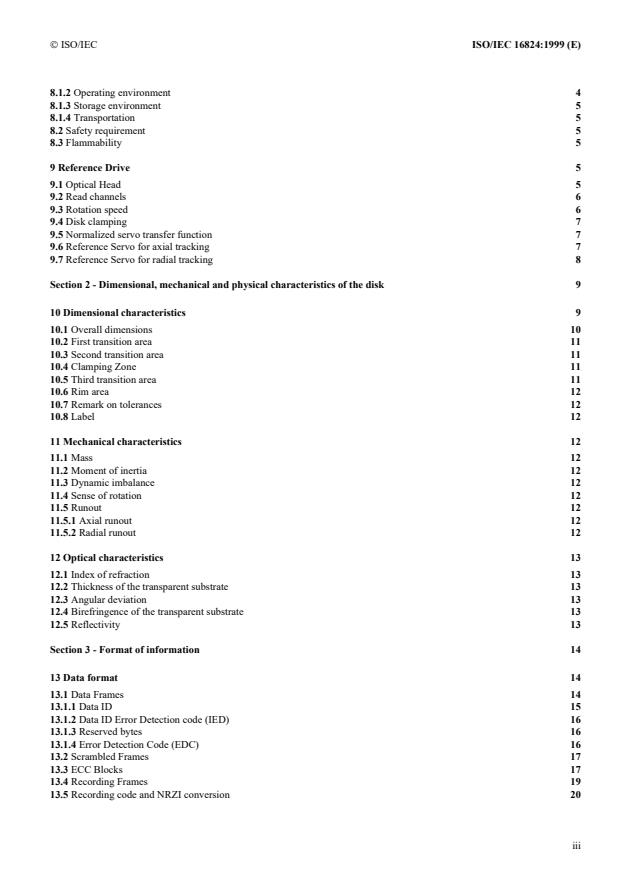
Contents Page
Section 1 - General 1
1 Scope 1
2 Conformance 1
2.1 Optical Disk 1
2.2 Generating system 1
2.3 Receiving system 1
3 Normative references 1
4 Definitions 1
4.1 Case 1
4.2 Channel bit 2
4.3 Digital Sum Value (DSV) 2
4.4 Disk Reference Plane 2
4.5 Dummy substrate 2
4.6 Embossed mark 2
4.7 Entrance surface 2
4.8 Land and Groove 2
4.9 Mark 2
4.10 Phase change 2
4.11 Polarization 2
4.12 Recording layer 2
4.13 Sector 2
4.14 Space 2
4.15 Substrate 2
4.16 Track 2
4.17 Track pitch 2
4.18 ZCLV 2
4.19 Zone 2
5 Conventions and notations 2
5.1 Representation of numbers 2
5.2 Names 3
6 List of acronyms 3
7 General description of the optical disk 3
8 General requirements 4
8.1 Environments 4
8.1.1 Test environment 4
© ISO/IEC 1999
All rights reserved. Unless otherwise specified, no part of this publication may be reproduced or utilized in any form or by any means, electronic or
mechanical, including photocopying and microfilm, without permission in writing from the publisher.
ISO/IEC Copyright Office · Case postale 56 · CH-1211 Genève 20 · Switzerland
Printed in Switzerland
ii
ISO/IEC ISO/IEC 16824:1999 (E)
8.1.2 Operating environment 4
8.1.3 Storage environment 5
8.1.4 Transportation 5
8.2 Safety requirement 5
8.3 Flammability 5
9 Reference Drive 5
9.1 Optical Head 5
9.2 Read channels 6
9.3 Rotation speed 6
9.4 Disk clamping 7
9.5 Normalized servo transfer function 7
9.6 Reference Servo for axial tracking 7
9.7 Reference Servo for radial tracking 8
Section 2 - Dimensional, mechanical and physical characteristics of the disk 9
10 Dimensional characteristics 9
10.1 Overall dimensions 10
10.2 First transition area 11
10.3 Second transition area 11
10.4 Clamping Zone 11
10.5 Third transition area 11
10.6 Rim area 12
10.7 Remark on tolerances 12
10.8 Label 12
11 Mechanical characteristics 12
11.1 Mass 12
11.2 Moment of inertia 12
11.3 Dynamic imbalance 12
11.4 Sense of rotation 12
11.5 Runout 12
11.5.1 Axial runout 12
11.5.2 Radial runout 12
12 Optical characteristics 13
12.1 Index of refraction 13
12.2 Thickness of the transparent substrate 13
12.3 Angular deviation 13
12.4 Birefringence of the transparent substrate 13
12.5 Reflectivity 13
Section 3 - Format of information 14
13 Data format 14
13.1 Data Frames 14
13.1.1 Data ID 15
13.1.2 Data ID Error Detection code (IED) 16
13.1.3 Reserved bytes 16
13.1.4 Error Detection Code (EDC) 16
13.2 Scrambled Frames 17
13.3 ECC Blocks 17
13.4 Recording Frames 19
13.5 Recording code and NRZI conversion 20
iii
13.6 Recorded Data Field 21
13.7 DC component suppress Control (DCC) 22
13.7.1 DCC for the data in the Rewritable Area 22
13.7.2 DCC for the data in the Embossed Area 22
13.7.3 PID and PED recording 23
14 Track format 23
14.1 Track shape 23
14.2 Track path 24
14.3 Track pitch 24
14.4 Track layout 24
14.5 Rotation speed 24
14.6 Radial alignment 25
14.7 Sector number 25
15 Sector format 26
15.1 Sector layout 26
15.1.1 Sector layout in the Rewritable Area 26
15.1.2 Sector layout in the Embossed Area 26
15.2 VFO fields 27
15.3 Address Mark (AM) 28
15.4 Physical ID (PID) fields 28
15.5 PID Error Detection code (PED) fields 29
15.6 Postamble 1 and Postamble 2 (PA 1, PA 2) fields 29
15.7 Mirror field 31
15.8 Gap field 31
15.9 Guard 1 field 31
15.10 Pre-Synchronous code (PS) field 31
15.11 Data field 31
15.12 Postamble 3 (PA 3) field 31
15.13 Guard 2 field 31
15.14 Recording polarity randomization 31
15.15 Buffer field 32
16 Format of the Information Zone 32
16.1 Division of the Information Zone 32
16.2 Lead-in Zone 34
16.2.1 Structure of Lead-in Zone 34
16.2.2 Initial Zone 34
16.2.3 Reference Code Zone 34
16.2.4 Buffer Zone 1 34
16.2.5 Buffer Zone 2 35
16.2.6 Control Data Zone 35
16.2.7 Connection Zone 39
16.2.8 Guard Track Zones 1 and 2 40
16.2.9 Disk Test Zone 40
16.2.10 Drive Test Zone 40
16.2.11 Reserved Zone 40
16.2.12 DMA 1 and DMA 2 40
16.3 Data Zone 41
16.3.1 Structure of Data Zone and of the Defect Management Areas (DMAs) 41
16.3.2 Guard Track Zones 41
16.3.3 Partitioning 41
16.4 Lead-out Zone 43
16.4.1 Structure of Lead-out Zone 43
16.4.2 DMA 3 and DMA 4 43
16.4.3 Reserved Zone 43
iv
ISO/IEC ISO/IEC 16824:1999 (E)
16.4.4 Guard Track Zone 1 43
16.4.5 Drive Test Zone 43
16.4.6 Disk Test Zone 43
16.4.7 Guard Track Zone 2 43
17 Defect management 43
17.1 Defect Management Areas (DMAs) 43
17.2 Disk Definition Structure (DDS) 44
17.3 Spare sectors 46
17.4 Slipping Algorithm 47
17.5 Linear Replacement Algorithm 47
17.6 Primary Defect List (PDL) 48
17.7 Secondary Defect List (SDL) 50
17.8 Formatting of the disk 51
17.8.1 Full and Partial Certification 52
17.8.2 Initialization 52
17.8.3 Re-initialization 52
17.8.4 Data field number resulting from Initialization and Re-initialization 53
17.9 Write procedure 54
17.10 Read procedure 54
17.10.1 Blank ECC block 54
17.10.2 Read procedure 54
Section 4 - Characteristics of embossed information 55
18 Method of testing 55
18.1 Environment 55
18.2 Reference Drive 55
18.2.1 Optics and mechanics 55
18.2.2 Read power 55
18.2.3 Read channels 55
18.2.4 Tracking channel 55
18.2.5 Tracking 55
18.3 Definition of signals 55
19 Signals from lands and grooves 60
19.1 Push-pull signal
19.2 Divided push-pull signal 60
19.3 On-track signal 61
19.4 Phase depth 61
19.5 Wobble signal 61
20 Signals from Header fields 62
20.1 VFO 1 and VFO 2 62
20.2 Address Mark, PID, PED and Postamble 62
20.3 Signals from Header 1, Header 2, Header 3 and Header 4 63
20.4 Phase depth 63
21 Signals from Embossed Area 63
21.1 High Frequency (HF) signal 63
21.1.1 Modulated amplitude 63
21.1.2 Signal asymmetry 64
21.1.3 Cross-track signal 64
21.2 Jitter 64
v
21.3 Servo signal 64
21.3.1 Differential phase tracking error signal 64
21.3.2 Tangential push-pull signal 64
Section 5 - Characteristics of the recording layer 65
22 Method of testing 65
22.1 Environment 65
22.2 Reference Drive 65
22.2.1 Optics and mechanics 66
22.2.2 Read power 66
22.2.3 Read channel 66
22.2.4 Tracking 66
22.3 Write conditions 66
22.3.1 Write pulse 66
22.3.2 Write power 66
22.4 Definition of signals 66
23 Write characteristics 67
23.1 Modulated amplitude and Signal asymmetry 67
23.2 Jitter 67
Section 6 - Characteristics of user data 67
24 Method of testing 67
Annexes
A - Measurement of the angular deviation a68
B - Measurement of birefringence 70
C - Measurement of the differential phase tracking error 72
D - Reflectivity calibration and measuring method 76
E - Tapered cone for disk clamping 78
F - Measuring conditions for the operation signals 79
G - 8-to-16 Recording code with RLL (2,10) requirements 81
H - Definition of the write pulse 91
J - Guideline for randomization of the Gap length, the Guard 1 length and the recording polarity 93
K - Transportation 94
L - Guideline for sector replacement 95
vi
ISO/IEC ISO/IEC 16824:1999 (E)
Foreword
ISO (the International Organization for Standardization) and IEC (the International Electrotechnical Commission) form the
specialized system for worldwide standardization. National bodies that are members of ISO or IEC participate in the
development of International Standards through technical committees established by the respective organization to deal with
particular fields of technical activity. ISO and IEC technical committees collaborate in fields of mutual interest. Other
international organizations, governmental and non-governmental, in liaison with ISO and IEC, also take part in the work.
International Standards are drafted in accordance with the rules given in the ISO/IEC Directives, Part 3.
In the field of information technology, ISO and IEC have established a joint technical committee, ISO/IEC JTC 1. Draft
International Standards adopted by the joint technical committee are circulated to national bodies for voting. Publication as an
International Standard requires approval by at least 75 % of the national bodies casting a vote.
This International Standard was prepared by JISC (as Standard JIS X 6243-1998) with document support and contribution
from ECMA and was adopted, under a special “fast-track procedure”, by Joint Technical Committee ISO/IEC JTC 1,
Information technology, in parallel with its approval by national bodies of ISO and IEC.
Annexes A to H form a normative part of this International Standard. Annexes J to L are for information only.
vii
©
INTERNATIONAL STANDARD ISO/IEC ISO/IEC 16824:1999 (E)
Information technology — 120 mm DVD rewritable disk (DVD-RAM)
Section 1 - General
1 Scope
This International Standard specifies the mechanical, physical and optical characteristics of a 120 mm optical disk to enable
interchange of such disks. It specifies the quality of the recorded signals, the format of the data and the recording method,
thereby allowing for information interchange by means of such disks. The data can be written, read and overwritten many
times using the phase change method. This disk is identified as DVD-RAM.
This International Standard specifies
- two related but different Types of this disk (see clause 7),
- the conditions for conformance,
- the environments in which the disk is to be tested, operated and stored,
- the mechanical, physical and dimensional characteristics of the disk, so as to provide mechanical interchange between data
processing systems,
- the format of the information on the disk, including the physical disposition of the tracks and sectors, the error correcting
codes and the coding method,
- the characteristics of the signals recorded on the disk, thus enabling data processing systems to read the data from the disk.
This International Standard provides for the interchange of disks between optical disk drives. Together with a standard for
volume and file structure, it provides for full data interchange between data processing systems. The optical disks specified by
this International Standard may be enclosed in cases according to ISO/IEC 16825 as specified therein.
2 Conformance
2.1 Optical Disk
A claim of conformance with this International Standard shall specify the Type implemented. An optical disk shall be in
conformance with this International Standard if it meets all mandatory requirements specified for this Type.
2.2 Generating system
A generating system shall be in conformance with this International Standard if the optical disk it generates is in accordance
with 2.1.
2.3 Receiving system
A receiving system shall be in conformance with this International Standard if it is able to handle both Types of optical disk
according to 2.1.
3 Normative references
The following normative documents contain provisions which, through reference in this text, constitute provisions of this
International Standard. For dated references, subsequent amendments to, or revisions of, any of these publications do not apply.
However, parties to agreements based on this International Standard are encouraged to investigate the possibility of applying the
most recent editions of the normative documents indicated below. For undated references, the latest edition of the normative
document referred to applies. Members of ISO and IEC maintain registers of currently valid International Standards.
ISO 950:1991, Safety of information technology equipment.
ISO/IEC 16825:1999, Information technology — Case for 120 mm DVD-RAM disks.
4 Definitions
For the purposes of this International Standard, the following definitions apply.
The housing for an optical disk, that protects the disk and facilitates disk interchange.
4.1 Case:
4.2 Channel bit: The elements by which the binary values ZERO and ONE are represented by marks and pits on the
disk.
4.3 Digital Sum Value (DSV): The arithmetic sum obtained from a bit stream by allocating the decimal value 1 to
Channel bits set to ONE and the decimal value -1 to Channel bits set to ZERO.
4.4 Disk Reference Plane: A plane defined by the perfectly flat annular surface of an ideal spindle onto which the
clamping area of the disk is clamped, and which is normal to the axis of rotation.
4.5 Dummy substrate: A layer which may be transparent or not, provided for the mechanical support of the disk
and/or a recording layer.
4.6 Embossed mark: A mark so formed as to be unalterable by optical means.
4.7 Entrance surface: The surface of the disk onto which the optical beam first impinges.
4.8 Land and Groove: A trench-like feature of the disk, applied before the recording of any information, and used
to define the track location. The groove is located nearer to the entrance surface than the land. The recording is made either on
the centre of the groove or on the centre of the land.
4.9 Mark: A feature of the Recording layer which may take the form of an amorphous domain, a pit, or any other type
or form that can be sensed by the optical system. The pattern of marks and spaces represents the data on the disk.
4.10 Phase change: A physical effect by which the area of a recording layer irradiated by a laser beam is heated so as
to change from an amorphous state to a crystalline state and vice versa.
4.11 Polarization: The direction of polarization of an optical beam is the direction of the electric vector of the beam.
Note - The plane of polarization is the plane containing the electric vector and the direction of propagation of the beam. The polarization is right-handed
when to an observer looking in the direction of propagation of the beam, the end-point of the electric vector would appear to describe an ellipse in the
clockwise sense.
4.12 Recording layer: A layer of the disk on, or in, which data is written during manufacture and/or use.
4.13 Sector: The smallest addressable part of a track in the Information Zone of a disk that can be accessed
independently of other addressable parts.
4.14 Space: A feature of the recording layer which may take the form of a crystalline domain, a non-pit or any other
type or form that can be sensed by the optical system. The pattern of marks and spaces represents the data on the disk.
4.15 Substrate: A transparent layer of the disk, provided for mechanical support of the recorded layer(s), through
which the optical beam can access a recording layer.
4.16 Track: A 360° turn of a continuous spiral.
4.17 Track pitch: The distance between centrelines of adjacent tracks (a groove and a land), measured in a radial
direction.
4.18 ZCLV: A disk format requiring Zoned Constant Linear Velocity operations.
4.19 Zone: An annular area of the disk.
5 Conventions and notations
5.1 Representation of numbers
A measured value is rounded off to the least significant digit of the corresponding specified value. For instance, it implies that
a specified value of 1,26 with a positive tolerance of + 0,01 and a negative tolerance of - 0,02 allows a range of measured
values from 1,235 to 1,275.
Numbers in decimal notations are represented by the digits 0 to 9.
Numbers in hexadecimal notation are represented by the hexadecimal digits 0 to 9 and A to F in parentheses.
The setting of bits is denoted by ZERO and ONE.
Numbers in binary notations and bit patterns are represented by strings of digits 0 and 1, with the most significant bit shown to
the left.
Negative values of numbers in binary notation are given as Two’s complement.
ISO/IEC ISO/IEC 16824:1999 (E)
In each field the data is recorded so that the most significant byte (MSB), identified as Byte 0, is recorded first and the least
significant byte (LSB) last.
In a field of 8n bits, bit b shall be the most significant bit (msb) and bit b the least significant bit (lsb). Bit b is
(8n-1) 0 (8n-1)
recorded first.
A binary digit which can be set indifferently to ZERO or to ONE is represented by “x”.
5.2 Names
The names of entities, e.g. specific tracks, fields, zones, etc. are given a capital initial.
6 List of acronyms
AM Address Mark NRZ Non Return to Zero
BCA Burst Cutting Area NRZI Non Return to Zero Inverted
BPF Band Pass Filter PA Postamble
DC Direct Current PDL Primary Defect List
DCC DC Component Suppress Control PED P(ID) Error Detection code
DDS Disk Definition Structure PI Parity of Inner-code
DMA Defect Management Area PID Physical Identification Data
DSV Digital Sum Value PLL Phase Locked Loop
ECC Error Correction Code PO Parity of Outer-code
EDC Error Detection Code PS Pre-Synchronous code
FRM Forced Reassignment Marking RS Reed-Solomon code
HF High Frequency SDL Secondary Defect List
ID Identification Data SYNC Code Synchronous Code
IED ID Error Detection code VFO Variable Frequency Oscillator
LPF Low Pass Filter ZCLV Zoned Constant Linear Velocity
LSN Logical Sector Number
7 General description of the optical disk
The optical disk that is the subject of this International Standard consists of two substrates bonded together by an adhesive
layer, so that the recording layer(s) is on the inside. The centring of the disk is performed on the edge of the centre hole of the
assembled disk on the side currently read. Clamping is performed in the Clamping Zone. This International Standard provides
for two Types of such disks.
Type 1S consists of a substrate, a single recording layer and a dummy substrate. The recording layer can be accessed
from one side only. The nominal capacity is 2,6 Gbytes.
Type 2S consists of two substrates and two recording layers. From one side of the disk, only one of these recording
layers can be accessed. The nominal capacity is 5,2 Gbytes.
Alternatively, in Type 1S, the recording layer may be placed, for instance embossed, on the dummy substrate.
When used with the case specified in International Standard ISO/IEC 16825, a disk of Type 1S may be enclosed in either of
the three case Types; a disk of Type 2S is to be enclosed only in a Type 1 case.
Data can be written onto the disk as marks in the form of amorphous spots in the crystalline recording layer and can be
overwritten with a focused optical beam, using the phase change effect between amorphous and crystalline states. The data can
be read with a focused optical beam, using phase change effect as the reflective difference between amorphous and crystalline
states. The beam accesses the recording layer through a transparent substrate of the disk.
Part of the disk contains read-only data for the drive in the form of pits embossed by the manufacturer. This data can be read
using the diffraction of the optical beam by the embossed pits.
Figure 1 shows schematically the two Types.
Entrancefacesur
ttubsraeS
dingRecorlyaer
ypeT1S
vehyre
Dummyubstrates
Entrancefacesur
ttubsraeS
dingRecorlyare
ypeT2S
vehyre
dingRecorlyare
ttubsraeSEntrancefacesur
A
Figure 1 - Types of 120 mm DVD-RAM disks
8 General requirements
8.1 Environments
8.1.1 Test environment
In the test environment, the air immediately surrounding the disk shall have the following properties.
Temperature : 23 °C ± 2 °C
Relative humidity : 50 % ± 5 %
Atmospheric pressure : 86 kPa to 106 kPa
No condensation on or in the disk shall occur. Before testing, the disk shall be conditioned in this environment for 48 hours
minimum. It is recommended that, before testing, the entrance surface of the optical disk shall be cleaned according to the
instructions of the manufacturer of the disk.
Unless otherwise stated, all tests and measurements shall be made in this test environment.
8.1.2 Operating environment
This International Standard requires that a disk which meets all requirements of this International Standard in the specified test
environment shall provide data interchange over the specified ranges of environmental parameters in the operating
environment.
The operating environment is the environment where the air immediately surrounding the disk has the following properties.
Temperature : 5 °C to 60 °C
Relative humidity : 3 % to 85 %
3 3
Absolute humidity : 1 g/m to 30 g/m
Temperature gradient : 10 °C/h max.
Relative humidity gradient : 10 %/h max.
No condensation on the disk shall occur. If the disk has been exposed to conditions outside those specified above, it shall be
acclimatized in the operating environment for at least 2 h before use.
97-0122-
la Adesi
la Adesi
ISO/IEC ISO/IEC 16824:1999 (E)
8.1.3 Storage environment
The storage environment is defined as an environment where the air immediately surrounding the disk shall have the following
properties.
Temperature : -10 °C to 50 °C
Relative humidity : 3 % to 85 %
3 3
Absolute humidity : 1 g/m to 30 g/m
Atmospheric pressure : 75 kPa to 106 kPa
Temperature gradient : 10 °C/h max.
Relative humidity gradient : 10 %/h max.
No condensation on the disk shall occur.
8.1.4 Transportation
This International Standard does not specify requirements for transportation; guidance is given in annex K.
8.2 Safety requirement
The optical disk shall satisfy the safety requirements of IEC 950, when used in the intended manner or in any foreseeable use
in an information processing system.
8.3 Flammability
The disk shall be made from materials that comply with the flammability class for HB materials, or better, as specified in
IEC 950.
9 Reference Drive
The Reference Drive shall be used for the measurement of optical parameters for conformance with the requirements of this
International Standard. The critical components of this device have the characteristics specified in this clause.
9.1 Optical Head
The basic set-up of the optical system of the Reference Drive used for measuring the overwrite and read parameters are shown
in figure 2. Different components and locations of components are permitted, provided that the performance remains the same
as that of the set-up in figure 2. The optical system shall be such that the detected light reflected from the entrance surface of
the disk is minimized so as not to influence the accuracy of the measurements.
H
1H
3IdilRaadicireton
+1
aRedlnneCha1+
+
+II
ba
aRedlnneCha2+
+
crakngiTneChaln
+II
dcI
H2
H4
ranthotoprd2
IIII
abcd
G
BDEACF
A
A Laser diode F Optical disk
B Collimator lens G Quadrant photo detector
C Polarizing beam splitter H , H , H , H d.c.-coupled amplifier
1 2 3 4
D Quarter-wave plate I , I , I , I Output currents from the quadrant photo
a b c d
detector
E Objective lens
Figure 2 - Optical system of the Reference Drive
The combination of polarizing beam splitter C and a quarter-wave plate D shall separate the entrance optical beam from a laser
diode A and the reflected optical beam from an optical disk F. The beam splitter C shall have a p-s intensity reflectance ratio
of at least 100.
The focused optical beam used for writing and reading data shall have the following properties :
+10 nm
a) Wavelength (l) 650 nm
-5 nm
a) Polarization circularly polarized light
b) Polarizing beam splitter shall be used unless otherwise stated.
c) Numerical aperture 0,60 ± 0,01
d) Light intensity at the rim of
the pupil of the objective lens 30 % to 55 % of the maximum intensity level
a) Wave front aberration 0,033 l rms max.
b) Relative Intensity Noise (RIN) of the laser diode
10 log [(a.c. power density/Hz) / d.c. light power] -134 dB/Hz max.
9.2 Read channels
A Read channel 1 shall detect the total amount of light in the exit pupil of the objective lens.
A Read channel 2 shall detect the differential output of the quadrant photo detectors.
Frequency characteristics of the equalizer, characteristics of the PLL, slicer etc. are specified in annex F.
9.3 Rotation speed
The actual rotation speed shall be within 1 % of the nominal rotation speed(s) specified in table 3.
97-0123-
etecto Quad
ISO/IEC ISO/IEC 16824:1999 (E)
9.4 Disk clamping
Clamping force : 2,0 N ± 0,5 N
Tapered cone angle : 40,0° ± 0,5° (see annex E)
9.5 Normalized servo transfer function
In order to specify the servo system for axial and radial tracking, a function H is used (equation I). It specifies the nominal
s
values of the open-loop transfer function H of the Reference Servo(s) in the frequency range 23,1 Hz to 10 kHz.
3iw
1+
1ww
oo
H()w=··(I)
i
s
Łłiw3 iw
1+
w3
o
where
w = 2pƒ
w=2pƒ
o o
i = -1
ƒ is the 0 dB crossover frequency of the open loop transfer function. The crossover frequencies of the lead-lag network of the
o
servo are given by
lead break frequency ƒ = ƒ · 1/3
1 o
lag break frequency ƒ = ƒ· 3
2 o
9.6 Reference Servo for axial tracking
For an open loop transfer function H of the Reference Servo for axial tracking, ‰1+H‰ is limited as schematically shown by
the shaded surface of figure 3.
anGi(dB)
086,
066,
362,
144,
640,
8,0ms/
916,123,839,10010000
AFreque ncy(Hz)
Figure 3 - Reference Servo for axial tracking
97-0164-
Bandwidth 100 Hz to 10 kHz
‰ 1 + H ‰ shall be within 20 % of ‰1+H‰.
s
The crossover frequency ƒ = w / 2p shall be specified by equation (II), where a shall be 1,5 times larger than the
o o max.
expected maximum axial acceleration of 8 m/s . The tracking error e shall not exceed 0,23 mm. Thus the crossover
max.
frequency ƒ shall be
o
1 3a1 81··,5 3
max
f = = = 2,0 kHz (II)
0-6
e
2p2p0,23·10
max
The axial tracking error e is the peak deviation measured axially above or below the 0 level.
max.
Bandwidth 23,1 Hz to 100 Hz
‰ 1 + H ‰ shall be within the limits defined by the following four points.
40,6 dB at 100 Hz (‰ 1 + Hs ‰ - 20% at 100 Hz )
66,0 dB at 23,1 Hz (‰ 1 + Hs ‰ - 20% at 23,1 Hz )
86,0 dB at 23,1 Hz (‰ 1 + Hs ‰ - 20% at 23,1 Hz add 20 dB)
44,1 dB at 100 Hz (‰ 1 + Hs ‰ + 20% at 100 Hz )
Bandwidth 16,9 Hz to 23,1 Hz
‰ 1 + H ‰ shall be between 66,0 dB and 86,0 dB.
9.7 Reference Servo for radial tracking
For an open-loop transfer function H of the Reference Servo for radial tracking, ‰1+H‰ is limited as schematically shown by
the shaded surface of figure 4.
an(dB)Gi
983,
963,
161,
451,
947,
81,m/s
916,839,10010000
A
Frequency(Hz)
Figure 4 - Reference Servo for radial tracking
97-0165-
ISO/IEC ISO/IEC 16824:1999 (E)
Bandwidth from 100 Hz to 10 kHz
‰ 1 + H ‰ shall be within 20 % of‰1 + H‰.
s
The crossover frequency ƒ = w / 2p shall be specified by equation (III), where a shall be 1,5 times larger than the
o o max.
expected maximum radial acceleration of 1,8 m/s . The tracking error e shall not exceed 0,022 mm. Thus the crossover
max.
frequency ƒ shall be
o
··
131a18,,15 3
max
f = = = 3,0 kHz (III)
0-6
2pe 2p0,022·10
max
The radial tracking error is the peak deviation measured radially inwards or outwards the 0 level.
Bandwidth from 39,8 Hz to 100 Hz
‰ 1 + H ‰ shall be within the limits defined by the following four points.
47,9 dB at 100 Hz (‰ 1 + Hs ‰ - 20% at 100 Hz )
63,9 dB at 39,8 Hz (‰ 1 + Hs ‰ - 20% at 39,8 Hz )
83,9 dB at 39,8 Hz (‰ 1 + Hs ‰ - 20% at 39,8 Hz add 20 dB)
51,4 dB at 100 Hz (‰ 1 + Hs ‰ + 20% at 100 Hz )
Bandwidth from 16,9 Hz to 39,8 Hz
‰ 1 + H ‰ shall be between 63,9 dB and 83,9 dB.
Section 2 - Dimensional, mechanical and physical characteristics of the disk
10 Dimensional characteristics
Dimensional characteristics are specified for those parameters deemed mandatory for interchange and compatible use of the
disk. Where there is freedom of design, only the functional characteristics of the elements described are indicated. The
enclosed drawings show the dimensional requirements in summarized form. The different parts of the disk are described from
the centre hole to the outside rim.
The dimensions are referred to two Reference Planes P and Q.
Reference Plane P is the primary Reference Plane. It is the plane on which the bottom surface of the Clamping Zone (see 10.4)
rests.
Reference Plane Q is the plane parallel to Reference Plane P at the height of the top surface of the Clamping Zone.
See figures 5 to 7.
d
d
0015,
mmn.mi
A
Figure 5 - Hole of the assembled disk
97-0001-
d
Qhh
ee
hh
3P4
d
d
d
d
d
d
A
Figure 6 - Areas of the disk
hh
Q
eemax.
h
P
h
d
d
A
Figure 7 - Rim area
10.1 Overall dimensions
The disk shall have an overall diameter
d = 120,00 mm – 0,30 mm
The centre hole of a substrate or a dummy substrate shall have a diameter
+ 0,15 mm
d = 15,00 mm
- 0,00 mm
97-0127-
97-0126-
ISO/IEC ISO/IEC 16824:1999 (E)
The diameter of the hole of an assembled disk, i.e. with both parts bonded together, shall be 15,00 mm min., see figure 5.
There shall be no burr on both edges of the centre hole.
The edge of the centre hole shall be rounded off or chamfered. The rounding radius shall be 0,1 mm max. The height of the
chamfer shall not exceed 0,1 mm.
The thickness of the disk, including adhesive layer, spacer(s) and label(s), shall be
+ 0,30 mm
e = 1,20 mm
- 0,06 mm
10.2 First transition area
In the area extending between diameter d and diameter
d = 16,0 mm min.
the surface of the disk is permitted to be above Reference Plane P and/or below Reference Plane Q by 0,10 mm max.
10.3 Second transition area
This area shall extend between diameter d and diameter
d = 22,0 mm max.
In this area the disk may have an uneven surface or burrs up to 0,05 mm max. beyond Reference Planes P and/or Q.
10.4 Clamping Zone
This zone shall extend between diameter d and diameter
d = 33,0 mm min.
Each side of the Clamping Zone shall be flat within 0,1 mm. The top side of the Clamping Zone, i.e. that of Reference Plane Q
shall be parallel to the bottom side, i.e. that of Reference Plane P within 0,1 mm.
In the Clamping Zone the thickness e of the disk shall be
+ 0,20 mm
e = 1,20 mm
- 0,10 mm
10.5 Third transition area
This area shall extend between diameter d and diameter
d = 44,0 mm max.
In this area the top surface is permitted to be above Reference Plane Q by
h = 0,25 mm max.
or below Reference Plane Q by
h = 0,10 mm max.
The bottom surface is permitted to be above Reference Plane P by
h = 0,10 mm max.
or below Reference Plane P by
h = 0,25 mm max.
An Information Zone shall extend from diameter d to diameter
+ 0,0 mm
d = 117,2 mm
- 0,4 mm
10.6 Rim area
The rim area shall extend from diameter d to diameter d (see figure 6). In this area the top surface is permitted to be above
7 1
Reference Plane Q by
h = 0,1 mm max.
and the bottom surface is permitted to be below Reference Plane P by
h = 0,1 mm max.
The total thickness of this area shall not be greater than 1,50 mm, i.e. the maximum value of e . The thickness of the rim
proper shall be
e = 0,6 mm min.
The outer edges of the disk shall be either rounded off with a rounding radius of 0,2 mm max. or be chamfered over
h = 0,2 mm max.
h = 0,2 mm max.
10.7 Remark on tolerances
All heights specified in the preceding clauses and indicated by h are independent from each other. This means that, for
i
example, if the top surface of the third transition area is below Reference Plane Q by up to h , there is no implication that the
bottom surface of this area has to be above Reference Plane P by up to h . Where dimensions have the same - generally
maximum - numerical value, this does not imply that the actual values have to be identical.
10.8 Label
Type 1S disks not enclosed in a case of Type 1 shall have a label placed on the side of the disk opposite the entrance surface
for the information to which the label is related. The label shall be placed either on an outer surface of the disk or inside the
disk bonding plane. In the former case, the label shall not extend over the Clamping Zone. In the latter case, the label may
extend over the Clamping Zone. In both cases, the label shall not extend over the rim of the centre hole nor over the outer edge
of the disk.
11 Mechanical characteristics
11.1 Mass
The mass of the disk shall be in the range 13 g to 20 g.
11.2 Moment of inertia
. 2
The moment of inertia of the disk, relative to its rotation axis, shall not exceed 0,040 g m .
11.3 Dynamic imbalance
.
The dynamic imbalance of the disk, relative to its rotation axis, shall not exceed 0,010 g m.
11.4 Sense of rotation
The sense of rotation of the disk shall be counterclockwise as seen by the optical system.
11.5 Runout
11.5.1 Axial runout
When measured by the Optical Head with the Reference Servo for axial tracking, the disk rotating at the scanning velocity, the
deviation of the recorded layer from its nominal position in the direction normal to the Reference Planes shall not exceed 0,3
mm.
The residual tracking error below 10 kHz, measured using the Reference Servo for axial tracking, shall not exceed 0,23 mm.
The measuring filter shall be a Butterworth LPF, ƒ (-3dB) : 10 kHz, slope : -80 dB/decade.
c
11.5.2 Radial runout
The runout of the outer edge of the disk shall not exceed 0,3 mm, peak-to-peak.
The radial runout of tracks shall not exceed 50 mm, peak-to-peak.
ISO/IEC ISO/IEC 16824:1999 (E)
The residual tracking error below 1,7 kHz, measured using the Reference Servo for radial tracking, shall not exceed 0,022 mm.
The measuring filter shall be a Butterworth LPF, ƒ (-3dB) : 1,7 kHz, slope : -80 dB/decade.
c
The rms noise value of the residual error signal in the frequency band from 1,7 kHz to 10 kHz, measured with an integration
time of 20 ms, using the Reference Servo for radial tracking, shall not exceed 0,016 mm in the Rewritable Area and shall not
exceed 0,025 mm in the Embossed Area (refer to clause 13). The measuring filter shall be a Butterworth BPF, frequency range
(-3 dB) : 1,7 kHz, slope : +80 dB/decade to 10 kHz, slope : - 80 dB/decade.
12 Optical characteristics
12.1 Index of refraction
The index of refraction of the transparent substrate shall be 1,55 – 0,10.
12.2 Thickness of the transparent substrate
The thickness of the transparent substrate shall be a function of its index of refraction as specified in figure 8.
12.3 Angular deviation
The angular deviation is the angle a between a parallel incident beam and the reflected beam. The incident beam shall have a
diameter in the range 0,3 mm to 3,0 mm. This angle includes deflection due to the entrance surface and to unparallelism of the
recorded layer, see figure A.1. It shall meet the following requirements when measured according to annex A.
In radial direction :a = 0,70° max.
In tangential direction :a = 0,30° max.
12.4 Birefringence of the transparent substrate
The birefringence of the transparent substrate shall be 60 nm max. when measured according to annex B.
12.5 Reflectivity
When measured according to annex D, the reflectivity of the recorded layer(s) shall be in the range 15 % to 25 %.
Thicsknes
(mm)
45;(1,643)0,
640,
56;(1,630)0,
65;(1,630)0,
620,
600,
580,
45;(1,583)0,
56;(1,570)0,65;(1,570)0,
xIndefo
ontir
401,501,1,60701,
A
Figure 8 - Thickness of the substrate
Section 3 - Format of information
13 Data format
The data received from the host, called Main Data, is formatted in a number of steps before being recorded on the disk. It is
transformed successively into
- a Data Frame
- a Scrambled Frame
- an ECC Block
- a Recording Frame
- a Recorded Data Field
These steps are specified in the following clauses.
13.1 Data Frames
A Data Frame shall consist of 2 064 bytes arranged in an array of 12 rows containing each 172 bytes (see figure 9). The first
row shall start with three fields, called Data Identification Data (Data ID), ID Error Detection Code (IED), and Reserved bytes
(RSV), followed by 160 Main Data bytes. The next 10 rows shall each contain 172 Main Data bytes, and the last row shall
contain 168 Main Data bytes followed by four bytes for recording an Error Detection Code (EDC). The 2 048 Main Data bytes
are identified as D to D .
0 2047
96-0300-
efrac
ISO/IEC ISO/IEC 16824:1999 (E)
172byets
2bytse4bytse6bytse
anMiData601bytes(DotD)DIEIDVRS0159
anMiData721bytes(DotD)
anMiData172bytes(DotD)
rows
anMiData721bytes(DtoD)
CanMiData681bytes(DtoD)
4bytse
A
Figure 9 - Data Frame
13.1.1 Data ID
This field shall consist of four bytes, the bits of which are numbered consecutively from b (lsb) to b (msb), see figures 10
0 31
and 11.
b b b b
31 24 23 0
Data Field Information Data Field Number
Figure 10 - Data ID
b b b b b b b b
31 30 29 28 27 26 25 24
Sector Tracking Reflectivity Reserved Zone type Data type Layer
Format type method number
Figure 11 - Data Field Information
The bits of the Data Field Information field shall be set as follows.
Bit b shall be set to ONE, indicating Zoned format type
Bit b shall be set to
ZERO in the Embossed Area, indicating pit tracking (see 16.1)
ONE in the Rewritable Area, indicating groove tracking (see 16.1)
Bit b shall be set to ONE, indicating that the reflectivity does not exceed 40 %
Bit b shall be set to ZERO
97-0151-
ED
Data
Bits b and b shall be set to
27 26
ZERO ZERO in the Data Zone
ZERO ONE in the Lead-in Zone
ONE ZERO in the Lead-out Zone
Bit b shall be set to
ZERO in the Embossed Area.
ONE in the Rewritable Area
Bit b shall be set to ZERO, indicating that through an entrance surface only one recording layer
can be accessed.
Bits b to b shall be set to
23 0
- to the sector number in the Embossed Area (see 16.1), in the DMAs.(see 17.1)and in the
Reserved Zones of the Lead-in Zone (see 16.2) and of the Lead-out Zone (see 16.4),
- to the values specified in 17.8.4 in the Data Zone (see 16.3),
Other settings are prohibited by this International Standard, see also annex L.
13.1.2 Data ID Error Detection code (IED)
When identifying all bytes of the array shown in figure 9 as C for i = 0 to 11 and j = 0 to171, the bytes of IED are represented
i,j
by C for j = 4 to 5. Their setting is obtained as follows.
0,j
5-j 2
IED(x) = C x = I(x) x mod G (x)
∑
0,j E
j=4
where
3-j
I(x) =∑ C x
0,j
j=0
k
G (x) = P ( x + a)
E
k=0
8 4 3 2
a is the primitive root of the primitive polynomial P(x) = x + x + x + x + 1
13.1.3 Reserved bytes
All the bytes of this 6-byte field shall be set to (00).
13.1.4 Error Detection Code (EDC)
This 4-byte field shall contain an Error Detection Code computed over the preceding 2 060 bytes of the Data Frame.
Considering the Data Frame as a single bit field starting with the most significant bit of the first byte of the ID field and ending
with the least significant bit of the EDC field, then this msb will be b and the lsb will be b . Each bit b of the EDC is as
16 511 0 i
follows for i = 31 to 0 :
i
EDC(x) = ∑ b x = I(x) mod G(x)
i
i=31
where
i
I(x) = ∑ b x
i
i=16 511
32 31 4
G(x) = x + x + x + 1
ISO/IEC ISO/IEC 16824:1999 (E)
13.2 Scrambled Frames
The 2 048 Main Data bytes shall be scrambled by means of the circuit shown in figure 12 which shall consist of a feedback bit
shift register in which bits r (msb) to r (lsb) represent a scrambling byte at each 8-bit shift. At the beginning of the
7 0
scrambling procedure of a Data Frame, positions r to r shall be pre-set to the value(s) specified in table 3. The same pre-set
14 0
value shall be used for 16 consecutive Data Frames. After 16 groups of 16 Data Frames, the sequence is repeated. The initial
pre-set number is equal to the value represented by bits b (msb) to bit b (lsb) of the Data ID field of the Data Frame. Table 1
7 4
specifies the initial pre-set value of the shift register corresponding to the 16 initial pre-set numbers.
Table 1 - Initial values of the shift register
Initial pre-set Initial pre-set Initial pre-set Initial pre-set
number value number value
(0) (0001) (8) (0010)
(1) (5500) (9) (5000)
(2) (0002) (A) (0020)
(3) (2A00) (B) (2001)
(4) (0004) (C) (0040)
(5) (5400) (D) (4002)
(6) (0008) (E) (0080)
(7) (2800) (F) (0005)
+
r r r r
r r r r r r r r r r r
14 13 12 11854311097620
A
Figure 12 - Feedback shift register
The part of the initial value of r to r is taken out as scrambling byte S . After that, 8-bit shift is repeated 2 047 times and the
7 0 0
following 2 047 bytes shall be taken from r to r as scrambling bytes S to S . The Main Data bytes D of the Data Frame
7 0 1 2 047 k
become scrambled bytes D’ where
k
D’ = D ¯ S for k = 0 to 2 047
k k k
¯ stands for Exclusive OR
13.3 ECC Blocks
An ECC Block is formed by arranging 16 consecutive Scrambled Frames in an array of 192 rows of 172 bytes each (see figure
13). To each of the 172 columns, 16 bytes of Parity of Outer Code are added, then, to each of the resulting 208 rows, 10 byte
of Parity of Inner Code are added. Thus a complete ECC Block comprises 208 rows of 182 bytes each. The bytes of this array
are identified as B as follows, where i is the row number and j the column number.
i,j
B for i = 0 to 191 and j = 0 to 171 are bytes from the Scrambled Frames
i,j
B for i = 192 to 207 and j = 0 to 171 are bytes of the Parity of Outer Code
i,j
B for i = 0 to 207 and j = 172 to 181 are bytes of the Parity of Inner Code
i,j
97-0021-
172byets10byets
BBBBBB0,217 0,118
0,00,017 0,117
0,1
BBBBBB1,017 1,217
1,117 1,118
1,01,1
BBBBBB2,217
2,12,02,117 2,118
2,017
rows
BBBBBB189,181
189,172
1809, 1819, 189,1701918,71
BBBBBB190,181
190,1701019,71
1900, 1910, 190,172
BBBBBB191,171 191,172
1911, 191,181
1901, 191,170
BBBBBB192,171 192,181
1912, 192,170 192,172
1902,
16wsro
BBBBBB
2007, 2017, 207,170 207,1712710,72 207,181
A
Figure 13 - ECC Block configuration
The PO and PI bytes shall be obtained as follows.
In each of columns j = 0 to 171, the 16 PO bytes are defined by the remainder polynomial R (x) to form the outer code RS
j
(208,192,17).
207-i 16
R (x) = ∑ B x = I (x) x mod G (x)
j
i,j j PO
i=192
where
191-i
I (x) = ∑ B x
j i,j
i=0
k
G (x) = P (x + a )
PO
k=0
In each of rows i = 0 to 207, the 10 PI bytes are defined by the remainder polynomial R (x) to form the inner code
i
RS (182,172,11).
181-j 10
R (x) = ∑ B x = I (x) x mod G (x)
i i,j i PI
j=172
97-0022-
PO
PI
ISO/IEC ISO/IEC 16824:1999 (E)
where
171-j
I (x) = ∑ B x
i i,j
j=0
k
G (x) = P (x + a )
PI
k=0
8 4 3 2
a is the primitive root of the primitive polynomial P(x) = x + x + x + x + 1
13.4 Recording Frames
Sixteen Recording Frames shall be obtained by interleaving one of the 16 PO rows at a time after every 12 rows of an ECC
Block (figure 13). This is achieved by re-locating the bytes B of the ECC Block as B for
i,j m,n
m = i + int[i / 12] and n = j for i £ 191
m = 13 (i - 191) - 1 and n = j for i ‡ 192
where int[x] represents the largest integer not greater than x.
Thus the 37 856 bytes of an ECC Block are re-arranged into 16 Recording Frames of 2 366 bytes. Each Recording Frame
consists of an array of 13 rows of 182 bytes (see figure 14).
281sb
BBBB0,00,1710,1810,172
ginrdcoeR
eamrF
sw.0
BBBB11,18111,011,17111,172
BBBB192,0192,17119 2,17219 2,181
BBBB12,012,17112,17212,181
ginrdcoeR
eamrF
sw.1
BBBB23,172
23,023,171 23,181
BBB19 3,019 3,17119 3,172B193,181
BBB18 0,172B18 0,171180,018 0,181
ginrdcoeR
eamrF
sw.51
BBB191,171B19 1,18119 1,0191,172
BBBB20 7,020 7,17120 7,17220 7,181
A00-
Figure 14 - Recording Frames obtained from an ECC Block
13.5 Recording code and NRZI conversion
The 8-bit bytes of each Recording Frame shall be transform
...