

ISO 11747:2012
(Main)Rice — Determination of rice kernel resistance to extrusion after cooking
General Information
- Abstract
ISO 11747:2012 Standard specifies a method for the determination of resistance to extrusion of milled rice kernels, parboiled or not parboiled, after cooking under specified conditions.
- Status
- Published
- Publication Date
- 24-Jul-2012
- Technical Committee
- ISO/TC 34/SC 4 - Cereals and pulses
- Drafting Committee
- ISO/TC 34/SC 4 - Cereals and pulses
- Current Stage
- 9093 - International Standard confirmed
- Start Date
- 03-Dec-2023
- Completion Date
- 29-Aug-2026
Buy Documents


ISO 11747:2012 - Rice — Determination of rice kernel resistance to extrusion after cooking Released:7/25/2012



ISO 11747:2012 - Riz — Détermination de la résistance a l'extrusion des grains de riz apres cuisson Released:7/25/2012

ISO 11747:2012 - Rice — Determination of rice kernel resistance to extrusion after cooking Released:6/25/2014
Overview
ISO 11747:2012 specifies a laboratory method to determine the resistance to extrusion of milled rice kernels (parboiled or not) after cooking. The test measures the force required to push cooked rice through a perforated plate using a dynamometer and an extrusion cell; results are reported as mean force per unit area (kg/cm²). This standard is used to assess cooked-rice texture related to processing, quality control and product specification.
Key topics and technical requirements
- Scope: Milled rice (parboiled or non-parboiled), cooked under defined conditions and tested for extrusion resistance.
- Sample moisture: Laboratory sample moisture must be (13.0 ± 1.0) % determined by ISO 712 before testing.
- Cooking procedure: For each test, weigh 20 g rice + 38 ml deionized water in borosilicate beakers; steam-cook on a perforated plate with vigorous boiling for 20 min, remove heat and stand 10 min, then cool 1 hour at 20–25 °C.
- Portioning: Form three portions ≈ 17 g from each cooked cylinder; test six portions per sample (two beakers × three portions).
- Extrusion apparatus:
- Dynamometer with loading cell ≥ 50 kg, constant speed 10 cm/min, data acquisition ≥ 5 samples/s.
- Extrusion/parallelepiped cell with hole area 7.5 cm², perforated plate 3 mm thick with 6.0 mm diameter holes and 7.0 mm pitch, piston clearance ≈ 0.5 mm.
- Ottawa cell is cited as an example of suitable equipment.
- Calculation & units: Mean of six measurements divided by parallelepiped hole area (7.5 cm²). Report in kg/cm², to two decimal places.
- Precision:
- Repeatability limits (r): 0.056 kg/cm² (non-parboiled), 0.082 kg/cm² (parboiled).
- Reproducibility limits (R): 0.107 kg/cm² (non-parboiled), 0.219 kg/cm² (parboiled).
- Test report minimums: sample ID, sampling method, reference to ISO 11747:2012, operating details, test results, any repeatability checks.
Practical applications
- Quality control in rice milling and processing - objective measure of cooked-rice firmness/texture for grading and batch acceptance.
- Product development & R&D - compare cooking and texture effects of varieties, parboiling processes or formulation changes.
- Regulatory and specification compliance - include in product specifications or contracts where cooked-rice resistance is a requirement.
- Breeding and screening - assist plant breeders and food scientists evaluating cooked-texture traits.
Who should use this standard
- Rice mill laboratories and processing plants
- Food testing and sensory labs combining instrumental and sensory data
- Agricultural research institutes, breeders and product developers
- Regulatory bodies and certification laboratories
Related standards
- ISO 712 - moisture content reference method (required).
- ISO 7301 - rice specification and terminology.
- ISO 24333 - recommended sampling for cereals and rice.
- ISO 5725-2 - statistical methods for repeatability and reproducibility (used in precision assessment).
Keywords: ISO 11747:2012, rice kernel resistance to extrusion, cooked rice testing, milled rice, parboiled rice, dynamometer, extrusion cell, Ottawa cell, laboratory method, cooked-rice texture.
Relations
- Effective Date
- 12-Feb-2026
- Effective Date
- 28-Aug-2021
Buy Documents
ISO 11747:2012 - Rice — Determination of rice kernel resistance to extrusion after cooking Released:7/25/2012
ISO 11747:2012 - Riz — Détermination de la résistance a l'extrusion des grains de riz apres cuisson Released:7/25/2012
ISO 11747:2012 - Rice — Determination of rice kernel resistance to extrusion after cooking Released:6/25/2014
Get Certified
Connect with accredited certification bodies for this standard

BSI Group
BSI (British Standards Institution) is the business standards company that helps organizations make excellence a habit.

Bureau Veritas
Bureau Veritas is a world leader in laboratory testing, inspection and certification services.

DNV
DNV is an independent assurance and risk management provider.
Sponsored listings
Frequently Asked Questions
ISO 11747:2012 is a standard published by the International Organization for Standardization (ISO). Its full title is "Rice — Determination of rice kernel resistance to extrusion after cooking". This standard covers: ISO 11747:2012 Standard specifies a method for the determination of resistance to extrusion of milled rice kernels, parboiled or not parboiled, after cooking under specified conditions.
ISO 11747:2012 Standard specifies a method for the determination of resistance to extrusion of milled rice kernels, parboiled or not parboiled, after cooking under specified conditions.
ISO 11747:2012 is classified under the following ICS (International Classification for Standards) categories: 67.060 - Cereals, pulses and derived products. The ICS classification helps identify the subject area and facilitates finding related standards.
ISO 11747:2012 has the following relationships with other standards: It is inter standard links to EN ISO 11747:2012, ISO 11747:2012/Amd 1:2017. Understanding these relationships helps ensure you are using the most current and applicable version of the standard.
ISO 11747:2012 is available in PDF format for immediate download after purchase. The document can be added to your cart and obtained through the secure checkout process. Digital delivery ensures instant access to the complete standard document.
Standards Content (Sample)
INTERNATIONAL ISO
STANDARD 11747
First edition
2012-08-01
Rice — Determination of rice kernel
resistance to extrusion after cooking
Riz — Détermination de la résistance à l’extrusion des grains de riz
après cuisson
Reference number
©
ISO 2012
All rights reserved. Unless otherwise specified, no part of this publication may be reproduced or utilized in any form or by any means,
electronic or mechanical, including photocopying and microfilm, without permission in writing from either ISO at the address below or ISO’s
member body in the country of the requester.
ISO copyright office
Case postale 56 • CH-1211 Geneva 20
Tel. + 41 22 749 01 11
Fax + 41 22 749 09 47
E-mail copyright@iso.org
Web www.iso.org
Published in Switzerland
ii © ISO 2012 – All rights reserved
Contents Page
Foreword .iv
1 Scope . 1
2 Normative references . 1
3 Terms and definitions . 1
4 Principle . 1
5 Apparatus . 1
6 Reagents . 2
7 Sampling . 2
8 Procedure . 3
8.1 Preparation of the test sample . 3
8.2 Determination . 3
9 Calculation and expression of results . 4
9.1 Calculation . 4
9.2 Expression of results . 4
10 Precision . 4
10.1 Interlaboratory test . 4
10.2 Repeatability . 4
10.3 Reproducibility . 4
11 Test report . 4
Annex A (informative) Example of rice extrusion for the determination of resistance to extrusion . 6
Annex B (informative) Results of interlaboratory test . 8
Bibliography .10
Foreword
ISO (the International Organization for Standardization) is a worldwide federation of national standards bodies
(ISO member bodies). The work of preparing International Standards is normally carried out through ISO
technical committees. Each member body interested in a subject for which a technical committee has been
established has the right to be represented on that committee. International organizations, governmental and
non-governmental, in liaison with ISO, also take part in the work. ISO collaborates closely with the International
Electrotechnical Commission (IEC) on all matters of electrotechnical standardization.
International Standards are drafted in accordance with the rules given in the ISO/IEC Directives, Part 2.
The main task of technical committees is to prepare International Standards. Draft International Standards
adopted by the technical committees are circulated to the member bodies for voting. Publication as an
International Standard requires approval by at least 75 % of the member bodies casting a vote.
Attention is drawn to the possibility that some of the elements of this document may be the subject of patent
rights. ISO shall not be held responsible for identifying any or all such patent rights.
ISO 11747 was prepared by Technical Committee ISO/TC 34, Food products, Subcommittee SC 4, Cereals
and pulses.
iv © ISO 2012 – All rights reserved
INTERNATIONAL STANDARD ISO 11747:2012(E)
Rice — Determination of rice kernel resistance to extrusion
after cooking
1 Scope
This International Standard specifies a method for the determination of resistance to extrusion of milled rice
kernels, parboiled or not parboiled, after cooking under specified conditions.
2 Normative references
The following referenced documents are indispensable for the application of this document. For dated
references, only the edition cited applies. For undated references, the latest edition of the referenced document
(including any amendments) applies.
ISO 712, Cereals and cereal products — Determination of moisture content — Reference method
ISO 7301, Rice — Specification
3 Terms and definitions
For the purposes of this document, the terms and definitions given in ISO 7301 and the following apply.
3.1
cooked rice
rice brought into contact with hot liquids with the intention of making it suitable for consumption
3.2
resistance to extrusion
ease of pushing cooked rice through a perforated plate using compression and shear
1)
NOTE An example of suitable perforated plate is the Ottawa cell.
4 Principle
Measurement of the force required to extrude cooked rice through a perforated plate.
5 Apparatus
Usual laboratory apparatus and, in particular, the following.
5.1 Beakers, borosilicate glass, capacity of 100 ml.
5.2 Cooking container, with a non-hermetic lid and a perforated plate on which the beakers (5.1) are placed.
The level of water in the cooking container shall be such that it does not rise above the perforated plate during
boiling, ensuring that cooking occurs exclusively by steam.
2)
5.3 Sample divider, conical sampler or multiple-slot sampler with a distribution system, or other
equivalent equipment.
1) The Ottawa cell is an example of a suitable product available commercially. This information is given for the
convenience of users of this document and does not constitute an endorsement by ISO of this product.
[2]
2) Some sample dividers are described in ISO 24333.
5.4 Heat source, suitable to allow water in the cooking container (5.2) to boil in a vigorous and steady way.
5.5 Balance, capable of being read to the nearest 0,1 g.
5.6 Glass rod.
5.7 Watch-glasses, 6 cm in diameter.
5.8 Dynamometer, able to work under compression, at a constant speed of 10 cm/min, equipped with the
devices specified in 5.8.1 and 5.8.2.
5.8.1 Loading cell, with a loading capacity of at least 50 kg.
5.8.2 Extrusion cell, see Figures A.1 and A.2, consisting of the components specified in 5.8.2.1 to 5.8.2.3.
5.8.2.1 Parallelepiped, with the following characteristics:
a) integral with the dynamometer;
b) about 20 cm high;
c) with a hole of area 7,5 cm in the centre;
d) with a basis area adequate to house the hole mentioned in c) and a removable plate intersecting the
parallelepiped at about one-third of its height.
5.8.2.2 Perforated plate, 3 mm thick, with holes of 6,0 mm in diameter and a wheelbase of 7,0 mm (centre to
centre), suitable for inser
...
NORME ISO
INTERNATIONALE 11747
Première édition
2012-08-01
Riz — Détermination de la résistance à
l’extrusion des grains de riz après cuisson
Rice — Determination of rice kernel resistance to extrusion after cooking
Numéro de référence
©
ISO 2012
DOCUMENT PROTÉGÉ PAR COPYRIGHT
Droits de reproduction réservés. Sauf prescription différente, aucune partie de cette publication ne peut être reproduite ni utilisée sous
quelque forme que ce soit et par aucun procédé, électronique ou mécanique, y compris la photocopie et les microfilms, sans l’accord écrit
de l’ISO à l’adresse ci-après ou du comité membre de l’ISO dans le pays du demandeur.
ISO copyright office
Case postale 56 • CH-1211 Geneva 20
Tel. + 41 22 749 01 11
Fax + 41 22 749 09 47
E-mail copyright@iso.org
Web www.iso.org
Publié en Suisse
ii © ISO 2012 – Tous droits réservés
Sommaire Page
Avant-propos .iv
1 Domaine d’application . 1
2 Références normatives . 1
3 Termes et définitions . 1
4 Principe . 1
5 Appareillage . 1
6 Réactifs . 3
7 Échantillonnage . 3
8 Mode opératoire . 3
8.1 Préparation de l’échantillon pour essai . 3
8.2 Détermination . 3
9 Calcul et expression des résultats . 4
9.1 Calcul . 4
9.2 Expression des résultats . 4
10 Fidélité . 4
10.1 Essai interlaboratoires . 4
10.2 Répétabilité . 4
10.3 Reproductibilité . 4
11 Rapport d’essai . 5
Annexe A (informative) Exemple d’extrusion du riz pour la détermination de la résistance à l’extrusion 6
Annexe B (informative) Résultats de l’essai interlaboratoires . 8
Bibliographie .10
Avant-propos
L’ISO (Organisation internationale de normalisation) est une fédération mondiale d’organismes nationaux de
normalisation (comités membres de l’ISO). L’élaboration des Normes internationales est en général confiée aux
comités techniques de l’ISO. Chaque comité membre intéressé par une étude a le droit de faire partie du comité
technique créé à cet effet. Les organisations internationales, gouvernementales et non gouvernementales,
en liaison avec l’ISO participent également aux travaux. L’ISO collabore étroitement avec la Commission
électrotechnique internationale (CEI) en ce qui concerne la normalisation électrotechnique.
Les Normes internationales sont rédigées conformément aux règles données dans les Directives ISO/CEI, Partie 2.
La tâche principale des comités techniques est d’élaborer les Normes internationales. Les projets de Normes
internationales adoptés par les comités techniques sont soumis aux comités membres pour vote. Leur publication
comme Normes internationales requiert l’approbation de 75 % au moins des comités membres votants.
L’attention est appelée sur le fait que certains des éléments du présent document peuvent faire l’objet de droits
de propriété intellectuelle ou de droits analogues. L’ISO ne saurait être tenue pour responsable de ne pas avoir
identifié de tels droits de propriété et averti de leur existence.
L’ISO 11747 a été élaborée par le comité technique ISO/TC 34, Produits alimentaires, sous-comité SC 4,
Céréales et légumineuses.
iv © ISO 2012 – Tous droits réservés
NORME INTERNATIONALE ISO 11747:2012(F)
Riz — Détermination de la résistance à l’extrusion des grains de
riz après cuisson
1 Domaine d’application
La présente Norme internationale spécifie une méthode de détermination de la résistance à l’extrusion des
grains de riz usinés, étuvés ou non, après cuisson dans des conditions spécifiques.
2 Références normatives
Les documents de référence suivants sont indispensables pour l’application du présent document. Pour les
références datées, seule l’édition citée s’applique. Pour les références non datées, la dernière édition du
document de référence s’applique (y compris les éventuels amendements).
ISO 712, Céréales et produits céréaliers — Détermination de la teneur en eau — Méthode de référence
ISO 7301, Riz — Spécifications
3 Termes et définitions
Pour les besoins du présent document, les termes et définitions donnés dans l’ISO 7301 ainsi que les suivants
s’appliquent.
3.1
riz cuit
riz mis en contact avec des liquides chauds avec l’intention de le rendre propre à la consommation
3.2
résistance à l’extrusion
facilité à pousser le riz cuit à travers une plaque perforée en utilisant la compression et le cisaillement
1)
NOTE Le dispositif Ottawa est un exemple de plaque perforée appropriée.
4 Principe
Mesurage de la force requise pour extruder le riz cuit à travers une plaque perforée.
5 Appareillage
Matériel courant de laboratoire et, en particulier, ce qui suit.
5.1 Béchers, en verre borosilicaté, d’une capacité de 100 ml.
5.2 Récipient de cuisson, équipé d’un couvercle non hermétique et d’une plaque perforée sur laquelle les
béchers (5.1) sont placés. Le niveau d’eau dans le récipient de cuisson ne doit pas dépasser la plaque perforée
pendant l’ébullition, ce qui garantit une cuisson exclusivement à la vapeur.
1) Le dispositif Ottawa est un exemple de produit approprié disponible sur le marché. Cette information est donnée à
l’intention des utilisateurs du présent document et ne signifie nullement que l’ISO approuve ou recommande l’emploi exclusif
du produit ainsi désigné.
2)
5.3 Diviseur d’échantillon , échantillonneur conique ou à fentes multiples équipé d’un système de
distribution, ou équipement équivalent.
5.4 Source de chaleur, adaptée pour faire bouillir l’eau dans le récipient de cuisson (5.2) de manière
énergique et continue.
5.5 Balance, pouvant être lue à 0,1 g près.
5.6 Baguette en verre.
5.7 Verres de montre, de 6 cm de diamètre.
5.8 Dynamomètre, capable de travailler en compression, à une vitesse constante de 10 cm/min, équipé des
éléments spécifiés en 5.8.1 et 5.8.2.
5.8.1 Cellule de chargement, d’une capacité de chargement d’au moins 50 kg.
5.8.2 Cellule d’extrusion (voir Figures A.1 et A.2), constituée des éléments spécifiés de 5.8.2.1 à 5.8.2.3.
5.8.2.1 Parallélépipède, ayant les caractéristiques suivantes:
a) intégré au dynamomètre;
b) d’environ 20 cm de hauteur;
c) muni en son centre d’un trou d’une aire de 7,5 cm ;
d) doté d’une surface de base adéquate pour accueillir le trou mentionné en c) et d’une plaque amovible
coupant le parallélépipède à un tiers environ de sa hauteur.
5.8.2.2 Plaque perforée, de 3 mm d’épaisseur, ayant des trous de 6,0 mm de diamètre et un empattement
de 7,0 mm (centre à centre), adaptée pour être insérée dans le parallélépipède (5.8.2.1).
5.8.2.3 Piston, ayant les caractéristiques suivantes:
a) adapté à la cellule de chargement (5.8.1);
b) de 20 cm de hauteur;
c) muni d’une base de section ayant une tolérance minimale (environ 0,5 mm) lui permettant de circuler
librement dans le trou parallélépipédique (5.8.
...
МЕЖДУНАРОДНЫЙ ISO
СТАНДАРТ 11747
Первое издание
2012-08-01
Рис. Определение сопротивления
зерна риса экструзии после
разваривания
Rice — Determination of rice kernel resistance to extrusion after
cooking
Ответственность за подготовку русской версии несѐт GOST R
(Российская Федерация) в соответствии со статьѐй 18.1 Устава ISO
Ссылочный номер
©
ISO 2012
ДОКУМЕНТ ЗАЩИЩЁН АВТОРСКИМ ПРАВОМ
Все права сохраняются. Если не указано иное, никакую часть настоящей публикации нельзя копировать или использовать в
какой-либо форме или каким-либо электронным или механическим способом, включая фотокопии и микрофильмы, без
предварительного письменного согласия ISO по адресу, указанному ниже, или членов ISO в стране регистрации пребывания.
ISO copyright office
Case postale 56 CH-1211 Geneva 20
Tel. + 41 22 749 01 11
Fax + 41 22 749 09 47
E-mail copyright@iso.org
Web www.iso.org
Опубликовано в Швейцарии
ii © ISO 2012 – Все права сохраняются
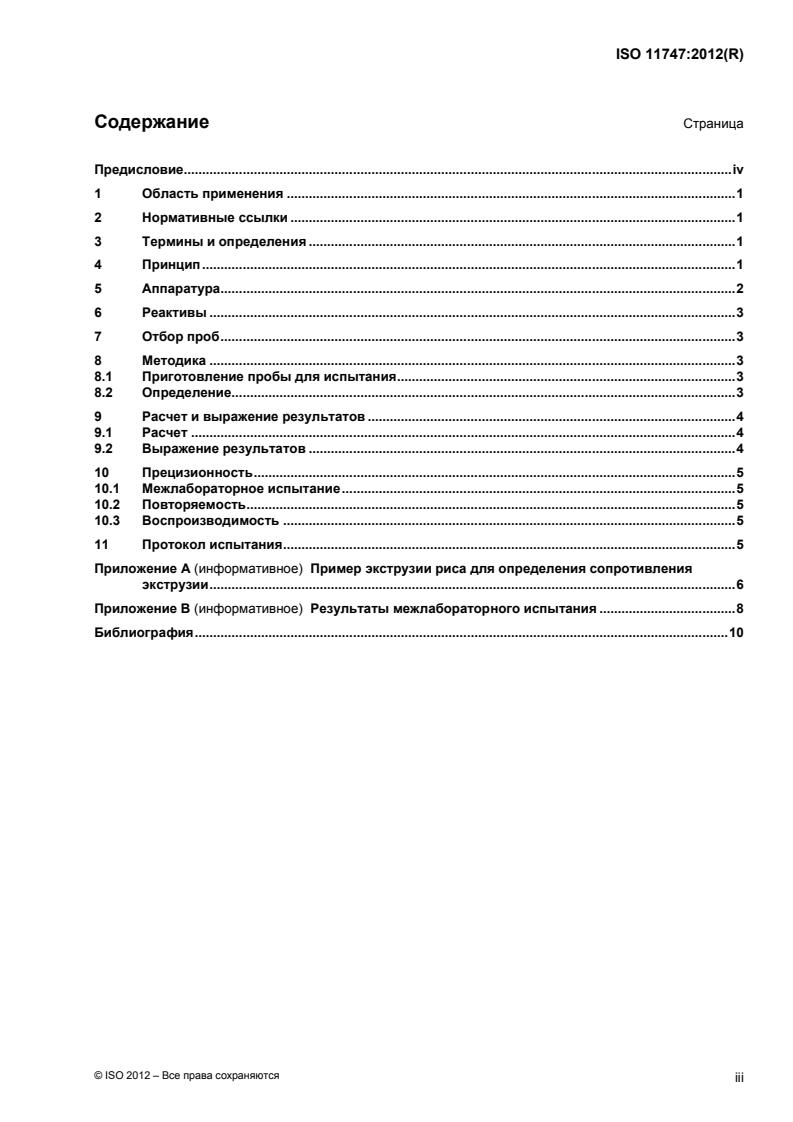
Содержание Страница
Предисловие. iv
1 Область применения . 1
2 Нормативные ссылки . 1
3 Термины и определения . 1
4 Принцип . 1
5 Аппаратура . 2
6 Реактивы . 3
7 Отбор проб . 3
8 Методика . 3
8.1 Приготовление пробы для испытания . 3
8.2 Определение. 3
9 Расчет и выражение результатов . 4
9.1 Расчет . 4
9.2 Выражение результатов . 4
10 Прецизионность . 5
10.1 Межлабораторное испытание . 5
10.2 Повторяемость. 5
10.3 Воспроизводимость . 5
11 Протокол испытания . 5
Приложение A (информативное) Пример экструзии риса для определения сопротивления
экструзии . 6
Приложение B (информативное) Результаты межлабораторного испытания . 8
Библиография . 10
iii
Предисловие
Международная организация по стандартизации (ISO) является всемирной федерацией
национальных организаций по стандартизации (комитетов-членов ISO). Разработка международных
стандартов обычно осуществляется техническими комитетами ISO. Каждый комитет-член ISO,
заинтересованный в деятельности, для которой был создан технический комитет, имеет право быть
представленным в этом комитете. Международные организации, правительственные и
неправительственные, имеющие связи с ISO, также принимают участие в работах. ISO
непосредственно сотрудничает с Международной электротехнической комиссией (IEC) по всем
вопросам электротехнической стандартизации.
Международные стандарты разрабатываются в соответствии с правилами, приведенными в
Директивах ISO/IEC, Часть 2.
Основная задача технических комитетов состоит в подготовке международных стандартов. Проекты
международных стандартов, одобренные техническими комитетами, рассылаются комитетам-членам
на голосование. Их опубликование в качестве международных стандартов требует одобрения, по
меньшей мере, 75 % комитетов-членов, принимающих участие в голосовании.
Следует иметь в виду, что некоторые элементы настоящего документа могут быть объектом патентных
прав. ISO не должен нести ответственность за идентификацию какого-либо одного или всех патентных
прав.
ISO 11747 разработан Техническим комитетом ISO/TC 34 Пищевые продукты, Подкомитетом SC 4,
Зерновые и бобовые культуры.
iv
МЕЖДУНАРОДНЫЙ СТАНДАРТ ISO 11747:2012(R)
Рис. Определение сопротивления зерна риса экструзии
после разваривания
1 Область применения
Настоящий международный стандарт устанавливает метод определения сопротивления экструзии
зерен шлифованного пропаренного или не пропаренного риса после разваривания в заданных
условиях.
2 Нормативные ссылки
Следующие ссылочные нормативные документы являются обязательными при применении данного
документа. Для плавающих ссылок необходимо использовать самое последнее издание нормативного
ссылочного документа (включая любые изменения).
ISO 712, Зерновые и продукты из них. Определение содержания влаги. Контрольный метод
ISO 7301, Рис. Технические условия
3 Термины и определения
Применительно к этому документу используются термины и определения, приведенные в ISO 7301, а
также следующие.
3.1
разваренный рис
cooked rice
рис, приведенный в контакт с горячей жидкостью для того, чтобы сделать его пригодным для
потребления
3.2
сопротивление экструзии
resistance to extrusion
легкость проталкивания разваренного риса через перфорированную пластину, используя сжатие и
сдвиг
)
ПРИМЕЧАНИЕ Примером подходящей перфорированной пластины является пластина Ottawa.
4 Принцип
Измерение силы, требуемой для выдавливания разваренного риса через перфорированную пластину.
1) Пластина Ottawa является примером подходящего продукта имеющегося в продаже. Эта информация дается
для удобства пользователей данного международного стандарта и не означает одобрения этого продукта со
стороны ISO.
5 Аппаратура
Обычная лабораторная аппаратура , в частности, следующая.
5.1 Химические стаканы, из боросиликатного стекла вместимостью 100 мл.
5.2 Емкость для разваривания, с негерметичной крышкой и перфорированной пластиной, на
которой размещаются стаканы (5.1). Уровень воды в емкости для разваривания должен быть таким,
чтобы вода не поднималась выше перфорированной пластины при кипении, гарантируя таким образом,
что разваривание осуществляется исключительно паром.
2)
5.3 Делитель проб, конический или многощелевой пробоотборник с распределительной
системой, или другое эквивалентное оборудование.
5.4 Источник тепла, пригодный для обеспечения энергичного и равномерного кипения воды в
емкости для разваривания (5.2).
5.5 Весы, пригодные для считывания показаний с точностью до 0,1 г.
5.6 Стеклянная палочка.
5.7 Часовые стекла, диаметром 6 см.
5.8 Динамометр, способный работать на сжатие с постоянной скоростью 10 см/мин и
оборудованный устройствами, указанными в 5.8.1 и 5.8.2.
5.8.1 Динамометрический датчик, с допустимой нагрузкой, по меньшей мере, 50 кг.
5.8.2 Экструдер, см. Рисунки A.1 и A.2, состоящий из компонентов, указанных в 5.8.2.1 – 5.8.2.3.
5.8.2.1 Параллелепипед, со следующими характеристиками:
a) составляющий одно целое с динамометром;
b) высотой приблизительно 20 см;
c) с отверстием площадью 7,5 см в центре;
d) с площадью основания, достаточной для размещения упомянутого отверстия в c), и съемной
пластиной, перекрывающей параллелепипед на расстоянии приблизительно одной трети его
высоты.
5.8.2.2 Перфорированная пластина, толщиной 3 мм, с отверстиями диаметром 6,0 мм и
расстоянием межу осями отверстий 7,0 мм (от центра до центра), вставляемая в параллелепипед
(5.8.2.1).
5.8.2.3 Поршень, со следующими характеристиками:
a) подходящей для динамометрического датчика (5.8.1);
b) высотой 20 см;
c) с основанием секции, имеющим минимальный допуск (приблизительно 0,5 мм), что позволяет ему
свободно передвигаться в отверстии параллелепипеда (5.8.2.1).
[2]
2) Некоторые делители проб описаны в ISO 24333.
© IS
...