


ISO 8472-2
(Main)Biotechnology — Data interoperability for stem cell data — Part 2: Key characteristics of stem cell data
Biotechnology — Data interoperability for stem cell data — Part 2: Key characteristics of stem cell data
This document specifies the key characteristics of stem cell data for data interoperability of stem cell data systems, which includes several biological characteristics, safety, stability, efficacy, etc. This document is applicable to stem cell database developers, stem cell data/system users, those who are generating, sending, receiving or sharing stem cell data, as well as information technology specialists focussing on system design or maintenance.
Biotechnologie — Interopérabilité des données associées à des cellules souches — Partie 2: Caractéristiques clés des données associées à des cellules souches
General Information
- Status
- Not Published
- Technical Committee
- ISO/TC 276 - Biotechnology
- Drafting Committee
- ISO/TC 276 - Biotechnology
- Current Stage
- 6000 - International Standard under publication
- Start Date
- 05-Dec-2025
- Completion Date
- 31-Jan-2026
ISO 8472-2: Biotechnology - Key Characteristics of Stem Cell Data
Overview
ISO 8472-2 is an international standard developed by the International Organization for Standardization (ISO) under Technical Committee ISO/TC 276, Biotechnology. This standard defines the key characteristics of stem cell data to enable effective data interoperability among stem cell data systems. The focus is on biological attributes such as safety, stability, efficacy, and other crucial data points that support the quality and reliability of stem cell information.
This standard is essential for:
- Stem cell database developers
- Stem cell researchers and clinicians
- Data system users managing stem cell data
- IT specialists designing or maintaining stem cell information systems
ISO 8472-2 promotes a common framework and vocabulary to ensure consistent data sharing, storage, and analysis across organizations and software platforms in the field of biotechnology and regenerative medicine.
Key Topics
- Biological Characteristics: Documenting essential biological attributes including cell morphology, viability, authentication through STR profiling, cell markers, and chromosome karyotype.
- Data Quality & Integrity: Emphasizes documenting genetic stability, functional testing, pharmacological action, and safety within stem cell datasets.
- Technical Specifications: Specifies the appropriate data types (string, Boolean, float) and formats for various parameters ensuring standards-compliant data interchange.
- Data Interoperability Fundamentals: Highlights the need for consistent data formatting aligned with ISO 20691 and adherence to a unified framework defined in ISO 8472-1.
- Optional Parameters: Addresses advanced metrics for specialized datasets, such as membrane potential, calcium flux, and contractility assessment for enhanced scientific insight.
- Ethical and Regulatory Considerations: Recommends awareness of varying national regulations impacting stem cell data accessibility and sharing.
Applications
- Stem Cell Biobanks: Enable uniform data reporting and cataloguing, facilitating large-scale biobanking efforts globally.
- Clinical Research & Trials: Supports standardized data exchange to boost reliability and reproducibility of stem cell therapy trials.
- Regenerative Medicine Development: Assists researchers and pharmaceutical developers in maintaining comprehensive, interoperable data for therapeutic product validation.
- Information Technology Solutions: Provides software developers and IT specialists with a clear framework to design compatible stem cell data systems, improving system integration and functionality.
- Collaborative Networks: Facilitates data sharing across research institutions, enterprises, and regulatory bodies ensuring compliance with international standards.
Related Standards
- ISO 8472-1: Biotechnology - Data interoperability for stem cell data - Part 1: Framework. This serves as the foundational framework aligning with Part 2’s key characteristics descriptions.
- ISO 20691: Biotechnology - Requirements for data formatting and description in life sciences. Details formatting rules critical for maintaining high-quality interoperable data.
- ISO/IEC 20944: Covers broader interoperability standards applicable to data creation, transfer, and use within digital systems.
- ISO/TS 27790: Provides terminology and general definitions related to interoperability and standards compliance relevant to life sciences.
Why ISO 8472-2 Matters
The standardization of stem cell data traits is critical amid accelerating stem cell research, clinical applications, and biobanking. ISO 8472-2 addresses complex challenges around data quality, consistency, and security, ensuring that datasets are sharable and usable across diverse platforms and organizations worldwide.
By following the key characteristics defined in this standard, stakeholders can:
- Enhance data accuracy and reproducibility
- Improve collaborative research through seamless data exchange
- Support regulatory compliance with documented safety and efficacy information
- Optimize technology development with standardized data structures
For any organization or professional involved in stem cell data systems, adherence to ISO 8472-2 ensures robust data interoperability and advances the global stem cell biotechnology field.
For more detailed information and access to ISO 8472 series standards, visit:www.iso.org
ISO/FDIS 8472-2 - Biotechnology — Data interoperability for stem cell data — Part 2: Key characteristics of stem cell data Released:9/25/2025
REDLINE ISO/FDIS 8472-2 - Biotechnology — Data interoperability for stem cell data — Part 2: Key characteristics of stem cell data Released:9/25/2025
Frequently Asked Questions
ISO 8472-2 is a draft published by the International Organization for Standardization (ISO). Its full title is "Biotechnology — Data interoperability for stem cell data — Part 2: Key characteristics of stem cell data". This standard covers: This document specifies the key characteristics of stem cell data for data interoperability of stem cell data systems, which includes several biological characteristics, safety, stability, efficacy, etc. This document is applicable to stem cell database developers, stem cell data/system users, those who are generating, sending, receiving or sharing stem cell data, as well as information technology specialists focussing on system design or maintenance.
This document specifies the key characteristics of stem cell data for data interoperability of stem cell data systems, which includes several biological characteristics, safety, stability, efficacy, etc. This document is applicable to stem cell database developers, stem cell data/system users, those who are generating, sending, receiving or sharing stem cell data, as well as information technology specialists focussing on system design or maintenance.
ISO 8472-2 is classified under the following ICS (International Classification for Standards) categories: 07.080 - Biology. Botany. Zoology. The ICS classification helps identify the subject area and facilitates finding related standards.
ISO 8472-2 is available in PDF format for immediate download after purchase. The document can be added to your cart and obtained through the secure checkout process. Digital delivery ensures instant access to the complete standard document.
Standards Content (Sample)
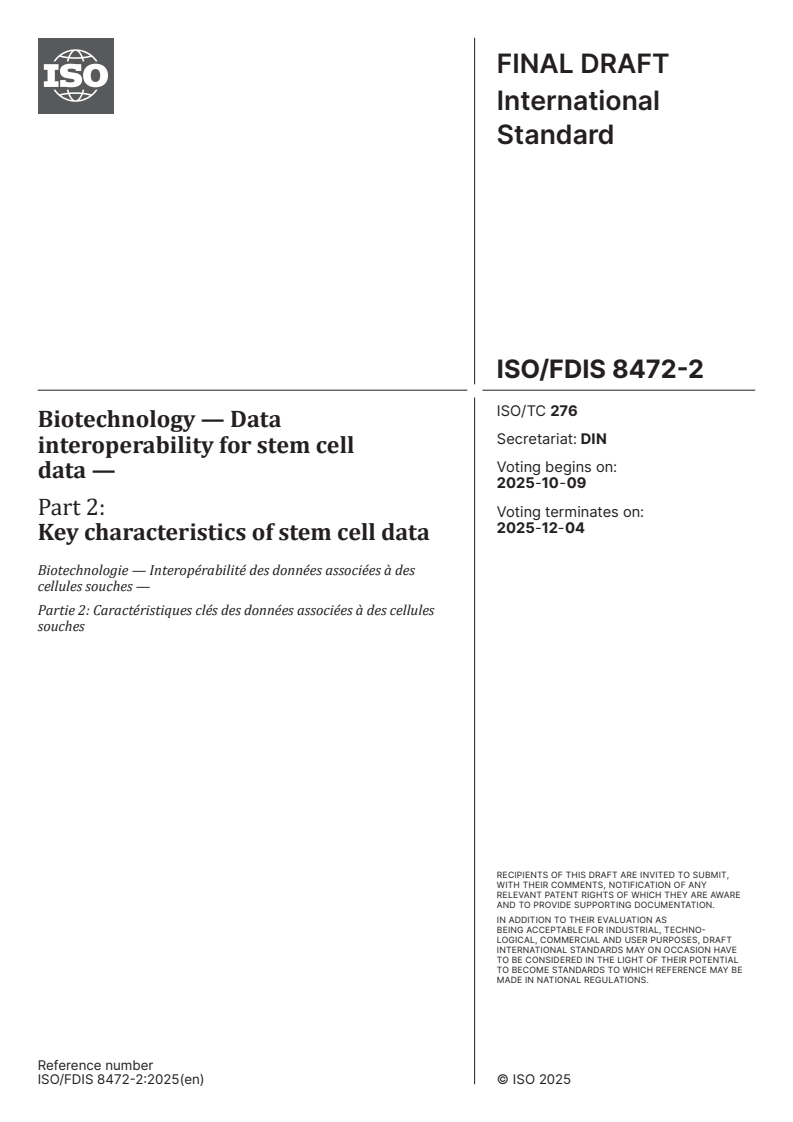
FINAL DRAFT
International
Standard
ISO/FDIS 8472-2
ISO/TC 276
Biotechnology — Data
Secretariat: DIN
interoperability for stem cell
Voting begins on:
data —
2025-10-09
Part 2:
Voting terminates on:
2025-12-04
Key characteristics of stem cell data
Biotechnologie — Interopérabilité des données associées à des
cellules souches —
Partie 2: Caractéristiques clés des données associées à des cellules
souches
RECIPIENTS OF THIS DRAFT ARE INVITED TO SUBMIT,
WITH THEIR COMMENTS, NOTIFICATION OF ANY
RELEVANT PATENT RIGHTS OF WHICH THEY ARE AWARE
AND TO PROVIDE SUPPOR TING DOCUMENTATION.
IN ADDITION TO THEIR EVALUATION AS
BEING ACCEPTABLE FOR INDUSTRIAL, TECHNO-
LOGICAL, COMMERCIAL AND USER PURPOSES, DRAFT
INTERNATIONAL STANDARDS MAY ON OCCASION HAVE
TO BE CONSIDERED IN THE LIGHT OF THEIR POTENTIAL
TO BECOME STAN DARDS TO WHICH REFERENCE MAY BE
MADE IN NATIONAL REGULATIONS.
Reference number
ISO/FDIS 8472-2:2025(en) © ISO 2025
FINAL DRAFT
ISO/FDIS 8472-2:2025(en)
International
Standard
ISO/FDIS 8472-2
ISO/TC 276
Biotechnology — Data
Secretariat: DIN
interoperability for stem cell data —
Voting begins on:
Part 2:
Key characteristics of stem cell data
Voting terminates on:
Biotechnologie — Interopérabilité des données associées à des
cellules souches —
Partie 2: Caractéristiques clés des données associées à des cellules
souches
RECIPIENTS OF THIS DRAFT ARE INVITED TO SUBMIT,
WITH THEIR COMMENTS, NOTIFICATION OF ANY
RELEVANT PATENT RIGHTS OF WHICH THEY ARE AWARE
AND TO PROVIDE SUPPOR TING DOCUMENTATION.
© ISO 2025
IN ADDITION TO THEIR EVALUATION AS
All rights reserved. Unless otherwise specified, or required in the context of its implementation, no part of this publication may
BEING ACCEPTABLE FOR INDUSTRIAL, TECHNO-
LOGICAL, COMMERCIAL AND USER PURPOSES, DRAFT
be reproduced or utilized otherwise in any form or by any means, electronic or mechanical, including photocopying, or posting on
INTERNATIONAL STANDARDS MAY ON OCCASION HAVE
the internet or an intranet, without prior written permission. Permission can be requested from either ISO at the address below
TO BE CONSIDERED IN THE LIGHT OF THEIR POTENTIAL
or ISO’s member body in the country of the requester.
TO BECOME STAN DARDS TO WHICH REFERENCE MAY BE
MADE IN NATIONAL REGULATIONS.
ISO copyright office
CP 401 • Ch. de Blandonnet 8
CH-1214 Vernier, Geneva
Phone: +41 22 749 01 11
Email: copyright@iso.org
Website: www.iso.org
Published in Switzerland Reference number
ISO/FDIS 8472-2:2025(en) © ISO 2025
ii
ISO/FDIS 8472-2:2025(en)
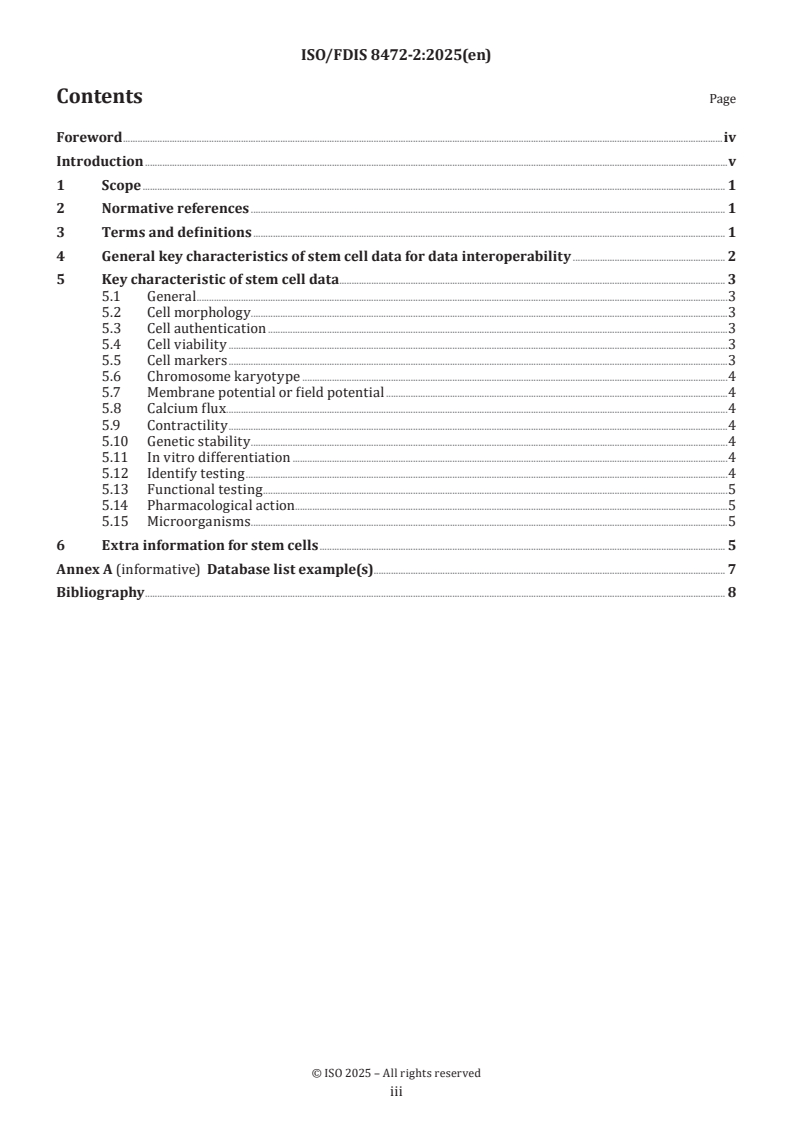
Contents Page
Foreword .iv
Introduction .v
1 Scope . 1
2 Normative references . 1
3 Terms and definitions . 1
4 General key characteristics of stem cell data for data interoperability . 2
5 Key characteristic of stem cell data. 3
5.1 General .3
5.2 Cell morphology.3
5.3 Cell authentication .3
5.4 Cell viability .3
5.5 Cell markers .3
5.6 Chromosome karyotype .4
5.7 Membrane potential or field potential .4
5.8 Calcium flux . . .4
5.9 Contractility .4
5.10 Genetic stability .4
5.11 In vitro differentiation .4
5.12 Identify testing .4
5.13 Functional testing .5
5.14 Pharmacological action . .5
5.15 Microorganisms .5
6 Extra information for stem cells . 5
Annex A (informative) Database list example(s) . 7
Bibliography . 8
iii
ISO/FDIS 8472-2:2025(en)
Foreword
ISO (the International Organization for Standardization) is a worldwide federation of national standards
bodies (ISO member bodies). The work of preparing International Standards is normally carried out through
ISO technical committees. Each member body interested in a subject for which a technical committee
has been established has the right to be represented on that committee. International organizations,
governmental and non-governmental, in liaison with ISO, also take part in the work. ISO collaborates closely
with the International Electrotechnical Commission (IEC) on all matters of electrotechnical standardization.
The procedures used to develop this document and those intended for its further maintenance are described
in the ISO/IEC Directives, Part 1. In particular, the different approval criteria needed for the different types
of ISO document should be noted. This document was drafted in accordance with the editorial rules of the
ISO/IEC Directives, Part 2 (see www.iso.org/directives).
ISO draws attention to the possibility that the implementation of this document may involve the use of (a)
patent(s). ISO takes no position concerning the evidence, validity or applicability of any claimed patent
rights in respect thereof. As of the date of publication of this document, ISO had not received notice of (a)
patent(s) which may be required to implement this document. However, implementers are cautioned that
this may not represent the latest information, which may be obtained from the patent database available at
www.iso.org/patents. ISO shall not be held responsible for identifying any or all such patent rights.
Any trade name used in this document is information given for the convenience of users and does not
constitute an endorsement.
For an explanation of the voluntary nature of standards, the meaning of ISO specific terms and expressions
related to conformity assessment, as well as information about ISO's adherence to the World Trade
Organization (WTO) principles in the Technical Barriers to Trade (TBT), see www.iso.org/iso/foreword.html.
This document was prepared by Technical Committee ISO/TC 276, Biotechnology.
A list of all parts in the ISO 8472 series can be found on the ISO website.
Any feedback or questions on this document should be directed to the user’s national standards body. A
complete listing of these bodies can be found at www.iso.org/members.html.
iv
ISO/FDIS 8472-2:2025(en)
Introduction
Data interoperability addresses the ability of systems and services that create, exchange and consume data
to have clear, shared expectations for the contents, context and meaning of that data.
One-off approaches to data carry hidden costs felt by people and the organizations who are impacted by
such data. Most people lack experience or technical support when it comes to the data generated about them.
Many organizations lack access to the data within their own firewalls. The value of the insights gained from
such data is limited because the real potential of such datasets is unknowable.
Stem cell research using human embryonic stem cells, as well as other induced and adult stem cells, within
strong ethical and regulatory governance frameworks in various countries. Within this field, it has been
recognised that it is premature to focus on any one stem cell type, and that research across a broad front is
important to moving the entire field towards application and clinical impact. Stem cell research has reached
to a new level. For example, human embryonic stem cell research has now reached the stage of clinical
testing, with clinical trials commencing or soon to start that can provide important ‘proof of concept’ for the
use of pluripotent stem cell-based therapies in delivering regenerative medicine.
In the past decades, many research projects, clinical trials, and industrial developments have been performed
successfully. In recent years, there are many stem cell biobanks establishing as well. Collaborations across
research institutes, enterprises, governments, industries, etc. (such as Chinese Alliance for Stem Cell
Resource Centers, EBiSC, hPSCreg, IABS, ISCBI etc.). Stem cell research offers unique opportunities to
develop therapies for a wide variety of currently untreatable conditions. But right now, due to the increasing
data and stem cell biobanking, it is critical that common clean approaches to working with data (such
as data sharing, storage, analysis, etc.) are standardized. This requires a diverse community of vendors,
customers and practitioners to work together and exchange under the same structure and framework. Data
interoperability standards can help stakeholders and people who create, manage and use the data to address
the shared needs and industrial/market needs.
v
FINAL DRAFT International Standard ISO/FDIS 8472-2:2025(en)
Biotechnology — Data interoperability for stem cell data —
Part 2:
Key characteristics of stem cell data
1 Scope
This document specifies the key characteristics of stem cell data for data interoperability of stem cell data
systems, which includes several biological characteristics, safety, stability, efficacy, etc.
This document is applicable to stem cell database developers, stem cell data/system users, those who are
generating, sen
...
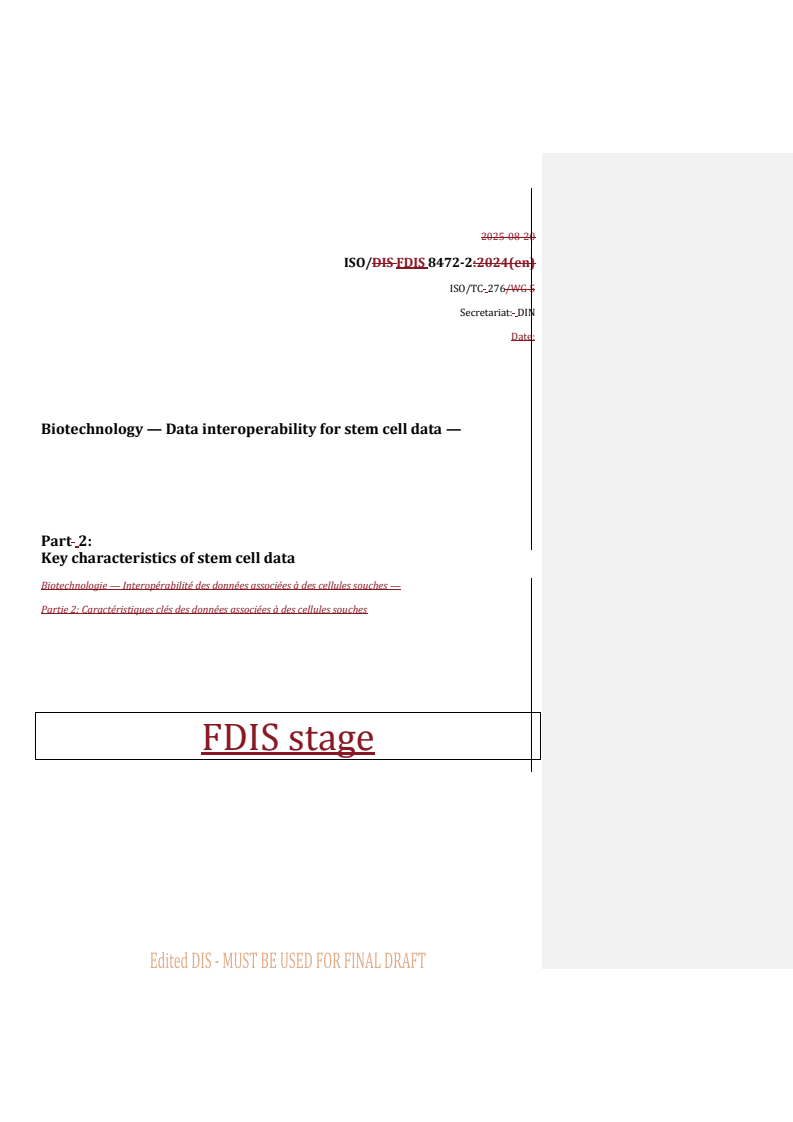
2025-08-20
ISO/DIS FDIS 8472-2:2024(en)
ISO/TC 276/WG 5
Secretariat: DIN
Date:
Biotechnology — Data interoperability for stem cell data —
Part 2:
Key characteristics of stem cell data
Biotechnologie — Interopérabilité des données associées à des cellules souches —
Partie 2: Caractéristiques clés des données associées à des cellules souches
FDIS stage
ISO/DIS FDIS 8472-2:2024(E2025(en)
All rights reserved. Unless otherwise specified, or required in the context of its implementation, no part of this publication
may be reproduced or utilized otherwise in any form or by any means, electronic or mechanical, including photocopying,
or posting on the internet or an intranet, without prior written permission. Permission can be requested from either ISO
at the address below or ISO’s member body in the country of the requester.
ISO copyright office
CP 401 • Ch. de Blandonnet 8
CH-1214 Vernier, Geneva
Phone: + 41 22 749 01 11
Fax: +41 22 749 09 47
EmailE-mail: copyright@iso.org
Website: www.iso.orgwww.iso.org
Published in Switzerland
ii © ISO 2024 2025 – All rights reserved
ii
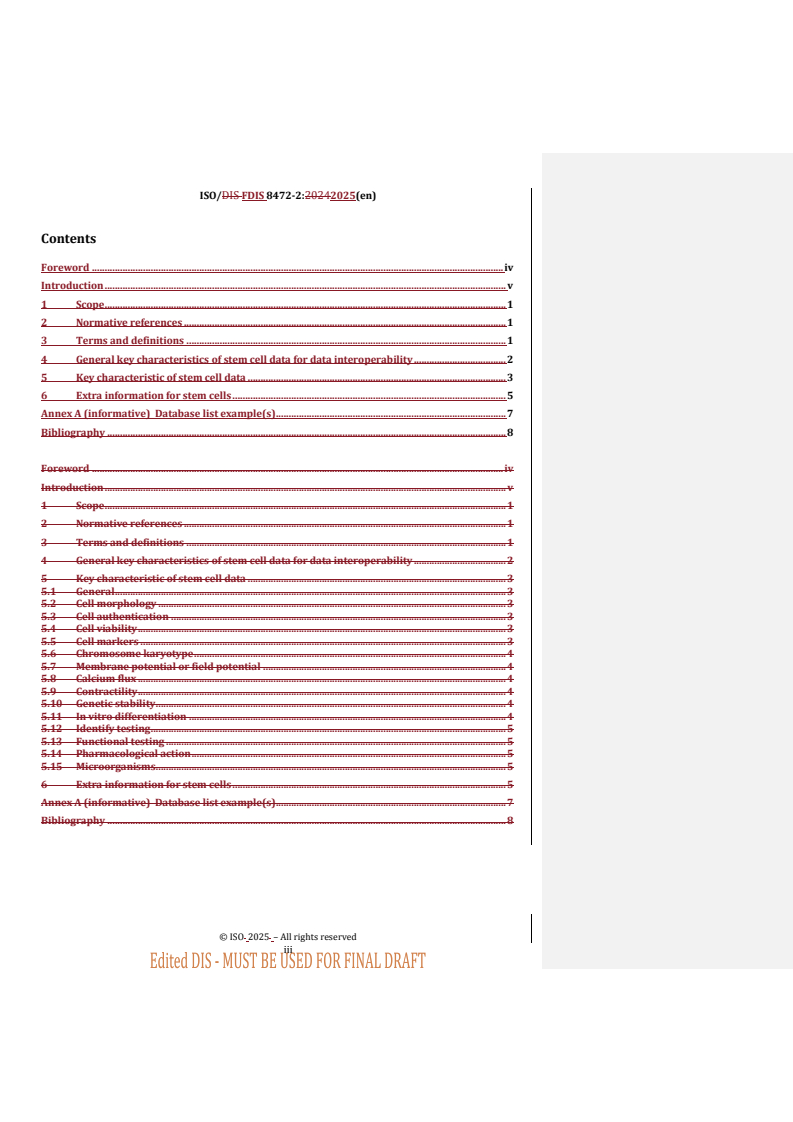
ISO/DIS FDIS 8472-2:20242025(en)
Contents
Foreword . iv
Introduction . v
1 Scope . 1
2 Normative references . 1
3 Terms and definitions . 1
4 General key characteristics of stem cell data for data interoperability . 2
5 Key characteristic of stem cell data . 3
6 Extra information for stem cells . 5
Annex A (informative) Database list example(s) . 7
Bibliography . 8
Foreword . iv
Introduction . v
1 Scope . 1
2 Normative references . 1
3 Terms and definitions . 1
4 General key characteristics of stem cell data for data interoperability . 2
5 Key characteristic of stem cell data . 3
5.1 General . 3
5.2 Cell morphology . 3
5.3 Cell authentication . 3
5.4 Cell viability . 3
5.5 Cell markers . 3
5.6 Chromosome karyotype . 4
5.7 Membrane potential or field potential . 4
5.8 Calcium flux . 4
5.9 Contractility . 4
5.10 Genetic stability . 4
5.11 In vitro differentiation . 4
5.12 Identify testing . 5
5.13 Functional testing . 5
5.14 Pharmacological action . 5
5.15 Microorganisms . 5
6 Extra information for stem cells . 5
Annex A (informative) Database list example(s) . 7
Bibliography . 8
© ISO 2025 – All rights reserved
iii
ISO/DIS FDIS 8472-2:2024(E2025(en)
Foreword
ISO (the International Organization for Standardization) is a worldwide federation of national standards
bodies (ISO member bodies). The work of preparing International Standards is normally carried out through
ISO technical committees. Each member body interested in a subject for which a technical committee has been
established has the right to be represented on that committee. International organizations, governmental and
non-governmental, in liaison with ISO, also take part in the work. ISO collaborates closely with the
International Electrotechnical Commission (IEC) on all matters of electrotechnical standardization.
The procedures used to develop this document and those intended for its further maintenance are described
in the ISO/IEC Directives, Part 1. In particular, the different approval criteria needed for the different types of
ISO document should be noted. This document was drafted in accordance with the editorial rules of the
ISO/IEC Directives, Part 2 (see www.iso.org/directives).
ISO draws attention to the possibility that the implementation of this document may involve the use of (a)
patent(s). ISO takes no position concerning the evidence, validity or applicability of any claimed patent rights
in respect thereof. As of the date of publication of this document, ISO had not received notice of (a) patent(s)
which may be required to implement this document. However, implementers are cautioned that this may not
represent the latest information, which may be obtained from the patent database available at
www.iso.org/patents.www.iso.org/patents. ISO shall not be held responsible for identifying any or all such
patent rights.
Any trade name used in this document is information given for the convenience of users and does not
constitute an endorsement.
For an explanation of the voluntary nature of standards, the meaning of ISO specific terms and expressions
related to conformity assessment, as well as information about ISO's adherence to the World Trade
Organization (WTO) principles in the Technical Barriers to Trade (TBT), see
www.iso.org/iso/foreword.htmlwww.iso.org/iso/foreword.html.
This document was prepared by Technical Committee ISO/TC 276, Biotechnology.
A list of all parts in the ISO 8472 series can be found on the ISO website.
Any feedback or questions on this document should be directed to the user’s national standards body. A
complete listing of these bodies can be found at www.iso.org/members.html.
Field Code Changed
iv © ISO 2024 2025 – All rights reserved
iv
ISO/DIS FDIS 8472-2:20242025(en)
Introduction
Data interoperability addresses the ability of systems and services that create, exchange and consume data to
have clear, shared expectations for the contents, context and meaning of that data.
One-off approaches to data carry hidden costs felt by people and the organizations who are impacted by such
data. Most people lack experience or technical support when it comes to the data generated about them. Many
organizations lack access to the data within their own firewalls. The value of the insights gained from such
data is limited because the real potential of such datasets is unknowable.
Stem cell research using human embryonic stem cells, as well as other induced and adult stem cells, within
strong ethical and regulatory governance frameworks in various countries. Within this field, it has been
recognised that it is premature to focus on any one stem cell type, and that research across a broad front is
important to moving the entire field towards application and clinical impact. Stem cell research has reached
to a new level. For example, human embryonic stem cell research has now reached the stage of clinical testing,
with clinical trials commencing or soon to start that can provide important ‘proof of concept’ for the use of
pluripotent stem cell-based therapies in delivering regenerative medicine.
In the past decades, many research projects, clinical trials, and industrial developments have been performed
successfully. In recent years, there are many stem cell biobanks establishing as well. Collaborations across
research institutes, enterprises, governments, industries, etc. (such as Chinese Alliance for Stem Cell Resource
Centers, EBiSC, hPSCreg, IABS, ISCBI etc.). Stem cell research offers unique opportunities to develop therapies
for a wide variety of currently untreatable conditions. But right now, due to the increasing data and stem cell
biobanking, it is critical that common clean approaches to working with data (such as data sharing, storage,
analysis, etc.) are standardized. This requires a diverse community of vendors, customers and practitioners to
work together and exchange under the same structure and framework. Data interoperability standards can
help stakeholders and people who create, manage and use the data to address the shared needs and
industrial/market needs.
© ISO 2025 – All rights reserved
v
ISO/FDIS 8472-2:2025(en)
Biotechnology — Data interoperability for stem cell data —
Part 2:
Key characteristiccharacteristics of stem cell data
1 Scope
This document specifies the key characteristics of stem cell data for data interoperability of stem cell data
systems, which includes several biological characteristics, safety, stability, efficacy, etc.
This document is applicable to stem cell database developers, stem cell data/system users, those who are
generating, sending, receiving or sharing stem cell data, as well as information technology specialists focussing
on system design or maintenance.
2 Normative references
The following documents are referred to in the text in such a way that some or all of their content constitutes
requirements of this document. For dated references, only the edition cited applies. For undated references,
the latest edition of the referenced document (including any amendments) applies.
ISO 20691, Biotechnology — Requirements for data formatting and description in the life sciences
ISO 8472--1, Biotechnology — Data interoperability for stem cell data — Part 1: Framework
3 Terms and definitions
For the purposes of this document, the following terms and definitions apply.
ISO and IEC maintain terminology databases for use in standardization at the following addresses:
— — ISO Online browsing platform: available at https://www.iso.org/obphttps://www.iso.org/obp
— — IEC Electropedia: available at https://www.electropedia.org/https://www.ele
...
Questions, Comments and Discussion
Ask us and Technical Secretary will try to provide an answer. You can facilitate discussion about the standard in here.
Loading comments...