


ISO 5676:2023
(Main)Tractors and machinery for agriculture and forestry - Hydraulic coupling - Braking circuit
Tractors and machinery for agriculture and forestry - Hydraulic coupling - Braking circuit
This document specifies the conditions for interchangeability, and the operating characteristics and lays down the technical specifications for tests, for the hydraulic couplings on braking systems for towed agriculture and forestry machinery. This document applies solely to hydraulic brake couplings.
Tracteurs et matériels agricoles et forestiers — Coupleurs hydrauliques — Circuit de freinage
Le présent document spécifie les conditions d’interchangeabilité et les caractéristiques de fonctionnement des liaisons hydrauliques de freinage assisté des matériels agricoles et forestiers remorqués. Il fixe également les spécifications techniques pour les essais. Le présent document est applicable aux liaisons hydrauliques de freinage, uniquement.
General Information
- Status
- Published
- Publication Date
- 19-Jun-2023
- Technical Committee
- ISO/TC 23/SC 4 - Tractors
- Drafting Committee
- ISO/TC 23/SC 4/WG 14 - Revision of ISO 17567
- Current Stage
- 6060 - International Standard published
- Start Date
- 20-Jun-2023
- Due Date
- 05-May-2023
- Completion Date
- 20-Jun-2023
Relations
- Effective Date
- 23-Apr-2020
Overview
ISO 5676:2023 is the international standard detailing the specifications for hydraulic couplings used in braking systems of tractors and towed agricultural and forestry machinery. This second edition supersedes the 1983 version, updating technical requirements to reflect current industry practices.
The standard focuses exclusively on hydraulic brake couplings, ensuring their interchangeability, reliable operation, and safety under specified pressure and temperature conditions. Compliance with ISO 5676:2023 facilitates compatibility across diverse machinery brands and models, enabling efficient and safe connection and disconnection of hydraulic braking circuits.
Key Topics
Scope and Application
Defines requirements for hydraulic brake couplings in agricultural and forestry settings, specifically for towed machinery braking systems. Covers only hydraulic couplings affecting braking circuits.Dimensional Characteristics
Includes critical dimensions and configurations for male and female coupling parts to guarantee interchangeability and proper connection.Operating Conditions
- Service pressure range: 10 MPa to 15 MPa (100 to 150 bar), with a maximum service pressure of 15 MPa.
- Temperature range: -30 °C to 100 °C (with short peaks up to 140 °C for up to 1 hour).
- Connection/disconnection must ideally happen without pressure applied.
- Forces to connect/disconnect are specified to ensure ergonomic handling (less than 150 N for connection, less than 45 N for locking ring disconnection).
Technical Specifications and Testing
- Seals must be compatible with agricultural hydraulic oils and withstand specified operating conditions.
- Corrosion resistance is verified according to ISO 18869 standards.
- Hydraulic fluid tests (ISO VG 32 viscosity) at 22.5 MPa for 5 minutes ensure no leakage or permanent damage.
- Couplings are tested for oil loss and air intake following 100 coupling/uncoupling cycles, maintaining a maximum oil loss of 5 ml.
- Pressure loss during operation at rated flow and pressure is limited to 0.2 MPa.
Mounting Instructions
The male coupling half is installed facing backward on the tractor to maintain proper operation.
Applications
ISO 5676:2023 is essential for manufacturers, engineers, and maintenance professionals involved with:
- Design and production of towed agricultural and forestry machinery with hydraulic braking systems.
- Ensuring compatibility and safety of brake couplings across different tractor and implement combinations.
- Performing quality assurance tests on hydraulic brake couplings to prevent leaks, pressure loss, and mechanical failures.
- Supporting maintenance and inspection procedures for hydraulic braking circuits in the agricultural sector.
- Facilitating interoperability in global agricultural equipment markets by standardizing connection interfaces and operating parameters for hydraulic brake couplings.
Related Standards
- ISO 5675: Agricultural tractors and machinery - General purpose quick-action hydraulic couplers.
- ISO 18869:2017: Hydraulic fluid power - Test methods for couplings (corrosion resistance and performance testing).
- ISO 3448: Industrial liquid lubricants - ISO viscosity classification and viscosity testing.
These related documents provide complementary guidelines on hydraulic couplers and testing procedures critical to the effective implementation of ISO 5676:2023.
By adhering to ISO 5676:2023, stakeholders ensure hydraulic brake coupling systems used in tractors and towed agricultural or forestry machinery perform reliably, safely, and with consistent interchangeability, promoting operational efficiency and equipment longevity in the agricultural industry.
Frequently Asked Questions
ISO 5676:2023 is a standard published by the International Organization for Standardization (ISO). Its full title is "Tractors and machinery for agriculture and forestry - Hydraulic coupling - Braking circuit". This standard covers: This document specifies the conditions for interchangeability, and the operating characteristics and lays down the technical specifications for tests, for the hydraulic couplings on braking systems for towed agriculture and forestry machinery. This document applies solely to hydraulic brake couplings.
This document specifies the conditions for interchangeability, and the operating characteristics and lays down the technical specifications for tests, for the hydraulic couplings on braking systems for towed agriculture and forestry machinery. This document applies solely to hydraulic brake couplings.
ISO 5676:2023 is classified under the following ICS (International Classification for Standards) categories: 65.060.01 - Agricultural machines and equipment in general. The ICS classification helps identify the subject area and facilitates finding related standards.
ISO 5676:2023 has the following relationships with other standards: It is inter standard links to ISO 5676:1983. Understanding these relationships helps ensure you are using the most current and applicable version of the standard.
You can purchase ISO 5676:2023 directly from iTeh Standards. The document is available in PDF format and is delivered instantly after payment. Add the standard to your cart and complete the secure checkout process. iTeh Standards is an authorized distributor of ISO standards.
Standards Content (Sample)
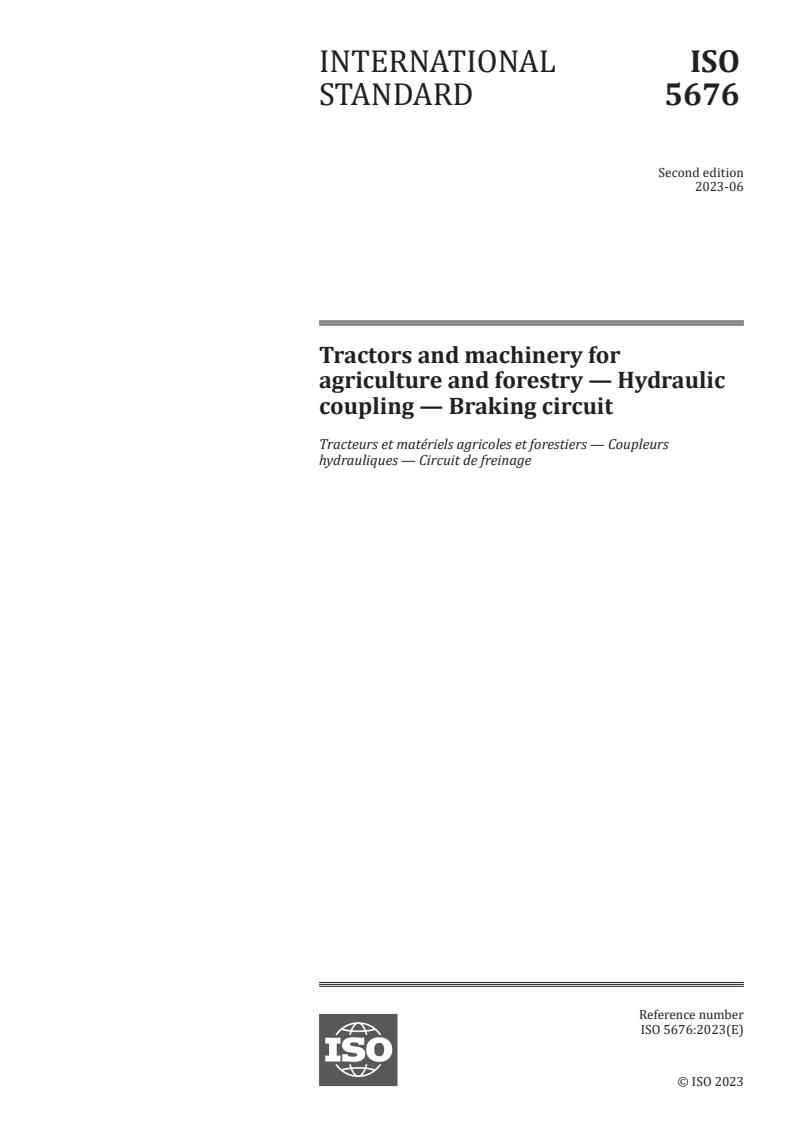
INTERNATIONAL ISO
STANDARD 5676
Second edition
2023-06
Tractors and machinery for
agriculture and forestry — Hydraulic
coupling — Braking circuit
Tracteurs et matériels agricoles et forestiers — Coupleurs
hydrauliques — Circuit de freinage
Reference number
© ISO 2023
All rights reserved. Unless otherwise specified, or required in the context of its implementation, no part of this publication may
be reproduced or utilized otherwise in any form or by any means, electronic or mechanical, including photocopying, or posting on
the internet or an intranet, without prior written permission. Permission can be requested from either ISO at the address below
or ISO’s member body in the country of the requester.
ISO copyright office
CP 401 • Ch. de Blandonnet 8
CH-1214 Vernier, Geneva
Phone: +41 22 749 01 11
Email: copyright@iso.org
Website: www.iso.org
Published in Switzerland
ii
Contents Page
Foreword .iv
1 Scope . 1
2 Normative references . 1
3 Terms and definitions . 1
4 Characteristics and specifications .1
4.1 General . 1
4.2 Dimensional characteristics . 1
4.3 Operating characteristics and technical specifications . 2
4.3.1 Operating characteristics . 2
4.3.2 Technical specifications . 3
5 Fixing of the male half of the coupling . 3
iii
Foreword
ISO (the International Organization for Standardization) is a worldwide federation of national standards
bodies (ISO member bodies). The work of preparing International Standards is normally carried out
through ISO technical committees. Each member body interested in a subject for which a technical
committee has been established has the right to be represented on that committee. International
organizations, governmental and non-governmental, in liaison with ISO, also take part in the work.
ISO collaborates closely with the International Electrotechnical Commission (IEC) on all matters of
electrotechnical standardization.
The procedures used to develop this document and those intended for its further maintenance are
described in the ISO/IEC Directives, Part 1. In particular, the different approval criteria needed for the
different types of ISO document should be noted. This document was drafted in accordance with the
editorial rules of the ISO/IEC Directives, Part 2 (see www.iso.org/directives).
ISO draws attention to the possibility that the implementation of this document may involve the use
of (a) patent(s). ISO takes no position concerning the evidence, validity or applicability of any claimed
patent rights in respect thereof. As of the date of publication of this document, ISO had not received
notice of (a) patent(s) which may be required to implement this document. However, implementers are
cautioned that this may not represent the latest information, which may be obtained from the patent
database available at www.iso.org/patents. ISO shall not be held responsible for identifying any or all
such patent rights.
Any trade name used in this document is information given for the convenience of users and does not
constitute an endorsement.
For an explanation of the voluntary nature of standards, the meaning of ISO specific terms and
expressions related to conformity assessment, as well as information about ISO's adherence to
the World Trade Organization (WTO) principles in the Technical Barriers to Trade (TBT), see
www.iso.org/iso/foreword.html.
This document was prepared by Technical Committ
...
Questions, Comments and Discussion
Ask us and Technical Secretary will try to provide an answer. You can facilitate discussion about the standard in here.
Loading comments...