

ISO 14451-8:2013
(Main)Pyrotechnic articles — Pyrotechnic articles for vehicles — Part 8: Requirements and categorization for igniters
General Information
- Abstract
ISO 14451-8:2013 specifies the types and order of tests to be applied to the igniter and sets out the acceptance criteria and means of categorization. ISO 14451-8:2013 applies to type tests. ISO 14451-8:2013 is not applicable to articles containing military explosives or commercial blasting agents except for black powder or flash composition.
- Status
- Published
- Publication Date
- 12-Mar-2013
- Technical Committee
- ISO/TC 22/SC 36 - Safety and impact testing
- Drafting Committee
- ISO/TC 22/SC 36 - Safety and impact testing
- Current Stage
- 9092 - International Standard to be revised
- Start Date
- 29-Apr-2024
- Completion Date
- 29-Aug-2026
Buy Documents

ISO 14451-8:2013 - Pyrotechnic articles — Pyrotechnic articles for vehicles — Part 8: Requirements and categorization for igniters Released:3/13/2013

ISO 14451-8:2013 - Articles pyrotechniques — Articles pyrotechniques pour véhicules — Partie 8: Exigences relatives aux allumeurs et leur classement en catégories Released:3/13/2013
Overview
ISO 14451-8:2013 is an international standard developed by the International Organization for Standardization (ISO) that specifies requirements and categorization for pyrotechnic igniters used in vehicles. This standard is part 8 of the broader ISO 14451 series, which addresses various pyrotechnic articles for vehicular safety applications. The document provides a comprehensive framework for the testing sequence, acceptance criteria, and classification of igniters based on safety and performance. It applies exclusively to type tests of igniters, excluding articles containing military explosives or commercial blasting agents, except for black powder or flash composition.
Key Topics
Scope and Applicability
Defines the specific focus on igniters within pyrotechnic vehicle articles and excludes certain explosive materials for safety and regulatory differentiation.Test Requirements and Order
Specifies a series of tests including design verification, vibration and temperature resistance, thermal humidity cycling, electrostatic discharge (ESD), igniter performance, tank testing, and functioning tests. These tests ensure reliability and safety under various environmental and operational conditions.Acceptance Criteria
Detailed criteria ensure that igniters do not prematurely ignite, spill pyrotechnic materials, or deviate from expected performance metrics during testing phases.Categorization of Igniters
Igniters are categorized into:- Category P1: Igniters presenting a low hazard, suitable for general use.
- Category P2: Igniters intended for use by personnel with specialist knowledge, due to higher hazards. Categorization depends on specific test outcomes, such as fragment distance upon activation.
Test Matrix
A structured matrix organizes the sequence and interrelationship of tests for exposed and unexposed igniters, facilitating standardized evaluation protocols.
Applications
ISO 14451-8:2013 serves as a crucial regulatory and quality benchmark for manufacturers, safety engineers, and regulatory authorities involved with vehicle safety systems that incorporate pyrotechnic igniters. Practical applications include:
Automotive Safety Systems
Ensuring the safety and reliability of pyrotechnic components in airbags, seatbelt pretensioners, and other crash protection devices.Product Development and Quality Assurance
Providing manufacturers with a rigorous framework for validating igniter design, performance, and environmental resilience.Regulatory Compliance
Facilitating adherence to international safety standards, thereby enhancing market access and safety certification for pyrotechnic vehicular components.Risk Management
Supporting hazard assessment and mitigation by categorizing igniters according to their safety profiles and operational risks.
Related Standards
ISO 14451-1: Terminology
Establishes the terms and definitions for pyrotechnic articles for vehicles, ensuring consistent language across standards.ISO 14451-2: Test Methods
Details standardized testing procedures referenced in Part 8 to verify functionality, durability, and safety.Other Parts of ISO 14451 Series
- Part 4: Micro gas generators
- Part 5: Airbag gas generators
- Part 6: Airbag modules
- Part 7: Seatbelt pretensioners
- Part 9: Actuators
- Part 10: Semi-finished products
These complementary parts provide a holistic approach to testing, categorization, and requirements for all pyrotechnic articles used in vehicle safety systems.
Keywords: ISO 14451-8, pyrotechnic igniters, vehicle safety, igniter requirements, pyrotechnic articles for vehicles, testing standards, igniter categorization, automotive safety compliance, pyrotechnic igniter tests, ISO pyrotechnic standards.
Relations
- Effective Date
- 09-Feb-2026
- Effective Date
- 09-Feb-2026
- Effective Date
- 09-Feb-2026
- Effective Date
- 09-Feb-2026
- Effective Date
- 12-Feb-2026
Buy Documents
ISO 14451-8:2013 - Pyrotechnic articles — Pyrotechnic articles for vehicles — Part 8: Requirements and categorization for igniters Released:3/13/2013
ISO 14451-8:2013 - Articles pyrotechniques — Articles pyrotechniques pour véhicules — Partie 8: Exigences relatives aux allumeurs et leur classement en catégories Released:3/13/2013
Get Certified
Connect with accredited certification bodies for this standard

TÜV Rheinland
TÜV Rheinland is a leading international provider of technical services.

TÜV SÜD
TÜV SÜD is a trusted partner of choice for safety, security and sustainability solutions.

DEKRA Certification Inc.
DEKRA US certification services.
Sponsored listings
Frequently Asked Questions
ISO 14451-8:2013 is a standard published by the International Organization for Standardization (ISO). Its full title is "Pyrotechnic articles — Pyrotechnic articles for vehicles — Part 8: Requirements and categorization for igniters". This standard covers: ISO 14451-8:2013 specifies the types and order of tests to be applied to the igniter and sets out the acceptance criteria and means of categorization. ISO 14451-8:2013 applies to type tests. ISO 14451-8:2013 is not applicable to articles containing military explosives or commercial blasting agents except for black powder or flash composition.
ISO 14451-8:2013 specifies the types and order of tests to be applied to the igniter and sets out the acceptance criteria and means of categorization. ISO 14451-8:2013 applies to type tests. ISO 14451-8:2013 is not applicable to articles containing military explosives or commercial blasting agents except for black powder or flash composition.
ISO 14451-8:2013 is classified under the following ICS (International Classification for Standards) categories: 43.040.80 - Crash protection and restraint systems. The ICS classification helps identify the subject area and facilitates finding related standards.
ISO 14451-8:2013 has the following relationships with other standards: It is inter standard links to EN ISO 14451-6:2013, EN ISO 14451-4:2013, EN ISO 14451-9:2013, EN ISO 14451-7:2013, EN ISO 14451-8:2013. Understanding these relationships helps ensure you are using the most current and applicable version of the standard.
ISO 14451-8:2013 is available in PDF format for immediate download after purchase. The document can be added to your cart and obtained through the secure checkout process. Digital delivery ensures instant access to the complete standard document.
Standards Content (Sample)
INTERNATIONAL ISO
STANDARD 14451-8
First edition
2013-03-15
Pyrotechnic articles — Pyrotechnic
articles for vehicles —
Part 8:
Requirements and categorization for
igniters
Articles pyrotechniques — Articles pyrotechniques pour véhicules —
Partie 8: Exigences relatives aux allumeurs et leur classement en
catégories
Reference number
©
ISO 2013
© ISO 2013
All rights reserved. Unless otherwise specified, no part of this publication may be reproduced or utilized otherwise in any form
or by any means, electronic or mechanical, including photocopying, or posting on the internet or an intranet, without prior
written permission. Permission can be requested from either ISO at the address below or ISO’s member body in the country of
the requester.
ISO copyright office
Case postale 56 • CH-1211 Geneva 20
Tel. + 41 22 749 01 11
Fax + 41 22 749 09 47
E-mail copyright@iso.org
Web www.iso.org
Published in Switzerland
ii © ISO 2013 – All rights reserved
Contents Page
Foreword .iv
1 Scope . 1
2 Normative references . 1
3 Terms and definitions . 1
4 Requirements and acceptance criteria . 1
4.1 General . 1
4.2 Verification of design and documentation . 1
4.3 Vibration and temperature test . 1
4.4 Thermal humidity cycling test . 2
4.5 Electrostatic discharge (ESD) test . 2
4.6 Igniter test . 2
4.7 Tank test. 2
4.8 Functioning test . 2
5 Test matrix for igniters . 3
6 Categorization . 3
Foreword
ISO (the International Organization for Standardization) is a worldwide federation of national standards
bodies (ISO member bodies). The work of preparing International Standards is normally carried out
through ISO technical committees. Each member body interested in a subject for which a technical
committee has been established has the right to be represented on that committee. International
organizations, governmental and non-governmental, in liaison with ISO, also take part in the work.
ISO collaborates closely with the International Electrotechnical Commission (IEC) on all matters of
electrotechnical standardization.
International Standards are drafted in accordance with the rules given in the ISO/IEC Directives, Part 2.
The main task of technical committees is to prepare International Standards. Draft International
Standards adopted by the technical committees are circulated to the member bodies for voting.
Publication as an International Standard requires approval by at least 75 % of the member bodies
casting a vote.
Attention is drawn to the possibility that some of the elements of this document may be the subject of
patent rights. ISO shall not be held responsible for identifying any or all such patent rights.
ISO 14451-8 was prepared by the European Committee for Standa
...
NORME ISO
INTERNATIONALE 14451-8
Première édition
2013-03-15
Articles pyrotechniques — Articles
pyrotechniques pour véhicules —
Partie 8:
Exigences relatives aux allumeurs et
leur classement en catégories
Pyrotechnic articles — Pyrotechnic articles for vehicles —
Part 8: Requirements and categorization for igniters
Numéro de référence
©
ISO 2013
DOCUMENT PROTÉGÉ PAR COPYRIGHT
© ISO 2013
Droits de reproduction réservés. Sauf indication contraire, aucune partie de cette publication ne peut être reproduite ni utilisée
sous quelque forme que ce soit et par aucun procédé, électronique ou mécanique, y compris la photocopie, l’affichage sur
l’internet ou sur un Intranet, sans autorisation écrite préalable. Les demandes d’autorisation peuvent être adressées à l’ISO à
l’adresse ci-après ou au comité membre de l’ISO dans le pays du demandeur.
ISO copyright office
Case postale 56 • CH-1211 Geneva 20
Tel. + 41 22 749 01 11
Fax + 41 22 749 09 47
E-mail copyright@iso.org
Web www.iso.org
Publié en Suisse
ii © ISO 2013 – Tous droits réservés
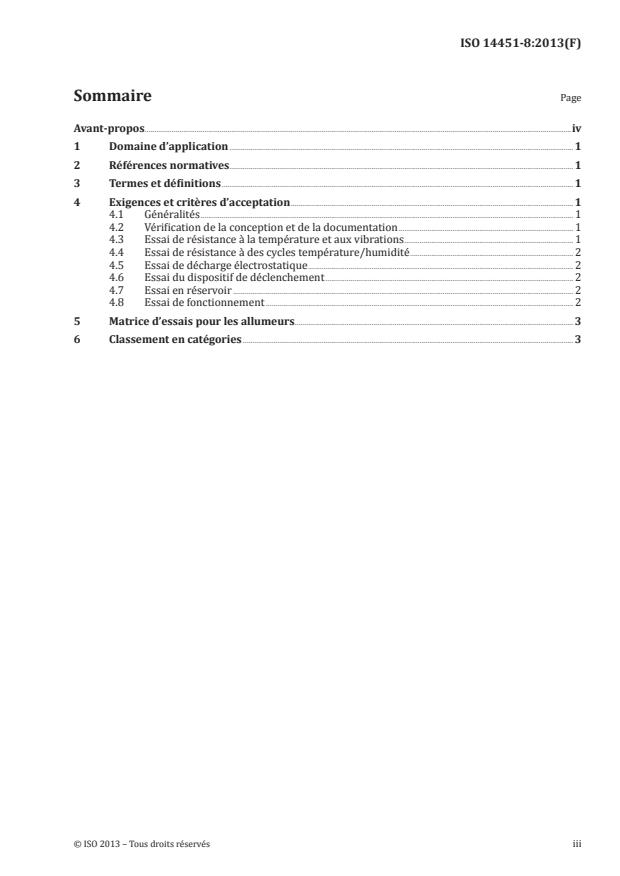
Sommaire Page
Avant-propos .iv
1 Domaine d’application . 1
2 Références normatives . 1
3 Termes et définitions . 1
4 Exigences et critères d’acceptation . 1
4.1 Généralités . 1
4.2 Vérification de la conception et de la documentation . 1
4.3 Essai de résistance à la température et aux vibrations . 1
4.4 Essai de résistance à des cycles température/humidité . 2
4.5 Essai de décharge électrostatique . 2
4.6 Essai du dispositif de déclenchement . 2
4.7 Essai en réservoir . 2
4.8 Essai de fonctionnement . 2
5 Matrice d’essais pour les allumeurs . 3
6 Classement en catégories . 3
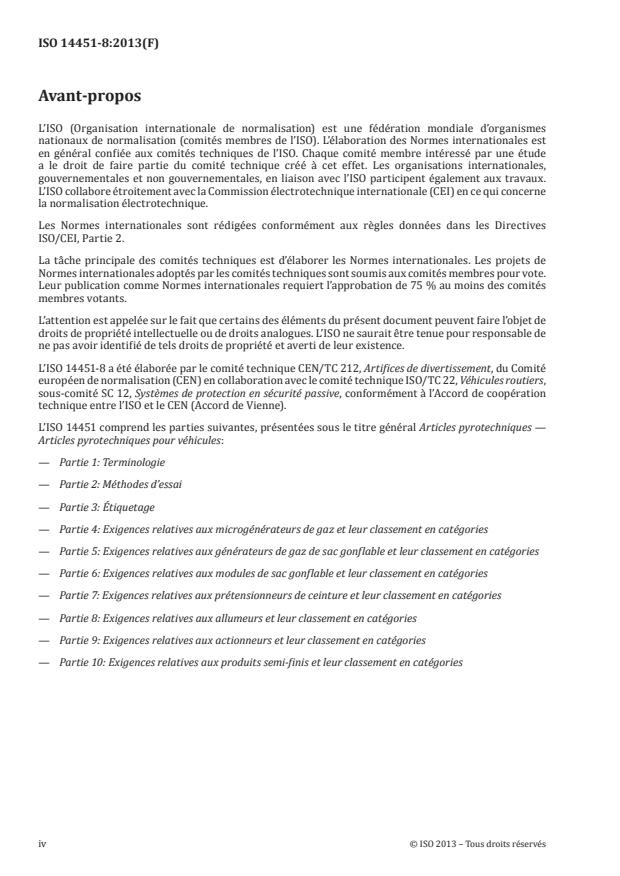
Avant-propos
L’ISO (Organisation internationale de normalisation) est une fédération mondiale d’organismes
nationaux de normalisation (comités membres de l’ISO). L’élaboration des Normes internationales est
en général confiée aux comités techniques de l’ISO. Chaque comité membre intéressé par une étude
a le droit de faire partie du comité technique créé à cet effet. Les organisations internationales,
gouvernementales et non gouvernementales, en liaison avec l’ISO participent également aux travaux.
L’ISO collabore étroitement avec la Commission électrotechnique internationale (CEI) en ce qui concerne
la normalisation électrotechnique.
Les Normes internationales sont rédigées conformément aux règles données dans les Directives
ISO/CEI, Partie 2.
La tâche principale des comités techniques est d’élaborer les Normes internationales. Les projets de
Normes internationales adoptés par les comités techniques sont soumis aux comités membres pour vote.
Leur publication comme Normes internationales requiert l’approbation de 75 % au moins des comités
membres votants.
L’attention est appelée sur le fait que certains des éléments du présent document peuvent faire l’objet de
droits de propriété intellectuelle ou de droits analogues. L’ISO ne saurait être tenue pour responsable de
ne pas avoir identifié de tels droits de propriété et averti de leur existence.
L’ISO 14451-8 a été élaborée par le comité technique CEN/TC 212, Artifices de divertissement, du Comité
européen de normalisation (CEN) en collaboration avec le comité technique ISO/TC 22, Véhicules routiers,
sous-comité SC 12, Systèmes de protection en sécurité passive, conformément à l’Accord de coopération
technique entre l’ISO et le CEN (Accord de Vienne).
L’ISO 14451 comprend les parties suivantes, présentées sous le titre général Articles pyrotechniques —
Articles pyrotechniques pour véhicules:
— Partie 1: Terminologie
— Partie 2: Méthodes d’essai
— Partie 3: Étiquetage
— Partie 4: Exigences relatives au
...