

ISO/TR 12353-3:2013
(Main)Road vehicles — Traffic accident analysis — Part 3: Guidelines for the interpretation of recorded crash pulse data to determine impact severity
General Information
- Abstract
ISO/TR 12353-3:2013 describes the determination of impact severity in road vehicle accidents as defined in ISO 12353-2, based on recorded acceleration and velocity data and derived parameters from vehicle crash pulse recorders or event data recorders, including data from self-contained devices or vehicle integrated functionalities.
- Status
- Published
- Publication Date
- 07-Jan-2013
- Technical Committee
- ISO/TC 22/SC 36 - Safety and impact testing
- Drafting Committee
- ISO/TC 22/SC 36/WG 7 - Traffic accident analysis methodology
- Current Stage
- 9093 - International Standard confirmed
- Start Date
- 29-Nov-2022
- Completion Date
- 29-Aug-2026

Overview
ISO/TR 12353-3:2013 - Road vehicles - Traffic accident analysis - Part 3 provides guidance for interpreting recorded crash pulse data to determine impact severity. The Technical Report covers how to use recorded acceleration and change-of-velocity (Δv) time histories from crash pulse recorders and Event Data Recorders (EDRs) (including Δv data compliant with 49 CFR Part 563) to derive severity parameters used in accident analysis, safety development, and research.
Key topics and technical requirements
- Scope and definitions: Clear definitions for crash pulse recorder, EDR, linear/rotational acceleration, Δv-time history, jerk and related terms (see ISO 12353-1 and ISO 4130 references).
- Crash pulse characteristics: Identification and calculation of key parameters such as peak acceleration, time to peak, mean acceleration, pulse duration, maximum cumulative Δv, and jerk. The report explains how acceleration-time history yields Δv (area under the curve) and how distance and velocity traces are derived.
- Measurement interpretation: Guidelines for defining pulse start/end times, methods to derive parameters from acceleration or Δv recordings, and examples of longitudinal and lateral applications (most examples are longitudinal).
- Calculation methods and examples: Informative annexes provide extended calculations, example pulses, and specific methods for determining time parameters.
- Misuse and limitations: Annex discussing common traps, limitations of recorded data and potential errors in interpretation to improve accuracy and avoid misuse.
- Dose–response context: Integrates crash pulse characteristics into the injury risk framework (Dose–Response model referenced in ISO 12353-2).
Practical applications and users
ISO/TR 12353-3:2013 is intended for:
- Vehicle manufacturers and safety engineers - to evaluate restraint systems and to quantify real-world crash severity for design validation.
- Accident reconstructionists and in-depth investigation teams - to interpret recorder data for crash reconstruction and injury causation analysis.
- Traffic safety researchers and policymakers - to correlate impact severity parameters (Δv, peak accel, pulse shape) with injury outcomes and to compare accident databases.
- Regulators and standards bodies - for guidance on using recorded crash pulse data in performance assessment.
- Insurance analysts and forensic experts - for objective quantification of crash severity in claims and litigation contexts.
Related standards
- ISO 12353-1: Vocabulary
- ISO 12353-2: Guidelines for the use of impact severity measures
- ISO 4130, ISO 6487
- SAE J211-1, SAE J1698-1
- 49 CFR Part 563 (EDR data requirements)
Keywords: ISO/TR 12353-3:2013, crash pulse, impact severity, Δv, acceleration-time history, crash pulse recorder, event data recorder, traffic accident analysis, injury risk.
Get Certified
Connect with accredited certification bodies for this standard

TÜV Rheinland
TÜV Rheinland is a leading international provider of technical services.

TÜV SÜD
TÜV SÜD is a trusted partner of choice for safety, security and sustainability solutions.

DEKRA Certification Inc.
DEKRA US certification services.
Sponsored listings
Frequently Asked Questions
ISO/TR 12353-3:2013 is a technical report published by the International Organization for Standardization (ISO). Its full title is "Road vehicles — Traffic accident analysis — Part 3: Guidelines for the interpretation of recorded crash pulse data to determine impact severity". This standard covers: ISO/TR 12353-3:2013 describes the determination of impact severity in road vehicle accidents as defined in ISO 12353-2, based on recorded acceleration and velocity data and derived parameters from vehicle crash pulse recorders or event data recorders, including data from self-contained devices or vehicle integrated functionalities.
ISO/TR 12353-3:2013 describes the determination of impact severity in road vehicle accidents as defined in ISO 12353-2, based on recorded acceleration and velocity data and derived parameters from vehicle crash pulse recorders or event data recorders, including data from self-contained devices or vehicle integrated functionalities.
ISO/TR 12353-3:2013 is classified under the following ICS (International Classification for Standards) categories: 43.040.80 - Crash protection and restraint systems. The ICS classification helps identify the subject area and facilitates finding related standards.
ISO/TR 12353-3:2013 is available in PDF format for immediate download after purchase. The document can be added to your cart and obtained through the secure checkout process. Digital delivery ensures instant access to the complete standard document.
Standards Content (Sample)
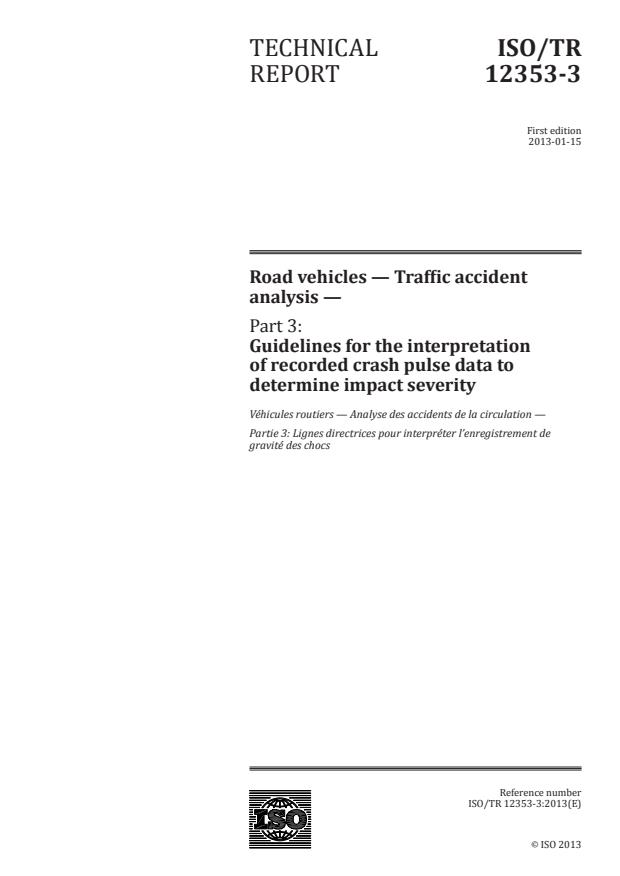
TECHNICAL ISO/TR
REPORT 12353-3
First edition
2013-01-15
Road vehicles — Traffic accident
analysis —
Part 3:
Guidelines for the interpretation
of recorded crash pulse data to
determine impact severity
Véhicules routiers — Analyse des accidents de la circulation —
Partie 3: Lignes directrices pour interpréter l’enregistrement de
gravité des chocs
Reference number
©
ISO 2013
© ISO 2013
All rights reserved. Unless otherwise specified, no part of this publication may be reproduced or utilized in any form or by any
means, electronic or mechanical, including photocopying and microfilm, without permission in writing from either ISO at the
address below or ISO’s member body in the country of the requester.
ISO copyright office
Case postale 56 • CH-1211 Geneva 20
Tel. + 41 22 749 01 11
Fax + 41 22 749 09 47
E-mail copyright@iso.org
Web www.iso.org
Published in Switzerland
ii © ISO 2013 – All rights reserved
Contents Page
Foreword .iv
Introduction .v
1 Scope . 1
2 References . 1
3 Terms and definitions . 1
4 Basic principles of crash pulse and derived measures . 3
5 Guidelines for basic interpretation of crash pulse recorder data . 5
5.1 General . 5
5.2 Crash pulse definitions. 6
5.3 Derived severity measures from crash pulse recorder output data .12
Annex A (informative) Extended application and calculations of impact severity parameters .13
Annex B (informative) Application and use of data recorded .27
Annex C (informative) Misuse, limitations and traps .33
Annex D (informative) Examples of measured acceleration and analysis .37
Annex E (informative) Calculation method for determination of t and t , Methods A, B and C .44
0 end
Annex F (informative) Example pulses with calculated or measured characteristics according to
the methods presented in this Technical Report .50
Bibliography .58
Foreword
ISO (the International Organization for Standardization) is a worldwide federation of national standards
bodies (ISO member bodies). The work of preparing International Standards is normally carried out
through ISO technical committees. Each member body interested in a subject for which a technical
committee has been established has the right to be represented on that committee. International
organizations, governmental and non-governmental, in liaison with ISO, also take part in the work.
ISO collaborates closely with the International Electrotechnical Commission (IEC) on all matters of
electrotechnical standardization.
International Standards are drafted in accordance with the rules given in the ISO/IEC Directives, Part 2.
The main task of technical committees is to prepare International Standards. Draft International
Standards adopted by the technical committees are circulated to the member bodies for voting.
Publication as an International Standard requires approval by at least 75 % of the member bodies
casting a vote.
In exceptional circumstances, when a technical committee has collected data of a different kind from
that which is normally published as an International Standard (“state of the art”, for example), it may
decide by a simple majority vote of its participating members to publish a Technical Report. A Technical
Report is entirely informative in nature and does not have to be reviewed until the data it provides are
considered to be no longer valid or useful.
Attention is drawn to the possibility that some of the elements of this document may be the subject of
patent rights. ISO shall not be held responsible for identifying any or all such patent rights.
ISO/TR 12353-3 was prepared by Technical Committee ISO/TC 22, Road vehicles, Subcommittee SC 12,
Passive safety crash protection systems.
ISO 12353 consists of the following parts, under the general title Road vehicles — Traffic accident analysis:
— Part 1: Vocabulary
— Part 2: Guidelines for the use of impact severity measures
— Part 3: Guidelines for the interpretation of recorded crash pulse data to determine impact severity
[Technical Report]
iv © ISO 2013 – All rights reserved
Introduction
With the completion of ISO 12353-2, an important extension is guidelines for the use and application
of the in-vehicle recorded crash pulse data. The aim of ISO/TR 12353-3 is to provide definitions and
recommended measurements of impact severity data recording to be used in evaluation and analyses.
This will facilitate a comparison of different accident databases, and urge on the work of accident
analyses based on impact severity data recording. The higher quality of impact severity determination
will improve the accuracy of analyses and development work for the industry, governments and others.
As more advanced active and passive safety technology is introduced in motor vehicles, it is important to
continuously evaluate the technology to determine its efficiency. Furthermore, it is essential to explore
occupant injury risk and severity for impact severity parameters best correlated to injury risk. Studies
of real-life crashes are the most important way to gain such knowledge.
Different types of accident data recorders have been developed and used for the purposes of improving
data quality. Car manufacturers also use data from sensors and recording devices in the development
process of new safety technology and to verify the effectiveness of existing technology.
Specifically for impact severity parameters, there is a need for definitions of their measurements,
recording, and process of calculation. This Technical Report concentrates on the data that can be
obtained from crash pulse data recorders for determination of impact severity.
The recorded data may be either acceleration-time data or change of velocity (Δv) time data. This Technical
Report includes methods applicable to the interpretation of recorded Δv data from event data recorders
[1]
(EDR) fulfilling the requirements of United States Code of Federal Regulations 49 CFR Part 563.
This Technical Report focuses on the crash pulse characteristics in Figure 1, the Dose – Response model
(also referred to in ISO 12353-2), slightly modified for the purposes of this Technical Report.
As shown in Figure 1 several parameters are influencing the risk of an injury. This Technical Report
focuses on the influence of crash pulse characteristics on injury risk.
Injury mechanism
Impact severity
and outcome
Road user/occupant pre-conditions
Collisionpre-conditions
Constitution,mass, posture, age,sex,
Subject vehicle Collision partner
restraint use, injury tolerance
Closing velocity
Crashconfiguration
Pre-crash phase
Crash phase
Road user/occupant response
Vehicle response
Pulsecharacteristics
Accelerations andtrajectoriesofbodyparts
shape
Contact velocity
duration ISO/TR 12353-3
∆v
Vehicle interior
(corepart)
mean acceleration Energyabsorption
Restraint systems
peak acceleration
Contactviolence/load
Deformation
crush
intrusion
intrusion velocity
EES
Restraint systems performance
Injury
Discussedunder B.2.2
Crash phase
Post- crashphase
Injuryconsequences
Rescue
Treatment
Scaling
Impairment
Severity
Harm
Figure 1 — Impact severity and injury mechanism/outcome (Dose – Response model)
With crash pulse recording techniques, and using a recorder in the undeformed part of the vehicle
chassis, it is possible to quantify physical crash pulse parameters during a vehicle crash. This is what the
vehicle restraint systems and the vehicle interior will have to handle in order to minimize the loading
on the vehicle occupants.
This Technical Report discusses the recorded physical parameters that are relevant to take into account
for certain impacts, and also discusses the possible misuse and traps when using crash pulse data.
vi © ISO 2013 – All rights reserved
TECHNICAL REPORT ISO/TR 12353-3:2013(E)
Road vehicles — Traffic accident analysis —
Part 3:
Guidelines for the interpretation of recorded crash pulse
data to determine impact severity
1 Scope
This Technical Report describes the determination of impact severity in road vehicle accidents as defined
in ISO 12353-2, based on recorded acceleration and velocity data and derived parameters from vehicle
crash pulse recorders or event data recorders, including data from self-contained devices or vehicle
integrated functionalities. Methods applicable to the interpretation of recorded Δv data from event data
recorders fulfilling the requirements of United States Code of Federal Regulations 49 CFR Part 563 are
also included.
This Technical Report includes definitions and interpretation of recorded data related to impact severity
determination. Some information on application of the data are also provided.
The purpose of this Technical Report is to interpret available recorded crash pulse data. The methods
in this Technical Report are applicable to interpretation of crash pulses in both longitudinal and lateral
directions. However, based on available data, most examples are given for the longitudinal direction.
This Technical Report does not address aspects such as the pre-crash phase, data element specifications,
and data recording and retrieval technology.
2 References
The following referenced documents are indispensable for the application of this document. For dated
references, only the edition cited applies. For undated references, the latest edition of the referenced
document (including any amendments) applies.
ISO 12353-1, Road vehicles — Traffic accident analysis — Part 1: Vocabulary
ISO 12353-2, Road vehicles — Traffic accident analysis — Part 2: Guidelines for the use of impact
severity measures
ISO 4130, Road vehicles — Three-dimensional reference system and fiducial marks — Definitions
ISO 6487, Road vehicles — Measurement techniques in impact tests — Instrumentation
SAE J211-1, Instrumentation for Impact Test — Part 1: Electronic Instrumentation
SAE J1698-1, Vehicle Event Data Interface — Output Data Definition
3 Terms and definitions
For the purposes of this document, the terms and definitions given in ISO 4130, ISO 12353-1, ISO 12353-2,
SAE J1698-1, and the following apply.
3.1
crash pulse recorder
device or unit capable of recording acceleration or Δv-time history data during the impact phase
Note 1 to entry: Crash pulse recorder is used as a generic term in this Technical Report to differentiate from Event
Data Recorders as defined in 49 CFR Part 563.
3.2
Event Data Recorder
EDR
device or function in a vehicle that records the vehicle’s dynamic time-series data during the time period
just prior to a crash event (e.g. vehicle speed vs. time) or during a crash event (e.g. Δv vs. time), intended
for retrieval after the crash event
Note 1 to entry: The definition is in accordance with 49 CFR Part 563.
Note 2 to entry: Data elements other than time series data are often recorded.
3.3
linear acceleration
acceleration in any direction during an impact event
3.3.1
longitudinal acceleration
acceleration in the vehicle X-axis direction during an impact event
3.3.2
lateral acceleration
acceleration in the vehicle Y-axis direction during an impact event
3.3.3
vertical acceleration
acceleration in the vehicle Z-axis direction during an impact event
3.4
rotational acceleration
acceleration about one of the vehicle axes
3.4.1
yaw acceleration
acceleration around the vehicle Z-axis
3.4.2
pitch acceleration
acceleration around the vehicle Y-axis
3.4.3
roll acceleration
acceleration around the vehicle X-axis
3.5
Δv – time history
cumulative history of developing change of velocity resulting in Δv
3.6
jerk
third derivative with respect to time of the position of an object; equivalently the rate of change of the
acceleration of an object
Note 1 to entry: Considered a measure of harshness of vehicle motion.
2 © ISO 2013 – All rights reserved
4 Basic principles of crash pulse and derived measures
The crash pulse time history provides the possibility of a superior determination of impact severity
compared to e.g. deformation-based Δv and EES (Energy Equivalent Speed), in several impact types.
The whole crash pulse is not possible to use as a single parameter for impact severity, but certain
characteristics of the crash pulse can be useful in interpreting the injury outcome in certain impact types.
Some characteristics can be directly obtained or calculated from the crash pulse, e.g.:
— (maximum cumulative) Δv;
— peak acceleration;
— time to peak acceleration;
— mean acceleration;
— and to some extent, the total duration.
For the calculation of some of these parameters the start and end time of the crash pulse need to be
defined, as the pulse duration needs to be defined. This is discussed in detail in 5.2.3.
Distance, velocity, acceleration and jerk time histories, if not directly recorded, can be derived by
differentiation or integration.
Δv can be obtained as the final value of the Δv-time history curve using the defined pulse duration,
also known as the area under the acceleration curve. Details of how to calculate these parameters are
further described and discussed in Clause 5.
The Δv-time history, the cumulative history of developing change of velocity, can be derived from the
acceleration-time history as the cumulative area under the crash pulse within a specified time period:
Δv(t) = at()dt
∫
where a is the acceleration (crash pulse).
Figure 2 illustrates a generic crash pulse with main characteristics and some derived parameters.
Figure 3 illustrates the same generic crash pulse with corresponding jerk, distance, and velocity curves.
Y
-10
X
-10
-20
Y
-30
-40
-50
Key
1 acceleration-time history 6 Δv (maximum cumulative Δv, also given by the area
under the crash pulse)
2 peak acceleration 7 time to maximum, Δv
3 time to peak acceleration 8 pulse duration, Δt
4 mean acceleration X time [ms]
5 Δv-time history Y acceleration [g], change of velocity [km/h]
NOTE The diagram is shown with both positive and negative y-axis, both are commonly used in the
literature. This Technical Report does not have a preference for either type of representation, and both types are
shown in examples.
Figure 2 — Crash pulse with derived parameters (shown with positive and negative y-axis)
4 © ISO 2013 – All rights reserved
In Figure 3, four parameters are shown, all derived from the recorded acceleration-time history:
— Acceleration-time history;
— Δv-time history;
— Distance-time history of the centre of gravity (or the crash pulse recorder);
— Jerk-time history.
From these calculated parameters, peak jerk, Δv and Δs can be derived.
Y
1 2 3 4
-10
020406080100 120 140
X
Key
1 crash pulse (acceleration-time history) [g]
2 Δv-time history [km/h]
3 distance-time history of the CG (or the crash pulse recorder) [cm]
4 jerk time history [m/s ] (magnified 10 times)
X time [ms]
Y acceleration [g], change of velocity [km/h], distance [cm], jerk [m/s /10]
Figure 3 — Crash pulse with corresponding jerk, distance, and velocity curves
5 Guidelines for basic interpretation of crash pulse recorder data
5.1 General
The procedure of exactly how to describe impact severity is still an open issue although ISO 12353-2 has
defined parameters relevant to certain crash configurations.
Most of the world-wide acting in-depth accident investigation teams use the change of velocity, ∆v, or the
Energy Equivalent Speed (EES), as a parameter for impact severity when presenting results of the injury
outcome versus impact severity.
There is a wide scatter of the results when the correlation of ∆v or EES and injury outcome is analysed.
One of the reasons for the scatter of injury outcome is the injury severity scaling system itself. Other
reasons are the variability in human-related parameters such as age, gender or body weight.
Another reason is that even at identical parameter values for impact severity like ∆v, the acceleration
crash pulse can be significantly different. The latter can be demonstrated by comparison of, e.g. the
dummy chest loading for different crash tests with identical ∆v and EES values but significantly differing
acceleration crash pulses. For a meaningful comparison, all other important parameters such as vehicle
crash performance and restraint systems have to be identical. These conditions are effectively fulfilled
for a series of four frontal impacts shown in D.1. Figure 4 illustrates an example from those.
Y
020406080 100 120 X
Key
1 car-to-car impact with 57 % overlap and a closing velocity of 110 km/h
2 impact against a rigid barrier with 50 % overlap at 55 km/h
X time [ms]
Y acceleration [g]
Figure 4 — Acceleration crash pulses of two different crashes with identical Δv and EES
5.2 Crash pulse definitions
5.2.1 General
According to ISO 12353-1, the crash pulse is defined as the acceleration-time history during the impact phase.
NOTE It is also common to refer to the Δv-time history as the crash pulse.
6 © ISO 2013 – All rights reserved
5.2.2 Sampling and filtering
The general recommendation (according to ISO 6487 and SAE J211-1) is that the sampling frequency
should be at least ten times the channel frequency class applied, e.g. a CFC60 filter can be applied to a
sampling frequency of 600 Hz or higher. According to SAE J211-1, CFC60 should be applied to vehicle
crash acceleration data. A filtering example is shown in Figure 5, where a curve showing CFC60 and
CFC20 filtering of the same pulse has been applied. The CFC20 filtering will also be used in 5.2.3.3.
Y
-20
-40
050100 150200
X
Key
1 original unfiltered acceleration data (1000 Hz)
2 CFC60 filtered (60 Hz 4 pole Butterworth)
3 CFC20 filtered (20 Hz 4 pole Butterworth)
X time [ms]
Y acceleration [g]
NOTE Each level of filtering / averaging contains less information.
Figure 5 — Effects of different filtering applied to an acceleration crash pulse
5.2.3 Determination of beginning (t ) and end (t ) of crash pulse
0 end
In many cases (for example for the determination of mean acceleration) it is crucial to define when the
crash pulse actually starts and ends, and very often this can be hard to determine.
The start and end of the crash pulse need to be determined in different ways depending on the data available.
The definitions of t and t could be determined either with respect to the crash pulse characteristics
0 end
or with respect to characteristics of derived measures such as Δv. Either of the following methods is
recommended according to this Technical Report.
NOTE See Annex E for calculation processes related to the respective methods.
5.2.3.1 Method A: Determination based on Δv – time history
This method is consistent with the determination of t and t according to SAE J1698-1, referenced
0 end
in 49 CFR Part 563 for continuously running algorithms. Using time of deployment will not allow an
appropriate determination of t .
Definition of t : Time when the cumulative Δv of over 0,8 km/h is reached within a 20 ms time period
in the longitudinal direction for a frontal/rear event, or within a 5 ms time period in the lateral direction
for a side impact event. See Figure 6.
NOTE 1 According to 49 CFR Part 563, for systems with wake-up occupant protection control algorithms, the
time at which the occupant protection control algorithm is activated may be used to define t .
Definition of t : Time where the end of an impact event (t ) is at the moment when the longitudinal,
end end
cumulative Δv within a 20 ms time period becomes 0,8 km/h or less.
NOTE 2 If t was not captured, the time to maximum Δv, if available, may be substituted for t when a) the
end end
recorded crash pulse time-history is truncated (cut short) before meeting the 0,8 km/h change of velocity within
20 ms criterion, and b) the time to maximum Δv is longer than the truncated crash pulse recording time period.
The same logic is applied to side and rear impact events.
NOTE 3 In special cases, it may be possible to draw sufficiently secure conclusions from the acceleration-time
history curve so that t and/or t can be determined directly. Examples showing determination of t and t for
0 end 0 end
specific crash pulses are given in Annex E.
NOTE 4 Special attention has to be drawn to this when there are multiple impacts or more than one crash pulse
in a crash sequence.
8 © ISO 2013 – All rights reserved
Y
∆v =
0,8km/h
20 ms
∆v =
0,8 km/h
-10
0 50 100 150 200
t =36ms
t =164 ms
0 end
X
Key
X time [ms]
Y acceleration [g], change of velocity [km/h]
NOTE This figure shows Method A applied to a longitudinal crash pulse.
Figure 6 — Definition of t and t , Method A
0 end
5.2.3.2 Method B: Determination based directly on acceleration – time history
This method directly uses a CFC60 filtered acceleration pulse, see Figure 7.
Draw one line representing 10 % of peak acceleration, and another line representing 90 % of peak
acceleration. Determine the intersections of the crash pulse and the above lines. This will form a triangle.
Definition of t : Time where the left intersection line meets the zero line.
Definition of t : Time where the right intersection line meets the zero line.
end
NOTE For some acceleration pulses it is not obvious if the first or a later intersection should be used. Below a
later intersection is shown. In case of doubt, Method C can be used.
Y
-10
0 50 100 150 200
t =29ms t =157 ms
0 end
X
Key
1 90 % of peak acceleration (CFC60 filtered acceleration pulse)
2 10 % of peak acceleration (CFC60 filtered acceleration pulse)
X time [ms]
Y acceleration [g], change of velocity [km/h]
NOTE This figure shows Method B applied to a longitudinal crash pulse.
Figure 7 — Definition of t and t , Method B
0 end
5.2.3.3 Method C: Determination based on application of a low filter frequency
Apply a CFC filter frequency of 20 Hz to the recorded acceleration pulse, see Figure 8.
Draw one line representing 10 % of peak acceleration. Determine the intersections of the acceleration
pulse and the above line.
Definition of t : Time where the 10 % peak acceleration line meets the CFC20 filtered acceleration
pulse to the left.
Definition of t : Time where the 10 % peak acceleration line meets the CFC20 filtered acceleration
end
pulse to the right.
10 © ISO 2013 – All rights reserved
Y
-10
0 50 100 150 200
t =29ms t =152 ms
0 end
X
Key
1 CFC60 filtered acceleration pulse
2 CFC20 filtered acceleration pulse
3 peak acceleration of CFC20 filtered acceleration pulse
4 10 % of peak acceleration of CFC20 filtered acceleration pulse
X time [ms]
Y acceleration [g], change of velocity [km/h]
NOTE This figure shows Method C applied to a longitudinal crash pulse.
Figure 8 — Definition of t and t , Method C
0 end
5.2.4 Calculation of acceleration resultant for an angled impact
If multiple directions (x, y, z) are recorded, a resultant acceleration value can be calculated at any time
during the impact phase:
22 2
aa=+aa+
resx yz
Relevant resultant values for Δv and mean acceleration can only be established by calculating Δv and
mean acceleration separately for each direction, and then using the formula for calculating the resultant:
22 2
aa=+aa+
resx yz
22 2
ΔΔvv=+ΔΔvv+
resx yz
5.3 Derived severity measures from crash pulse recorder output data
5.3.1 General
This clause describes the acceleration-related and velocity-related measures that can be directly derived
or calculated from the crash pulse recorder output data.
5.3.2 Mean acceleration
The mean acceleration is calculated with respect to Δt (a = Δv/Δt), between t and t .
mean 0 end
5.3.3 Peak acceleration
Crash pulse should be CFC60 filtered. Identify the peak acceleration value during the pulse duration.
NOTE Peak acceleration is affected by the sampling frequency and the subsequent filtering.
5.3.4 Δv (maximum cumulative Δv)
5.3.4.1 Methodology to derive Δv from recorded data
a) From acceleration-time history:
— If crash pulse is complete, integrate acceleration-time history over the full duration;
— If crash pulse is truncated or incomplete, an appropriate acceleration-time-history curve fitting
model (e.g. a third degree polynomial, trigonometric, or a geometric) may be applied to extend
crash pulse to predict the total pulse length before the integration. Such extensions must however
be applied with great care and must be related to other evidence supporting the extension. See
Annex A for more information.
b) From Δv-time history:
Required minimum recording frequency is 100 Hz. If crash pulse is complete, select Δv at the end of the
impact phase.
12 © ISO 2013 – All rights reserved
Annex A
(informative)
Extended application and calculations of impact severity parameters
A.1 Extended application of basic impact severity parameters
A.1.1 Maximum average acceleration over a specified time interval
The average value of the acceleration a(t) over the interval t to t is given by
1 2
t
a = at()dt
∫
tt−
t
A fixed time frame (window), e.g. 40 ms or 80 ms duration, can be used. The window is applied where
the maximum mean acceleration for the specific window size is found.
NOTE A very narrow window will approach the peak acceleration. A wide window will approach the mean
acceleration.
Use of different window sizes is illustrated by Figure A.1.
Y
A A
B
B
-10
0 20 40 60 80 100 120 140
X
t t
1A
2A
t t
1B 2B
Key
A maximum average over 10 ms window size: 34,0 g
B maximum average over 40 ms window size: 19,8 g
X time [ms]
Y acceleration [g], change of velocity [km/h]
Figure A.1 — Illustration of maximum average over a specified time interval
A.1.2 ASI — Acceleration Severity Index
ASI is used in the evaluation of performance of barriers and roadside equipment/installations in crashes
with vehicles in accordance with EN 1317-1.
Maximum value of ASI (t) plot obtained from vehicle Centre of Gravity accelerations (x, y, z)
2 2 2
a
a a
x y z
ASI(t)= + +
12 910
where aa,,a are the filtered components of the vehicle acceleration.
xy z
To calculate the average acceleration components, a maximum average of the same 50 ms window is
used (in a similar way as described in A.1.1).
NOTE An ASI value can be calculated with at least one of these components.
A.1.3 Influence of several crash pulse characteristics
Several crash pulse characteristics may be taken into account in combination to better explain the
occupant response. Some examples are listed below:
— peak acceleration combined with time to peak acceleration;
— mean acceleration combined with peak acceleration;
— Δv combined with crash pulse duration.
NOTE Some examples are included in B.2 and D.2.
A.1.4 VDC — Theoretical Occupant Contact Velocity
A.1.4.1 Objective
VCD (in formulas v ) is a Δv metric focused on the early portion of the crash pulse that is more critical
CD
to the crash severity experienced by an occupant. Abrupt crash pulses or early peak-g’s (e.g. full-frontal
barrier) have notable higher crash severity than a soft pulse or late peak-g (e.g. angle impact) with the
same Δv or peak-g. VCD rates abrupt crash pulses and early peak-g’s with a higher severity measure.
VCD defines impact severity in terms of a theoretical unrestrained occupant contact velocity based on
crash event Δv-time history data. VCD relates to chest contact velocity and gives a theoretical measure
of the occupant energy that must be managed by the restraint system for a given pulse.
A.1.4.2 Method
VCD gives the theoretical driver chest to steering wheel hub contact velocity of an unrestrained occupant
with an initial distance (D). It can be calculated from all recorded vehicle v-t pulses.
Construct the vehicle v-t pulse from the crash pulse recorder or EDR data. Define a standard distance, D,
as the distance between the driver’s chest (50th percentile male) and the steering wheel hub. A suitable
value is 300 mm. Once a value for D is defined, use it for all vehicles and all recorded v-t pulses to be
compared. Next, assume that the driver is unrestrained and travels at the vehicle velocity, v , until the
driver has travelled the distance D.
The theoretical contact velocity, v , is calculated by numerical integration from the v-t curves of the
CD
vehicle and the driver until the cumulative value of D is reached, as shown in Figure A.2. v is not required
to do the integration.
14 © ISO 2013 – All rights reserved
3 2
Y
X
Key
1 vehicle, v-t
2 unrestrained driver, v-t; v
3 D; area between driver and vehicle v-t curves
X time
Y velocity
NOTE v is driver to hub contact velocity, which is the measure of vehicle pulse severity.
CD
Figure A.2 — VCD approach, principle
The choice of D determines two groups of crash pulses. In one group are the pulses where v < Δv of
CD
the crash (as illustrated in Figure A.2). The second group are the pulses where v = Δv of the crash. The
CD
distribution of pulses between the two groups depends on the choice of D.
A.1.5 VPI — Vehicle Pulse Index
A.1.5.1 Objective and description
The Vehicle Pulse Index (VPI) is a metric that can be used to assess the relative severity of a crash pulse to
a restrained occupant. This metric utilizes a Single Degree of Freedom (SDOF) model as a processing tool.
The model consists of a mass (M) representing the occupant, a spring (k) and a slack (s) representing
the restraint system. The restraint stiffness value and slack can be assigned by the user. The input is the
vehicle body motion x(t) (derived from a crash pulse recorder or an EDR) and the output is the calculated
y acceleration pulse associated with the occupant mass.
By solving the equation of motion for the mass M, VPI is defined as the maximum value of the calculated
occupant mass acceleration, i.e.:
v
CD
Mÿ+ky =P(t)
where
0, x
P(t) =
k(x –s), x≥s
y(t)
VPI =max(ÿ)
M
x(t)
Slack(s) Spring (k)
Figure A.3 — SDOF VPI model
As the output of the model depends on the characteristics of the spring and the amount of slack, it is
recommended to select fixed values for these parameters and only vary the pulse input to calculate the
VPI for different crash pulses.
With a mass of 1 kg recommended values are: k = 2500 N/m, s = 0,03 m.
A.1.5.2 Calculation examples
A.1.5.2.1 Example 1: Constant pulse
2 2
Crash pulse: Constant 200 m/s for 80 ms. Result: VPI = 464,6 m/s (47,4 g). See Figure A.4.
NOTE This may be a suitable pulse for checking the calculation algorithm.
16 © ISO 2013 – All rights reserved
Y
VPI
0 20 40 60 80 100 120 140 160
X
Key
1 acceleration input
2 response
X time [ms]
Y acceleration [m/s ]
Figure A.4 — VPI calculation Example 1
A.1.5.2.2 Example 2: Sine pulse
2 2
Crash pulse: 300sin(30t) m/s for 105 ms. Result: VPI = 600,9 m/s (61,3 g). See Figure A.5.
Y
VPI
0 20 40 60 80 100 120 140 160
X
Key
1 acceleration input
2 response
X time [s]
Y acceleration [m/s ]
Figure A.5 — VPI calculation Example 2
A.2 Derived surrogate acceleration pulse from cumulative Δv-time history
A.2.1 Background
Event data recorders may only report Δv-time history. Therefore a process to convert this data to an
acceleration-time history is useful. Since this is a differential process over discrete time intervals the
derived pulse will not contain all the features and the resolution of a directly measured acceleration-
time history. The acceleration pulse derived from the lower resolution EDR data may also have a time lag.
There can be variations in an EDR’s crash pulse reporting rate and duration. However, US market vehicles
manufactured on or after September 1, 2012 equipped with an Event Data Recorder function should
comply with the United States Code of Federal Regulation, 49 Part 563 – Event Data Recorders. The Part
563 rule standardizes the minimum required data elements including the longitudinal Δv-time history.
Minimum required reporting intervals and sampling rates are:
— 0 to 250 ms, or 0 to End of Event Time plus 30 ms, whichever is shorter;
— 100 Hz sampling rate.
A.2.2 Methodology
When only a Δv-time history is available from an EDR report, an acceleration-time history can be
calculated from the provided Δv-time history by differencing the incremental change of velocity over
the associated time increment to obtain a coarse acceleration-time history.
dv vv−
ii+1
a==
dt Δt
The computed acceleration is plotted at the midpoint between time i and i+1.
18 © ISO 2013 – All rights reserved
A.2.3 Application example
Data from NHTSA NCAP test 4445 is used in this application example. The usual array of accelerometers
in an NCAP test recording data at 1000 Hz captured this impact. This data along with the EDR reports
can be obtained via the NHTSA’s website at http://www.nhtsa.gov.
The acceleration-time history, recorded at 1000 Hz and filtered according to CFC60, and velocity time
history are plotted in Figure A.6. The EDR data concurrently recorded at 100 Hz during this crash test is
plotted in Figure A.6 as well. For example purposes the above equation was applied to the EDR data and
the associated lower resolution EDR derived acceleration pulse is plotted and compared to the higher
resolution accelerometer data, depicted in Figure A.6.
10 10
0 0
-10 -10
Y1 2 Y2
-20 -20
-30 -30
-40 -40
-50 -50
-0,020 0,02 0,04 0,06 0,08 0,10,120,140,160,18
X
Key
1 acceleration-time history (1000 Hz CFC60)
2 Δv-time history (1000 Hz CFC60)
3 calculated surrogate acceleration pulse from EDR Δv output data
4 EDR Δv output
X time [s]
Y1 acceleration [g]
Y2 change of velocity [mph]
Figure A.6 — Crash test acceleration and velocity compared to the EDR data in NHTSA test 4445
NOTE 1 There is an obvious (dramatic) spike in the derived acceleration pulse after 110 ms. This EDR stores
up to 50 ms before deployment and 100 ms after deployment. Because the airbag is deployed near 10 ms into
the pulse, the total recording duration is 110 ms. Data after 110 ms is default data (all zero) and the calculation
process is stopped at 110 ms. If it was not ignored, the analyst would reach the wrong conclusion that there was a
positive 36 G acceleration at between 110 ms and 120 ms, which is a higher numerical value than the negative G’s
in the real crash pulse.
NOTE 2 The pulse derived from the lower resolution EDR data under-reports the actual values and there may
be a time lag.
A.3 Comparison of characteristics calculated from recorded Δv and acceleration
A.3.1 Introduction
Controlled barrier crashes run in laboratories and specialized test fleets often have extensive
instrumentation that can measure X, Y and Z acceleration at 1 ms or less intervals that allow methods
A, B and C to be used to characterize the beginning and end of a crash pulse. There are also many real
world crashes where a vehicle event data recorder may be the only instrumentation available. While
some of these data recorders may record acceleration data at high frequencies similar to barrier test
instrumentation, many only record longitudinal X (or X and Y) Δv at 10 ms intervals.
Using the 10 ms Δv intervals to derive a surrogate acceleration pulse has been discussed in A.2. This
surrogate acceleration pulse is effectively much more heavily damped than the CFC60 filter typically
used on higher frequency instrumentation data. The heavy damping will reduce any sharp peaks in the
CFC60 data substantially, such that it is inappropriate to compare a peak acceleration value from CFC60
data with a surrogate derived peak acceleration value from an EDR.
Annex F illustrates high frequency CFC60 data versus EDR data derived from the raw acceleration data
used to generate the CFC60 data. A different metric is needed to be able to compare some measure of
peak acceleration between these pulses.
A.3.2 Peak surrogate acceleration
For the recorder which has only Δv at 10 ms intervals, the surrogate acceleration calculated for each
10 ms interval as described in A.2 can be compared and the peak value selected.
A.3.3 Peak 10 ms rolling average acceleration
The peak surrogate acceleration selected in A.3.2 should not be compared directly to the peak
acceleration from higher frequency data. Higher frequency data with only a CFC60 filter applied must
be more heavily damped to be comparable to the EDR surrogate acceleration pulse. Any number of
different heavier filters could be used.
It is possible to take a set of 1 ms interval acceleration data and estimate when an airbag “wakeup”
deployment algorithm would have triggered, or to use the US 49 CFR Part 563 definition of the start of
an event for continuously running algorithms (Method “A”). The data could be processed to duplicate
the function of an EDR, calculating the Δv for each 1 ms interval and accumulating it and reporting it at
10 ms intervals. However, selecting the start point and doing the accumulation is a relatively complex
calculation. A simpler measure, one that lends itself to automated calculations, is needed.
One of the simple measures is to take the 10 ms rolling average of the 1 ms CFC60 data. The peak value of
this more heavily damped parameter should approximate the peak values that would be obtained from
an EDR surrogate acceleration pulse.
Since the 10 ms rolling average would be calculated every 1 ms, and the EDR reports only every 10 ms,
it is possible that the rolling average will still catch a slightly higher peak value than the EDR. Since the
EDR is processing raw data, not CFC60 filtered data, it is also possible that there could be some random
variations where the EDR peak value could be higher than the 10 ms CFC60 rolling average. However,
for the purpose of comparing large data sets these variations are relatively small and can be considered
negligible on an aggregate basis.
The instantaneous 10 ms rolling average acceleration can be described as:
A = (A + A + A + A + A + A + A + A + A A )/10
10ms avg x x-5 x-4 x-3 x-2 x-1 x x+1 x+2 x+3 + x+4
20 © ISO 2013 – All rights reserved
A.4 Handling of truncated pulses
A.4.1 Introduction
There are instances when the on-board crash pulse recorder does not capture the complete acceleration
crash pulse. This may be as a result of the design and configuration of the crash pulse recorder, the
result of power failure, insufficient memory, or electronic components being compromised. A method
to extrapolate the truncated crash pulse acceleration data in order to derive a surrogate maximum ∆v
for statistical comparison of accidents has been developed. This method is recently explored by some
[6] [8]
experts and needs to be further verified (see e.g. References , ). The method utilizes analytical crash
pulse modelling, vehicle specific crash performance data, and specific crash related data.
This method may be applicable if the recorded part of acceleration crash pulse is long enough to indicate
that its shape can be represented by a certain model shape, its maximum values are well passed over
and the pulse duration can be estimated.
A.4.2 Methodology
Given a significant portion of the acceleration-time history, the objective is to extrapolate the missing
data to derive a surrogate maximum ∆v value for statistical comparison of accident using constraints that
best reflect the characteristics of the subject crash. In order to apply these constraints, a mathematical
model for the pulse under study must first be developed. Once the shape is determined, the measured
vehicle deformation, crash dynamics information, pulse duration, physics based determinations of
velocity changes and other known parameters can be utilized to scale the chosen pulse shape to the
crash under study.
A mathematical model to represent the incomplete crash pulse recorder recorded acceleration profile is
selected. The requirement for the chosen mathematical model is that it is integrable either in closed form
or numerically. The simplest approach is to use an integrable geometric or trigonometric function such
as a square, triangle (bi-linear), sine, haversine o
...