

ISO 20766-14:2022
(Main)Road vehicles — Liquefied petroleum gas (LPG) fuel system components — Part 14: Vaporizer/pressure regulator
General Information
- Abstract
This document specifies general requirements for the vaporizer/pressure regulator, a component of liquefied petroleum gas fuel, intended for use on the types of motor vehicles as defined in ISO 3833. It also provides general design principles and specifies requirements for instructions and marking. This document is applicable to vehicles (mono-fuel, bi-fuel or dual-fuel applications) using gaseous fuels in accordance with ISO 9162. It is not applicable to the following: a) fuel containers; b) stationary gas engines; c) container mounting hardware; d) electronic fuel management; e) refuelling receptacles. It is recognized that miscellaneous components not specifically addressed herein can be examined for compliance with the criteria of any applicable part of the ISO 20766 series, including testing to the appropriate functional tests. All references to pressure in this document are considered gauge pressures unless otherwise specified. This document applies to devices which have a service pressure in the range of 110 kPa (butane rich at 20 °C) and 840 kPa (propane at 20 °C), hereinafter referred to in this document. Other service pressures can be accommodated by adjusting the pressure by the appropriate factor (ratio).
- Status
- Published
- Publication Date
- 03-Jan-2022
- Technical Committee
- ISO/TC 22/SC 41 - Specific aspects for gaseous fuels
- Current Stage
- 6060 - International Standard published
- Start Date
- 04-Jan-2022
- Due Date
- 13-Mar-2022
- Completion Date
- 04-Jan-2022

Overview
ISO 20766-14:2022 is an international standard that specifies the general requirements and design principles for vaporizer/pressure regulators used in liquefied petroleum gas (LPG) fuel systems for road vehicles. This component plays a crucial role in controlling LPG fuel pressure and vaporization to ensure safe and efficient operation in various types of motor vehicles as defined in ISO 3833. Applicable to mono-fuel, bi-fuel, or dual-fuel vehicle applications using gaseous fuels per ISO 9162, the standard excludes fuel containers, stationary gas engines, mounting hardware, electronic fuel management, and refueling receptacles.
The standard defines criteria for pressure ranges between 110 kPa (butane-rich) and 840 kPa (propane) gauge pressure, establishing methods for testing, marking, and operational performance to ensure safety, reliability, and compliance within automotive LPG systems.
Key Topics
Scope and Application
ISO 20766-14 targets LPG vaporizer/pressure regulators fitted to road vehicles utilizing gaseous fuels. It sets design and operational requirements while clarifying exclusions such as refueling components and electronic management systems.Marking Requirements
The standard mandates comprehensive markings on components including manufacturer identification, model number, working pressure, flow direction, and recommended additional data like fuel type, electrical ratings, certification symbols, and type approval numbers to facilitate traceability and correct installation.Construction and Assembly Compliance
The vaporizer/pressure regulator must comply with general ISO 20766 series standards-especially ISO 20766-1 (general requirements), ISO 20766-2 (performance and test methods), and ISO 20766-12 (non-return valve)-ensuring uniformity across LPG fuel system components.Rigorous Testing Procedures
ISO 20766-14 outlines extensive tests to confirm the component’s durability and safety including:- Hydrostatic strength tests at 2.25 times working pressure
- Leakage tests across a range of temperatures and pressures
- Continued operation endurance for up to 50,000 cycles under varied temperature and pressure conditions
- Insulation and minimum opening voltage tests to verify electrical integrity
- Pressure impulse tests simulating instantaneous pressure surges internally and externally
- Water jacket freezing tests to ensure resistance to cold weather conditions
Applications
ISO 20766-14:2022 is essential for manufacturers, engineers, and quality assurance professionals involved with LPG fuel system components in road vehicles. It enables:
- Design and Manufacturing of vaporizer/pressure regulators that meet global safety and performance benchmarks.
- Vehicle Integration ensuring components are compatible with mono-fuel, bi-fuel, and dual-fuel LPG vehicle systems, facilitating reliable fuel pressure management.
- Testing and Certification through standardized test methods verifying endurance, leak-tightness, electrical safety, and resilience against environmental stressors such as cold temperatures and pressure spikes.
- Maintenance and Traceability supported by mandatory marking and documentation, streamlining warranty claims, repairs, and vehicle inspections.
This standard supports the automotive industry’s transition to cleaner, alternative gaseous fuels by establishing trustworthy, interoperable LPG fuel system components.
Related Standards
- ISO 20766-1: General requirements and definitions for LPG fuel system components in road vehicles.
- ISO 20766-2: Performance criteria and test methods applicable to LPG components including the vaporizer/pressure regulator.
- ISO 20766-12: Specific to non-return valves in LPG fuel systems, often integrated within the vaporizer/pressure regulator assembly.
- ISO 3833: Defines vehicle types and basic terminology for road vehicles essential for classification under ISO 20766-14.
- ISO 9162: Specifications for gaseous fuels, ensuring the compatibility of fuel types used with LPG systems covered by this standard.
ISO 20766-14:2022 sets a comprehensive framework for the safe, efficient, and durable design of vaporizer/pressure regulators in LPG road vehicle fuel systems, supporting the automotive sector’s advancement towards sustainable and environmentally-friendly fuel solutions.
Get Certified
Connect with accredited certification bodies for this standard

TÜV Rheinland
TÜV Rheinland is a leading international provider of technical services.

TÜV SÜD
TÜV SÜD is a trusted partner of choice for safety, security and sustainability solutions.

DEKRA Certification Inc.
DEKRA US certification services.
Sponsored listings
Frequently Asked Questions
ISO 20766-14:2022 is a standard published by the International Organization for Standardization (ISO). Its full title is "Road vehicles — Liquefied petroleum gas (LPG) fuel system components — Part 14: Vaporizer/pressure regulator". This standard covers: This document specifies general requirements for the vaporizer/pressure regulator, a component of liquefied petroleum gas fuel, intended for use on the types of motor vehicles as defined in ISO 3833. It also provides general design principles and specifies requirements for instructions and marking. This document is applicable to vehicles (mono-fuel, bi-fuel or dual-fuel applications) using gaseous fuels in accordance with ISO 9162. It is not applicable to the following: a) fuel containers; b) stationary gas engines; c) container mounting hardware; d) electronic fuel management; e) refuelling receptacles. It is recognized that miscellaneous components not specifically addressed herein can be examined for compliance with the criteria of any applicable part of the ISO 20766 series, including testing to the appropriate functional tests. All references to pressure in this document are considered gauge pressures unless otherwise specified. This document applies to devices which have a service pressure in the range of 110 kPa (butane rich at 20 °C) and 840 kPa (propane at 20 °C), hereinafter referred to in this document. Other service pressures can be accommodated by adjusting the pressure by the appropriate factor (ratio).
This document specifies general requirements for the vaporizer/pressure regulator, a component of liquefied petroleum gas fuel, intended for use on the types of motor vehicles as defined in ISO 3833. It also provides general design principles and specifies requirements for instructions and marking. This document is applicable to vehicles (mono-fuel, bi-fuel or dual-fuel applications) using gaseous fuels in accordance with ISO 9162. It is not applicable to the following: a) fuel containers; b) stationary gas engines; c) container mounting hardware; d) electronic fuel management; e) refuelling receptacles. It is recognized that miscellaneous components not specifically addressed herein can be examined for compliance with the criteria of any applicable part of the ISO 20766 series, including testing to the appropriate functional tests. All references to pressure in this document are considered gauge pressures unless otherwise specified. This document applies to devices which have a service pressure in the range of 110 kPa (butane rich at 20 °C) and 840 kPa (propane at 20 °C), hereinafter referred to in this document. Other service pressures can be accommodated by adjusting the pressure by the appropriate factor (ratio).
ISO 20766-14:2022 is classified under the following ICS (International Classification for Standards) categories: 43.060.40 - Fuel systems. The ICS classification helps identify the subject area and facilitates finding related standards.
ISO 20766-14:2022 is available in PDF format for immediate download after purchase. The document can be added to your cart and obtained through the secure checkout process. Digital delivery ensures instant access to the complete standard document.
Standards Content (Sample)
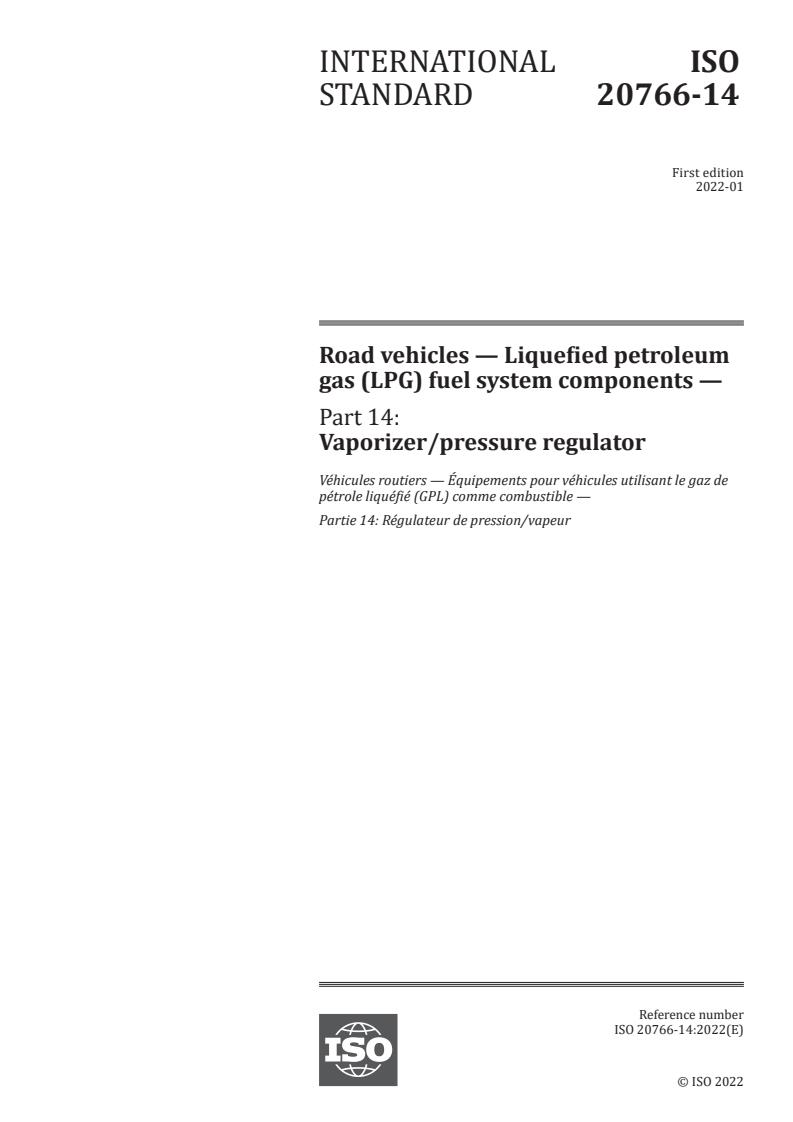
INTERNATIONAL ISO
STANDARD 20766-14
First edition
2022-01
Road vehicles — Liquefied petroleum
gas (LPG) fuel system components —
Part 14:
Vaporizer/pressure regulator
Véhicules routiers — Équipements pour véhicules utilisant le gaz de
pétrole liquéfié (GPL) comme combustible —
Partie 14: Régulateur de pression/vapeur
Reference number
© ISO 2022
All rights reserved. Unless otherwise specified, or required in the context of its implementation, no part of this publication may
be reproduced or utilized otherwise in any form or by any means, electronic or mechanical, including photocopying, or posting on
the internet or an intranet, without prior written permission. Permission can be requested from either ISO at the address below
or ISO’s member body in the country of the requester.
ISO copyright office
CP 401 • Ch. de Blandonnet 8
CH-1214 Vernier, Geneva
Phone: +41 22 749 01 11
Email: copyright@iso.org
Website: www.iso.org
Published in Switzerland
ii
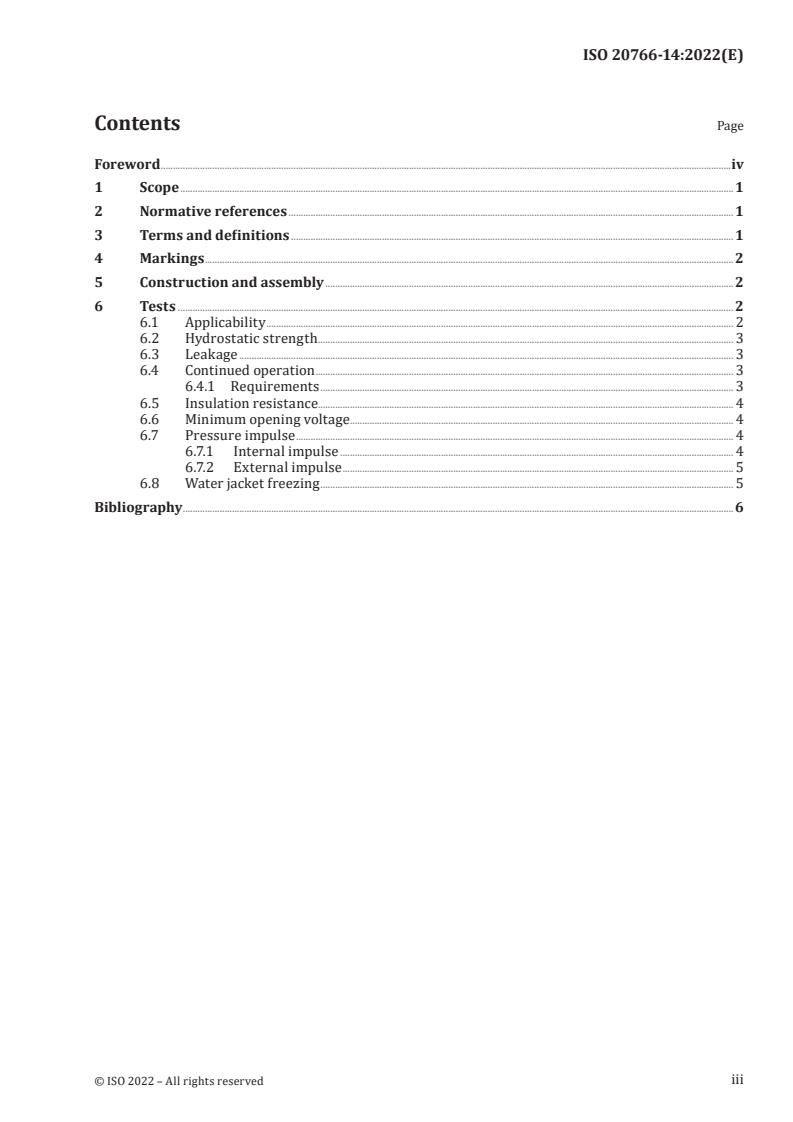
Contents Page
Foreword .iv
1 Scope . 1
2 Normative references . 1
3 Terms and definitions . 1
4 Markings . 2
5 Construction and assembly .2
6 Tests . 2
6.1 Applicability . 2
6.2 Hydrostatic strength . 3
6.3 Leakage . 3
6.4 Continued operation . 3
6.4.1 Requirements . 3
6.5 Insulation resistance. 4
6.6 Minimum opening voltage . . 4
6.7 Pressure impulse . 4
6.7.1 Internal impulse . 4
6.7.2 External impulse . 5
6.8 Water jacket freezing . 5
Bibliography . 6
iii
Foreword
ISO (the International Organization for Standardization) is a worldwide federation of national standards
bodies (ISO member bodies). The work of preparing International Standards is normally carried out
through ISO technical committees. Each member body interested in a subject for which a technical
committee has been established has the right to be represented on that committee. International
organizations, governmental and non-governmental, in liaison with ISO, also take part in the work.
ISO collaborates closely with the International Electrotechnical Commission (IEC) on all matters of
electrotechnical standardization.
The procedures used to develop this document and those intended for its further maintenance are
described in the ISO/IEC Directives, Part 1. In particular, the different approval criteria needed for the
different types of ISO documents should be noted. This document was drafted in accordance with the
editorial rules of the ISO/IEC Directives, Part 2 (see www.iso.org/directives).
Attention is drawn to the possibility that some of the elements of this document may be the subject of
patent rights. ISO shall not be held responsible for identifying any or all such patent rights. Details of
any patent rights identified during the development of the document will be in the Introduction and/or
on the ISO list of patent declarations received (see www.iso.org/patents).
Any trade name used in this document is information given for the convenience of users and does not
constitute an endorsement.
For an explanation of the voluntary nature of standards, the meaning of ISO specific terms and
expressions related to conformity assessment, as well as information about ISO's adherence to
the World Trade Organization (WTO) principles in the Technical Barriers to Trade (TBT), see
www.iso.org/iso/foreword.html.
This document was prepared by Technical Committee ISO/TC 22, Road Vehicles, Subcommittee SC 41,
Specific aspects for gaseous fuels.
A list of all parts in the ISO 20766 series can be found on the ISO website.
Any feedback or questions on this document should be directed to the user’s national standards body. A
complete listing of these bodies can be found at www.iso.org/members.html.
iv
INTERNATIONAL STANDARD ISO 20766-14:2022(E)
Road vehicles — Liquefied petroleum gas (LPG) fuel system
components —
Part 14:
Vaporizer/pressure regulator
1 Scope
This document specifies general requirements for the vaporizer/pressure regulator, a component of
liquefied petroleum gas fuel, intended for use on the types of motor vehicles as defined in ISO 3833. It
also provides general design principles and specifies requirements for instructions and marking.
This document is applicable to vehicles (mono-fuel, bi-fuel or dual-fuel applications) using gaseous fuels
in accordance with ISO 9162. It is not applicable to the following:
a) fuel containers;
b) stationary gas engines;
c) container mounting hardware;
d) electronic fuel management;
e) refuelling receptacles.
It is recognized that miscellaneous components not specifically addressed herein can be examined
for compliance with the criteria of any applicable part of the ISO 20766 series, including testing to the
appropriate functional tests.
All references to pressure in this document are considered gauge pressures unless otherwise specified.
This document applies to devices which have a service pressure in the range of 110 kPa (butane rich at
20 °C) and 840 kPa (propane at 20 °C), hereinafter referred to in this document. Other service pressures
can be accommodated by adjusting the pressure by the appropriate factor (ratio).
2 Normative references
The following documents are referred to in the text in such a way that some or all of their content
constitutes requirements of this document. For dated references, only the edition cited applies. For
undated references, the latest edition of the referenced document (including any amendments) applies.
ISO 20766-1, Road vehicles — Liquefied petroleum gas (LPG) fuel systems components — Part 1: General
requirements and definitions
ISO 20766-2, Road vehicles — Liquefied pet
...