

ISO 16620-2:2019
(Main)Plastics — Biobased content — Part 2: Determination of biobased carbon content
General Information
- Abstract
This document specifies a calculation method for the determination of the biobased carbon content in monomers, polymers, and plastic materials and products, based on the 14C content measurement. This document is applicable to plastic products and plastic materials (e.g. plasticisers or modifiers), polymer resins, monomers, or additives, which are made from biobased or fossil-based constituents. Knowing the biobased content of plastic products is useful when evaluating their environmental impact.
- Status
- Published
- Publication Date
- 30-Oct-2019
- Technical Committee
- ISO/TC 61/SC 14 - Environmental aspects
- Drafting Committee
- ISO/TC 61/SC 14/WG 3 - Biobased plastics
- Current Stage
- 9092 - International Standard to be revised
- Start Date
- 21-Nov-2025
- Completion Date
- 29-Aug-2026
Buy Documents

ISO 16620-2:2019 - Plastics -- Biobased content
ISO 16620-2:2019 - Plastics — Biobased content — Part 2: Determination of biobased carbon content/31/2019
Overview
ISO 16620-2:2019 - Plastics - Biobased content - Part 2 specifies an internationally accepted calculation method for determining the biobased carbon content of plastics, monomers, polymer resins, additives and plastic materials. The method is based on measurement of radiocarbon (14C) and converts measured 14C content into the fraction of carbon that is of recent biogenic origin. Knowing biobased carbon content is valuable for environmental assessment, product labeling and life‑cycle analysis.
Key topics and requirements
- Scope: Applicable to plastic products, polymer resins, monomers, additives and modifiers containing biobased and/or fossil constituents.
- Radiocarbon principle: Uses 14C as a tracer - biogenic carbon contains modern 14C whereas fossil carbon contains negligible 14C.
- Sample preparation and sampling: Samples must be representative; complete combustion and conversion of carbon to CO2 (or suitable target) is required for measurement.
- Measurement methods: Three validated options are specified:
- Method A - Liquid scintillation counting (LSC): Low cost, normal lab equipment; typical duration 4–12 h; relative standard deviation ~2–5%.
- Method B - Beta‑ionization (BI): Low background gas counting; duration 8–24 h; relative standard deviation ~0.2–5%.
- Method C - Accelerator mass spectrometry (AMS): Direct 14C measurement; fast (10–30 min), high precision (0.2–2%) but higher instrument cost.
- Carbon metrics: Standard requires determination of total carbon (TC) and/or total organic carbon (TOC) and defines calculations for:
- Biobased carbon by mass (xB,TC),
- Biobased fraction of total carbon (xB by TC),
- Biobased fraction of total organic carbon (xB by TOC).
- Corrections & reference values: REF values and correction factors are used to convert measured percent modern carbon (pMC) to 100% biobased carbon equivalents (Table references included in the standard).
- Reporting: Test report content and normative annexes (sample conversion, LSC, BI, AMS methods) are specified.
Applications and users
- Manufacturers and material suppliers for product claims, biobased labeling and sourcing transparency.
- Independent testing laboratories and accreditation bodies performing 14C analysis and issuing certification.
- Environmental consultants and life‑cycle assessment (LCA) practitioners quantifying biobased content in carbon accounting.
- Regulators and procurement teams defining biobased product criteria and sustainability targets.
- R&D and polymer scientists validating new bio‑based resins, additives or blends.
Related standards
- ISO 16620-1: General principles for biobased content measurements.
- ASTM D6866: Comparable methods and terminology for biobased/biogenic carbon measurement (useful cross‑reference).
ISO 16620-2:2019 is a practical, methodical standard for verifying the biogenic fraction of plastics using radiocarbon techniques, enabling consistent, defensible assessments of biobased content for sustainability reporting and compliance.
Relations
- Effective Date
- 09-Feb-2026
- Effective Date
- 09-Feb-2026
- Revises
ISO 16620-2:2015 - Plastics — Biobased content — Part 2: Determination of biobased carbon content - Effective Date
- 10-Dec-2016
Buy Documents
ISO 16620-2:2019 - Plastics -- Biobased content
ISO 16620-2:2019 - Plastics — Biobased content — Part 2: Determination of biobased carbon content/31/2019
Get Certified
Connect with accredited certification bodies for this standard

DIN CERTCO
DIN Group product certification.

Smithers Quality Assessments
US management systems and product certification.
Sponsored listings
Frequently Asked Questions
ISO 16620-2:2019 is a standard published by the International Organization for Standardization (ISO). Its full title is "Plastics — Biobased content — Part 2: Determination of biobased carbon content". This standard covers: This document specifies a calculation method for the determination of the biobased carbon content in monomers, polymers, and plastic materials and products, based on the 14C content measurement. This document is applicable to plastic products and plastic materials (e.g. plasticisers or modifiers), polymer resins, monomers, or additives, which are made from biobased or fossil-based constituents. Knowing the biobased content of plastic products is useful when evaluating their environmental impact.
This document specifies a calculation method for the determination of the biobased carbon content in monomers, polymers, and plastic materials and products, based on the 14C content measurement. This document is applicable to plastic products and plastic materials (e.g. plasticisers or modifiers), polymer resins, monomers, or additives, which are made from biobased or fossil-based constituents. Knowing the biobased content of plastic products is useful when evaluating their environmental impact.
ISO 16620-2:2019 is classified under the following ICS (International Classification for Standards) categories: 83.080.01 - Plastics in general. The ICS classification helps identify the subject area and facilitates finding related standards.
ISO 16620-2:2019 has the following relationships with other standards: It is inter standard links to EN ISO 22526-1:2021, EN ISO 22526-2:2021, ISO 16620-2:2015. Understanding these relationships helps ensure you are using the most current and applicable version of the standard.
ISO 16620-2:2019 is available in PDF format for immediate download after purchase. The document can be added to your cart and obtained through the secure checkout process. Digital delivery ensures instant access to the complete standard document.
Standards Content (Sample)
INTERNATIONAL ISO
STANDARD 16620-2
Second edition
2019-10
Plastics — Biobased content —
Part 2:
Determination of biobased carbon
content
Plastiques — Teneur biosourcée —
Partie 2: Détermination de la teneur en carbone biosourcé
Reference number
©
ISO 2019
© ISO 2019
All rights reserved. Unless otherwise specified, or required in the context of its implementation, no part of this publication may
be reproduced or utilized otherwise in any form or by any means, electronic or mechanical, including photocopying, or posting
on the internet or an intranet, without prior written permission. Permission can be requested from either ISO at the address
below or ISO’s member body in the country of the requester.
ISO copyright office
CP 401 • Ch. de Blandonnet 8
CH-1214 Vernier, Geneva
Phone: +41 22 749 01 11
Fax: +41 22 749 09 47
Email: copyright@iso.org
Website: www.iso.org
Published in Switzerland
ii © ISO 2019 – All rights reserved
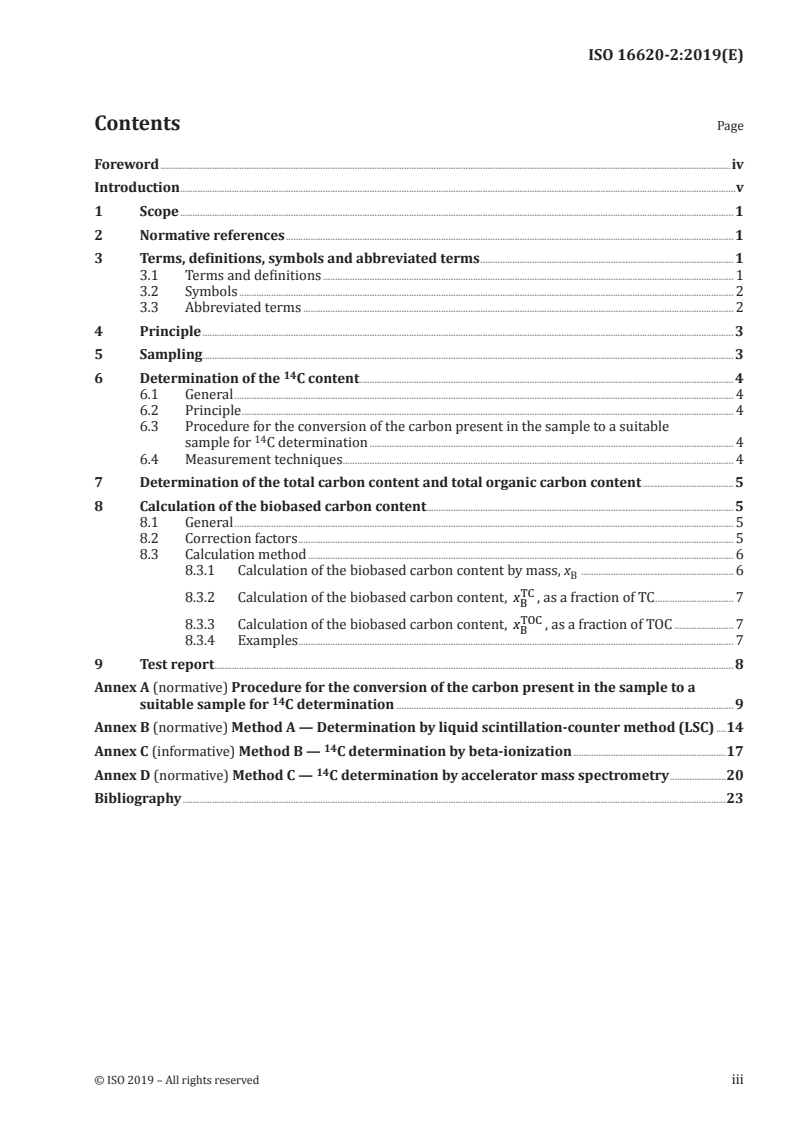
Contents Page
Foreword .iv
Introduction .v
1 Scope . 1
2 Normative references . 1
3 Terms, definitions, symbols and abbreviated terms . 1
3.1 Terms and definitions . 1
3.2 Symbols . 2
3.3 Abbreviated terms . 2
4 Principle . 3
5 Sampling . 3
6 Determination of the C content . 4
6.1 General . 4
6.2 Principle . 4
6.3 Procedure for the conversion of the carbon present in the sample to a suitable
sample for C determination . 4
6.4 Measurement techniques . 4
7 Determination of the total carbon content and total organic carbon content .5
8 Calculation of the biobased carbon content. 5
8.1 General . 5
8.2 Correction factors . 5
8.3 Calculation method . 6
8.3.1 Calculation of the biobased carbon content by mass, x . 6
B
TC
8.3.2 Calculation of the biobased carbon content, x , as a fraction of TC . 7
B
TOC
8.3.3 Calculation of the biobased carbon content, x , as a fraction of TOC . 7
B
8.3.4 Examples . 7
9 Test report . 8
Annex A (normative) Procedure for the conversion of the carbon present in the sample to a
suitable sample for C determination . 9
Annex B (normative) Method A — Determination by liquid scintillation-counter method (LSC) .14
Annex C (informative) Method B — C determination by beta-ionization .17
Annex D (normative) Method C — C determination by accelerator mass spectrometry .20
Bibliography .23
Foreword
ISO (the International Organization for Standardization) is a worldwide federation of national standards
bodies (ISO member bodies). The work of preparing International Standards is normally carried out
through ISO technical committees. Each member body interested in a subject for which a technical
committee has been established has the right to be represented on that committee. International
organizations, governmental and non-governmental, in liaison with ISO, also take part in the work.
ISO collaborates closely with the International Electrotechnical Commission (IEC) on all matters of
electrotechnical standardization.
The procedures used to develop this document and those intended for its further maintenance are
described in the ISO/IEC Directives, Part 1. In particular the different approval criteria needed for the
different types of ISO documents should be noted. This document was drafted in accordance with the
editorial rules of the ISO/IEC Directives, Part 2 (see www .iso .org/ directives).
Attention is drawn to the possibility that some of the elements of this document may be the subject of
patent rights. ISO shall not be held responsible for identifying any or all such patent rights. Details of
any patent rights identified during the development of the document will be in the Introduction and/or
on the ISO list of patent declarations received (see www .iso .org/ patents).
Any trade name used in this document is information given for the convenience of users and does not
constitute an endorsement.
For an explanation of the voluntary nature of standards, the meaning of ISO specific terms and
expressions related to conformity assessment, as well as information about ISO's adherence to the
World Trade Organization (WTO) principles in the Technical Barriers to Trade (TBT), see: www .iso
.org/ iso/ foreword .html.
This document was prepared by Technical Committee ISO/TC 61, Plastics, Subcommittee SC 14,
Environmental aspects.
This second edition cancels and replaces the first edition (ISO 16620-2:2015), which has been
technically revised.
The main changes compared to the previous edition are as follows:
— REF values for calculation of biobased carbon content from percent modern carbon vs. years are
listed in Table 2.
A list of all parts in the ISO 16620 series can be found on the ISO website.
Any feedback or questions on this document should be directed to the user’s national standards body. A
complete listing of these bodies can be found at www .iso .org/ members .html.
iv © ISO 2019 – All rights reserved
Introduction
Increased use of biomass resources for manufacturing plastic products is effective in reducing global
warming and the depletion of fossil resources.
Current plastic products are composed of biobased synthetic polymers, fossil-based synthetic polymers,
natural polymers, and additives that can include biobased materials.
“Biobased plastics” refer to plastics that contain materials, wholly or partly of biogenic origin.
In the ISO 16620 series, the “biobased content” of biobased plastics refers to the amount of the biobased
carbon content, the amount of the biobased synthetic polymer content, or the amount of the biobased
mass content only.
INTERNATIONAL STANDARD ISO 16620-2:2019(E)
Plastics — Biobased content —
Part 2:
Determination of biobased carbon content
WARNING — The use of this document might involve hazardous materials, operations, and
equipment. This document does not purport to address all of the safety concerns, if any,
associated with its use. It is the responsibility of the user of this document to establish
appropriate safety and health practices and determine any restrictions prior to use.
1 Scope
This document specifies a calculation method for the determination of the biobased carbon content in
monomers, polymers, and plastic materials and products, based on the C content measurement.
This document is applicable to plastic products and plastic materials (e.g. plasticisers or modifiers),
polymer resins, monomers, or additives, which are made from biobased or fossil-based constituents.
Knowing the biobased content of plastic products is useful when evaluating their environmental impact.
2 Normative references
The following documents are referred to in the text in such a way that some or all of their content
constitutes requirements of this document. For dated references, only the edition cited applies. For
undated references, the latest edition of the referenced document (including any amendments) applies.
ISO 16620-1, Plastics — Biobased content — Part 1: General principles
3 Terms, definitions, symbols and abbreviated terms
3.1 Terms and definitions
For the purposes of this document, the terms and definitions given in ISO 16620-1 and the following apply.
ISO and IEC maintain terminological databases for use in standardization at the following addresses:
— ISO Online browsing platform: available at https:// www .iso .org/ obp/
— IEC Electropedia: available at http:// www .electropedia .org/
3.1.1
percent modern carbon
pMC
normalized and standardized value for the amount of the C isotope in a sample, calculated relative to
the standardized and normalized C isotope amount of oxalic acid standard reference material, NIST
1)
SRM 4990b or NIST SRM 4990c or Sucrose (NIST SRM 8542)
Note 1 to entry: The reference value of 100 % biobased carbon is given in Table 2.
1) NIST SRM 4990b or NIST SRM 4990c or Sucrose (NIST SRM 8542) is the trade name of a product supplied by
the US National Institute of Standards and Technology. This information is given for the convenience of users of this
document and does not constitute an endorsement by ISO of the product named. Equivalent products can be used if
they can be shown to lead to the same results.
3.1.2
radiocarbon
radioactive isotope of the element carbon, C, having 8 neutrons, 6 protons, and 6 electrons
−10 14
Note 1 to entry: Of the total carbon on Earth, 1 × 10 % is C. It decays exponentially with a half-life of
5 730 years and, as such, it is not measurable in fossil materials derived from petroleum, coal, natural gas, or any
other source older than about 50 000 years.
[SOURCE: ISO 13833:2013, 3.7]
3.2 Symbols
C carbon isotope with an atomic mass of 14
m mass of a sample expressed in grams
pMC(s) measured value, expressed in pMC, according to AMS method, of the sample
REF reference value, expressed in pMC, of 100 % biobased carbon depending on the origin of
organic carbon
TC
x total carbon content, expressed as a percentage of the mass of the sample
TOC
x total organic carbon content, expressed as a percentage of the mass of the sample
x biobased carbon content by mass, expressed as a percentage of the mass of the sample
B
TC
biobased carbon content by total carbon content, expressed as a percentage of the total
x
B
carbon content
TOC
biobased carbon content by total organic carbon content, expressed as a percentage of the
x
B
total organic carbon content
NOTE 1 “Biobased carbon content by mass, x ” used in this document corresponds to “biobased carbon
B
content on mass” defined in 3.3.9 of ASTM D6866-18.
TC
NOTE 2 “Biobased carbon content by total carbon content, x ” corresponds to “biogenic carbon content”
B
defined in 3.3.8 of ASTM D6866-18.
TOC
NOTE 3 “Biobased carbon content by total organic carbon content, x ” corresponds to “biobased carbon
B
content” defined in 3.3.7 of ASTM D6866-18.
3.3 Abbreviated terms
AMS accelerator mass spectroscopy
BI beta-ionization
Bq Bequerel (disintegrations per second)
cpm counts per minute
dpm disintegrations per minute
GM Geiger-Müller
LLD lower limit of detection
LSC liquid scintillation-counter or liquid scintillation-counting
2 © ISO 2019 – All rights reserved
MOP 3-methoxy 1-propyl amine
pMC percentage of modern carbon
TC total carbon
TOC total organic carbon
4 Principle
The C present in chemicals originates from recent atmospheric CO . Due to its radioactive decay, it is
almost absent from fossil products older than 20 000 years to 30 000 years. Thus, the C content might
be considered as a tracer of chemicals recently synthesized from atmospheric CO and particularly of
recently produced bio-products.
The determination of the biomass content is based on the measurement of C in polymers which allows
the calculation of the biobased carbon fraction.
A large experience in C determination and reference samples are available from dating of
archaeological objects, on which the three methods described in this document are based:
— Method A: Liquid scintillation-counter method (LSC);
— Method B: Beta-ionization (BI);
— Method C: Accelerator mass spectrometry (AMS).
NOTE 1 The advantages and disadvantages of these test methods are given in Table 1.
Table 1 — Advantages and disadvantages of the methods
Duration
Relative standard Instrumental
Method Additional requests needed for
deviation costs
measurement
Method A (LSC) Normal laboratory 4 h to 12 h 2 % to 5 % Low
Method B (BI) — Low background 8 h to 24 h 0,2 % to 5 % Low
laboratory
— Gas purification device
Method C (AMS) — Large installation 10 min to 30 min 0,2 % to 2 % High
— Graphite conversion
device
For the C LSC measurement, a low level counter should be used. The statistical scattering of
the radioactive decay sets a limit, both for Method A and B. Thereby, both methods need a purified
carbon dioxide, otherwise, oxides of nitrogen from the combustion in the calorific bomb will result
in counting losses by quenching and adulteration of the cocktail in case of LSC measurement. When
using Method A (LSC), samples with low bio-based carbon content (<10 %) can only be measured with
sufficient precision using the benzene conversion procedure or, if applicable, direct LSC measurement,
as described in Annex A.
NOTE 2 At this moment compact new AMS equipment has become available. In a number of cases, no graphite
conversion is required anymore. CO gas can be measured directly by these AMS.
5 Sampling
If there is a standard sampling procedure for the material or product to be evaluated that is widely
accepted by the different parties, such a procedure can be used and the details of sampling recorded.
For any sampling procedure, the samples shall be representative of the material or product and the
quantity or mass of sample shall be accurately established.
6 Determination of the C content
6.1 General
A general sample preparation and three test methods for the determination of the C content are
described in this document. With this modular approach, it will be possible for normally equipped
14 14
laboratories to prepare samples for the C content and determine the C content with own equipment
or to outsource the determination of the C content to laboratories that are specialized in this
technique.
For the collection from the sample of the C content, generally accepted methods for the conversion of
the carbon present in the sample to CO are described.
For the measurement of the C content, methods are selected that are already generally accepted as
methods for the determination of the age of objects.
6.2 Principle
The amount of biobased carbon in the biobased polymer is proportional to this C content.
Complete combustion (see Annex A) is carried out in a way to comply with the requirements of the
subsequent measurement of the C content and shall provide the quantitative recovery of all carbon
present in the sample as CO in order to yield valid results. This measurement shall be carried out
according to one of the two following methods:
— Liquid scintillation-counter method (LSC) (Method A): indirect determination of the isotope
abundance of C through its emission of beta-particles (interaction with scintillation molecules),
specified in Annex B;
— Accelerator mass spectrometry (AMS) (Method C): direct determination of the isotope abundance
of C, specified in Annex D.
This measurement can also be carried out according to Method B [Beta-ionization (BI)]: indirect
determination of the isotope abundance of C, through its emission of beta-particle (Geiger-Müller
type detector), described in Annex C.
6.3 Procedure for the conversion of the carbon present in the sample to a suitable
sample for C determination
The conversion of the carbon present in the sample to a suitable sample for the determination of the
C content shall be carried out according to the Annex A.
6.4 Measurement techniques
The C content of the sample shall be determined using one of the methods as described in Annex B,
Annex C, or Annex D.
When collected samples are sent to specialized laboratories, the samples shall be stored in a way
that no CO from air can enter the absorption solution. A check on the in leak of CO from air shall be
2 2
performed by preparing laboratory blank’s during the sampling stage.
For the determination of the 0 % biomass content, the combustion of a coal standard (e.g. BCR 181) can
be used.
For validation of the 100 % biomass content, the oxalic acid standard reference material NIST SRM 4990b
or SRM 4990c or Sucrose (NIST SRM 8542) may be used. Mixing reference material NIST 4990 with a
4 © ISO 2019 – All rights reserved
known amount of fossil combustion aid improves its combustion behaviour, as oxalic acid is difficult to
combust due to its low calorific value. For routine checks, a wood standard reference material calibrated
against the oxalic acid is sufficient.
7 Determination of the total carbon content and total organic carbon content
The total carbon content and total organic carbon content shall be determined according to suitable
methods.
Test methods as described in ISO 609, ISO 8245, ISO 10694, ISO 15350, ISO 17247, ASTM D5291-16,
ASTM E1019 or EN 13137, can be used, as applicable.
8 Calculation of the biobased carbon content
8.1 General
The calculation of the biobased carbon content includes the following steps:
TC
a) the determination of the total carbon content of the sample, x , determined by one of the test
methods specified in Clause 7, expressed as a percentage of the total mass or the determination
TOC
of the total organic carbon content of the sample, x , determined by one of the test methods
specified in Clause 7, expressed as a percentage of the total mass;
b) the calculation of the biobased carbon content by mass, x , using the C content value, determined
B
by calculation from one of the test methods specified in Clause 6, and applying the correction
factors detailed in 8.2;
TC
c) the calculation of the biobased carbon content as a fraction of the total carbon content, x (see
B
TOC
8.3.2) or a fraction of the total organic carbon content, x (see 8.3.3).
B
8.2 Correction factors
Before the above-ground hydrogen bomb testing (started around 1955 and terminated in 1962), the
atmospheric C level had been constant to within a few percent for the past millennium. Hence, a
sample grown during this time has a well-defined “modern” activity and the fossil contribution could be
determined in a straightforward way. However, C created during the weapons testing increased the
14 14
atmospheric C level to up to 200 pMC in 1962, with a decline to 102 pMC in 2015. The C activity of a
sample grown since year 1962 is elevated according to the average C level over the growing interval.
In addition, the large emission of fossil C during the last decades contributes to the decrease of the
14 12
atmospheric C/ C ratio.
In ASTM D 6866-18 the 100 % bio-based C value of 100,5 pMC (for year 2018) is used. This value shall
be the base of calculations. Other values are only acceptable if evidence can be given on the pMC value
of the biogenic part of the material.
st
The 100 % bio-based C value equates to decline of 0,5 pMC per year. Therefore, on January 1 of each
year, the values given in Table 2 are used through 2019, reflecting the 0,5 pMC decrease per year.
Table 2 — 100 % biobased carbon values versus year
100 % biobased carbon value
Year
REF (pMC, %)
2015 102,0
2016 101,5
2017 101,0
2018 100,5
Table 2 (continued)
100 % biobased carbon value
Year
REF (pMC, %)
2019 100,0
2020 To be determined
NOTE These values are in accordance with ASTM D 6866-18.
From the 100,5 pMC value the correction factor of 0,995 (1/1,005) is derived. For the calculation of the
bio-based carbon content, a C content of 100/0,995 pMC or 13,56/0,995 dpm per gram C is considered
as a 100 % biobased carbon content for biomass that is grown in year 2016.
The fraction of biomass content by mass shall be calculated using the biomass carbon in the biobased
polymer as for other organic carbon materials.
8.3 Calculation method
8.3.1 Calculation of the biobased carbon content by mass, x
B
8.3.1.1 C content determined by Method A (LSC) or Method B (BI)
Calculate the biobased carbon content by mass, x , expressed as a percentage, using Formula (1):
B
C
activity
x = ×100 (1)
B
REF
13,56××m
where
14 14
C is the C activity, expressed in dpm, of the sample obtained by calculation when using
activity
Method A or Method B (see Annex B or Annex C);
REF is the reference value, expressed in pMC, of 100 % biobased carbon of the biomass
from which the sample is constituted;
m is the mass, expressed in grams, of the sample.
6 © ISO 2019 – All rights reserved
8.3.1.2 C content determined by Method C (AMS)
Calculate the biobased carbon content by mass, x , expressed as a percentage, using Formula (2):
B
pMCs
()
pMCs()
TC TC
xx= =x (2)
B
REF
REF
where
TC
x is the total carbon content obtained by elemental analysis, expressed as a percentage, of
the total mass, of the sample;
pMC(s) is the measured value, expressed in pMC, of the sample;
REF is the reference value, expressed in pMC, of 100 % biobased carbon of the biomass from
which the sample is constituted.
TC
8.3.2 Calculation of the biobased carbon content, x , as a fraction of TC
B
TC
Calculate the biobased carbon content as a fraction of the total carbon content, x , expressed as a
B
percentage, using Formula (3):
x
B
TC
x =×100 (3)
B
TC
x
where
x is the biobased carbon content by mass, expressed as a percentage;
B
TC
x is the total carbon content, expressed as a percentage, of the sample.
TOC
8.3.3 Calculation of the biobased carbon content, x , as a fraction of TOC
B
TOC
Calculate the biobased carbon content as a fraction of the total organic carbon content, x , expressed
B
as a percentage, using Formula (4):
x
B
TOC
x =×100 (4)
B
TOC
x
where
x is the biobased carbon content by mass, expressed as a percentage;
B
TOC
x is the total organic carbon content, expressed as a percentage, of the sample.
8.3.4 Examples
EXAMPLE 1 Calculation of biobased carbon content as a fraction of TC
Pure biobased polymer material
TC
Sample made from PLA material: x = 50,0 %; x = 50 %
B
50,0
TC
x =×100=100%
B
50,0
EXAMPLE 2 Calculation of biobased carbon content as a fraction of TOC
Mixed biobased polymer material
Sample made from PE material containing a mixture of fossil PE and PE produced from biogenic synthesis gas:
TOC
xx==86,%02;,40%
B
24,0
TOC
x =×100=27,%9
B
86,0
9 Test report
The test report shall include at least the following information:
a) a reference to this document, i.e. ISO 16620-2:2019;
b) all information necessary for complete identification of the biobased polymer material or product
tested, including the origin of the biomass from which the material or product is constituted;
c) identification of the laboratory performing the test;
d) sample preparation;
e) storage conditions;
f) test method used for the determination of the C content (Method A, B, or C, see Annex B, Annex C,
or Annex D);
g) test methods used for the determination of the TC content and TOC content (see Clause 7);
h) results of the test including the basis on which they are expressed and application of the isotope
correction, including a precision statement;
i) method for the conversion of the carbon (see A.4);
14 14
j) C activity, expressed in dpm, of the sample or C value, expressed in pMC;
TC
k) total carbon content, x , expressed as a percentage, of the sample;
l) REF value used;
TOC
m) total organic carbon content, x , expressed as a percentage, of the sample;
n) biobased carbon content by mass, x , expressed as a percentage, of the sample;
B
TC
o) biobased carbon content by total carbon content, x , expressed as a percentage, of the sample;
B
TOC
p) biobased carbon content by total organic carbon content, x , expressed as a percentage, of
B
the sample;
q) any additional information, including details of any deviations from the test methods and any
operations not specified in this document which could have had an influence on the results;
r) date of receipt of laboratory sample and dates of the test (beginning and end).
8 © ISO 2019 – All rights reserved
Annex A
(normative)
Procedure for the conversion of the carbon present in the sample
to a suitable sample for C determination
A.1 General
This annex describes the steps to prepare samples for C determinations. The laboratories which
are not equipped for C analysis can prepare their samples for distribution to laboratories that are
equipped for C analysis.
For the determination of the C content, carbon present in the sample shall be converted to CO . The
conversion is performed by the combustion in oxygen. If necessary, a combustion aid can be used to
ensure complete oxidation of carbon to CO .
For some liquid samples, no conversion to CO is needed and a direct measurement of the C content
can be performed using LSC.
A.2 Preparation
A.2.1 General
The C content of a biobased polymer is determined on CO produced by the sample combustion. For
the conversion of the sample to CO used for the determination of the C content, the following three
methods are allowed:
— combustion in a calorimetric bomb (A.3.1);
— combustion in a tube furnace (A.3.2);
— combustion in a laboratory scale combustion apparatus (A.3.2).
In case of combustion, it depends on the method to be used for the determination of C content how the
formed CO is collected and prepared for the measurement.
When Method C is used, the following are the three options:
a) direct collection of the formed CO in a gas bag or a sealed quartz tube with CuO;
b) absorption of CO in a 4 mol/l NaOH solution;
c) absorption in a solid absorber, developed for that purpose, usually NaOH or KOH fixed on a silica
2)
carrier (e.g. Carbotrap ® ).
As Method C requires only a few milligrams of carbon containing matter, sample material containing
CO amounts of a few milligrams can be used.
In case of Method B, a direct collection of CO in a gas bag, lecture bottle, or NaOH solution is allowed as
well, provided the total amount of carbon present in the sample is at least 2 g.
2) Carbotrap is an example of a suitable product available commercially. This information is given for the
convenience of users of this document and does not constitute an endorsement by ISO of this product.
In case of Method A, the following three options are possible after combustion:
a) direct adsorption of the formed CO in a carbamate solution [a suitable CO absorption solution
2 2
3)
containing an amine, e.g. 1 mol/l 3-methoxypropylamine in ethanolamine, or Carbo-Sorb E® ];
b) adsorption of the CO in a 2 mol/l NaOH solution and transfer of CO in NaOH to a carbamate
2 2
solution;
c) direct conversion of CO to benzene.
In some cases, the total carbonate content in the sampling solution shall be determined. For the direct
sampling in carbamate solutions, the carbonate content can be determined by weighing the sample
solution before and after sampling. For sampling in NaOH or KOH solutions, the carbonate content can
be determined by standard methods using e.g. titrimetry. Guidance for such determination can be found
in, for example, ISO 9963 (all parts) and ASTM D513-16. Carbamate solution was directly measured
by Method A or B. CO or graphite from CO reproduced from carbamate solution was measured by
2 2
Method C.
A.2.2 Reagents and materials
A.2.2.1 Carbamate solution.
A.2.2.2 Scintillation medium.
A.2.2.3 Glass bottles (standard glass sample bottles with plastic screw caps that are resistant to
4 mol/l NaOH).
A.2.2.4 4 mol/l NaOH, absorption liquid.
For the preparation of a carbonate-free absorption liquid, preparation using freshly opened NaOH pellet
containers is sufficient. Dissolve the NaOH pellets in a small amount of water (the heat produced during
the dissolution process will enhance the dissolution process). Small amounts of precipitation are an
indication of the presence of Na CO . By decanting the clear phase, the almost carbonate-free solution
2 3
is diluted to the desired volume. As the dissolution of NaOH is an exothermic process, extra care shall
be taken as boiling of the concentrated solution during dilution can occur.
A.3 Combustion of the sample
A.3.1 Combustion of the sample in a calorimetric bomb
For the combustion of the sample in a calorimetric bomb, any suitable test method such as ISO 1716,
ISO 1928 or EN 15400 can be used.
After the complete combustion in the oxygen bomb, the combustion gases are collected in a gas bag.
For biobased polymers that are difficult to combust, use a combustion aid to obtain complete
combustion. Examples of combustion aids are polyethylene combustion bags, benzoic acid and glucose.
Take care not to exceed the maximum amount of organic material allowable for the oxygen bomb that
is used. Determine the amount of C present in the combustion aid and correct for the contribution of
the use of the combustion aid. ( C content and total carbon content).
The determination of the carbonate content in the solution collected after combustion can be used to
determine the yield of conversion. The carbonate content shall be equivalent to the amount of total
carbon present in the combusted sample (including combustion aid).
3) Carbo-Sorb E is an example of a suitable product available commercially. This information is given for the
convenience of users of this document and does not constitute an endorsement by ISO of this product.
10 © ISO 2019 – All rights reserved
When Method A is used, the CO shall be collected in a 4 mol/l NaOH solution prior to the conversion to
benzene or collected in a cooled mixture of carbamate solution and a suitable scintillation liquid.
For the collection of CO in 4 mol/l NaOH solution use a 250 ml washing bottle filled with 200 ml 4 mol/l
NaOH solution, apply a flow of 50 ml/min.
For the collection of CO in a carbamate solution the gas sample bag is connected to a pump with a
connection line into a 20 ml glass vial, filled with a mixture of 10 ml of the carbamate sorption liquid and
10 ml of the scintillation cocktail, placed in an ice bath, to remove the heat of the exothermic carbamate
−1 −1
formation reaction. The pumping speed is low, typically 50 ml·min to 60 ml·min . The transfer of the
gas from the bag takes about 2 h to 3 h. After the sample has been collected, it is ready to be counted on
a liquid scintillation counter. Blank samples shall also be counted at the same time to allow that small
day-to-day variations in the background can be accounted for.
Measurements shall be done as soon as possible after collection. At the latest, it shall be done within one
week after sampling. There are strong indications that the NOx formed during the combustion reacts
with the absorption mixture resulting in yet unexplained errors after a few days of storage. If the one
week limit cannot be realized, collection of the CO in a 4 mol/l NaOH solution is a good alternative.
When Method B or Method C is used, the CO shall be collected in a 4 mol/l NaOH solution or on a
suitable scintillation solid absorber.
For Method C, alternatively, approximately 2 ml of the CO gas can be taken from the bag using a glass
syringe and the gas can be transferred to the AMS target preparations system. As the bomb volume is
released to atmospheric pressure, there will be a residual amount left over in the bomb that is directly
related to the pressure in the bomb after the combustion.
NOTE With a residual pressure of 2,5 MPa, 4 % of the combustion gas will be left after release to atmospheric
pressure.
To overcome this artefact:
a) perform the calibration and the analysis taking account of this residual amount by using the
pressure correction factor;
b) use the vacuum pump to remove the residue;
c) flush the bomb with argon and collect the CO in the rinsing gases as well.
A.3.2 Combustion of the sample in a tube furnace or a combustion apparatus
The tube furnace or the combustion apparatus shall be able to combust the biobased polymer with a
complete conversion of the carbon present to CO . For the determination of the C content by Method A,
the CO shall be collected using a suitable impinger filled with a cooled mixture of carbamate and a
suitable scintillation liquid, a scintillation medium already containing a CO absorber, or a 4 mol/l NaOH
solution (see A.2.2.4). For the determination of the C content by Method C or Method B, the CO shall
be collected using a suitable impinger filled with a 4 mol/l NaOH solution. As a result of the absorption
of the CO , a large volume reduction of the gas volume will be observed after trapping. Therefore, the
gas pump is to be positioned in front of the impinger and the gas pump used shall be gas tight.
As an alternative, the CO can be trapped by means of a cryogenic trap. In that case, the cryogenic trap
shall consist of a water trap (dry ice in ethanol or acetone) followed by a cryogenic trap. Care shall be
taken to avoid formation of liquid oxygen, which can be achieved by heating the trap slightly above the
boiling point of oxygen, using liquid argon or performing the separation at diminished pressure. As
an alternative, when Method C is being used, CO can be collected by mixing homogenized biobased
polymer with cupric oxide (CuO) in a sealed evacuated quartz or Vycor glass tube. Water vapour (up
to 3 Pa) can be added to the tube prior to introduction of the CO to help remove sulfur compounds. The
tube is heated to 900 °C for 3 h to 5 h. The CO is collected by breaking the tube using a tube-cracker
connected to an evacuated glass collection line.
A.3.3 Direct LSC measurement on the polymer
For liquid clear biobased polymers, direct measurement on the biobased polymer with the LSC
technique is possible. This option is only allowed if equivalence with the methods with conversion
to CO can be demonstrated. This will, in general, be the case if no quenching is observed or if correction
for quenching is performed using standard addition technique using the same, C labelled, biobased
polymer with known C activity.
The dissolution method might not be appropriate to some biobased polymers, for instance when fillers
are present.
For direct LSC measurements, DIN 51637 is recommended.
A.4 Standardization measurement results
A.4.1 LSC and BI methods
A liquid scintillation counter measures β-decay counts of C (in counts per minute, cpm) indirectly by
measuring the interaction signals of the β particles with scintillation molecules (emission of photons
–light- proportional to the decay energy). For this measurement, sample CO is either absorbed in a
suitable absorbing solution to which also a scintillation reagent is added ("CO -cocktail") or the CO
2 2
has been converted to benzene and is then mixed with liquid (scintillation) reagents to a ‘benzene-
cocktail’. The "benzene cocktail" method is more precise than the "CO -cocktail" method.
The same standardization as used for AMS and proportional gas counters shall be used for LSC
measurement results. C shall be calculated by using Formula (A.1):
sampleC
1+ δ
N
14 14
AA− ⋅⋅η
( ))
sample bg meas
14 s
1+ δ
A
sample
N
14 14 s
Cp()MC =⋅a 100=⋅100= ⋅100 (A.1)
sampleCN
14 0 14 0
A A
RN RN
where
is the measured C value (in pMC) of the investigated CO sample;
C
sampleC
14 S
is the standardized and normalized C amount of the measured sample;
a
N
14 S
ap⋅=100 MC
N
14 S
is the normalized C signal (isotope concentration or activity) of the measured
A
N
sample;
14 0
is the standardized and normalized C amount of the primary reference standard,
A
RN
Oxalic acid (HOx-II, SRM 4990c);
is the measured C signal (isotope concentration or activity) of the sample;
A
sample
is the measured C signal (isotope concentration or activity) of the background
A
bg
sample
sample/blank sample, measured in the same batch as the sample and represents the
background C signal of the measured samples;
η is the measuring efficiency of the used measurement technique;
meas
13 13
δ is the standardized value for isotope fractionation. δ = −0,025 (relative to VPDB);
N N
is the measured isotope fractionation value of the sample. It is obtained by measur-
δ
sample
13 12 13 12
ing the C/ C ratio of the sample, relative to the measured C/ C ratio of a refer-
ence standard with known isotope fractionation value related to VPDB.
12 © ISO 2019 – All rights reserved
In the case that no primary or secondary reference standard has been measured, the measuring
efficiency is not cancelled out and shall be determined using an internal standard. It is also necessary in
that case to determine the activity of the sample in dpm/gC (disintegrations per minute) instead of
cpm/gC. 14A = 13,56 ± 0,07 dpm/gC = 0,226 ± 0,001 Bq/gC.
RN
A.4.2 AMS method
12 13 14
The AMS system measures the carbon isotopes C, C and C of a carbon sample in the same sample
14 14
run. A batch of samples shall also contain reference material samples. The measured C amount (= C
isotope concentration) in a sample is calculated relative to the measured (average) C amount of the
reference material samples in the same batch. If the reference material is the primary reference
standard Oxalic Acid II (HOx-II, SRM 4990c), which is commonly used for this purpose, the standardized
14 14 S
C amount in the sample, C (= 14a ⋅100% = pMC), shall be calculated by using Formula (A.2).
sampleC
N
1+ δ
N
14 14
AA− ⋅⋅η
( )
sample bg meas
sample
1+ δ
saample
Cp()MC = ⋅100 (A.2)
sampleC
1+ δ
N
14 14
0,745 9⋅−AA ⋅⋅η
()
OX2 bg meas
OX2
1+ δ
OOX2
where
is the measured C value (in pMC) of the investigated CO sample;
C
sampleC
is the measured C signal (isotope concentration or activity) of the sample;
A
sample
is the measured C signal (isotope concentration or activity) of the background
A
bg
sample
sample/blank sample, measured in the same batch as the sample and represents
the background C signal of the measured samples;
is the measured (average) C signal (isotope concentration or activity) of Oxalic
A
OX2
acid reference standard samples (HOx-II, SRM 4990c), measured in the same batch
as the unknown samples;
is the measured (average) C signal (isotope concentration or activity) of back-
A
bg
OX2
ground samples, which represent the background signal of the measured Oxalic
Acid reference standard (HOx-II, SRM 4990c), measured in the same batch as the
Oxalic Acid samples;
η is the measuring efficiency of the used measurement technique;
meas
is the standardized value for isotope fractionation,
δ
N
where δ = −0,025 (relative to VPDB);
N
is the measured isotope fractionation value of the sample. It is obtained by meas-
δ
sample
13 12 13 12
uring the C/ C ratio of the sample, relative to the measured C/ C ratio of a
reference standard with known isotope fractionation value related to VPDB;
is the standardized isotope fractionation value of the Oxalic Acid reference
δ
OX2
standard; (HOx-II, SRM 4990c). δ = −0,017 6 (relative to VPDB). Decay rate of
OX2
14 14
C (in year). C has a half-life of 5 730 years.
Annex B
(normative)
Method A — Determination by liquid scintillation-counter
method (LSC)
B.1 General
This annex describes the method for the determination of the C content by LSC in carbonate solutions
or carbamate solutions obtained from the combustion of biobased polymer samples in a calorimetric
bomb, a tube
...
INTERNATIONAL ISO
STANDARD 16620-2
Second edition
2019-10
Plastics — Biobased content —
Part 2:
Determination of biobased carbon
content
Plastiques — Teneur biosourcée —
Partie 2: Détermination de la teneur en carbone biosourcé
Reference number
©
ISO 2019
© ISO 2019
All rights reserved. Unless otherwise specified, or required in the context of its implementation, no part of this publication may
be reproduced or utilized otherwise in any form or by any means, electronic or mechanical, including photocopying, or posting
on the internet or an intranet, without prior written permission. Permission can be requested from either ISO at the address
below or ISO’s member body in the country of the requester.
ISO copyright office
CP 401 • Ch. de Blandonnet 8
CH-1214 Vernier, Geneva
Phone: +41 22 749 01 11
Fax: +41 22 749 09 47
Email: copyright@iso.org
Website: www.iso.org
Published in Switzerland
ii © ISO 2019 – All rights reserved
Contents Page
Foreword .iv
Introduction .v
1 Scope . 1
2 Normative references . 1
3 Terms, definitions, symbols and abbreviated terms . 1
3.1 Terms and definitions . 1
3.2 Symbols . 2
3.3 Abbreviated terms . 2
4 Principle . 3
5 Sampling . 3
6 Determination of the C content . 4
6.1 General . 4
6.2 Principle . 4
6.3 Procedure for the conversion of the carbon present in the sample to a suitable
sample for C determination . 4
6.4 Measurement techniques . 4
7 Determination of the total carbon content and total organic carbon content .5
8 Calculation of the biobased carbon content. 5
8.1 General . 5
8.2 Correction factors . 5
8.3 Calculation method . 6
8.3.1 Calculation of the biobased carbon content by mass, x . 6
B
TC
8.3.2 Calculation of the biobased carbon content, x , as a fraction of TC . 7
B
TOC
8.3.3 Calculation of the biobased carbon content, x , as a fraction of TOC . 7
B
8.3.4 Examples . 7
9 Test report . 8
Annex A (normative) Procedure for the conversion of the carbon present in the sample to a
suitable sample for C determination . 9
Annex B (normative) Method A — Determination by liquid scintillation-counter method (LSC) .14
Annex C (informative) Method B — C determination by beta-ionization .17
Annex D (normative) Method C — C determination by accelerator mass spectrometry .20
Bibliography .23
Foreword
ISO (the International Organization for Standardization) is a worldwide federation of national standards
bodies (ISO member bodies). The work of preparing International Standards is normally carried out
through ISO technical committees. Each member body interested in a subject for which a technical
committee has been established has the right to be represented on that committee. International
organizations, governmental and non-governmental, in liaison with ISO, also take part in the work.
ISO collaborates closely with the International Electrotechnical Commission (IEC) on all matters of
electrotechnical standardization.
The procedures used to develop this document and those intended for its further maintenance are
described in the ISO/IEC Directives, Part 1. In particular the different approval criteria needed for the
different types of ISO documents should be noted. This document was drafted in accordance with the
editorial rules of the ISO/IEC Directives, Part 2 (see www .iso .org/ directives).
Attention is drawn to the possibility that some of the elements of this document may be the subject of
patent rights. ISO shall not be held responsible for identifying any or all such patent rights. Details of
any patent rights identified during the development of the document will be in the Introduction and/or
on the ISO list of patent declarations received (see www .iso .org/ patents).
Any trade name used in this document is information given for the convenience of users and does not
constitute an endorsement.
For an explanation of the voluntary nature of standards, the meaning of ISO specific terms and
expressions related to conformity assessment, as well as information about ISO's adherence to the
World Trade Organization (WTO) principles in the Technical Barriers to Trade (TBT), see: www .iso
.org/ iso/ foreword .html.
This document was prepared by Technical Committee ISO/TC 61, Plastics, Subcommittee SC 14,
Environmental aspects.
This second edition cancels and replaces the first edition (ISO 16620-2:2015), which has been
technically revised.
The main changes compared to the previous edition are as follows:
— REF values for calculation of biobased carbon content from percent modern carbon vs. years are
listed in Table 2.
A list of all parts in the ISO 16620 series can be found on the ISO website.
Any feedback or questions on this document should be directed to the user’s national standards body. A
complete listing of these bodies can be found at www .iso .org/ members .html.
iv © ISO 2019 – All rights reserved
Introduction
Increased use of biomass resources for manufacturing plastic products is effective in reducing global
warming and the depletion of fossil resources.
Current plastic products are composed of biobased synthetic polymers, fossil-based synthetic polymers,
natural polymers, and additives that can include biobased materials.
“Biobased plastics” refer to plastics that contain materials, wholly or partly of biogenic origin.
In the ISO 16620 series, the “biobased content” of biobased plastics refers to the amount of the biobased
carbon content, the amount of the biobased synthetic polymer content, or the amount of the biobased
mass content only.
INTERNATIONAL STANDARD ISO 16620-2:2019(E)
Plastics — Biobased content —
Part 2:
Determination of biobased carbon content
WARNING — The use of this document might involve hazardous materials, operations, and
equipment. This document does not purport to address all of the safety concerns, if any,
associated with its use. It is the responsibility of the user of this document to establish
appropriate safety and health practices and determine any restrictions prior to use.
1 Scope
This document specifies a calculation method for the determination of the biobased carbon content in
monomers, polymers, and plastic materials and products, based on the C content measurement.
This document is applicable to plastic products and plastic materials (e.g. plasticisers or modifiers),
polymer resins, monomers, or additives, which are made from biobased or fossil-based constituents.
Knowing the biobased content of plastic products is useful when evaluating their environmental impact.
2 Normative references
The following documents are referred to in the text in such a way that some or all of their content
constitutes requirements of this document. For dated references, only the edition cited applies. For
undated references, the latest edition of the referenced document (including any amendments) applies.
ISO 16620-1, Plastics — Biobased content — Part 1: General principles
3 Terms, definitions, symbols and abbreviated terms
3.1 Terms and definitions
For the purposes of this document, the terms and definitions given in ISO 16620-1 and the following apply.
ISO and IEC maintain terminological databases for use in standardization at the following addresses:
— ISO Online browsing platform: available at https:// www .iso .org/ obp/
— IEC Electropedia: available at http:// www .electropedia .org/
3.1.1
percent modern carbon
pMC
normalized and standardized value for the amount of the C isotope in a sample, calculated relative to
the standardized and normalized C isotope amount of oxalic acid standard reference material, NIST
1)
SRM 4990b or NIST SRM 4990c or Sucrose (NIST SRM 8542)
Note 1 to entry: The reference value of 100 % biobased carbon is given in Table 2.
1) NIST SRM 4990b or NIST SRM 4990c or Sucrose (NIST SRM 8542) is the trade name of a product supplied by
the US National Institute of Standards and Technology. This information is given for the convenience of users of this
document and does not constitute an endorsement by ISO of the product named. Equivalent products can be used if
they can be shown to lead to the same results.
3.1.2
radiocarbon
radioactive isotope of the element carbon, C, having 8 neutrons, 6 protons, and 6 electrons
−10 14
Note 1 to entry: Of the total carbon on Earth, 1 × 10 % is C. It decays exponentially with a half-life of
5 730 years and, as such, it is not measurable in fossil materials derived from petroleum, coal, natural gas, or any
other source older than about 50 000 years.
[SOURCE: ISO 13833:2013, 3.7]
3.2 Symbols
C carbon isotope with an atomic mass of 14
m mass of a sample expressed in grams
pMC(s) measured value, expressed in pMC, according to AMS method, of the sample
REF reference value, expressed in pMC, of 100 % biobased carbon depending on the origin of
organic carbon
TC
x total carbon content, expressed as a percentage of the mass of the sample
TOC
x total organic carbon content, expressed as a percentage of the mass of the sample
x biobased carbon content by mass, expressed as a percentage of the mass of the sample
B
TC
biobased carbon content by total carbon content, expressed as a percentage of the total
x
B
carbon content
TOC
biobased carbon content by total organic carbon content, expressed as a percentage of the
x
B
total organic carbon content
NOTE 1 “Biobased carbon content by mass, x ” used in this document corresponds to “biobased carbon
B
content on mass” defined in 3.3.9 of ASTM D6866-18.
TC
NOTE 2 “Biobased carbon content by total carbon content, x ” corresponds to “biogenic carbon content”
B
defined in 3.3.8 of ASTM D6866-18.
TOC
NOTE 3 “Biobased carbon content by total organic carbon content, x ” corresponds to “biobased carbon
B
content” defined in 3.3.7 of ASTM D6866-18.
3.3 Abbreviated terms
AMS accelerator mass spectroscopy
BI beta-ionization
Bq Bequerel (disintegrations per second)
cpm counts per minute
dpm disintegrations per minute
GM Geiger-Müller
LLD lower limit of detection
LSC liquid scintillation-counter or liquid scintillation-counting
2 © ISO 2019 – All rights reserved
MOP 3-methoxy 1-propyl amine
pMC percentage of modern carbon
TC total carbon
TOC total organic carbon
4 Principle
The C present in chemicals originates from recent atmospheric CO . Due to its radioactive decay, it is
almost absent from fossil products older than 20 000 years to 30 000 years. Thus, the C content might
be considered as a tracer of chemicals recently synthesized from atmospheric CO and particularly of
recently produced bio-products.
The determination of the biomass content is based on the measurement of C in polymers which allows
the calculation of the biobased carbon fraction.
A large experience in C determination and reference samples are available from dating of
archaeological objects, on which the three methods described in this document are based:
— Method A: Liquid scintillation-counter method (LSC);
— Method B: Beta-ionization (BI);
— Method C: Accelerator mass spectrometry (AMS).
NOTE 1 The advantages and disadvantages of these test methods are given in Table 1.
Table 1 — Advantages and disadvantages of the methods
Duration
Relative standard Instrumental
Method Additional requests needed for
deviation costs
measurement
Method A (LSC) Normal laboratory 4 h to 12 h 2 % to 5 % Low
Method B (BI) — Low background 8 h to 24 h 0,2 % to 5 % Low
laboratory
— Gas purification device
Method C (AMS) — Large installation 10 min to 30 min 0,2 % to 2 % High
— Graphite conversion
device
For the C LSC measurement, a low level counter should be used. The statistical scattering of
the radioactive decay sets a limit, both for Method A and B. Thereby, both methods need a purified
carbon dioxide, otherwise, oxides of nitrogen from the combustion in the calorific bomb will result
in counting losses by quenching and adulteration of the cocktail in case of LSC measurement. When
using Method A (LSC), samples with low bio-based carbon content (<10 %) can only be measured with
sufficient precision using the benzene conversion procedure or, if applicable, direct LSC measurement,
as described in Annex A.
NOTE 2 At this moment compact new AMS equipment has become available. In a number of cases, no graphite
conversion is required anymore. CO gas can be measured directly by these AMS.
5 Sampling
If there is a standard sampling procedure for the material or product to be evaluated that is widely
accepted by the different parties, such a procedure can be used and the details of sampling recorded.
For any sampling procedure, the samples shall be representative of the material or product and the
quantity or mass of sample shall be accurately established.
6 Determination of the C content
6.1 General
A general sample preparation and three test methods for the determination of the C content are
described in this document. With this modular approach, it will be possible for normally equipped
14 14
laboratories to prepare samples for the C content and determine the C content with own equipment
or to outsource the determination of the C content to laboratories that are specialized in this
technique.
For the collection from the sample of the C content, generally accepted methods for the conversion of
the carbon present in the sample to CO are described.
For the measurement of the C content, methods are selected that are already generally accepted as
methods for the determination of the age of objects.
6.2 Principle
The amount of biobased carbon in the biobased polymer is proportional to this C content.
Complete combustion (see Annex A) is carried out in a way to comply with the requirements of the
subsequent measurement of the C content and shall provide the quantitative recovery of all carbon
present in the sample as CO in order to yield valid results. This measurement shall be carried out
according to one of the two following methods:
— Liquid scintillation-counter method (LSC) (Method A): indirect determination of the isotope
abundance of C through its emission of beta-particles (interaction with scintillation molecules),
specified in Annex B;
— Accelerator mass spectrometry (AMS) (Method C): direct determination of the isotope abundance
of C, specified in Annex D.
This measurement can also be carried out according to Method B [Beta-ionization (BI)]: indirect
determination of the isotope abundance of C, through its emission of beta-particle (Geiger-Müller
type detector), described in Annex C.
6.3 Procedure for the conversion of the carbon present in the sample to a suitable
sample for C determination
The conversion of the carbon present in the sample to a suitable sample for the determination of the
C content shall be carried out according to the Annex A.
6.4 Measurement techniques
The C content of the sample shall be determined using one of the methods as described in Annex B,
Annex C, or Annex D.
When collected samples are sent to specialized laboratories, the samples shall be stored in a way
that no CO from air can enter the absorption solution. A check on the in leak of CO from air shall be
2 2
performed by preparing laboratory blank’s during the sampling stage.
For the determination of the 0 % biomass content, the combustion of a coal standard (e.g. BCR 181) can
be used.
For validation of the 100 % biomass content, the oxalic acid standard reference material NIST SRM 4990b
or SRM 4990c or Sucrose (NIST SRM 8542) may be used. Mixing reference material NIST 4990 with a
4 © ISO 2019 – All rights reserved
known amount of fossil combustion aid improves its combustion behaviour, as oxalic acid is difficult to
combust due to its low calorific value. For routine checks, a wood standard reference material calibrated
against the oxalic acid is sufficient.
7 Determination of the total carbon content and total organic carbon content
The total carbon content and total organic carbon content shall be determined according to suitable
methods.
Test methods as described in ISO 609, ISO 8245, ISO 10694, ISO 15350, ISO 17247, ASTM D5291-16,
ASTM E1019 or EN 13137, can be used, as applicable.
8 Calculation of the biobased carbon content
8.1 General
The calculation of the biobased carbon content includes the following steps:
TC
a) the determination of the total carbon content of the sample, x , determined by one of the test
methods specified in Clause 7, expressed as a percentage of the total mass or the determination
TOC
of the total organic carbon content of the sample, x , determined by one of the test methods
specified in Clause 7, expressed as a percentage of the total mass;
b) the calculation of the biobased carbon content by mass, x , using the C content value, determined
B
by calculation from one of the test methods specified in Clause 6, and applying the correction
factors detailed in 8.2;
TC
c) the calculation of the biobased carbon content as a fraction of the total carbon content, x (see
B
TOC
8.3.2) or a fraction of the total organic carbon content, x (see 8.3.3).
B
8.2 Correction factors
Before the above-ground hydrogen bomb testing (started around 1955 and terminated in 1962), the
atmospheric C level had been constant to within a few percent for the past millennium. Hence, a
sample grown during this time has a well-defined “modern” activity and the fossil contribution could be
determined in a straightforward way. However, C created during the weapons testing increased the
14 14
atmospheric C level to up to 200 pMC in 1962, with a decline to 102 pMC in 2015. The C activity of a
sample grown since year 1962 is elevated according to the average C level over the growing interval.
In addition, the large emission of fossil C during the last decades contributes to the decrease of the
14 12
atmospheric C/ C ratio.
In ASTM D 6866-18 the 100 % bio-based C value of 100,5 pMC (for year 2018) is used. This value shall
be the base of calculations. Other values are only acceptable if evidence can be given on the pMC value
of the biogenic part of the material.
st
The 100 % bio-based C value equates to decline of 0,5 pMC per year. Therefore, on January 1 of each
year, the values given in Table 2 are used through 2019, reflecting the 0,5 pMC decrease per year.
Table 2 — 100 % biobased carbon values versus year
100 % biobased carbon value
Year
REF (pMC, %)
2015 102,0
2016 101,5
2017 101,0
2018 100,5
Table 2 (continued)
100 % biobased carbon value
Year
REF (pMC, %)
2019 100,0
2020 To be determined
NOTE These values are in accordance with ASTM D 6866-18.
From the 100,5 pMC value the correction factor of 0,995 (1/1,005) is derived. For the calculation of the
bio-based carbon content, a C content of 100/0,995 pMC or 13,56/0,995 dpm per gram C is considered
as a 100 % biobased carbon content for biomass that is grown in year 2016.
The fraction of biomass content by mass shall be calculated using the biomass carbon in the biobased
polymer as for other organic carbon materials.
8.3 Calculation method
8.3.1 Calculation of the biobased carbon content by mass, x
B
8.3.1.1 C content determined by Method A (LSC) or Method B (BI)
Calculate the biobased carbon content by mass, x , expressed as a percentage, using Formula (1):
B
C
activity
x = ×100 (1)
B
REF
13,56××m
where
14 14
C is the C activity, expressed in dpm, of the sample obtained by calculation when using
activity
Method A or Method B (see Annex B or Annex C);
REF is the reference value, expressed in pMC, of 100 % biobased carbon of the biomass
from which the sample is constituted;
m is the mass, expressed in grams, of the sample.
6 © ISO 2019 – All rights reserved
8.3.1.2 C content determined by Method C (AMS)
Calculate the biobased carbon content by mass, x , expressed as a percentage, using Formula (2):
B
pMCs
()
pMCs()
TC TC
xx= =x (2)
B
REF
REF
where
TC
x is the total carbon content obtained by elemental analysis, expressed as a percentage, of
the total mass, of the sample;
pMC(s) is the measured value, expressed in pMC, of the sample;
REF is the reference value, expressed in pMC, of 100 % biobased carbon of the biomass from
which the sample is constituted.
TC
8.3.2 Calculation of the biobased carbon content, x , as a fraction of TC
B
TC
Calculate the biobased carbon content as a fraction of the total carbon content, x , expressed as a
B
percentage, using Formula (3):
x
B
TC
x =×100 (3)
B
TC
x
where
x is the biobased carbon content by mass, expressed as a percentage;
B
TC
x is the total carbon content, expressed as a percentage, of the sample.
TOC
8.3.3 Calculation of the biobased carbon content, x , as a fraction of TOC
B
TOC
Calculate the biobased carbon content as a fraction of the total organic carbon content, x , expressed
B
as a percentage, using Formula (4):
x
B
TOC
x =×100 (4)
B
TOC
x
where
x is the biobased carbon content by mass, expressed as a percentage;
B
TOC
x is the total organic carbon content, expressed as a percentage, of the sample.
8.3.4 Examples
EXAMPLE 1 Calculation of biobased carbon content as a fraction of TC
Pure biobased polymer material
TC
Sample made from PLA material: x = 50,0 %; x = 50 %
B
50,0
TC
x =×100=100%
B
50,0
EXAMPLE 2 Calculation of biobased carbon content as a fraction of TOC
Mixed biobased polymer material
Sample made from PE material containing a mixture of fossil PE and PE produced from biogenic synthesis gas:
TOC
xx==86,%02;,40%
B
24,0
TOC
x =×100=27,%9
B
86,0
9 Test report
The test report shall include at least the following information:
a) a reference to this document, i.e. ISO 16620-2:2019;
b) all information necessary for complete identification of the biobased polymer material or product
tested, including the origin of the biomass from which the material or product is constituted;
c) identification of the laboratory performing the test;
d) sample preparation;
e) storage conditions;
f) test method used for the determination of the C content (Method A, B, or C, see Annex B, Annex C,
or Annex D);
g) test methods used for the determination of the TC content and TOC content (see Clause 7);
h) results of the test including the basis on which they are expressed and application of the isotope
correction, including a precision statement;
i) method for the conversion of the carbon (see A.4);
14 14
j) C activity, expressed in dpm, of the sample or C value, expressed in pMC;
TC
k) total carbon content, x , expressed as a percentage, of the sample;
l) REF value used;
TOC
m) total organic carbon content, x , expressed as a percentage, of the sample;
n) biobased carbon content by mass, x , expressed as a percentage, of the sample;
B
TC
o) biobased carbon content by total carbon content, x , expressed as a percentage, of the sample;
B
TOC
p) biobased carbon content by total organic carbon content, x , expressed as a percentage, of
B
the sample;
q) any additional information, including details of any deviations from the test methods and any
operations not specified in this document which could have had an influence on the results;
r) date of receipt of laboratory sample and dates of the test (beginning and end).
8 © ISO 2019 – All rights reserved
Annex A
(normative)
Procedure for the conversion of the carbon present in the sample
to a suitable sample for C determination
A.1 General
This annex describes the steps to prepare samples for C determinations. The laboratories which
are not equipped for C analysis can prepare their samples for distribution to laboratories that are
equipped for C analysis.
For the determination of the C content, carbon present in the sample shall be converted to CO . The
conversion is performed by the combustion in oxygen. If necessary, a combustion aid can be used to
ensure complete oxidation of carbon to CO .
For some liquid samples, no conversion to CO is needed and a direct measurement of the C content
can be performed using LSC.
A.2 Preparation
A.2.1 General
The C content of a biobased polymer is determined on CO produced by the sample combustion. For
the conversion of the sample to CO used for the determination of the C content, the following three
methods are allowed:
— combustion in a calorimetric bomb (A.3.1);
— combustion in a tube furnace (A.3.2);
— combustion in a laboratory scale combustion apparatus (A.3.2).
In case of combustion, it depends on the method to be used for the determination of C content how the
formed CO is collected and prepared for the measurement.
When Method C is used, the following are the three options:
a) direct collection of the formed CO in a gas bag or a sealed quartz tube with CuO;
b) absorption of CO in a 4 mol/l NaOH solution;
c) absorption in a solid absorber, developed for that purpose, usually NaOH or KOH fixed on a silica
2)
carrier (e.g. Carbotrap ® ).
As Method C requires only a few milligrams of carbon containing matter, sample material containing
CO amounts of a few milligrams can be used.
In case of Method B, a direct collection of CO in a gas bag, lecture bottle, or NaOH solution is allowed as
well, provided the total amount of carbon present in the sample is at least 2 g.
2) Carbotrap is an example of a suitable product available commercially. This information is given for the
convenience of users of this document and does not constitute an endorsement by ISO of this product.
In case of Method A, the following three options are possible after combustion:
a) direct adsorption of the formed CO in a carbamate solution [a suitable CO absorption solution
2 2
3)
containing an amine, e.g. 1 mol/l 3-methoxypropylamine in ethanolamine, or Carbo-Sorb E® ];
b) adsorption of the CO in a 2 mol/l NaOH solution and transfer of CO in NaOH to a carbamate
2 2
solution;
c) direct conversion of CO to benzene.
In some cases, the total carbonate content in the sampling solution shall be determined. For the direct
sampling in carbamate solutions, the carbonate content can be determined by weighing the sample
solution before and after sampling. For sampling in NaOH or KOH solutions, the carbonate content can
be determined by standard methods using e.g. titrimetry. Guidance for such determination can be found
in, for example, ISO 9963 (all parts) and ASTM D513-16. Carbamate solution was directly measured
by Method A or B. CO or graphite from CO reproduced from carbamate solution was measured by
2 2
Method C.
A.2.2 Reagents and materials
A.2.2.1 Carbamate solution.
A.2.2.2 Scintillation medium.
A.2.2.3 Glass bottles (standard glass sample bottles with plastic screw caps that are resistant to
4 mol/l NaOH).
A.2.2.4 4 mol/l NaOH, absorption liquid.
For the preparation of a carbonate-free absorption liquid, preparation using freshly opened NaOH pellet
containers is sufficient. Dissolve the NaOH pellets in a small amount of water (the heat produced during
the dissolution process will enhance the dissolution process). Small amounts of precipitation are an
indication of the presence of Na CO . By decanting the clear phase, the almost carbonate-free solution
2 3
is diluted to the desired volume. As the dissolution of NaOH is an exothermic process, extra care shall
be taken as boiling of the concentrated solution during dilution can occur.
A.3 Combustion of the sample
A.3.1 Combustion of the sample in a calorimetric bomb
For the combustion of the sample in a calorimetric bomb, any suitable test method such as ISO 1716,
ISO 1928 or EN 15400 can be used.
After the complete combustion in the oxygen bomb, the combustion gases are collected in a gas bag.
For biobased polymers that are difficult to combust, use a combustion aid to obtain complete
combustion. Examples of combustion aids are polyethylene combustion bags, benzoic acid and glucose.
Take care not to exceed the maximum amount of organic material allowable for the oxygen bomb that
is used. Determine the amount of C present in the combustion aid and correct for the contribution of
the use of the combustion aid. ( C content and total carbon content).
The determination of the carbonate content in the solution collected after combustion can be used to
determine the yield of conversion. The carbonate content shall be equivalent to the amount of total
carbon present in the combusted sample (including combustion aid).
3) Carbo-Sorb E is an example of a suitable product available commercially. This information is given for the
convenience of users of this document and does not constitute an endorsement by ISO of this product.
10 © ISO 2019 – All rights reserved
When Method A is used, the CO shall be collected in a 4 mol/l NaOH solution prior to the conversion to
benzene or collected in a cooled mixture of carbamate solution and a suitable scintillation liquid.
For the collection of CO in 4 mol/l NaOH solution use a 250 ml washing bottle filled with 200 ml 4 mol/l
NaOH solution, apply a flow of 50 ml/min.
For the collection of CO in a carbamate solution the gas sample bag is connected to a pump with a
connection line into a 20 ml glass vial, filled with a mixture of 10 ml of the carbamate sorption liquid and
10 ml of the scintillation cocktail, placed in an ice bath, to remove the heat of the exothermic carbamate
−1 −1
formation reaction. The pumping speed is low, typically 50 ml·min to 60 ml·min . The transfer of the
gas from the bag takes about 2 h to 3 h. After the sample has been collected, it is ready to be counted on
a liquid scintillation counter. Blank samples shall also be counted at the same time to allow that small
day-to-day variations in the background can be accounted for.
Measurements shall be done as soon as possible after collection. At the latest, it shall be done within one
week after sampling. There are strong indications that the NOx formed during the combustion reacts
with the absorption mixture resulting in yet unexplained errors after a few days of storage. If the one
week limit cannot be realized, collection of the CO in a 4 mol/l NaOH solution is a good alternative.
When Method B or Method C is used, the CO shall be collected in a 4 mol/l NaOH solution or on a
suitable scintillation solid absorber.
For Method C, alternatively, approximately 2 ml of the CO gas can be taken from the bag using a glass
syringe and the gas can be transferred to the AMS target preparations system. As the bomb volume is
released to atmospheric pressure, there will be a residual amount left over in the bomb that is directly
related to the pressure in the bomb after the combustion.
NOTE With a residual pressure of 2,5 MPa, 4 % of the combustion gas will be left after release to atmospheric
pressure.
To overcome this artefact:
a) perform the calibration and the analysis taking account of this residual amount by using the
pressure correction factor;
b) use the vacuum pump to remove the residue;
c) flush the bomb with argon and collect the CO in the rinsing gases as well.
A.3.2 Combustion of the sample in a tube furnace or a combustion apparatus
The tube furnace or the combustion apparatus shall be able to combust the biobased polymer with a
complete conversion of the carbon present to CO . For the determination of the C content by Method A,
the CO shall be collected using a suitable impinger filled with a cooled mixture of carbamate and a
suitable scintillation liquid, a scintillation medium already containing a CO absorber, or a 4 mol/l NaOH
solution (see A.2.2.4). For the determination of the C content by Method C or Method B, the CO shall
be collected using a suitable impinger filled with a 4 mol/l NaOH solution. As a result of the absorption
of the CO , a large volume reduction of the gas volume will be observed after trapping. Therefore, the
gas pump is to be positioned in front of the impinger and the gas pump used shall be gas tight.
As an alternative, the CO can be trapped by means of a cryogenic trap. In that case, the cryogenic trap
shall consist of a water trap (dry ice in ethanol or acetone) followed by a cryogenic trap. Care shall be
taken to avoid formation of liquid oxygen, which can be achieved by heating the trap slightly above the
boiling point of oxygen, using liquid argon or performing the separation at diminished pressure. As
an alternative, when Method C is being used, CO can be collected by mixing homogenized biobased
polymer with cupric oxide (CuO) in a sealed evacuated quartz or Vycor glass tube. Water vapour (up
to 3 Pa) can be added to the tube prior to introduction of the CO to help remove sulfur compounds. The
tube is heated to 900 °C for 3 h to 5 h. The CO is collected by breaking the tube using a tube-cracker
connected to an evacuated glass collection line.
A.3.3 Direct LSC measurement on the polymer
For liquid clear biobased polymers, direct measurement on the biobased polymer with the LSC
technique is possible. This option is only allowed if equivalence with the methods with conversion
to CO can be demonstrated. This will, in general, be the case if no quenching is observed or if correction
for quenching is performed using standard addition technique using the same, C labelled, biobased
polymer with known C activity.
The dissolution method might not be appropriate to some biobased polymers, for instance when fillers
are present.
For direct LSC measurements, DIN 51637 is recommended.
A.4 Standardization measurement results
A.4.1 LSC and BI methods
A liquid scintillation counter measures β-decay counts of C (in counts per minute, cpm) indirectly by
measuring the interaction signals of the β particles with scintillation molecules (emission of photons
–light- proportional to the decay energy). For this measurement, sample CO is either absorbed in a
suitable absorbing solution to which also a scintillation reagent is added ("CO -cocktail") or the CO
2 2
has been converted to benzene and is then mixed with liquid (scintillation) reagents to a ‘benzene-
cocktail’. The "benzene cocktail" method is more precise than the "CO -cocktail" method.
The same standardization as used for AMS and proportional gas counters shall be used for LSC
measurement results. C shall be calculated by using Formula (A.1):
sampleC
1+ δ
N
14 14
AA− ⋅⋅η
( ))
sample bg meas
14 s
1+ δ
A
sample
N
14 14 s
Cp()MC =⋅a 100=⋅100= ⋅100 (A.1)
sampleCN
14 0 14 0
A A
RN RN
where
is the measured C value (in pMC) of the investigated CO sample;
C
sampleC
14 S
is the standardized and normalized C amount of the measured sample;
a
N
14 S
ap⋅=100 MC
N
14 S
is the normalized C signal (isotope concentration or activity) of the measured
A
N
sample;
14 0
is the standardized and normalized C amount of the primary reference standard,
A
RN
Oxalic acid (HOx-II, SRM 4990c);
is the measured C signal (isotope concentration or activity) of the sample;
A
sample
is the measured C signal (isotope concentration or activity) of the background
A
bg
sample
sample/blank sample, measured in the same batch as the sample and represents the
background C signal of the measured samples;
η is the measuring efficiency of the used measurement technique;
meas
13 13
δ is the standardized value for isotope fractionation. δ = −0,025 (relative to VPDB);
N N
is the measured isotope fractionation value of the sample. It is obtained by measur-
δ
sample
13 12 13 12
ing the C/ C ratio of the sample, relative to the measured C/ C ratio of a refer-
ence standard with known isotope fractionation value related to VPDB.
12 © ISO 2019 – All rights reserved
In the case that no primary or secondary reference standard has been measured, the measuring
efficiency is not cancelled out and shall be determined using an internal standard. It is also necessary in
that case to determine the activity of the sample in dpm/gC (disintegrations per minute) instead of
cpm/gC. 14A = 13,56 ± 0,07 dpm/gC = 0,226 ± 0,001 Bq/gC.
RN
A.4.2 AMS method
12 13 14
The AMS system measures the carbon isotopes C, C and C of a carbon sample in the same sample
14 14
run. A batch of samples shall also contain reference material samples. The measured C amount (= C
isotope concentration) in a sample is calculated relative to the measured (average) C amount of the
reference material samples in the same batch. If the reference material is the primary reference
standard Oxalic Acid II (HOx-II, SRM 4990c), which is commonly used for this purpose, the standardized
14 14 S
C amount in the sample, C (= 14a ⋅100% = pMC), shall be calculated by using Formula (A.2).
sampleC
N
1+ δ
N
14 14
AA− ⋅⋅η
( )
sample bg meas
sample
1+ δ
saample
Cp()MC = ⋅100 (A.2)
sampleC
1+ δ
N
14 14
0,745 9⋅−AA ⋅⋅η
()
OX2 bg meas
OX2
1+ δ
OOX2
where
is the measured C value (in pMC) of the investigated CO sample;
C
sampleC
is the measured C signal (isotope concentration or activity) of the sample;
A
sample
is the measured C signal (isotope concentration or activity) of the background
A
bg
sample
sample/blank sample, measured in the same batch as the sample and represents
the background C signal of the measured samples;
is the measured (average) C signal (isotope concentration or activity) of Oxalic
A
OX2
acid reference standard samples (HOx-II, SRM 4990c), measured in the same batch
as the unknown samples;
is the measured (average) C signal (isotope concentration or activity) of back-
A
bg
OX2
ground samples, which represent the background signal of the measured Oxalic
Acid reference standard (HOx-II, SRM 4990c), measured in the same batch as the
Oxalic Acid samples;
η is the measuring efficiency of the used measurement technique;
meas
is the standardized value for isotope fractionation,
δ
N
where δ = −0,025 (relative to VPDB);
N
is the measured isotope fractionation value of the sample. It is obtained by meas-
δ
sample
13 12 13 12
uring the C/ C ratio of the sample, relative to the measured C/ C ratio of a
reference standard with known isotope fractionation value related to VPDB;
is the standardized isotope fractionation value of the Oxalic Acid reference
δ
OX2
standard; (HOx-II, SRM 4990c). δ = −0,017 6 (relative to VPDB). Decay rate of
OX2
14 14
C (in year). C has a half-life of 5 730 years.
Annex B
(normative)
Method A — Determination by liquid scintillation-counter
method (LSC)
B.1 General
This annex describes the method for the determination of the C content by LSC in carbonate solutions
or carbamate solutions obtained from the combustion of biobased polymer samples in a calorimetric
bomb, a tube
...