

ISO 16620-4:2024
(Main)Plastics — Biobased content — Part 4: Determination of biobased mass content
General Information
- Abstract
This document specifies a method of determining the biobased mass content in plastics products, based on the radiocarbon analysis and elemental analysis. This document is applicable to plastic products and plastic materials, polymer resins, monomers or additives, which are made from biobased and/or fossil-based constituents. This method can be applied provided that the plastic product contains the element carbon and that a statement giving its elemental composition and its biobased carbon content is available.
- Status
- Published
- Publication Date
- 27-Feb-2024
- Technical Committee
- ISO/TC 61/SC 14 - Environmental aspects
- Drafting Committee
- ISO/TC 61/SC 14 - Environmental aspects
- Current Stage
- 6060 - International Standard published
- Start Date
- 28-Feb-2024
- Due Date
- 21-Sep-2024
- Completion Date
- 28-Feb-2024
Overview - ISO 16620-4:2024 (Plastics - Biobased content - Part 4)
ISO 16620-4:2024 specifies a laboratory method for determining the biobased mass content of plastics and plastic materials using radiocarbon analysis (14C) together with elemental analysis. Applicable to plastic products, polymer resins, monomers and additives that contain carbon, the standard requires a prior statement of the product’s elemental composition and biobased carbon content. This second edition updates procedures and normative references from the 2016 edition.
Key technical topics and requirements
- Measurement principle: Combines radiocarbon (biobased carbon fraction) and elemental analysis (C, H, N, O) to calculate biobased mass content.
- Product grouping: Distinguishes Group I (products made by chemical/biochemical/biological reactions) and Group II (mixtures of Group I products without further reaction), with specific procedures for each group.
- Rules for element allocation: Defines how hydrogen, oxygen and nitrogen are allocated to biobased mass when bound to biobased carbon structures; non CHON elements are excluded from the biobased mass calculation.
- Natural constituents: Natural polymers wholly derived from biomass are considered 100% biobased mass content; radiocarbon testing is not required.
- Monomers and additives: If composition and origin are unequivocal, determination may be limited to biobased carbon content.
- Validation, sampling and reporting: Specifies sampling guidance, variability assessment, validation criteria and formats for test reports (informative and normative annexes).
- Limitations: Isotopic analysis can distinguish biobased vs fossil carbon but cannot reliably attribute the origin of O, H or N atoms without considering their chemical linkage to carbon.
Practical applications
- Verifying biobased claims for product labeling, sustainability reporting and regulatory compliance.
- Supporting supply-chain traceability when plastics are produced from mixed biobased and fossil feedstocks.
- Providing test-lab methods for quantifying biobased mass content for circular-economy metrics and procurement specifications.
- Informing formulation decisions by R&D teams when substituting fossil-derived monomers or additives with biobased alternatives.
Who should use ISO 16620-4:2024
- Testing laboratories and accredited analytical service providers
- Plastics manufacturers, polymer chemists and formulators
- Product certifiers, ecolabel schemes and compliance officers
- Brand owners, sustainability managers and procurement teams
Related standards
- ISO 16620-1 - General principles for biobased content
- ISO 16620-2 - Determination of biobased carbon content (radiocarbon methods)
- ISO 16620-3 - Biobased synthetic polymer content (related calculations)
- ISO 16620-5 - Declaration of biobased mass content (claims)
- EN 17351 - Determination of oxygen content using an elemental analyser
Keywords: ISO 16620-4:2024, biobased mass content, radiocarbon analysis, elemental analysis, plastics, biobased carbon content, Group I, Group II.
Relations
- Revises
ISO 16620-4:2016 - Plastics — Biobased content — Part 4: Determination of biobased mass content - Effective Date
- 06-Jun-2022
Get Certified
Connect with accredited certification bodies for this standard

DIN CERTCO
DIN Group product certification.

Smithers Quality Assessments
US management systems and product certification.
Sponsored listings
Frequently Asked Questions
ISO 16620-4:2024 is a standard published by the International Organization for Standardization (ISO). Its full title is "Plastics — Biobased content — Part 4: Determination of biobased mass content". This standard covers: This document specifies a method of determining the biobased mass content in plastics products, based on the radiocarbon analysis and elemental analysis. This document is applicable to plastic products and plastic materials, polymer resins, monomers or additives, which are made from biobased and/or fossil-based constituents. This method can be applied provided that the plastic product contains the element carbon and that a statement giving its elemental composition and its biobased carbon content is available.
This document specifies a method of determining the biobased mass content in plastics products, based on the radiocarbon analysis and elemental analysis. This document is applicable to plastic products and plastic materials, polymer resins, monomers or additives, which are made from biobased and/or fossil-based constituents. This method can be applied provided that the plastic product contains the element carbon and that a statement giving its elemental composition and its biobased carbon content is available.
ISO 16620-4:2024 is classified under the following ICS (International Classification for Standards) categories: 83.080.01 - Plastics in general. The ICS classification helps identify the subject area and facilitates finding related standards.
ISO 16620-4:2024 has the following relationships with other standards: It is inter standard links to ISO 16620-4:2016. Understanding these relationships helps ensure you are using the most current and applicable version of the standard.
ISO 16620-4:2024 is available in PDF format for immediate download after purchase. The document can be added to your cart and obtained through the secure checkout process. Digital delivery ensures instant access to the complete standard document.
Standards Content (Sample)
International
Standard
ISO 16620-4
Second edition
Plastics — Biobased content —
2024-02
Part 4:
Determination of biobased mass
content
Plastiques — Teneur biosourcée —
Partie 4: Détermination de la teneur en masse biosourcée
Reference number
© ISO 2024
All rights reserved. Unless otherwise specified, or required in the context of its implementation, no part of this publication may
be reproduced or utilized otherwise in any form or by any means, electronic or mechanical, including photocopying, or posting on
the internet or an intranet, without prior written permission. Permission can be requested from either ISO at the address below
or ISO’s member body in the country of the requester.
ISO copyright office
CP 401 • Ch. de Blandonnet 8
CH-1214 Vernier, Geneva
Phone: +41 22 749 01 11
Email: copyright@iso.org
Website: www.iso.org
Published in Switzerland
ii
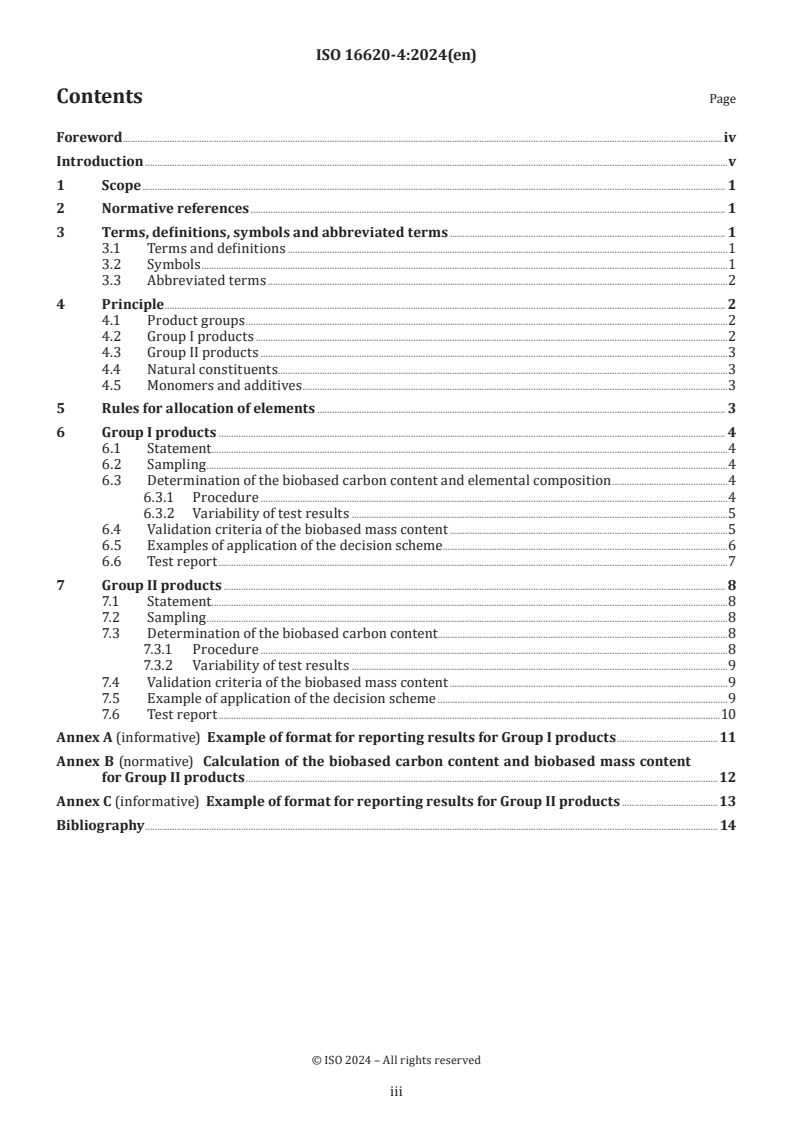
Contents Page
Foreword .iv
Introduction .v
1 Scope . 1
2 Normative references . 1
3 Terms, definitions, symbols and abbreviated terms . 1
3.1 Terms and definitions .1
3.2 Symbols .1
3.3 Abbreviated terms .2
4 Principle . 2
4.1 Product groups .2
4.2 Group I products .2
4.3 Group II products .3
4.4 Natural constituents.3
4.5 Monomers and additives .3
5 Rules for allocation of elements . 3
6 Group I products . 4
6.1 Statement . . .4
6.2 Sampling .4
6.3 Determination of the biobased carbon content and elemental composition .4
6.3.1 Procedure .4
6.3.2 Variability of test results .5
6.4 Validation criteria of the biobased mass content .5
6.5 Examples of application of the decision scheme .6
6.6 Test report .7
7 Group II products . 8
7.1 Statement . . .8
7.2 Sampling .8
7.3 Determination of the biobased carbon content.8
7.3.1 Procedure .8
7.3.2 Variability of test results .9
7.4 Validation criteria of the biobased mass content .9
7.5 Example of application of the decision scheme .9
7.6 Test report .10
Annex A (informative) Example of format for reporting results for Group I products .11
Annex B (normative) Calculation of the biobased carbon content and biobased mass content
for Group II products .12
Annex C (informative) Example of format for reporting results for Group II products .13
Bibliography . 14
iii
Foreword
ISO (the International Organization for Standardization) is a worldwide federation of national standards
bodies (ISO member bodies). The work of preparing International Standards is normally carried out through
ISO technical committees. Each member body interested in a subject for which a technical committee
has been established has the right to be represented on that committee. International organizations,
governmental and non-governmental, in liaison with ISO, also take part in the work. ISO collaborates closely
with the International Electrotechnical Commission (IEC) on all matters of electrotechnical standardization.
The procedures used to develop this document and those intended for its further maintenance are described
in the ISO/IEC Directives, Part 1. In particular, the different approval criteria needed for the different types
of ISO document should be noted. This document was drafted in accordance with the editorial rules of the
ISO/IEC Directives, Part 2 (see www.iso.org/directives).
ISO draws attention to the possibility that the implementation of this document may involve the use of (a)
patent(s). ISO takes no position concerning the evidence, validity or applicability of any claimed patent
rights in respect thereof. As of the date of publication of this document, ISO had not received notice of (a)
patent(s) which may be required to implement this document. However, implementers are cautioned that
this may not represent the latest information, which may be obtained from the patent database available at
www.iso.org/patents. ISO shall not be held responsible for identifying any or all such patent rights.
Any trade name used in this document is information given for the convenience of users and does not
constitute an endorsement.
For an explanation of the voluntary nature of standards, the meaning of ISO specific terms and expressions
related to conformity assessment, as well as information about ISO's adherence to the World Trade
Organization (WTO) principles in the Technical Barriers to Trade (TBT), see www.iso.org/iso/foreword.html.
This document was prepared by Technical Committee ISO/TC 61, Plastics, Subcommittee SC 14, Environmental
aspects.
This second edition cancels and replaces the first edition (ISO 16620-4:2016), which has been technically
revised.
The main changes are as follows:
— the Scope was editorially revised;
— the Normative references have been updated;
— 6.3.1 “Procedure” has been revised;
— the Bibliography has been updated.
A list of all parts in the ISO 16620 series can be found on the ISO website.
Any feedback or questions on this document should be directed to the user’s national standards body. A
complete listing of these bodies can be found at www.iso.org/members.html.
iv
Introduction
Increased use of biomass resources for manufacturing plastics products contributes to both reduction of
global warming and conservation of fossil resources.
Current plastics products are composed of biobased synthetic polymers, fossil-based synthetic polymers,
natural polymers and additives that can include biobased materials.
“Biobased plastics” refer to plastics that contain materials wholly or partly of biogenic origin.
In the ISO 16620 series, the “biobased content” of biobased plastics refers to the amount of the biobased
carbon content, the amount of the biobased synthetic polymer content or the amount of the biobased mass
content only.
v
International Standard ISO 16620-4:2024(en)
Plastics — Biobased content —
Part 4:
Determination of biobased mass content
1 Scope
This document specifies a method of determining the biobased mass content in plastics products, based on
the radiocarbon analysis and elemental analysis.
This document is applicable to plastic products and plastic materials, polymer resins, monomers or additives,
which are made from biobased and/or fossil-based constituents.
This method can be applied provided that the plastic product contains the element carbon and that a
statement giving its elemental composition and its biobased carbon content is available.
2 Normative references
The following documents are referred to in the text in such a way that some or all of their content constitutes
requirements of this document. For dated references, only the edition cited applies. For undated references,
the latest edition of the referenced document (including any amendments) applies.
ISO 16620-1, Plastics — Biobased content — Part 1: General principles
ISO 16620-2, Plastics — Biobased content — Part 2: Determination of biobased carbon content
EN 17351, Bio-based products — Determination of the oxygen content using an elemental analyser
3 Terms, definitions, symbols and abbreviated terms
3.1 Terms and definitions
For the purposes of this document, the terms and definitions given in ISO 16620-1 apply.
ISO and IEC maintain terminology databases for use in standardization at the following addresses:
— ISO Online browsing platform: available at https:// www .iso .org/ obp
— IEC Electropedia: available at https:// www .electropedia .org/
3.2 Symbols
C carbon isotope with an atomic mass of 14
C symbol for element carbon
H symbol for element hydrogen
N symbol for element nitrogen
O symbol for element oxygen
m biobased mass content, expressed as a percentage of the total mass of sample
B
x biobased carbon content, expressed as a percentage of the total mass of the sample
B
TC
x total carbon content, expressed as a percentage of the total mass of the sample
TH
x total hydrogen content, expressed as a percentage of the total mass of the sample
TN
x total nitrogen content, expressed as a percentage of the total mass of the sample
TO
x total oxygen content, expressed as a percentage of the total mass of the sample
W mass of a sample, expressed in grams
3.3 Abbreviated terms
CL confidence level
TC total carbon
TH total hydrogen
TN total nitrogen
TO total oxygen
4 Principle
4.1 Product groups
For the purpose of this document, two groups of products are distinguished as follows:
a) Group I products are obtained by chemical, biochemical or biological reaction(s);
b) Group II products are obtained by mixing Group I products without chemical, biochemical or biological
reaction.
Natural constituents (4.4) can be used to produce Group I products or as constituent(s) of Group II products.
4.2 Group I products
This method, supported by rules described in Clause 6, consists in
a) the determination of the biobased carbon content and elemental composition of the product by using
the radiocarbon analysis and elemental analysis respectively (6.3), and
b) the comparison between
1) the data of the statement (6.1) comprising the composition and the origin (biobased and/or fossil
resources) of the product, and
2) the data resulting from the radiocarbon analysis and elemental analysis of the product (6.3).
NOTE The “statement” in the sense of this document is to be distinguished from the “declaration” of the biobased
mass content resulting from this method, which is in the scope of ISO 16620-5.
4.3 Group II products
This method consists in
a) the determination of the biobased carbon content of the product by using the radiocarbon analysis (7.3),
and
b) the comparison between
1) the data of the statement (7.1) comprising the composition and the origin (biobased and/or fossil
resources) of the product, and
2) the data resulting from the radiocarbon analysis of the product (7.3).
NOTE The “statement” in the sense of this document is to be distinguished from the “declaration” of the biobased
mass content resulting of this method, which is in the scope of ISO 16620-5.
4.4 Natural constituents
This method is not needed for the determination of the biobased mass content in natural constituents (e.g.
natural polymers) wholly derived from biomass.
The biobased mass content of a natural constituent is equal to 100 %.
The biobased carbon content of a natural constituent, expressed as a percentage of the total carbon content,
is equal to 100 %.
NOTE This differentiates the calculation of the biobased mass content according to this document from the
calculation of the biobased synthetic polymer content according to ISO 16620-3, where the biobased synthetic polymer
content of a natural constituent is 0 % (see ISO 16620-1:2015, Clause 4).
4.5 Monomers and additives
In case of monomers and additives for which the composition and raw material(s)/chemical(s) from which
they are made are known, and whose chemical identification is unequivocal, the method may consist only
in a determination of the biobased carbon content. The biobased mass content may be validated by applying
the validation criteria (6.4), considering only the biobased carbon content.
5 Rules for allocation of elements
NOTE According to the current state of the art, it is not possible by isotopic measurements to establish a
distinction between elements originating from biomass and elements originating from non-biomass for elements such
as oxygen, hydrogen or nitrogen.
For a product/constituent of a product obtained by chemical, biochemical or biological reaction(s) (Group I),
the following rules shall apply:
a) if the reactants are exclusively derived from biomass, the biobased mass content of the product/
constituent of the product is 100 %;
b) if none of the reactants is derived from biomass, the biobased mass content of the product/constituent
of the product is 0 %;
c) if the reactants are derived from both biomass and non-biomass, the following conventions apply:
1) if oxygen (O) and/or hydrogen (H) and/or nitrogen (N) element(s) is(are) bound to a carbon
structure derived from biomass, its(their) fraction is(are) considered to be part(s) of the biobased
mass content;
2) element(s) other than C, H, O and N elements are not considered in this document.
EXAMPLE Esters derived from the condensation of an acid wit
...