

ISO 4384-1:2019
(Main)Plain bearings — Hardness testing of bearing metals — Part 1: Multilayer bearings materials
General Information
- Abstract
This document specifies parameters for the hardness testing of compound materials for plain bearings made from steel and bearing metal with bearing metals based on copper and aluminium, manufactured by casting, sintering or bonding. It represents a supplement to the existing ISO publications on hardness testing and, therefore, includes only the extensions and restrictions to be observed compared to those publications. The measuring method applied depends on the bearing metal layer thickness, its hardness and its structure.
- Status
- Published
- Publication Date
- 26-Feb-2019
- Current Stage
- 9093 - International Standard confirmed
- Start Date
- 13-Jun-2024
- Completion Date
- 29-Aug-2026
Buy Documents


ISO 4384-1:2019 - Plain bearings -- Hardness testing of bearing metals
ISO 4384-1:2019 - Plain bearings — Hardness testing of bearing metals — Part 1: Multilayer bearings materials/27/2019
Overview
ISO 4384-1:2019 is an international standard developed by the International Organization for Standardization (ISO) that specifies the parameters for hardness testing of compound materials used in plain bearings. This part of the ISO 4384 series focuses specifically on multilayer bearing materials composed of steel combined with bearing metals based on copper and aluminium. Applicable to materials manufactured by casting, sintering, or bonding, this document supplements existing ISO hardness testing standards by providing extensions and restrictions relevant to multilayer bearings. The hardness testing method applied varies depending on factors such as the bearing metal layer thickness, hardness, and microstructure.
Key Topics
- Multilayer Bearing Materials: Covers compound materials combining steel backings with copper- or aluminium-based bearing metals.
- Hardness Testing Parameters: Specifies test conditions tailored to the thickness and structure of bearing metal layers.
- Specimen Preparation: Requires test specimen surfaces to be bright metallic, plane, and heat-free to ensure reliable indentation measurements.
- Testing Methods: Uses Brinell hardness testing with varied ball diameters, test forces, and durations depending on layer thickness:
- Small load hardness testing for very thin layers (≤0.2 mm)
- Standard Brinell hardness testing (HBW) for thicker layers, with load sizes adapted to thickness ranges
- Test Reporting: Mandates detailed documentation including reference to ISO 4384-1:2019, specimen details, test conditions, results, and any deviations or observations affecting outcomes.
Applications
ISO 4384-1:2019 plays a critical role in quality control and material characterization within industries utilizing plain bearings with multilayer compound materials. Key applications include:
- Bearing Manufacturing: Ensuring the integrity and performance of multilayer bearings for automotive, aerospace, industrial machinery, and heavy equipment sectors.
- Material Certification: Verifying hardness properties to meet specifications for copper and aluminium-based bearing metals bonded to steel.
- Research and Development: Assisting in the development of new bearing materials and manufacturing processes by providing reproducible hardness measurement parameters.
- Failure Analysis: Providing standardized hardness data which helps assess wear, structural integrity, and longevity of plain bearings in service.
Related Standards
ISO 4384-1:2019 complements other standards relevant to hardness testing and plain bearing materials, including:
- ISO 6506-1: Metallic materials - Brinell hardness test - Part 1: Test method. This standard provides the fundamental Brinell hardness testing procedure referenced and supplemented by ISO 4384-1.
- Other parts of the ISO 4384 series which cover different types of bearing materials and hardness testing methods.
- Standards related to metallurgical testing, specimen preparation, and mechanical property characterization.
By adhering to ISO 4384-1:2019, organizations benefit from consistent, reliable hardness testing protocols tailored for advanced multilayer bearing materials, supporting product quality and performance excellence.
Relations
- Effective Date
- 23-Apr-2020
Buy Documents
ISO 4384-1:2019 - Plain bearings -- Hardness testing of bearing metals
ISO 4384-1:2019 - Plain bearings — Hardness testing of bearing metals — Part 1: Multilayer bearings materials/27/2019
Frequently Asked Questions
ISO 4384-1:2019 is a standard published by the International Organization for Standardization (ISO). Its full title is "Plain bearings — Hardness testing of bearing metals — Part 1: Multilayer bearings materials". This standard covers: This document specifies parameters for the hardness testing of compound materials for plain bearings made from steel and bearing metal with bearing metals based on copper and aluminium, manufactured by casting, sintering or bonding. It represents a supplement to the existing ISO publications on hardness testing and, therefore, includes only the extensions and restrictions to be observed compared to those publications. The measuring method applied depends on the bearing metal layer thickness, its hardness and its structure.
This document specifies parameters for the hardness testing of compound materials for plain bearings made from steel and bearing metal with bearing metals based on copper and aluminium, manufactured by casting, sintering or bonding. It represents a supplement to the existing ISO publications on hardness testing and, therefore, includes only the extensions and restrictions to be observed compared to those publications. The measuring method applied depends on the bearing metal layer thickness, its hardness and its structure.
ISO 4384-1:2019 is classified under the following ICS (International Classification for Standards) categories: 21.100.10 - Plain bearings. The ICS classification helps identify the subject area and facilitates finding related standards.
ISO 4384-1:2019 has the following relationships with other standards: It is inter standard links to ISO 4384-1:2012. Understanding these relationships helps ensure you are using the most current and applicable version of the standard.
ISO 4384-1:2019 is available in PDF format for immediate download after purchase. The document can be added to your cart and obtained through the secure checkout process. Digital delivery ensures instant access to the complete standard document.
Standards Content (Sample)
SLOVENSKI STANDARD
01-oktober-2020
Drsni ležaji - Preskušanje trdote materialov za ležaje - 1. del: Kompozitni materiali
Plain bearings - Hardness testing of bearing metals - Part 1: Multilayer bearings
materials
Paliers lisses - Essai de dureté des matériaux antifriction
Ta slovenski standard je istoveten z: ISO 4384-1:2019
ICS:
21.100.10 Drsni ležaji Plain bearings
2003-01.Slovenski inštitut za standardizacijo. Razmnoževanje celote ali delov tega standarda ni dovoljeno.
INTERNATIONAL ISO
STANDARD 4384-1
Fourth edition
2019-02
Plain bearings — Hardness testing of
bearing metals —
Part 1:
Multilayer bearings materials
Paliers lisses — Essai de dureté des matériaux antifriction —
Partie 1: Matériaux multicouches pour paliers lisses
Reference number
©
ISO 2019
© ISO 2019
All rights reserved. Unless otherwise specified, or required in the context of its implementation, no part of this publication may
be reproduced or utilized otherwise in any form or by any means, electronic or mechanical, including photocopying, or posting
on the internet or an intranet, without prior written permission. Permission can be requested from either ISO at the address
below or ISO’s member body in the country of the requester.
ISO copyright office
CP 401 • Ch. de Blandonnet 8
CH-1214 Vernier, Geneva
Phone: +41 22 749 01 11
Fax: +41 22 749 09 47
Email: copyright@iso.org
Website: www.iso.org
Published in Switzerland
ii © ISO 2019 – All rights reserved
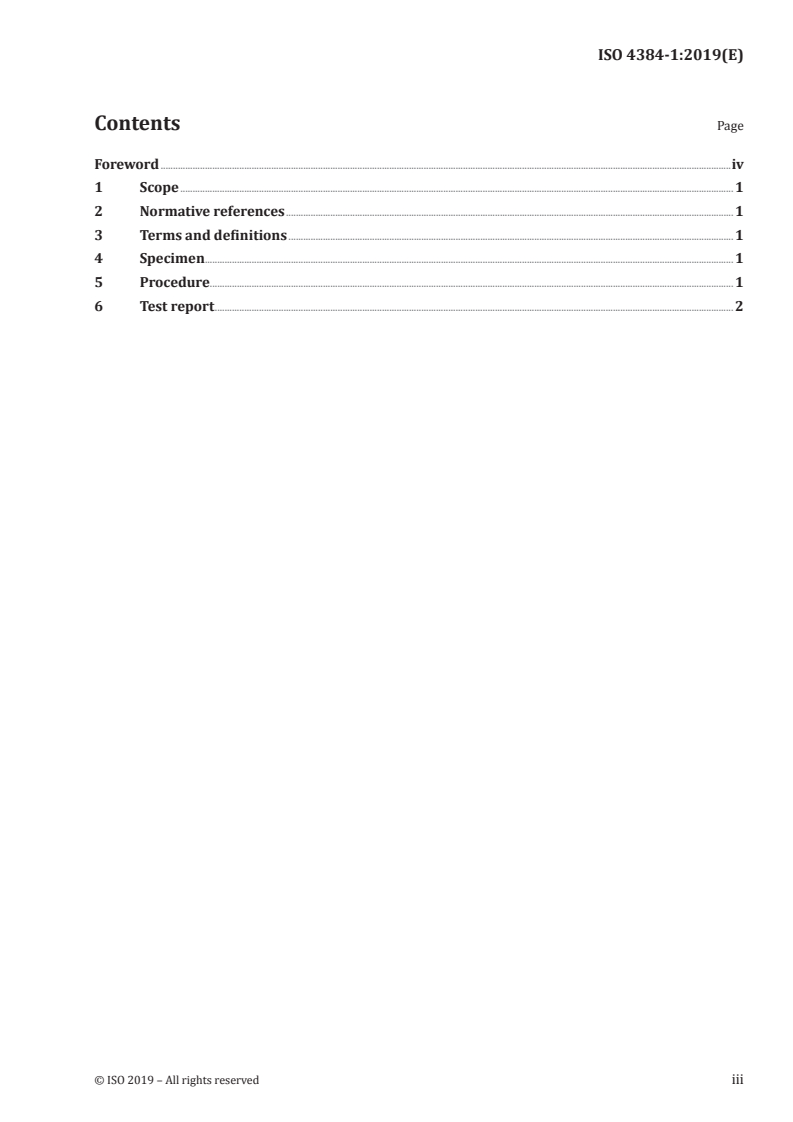
Contents Page
Foreword .iv
1 Scope . 1
2 Normative references . 1
3 Terms and definitions . 1
4 Specimen . 1
5 Procedure. 1
6 Test report . 2
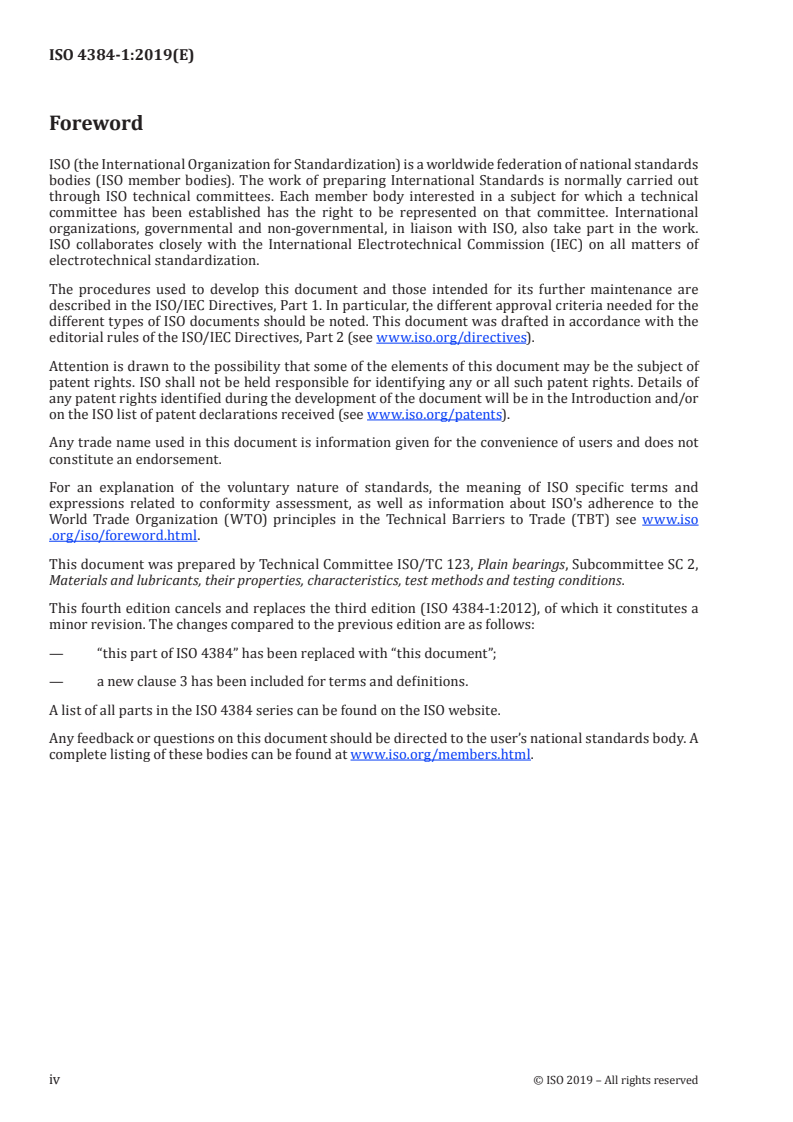
Foreword
ISO (the International Organization for Standardization) is a worldwide federation of national standards
bodies (ISO member bodies). The work of preparing International Standards is normally carried out
through ISO technical committees. Each member body interested in a subject for which a technical
committee has been established has the right to be represented on that committee. International
organizations, governmental and non-governmental, in liaison with ISO, also take part in the work.
ISO collaborates closely with the International Electrotechnical Commission (IEC) on all matters of
electrotechnical standardization.
The procedures used to develop this document and those intended for its further maintenance are
described in the ISO/IEC Directives, Part 1. In particular, the different approval criteria needed for the
different types of ISO documents should be noted. This document was drafted in accordance with the
editorial rules of the ISO/IEC Directives, Part 2 (see www .iso .org/directives).
Attention is drawn to the possibility that some of the elements of this document may be the subject of
patent rights. ISO shall not be held responsible for identifying any or all such patent rights. Details of
any patent rights identified during the development of the document will be in the Introduction and/or
on t
...
INTERNATIONAL ISO
STANDARD 4384-1
Fourth edition
2019-02
Plain bearings — Hardness testing of
bearing metals —
Part 1:
Multilayer bearings materials
Paliers lisses — Essai de dureté des matériaux antifriction —
Partie 1: Matériaux multicouches pour paliers lisses
Reference number
©
ISO 2019
© ISO 2019
All rights reserved. Unless otherwise specified, or required in the context of its implementation, no part of this publication may
be reproduced or utilized otherwise in any form or by any means, electronic or mechanical, including photocopying, or posting
on the internet or an intranet, without prior written permission. Permission can be requested from either ISO at the address
below or ISO’s member body in the country of the requester.
ISO copyright office
CP 401 • Ch. de Blandonnet 8
CH-1214 Vernier, Geneva
Phone: +41 22 749 01 11
Fax: +41 22 749 09 47
Email: copyright@iso.org
Website: www.iso.org
Published in Switzerland
ii © ISO 2019 – All rights reserved
Contents Page
Foreword .iv
1 Scope . 1
2 Normative references . 1
3 Terms and definitions . 1
4 Specimen . 1
5 Procedure. 1
6 Test report . 2
Foreword
ISO (the International Organization for Standardization) is a worldwide federation of national standards
bodies (ISO member bodies). The work of preparing International Standards is normally carried out
through ISO technical committees. Each member body interested in a subject for which a technical
committee has been established has the right to be represented on that committee. International
organizations, governmental and non-governmental, in liaison with ISO, also take part in the work.
ISO collaborates closely with the International Electrotechnical Commission (IEC) on all matters of
electrotechnical standardization.
The procedures used to develop this document and those intended for its further maintenance are
described in the ISO/IEC Directives, Part 1. In particular, the different approval criteria needed for the
different types of ISO documents should be noted. This document was drafted in accordance with the
editorial rules of the ISO/IEC Directives, Part 2 (see www .iso .org/directives).
Attention is drawn to the possibility that some of the elements of this document may be the subject of
patent rights. ISO shall not be held responsible for identifying any or all such patent rights. Details of
any patent rights identified during the development of the document will be in the Introduction and/or
on the ISO list of patent declarations received (see www .iso .org/patents).
Any trade name used in this document is information given for the convenience of users and does not
constitute an endorsement.
For an explanation of the voluntary nature of standards, the meaning of ISO specific terms and
expressions related to conformity assessment, as well as information about ISO's adherence to the
World Trade Organization (WTO) p
...
INTERNATIONAL ISO
STANDARD 4384-1
Fourth edition
2019-02
Plain bearings — Hardness testing of
bearing metals —
Part 1:
Multilayer bearings materials
Paliers lisses — Essai de dureté des matériaux antifriction —
Partie 1: Matériaux multicouches pour paliers lisses
Reference number
©
ISO 2019
© ISO 2019
All rights reserved. Unless otherwise specified, or required in the context of its implementation, no part of this publication may
be reproduced or utilized otherwise in any form or by any means, electronic or mechanical, including photocopying, or posting
on the internet or an intranet, without prior written permission. Permission can be requested from either ISO at the address
below or ISO’s member body in the country of the requester.
ISO copyright office
CP 401 • Ch. de Blandonnet 8
CH-1214 Vernier, Geneva
Phone: +41 22 749 01 11
Fax: +41 22 749 09 47
Email: copyright@iso.org
Website: www.iso.org
Published in Switzerland
ii © ISO 2019 – All rights reserved
Contents Page
Foreword .iv
1 Scope . 1
2 Normative references . 1
3 Terms and definitions . 1
4 Specimen . 1
5 Procedure. 1
6 Test report . 2
Foreword
ISO (the International Organization for Standardization) is a worldwide federation of national standards
bodies (ISO member bodies). The work of preparing International Standards is normally carried out
through ISO technical committees. Each member body interested in a subject for which a technical
committee has been established has the right to be represented on that committee. International
organizations, governmental and non-governmental, in liaison with ISO, also take part in the work.
ISO collaborates closely with the International Electrotechnical Commission (IEC) on all matters of
electrotechnical standardization.
The procedures used to develop this document and those intended for its further maintenance are
described in the ISO/IEC Directives, Part 1. In particular, the different approval criteria needed for the
different types of ISO documents should be noted. This document was drafted in accordance with the
editorial rules of the ISO/IEC Directives, Part 2 (see www .iso .org/directives).
Attention is drawn to the possibility that some of the elements of this document may be the subject of
patent rights. ISO shall not be held responsible for identifying any or all such patent rights. Details of
any patent rights identified during the development of the document will be in the Introduction and/or
on the ISO list of patent declarations received (see www .iso .org/patents).
Any trade name used in this document is information given for the convenience of users and does not
constitute an endorsement.
For an explanation of the voluntary nature of standards, the meaning of ISO specific terms and
expressions related to conformity assessment, as well as information about ISO's adherence to the
World Trade Organization (WTO) p
...