

ISO 4127-2:1980
(Main)Shipbuilding — Inland vessels — Fairleads — Part 2: Roller fairleads
General Information
- Abstract
Specifies the types, kinds, basic parameters and technical requirements.
- Status
- Withdrawn
- Publication Date
- 31-May-1980
- Technical Committee
- ISO/TC 8/SC 7 - Inland navigation vessels
- Drafting Committee
- ISO/TC 8/SC 7 - Inland navigation vessels
- Current Stage
- 9599 - Withdrawal of International Standard
- Start Date
- 16-Jun-2025
- Completion Date
- 29-Aug-2026
Buy Documents
ISO 4127-2:1980 - Shipbuilding -- Inland vessels -- Fairleads
ISO 4127-2:1980 - Shipbuilding — Inland vessels — Fairleads — Part 2: Roller fairleads/1/1980
ISO 4127-2:1980 - Construction navale -- Bateaux de navigation intérieure -- Chaumards
ISO 4127-2:1980 - Construction navale — Bateaux de navigation intérieure — Chaumards — Partie 2: Chaumards à rouleaux/1/1980
ISO 4127-2:1980 - Construction navale — Bateaux de navigation intérieure — Chaumards — Partie 2: Chaumards à rouleaux/1/1980
Overview
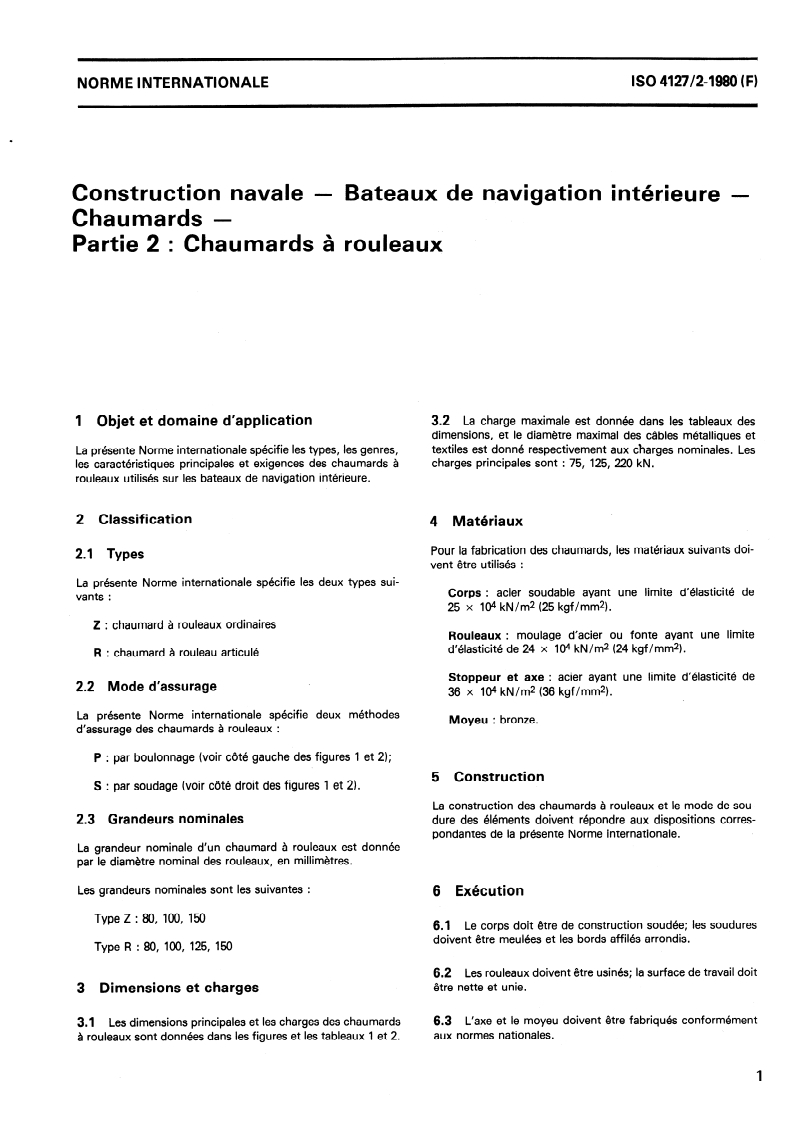
ISO 4127-2:1980 is an international standard developed by the International Organization for Standardization (ISO) that specifies the types, classifications, dimensional parameters, and technical requirements for roller fairleads used on inland vessels. Part 2 of the ISO 4127 series focuses exclusively on roller fairleads, which are essential components in shipbuilding for inland navigation, particularly in riverine and canal vessels.
This standard defines two main types of roller fairleads - ordinary roller fairleads (Type Z) and articulated roller fairleads (Type R). It provides detailed guidelines on material properties, construction methods, dimensions, load capacities, and installation options that ensure safe and reliable mooring operations.
Key Topics
Types and Classification
- Type Z (Ordinary roller fairlead): Standard roller design for routine mooring lines.
- Type R (Articulated roller fairlead): Enhanced flexibility via articulated roller, suitable for specific vessel configurations.
Nominal Sizes and Dimensions
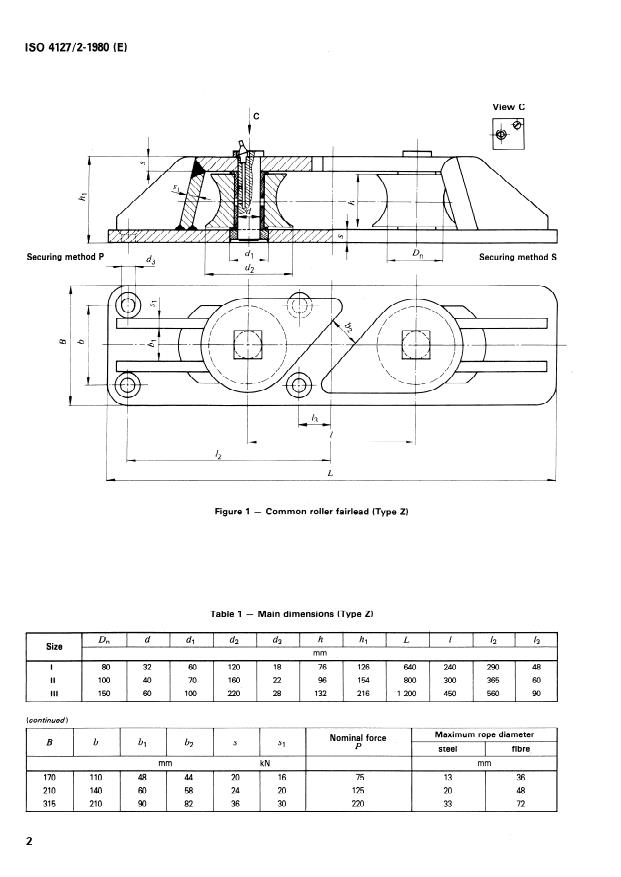
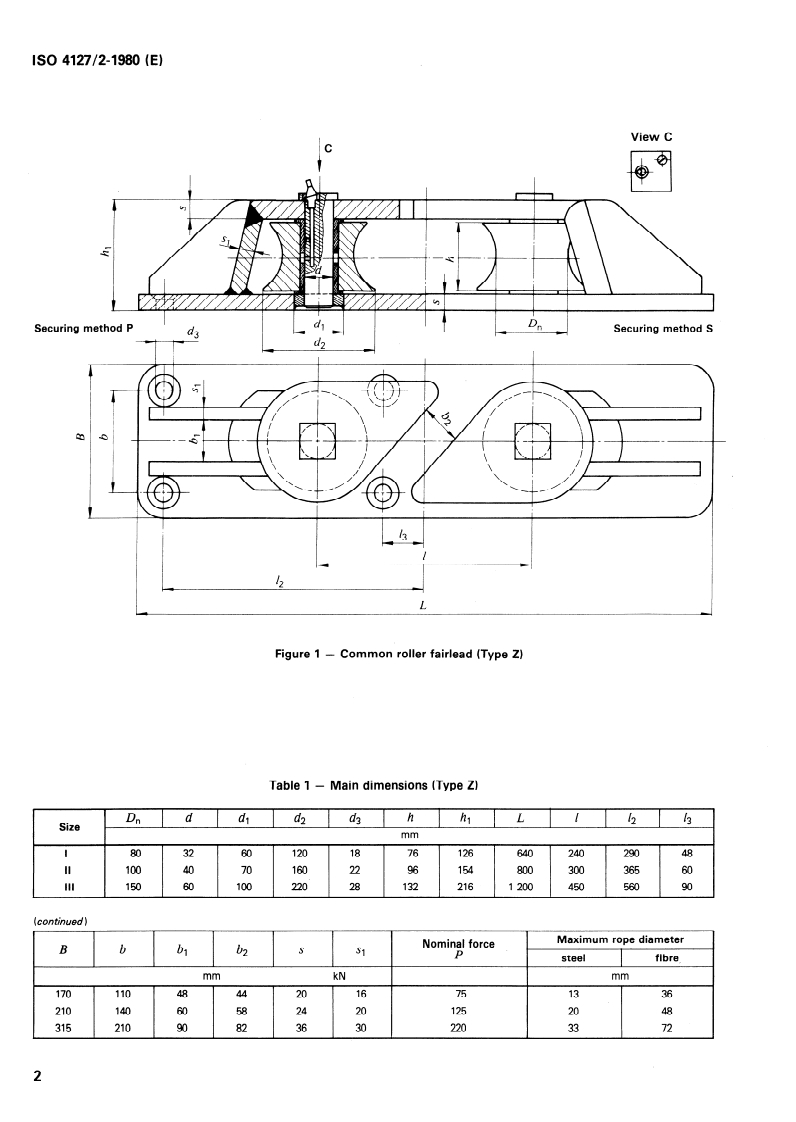
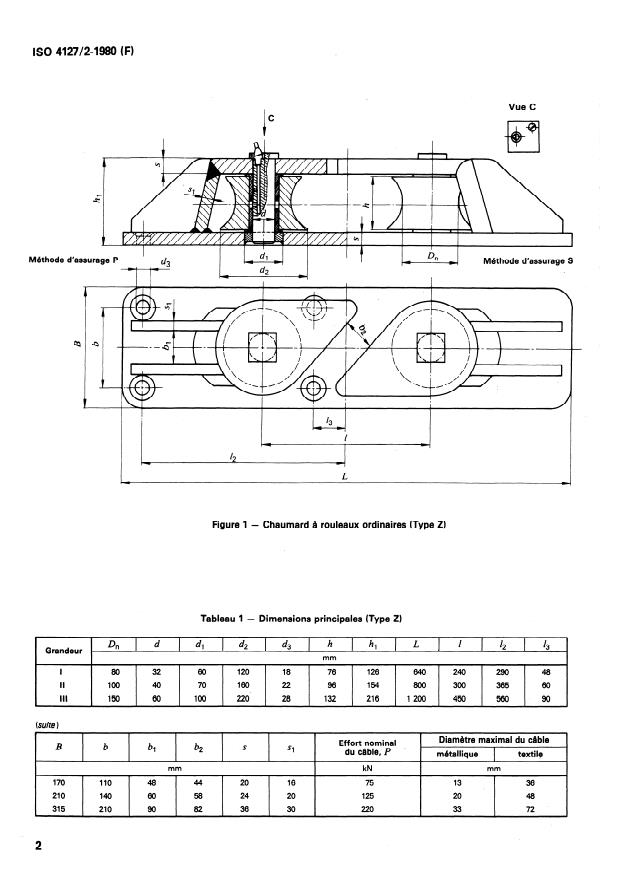
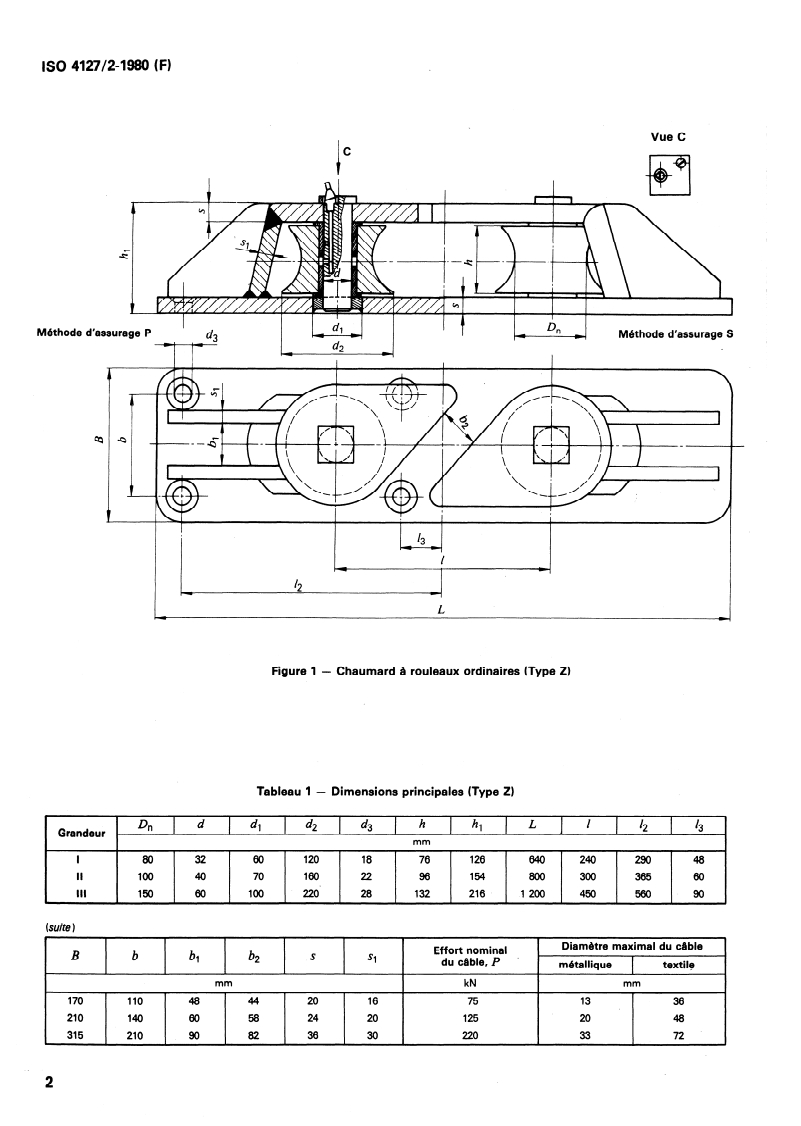
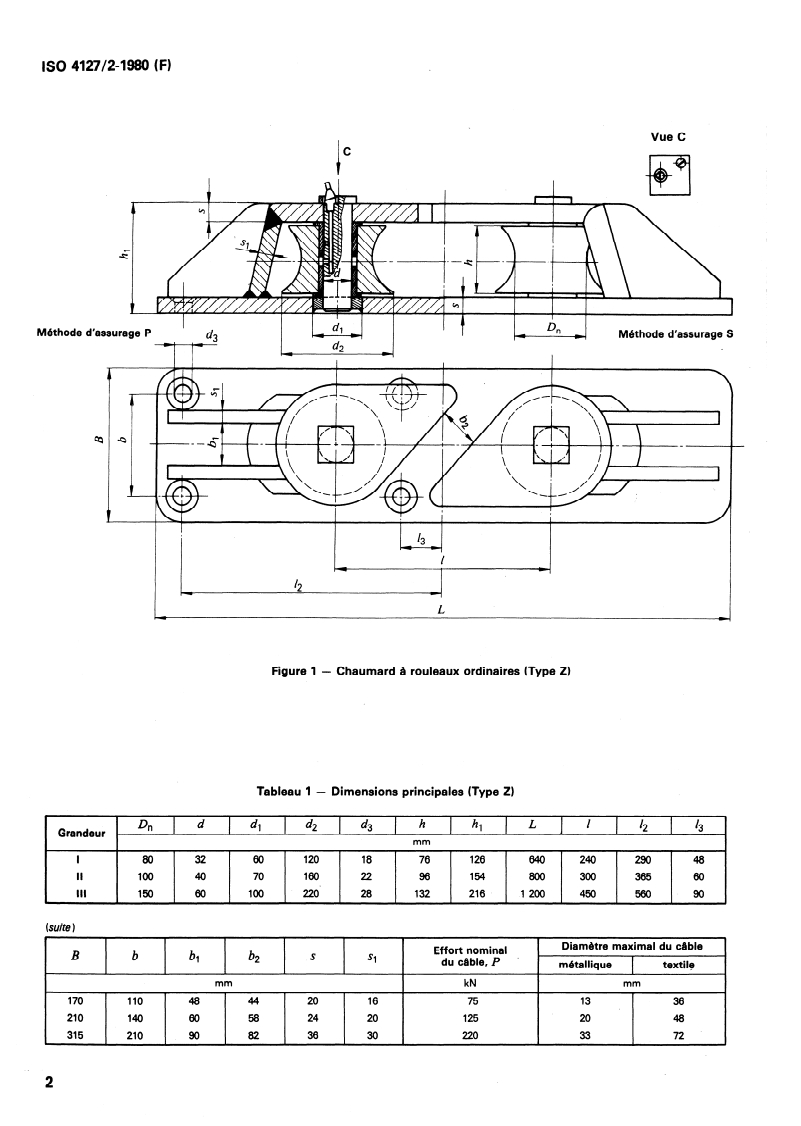
Roller diameters are specified as nominal dimensions from 80 mm up to 150 mm depending on type and application. Comprehensive tables outline key dimensions such as diameter (d), height (h), length (L), and related measurements critical for design consistency.Load and Cable Specifications
The standard enumerates the maximum nominal loads applicable to each fairlead size type, ranging typically from 75 kN to 220 kN, and associates these with maximum permissible metal and textile cable diameters for safety and functionality.Material Requirements
- Fairlead bodies are constructed from weldable steel with a minimum yield strength of 250 MPa (25 x 10^4 kN/m²).
- Rollers are made from cast steel or cast iron with a 240 MPa minimum elasticity limit.
- Fastening components like stoppers and shafts require higher strength steel (360 MPa).
- Bronze is used for hubs, ensuring durability and corrosion resistance.
Construction and Execution
- Bodies must feature welded construction with smooth finished welds and rounded edges.
- Rollers must be precision machined for smooth contact surfaces.
- Assembly and securing options are detailed, including bolt-on installation (P type) or welding (S type).
Applications
ISO 4127-2:1980 applies primarily to inland waterway vessels such as river barges, canal boats, and other shallow draft ships operating on lakes and rivers. The standard supports:
- Mooring operations: Ensuring lines run smoothly over fairleads to prevent chafing and abrupt line movement.
- Towing and anchoring: Facilitating secure handling of towlines and anchor cables.
- Ship safety: Providing uniform mechanical strength and durability for repeated operational stresses on fairleads.
By adhering to this standard, shipbuilders and operators can achieve increased safety margins, reduced maintenance, and consistent interchangeability of parts for inland navigation fleets.
Related Standards
- ISO 4127-1: Covers other types of fairleads for inland vessels, offering complementary specifications for non-roller designs.
- ISO TC 8 series: Set of standards established by ISO’s Technical Committee 8 (Shipbuilding), addressing materials, design, and testing of ship components.
- Relevant welding standards: For fabrication compliance, involving steel welding and joint integrity in ship structures.
- Maritime safety regulations: Local and international codes regulating mooring equipment and vessel handling.
Keywords: ISO 4127-2, roller fairleads, inland vessels, shipbuilding standards, mooring equipment, fairlead dimensions, inland navigation, steel construction, mooring line safety, articulated roller fairlead, welded fairlead, ship components standard.
Buy Documents
ISO 4127-2:1980 - Shipbuilding -- Inland vessels -- Fairleads
ISO 4127-2:1980 - Shipbuilding — Inland vessels — Fairleads — Part 2: Roller fairleads/1/1980
ISO 4127-2:1980 - Construction navale -- Bateaux de navigation intérieure -- Chaumards
ISO 4127-2:1980 - Construction navale — Bateaux de navigation intérieure — Chaumards — Partie 2: Chaumards à rouleaux/1/1980
ISO 4127-2:1980 - Construction navale — Bateaux de navigation intérieure — Chaumards — Partie 2: Chaumards à rouleaux/1/1980
Get Certified
Connect with accredited certification bodies for this standard

DNV
DNV is an independent assurance and risk management provider.

Lloyd's Register
Lloyd's Register is a global professional services organisation specialising in engineering and technology.

FSC International
Forest Stewardship Council certification.
Sponsored listings
Frequently Asked Questions
ISO 4127-2:1980 is a standard published by the International Organization for Standardization (ISO). Its full title is "Shipbuilding — Inland vessels — Fairleads — Part 2: Roller fairleads". This standard covers: Specifies the types, kinds, basic parameters and technical requirements.
Specifies the types, kinds, basic parameters and technical requirements.
ISO 4127-2:1980 is classified under the following ICS (International Classification for Standards) categories: 47.060 - Inland navigation vessels. The ICS classification helps identify the subject area and facilitates finding related standards.
ISO 4127-2:1980 is available in PDF format for immediate download after purchase. The document can be added to your cart and obtained through the secure checkout process. Digital delivery ensures instant access to the complete standard document.
Standards Content (Sample)
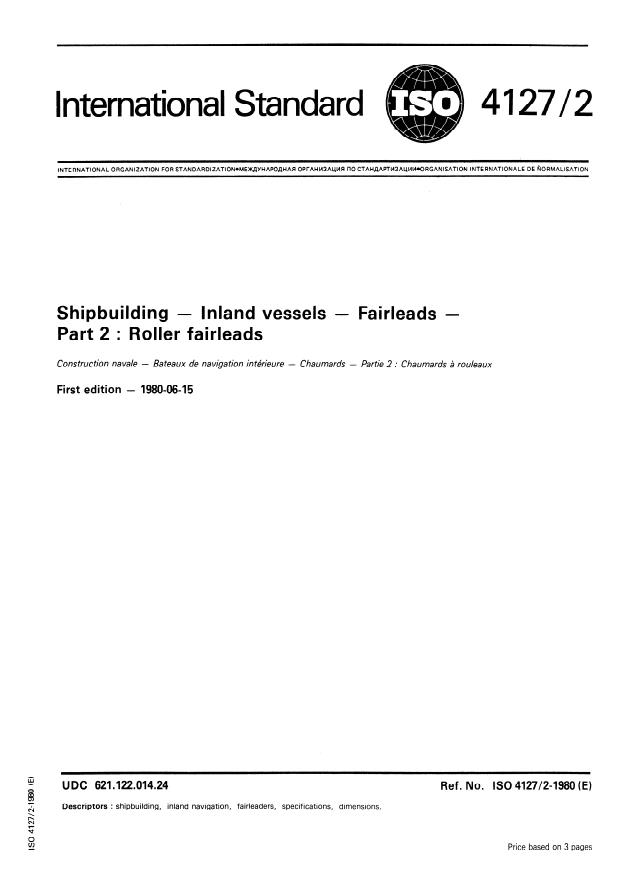
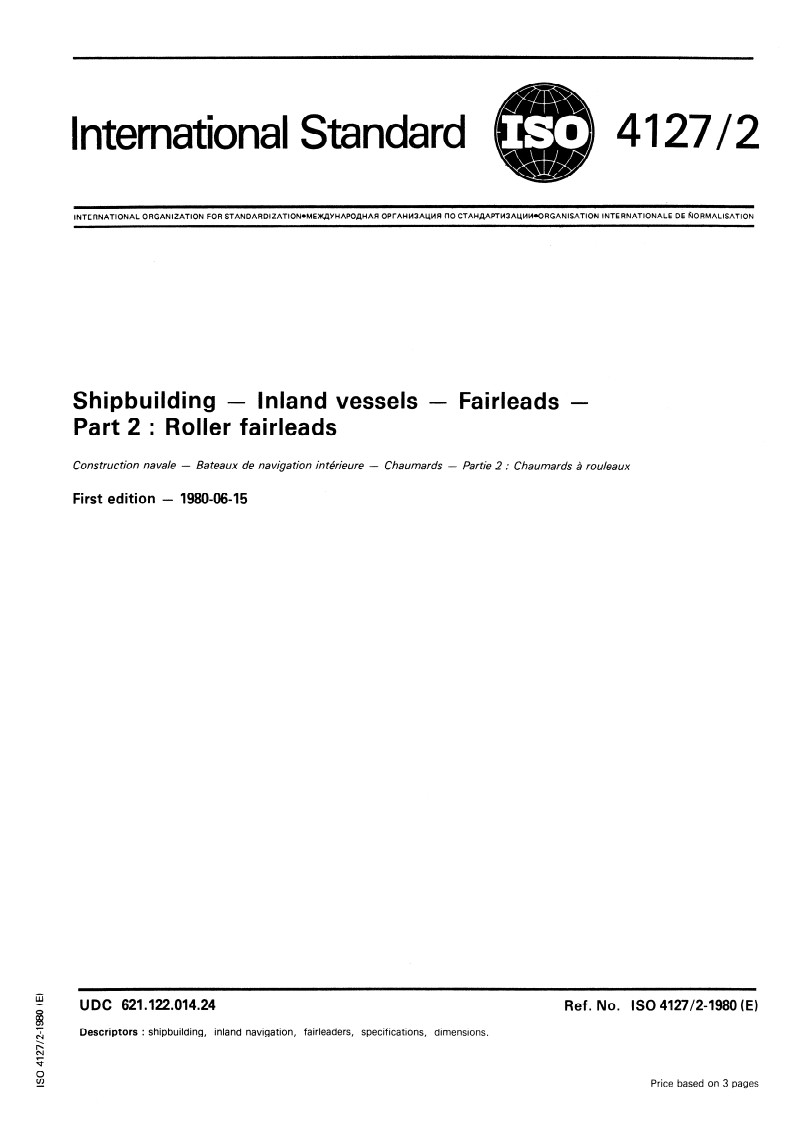
International Standard
INTERNATIONAL ORGANIZATION FOR STANDARDIZATIONWblE>KC1YHAPO&HAR OPI-AHM3AL&lR fl0 CTAH~APTb’l3AL&lbl~RGANISATION INTERNATIONALE DE 6lORMALISATION
Shipbuilding - Inland vessels - Fairleads -
Part 2 : Roller fairleads
Cons truc tion na vale - Bateaux de navigation intbrieure - Chaumards - Partie 2 : Chaumards 2 rouleaux
First edition - 1980-06-15
ii7
-
Ref. No. ISO 4127/2-1980 IE)
UDC 621.122.014.24
: shipbuilding, inland navigation, fairleaders, specifications, dimensions.
Descriptors
Price based on 3 pages
v)
Foreword
ISO (the International Organization for Standardization) is a worldwide federation of
national Standards institutes (ISO member bodies). The work of developing Inter-
national Standards is carried out through ISO technical committees. Every member
body interested in a subject for which a technical committee has been set up has the
right to be represented on that committee. International organizations, governmental
and non-governmental, in liaison with ISO, also take part in the work.
Draft International Standards adopted by the technical committees are circulated to
the member bodies for approval before their acceptance as International Standards by
the ISO Council.
International Standard ISO 4127/2 was developed by Technical Committee ISO/TC 8,
Shipbulding, and was circulated to the member bodies in November 1978.
lt has been approved by the member bodies of the following countries :
Australia France Poland
Austria India Romania
Belgium I reland Turkey
Bulgaria I taly United Kingdom
Chile Japan USSR
China Korea, Dem. P. Rep. of Y ugoslavia
Czechoslovakia Korea, Rep. of
member body of the following country expressed disapproval of the
The document on
tech nical grounds
Germany, F. R.
International Organization for Standardization, 1980
Printed in Switzerland
ISO 4127/2-1980 (E)
INTERNATIONAL STANDARD
Shipbuilding - Inland vessels - Fairleads -
Part 2 : Roller fairleads
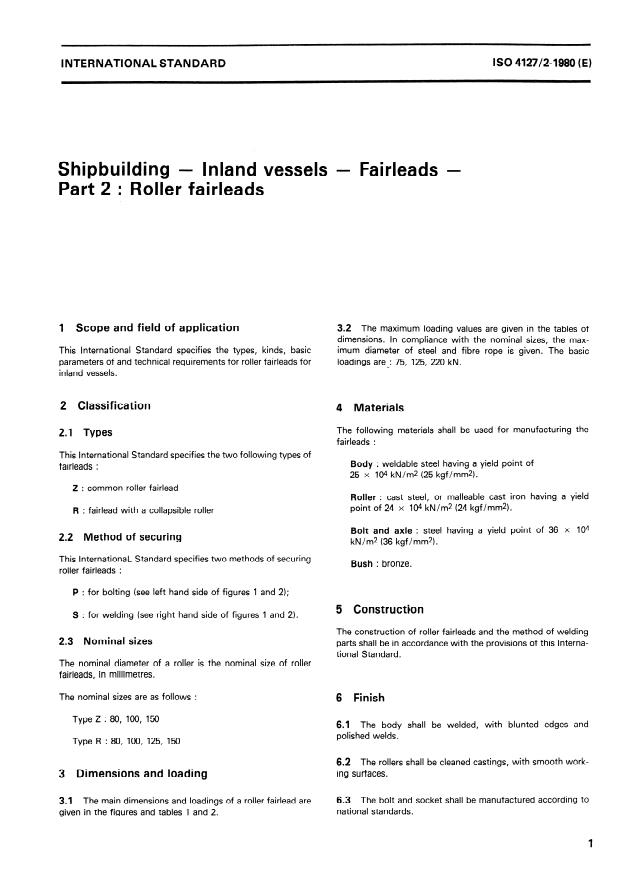
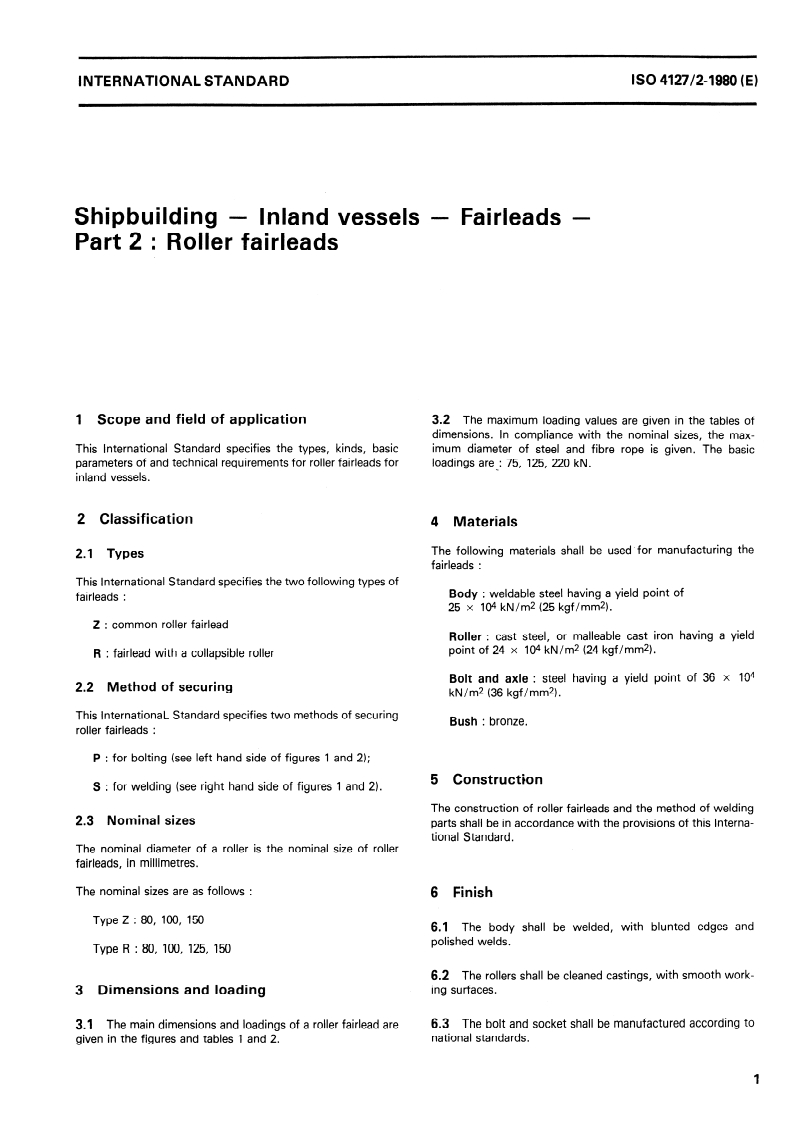
1 Scope and field of application 3.2 The maximum loading values are given in the tables of
dimensions. In compliance with the nominal sizes, the max-
This International Standard specifies the types, kinds, basic imum diameter of steel and fibre rope is given. The basic
Parameters of and technical requirements for roller fairleads for loadings are : 75, 125, 220 kN.
inland vessels.
2 Classification
4 Materials
The following materials shall be used’for manufacturing the
2.1 Types
fairleads :
This International Standard specifies the two following types of
Body : weldable steel having a yield Point of
fairleads :
25 x 104 kN/m2 (25 kgf/mm%
2 : common roller fairlead
Roller : cast steel, or malleable cast iron having a yield
Point of 24 x 104 kN/m2 (24 kgf/mmz).
R : fairlead with
...
International Standard
INTERNATIONAL ORGANIZATION FOR STANDARDIZATIONWblE>KC1YHAPO&HAR OPI-AHM3AL&lR fl0 CTAH~APTb’l3AL&lbl~RGANISATION INTERNATIONALE DE 6lORMALISATION
Shipbuilding - Inland vessels - Fairleads -
Part 2 : Roller fairleads
Cons truc tion na vale - Bateaux de navigation intbrieure - Chaumards - Partie 2 : Chaumards 2 rouleaux
First edition - 1980-06-15
ii7
-
Ref. No. ISO 4127/2-1980 IE)
UDC 621.122.014.24
: shipbuilding, inland navigation, fairleaders, specifications, dimensions.
Descriptors
Price based on 3 pages
v)
Foreword
ISO (the International Organization for Standardization) is a worldwide federation of
national Standards institutes (ISO member bodies). The work of developing Inter-
national Standards is carried out through ISO technical committees. Every member
body interested in a subject for which a technical committee has been set up has the
right to be represented on that committee. International organizations, governmental
and non-governmental, in liaison with ISO, also take part in the work.
Draft International Standards adopted by the technical committees are circulated to
the member bodies for approval before their acceptance as International Standards by
the ISO Council.
International Standard ISO 4127/2 was developed by Technical Committee ISO/TC 8,
Shipbulding, and was circulated to the member bodies in November 1978.
lt has been approved by the member bodies of the following countries :
Australia France Poland
Austria India Romania
Belgium I reland Turkey
Bulgaria I taly United Kingdom
Chile Japan USSR
China Korea, Dem. P. Rep. of Y ugoslavia
Czechoslovakia Korea, Rep. of
member body of the following country expressed disapproval of the
The document on
tech nical grounds
Germany, F. R.
International Organization for Standardization, 1980
Printed in Switzerland
ISO 4127/2-1980 (E)
INTERNATIONAL STANDARD
Shipbuilding - Inland vessels - Fairleads -
Part 2 : Roller fairleads
1 Scope and field of application 3.2 The maximum loading values are given in the tables of
dimensions. In compliance with the nominal sizes, the max-
This International Standard specifies the types, kinds, basic imum diameter of steel and fibre rope is given. The basic
Parameters of and technical requirements for roller fairleads for loadings are : 75, 125, 220 kN.
inland vessels.
2 Classification
4 Materials
The following materials shall be used’for manufacturing the
2.1 Types
fairleads :
This International Standard specifies the two following types of
Body : weldable steel having a yield Point of
fairleads :
25 x 104 kN/m2 (25 kgf/mm%
2 : common roller fairlead
Roller : cast steel, or malleable cast iron having a yield
Point of 24 x 104 kN/m2 (24 kgf/mmz).
R : fairlead with
...
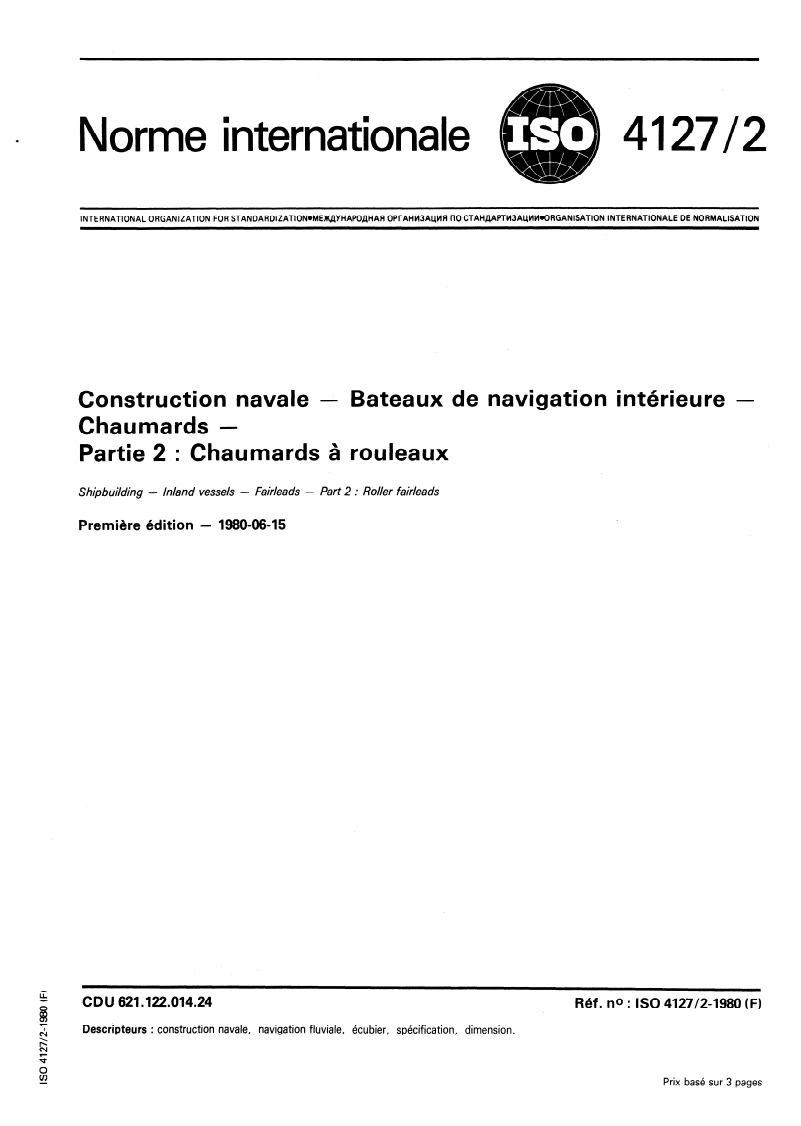
Norme internationale 412712
INTERNATIONAL ORGANIZATION FOR STANDARDIZATIONWlEIKJJYHAPO~HAR OPrAHH3Al#lfI ll0 CTAH~PTbl3ALWl~RGANISATION INTERNATIONALE DE NORMALISATION
Construction navale - Bateaux de navigation intérieure -
Chaumards -
Partie 2 : Chaumards à rouleaux
Shipbuilding - lnland Vesse/s - Fairleads - Part 2 : Roller fairleads
Première édition - 1980-06-15
il:
Y
CDU 621.122.014.24
Réf. no : ISO 4127/2-1980 (F)
Descripteurs : construction navale, navigation fluviale, écubier, spécification, dimension.
Prix basé sur 3 pages
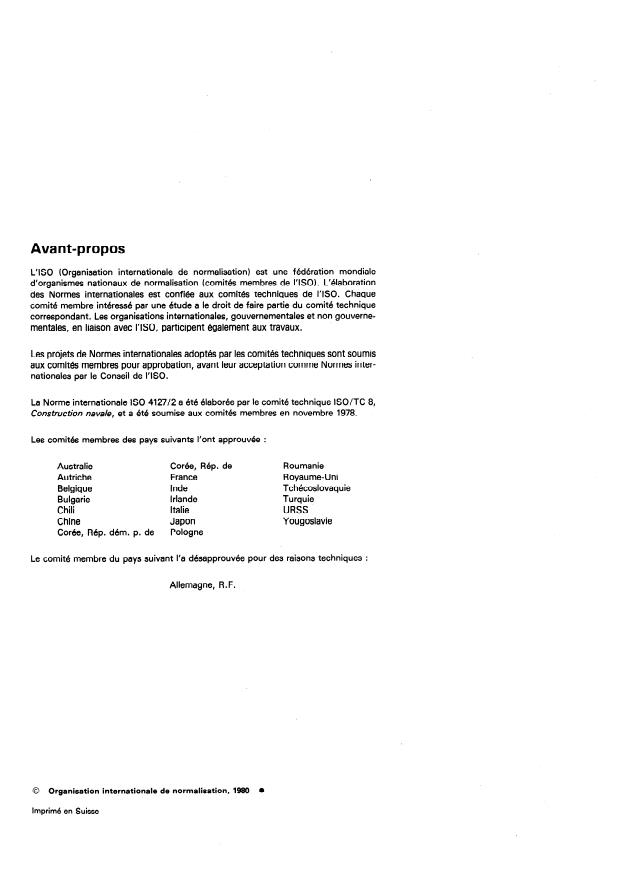
Avant-propos
L’ISO (Organisation internationale de normalisation) est une fédération mondiale
d’organismes nationaux de normalisation (comités membres de I’ISO). L’élaboration
des Normes internationales est confiee aux comités techniques de I’ISO. Chaque
comité membre interesse par une étude a le droit de faire partie du comité technique
correspondant. Les organisations internationales, gouvernementales et non gouverne-
mentales, en liaison avec I’ISO, participent également aux travaux.
Les projets de Normes internationales adoptés par les comités techniques sont soumis
aux comités membres pour approbation, avant leur acceptation comme Normes inter-
nationales par le Conseil de I’ISO.
La Norme internationale ISO 4127/2 a été élaborée par le comité technique ISO/TC 8,
Construction navale, et a été soumise aux comites membres en novembre 1978.
Les comites membres des pays suivants l’ont approuvée :
Corée, Rép. de Roumanie
Australie
Autriche France Royaume-Uni
Inde Tchécoslovaquie
Belgique
Bulgarie Irlande Turquie
Chili Italie URSS
Chine Japon Yougoslavie
Corée, Rép. dem. p. de Pologne
Le comité membre du pays suivant l’a désapprouvée pour des raisons techniques :
Allemagne, R. F.
@ Organisation internationale de normalisation, 1980
Imprimé en Suisse
60 4127/2-1980 (F)
NORME INTERNATIONALE
- Bateaux de navigation intérieure -
Construction navale
Chaumards -
Partie 2 : Chaumards à rouleaux
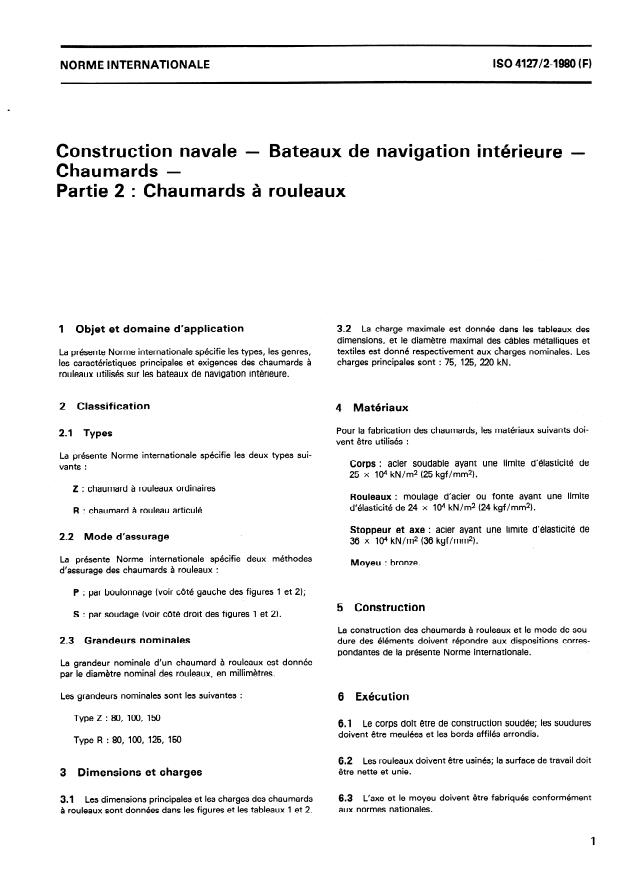
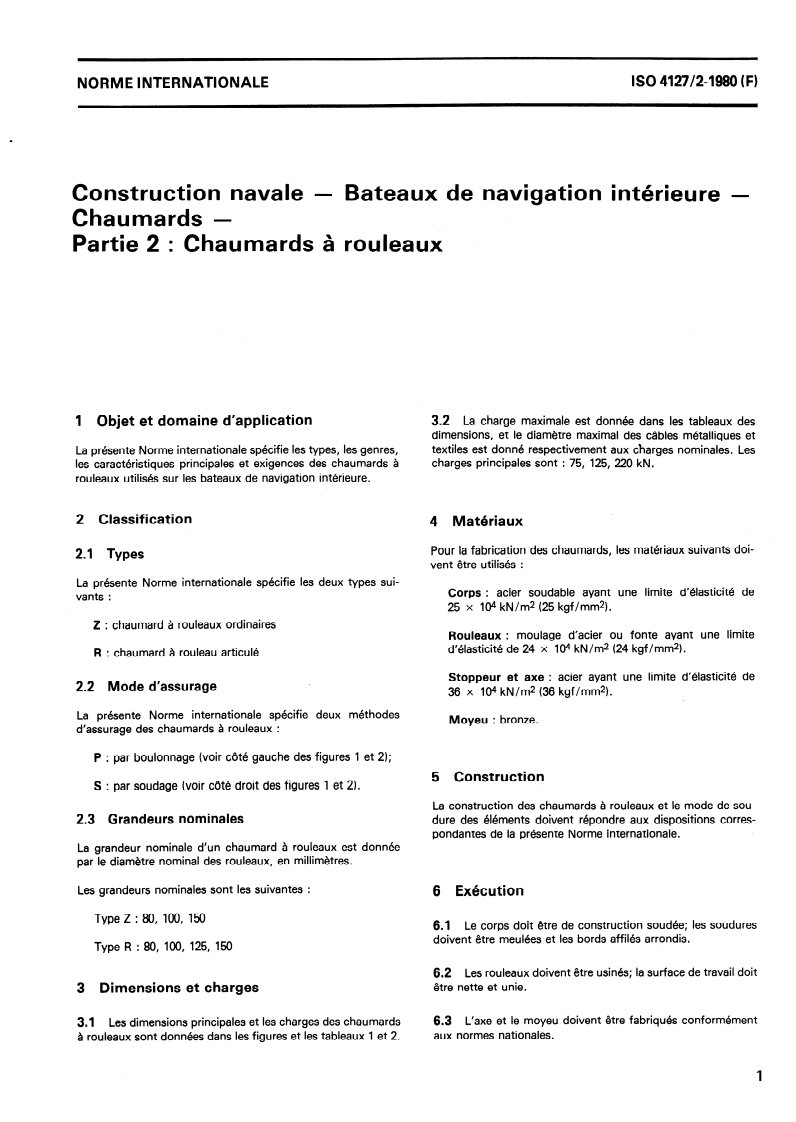
1 Objet et domaine d’application 3.2 La charge maximale est donnée dans les tableaux des
dimensions, et le diamétre maximal des câbles métalliques et
La présente Norme internationale spécifie les types, les genres, textiles est donné respectivement aux charges nominales. Les
les caractéristiques principales et exigences des chaumards à charges principales sont : 75, 125, 220 kN.
rouleaux utilisés sur les bateaux de navigation intérieure.
2 Classification
4 Matériaux
Pour la fabrication des chaumards, les matériaux suivants doi-
2.1 Types
vent être utilisés :
La présente Norme internationale spécifie les deux types sui-
Corps : acier soudable ayant une limite d’élasticité de
vants :
25 x 104 kN/m2 (25 kgf/mm$
Z : chaumard à rouleaux ordinaires
Rouleaux : moulage d’acier ou fonte ayant une limite
d’élasticité de 24 x 104 kN/m2 (24 kgf /mm2).
R : cha
...
Norme internationale 412712
INTERNATIONAL ORGANIZATION FOR STANDARDIZATIONWlEIKJJYHAPO~HAR OPrAHH3Al#lfI ll0 CTAH~PTbl3ALWl~RGANISATION INTERNATIONALE DE NORMALISATION
Construction navale - Bateaux de navigation intérieure -
Chaumards -
Partie 2 : Chaumards à rouleaux
Shipbuilding - lnland Vesse/s - Fairleads - Part 2 : Roller fairleads
Première édition - 1980-06-15
il:
Y
CDU 621.122.014.24
Réf. no : ISO 4127/2-1980 (F)
Descripteurs : construction navale, navigation fluviale, écubier, spécification, dimension.
Prix basé sur 3 pages
Avant-propos
L’ISO (Organisation internationale de normalisation) est une fédération mondiale
d’organismes nationaux de normalisation (comités membres de I’ISO). L’élaboration
des Normes internationales est confiee aux comités techniques de I’ISO. Chaque
comité membre interesse par une étude a le droit de faire partie du comité technique
correspondant. Les organisations internationales, gouvernementales et non gouverne-
mentales, en liaison avec I’ISO, participent également aux travaux.
Les projets de Normes internationales adoptés par les comités techniques sont soumis
aux comités membres pour approbation, avant leur acceptation comme Normes inter-
nationales par le Conseil de I’ISO.
La Norme internationale ISO 4127/2 a été élaborée par le comité technique ISO/TC 8,
Construction navale, et a été soumise aux comites membres en novembre 1978.
Les comites membres des pays suivants l’ont approuvée :
Corée, Rép. de Roumanie
Australie
Autriche France Royaume-Uni
Inde Tchécoslovaquie
Belgique
Bulgarie Irlande Turquie
Chili Italie URSS
Chine Japon Yougoslavie
Corée, Rép. dem. p. de Pologne
Le comité membre du pays suivant l’a désapprouvée pour des raisons techniques :
Allemagne, R. F.
@ Organisation internationale de normalisation, 1980
Imprimé en Suisse
60 4127/2-1980 (F)
NORME INTERNATIONALE
- Bateaux de navigation intérieure -
Construction navale
Chaumards -
Partie 2 : Chaumards à rouleaux
1 Objet et domaine d’application 3.2 La charge maximale est donnée dans les tableaux des
dimensions, et le diamétre maximal des câbles métalliques et
La présente Norme internationale spécifie les types, les genres, textiles est donné respectivement aux charges nominales. Les
les caractéristiques principales et exigences des chaumards à charges principales sont : 75, 125, 220 kN.
rouleaux utilisés sur les bateaux de navigation intérieure.
2 Classification
4 Matériaux
Pour la fabrication des chaumards, les matériaux suivants doi-
2.1 Types
vent être utilisés :
La présente Norme internationale spécifie les deux types sui-
Corps : acier soudable ayant une limite d’élasticité de
vants :
25 x 104 kN/m2 (25 kgf/mm$
Z : chaumard à rouleaux ordinaires
Rouleaux : moulage d’acier ou fonte ayant une limite
d’élasticité de 24 x 104 kN/m2 (24 kgf /mm2).
R : cha
...
Norme internationale 412712
INTERNATIONAL ORGANIZATION FOR STANDARDIZATIONWlEIKJJYHAPO~HAR OPrAHH3Al#lfI ll0 CTAH~PTbl3ALWl~RGANISATION INTERNATIONALE DE NORMALISATION
Construction navale - Bateaux de navigation intérieure -
Chaumards -
Partie 2 : Chaumards à rouleaux
Shipbuilding - lnland Vesse/s - Fairleads - Part 2 : Roller fairleads
Première édition - 1980-06-15
il:
Y
CDU 621.122.014.24
Réf. no : ISO 4127/2-1980 (F)
Descripteurs : construction navale, navigation fluviale, écubier, spécification, dimension.
Prix basé sur 3 pages
Avant-propos
L’ISO (Organisation internationale de normalisation) est une fédération mondiale
d’organismes nationaux de normalisation (comités membres de I’ISO). L’élaboration
des Normes internationales est confiee aux comités techniques de I’ISO. Chaque
comité membre interesse par une étude a le droit de faire partie du comité technique
correspondant. Les organisations internationales, gouvernementales et non gouverne-
mentales, en liaison avec I’ISO, participent également aux travaux.
Les projets de Normes internationales adoptés par les comités techniques sont soumis
aux comités membres pour approbation, avant leur acceptation comme Normes inter-
nationales par le Conseil de I’ISO.
La Norme internationale ISO 4127/2 a été élaborée par le comité technique ISO/TC 8,
Construction navale, et a été soumise aux comites membres en novembre 1978.
Les comites membres des pays suivants l’ont approuvée :
Corée, Rép. de Roumanie
Australie
Autriche France Royaume-Uni
Inde Tchécoslovaquie
Belgique
Bulgarie Irlande Turquie
Chili Italie URSS
Chine Japon Yougoslavie
Corée, Rép. dem. p. de Pologne
Le comité membre du pays suivant l’a désapprouvée pour des raisons techniques :
Allemagne, R. F.
@ Organisation internationale de normalisation, 1980
Imprimé en Suisse
60 4127/2-1980 (F)
NORME INTERNATIONALE
- Bateaux de navigation intérieure -
Construction navale
Chaumards -
Partie 2 : Chaumards à rouleaux
1 Objet et domaine d’application 3.2 La charge maximale est donnée dans les tableaux des
dimensions, et le diamétre maximal des câbles métalliques et
La présente Norme internationale spécifie les types, les genres, textiles est donné respectivement aux charges nominales. Les
les caractéristiques principales et exigences des chaumards à charges principales sont : 75, 125, 220 kN.
rouleaux utilisés sur les bateaux de navigation intérieure.
2 Classification
4 Matériaux
Pour la fabrication des chaumards, les matériaux suivants doi-
2.1 Types
vent être utilisés :
La présente Norme internationale spécifie les deux types sui-
Corps : acier soudable ayant une limite d’élasticité de
vants :
25 x 104 kN/m2 (25 kgf/mm$
Z : chaumard à rouleaux ordinaires
Rouleaux : moulage d’acier ou fonte ayant une limite
d’élasticité de 24 x 104 kN/m2 (24 kgf /mm2).
R : cha
...