

ISO 10384:2012
(Main)Hot-rolled carbon steel sheet as defined by chemical composition
General Information
- Abstract
ISO 10384:2012 applies to hot-rolled carbon steel sheet as defined by chemical composition. The product is generally used in the heat-treated condition after hot or cold working, press forming or cutting by the customer. For example, the product is used for general machinery such as sprocket wheels, chain links, washers, knife blades and agricultural implements.
- Status
- Published
- Publication Date
- 09-Dec-2012
- Technical Committee
- ISO/TC 17/SC 12 - Continuous mill flat rolled products
- Drafting Committee
- ISO/TC 17/SC 12 - Continuous mill flat rolled products
- Current Stage
- 9093 - International Standard confirmed
- Start Date
- 09-Aug-2024
- Completion Date
- 29-Aug-2026
Buy Documents
ISO 10384:2012 - Hot-rolled carbon steel sheet as defined by chemical composition
ISO 10384:2012 - Hot-rolled carbon steel sheet as defined by chemical composition/10/2012
Overview
ISO 10384:2012 specifies requirements for hot‑rolled carbon steel sheet defined by chemical composition. It covers material grades (S08C through S58C), typical product forms (coils and cut lengths), nominal thickness ranges, chemical analysis and reporting, surface condition, descaling/oiling options, marking and inspection. The sheet is generally supplied for further heat treatment and customer forming (hot or cold) and is commonly used for machinery parts such as sprocket wheels, chain links, washers, knife blades and agricultural implements.
Key topics and technical requirements
- Chemical composition and grades: Defines heat‑analysis composition limits for grades S08C to S58C and limits on additional elements (Cu, Ni, Cr, Mo, Nb, V, Ti). The sum limits and reporting rules are specified in tables.
- Heat and product analysis: Manufacturer performs a heat analysis for each heat; purchasers may request product analysis. Sampling follows ISO 14284 and permissible deviations between heat and product analysis are provided.
- Dimensions and forms: Typical thickness range is about 0.8 mm to 12.5 mm; widths normally ≥ 600 mm (narrower widths may be slit from wide sheet). Dimensional and shape tolerances are referenced to ISO 16160.
- Surface condition and descaling: Hot‑rolled sheet carries oxide/scale. Descaling by pickling or mechanical means (grit/shot blasting) is addressed - purchaser should specify method because mechanical descaling can affect hardness/ductility.
- Oiling and rust protection: Descaled sheet is usually oiled to deter rust; the standard explains oiling is not a forming lubricant and that unoiled material can be supplied on request with limited supplier responsibility for oxidation.
- Tests available on request: Purchaser may request tests such as depth of decarburization (ISO 3887), non‑metallic inclusions (ISO 4967), grain size (ISO 643), hardness (ISO 6507‑1, ISO 6508‑1) and microstructure. Tensile properties are generally not specified because parts are heat treated after delivery.
- Marking and documentation: Minimum marking (manufacturer, ISO number, grade, order number, dimensions, lot and mass) and options for heat‑analysis and test reports are specified. Coil inside/outside diameter and mass limits should be agreed at order.
Applications and users
Who uses ISO 10384:2012:
- Steel producers and mills (for product specification and certification)
- OEMs and fabricators specifying raw material for stamped, formed or heat‑treated parts
- Procurement and quality engineers who require material traceability, heat analyses and acceptance testing
- Product designers and metallurgists selecting carbon steel grades for machinery, agricultural implements and abrasion‑resistant components
Related standards (normative references)
- ISO 14284 - sampling for chemical analysis
- ISO 16160 - dimensional and shape tolerances for hot‑rolled sheet
- ISO 3887, ISO 4967, ISO 643, ISO 6507‑1, ISO 6508‑1 - optional tests referenced by ISO 10384
Keywords: ISO 10384:2012, hot‑rolled carbon steel sheet, chemical composition, S40C, heat analysis, product analysis, descaling, coil marking, ISO 16160.
Relations
- Effective Date
- 10-Jan-2012
Buy Documents
ISO 10384:2012 - Hot-rolled carbon steel sheet as defined by chemical composition
ISO 10384:2012 - Hot-rolled carbon steel sheet as defined by chemical composition/10/2012
Get Certified
Connect with accredited certification bodies for this standard

Element Materials Technology
Materials testing and product certification.

Inštitut za kovinske materiale in tehnologije
Institute of Metals and Technology. Materials testing, metallurgical analysis, NDT.
Sponsored listings
Frequently Asked Questions
ISO 10384:2012 is a standard published by the International Organization for Standardization (ISO). Its full title is "Hot-rolled carbon steel sheet as defined by chemical composition". This standard covers: ISO 10384:2012 applies to hot-rolled carbon steel sheet as defined by chemical composition. The product is generally used in the heat-treated condition after hot or cold working, press forming or cutting by the customer. For example, the product is used for general machinery such as sprocket wheels, chain links, washers, knife blades and agricultural implements.
ISO 10384:2012 applies to hot-rolled carbon steel sheet as defined by chemical composition. The product is generally used in the heat-treated condition after hot or cold working, press forming or cutting by the customer. For example, the product is used for general machinery such as sprocket wheels, chain links, washers, knife blades and agricultural implements.
ISO 10384:2012 is classified under the following ICS (International Classification for Standards) categories: 77.140.50 - Flat steel products and semi-products. The ICS classification helps identify the subject area and facilitates finding related standards.
ISO 10384:2012 has the following relationships with other standards: It is inter standard links to ISO 10384:2008. Understanding these relationships helps ensure you are using the most current and applicable version of the standard.
ISO 10384:2012 is available in PDF format for immediate download after purchase. The document can be added to your cart and obtained through the secure checkout process. Digital delivery ensures instant access to the complete standard document.
Standards Content (Sample)
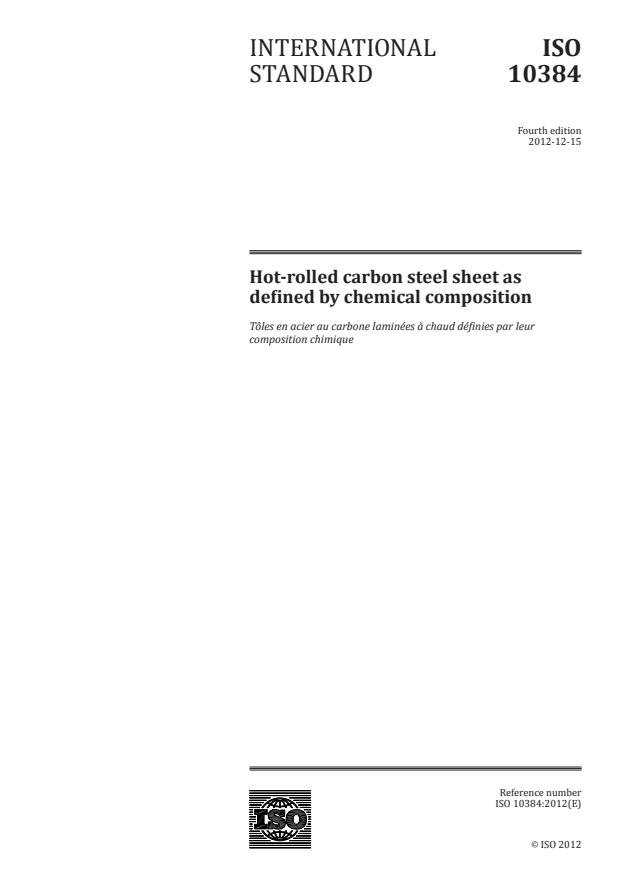
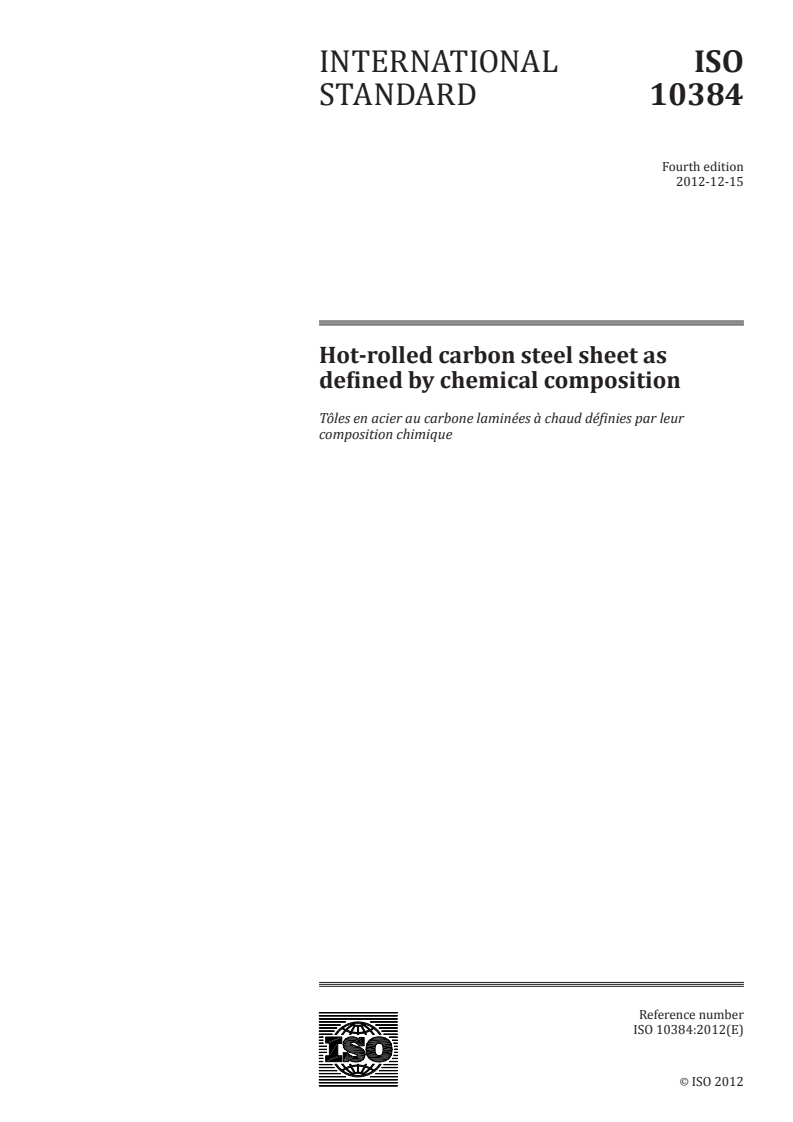
INTERNATIONAL ISO
STANDARD 10384
Fourth edition
2012-12-15
Hot-rolled carbon steel sheet as
defined by chemical composition
Tôles en acier au carbone laminées à chaud définies par leur
composition chimique
Reference number
©
ISO 2012
© ISO 2012
All rights reserved. Unless otherwise specified, no part of this publication may be reproduced or utilized in any form or by any
means, electronic or mechanical, including photocopying and microfilm, without permission in writing from either ISO at the
address below or ISO’s member body in the country of the requester.
ISO copyright office
Case postale 56 • CH-1211 Geneva 20
Tel. + 41 22 749 01 11
Fax + 41 22 749 09 47
E-mail copyright@iso.org
Web www.iso.org
Published in Switzerland
ii © ISO 2012 – All rights reserved
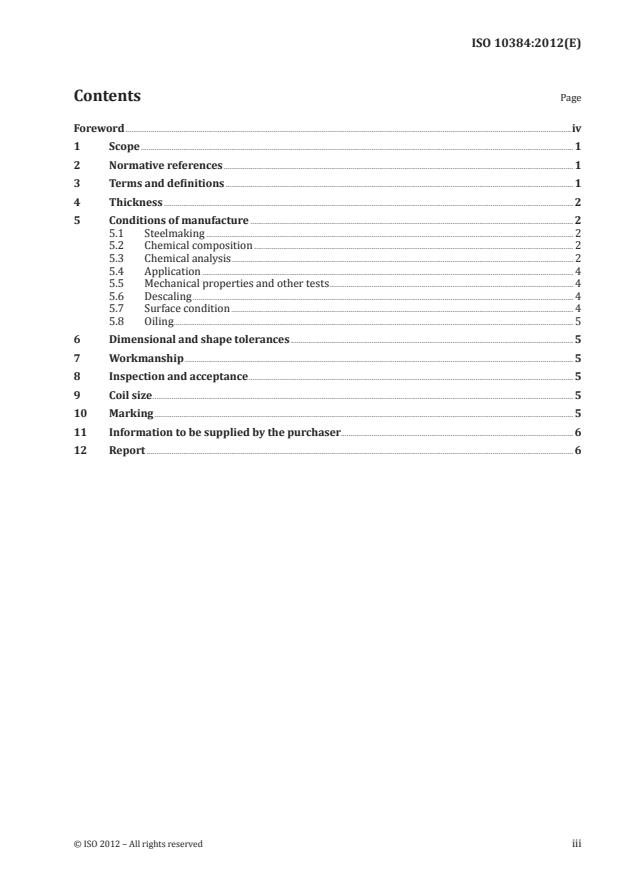
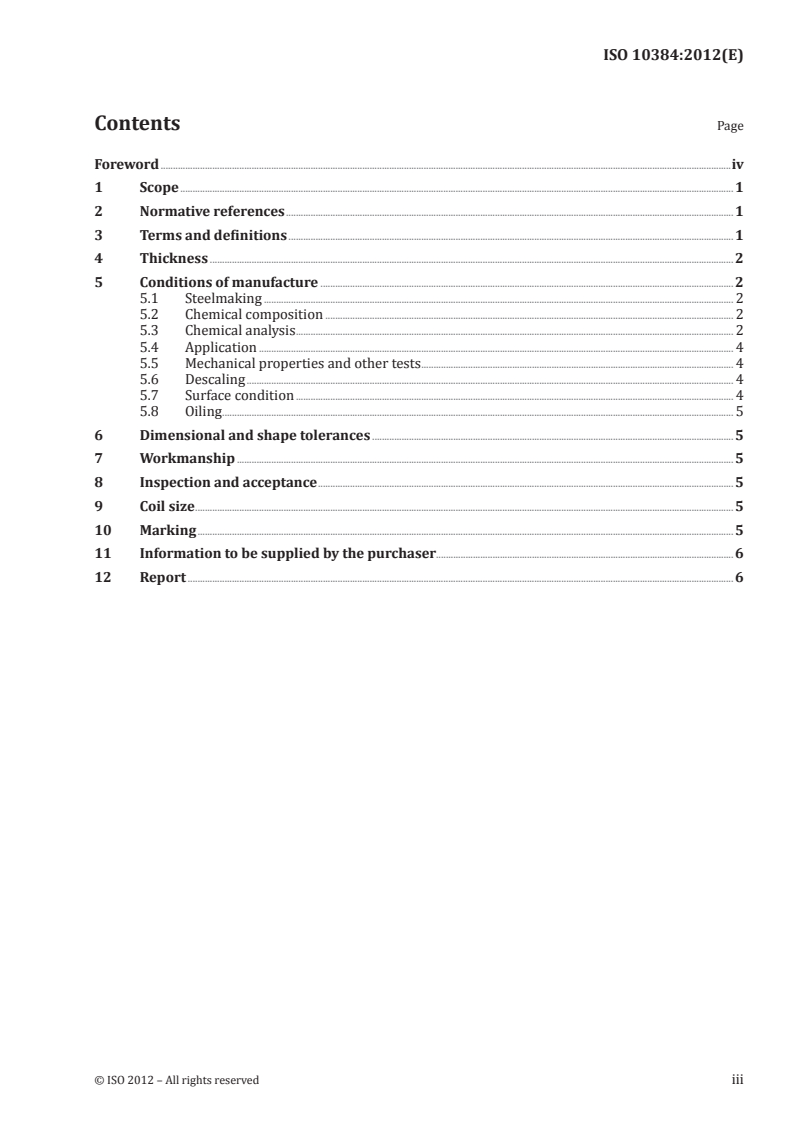
Contents Page
Foreword .iv
1 Scope . 1
2 Normative references . 1
3 Terms and definitions . 1
4 Thickness . 2
5 Conditions of manufacture . 2
5.1 Steelmaking . 2
5.2 Chemical composition . 2
5.3 Chemical analysis . 2
5.4 Application . 4
5.5 Mechanical properties and other tests . 4
5.6 Descaling . 4
5.7 Surface condition . 4
5.8 Oiling . 5
6 Dimensional and shape tolerances . 5
7 Workmanship . 5
8 Inspection and acceptance . 5
9 Coil size . 5
10 Marking . 5
11 Information to be supplied by the purchaser. 6
12 Report . 6
Foreword
ISO (the International Organization for Standardization) is a worldwide federation of national standards
bodies (ISO member bodies). The work of preparing International Standards is normally carried out
through ISO technical committees. Each member body interested in a subject for which a technical
committee has been established has the right to be represented on that committee. International
organizations, governmental and non-governmental, in liaison with ISO, also take part in the work.
ISO collaborates closely with the International Electrotechnical Commission (IEC) on all matters of
electrotechnical standardization.
International Standards are drafted in accordance with the rules given in the ISO/IEC Directives, Part 2.
The main task of technical committees is to prepare International Standards. Draft International
Standards adopted by the technical committees are circulated to the member bodies for voting.
Publication as an International Standard requires approval by at least 75 % of the member bodies
casting a vote.
Attention is drawn to the possibility that some of the elements of this document may be the subject of
patent rights. ISO shall not be held responsible for identifying any or all such patent rights.
ISO 10384 was prepared by Technical Committee ISO/TC 17, Steel, Subcommittee SC 12, Continuous mill
flat rolled products.
This fourth edition cancels and replaces the third edition (ISO 10384:2008), which has been
technically revised.
iv © ISO 2012 – All rights reserved
INTERNATIONAL STANDARD ISO 10384:2012(E)
Hot-rolled carbon steel sheet as defined by chemical
composition
1 Scope
This International Standard applies to hot-rolled carbon steel sheet as defined by chemical composition.
The product is generally used in the heat-treated condition after hot or cold working, press forming
or cutting by the customer. For example, the product is used for general machinery such as sprocket
wheels, chain links, washers, knife blades and agricultural implements.
NOTE 1 Hot-rolled sheet up to but not including 3 mm in thickness is commonly known as “sheet”. Hot-rolled
sheet 3 mm and over in thickness is commonly known as either “sheet” or “plate”.
NOTE 2 Steel sheet that is to be subjected to subsequent rerolling is not covered by this International Standard.
2 Normative references
The following documents, in whole or in part, are normatively referenced in this document and are
indispensable for its application. For dated references, only the edition cited applies. For undated
references, the latest edition of the reference document (including any amendments) applies.
ISO 643, Steels — Micrographic determination of the apparent grain size
ISO 3887, Steels — Determination of depth of decarburization
ISO 4967, Steel — Determination of content of nonmetallic inclusions — Micrographic method using
standard diagrams
ISO 6507-1, Metallic materials — Vickers hardness test — Part 1: Test method
ISO 6508-1, Metallic materials — Rockwell hardness test — Part 1: Test method (scales A, B, C, D, E, F,
G, H, K, N, T)
ISO 14284, Steel and iron — Sampling and preparation of samples for the determination of chemical composition
ISO 16160, Hot-rolled steel sheet products — Dimensional and shape tolerances
3 Terms and definitions
For the purposes of this document, the following terms and definitions apply.
3.1
hot-rolled steel sheet
product obtained by rolling heated steel through a continuous hot strip mill or other hot rolling processes
that produce a coiled product to the required sheet thickness and tolerances
Note 1 to entry: The product has a surface covered with oxide or scale resulting from the hot rolling operation.
3.2
hot-rolled descaled steel sheet
hot-rolled steel sheet from which oxide or scale has been removed, usually by pickling in an acid solution
Note 1 to entry: Descaling may also be performed by appropriate mechanical means.
3.3
mill edge
normal edge without any definite contour produced in hot rolling
Note 1 to entry: Mill edges can contain some irregularities such as cracked or torn edges or thin (feathered) edges.
3.4
sheared edge
normal edge obtained by shearing, slitting or trimming a mill edge product
Note 1 to entry: Normal processing does not necessarily provide a definite positioning of the slitting burr.
4 Thickness
4.1 Hot-rolled carbon steel sheet based on chemical composition is manufactured from killed steel
of the chemical compositions listed in Table 1. It is usually produced in the range of thicknesses from
0,8 mm to 12,5 mm inclusive, and in widths of 600 mm and over, in coils and cut lengths.
4.2 Hot-rolled carbon steel sheet less than 600 mm wide may be slit from wide sheet and will be
considered as sheet.
5 Conditions of manufacture
5.1 Steelmaking
Unless otherwise agreed by the interested parties, the processes used in making the steel and in
manufacturing hot-rolled sheet are left to the discretion of the manufacturer. On request, the purchaser
shall be informed of the steelmaking process used.
5.2 Chemical composition
The chemical composition (heat analysis) shall comply with the
...
INTERNATIONAL ISO
STANDARD 10384
Fourth edition
2012-12-15
Hot-rolled carbon steel sheet as
defined by chemical composition
Tôles en acier au carbone laminées à chaud définies par leur
composition chimique
Reference number
©
ISO 2012
© ISO 2012
All rights reserved. Unless otherwise specified, no part of this publication may be reproduced or utilized in any form or by any
means, electronic or mechanical, including photocopying and microfilm, without permission in writing from either ISO at the
address below or ISO’s member body in the country of the requester.
ISO copyright office
Case postale 56 • CH-1211 Geneva 20
Tel. + 41 22 749 01 11
Fax + 41 22 749 09 47
E-mail copyright@iso.org
Web www.iso.org
Published in Switzerland
ii © ISO 2012 – All rights reserved
Contents Page
Foreword .iv
1 Scope . 1
2 Normative references . 1
3 Terms and definitions . 1
4 Thickness . 2
5 Conditions of manufacture . 2
5.1 Steelmaking . 2
5.2 Chemical composition . 2
5.3 Chemical analysis . 2
5.4 Application . 4
5.5 Mechanical properties and other tests . 4
5.6 Descaling . 4
5.7 Surface condition . 4
5.8 Oiling . 5
6 Dimensional and shape tolerances . 5
7 Workmanship . 5
8 Inspection and acceptance . 5
9 Coil size . 5
10 Marking . 5
11 Information to be supplied by the purchaser. 6
12 Report . 6
Foreword
ISO (the International Organization for Standardization) is a worldwide federation of national standards
bodies (ISO member bodies). The work of preparing International Standards is normally carried out
through ISO technical committees. Each member body interested in a subject for which a technical
committee has been established has the right to be represented on that committee. International
organizations, governmental and non-governmental, in liaison with ISO, also take part in the work.
ISO collaborates closely with the International Electrotechnical Commission (IEC) on all matters of
electrotechnical standardization.
International Standards are drafted in accordance with the rules given in the ISO/IEC Directives, Part 2.
The main task of technical committees is to prepare International Standards. Draft International
Standards adopted by the technical committees are circulated to the member bodies for voting.
Publication as an International Standard requires approval by at least 75 % of the member bodies
casting a vote.
Attention is drawn to the possibility that some of the elements of this document may be the subject of
patent rights. ISO shall not be held responsible for identifying any or all such patent rights.
ISO 10384 was prepared by Technical Committee ISO/TC 17, Steel, Subcommittee SC 12, Continuous mill
flat rolled products.
This fourth edition cancels and replaces the third edition (ISO 10384:2008), which has been
technically revised.
iv © ISO 2012 – All rights reserved
INTERNATIONAL STANDARD ISO 10384:2012(E)
Hot-rolled carbon steel sheet as defined by chemical
composition
1 Scope
This International Standard applies to hot-rolled carbon steel sheet as defined by chemical composition.
The product is generally used in the heat-treated condition after hot or cold working, press forming
or cutting by the customer. For example, the product is used for general machinery such as sprocket
wheels, chain links, washers, knife blades and agricultural implements.
NOTE 1 Hot-rolled sheet up to but not including 3 mm in thickness is commonly known as “sheet”. Hot-rolled
sheet 3 mm and over in thickness is commonly known as either “sheet” or “plate”.
NOTE 2 Steel sheet that is to be subjected to subsequent rerolling is not covered by this International Standard.
2 Normative references
The following documents, in whole or in part, are normatively referenced in this document and are
indispensable for its application. For dated references, only the edition cited applies. For undated
references, the latest edition of the reference document (including any amendments) applies.
ISO 643, Steels — Micrographic determination of the apparent grain size
ISO 3887, Steels — Determination of depth of decarburization
ISO 4967, Steel — Determination of content of nonmetallic inclusions — Micrographic method using
standard diagrams
ISO 6507-1, Metallic materials — Vickers hardness test — Part 1: Test method
ISO 6508-1, Metallic materials — Rockwell hardness test — Part 1: Test method (scales A, B, C, D, E, F,
G, H, K, N, T)
ISO 14284, Steel and iron — Sampling and preparation of samples for the determination of chemical composition
ISO 16160, Hot-rolled steel sheet products — Dimensional and shape tolerances
3 Terms and definitions
For the purposes of this document, the following terms and definitions apply.
3.1
hot-rolled steel sheet
product obtained by rolling heated steel through a continuous hot strip mill or other hot rolling processes
that produce a coiled product to the required sheet thickness and tolerances
Note 1 to entry: The product has a surface covered with oxide or scale resulting from the hot rolling operation.
3.2
hot-rolled descaled steel sheet
hot-rolled steel sheet from which oxide or scale has been removed, usually by pickling in an acid solution
Note 1 to entry: Descaling may also be performed by appropriate mechanical means.
3.3
mill edge
normal edge without any definite contour produced in hot rolling
Note 1 to entry: Mill edges can contain some irregularities such as cracked or torn edges or thin (feathered) edges.
3.4
sheared edge
normal edge obtained by shearing, slitting or trimming a mill edge product
Note 1 to entry: Normal processing does not necessarily provide a definite positioning of the slitting burr.
4 Thickness
4.1 Hot-rolled carbon steel sheet based on chemical composition is manufactured from killed steel
of the chemical compositions listed in Table 1. It is usually produced in the range of thicknesses from
0,8 mm to 12,5 mm inclusive, and in widths of 600 mm and over, in coils and cut lengths.
4.2 Hot-rolled carbon steel sheet less than 600 mm wide may be slit from wide sheet and will be
considered as sheet.
5 Conditions of manufacture
5.1 Steelmaking
Unless otherwise agreed by the interested parties, the processes used in making the steel and in
manufacturing hot-rolled sheet are left to the discretion of the manufacturer. On request, the purchaser
shall be informed of the steelmaking process used.
5.2 Chemical composition
The chemical composition (heat analysis) shall comply with the
...