

ISO/CIE TR 3092:2023
(Main)Light and lighting — Energy performance of lighting in buildings — Explanation and justification of ISO/CIE 20086
General Information
- Abstract
This document is a technical report supporting ISO/CIE 20086.
- Status
- Published
- Publication Date
- 18-Sep-2023
- Technical Committee
- ISO/TC 274 - Light and lighting
- Current Stage
- 6060 - International Standard published
- Start Date
- 19-Sep-2023
- Due Date
- 13-Sep-2022
- Completion Date
- 19-Sep-2023
Overview
ISO/CIE TR 3092:2023 is a technical report that accompanies ISO/CIE 20086 and provides explanation, justification and practical guidance for assessing the energy performance of lighting in buildings. Rather than adding normative content to the core standard, this report clarifies intent, scope and limitations, explains the calculation methodology for lighting energy, and gives worked examples (including an annex example for a retail design). It is intended to support correct national implementation and to improve understanding of the lighting energy evaluation methods used to produce the Lighting Energy Numeric Indicator (LENI).
Key topics and technical content
The report expands on ISO/CIE 20086 by detailing:
- Three energy-assessment methods
- Method 1 - Comprehensive calculation: stepwise energy calculation using specified time steps, inputs and operating conditions.
- Method 2 - Quick calculation: simplified/fast approach for screening or early design stages.
- Method 3 - Direct metering: using measured energy consumption for lighting where separate metering is available.
- Inputs and data requirements, including lighting system data, product data, system design parameters and operating conditions.
- Calculation procedures such as applicable time steps, operating-condition computations and annual energy estimation.
- Expenditure factors and how they complement LENI to make system energy flows more transparent.
- Quality control and compliance checks for each method to ensure reliable results.
- Terminology, symbols and abbreviations, aligned with ISO/CIE 20086 and CIE S 017 (International Lighting Vocabulary).
- Worked calculation example(s) that illustrate application of integrated lighting control options and daylight considerations.
Practical applications
ISO/CIE TR 3092:2023 is practical for:
- Designing energy-efficient daylight and electric lighting schemes.
- Estimating annual lighting energy loads for building energy models and HVAC load interactions.
- Producing LENI values for building compliance, benchmarking and code reporting.
- Evaluating the impact of lighting controls, daylighting and system design choices on energy use.
- Implementing metering strategies to monitor lighting energy performance.
Who should use this standard
- Lighting designers and specifiers
- Energy assessors and building performance modelers
- Facility managers and maintenance engineers
- Regulators and code writers adopting ISO/CIE 20086 in national contexts
- Manufacturers and product certifiers seeking to understand energy-accounting implications
Related standards
- ISO/CIE 20086:2019 - Light and lighting - Energy performance of lighting in buildings (normative companion)
- CIE S 017 - International Lighting Vocabulary
This report is a practical explanatory resource - use it to interpret ISO/CIE 20086 correctly, apply the appropriate calculation method, and ensure robust, compliant lighting energy assessments.
Get Certified
Connect with accredited certification bodies for this standard

DIBt (Deutsches Institut für Bautechnik)
German Institute for Building Technology.
DIN CERTCO
DIN Group product certification.

Aboma Certification B.V.
Specialized in construction, metal, and transport sectors.
Sponsored listings
Frequently Asked Questions
ISO/CIE TR 3092:2023 is a technical report published by the International Organization for Standardization (ISO). Its full title is "Light and lighting — Energy performance of lighting in buildings — Explanation and justification of ISO/CIE 20086". This standard covers: This document is a technical report supporting ISO/CIE 20086.
This document is a technical report supporting ISO/CIE 20086.
ISO/CIE TR 3092:2023 is classified under the following ICS (International Classification for Standards) categories: 91.160.10 - Interior lighting. The ICS classification helps identify the subject area and facilitates finding related standards.
ISO/CIE TR 3092:2023 is available in PDF format for immediate download after purchase. The document can be added to your cart and obtained through the secure checkout process. Digital delivery ensures instant access to the complete standard document.
Standards Content (Sample)
TECHNICAL ISO/CIE TR
REPORT 3092
First edition
2023-09
Light and lighting — Energy
performance of lighting in buildings —
Explanation and justification of
ISO/CIE 20086
Reference number
© ISO/CIE 2023
© ISO/CIE 2023
All rights reserved. Unless otherwise specified, or required in the context of its implementation, no part of this publication may
be reproduced or utilized otherwise in any form or by any means, electronic or mechanical, including photocopying, or posting on
the internet or an intranet, without prior written permission. Permission can be requested from either ISO at the address below
or ISO’s member body in the country of the requester
ISO copyright office CIE Central Bureau
CP 401 • Ch. de Blandonnet 8 Babenbergerstraße 9/9A • A-1010 Vienna
CH-1214 Vernier, Geneva
Phone: +41 22 749 01 11 Phone: +43 1 714 3187
Fax: +41 22 749 09 47
Email: copyright@iso.org Email: ciecb@cie.co.at
Website: www.iso.org Website: www.cie.co.at
Published in Switzerland
ii
© ISO/CIE 2023 – All rights reserved
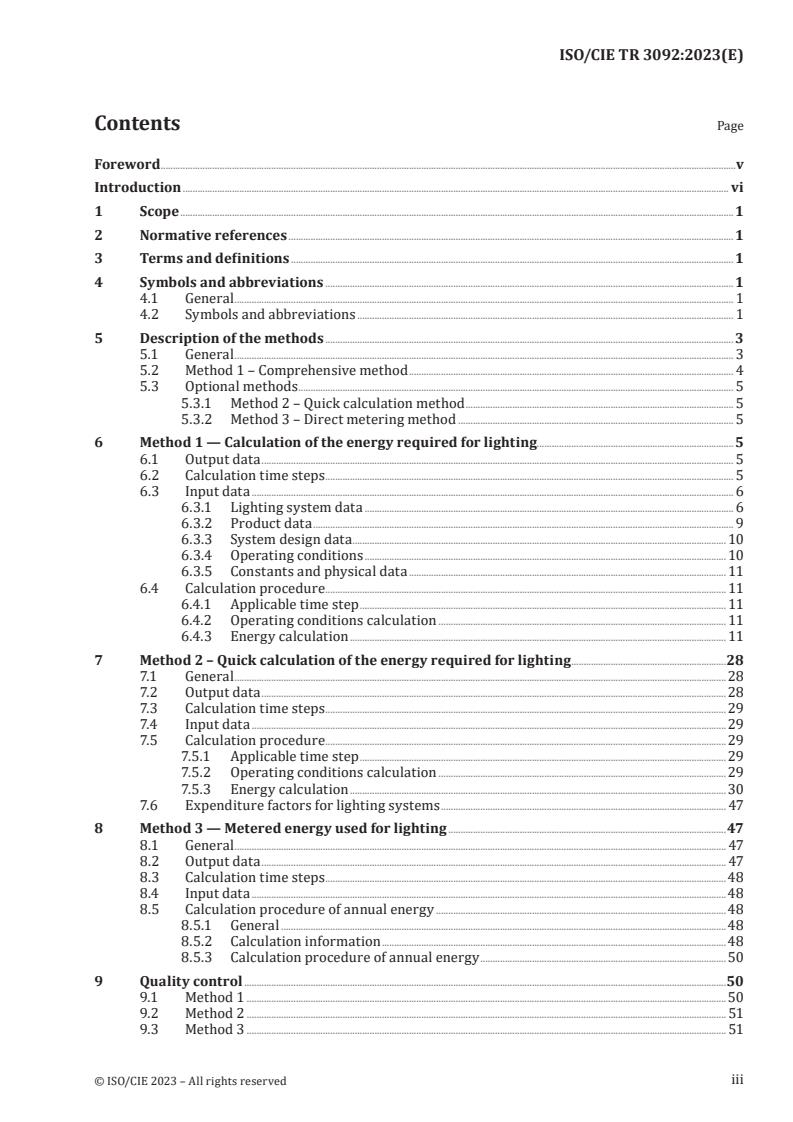
Contents Page
Foreword .v
Introduction . vi
1 Scope . 1
2 Normative references . 1
3 Terms and definitions . 1
4 Symbols and abbreviations .1
4.1 General . 1
4.2 Symbols and abbreviations . 1
5 Description of the methods . 3
5.1 General . 3
5.2 Method 1 – Comprehensive method . 4
5.3 Optional methods . 5
5.3.1 Method 2 – Quick calculation method . 5
5.3.2 Method 3 – Direct metering method . 5
6 Method 1 — Calculation of the energy required for lighting. 5
6.1 Output data . 5
6.2 Calculation time steps . 5
6.3 Input data . 6
6.3.1 Lighting system data . 6
6.3.2 Product data . 9
6.3.3 System design data . 10
6.3.4 Operating conditions . 10
6.3.5 Constants and physical data . 11
6.4 Calculation procedure . . 11
6.4.1 Applicable time step . 11
6.4.2 Operating conditions calculation . 11
6.4.3 Energy calculation . 11
7 Method 2 – Quick calculation of the energy required for lighting .28
7.1 General .28
7.2 Output data .28
7.3 Calculation time steps . 29
7.4 Input data .29
7.5 Calculation procedure . .29
7.5.1 Applicable time step .29
7.5.2 Operating conditions calculation .29
7.5.3 Energy calculation . 30
7.6 Expenditure factors for lighting systems . 47
8 Method 3 — Metered energy used for lighting .47
8.1 General . 47
8.2 Output data . 47
8.3 Calculation time steps .48
8.4 Input data .48
8.5 Calculation procedure of annual energy .48
8.5.1 General .48
8.5.2 Calculation information .48
8.5.3 Calculation procedure of annual energy .50
9 Quality control .50
9.1 Method 1 .50
9.2 Method 2 . 51
9.3 Method 3 . 51
iii
© ISO/CIE 2023 – All rights reserved
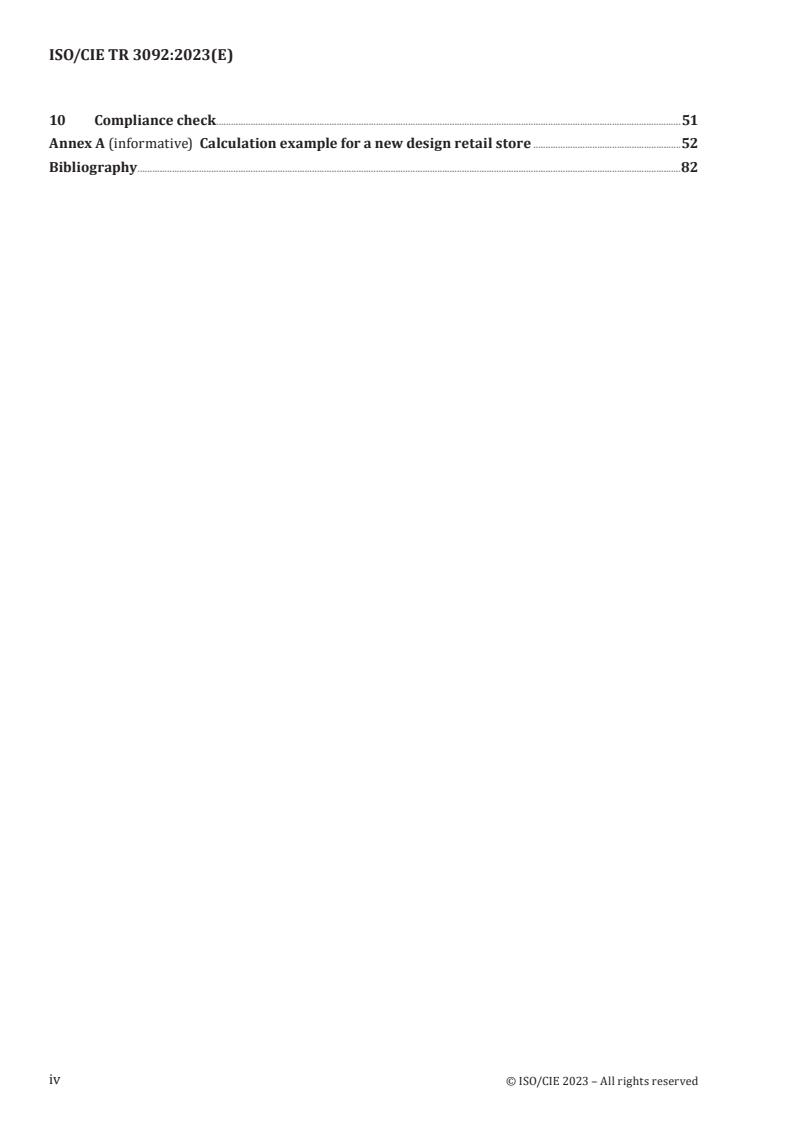
10 Compliance check .51
Annex A (informative) Calculation example for a new design retail store .52
Bibliography .82
iv
© ISO/CIE 2023 – All rights reserved
Foreword
ISO (the International Organization for Standardization) is a worldwide federation of national standards
bodies (ISO member bodies). The work of preparing International Standards is normally carried out
through ISO technical committees. Each member body interested in a subject for which a technical
committee has been established has the right to be represented on that committee. International
organizations, governmental and non-governmental, in liaison with ISO, also take part in the work.
ISO collaborates closely with the International Electrotechnical Commission (IEC) on all matters of
electrotechnical standardization.
The procedures used to develop this document and those intended for its further maintenance are
described in the ISO/IEC Directives, Part 1. In particular, the different approval criteria needed for the
different types of ISO document should be noted. This document was drafted in accordance with the
editorial rules of the ISO/IEC Directives, Part 2 (see www.iso.org/directives).
ISO draws attention to the possibility that the implementation of this document may involve the use
of (a) patent(s). ISO takes no position concerning the evidence, validity or applicability of any claimed
patent rights in respect thereof. As of the date of publication of this document, ISO had not received
notice of (a) patent(s) which may be required to implement this document. However, implementers are
cautioned that this may not represent the latest information, which may be obtained from the patent
database available at www.iso.org/patents. ISO shall not be held responsible for identifying any or all
such patent rights.
Any trade name used in this document is information given for the convenience of users and does not
constitute an endorsement.
For an explanation of the voluntary nature of standards, the meaning of ISO specific terms and
expressions related to conformity assessment, as well as information about ISO's adherence to
the World Trade Organization (WTO) principles in the Technical Barriers to Trade (TBT), see
www.iso.org/iso/foreword.html.
This document was prepared by Technical Committee ISO/TC 274, Light and lighting, in cooperation
with CIE Joint Technical Committee 6.
Any feedback or questions on this document should be directed to the user’s national standards body. A
complete listing of these bodies can be found at www.iso.org/members.html.
v
© ISO/CIE 2023 – All rights reserved
Introduction
It is important that lighting schemes are designed appropriately to provide the right light in the right
place at the right time, while being energy efficient and conforming to local, regional, and/or national
regulations. It is also important that the lighting systems are operated energy efficiently and managed
by suitable lighting control systems.
Carrying out a comprehensive lighting design (daylight and electric lighting) for new or refurbished
buildings will yield both effective and energy efficient lighting solutions that fulfil the lighting criteria
specified in the lighting application standards. The lighting design process will show how much daylight
will be available and how much electric lighting is needed and what scheme solutions will satisfy the
required lighting conditions during the occupied and unoccupied periods.
ISO/CIE 20086 gives a procedure to estimate the required energy and the energy efficiency of the
electric lighting scheme.
There is a risk that the purpose and limitations of ISO/CIE 20086 will be misunderstood, unless the
background and context to its content is explained in some detail to users. If this information would
have been placed in ISO/CIE 20086, the standard would be overloaded with informative content; and
the result is likely to be confusing and cumbersome, especially if ISO/CIE 20086 is referenced in local,
regional, or national building codes.
Therefore, this document accompanies ISO/CIE 20086 and provides informative content to support
the correct understanding, use and national implementation of the lighting standard. It also provides
explanation of the lighting energy calculation methodology and working calculation example of
integrated lighting control options. ISO/CIE 20086 defines the methods for estimating or measuring
the amount of energy required or used for lighting in buildings. The method of separate metering of the
energy used for lighting will also give regular feedback on the effectiveness of the lighting control. The
methodology of energy estimation not only provides values for the Lighting Energy Numeric Indicator
(LENI) but it will also provide input for the heating and cooling load estimations for the combined total
energy performance of building indicator.
LENI represents the absolute amount of energy required for a lighting scheme and does not directly
provide indications on the efficiency of the lighting technology employed. Therefore, a concept
of expenditure factors intending to render energy flows in lighting systems more transparent is
introduced in ISO/CIE 20086:2019, 6.5 and Annex E to complement LENI.
vi
© ISO/CIE 2023 – All rights reserved
TECHNICAL REPORT ISO/CIE TR 3092:2023(E)
Light and lighting — Energy performance of lighting in
buildings — Explanation and justification of ISO/CIE 20086
1 Scope
This document is a technical report supporting ISO/CIE 20086.
2 Normative references
The following documents are referred to in the text in such a way that some or all of their content
constitutes requirements of this document. For dated references, only the edition cited applies. For
undated references, the latest edition of the referenced document (including any amendments) applies.
ISO/CIE 20086:2019, Light and lighting — Energy performance of lighting in buildings
CIE S 017, ILV: International Lighting Vocabulary
3 Terms and definitions
For the purposes of this document, the terms and definitions given in ISO/CIE 20086, CIE S 017 and the
following apply.
ISO and IEC maintain terminology databases for use in standardization at the following addresses:
— ISO Online browsing platform: available at https:// www .iso .org/ obp
— IEC Electropedia: available at https:// www .electropedia .org/
CIE maintains a terminology database for use in standardization at the following address:
— e-ILV: available at https:// cie .co .at/ e -ilv
3.1
useful floor area
total gross floor area of all enclosed spaces, measured to the internal face of the external walls
Note 1 to entry: The total useful floor area can have a different value than the total floor area in the building.
4 Symbols and abbreviations
4.1 General
As given in CIE S 017, considering that LED technology has mostly replaced the conventional form of
lamps, the term “lamp” should be replaced with the more general term “light source” to follow changes
already introduced in some definitions of terms. However, as this document intends to accompany
ISO/CIE 20086, the terms and definitions used in this document are consistent with ISO/CIE 20086 by
using the term “lamp”. Still, whenever the term “lamp” is used in this document, it also refers to the
term “light source”.
4.2 Symbols and abbreviations
For the purposes of this document, the symbols given in ISO/CIE 20086 and the specific symbols listed
in Table 1 apply.
© ISO/CIE 2023 – All rights reserved
Table 1 — Symbols and units
Symbol Name of quantity Unit
A Total useful floor area in the building m
a Depth of daylight area m
D
b Width of the daylight area m
D
A Total useful floor area of the relevant zone or area m
i
A Sum of task areas within the room or zone m
s
D Daylight factor %
D Daylight factor of the raw building carcass opening %
CA
E Maintained illuminance on immediate surround of task area lx
sur
E Maintained illuminance on the task area lx
task
F Absence factor 1
A
F Constant illuminance dependency factor 1
c
F Correction factor for reduced power of area 1
CA
F Factor for the efficiency of the constant illuminance control 1
cc
F Daylight dependency factor 1
D
F Lighting control factor 1
D,C
F Daylight supply factor 1
D,S
F Correction factor for the light source efficiency 1
L
f Maintenance factor 1
m
F Correction factor for maintenance factor 1
CMF
a
f Lamp luminous flux maintenance factor 1
LLM
a
f Lamp survival factor 1
LS
a
f Luminaire maintenance factor 1
LM
a
f Room surface maintenance factor 1
RSM
F Occupancy dependency factor 1
O
F Controls function factor 1
OC
h Height of the window lintel above the floor m
Li
h Mounting height of luminaire m
m
H /H Luminous exposure ratio 1
dir glob
h Height of the task area above the floor m
Ta
I Room depth index 1
RD
I Shading index 1
Sh
I Transparency index 1
Tr
K Room index 1
L Time period at which x % of the measured initial luminous flux value is main- h
x
tained
L Length of room m
R
n Number of lamps in the luminaire 1
La
P Control standby power of luminaire i W
c,i
P Total emergency standby power W
em
P Emergency charging power of luminaire i W
e,i
P Power of luminaire i W
i
P Power density of area j W/m
j
a
The symbols for lamp luminous flux maintenance factor, lamp survival factor, luminaire maintenance factor and room
surface maintenance factor have changed according to CIE S 017 ILV and differ from ISO/CIE 20086.
© ISO/CIE 2023 – All rights reserved
TTaabblle 1 e 1 ((ccoonnttiinnueuedd))
Symbol Name of quantity Unit
P Illuminance-normalized power density of area j W/(m lx)
j,lx
P Total power of n luminaires W
n
P Total standby power for automatic lighting controls W
pc
P Declared (marked) lamp rated power W
r
Q Lighting energy numeric indicator (LENI) for a building kWh/m
LENI
Q Lighting energy numeric indicator for an area or relevant zone kWh/m
LENI,sub
t Battery charge time h
e
t Daylight time h
D
t Daylight absence time h
N
t Specified time step hour, month,
s
year
t Total operating hours h
tot
t Number of hours in a standard year h
y
W Total annual energy used for lighting kWh
W Annual energy required for lighting for an area or a zone kWh
az
W Total energy for illumination kWh
L,t
W Total metered energy used for electric lighting kWh
mt
W Total energy for standby kWh
P,t
W Energy used for lighting per time step kWh
t
W Standby energy density for automatic lighting controls per year kWh/m
pc
W Standby energy density for battery charging of emergency luminaires per year kWh/m
pe
W Width of the room or zone m
R
a
The symbols for lamp luminous flux maintenance factor, lamp survival factor, luminaire maintenance factor and room
surface maintenance factor have changed according to CIE S 017 ILV and differ from ISO/CIE 20086.
For the purposes of this document, the specific subscripts listed in Table 2 apply.
Table 2 — Subscripts
i Relevant element under consideration
or Month number, 1-12
j Relevant area under consideration
5 Description of the methods
5.1 General
ISO/CIE 20086 provides three methods for the assessment of the energy required for electric lighting
within buildings:
a) Method (1): comprehensive;
b) Method (2): quick calculation;
c) Method (3): direct metering (see figure 1).
These methods can provide the information on the electric energy required for lighting in the selected
time steps and the Lighting Energy Numeric Indicator (LENI) for the whole building, individual room
© ISO/CIE 2023 – All rights reserved
or zones. LENI can be used for comparison of similar buildings and as a measure of the lighting energy
performance of the building.
Methods (1) and (2) are based on calculations, and Method (3) is based on the direct metering of the
lighting circuit. The calculation methods [(1) and (2)] can be used during feasibility studies or detailed
design of new or refurbished buildings, and for the assessment of energy use in existing buildings by
first performing a lighting installation audit [(1)]. The metered Method (3) can only be used in existing
buildings that have segregated lighting circuits that include meters to facilitate direct metering of the
energy used for lighting only or a building management system that can measure lighting energy use.
Figure 1 — Flow chart illustrating alternative routes to determine energy use
In terms of the outcome for the installed power, occupancy estimation and daylight availability,
Method 1, which relies upon a comprehensive lighting design, is a more accurate calculation procedure
than Method 2, which provides a quick estimation based on default values used during pre-design.
Method 3 provides the actual energy use for lighting information; however, it can only be used for
existing buildings that are lighting end-use metered, commissioned and occupied.
5.2 Method 1 – Comprehensive method
Method 1 provides the most accurate calculation procedure as it relies upon a comprehensive lighting
scheme design that is based on real data of the specified products as the main input to the energy
calculation. This method can be used for new and refurbished buildings and for assessing existing
buildings where it involves a detailed audit of the existing lighting system to establish the installed
lighting load. The lighting energy (kWh) per time step (month or hour) normalized to an area unit
(m ) of the useful applicable zone area provides a sub-LENI value for the building zone. In a case of the
yearly time step, and for total useful building area, this is the total annual Lighting Energy Numeric
Indicator (LENI).
© ISO/CIE 2023 – All rights reserved
5.3 Optional methods
5.3.1 Method 2 – Quick calculation method
Method 2 is a simplified method that calculates the required lighting load and evaluates an impact of the
control's features using an approximation approach and a set of default data for new and refurbished
buildings at the conceptual project stage where no comprehensive lighting design has been completed.
Therefore, the calculation results in a preliminary lighting energy (kWh) per time step (year)
normalized to an area unit (m ) of the useful applicable building or zone area and gives the budget LENI
or sub-LENI value, respectively. This estimated energy budget in general is likely to be higher than
those obtained from the comprehensive design process and is recalculated for more accurate results
with real data when the more detailed and comprehensive lighting system design has been completed.
5.3.2 Method 3 – Direct metering method
Method 3 relies on the direct measurement of the energy used for lighting in buildings. It is ideal for
buildings where segregated lighting power circuits exist and separate energy meter has been installed.
This method gives true values of the energy used for lighting at any time intervals and the annual
value can also be used to calculate the LENI for the building. This method can be used to verify the
values obtained by calculations and to continuously monitor the energy used for lighting. It can also be
used where a building management system (BMS) allows energy use for lighting to be measured. It is
important that the segregated energy meters only record the energy used for lighting in any parts of
the building.
6 Method 1 — Calculation of the energy required for lighting
6.1 Output data
For the purposes of this document, the output data of Method 1 listed in Table 3 apply.
Table 3 — Output data of Method 1
Description Symbol Unit
Specified time step, e.g. hourly, monthly or annually t hour, month, year
s
Energy used for lighting (kWh) per time step (e.g. hourly,
W kWh
t
monthly or yearly) within rooms or zones
LENI is the area normalized annual energy used for lighting within the building [kWh/m ]. Method 3
(direct metering) provides the most accurate value of Q , while Method 1 (comprehensive) assesses
LENI
Q more accurate than Method 2 (quick calculation).
LENI
6.2 Calculation time steps
The time step for calculations is chosen consistently for the input and output data and can be:
— yearly – 8 760 h/year,
— monthly – 730 h/month, or
— hourly – 1 h, derived from the monthly calculated value divided by 730,
— with accordance to the time step of the input data.
The provided method for the estimation of the lighting energy demand is based on an annual approach.
Seasonal impacts can be considered with monthly correction factors, if available. Hourly values cannot
be derived in any correct correlation with climatic data. Accurate hourly calculation of the energy
required for lighting is not practical as there is no robust method for the prediction of the values of the
dependency factors.
© ISO/CIE 2023 – All rights reserved
This document takes an alternative way to link into the hourly calculation scheme of other parts of
the energy balance, such as internal loads for heat load calculation, by the average hourly value. The
average hourly value is obtained from the monthly calculated value divided by the hours (730) in the
month. For each month a constant (not variable) term will therefore be added as lighting energy to the
other hourly variable parts of the energy balance.
The reason for this restriction lies in modelling the impact of daylight. This requires a photometrically
correct three-dimensional calculation scheme of the light distribution outside entering through the
façades into the adjacent indoor spaces. Early simple approaches have been based on the determination
of the daylight factor (D) at a given inside position and an hourly multiplication with an estimate of the
outside illuminance to obtain the indoor illumination which then serves as the basis for estimating the
electric lighting needs. As the daylight factor is defined for a CIE overcast sky only (fixed uncommon
outside luminance distribution), multiplication of the daylight factor with general outside illuminance
values as derived from real weather data (including clear, sunny and partially overcast conditions) led
to significant and not tolerable errors. Moreover, the daylight factor method does not allow accounting
for any sun shading devices, which are mandatory in today’s rating methods. Simplified methods
to cope on an hourly basis – without the use of photometric algorithms – with the versatile outside
luminance distribution and complex light transmission through façade elements like different sun-
shading systems so far do not exist.
Therefore, rating the impact of daylight nowadays has been accounted for in such a way, that monthly
and annual detailed simulation runs with photometrical exact sky and room models have been
performed with lighting simulation software for a representative set of room geometries, sun-shading
devices and locations. Regression models (analytical and tabular) have been derived from these detailed
simulation results, allowing the annual and monthly impact of daylight penetration through the façade
to be estimated without the need of using detailed computer tools, and with a higher accuracy than the
former D (Daylight Factor) method and allowing to incorporate not only simple glazing systems but
also sun-shading and light redirection devices.
Generally, selecting a calculation step that is smaller than necessary, makes application more complicated
as the occupation profiles and other input parameters for hourly calculation are considerably more
detailed. As monthly or even annual balancing methods would be sufficiently precise for all balancing
applications, a monthly balancing procedure approach enhances the acceptance and user-friendliness
of ISO/CIE 20086.
Nevertheless, if deemed necessary, the direct usage of detailed lighting simulation software on an
hourly basis is always possible but with associated higher expenses (modelling and calculation time).
No reliable method can be recommended to break down the monthly period values into hourly time
steps. This implies that the overall general hourly method cannot properly represent energy flows in
the building on hourly time steps.
6.3 Input data
6.3.1 Lighting system data
6.3.1.1 General
The comprehensive method (Method 1 of ISO/CIE 20086) makes the energy estimation based upon the
lighting design scheme, including lighting controls with their protocols, that is fully developed based on
the requirements specified in the lighting application standards (i.e. ISO 8995-1/CIE S 008 for lighting
of indoor work places and ISO 30061/CIE S 020 for emergency lighting)”). ISO/CIE 20086 also highlights
the importance of the available daylight and electric light combination for fulfilling the requirements
of ISO 8995-1/CIE S 008 and the general and specific lighting criteria for all places within the buildings.
© ISO/CIE 2023 – All rights reserved
The following relevant input data and details for each room and zone of the building are based on the
lighting design scheme (for new or refurbished buildings) or on the lighting survey results (for existing
buildings):
— types of luminaires identified by a unique product reference code;
— quantities of each specific type of luminaire;
— luminaires which respond to daylight (e.g. Manual, Automated/Dimmed, Automated/switched)
to control the artificial light, when located in an A area (i.e. those close to windows). In these
D
areas the daylight parameter D . is calculated;
ca,j
— luminaires which respond to occupancy (e.g. Manual On/Off switch, Manual On/Off
switch + additional automatic sweeping extinction signal, Auto on/Dimmed, Auto on/Auto off,
Manual on/Dimmed, Manual on/Auto Off);
— control technique and device types;
— Efficiency Factor of Constant Illuminance Control, F (F calculated from f and F );
CC C m CC
— maintenance factor ( f ) assumed in the design or defined by the maintenance schedule (for each
m
room and/or area);
— dominant building type;
— latitude;
— longitude;
— luminous exposure H /H ;
dir glob
— shading system solution (shading type/s) for rooms/areas;
— shading obstructing context (shading index/s);
— daylight time t ;
D
— daylight absence time t ;
N
— maintained illuminance of zone (lx) (E );
task
— occupancy, F (for each room and/or area);
O
— users absence factor, F (for each room and/or area);
A
— window/rooflight/atrium properties;
— zone properties: set the properties of the zone.
6.3.1.2 New or refurbished building lighting system
The completion of the lighting design process will produce the lighting solution, the required lighting
scheme and the product schedule. The lighting solution will give the specification details of the required
luminaire types, including maintenance factors; and the lighting control system. There can be several
types of luminaires in the scheme, each performing specific functions from a specific mounting position.
The luminaire types could only be used for illumination, but some could also contain components
to provide emergency lighting. The luminaires usually have embodied components to make them
controllable by receiving signals from remotely mounted or in-built detectors and/or from a central
control system. Each luminaire type will have a unique product reference code (luminaire type) for
clear identification.
© ISO/CIE 2023 – All rights reserved
The information on the type and number of luminaires used in a zone, room or building and the type of
controls is a prerequisite to form the input data for estimating the energy requirements for lighting. An
example of how the lighting system data can be set out is shown in Table 4 below.
Table 4 — Example of the luminaire schedule
Luminaire Luminaire product
Area Quantity Control type/Operation technique
ID/type number
Reception/Main DALI Dimmable, Daylight and Occu-
L1 ABC32830WH 18
Lobby 1011 pancy linked
DALI Dimmable, Daylight and Occu-
Reception/Main
L1E ABC32830WHEM 4 pancy detectors linked, Emergency
Lobby 1011
battery
DALI, Integrated occupancy detector,
Stairways S1-S8 L4E AABB14D8402EBOS 48 10-50-100 % step-dimmable driver,
Emergency battery
DALI Dimmable, Daylight and Occu-
Open office 2012 L12 SSS96W35 60
pancy detectors linked
6.3.1.3 Existing building lighting system
Method 1 is suitable for existing buildings that already have installed lighting systems. In this method,
a lighting audit according to ISO 50001 or ISO 50002 is carried out in the building to establish the type
and numbers of luminaires installed and the power rating of each luminaire type.
The audit includes the identification of the luminaire types in use, counting the number of each
luminaire type and recording the data information on the product label. Ideally the luminaire label
contains the manufacturer’s name, luminaire code and the technical information (light source type,
number of light sources and their power rating). If the power of luminaire (P ) is not shown on the label,
i
this ideally can be obtained from the manufacturer’s data sheet for the luminaire. If the label is not
readable, then the characteristics could be established by noting and recording the number, rating and
type of light sources used in the luminaire from which the power of luminaire (P ) can be calculated.
i
The information and data obtained will form the input to the energy estimation process. Once the
installed lighting load is established, the calculation procedure of the lighting energy requirement
described in Method 1 can be followed. The output of Method 1 is
— specified time step, e.g. hourly, monthly or annually,
— energy used for lighting (in kWh) per time step (e.g. hourly, monthly or annually) within rooms or
zones,
as described in ISO/CIE 20086:2019, 6.1.
Method 1 is also applicable for buildings that already have lighting controls or where it is planned to
add such controls. The standby power for emergency lighting and/or having lighting controls in the
lighting system can similarly be obtained from the manufacturer’s data sheets; however, for the case
that such data are not available, default values are indicated in ISO/CIE 20086:2019, Table A.1, shown
here in Table 5.
© ISO/CIE 2023 – All rights reserved
Table 5 — Standby energy density
a
Purpose Symbol Default annual energy density
kWh/m
Standby energy for battery charging of emergency
W 1
pe
luminaires per year
Standby energy for automatic lighting controls per
W 1,5
pc
year
a
Default values according to ISO/CIE 20086:2019, Table A.1
The calculation procedure for lighting energy assessment in existing buildings is described in
ISO/CIE 20086:2019, Annex C and the schedule of luminaires can be presented as shown in Table 4
above.
6.3.2 Product data
6.3.2.1 General
See 6.3.2.3.
6.3.2.2 Luminaire description data (qualitative)
See 6.3.2.3.
6.3.2.3 Luminaire technical data
For each place and for each luminaire type specified in the lighting scheme, the electrical data as
shown in the example Table 6 to Table 9 are obtained from the manufacturer’s product information
sheet or from the lighting audit. The product description provides the information on the luminaire
characteristics and functional capabilities regarding dimming control, integral or remotely connected
detectors and emergency lighting facility.
Table 6 — Luminaire identification
Code Description
The power of luminaire i, P in Table 7 is the total circuit power supplied to the luminaire with the light
i
source and the controls operating and charge power supplied to the emergency batteries. The control
standby power of luminaire i, P in Table 8 and the emergency charging power of luminaire i, P in
c,i e,i
Table 9 are measured with the light sources in the luminaire switched off. ISO/CIE 20086 requires that
all the luminaire power values listed in the Table 6 to Table 9 are declared by the lighting equipment
manufacturer based on the certified testing in accordance with the relevant product standard.
Table 7 — Power of luminaire i (P )
i
Code Power, W
Table 8 — Power of luminaire i (P )
c,i
Code Power, W
© ISO/CIE 2023 – All rights reserved
Table 9 — Emergency charging power of luminaire i (P )
e,i
Code Power, W
Alternatively, the required power data can be presented in an assembly way as shown in Table 10.
Table 10 — Luminaire data example table
Luminaire Control standby power of Emergency charging power of
Power of luminaire i
ID/type luminaire i luminaire i
P P P
i c,i e,i
W W W
L1 38,4 1,4 0,0
L1E 39,0 1,4 0,6
L4E 19,4 1,4 0,9
L12 49,4 1,4 0,0
If the control standby power of luminaire i and/or the emergency charging power of luminaire i
information is not available from the manufacturer, then the default standby energy (kWh/m ) values
given in Table 5 (resp. ISO/CIE 20086:2019, Table A.1) can be used in calculations.
For existing buildings, the data gathered during the lighting audit can be organized into Table 6 to
Table 9. However, if the power of luminaire i, P is not known, then the lamp rated power can be used, but if
i
the lamp use ballasts or drivers, the power of luminaire i is corrected according to ISO/CIE 20086:2019,
Formula (C.3):
PP=12,· ·n (1)
i rLa
where
n is the number of lamps in the luminaire;
La
P is the lamp rated power.
r
6.3.3 System design data
The required system design data for each zone, room or building will consist of the details, dimensions
and function of the building or place and the functional characteristics of the controls and the power
ratings of the elements in the electric lighting system. The data permits calculation of the values of the
installed lighting power, P , P , and P and the various dependency factors: occupancy dependency
n em pc
factor F , daylight dependency factor F and constant illuminance dependency factor F for the place.
O D c
The results are presented as shown in the following example in Table 11:
Table 11 — System design data
Area Code F F F P P P
O D c n em pc
Office 202 0,90 0,35 0,91 1 618 22 4,6
The required information and the calculation process involved is provided in detail in
ISO/CIE 20086:2019, Annex D, Annex E and Annex F. The results of the calculations will show the
amount of energy that can be saved using lighting controls.
6.3.4 Operating conditions
The operating conditions are largely determined by the activity in the space, flexibility of the lighting
system and the appropriateness of the lighting controls. Only operating the electric lights when there
© ISO/CIE 2023 – All rights reserved
are occupants in the area and when there is insufficient daylight available to fulfil the illumination
criteria minimizes the amount of energy used for lighting. It is accepted that the electric lighting
system has been designed to provide the full lighting requirements in accordance with the relevant
lighting application standards (e.g. ISO/CIE 8995-1 and ISO 30061/CIE S 008) for the area without
daylight at any time. To then use the electric lighting only to compensate the available daylight to the
design conditions and only when the area is occupied, a well-designed lighting control system is an
essential part of the lighting solution. The controls are manually or automatically operated. The details
of some control types and their operation and effectiveness can be found in CIE 222 and CEN/TR 15193-
2:2017, Annex K. In addition, the occupancy and activity patterns are prerequisite as basis to allow the
evaluation of t and t for each area of a zone or building. This information is presented as shown in the
D N
example of Table 12 below.
Table 12 — Times for operating conditions
Area Code t t
D N
Office 202 2 271 75
6.3.5 Constants and physical data
The number of hours in a standard year (t ) is defined as 8 760 h.
y
6.4 Calculation procedure
6.4.1 Applicable time step
According to ISO/CIE 20086:2019, 6.2, the calculation procedure can be used with the yearly, monthly,
or hourly time steps.
The time steps are intended for a procedure which considers steady data for each time interval where
each single combination of parameters is used for the calculation (e.g. daylight availability time and
daylight absence time, etc.).
6.4.2 Operating conditions calculation
If no accurate data are available for daylight time and daylight absence time, the default values of t , and
D
t as provided in ISO/CIE 20086:2019, Table A.2 and F as provided in ISO/CIE 20086:2019, Table A.6
N A
can be used. The occupancy schedules are based on documented assumptions for each space type or
activity area (e.g. circul
...