


ISO 26871:2020
(Main)Space systems — Explosive systems and devices
Space systems — Explosive systems and devices
This document specifies criteria and requirements for the use of explosive systems and explosive devices commonly used on spacecraft and other space products, including launch vehicles and space vehicle systems. It addresses the aspects of design, analysis, verification, manufacturing, operations and safety. To the greatest extent possible, requirements from past and existing standards have been analyzed, selected and tailored to be incorporated herein. In addition, the requirements herein include those generated as a result of lessons learned from launch and space vehicle programs. NOTE Specific requirements for man-rating are not addressed.
Systèmes spaciaux — Dispositifs et equipements explosifs
General Information
Relations
Standards Content (Sample)
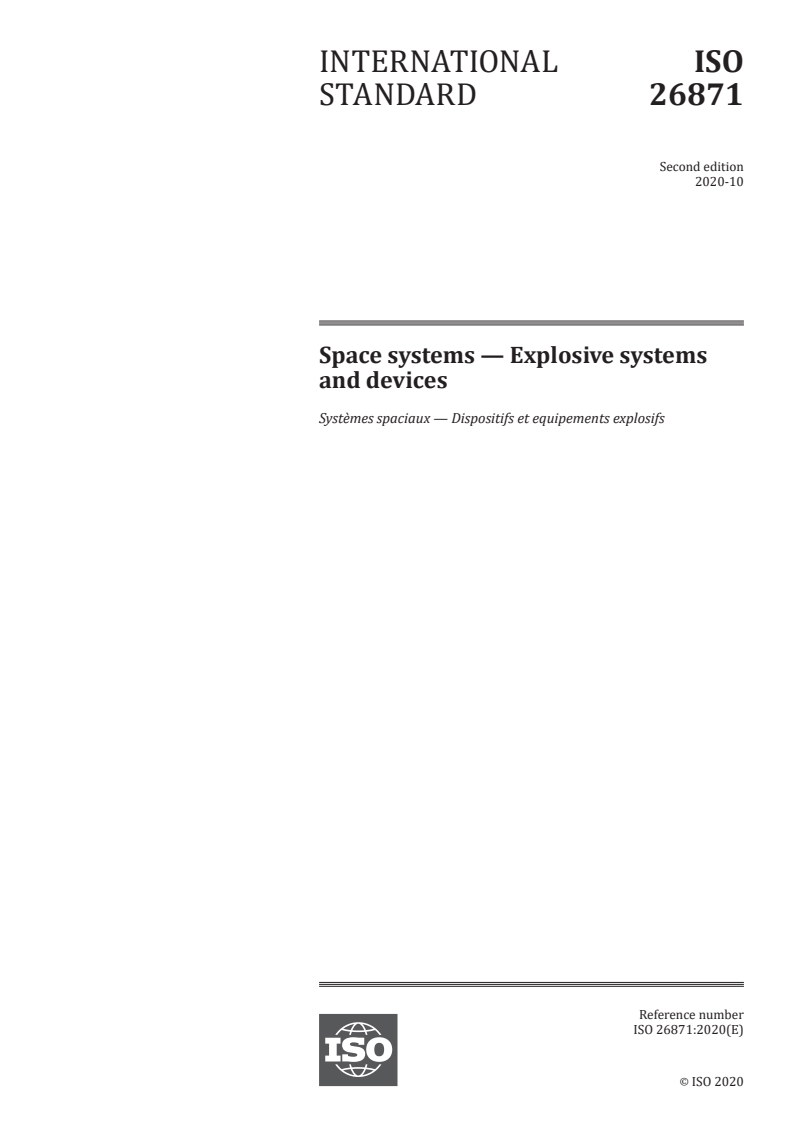
INTERNATIONAL ISO
STANDARD 26871
Second edition
2020-10
Space systems — Explosive systems
and devices
Systèmes spaciaux — Dispositifs et equipements explosifs
Reference number
©
ISO 2020
© ISO 2020
All rights reserved. Unless otherwise specified, or required in the context of its implementation, no part of this publication may
be reproduced or utilized otherwise in any form or by any means, electronic or mechanical, including photocopying, or posting
on the internet or an intranet, without prior written permission. Permission can be requested from either ISO at the address
below or ISO’s member body in the country of the requester.
ISO copyright office
CP 401 • Ch. de Blandonnet 8
CH-1214 Vernier, Geneva
Phone: +41 22 749 01 11
Email: copyright@iso.org
Website: www.iso.org
Published in Switzerland
ii © ISO 2020 – All rights reserved
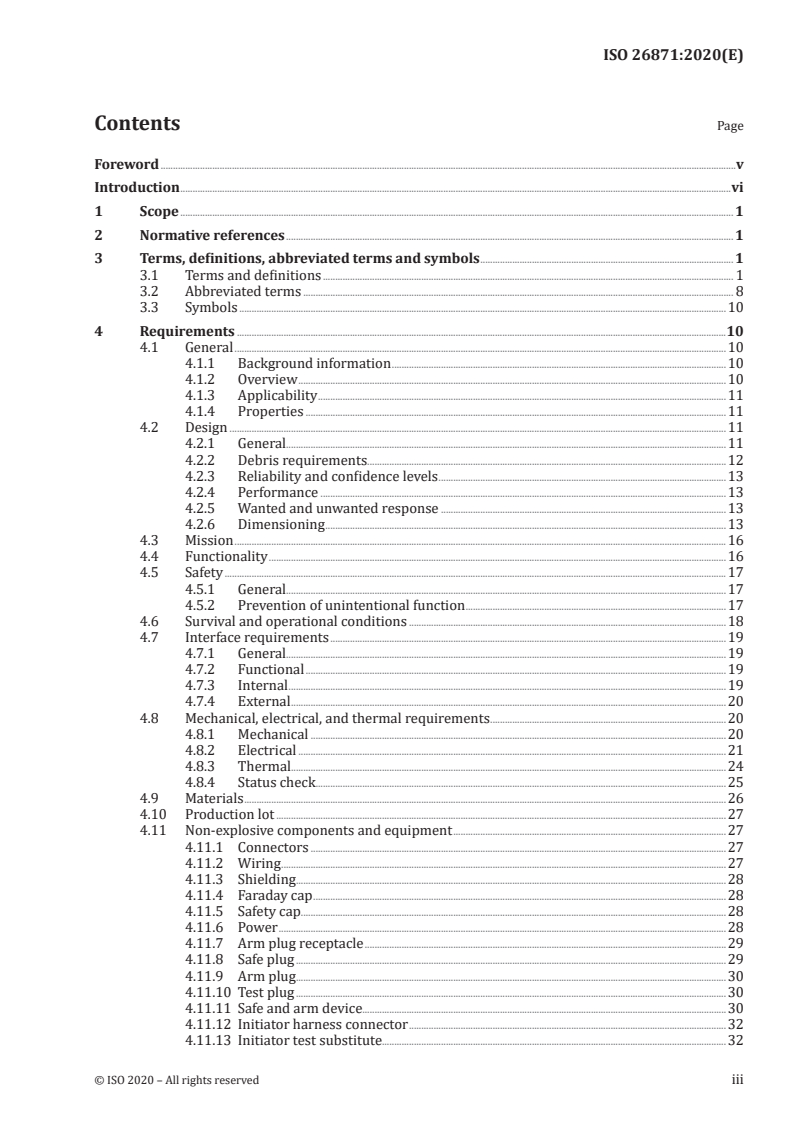
Contents Page
Foreword .v
Introduction .vi
1 Scope . 1
2 Normative references . 1
3 Terms, definitions, abbreviated terms and symbols . 1
3.1 Terms and definitions . 1
3.2 Abbreviated terms . 8
3.3 Symbols .10
4 Requirements .10
4.1 General .10
4.1.1 Background information .10
4.1.2 Overview .10
4.1.3 Applicability .11
4.1.4 Properties .11
4.2 Design .11
4.2.1 General.11
4.2.2 Debris requirements.12
4.2.3 Reliability and confidence levels .13
4.2.4 Performance .13
4.2.5 Wanted and unwanted response .13
4.2.6 Dimensioning .13
4.3 Mission .16
4.4 Functionality .16
4.5 Safety .17
4.5.1 General.17
4.5.2 Prevention of unintentional function .17
4.6 Survival and operational conditions .18
4.7 Interface requirements .19
4.7.1 General.19
4.7.2 Functional .19
4.7.3 Internal .19
4.7.4 External .20
4.8 Mechanical, electrical, and thermal requirements .20
4.8.1 Mechanical .20
4.8.2 Electrical .21
4.8.3 Thermal.24
4.8.4 Status check.25
4.9 Materials .26
4.10 Production lot .27
4.11 Non-explosive components and equipment .27
4.11.1 Connectors .27
4.11.2 Wiring .27
4.11.3 Shielding.28
4.11.4 Faraday cap .28
4.11.5 Safety cap.28
4.11.6 Power .28
4.11.7 Arm plug receptacle .29
4.11.8 Safe plug .29
4.11.9 Arm plug . .30
4.11.10 Test plug .30
4.11.11 Safe and arm device.30
4.11.12 Initiator harness connector .32
4.11.13 Initiator test substitute.32
4.12 Explosive components .32
4.12.1 General.32
4.12.2 Initiators, cartridges, detonators and packaged charges .33
4.12.3 Through-Bulkhead initiators .38
4.12.4 Integral initiator connectors .38
4.12.5 Transfer devices .39
4.12.6 Safe and arm devices containing explosive .40
4.12.7 Gas generators .41
4.12.8 Shaped charges.41
4.12.9 Expanding tube separation system .42
4.12.10 Distribution boxes .43
4.12.11 Explosive delays .44
4.13 Explosively actuated devices .45
4.13.1 General.45
4.13.2 Separation nuts and separation bolts .46
4.13.3 Pullers .47
4.13.4 Pushers (Thrusters) .48
4.13.5 Cutters .48
4.13.6 Pyro-valves .49
4.14 Items external to the flight equipment .50
4.14.1 GSE .50
4.14.2 Test equipment .50
4.14.3 Launch site .50
4.15 Verification .50
4.15.1 General.50
4.15.2 Inspection .50
4.15.3 Tests .51
4.15.4 Qualification and lot acceptance .53
4.16 Transport, facilities, handling and storage .56
4.16.1 General.56
4.16.2 Transport .56
4.16.3 Facilities . .57
4.16.4 Handling and storage .57
4.17 In-service .58
4.17.1 Information feedback .58
4.17.2 Launch site procedures .58
4.17.3 Monitoring .58
4.18 Product assurance .58
4.18.1 General.58
4.18.2 Dependability .58
4.18.3 Assembly integration and tests .58
4.19 Deliverables .59
Annex A (normative) Loads and factors of safety relationship .61
Annex B (normative) Factors of safety .63
Annex C (informative) Explosive component colour code .64
Annex D (informative) Component qualification test levels to be customized to the space
system considered .65
Annex E (informative) Product user manual (PUM/UM) — DRD .67
Annex F (informative) Safety data sheet .73
Bibliography .77
iv © ISO 2020 – All rights reserved
Foreword
ISO (the International Organization for Standardization) is a worldwide federation of national standards
bodies (ISO member bodies). The work of preparing International Standards is normally carried out
through ISO technical committees. Each member body interested in a subject for which a technical
committee has been established has the right to be represented on that committee. International
organizations, governmental and non-governmental, in liaison with ISO, also take part in the work.
ISO collaborates closely with the International Electrotechnical Commission (IEC) on all matters of
electrotechnical standardization.
The procedures used to develop this document and those intended for its further maintenance are
described in the ISO/IEC Directives, Part 1. In particular, the different approval criteria needed for the
different types of ISO documents should be noted. This document was drafted in accordance with the
editorial rules of the ISO/IEC Directives, Part 2 (see www .iso .org/ directives).
Attention is drawn to the possibility that some of the elements of this document may be the subject of
patent rights. ISO shall not be held responsible for identifying any or all such patent rights. Details of
any patent rights identified during the development of the document will be in the Introduction and/or
on the ISO list of patent declarations received (see www .iso .org/ patents).
Any trade name used in this document is information given for the convenience of users and does not
constitute an endorsement.
For an explanation of the voluntary nature of standards, the meaning of ISO specific terms and
expressions related to conformity assessment, as well as information about ISO's adherence to the
World Trade Organization (WTO) principles in the Technical Barriers to Trade (TBT), see www .iso .org/
iso/ foreword .html.
This document was prepared by Technical Committee ISO/TC 20, Aircraft and space vehicles,
Subcommittee SC 14, Space systems and operations.
This second edition cancels and replaces the first edition (ISO 26871:2012), which has been technically
revised.
The main changes compared to the previous edition are as follows:
— simplification for some requirements;
— updating terminology;
— introduction of a paragraph about debris issues.
Any feedback or questions on this document should be directed to the user’s national standards body. A
complete listing of these bodies can be found at www .iso .org/ members .html.
Introduction
0.1 Background
The evolution of this document is motivated by changes inputted by the last issue of 2 main mother
[1],[2]
documents .
0.2 Tailoring
This document may be tailored, by the contractor, in consultation with the procuring authority, for the
specific characteristics and constraints of a space project.
Tailoring is a process by which individual requirements or specifications, standards, and related
documents are evaluated and made applicable to a specific program or project by selection, and in some
cases, modification and addition (e.g., for manned spaceflight) of requirements in the standards.
However, the tailored requirements may achieve a level of verification equivalent to the baseline
described herein. Rationale for each tailored requirement may be established. If the requirements in
this document are not tailored by a contract, they stand as written.
This document will be updated and revised periodically, each five years as appropriate to incorporate
technological advances and innovations as well as lessons learned.
vi © ISO 2020 – All rights reserved
INTERNATIONAL STANDARD ISO 26871:2020(E)
Space systems — Explosive systems and devices
IMPORTANT — The electronic file of this document contains colours which are considered to be
useful for the correct understanding of the document. Users should therefore consider printing
this document using a colour printer.
1 Scope
This document specifies criteria and requirements for the use of explosive systems and explosive
devices commonly used on spacecraft and other space products, including launch vehicles and space
vehicle systems. It addresses the aspects of design, analysis, verification, manufacturing, operations
and safety.
To the greatest extent possible, requirements from past and existing standards have been analyzed,
selected and tailored to be incorporated herein. In addition, the requirements herein include those
generated as a result of lessons learned from launch and space vehicle programs.
NOTE Specific requirements for man-rating are not addressed.
2 Normative references
The following documents are referred to in the text in such a way that some or all of their content
constitutes requirements of this document. For dated references, only the edition cited applies. For
undated references, the latest edition of the referenced document (including any amendments) applies.
ISO 14300-1, Space systems — Programme management — Part 1: Structuring of a project
ISO 24113, Space systems — Space debris mitigation requirements
3 Terms, definitions, abbreviated terms and symbols
3.1 Terms and definitions
For the purposes of this document, the following terms and definitions apply.
ISO and IEC maintain terminological databases for use in standardization at the following addresses:
— ISO Online browsing platform: available at https:// www .iso .org/ obp
— IEC Electropedia: available at http:// www .electropedia .org/
3.1.1
actuator
component (3.1.10) that performs the moving function of a mechanism
Note 1 to entry: An actuator can be either an electric motor, or any other mechanical (e.g. spring) or electric
component or part providing the torque or force for the motion of the mechanism.
3.1.2
all-fire level
lowest level of the fire stimulus (including rise time, shape, duration), which results in initiation of a
first element (initiator) (3.1.36) within a specific reliability and confidence level as determined by test
and analysis
Note 1 to entry: The stimulus duration shall be compliant with the system.
Note 2 to entry: The test sequence should be carried out at the lowest temperature of the operating range.
Note 3 to entry: The probability of functioning should be equal to or better than 0,999 at the 95 % confidence level.
3.1.3
armed
status of an explosive subsystem, when all the safety devices have been disabled and which is able
to trigger
3.1.4
auto-ignition
spontaneous explosive reaction of energetic materials (3.1.19) in an explosively loaded device due to
exposure to environments or interfacing materials
3.1.5
bridgewire
resistive element incorporated into the first element (3.1.30) that converts electrical energy into heat or
shock to cause initiation of an explosive charge (3.1.8)
3.1.6
cartridge
explosive device designed to produce pressure for performing a mechanical function or actuate a
mechanical device
Note 1 to entry: A cartridge is called an initiator (3.1.36) if it is the first or only explosive element in an explosive
train (3.1.28).
3.1.7
catastrophic failure
failure which results in the loss of human life, mission or a major ground facility, or long-term
detrimental environmental effects
3.1.8
charge
explosive (3.1.23) loaded in a cartridge (3.1.6), detonator (3.1.14) or separate container for use in an
explosive device
3.1.9
closed bomb
fixed volume test chamber to measure output characteristics of pressure producing devices
3.1.10
component
set of materials, assembled according to defined and controlled processes, which cannot be disassembled
without destroying its capability and which performs a simple function that can be evaluated against
expected performance requirements
Note 1 to entry: The term “part” is preferred when referring to purely mechanical or explosive devices.
Note 2 to entry: The term “component” is preferred for EEE devices.
3.1.11
cook-off temperature
maximum temperature to which an explosively loaded device can be exposed for a period of one hour
without reaction
Note 1 to entry: The determination of the cook-off temperature is time and application dependent.
3.1.12
deflagration
chemical decomposition propagating through the explosive (3.1.23) at a subsonic velocity
2 © ISO 2020 – All rights reserved
3.1.13
detonation
chemical decomposition propagating through the explosive (3.1.23) at a supersonic velocity such that a
shock wave is generated
3.1.14
detonator
initiator (3.1.36) whose function is to transform external energy (e.g., mechanical, electrical, thermal)
directly into a shock wave strong enough to detonate a secondary high explosive (3.1.34)
Note 1 to entry: Detonators are generally used to effect detonation (3.1.13) transfers within explosive trains
(3.1.28).
3.1.15
duding
explosive charge (3.1.8) or component (3.1.10) that fails to fire or function upon receipt of the prescribed
initiating stimulus, after an external effect (human failure, manufacturing failure, environmental,
chemical, ageing, etc.)
3.1.16
electro-explosive device
EED
first element (3.1.30) of an explosive train (3.1.28): initiator (3.1.36) electrically actuated, which has
a bridgewire (3.1.5) to transform electrical energy inputted into a reaction of the mixture used (e.g.,
explosive (3.1.23) or pyrotechnics (3.1.47))
Note 1 to entry: The output of the initiation is heat, shock or mechanical action, see 3.1.13.
3.1.17
electrostatic discharge
ESD
transfer of electrostatic charge (3.1.8) between objects at different potentials caused by direct contact
or induced by an electrostatic field
3.1.18
end user
person who, or organization that, actually uses a product
Note 1 to entry: The end user may not to be the owner or buyer.
3.1.19
energetic material
material containing, an explosive (3.1.23), oxidizer, fuel or combination of them, that can undergo,
contribute to, or cause rapid exothermic decomposition such as: combustion, deflagration (3.1.12) or
detonation (3.1.13)
3.1.20
expanding tube separation system
separation system that emits no contamination and that includes detonating cord in a ductile metal
tube and a structure containing geometrically controlled stress risers
3.1.21
exploding bridgewire device
EBW
high voltage device in which the bridgewire (3.1.5) explodes when functioned
3.1.22
exploding foil initiator
EFI
high voltage device that generates a supersonic flyer plate when functioned
3.1.23
explosive
material which is capable of undergoing an explosion when subjected to heat, impact, friction, detonation
(3.1.13) or other suitable initiation
3.1.24
explosively actuated device
mechanism that converts the products of explosion (combustion, deflagration (3.1.12) or detonation
(3.1.13)) into useful mechanical work
Note 1 to entry: Pyro-mechanisms and linear detonating separation devices are explosively actuated devices.
3.1.25
explosive component
any discrete item containing an explosive substance
3.1.26
explosive function
any function that uses energy released from explosive substances for its operation
3.1.27
explosive system
collection of all the explosive trains (3.1.28) on the spacecraft (3.1.60) or launcher (3.1.38) system, and
the interface aspects of any on-board computers, launch operation equipment, ground support and test
equipment and all software associated with explosive functions (3.1.26)
3.1.28
explosive train
ET
series of explosive components (3.1.25) that transfer explosive signal from the first element (3.1.30) to
the final explosively actuated device (3.1.24)
3.1.29
extreme envelope
positive margin over the conditions of the qualification envelope
Note 1 to entry: The device or system design is based on the conditions that define the extreme envelope.
3.1.30
first element
initial element of an explosive system (3.1.27) that converts electrical, optical, or mechanical energy to
explosive energy
3.1.31
fail operational
mission capable after one failure
3.1.32
fail safe
design property of a system/subsystem (or part of it), which prevents its failures from resulting in
critical or catastrophic consequences (i.e. remain safe (3.1.50) after one failure)
Note 1 to entry: Maintaining safety following two independent failures is referred to “fail safe – fail safe”.
3.1.33
gas generator
explosive device wherein pyro charge (3.1.8), as a result of chemical reaction, is converted in gaseous
products of reaction or exothermic output, or both
4 © ISO 2020 – All rights reserved
3.1.34
high explosive
HE
any chemical material in which the fuel and oxidizer are contained in the same molecule, the
decomposition of which is a detonation (3.1.13)
3.1.35
hot bridgewire device
HBW
low voltage EED (3.1.16)
3.1.36
initiator
first explosive element in an explosive train (3.1.28) which, upon receipt of the proper mechanical,
optical or electrical impulse, produces a deflagrating or detonating action
Note 1 to entry: The initiator is divided into three categories: 1) igniter, a first element whose output is hot
gases and hot particles (igniters may be initiators for solid or liquid propellant (3.1.45)); 2) squib, a first element
whose output is primarily gas and heat (squibs may be initiators for gas generators (3.1.33) and igniters or may
be cartridges (3.1.6) for actuated devices); 3) detonator, a first element whose output is a high-order detonation
(3.1.13) (detonators (3.1.14) are generally used to effect detonation transfers within explosive trains).
Note 2 to entry: The deflagrating or detonating action is transmitted to the elements following in the train.
Note 3 to entry: Initiators can be electrically (EEDs (3.1.16)), optically or mechanically actuated.
3.1.37
laser initiated device
LID
first element (3.1.30) containing explosives (3.1.23) that is ignited by laser energy
3.1.38
launcher
launch vehicle
vehicle designed to transport payloads to space
3.1.39
lifetime
period over which any properties are required to be within defined limits
3.1.40
lot
batch
group of components (3.1.10) produced in continuous, without uninterrupted production run, with no
change in process or drawings
3.1.41
lot acceptance
demonstration by measurement or test that a lot (3.1.40) of items meet its requirements
3.1.42
no-fire level
maximal level of input energy with an ignition stimulus (including nominal rise time and shape as
required by the system, but with a 5 min extended duration), to a first element (initiator) (3.1.36) at
which initiation will not occur within a specific reliability and confidence level as determined by test
and analysis
Note 1 to entry: The test sequence should be carried out at the hottest temperature of the operating range.
Note 2 to entry: The probability of functioning should be less than or equal to 0,001 at the 95 % confidence level.
Note 3 to entry: A first element tested at this level shall remain safe (3.1.50) and functional and shall guarantee
the level of performances required after the no-fire level test.
3.1.43
packaged charge
explosive material in a closed container
3.1.44
primary explosive
reaction extremely sensitive explosive material that will detonate in response to normal
environmental stimuli
Note 1 to entry: In their intended role, these materials are sensitive to a range of thermal, mechanical and
electrical stimuli, including exposures during processing.
3.1.45
propellant
deflagrating explosive material whose output is essentially gaseous
3.1.46
pyro-mechanism
device intended to perform one or more mechanical actions, using the energy produced by the reaction
of an energetic material (3.1.19)
3.1.47
pyrotechnics
mixture of fuels and oxidizers that can deflagrate
3.1.48
pyrotechnic device
basic pyrotechnic object (from explosive train (3.1.28) or explosive device) containing explosive
substances and intended to perform an initiation (e.g., ignition, priming), a pyrotechnic effect
transmission, amplification effect, or generation of a function
3.1.49
refurbish
replace components (3.1.10) or elements in an explosive device or system to maintain reliability or
extend service life (3.1.58)
3.1.50
safe
property of an item and its environment that limits its potential for damage to an acceptable risk
3.1.51
safe and arm device
S&A
mechanical or electromechanical device that provides a moveable barrier within the explosive train
(3.1.28) downstream of the first element (3.1.30)
3.1.52
scoop-proof connector
connector shell design in which the male contacts are recessed into the connector body to prevent
mismating damage to pins (especially in blind mating applications)
3.1.53
secondary characteristic
any characteristic other than the function
6 © ISO 2020 – All rights reserved
3.1.54
secondary explosive
explosive material that is insensitive to heat or handling impact but will detonate under strong
shock impulse
3.1.55
semiconductor bridge initiator
SCB
EED (3.1.16) that uses a semiconductor as the bridge element
3.1.56
sensitivity
characteristic of an explosive (3.1.23) that expresses its susceptibility to initiation by externally applied
energy such as heat, mechanical shock, or other stimuli
3.1.57
sequential firing
application of the firing pulses to initiators (3.1.36) separated in time
3.1.58
service life
life that is established by testing or analysis during qualification or acceptance testing and is
periodically extended by testing
3.1.59
sneak circuit
undesired function or function that inhibits a desired function
Note 1 to entry: The path may consist of hardware, software, operator actions, or combinations of these elements.
Sneak circuits are not the result of hardware failure but are latent conditions, inadvertently designed into the
system, coded into the software program, or triggered by human error.
3.1.60
spacecraft
manned or unmanned vehicle purposely delivered by the upper stage of a launch vehicle (3.1.38) or
transfer vehicle, and designed to orbit or travel in space
Note 1 to entry: A spacecraft is a space segment element.
EXAMPLE Satellite, ballistic probe, re-entry vehicle, space probes and space stations.
3.1.61
space vehicle
manned or unmanned vehicle constructed or assembled for the purpose of manœuvring, moving,
operating, or being placed in outer space
Note 1 to entry: A space vehicle can be a launcher (3.1.38), a rocket, a payload, a space capsule, a space shuttle, a
space plane, a space station, etc., or any assembled combination thereof.
3.1.62
success
simultaneous achievement by all characteristics of required performance
3.1.63
sympathetic firing
firing of other explosive devices due to the output of any other
3.1.64
transfer line
linear explosive assembly in which the explosive material is confined in a metallic sheath plus various
layers of over-wrap materials intended to limit radial expulsion of detonation (3.1.13) products, but
sustain linear propagation of detonation waves
3.1.65
through-bulkhead initiator
TBI
relay which provides transition between the detonation (3.1.13) from a transmission line inputted, into
combustion of the explosive material located output, through a sealed bulkhead metallic component
(3.1.10)
Note 1 to entry: The bulkhead remains tight after functioning under the specified environment, e.g., pressure
and temperature.
3.1.66
ultimate design factor of safety
FOSU
multiplying factor applied to the design load in order to calculate the design ultimate load
3.1.67
yield design factor of safety
FOSY
multiplying factor applied to the design limit load in order to calculate the design yield load
3.1.68
user manual
document provided by the supplier to describe all the appropriate rules of operations
Note 1 to entry: A content description is given in Annex E.
3.2 Abbreviated terms
AIT assembly integration and tests
AIV assembly integration and verification
AL acceptance test load
CDR critical design review
DC direct current
DLL design limit load
DMPL declared materials and processes list
DRB delivery review board
DRD document requirements definition
DSC differential scanning calorimetric
DTA differential thermal analysis
DUL design ultimate load
DYL design yield load
EMC electromagnetic compatibility
EMI electromagnetic interference
FMECA failure modes, effects and criticality analysis
FRP fibre reinforced polymer
8 © ISO 2020 – All rights reserved
FTA fault tree analysis
GSE ground support equipment
ICD interface control document
KA acceptance test factor
KQ qualification test factor
LEO low earth orbit
MEOP maximum expected operating pressure
MRR manufacturing readiness review
MSDS material safety data sheet
N/A not applicable
NC normally closed
NO normally open
PDR preliminary design review
QL qualification test load
RAMS reliability, availability, maintainability, safety
RF radio frequency
RFI radio frequency interference
RFP request for proposal
S/C spacecraft
SDS safety data sheet
SRS shock response spectrum
TBPC to be provided by customer
TBPM to be provided by manufacturer
TBPU to be provided by user
TGA thermo-gravimetric analysis
UM user manual
UNO United Nations Organization
UNECE United Nations Economic Commission for Euriope
VTS vacuum thermal stability
3.3 Symbols
@ At
g standard surface gravity (9,806 65 m/s )
h drop height (m)
He helium
M mass of drop weight (kg)
σ standard deviation
4 Requirements
4.1 General
4.1.1 Background information
Since an explosive item used for flight can function only once, it can never be fully tested before its
crucial mission operation. The required confidence can only be established indirectly by testing
identical items, within destructive tests on samples from common production lots. Test results and
theoretical justification are essential to demonstrate fulfilment of the requirements. The requirement
for repeatability shows that product assurance plays a crucial role in support of technical aspects.
The need for statistics requires that the explosive components used in an explosive system be tested
and characterized extensively. The variability in components means it is essential that manufacturers
provide customers with proof that the delivered items are identical to those qualified.
Failure or unintentional operation of an explosive item can be catastrophic for the whole mission and
life-threatening. Specific requirements can exist for the items associated with it. As all explosives,
whatever their use, are to be treated similarly, the same requirements, regulations, practices and
standards need to be applied to help avoiding human error.
If there is sufficient data to establish the reliability and confidence level for any given performance
against any given condition, this should be done. Subsequently, all margins should be converted into
standard deviations (σ) and be incorporated into the reliability and confidence analysis.
When viewed from the perspective of a specific project context, the requirements defined in this
document should be tailored to match the genuine requirements of the particular profile and
circumstances of a project.
NOTE Tailoring is a process by which individual requirements of specifications, standards and related
documents are evaluated, and made applicable to a specific project by selection and, in some exceptional cases,
modification of existing or addition of new requirements.
The requirements of this document are drawn from the more detailed specifications of AIAA S-113A
and ECSS-E
...
Questions, Comments and Discussion
Ask us and Technical Secretary will try to provide an answer. You can facilitate discussion about the standard in here.