

ISO/TS 7240-30:2022
(Main)Fire detection and alarm systems — Part 30: Design, installation, commissioning and service of video fire detector systems
General Information
- Abstract
This document specifies the design, installation, commissioning and service requirements for video fire detector systems (VFDS; see ISO/TS 7240-29), which are primarily intended to provide early detection of fire within one or more specified indoor areas for the protection of lives and equipment. The VFDS can also serve to protect from specific defined risks. The VFDS can be an independent fire detection system or can be used in conjunction with a fire detection and alarm system (FDAS; see ISO 7240‑1:2014, Figure 1).
- Status
- Published
- Publication Date
- 07-Jul-2022
- Technical Committee
- ISO/TC 21/SC 3 - Fire detection and alarm systems
- Drafting Committee
- ISO/TC 21/SC 3/WG 24 - Video fire detectors
- Current Stage
- 9093 - International Standard confirmed
- Start Date
- 18-Sep-2026
- Completion Date
- 26-Sep-2026



Overview
ISO/TS 7240-30:2022 - "Fire detection and alarm systems - Part 30: Design, installation, commissioning and service of video fire detector systems" - specifies requirements for video fire detector systems (VFDS). It covers the full lifecycle from design through installation, commissioning and ongoing service for VFDS used to provide early fire detection in indoor areas to protect lives, equipment and defined risks. A VFDS can operate as an independent detection system or be integrated with a conventional fire detection and alarm system (FDAS).
Key topics and technical requirements
This technical specification addresses practical and technical aspects of VFDS installations, including:
- Equipment and materials: quality, environmental suitability and necessary ancillary equipment for video fire detection hardware.
- System functionality and documentation: responsibilities, certification and the documentation required to demonstrate correct operation.
- Design considerations: designer qualifications, design documentation, power supply and standby arrangements, and minimum illumination requirements for reliable video-based detection.
- Detection performance: guidance on VFD smoke and flame detection, nuisance alarm mitigation, coverage considerations, detection zones and area-of-interest monitoring.
- Installation and commissioning: installer qualifications, certification, commissioning procedures and content of a commissioning report (Annex B provides an example).
- Service and maintenance: service plans, routine inspection, testing and preventive maintenance to sustain system performance.
- Annexes: informative annexes on VFD coverage and example commissioning reports to support practical implementation.
Applications and who uses this standard
ISO/TS 7240-30 is intended for professionals involved in the specification, delivery and upkeep of video-based fire detection solutions:
- Fire safety designers and consultants specifying VFDS for buildings and industrial sites
- System integrators and manufacturers of video fire detection equipment
- Installers and commissioning engineers responsible for system validation and handover
- Facilities managers, building owners and operators implementing fire detection strategies
- Authorities having jurisdiction, insurers and asset owners assessing compliance and risk mitigation
Typical applications include early detection in high-ceiling or complex indoor environments, areas with specific defined risks, or where visual verification is needed alongside alarm triggering.
Related standards
- ISO/TS 7240-29 (video fire detector performance and testing)
- ISO 7240-1 (general and definitions)
- ISO 7240-4 (power supply equipment)
- ISO 7240-13 (compatibility assessment)
- ISO 7240-14 (design, installation, commissioning and service of FDAS)
Keywords: ISO/TS 7240-30:2022, video fire detector systems, VFDS, video fire detection, design installation commissioning service, fire detection and alarm systems.
Get Certified
Connect with accredited certification bodies for this standard

CIS Institut d.o.o.
Personal Protective Equipment (PPE) certification body. Notified Body NB-2890 for EU Regulation 2016/425 PPE.

Kiwa BDA Testing
Building and construction product certification.
Kmetijski inštitut Slovenije
Agricultural Institute of Slovenia. Soil testing, plant health, agricultural product analysis.
Sponsored listings
Frequently Asked Questions
ISO/TS 7240-30:2022 is a technical specification published by the International Organization for Standardization (ISO). Its full title is "Fire detection and alarm systems — Part 30: Design, installation, commissioning and service of video fire detector systems". This standard covers: This document specifies the design, installation, commissioning and service requirements for video fire detector systems (VFDS; see ISO/TS 7240-29), which are primarily intended to provide early detection of fire within one or more specified indoor areas for the protection of lives and equipment. The VFDS can also serve to protect from specific defined risks. The VFDS can be an independent fire detection system or can be used in conjunction with a fire detection and alarm system (FDAS; see ISO 7240‑1:2014, Figure 1).
This document specifies the design, installation, commissioning and service requirements for video fire detector systems (VFDS; see ISO/TS 7240-29), which are primarily intended to provide early detection of fire within one or more specified indoor areas for the protection of lives and equipment. The VFDS can also serve to protect from specific defined risks. The VFDS can be an independent fire detection system or can be used in conjunction with a fire detection and alarm system (FDAS; see ISO 7240‑1:2014, Figure 1).
ISO/TS 7240-30:2022 is classified under the following ICS (International Classification for Standards) categories: 13.220.20 - Fire protection. The ICS classification helps identify the subject area and facilitates finding related standards.
ISO/TS 7240-30:2022 is available in PDF format for immediate download after purchase. The document can be added to your cart and obtained through the secure checkout process. Digital delivery ensures instant access to the complete standard document.
Standards Content (Sample)
TECHNICAL ISO/TS
SPECIFICATION 7240-30
First edition
2022-07
Fire detection and alarm systems —
Part 30:
Design, installation, commissioning
and service of video fire detector
systems
Systèmes de détection et d'alarme d'incendie —
Partie 30: Conception, installation, prise en charge et entretien des
systèmes de détection incendie par vidéo
Reference number
© ISO 2022
All rights reserved. Unless otherwise specified, or required in the context of its implementation, no part of this publication may
be reproduced or utilized otherwise in any form or by any means, electronic or mechanical, including photocopying, or posting on
the internet or an intranet, without prior written permission. Permission can be requested from either ISO at the address below
or ISO’s member body in the country of the requester.
ISO copyright office
CP 401 • Ch. de Blandonnet 8
CH-1214 Vernier, Geneva
Phone: +41 22 749 01 11
Email: copyright@iso.org
Website: www.iso.org
Published in Switzerland
ii
Contents Page
Foreword .v
Introduction . vi
1 Scope . 1
2 Normative references . 1
3 Terms, definitions and abbreviated terms . 1
3.1 Terms and definitions . 1
3.2 Abbreviated terms . 2
4 Equipment and material .3
4.1 Quality of components . 3
4.2 Standards . 3
4.3 Environmental requirements. 3
4.4 Additional equipment . 3
4.5 Installation materials . 3
5 System functionality . 4
5.1 Responsibility . 4
5.2 Documentation . 4
5.3 Certification . 4
6 Design . 4
6.1 Responsibilities . 4
6.2 Qualifications . 5
6.3 Documentation required for the design . 5
6.4 Power supply . 5
6.4.1 Power supply equipment . 5
6.4.2 Main power source . 5
6.4.3 Standby power source . 6
6.5 Minimum illumination requirements . 6
6.6 VFD smoke detection . 6
6.7 VFD flame detection . 6
6.8 Nuisance alarm mitigation for flame and smoke . 6
6.9 Coverage consideration . 7
6.9.1 General . 7
6.9.2 Full site monitoring . 7
6.9.3 Monitoring for smoke detection . 7
6.9.4 Maximum height of obstacles . 7
6.9.5 Spacing requirements to walls . 8
6.9.6 Monitoring for flame detection . 8
6.9.7 Area of interest monitoring . 8
6.9.8 Monitoring for smoke . 8
6.9.9 Monitoring for flame . 9
6.10 Detection zones . 9
6.11 Other considerations . 9
7 Installation .9
7.1 Responsibility . 9
7.2 Qualification . 9
7.3 Certification . 10
8 Commissioning.10
8.1 Responsibility . 10
8.2 Qualification . 10
8.3 Procedure . 10
8.4 Commissioning report . 11
9 Approvals .11
iii
10 Service .11
10.1 Responsibility . 11
10.2 Qualifications . 11
10.3 Service plan . 11
10.3.1 General . 11
10.3.2 Pre-planned maintenance . 11
10.3.3 Precautions . 11
10.4 Routine inspection . 11
10.5 Routine testing .12
10.6 Prevention maintenance .12
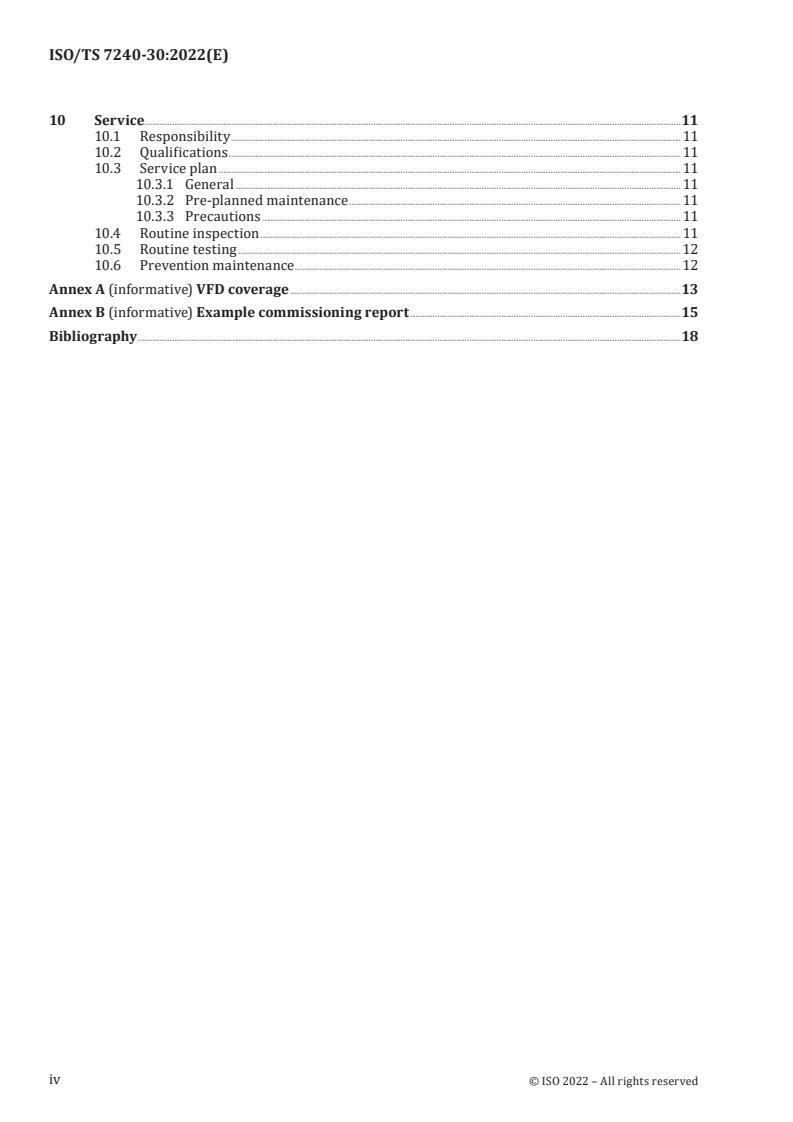
Annex A (informative) VFD coverage .13
Annex B (informative) Example commissioning report .15
Bibliography .18
iv
Foreword
ISO (the International Organization for Standardization) is a worldwide federation of national standards
bodies (ISO member bodies). The work of preparing International Standards is normally carried out
through ISO technical committees. Each member body interested in a subject for which a technical
committee has been established has the right to be represented on that committee. International
organizations, governmental and non-governmental, in liaison with ISO, also take part in the work.
ISO collaborates closely with the International Electrotechnical Commission (IEC) on all matters of
electrotechnical standardization.
The procedures used to develop this document and those intended for its further maintenance are
described in the ISO/IEC Directives, Part 1. In particular, the different approval criteria needed for the
different types of ISO documents should be noted. This document was drafted in accordance with the
editorial rules of the ISO/IEC Directives, Part 2 (see www.iso.org/directives).
Attention is drawn to the possibility that some of the elements of this document may be the subject of
patent rights. ISO shall not be held responsible for identifying any or all such patent rights. Details of
any patent rights identified during the development of the document will be in the Introduction and/or
on the ISO list of patent declarations received (see www.iso.org/patents).
Any trade name used in this document is information given for the convenience of users and does not
constitute an endorsement.
For an explanation of the voluntary nature of standards, the meaning of ISO specific terms and
expressions related to conformity assessment, as well as information about ISO's adherence to
the World Trade Organization (WTO) principles in the Technical Barriers to Trade (TBT), see
www.iso.org/iso/foreword.html.
This document was prepared by Technical Committee ISO/TC 21, Equipment for fire protection and fire
fighting, Subcommittee SC 3, Fire detection and alarm systems.
A list of all parts in the ISO 7240 series can be found on the ISO website.
Any feedback or questions on this document should be directed to the user’s national standards body. A
complete listing of these bodies can be found at www.iso.org/members.html.
v
Introduction
The installation of a video fire detection system (VFDS) can only be successfully accomplished if the
following conditions are fulfilled:
— materials are of a suitable quality;
— special knowledge in the field of video fire detection (VFD) is implemented;
— skilled personnel carry out the work.
Although the quality of the material can be ensured by adherence to applicable standards and quality
audits, the overall effectiveness of an installation depends widely on the quality of work, the experience
of the designer and installer, and regular service.
This document has been prepared by ISO/TC 21/SC 3. A number of existing national codes and
standards were reviewed during the preparation of this document. As VFD technology is significantly
different from conventional fire detection technology, different considerations need to be addressed and
therefore a document specifying the installation of VFDSs has been developed. While specific to VFDSs,
this document has the same objective of early fire detection as ISO 7240-7. This document specifies the
minimum requirements for fire detection installation using equipment conforming ISO/TS 7240-29.
vi
TECHNICAL SPECIFICATION ISO/TS 7240-30:2022(E)
Fire detection and alarm systems —
Part 30:
Design, installation, commissioning and service of video
fire detector systems
1 Scope
This document specifies the design, installation, commissioning and service requirements for video
fire detector systems (VFDS; see ISO/TS 7240-29), which are primarily intended to provide early
detection of fire within one or more specified indoor areas for the protection of lives and equipment.
The VFDS can also serve to protect from specific defined risks. The VFDS can be an independent fire
detection system or can be used in conjunction with a fire detection and alarm system (FDAS; see
ISO 7240-1:2014, Figure 1).
2 Normative references
The following documents are referred to in the text in such a way that some or all of their content
constitutes requirements of this document. For dated references, only the edition cited applies. For
undated references, the latest edition of the referenced document (including any amendments) applies.
ISO 7240-1, Fire detection and alarm systems — Part 1: General and definitions
ISO 7240-4, Fire detection and alarm systems — Part 4: Power supply equipment
ISO 7240-13, Fire detection and alarm systems — Part 13: Compatibility assessment of system components
ISO 7240-14, Fire detection and alarm systems — Part 14: Design, installation, commissioning and service
of fire detection and fire alarm systems in and around buildings
3 Terms, definitions and abbreviated terms
3.1 Terms and definitions
For the purposes of this document, the terms and definitions given in ISO 7240-1 and the following
apply.
ISO and IEC maintain terminology databases for use in standardization at the following addresses:
— ISO Online browsing platform: available at https:// www .iso .org/ obp
— IEC Electropedia: available at https:// www .electropedia .org/
3.1.1
alarm zone
geographic subdivision of the premises in which one or more alarm devices are installed and for which
a common zonal alarm indication is provided
3.1.2
detection zone
geographic subdivision of the premises in which one or more points are installed and for which a
common zonal detection indication is provided
3.1.3
field of view
image captured by the video fire detector
Note 1 to entry: Field of view is a 2D projection/representation of the objects within a 3D rectangular pyramid.
3.1.4
active field of view
area in field of view in which smoke and/or flame can be detected by the video fire detector
Note 1 to entry: The active field of view takes into consideration any borders to the field of view where detection
is not effective and areas within the field of view deliberately masked to avoid nuisance alarms.
3.1.5
illuminator
light source, internal or external to the video fire detector that assists the equipment to operate in low
ambient light conditions
3.1.6
monitored volume
3-dimensional space within a protected space that is visible in the active field of view of the video fire
detector such that smoke/flame occurring in (or around) that space is detected
Note 1 to entry: The monitored volume takes into consideration the active field of view, the declared range for
the video fire detector and any obstacles within the space which can potentially obscure the view.
3.1.7
protected space
the area(s) where the threat of a fire is to be detected by one or more video fire detectors
3.1.8
quiescent condition
functional condition characterized by the absence of the alarm, fault warning and disabled and test
conditions
3.1.9
video fire detector
self-contained device or distributed system in which analysis of video images is performed in order to
detect the presence of smoke and/or flame within the images being analyzed
3.1.10
video fire detector system
fire detection system comprising one or more video fire detectors
3.2 Abbreviated terms
AC alternating current
AHJ authority having jurisdiction
EMC electromagnetic compatibility
EMI electromagnetic interference
FDAS fire detection and alarm system
FoV field of view
aFoV active field of view
FDCIE fire detection control and indicating equipment
VFD video fire detector
VFDS video fire detector system
4 Equipment and material
4.1 Quality of components
Components used as part of the VFDS shall be designed and manufactured in accordance with a
recognized quality system.
The equipment manufacturer shall make available to the VFDS designer information about the
manufacturer’s quality assurance system to satisfy the designer that the components selected for the
VFDS are suitable for the application.
4.2 Standards
Equipment used in the VFDS shall conform to the relevant part of the ISO 7240 series or other
International Standards, as appropriate. The testing supporting such conformity shall be performed in
a testing laboratory that meets the requirements of ISO/IEC 17025.
Note 1 Certification can be used to demonstrate conformity of the equipment to the relevant standard.
Note 2 Accreditation of the testing laboratory for the testing of equipment in accordance with the relevant
standard can be used to demonstrate competence of the laboratory to perform the specific tests. Where
assessment has not been made by an independent party, the designer identifies the components and describes
why assessment has not been undertaken.
4.3 Environmental requirements
Each item of equipment shall be installed within an environment for which it has been certified.
Additional requirements may apply in special cases, e.g.:
— potentially explosive atmospheres;
— special electromagnetic compatibility (EMC) requirements.
4.4 Additional equipment
Additional equipment (e.g. remote terminals or graphic displays) may be included in the design of, or
connected to the VFDS.
The operation of th
...