

ISO 19825:2018
(Main)Road vehicles — Liquefied petroleum gas (LPG) refuelling connector
General Information
- Abstract
This document applies to Liquefied Petroleum Gas vehicle nozzles and receptacles, hereinafter referred to as devices, constructed entirely of new, unused parts and materials. Liquefied Petroleum Gas fuelling connectors consist of the following components, as applicable: a) nozzle (mounted on dispenser side) (see Clause 5); b) receptacle (mounted on vehicle) (see Clause 7). This document applies to devices which have a gauge service pressure in the range of 110 kPa (Butane rich at 20 °C) and 840 kPa (Propane at 20 °C), hereinafter referred to as [see 9.1 c)]: — J15; — K15. This document also applies to: — devices with standardized mating components; — connectors which prevent Liquefied Petroleum Gas vehicles from being fuelled by other gaseous fuels station dispensers; and — Liquefied Petroleum Gas in accordance with ISO 9162. NOTE All references to pressures (kPa) throughout this document are considered gauge pressures unless otherwise specified. This document does not apply to the fuel system of vehicle, with the exception of the Liquefied Petroleum Gas receptacle.
- Status
- Published
- Publication Date
- 25-Nov-2018
- Technical Committee
- ISO/TC 22/SC 41 - Specific aspects for gaseous fuels
- Current Stage
- 9093 - International Standard confirmed
- Start Date
- 22-Apr-2024
- Completion Date
- 29-Aug-2026
Buy Documents

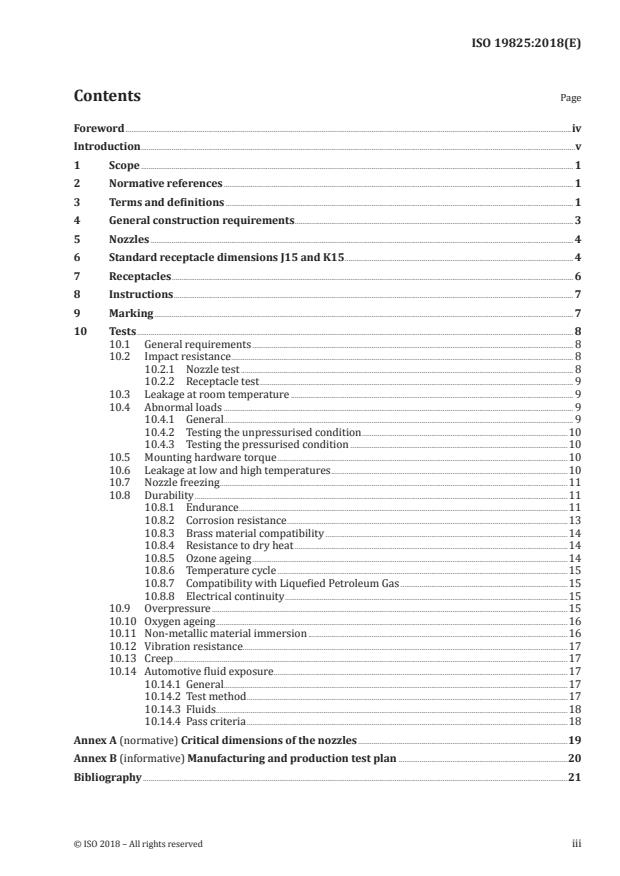
ISO 19825:2018 - Road vehicles -- Liquefied petroleum gas (LPG) refuelling connector

ISO 19825:2018 - Road vehicles — Liquefied petroleum gas (LPG) refuelling connector/26/2018
Overview
ISO 19825:2018 specifies requirements for Liquefied Petroleum Gas (LPG) vehicle refuelling connectors - the nozzles (dispenser side) and receptacles (vehicle side). It applies to devices made entirely of new, unused parts, designed for gauge service pressures from 110 kPa to 840 kPa and to the standard connector profiles J15 and K15. The standard covers dimensional requirements, construction, materials compatibility with LPG (per ISO 9162), marking, instructions and a comprehensive set of tests for safety and durability.
Key topics and technical requirements
- Components covered: nozzle and receptacle assemblies, including standardized mating components and service gaskets.
- Pressure range: devices rated for 110–840 kPa (gauge) depending on LPG composition.
- Profiles: two distinct sizes - J15 and K15 - designed to prevent cross-connection.
- Cycle life / design life:
- Nozzles: 100,000 connect/disconnect cycles (testing requirement).
- Receptacles: 20,000 connect/disconnect cycles; service gasket replaceable at minimum 20,000 cycles.
- Temperature ranges:
- Receptacle: moderate −20 °C to +85 °C; cold −40 °C to +85 °C.
- Nozzle: moderate −20 °C to +65 °C; cold −40 °C to +65 °C.
- Performance and safety tests (examples): impact resistance, leakage (room, low/high temperature), abnormal loads, durability (endurance, corrosion, material compatibility), overpressure, vibration resistance and automotive fluid exposure.
- Construction requirements: materials suitable for LPG, single‑hand operation without tools, limit liquid spillage on disconnection (< 1 cm), and manufacturing according to a production test plan (Annex B).
- Normative references: includes ISO 9162 for LPG, plus relevant material and test standards (e.g., ISO 188, ISO 1431‑1, ISO 1817, ISO 9227).
Practical applications and users
ISO 19825:2018 is essential for:
- Vehicle OEMs specifying safe LPG receptacles and ensuring interoperability with dispensers.
- Refuelling equipment manufacturers designing nozzles and dispenser hardware to comply with J15/K15 profiles and pressure classes.
- Component suppliers (gaskets, fittings, non‑metallic parts) validating material compatibility and lifecycle performance.
- Testing and certification laboratories performing endurance, leakage and environmental tests.
- Regulators and fuelling station operators implementing safe refuelling infrastructure and preventing cross-fuelling with other gaseous fuels.
Adoption of ISO 19825 supports interoperable, safe and durable LPG refuelling systems and helps reduce safety risks during vehicle fuelling.
Related standards
- ISO 9162 (LPG fuel specification and compatibility)
- ISO 188, ISO 1431‑1, ISO 1817, ISO 9227 (material and test methods)
- ASTM D4814 (fuel specification references)
Buy Documents
ISO 19825:2018 - Road vehicles -- Liquefied petroleum gas (LPG) refuelling connector
ISO 19825:2018 - Road vehicles — Liquefied petroleum gas (LPG) refuelling connector/26/2018
Get Certified
Connect with accredited certification bodies for this standard

TÜV Rheinland
TÜV Rheinland is a leading international provider of technical services.

TÜV SÜD
TÜV SÜD is a trusted partner of choice for safety, security and sustainability solutions.

DEKRA Certification Inc.
DEKRA US certification services.
Sponsored listings
Frequently Asked Questions
ISO 19825:2018 is a standard published by the International Organization for Standardization (ISO). Its full title is "Road vehicles — Liquefied petroleum gas (LPG) refuelling connector". This standard covers: This document applies to Liquefied Petroleum Gas vehicle nozzles and receptacles, hereinafter referred to as devices, constructed entirely of new, unused parts and materials. Liquefied Petroleum Gas fuelling connectors consist of the following components, as applicable: a) nozzle (mounted on dispenser side) (see Clause 5); b) receptacle (mounted on vehicle) (see Clause 7). This document applies to devices which have a gauge service pressure in the range of 110 kPa (Butane rich at 20 °C) and 840 kPa (Propane at 20 °C), hereinafter referred to as [see 9.1 c)]: — J15; — K15. This document also applies to: — devices with standardized mating components; — connectors which prevent Liquefied Petroleum Gas vehicles from being fuelled by other gaseous fuels station dispensers; and — Liquefied Petroleum Gas in accordance with ISO 9162. NOTE All references to pressures (kPa) throughout this document are considered gauge pressures unless otherwise specified. This document does not apply to the fuel system of vehicle, with the exception of the Liquefied Petroleum Gas receptacle.
This document applies to Liquefied Petroleum Gas vehicle nozzles and receptacles, hereinafter referred to as devices, constructed entirely of new, unused parts and materials. Liquefied Petroleum Gas fuelling connectors consist of the following components, as applicable: a) nozzle (mounted on dispenser side) (see Clause 5); b) receptacle (mounted on vehicle) (see Clause 7). This document applies to devices which have a gauge service pressure in the range of 110 kPa (Butane rich at 20 °C) and 840 kPa (Propane at 20 °C), hereinafter referred to as [see 9.1 c)]: — J15; — K15. This document also applies to: — devices with standardized mating components; — connectors which prevent Liquefied Petroleum Gas vehicles from being fuelled by other gaseous fuels station dispensers; and — Liquefied Petroleum Gas in accordance with ISO 9162. NOTE All references to pressures (kPa) throughout this document are considered gauge pressures unless otherwise specified. This document does not apply to the fuel system of vehicle, with the exception of the Liquefied Petroleum Gas receptacle.
ISO 19825:2018 is classified under the following ICS (International Classification for Standards) categories: 43.060.40 - Fuel systems. The ICS classification helps identify the subject area and facilitates finding related standards.
ISO 19825:2018 is available in PDF format for immediate download after purchase. The document can be added to your cart and obtained through the secure checkout process. Digital delivery ensures instant access to the complete standard document.
Standards Content (Sample)
INTERNATIONAL ISO
STANDARD 19825
First edition
2018-11
Road vehicles — Liquefied petroleum
gas (LPG) refuelling connector
Véhicules routiers — Connecteur de remplissage en gaz de pétrole
liquéfié (GPL)
Reference number
©
ISO 2018
© ISO 2018
All rights reserved. Unless otherwise specified, or required in the context of its implementation, no part of this publication may
be reproduced or utilized otherwise in any form or by any means, electronic or mechanical, including photocopying, or posting
on the internet or an intranet, without prior written permission. Permission can be requested from either ISO at the address
below or ISO’s member body in the country of the requester.
ISO copyright office
CP 401 • Ch. de Blandonnet 8
CH-1214 Vernier, Geneva
Phone: +41 22 749 01 11
Fax: +41 22 749 09 47
Email: copyright@iso.org
Website: www.iso.org
Published in Switzerland
ii © ISO 2018 – All rights reserved
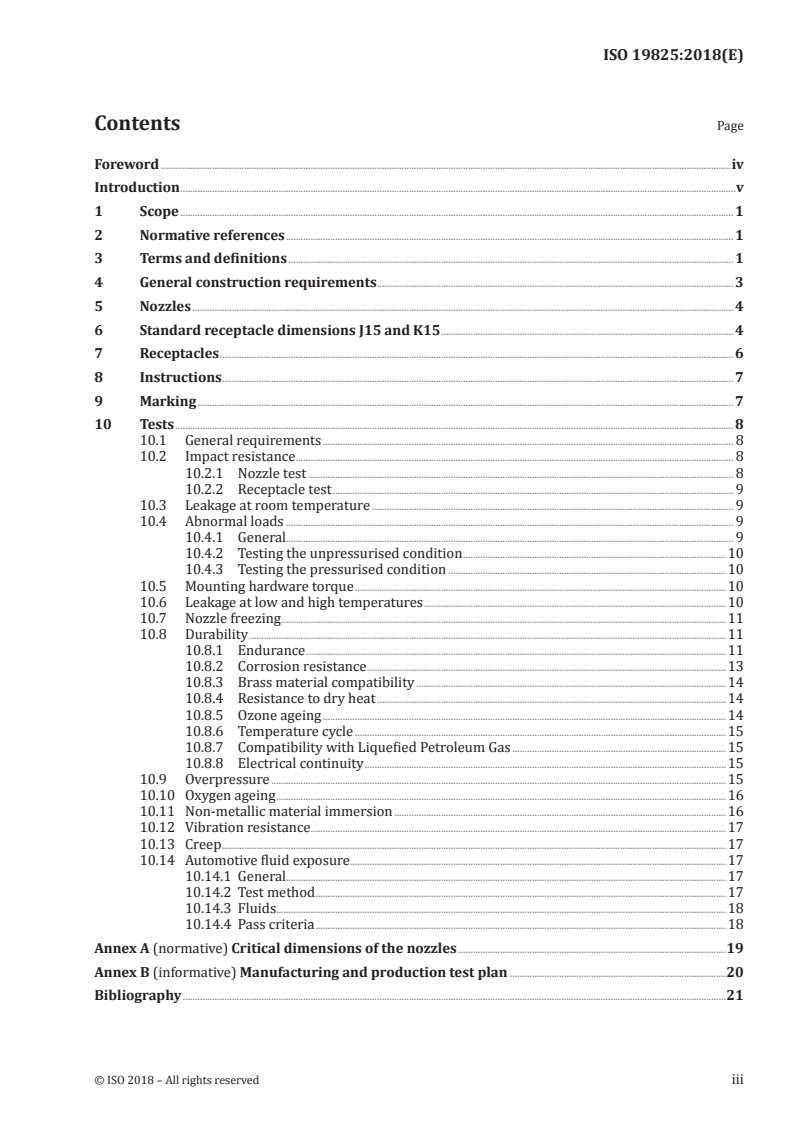
Contents Page
Foreword .iv
Introduction .v
1 Scope . 1
2 Normative references . 1
3 Terms and definitions . 1
4 General construction requirements . 3
5 Nozzles . 4
6 Standard receptacle dimensions J15 and K15 . 4
7 Receptacles . 6
8 Instructions . 7
9 Marking . 7
10 Tests . 8
10.1 General requirements . 8
10.2 Impact resistance . 8
10.2.1 Nozzle test . 8
10.2.2 Receptacle test . 9
10.3 Leakage at room temperature . 9
10.4 Abnormal loads . 9
10.4.1 General. 9
10.4.2 Testing the unpressurised condition .10
10.4.3 Testing the pressurised condition .10
10.5 Mounting hardware torque .10
10.6 Leakage at low and high temperatures .10
10.7 Nozzle freezing .11
10.8 Durability .11
10.8.1 Endurance .11
10.8.2 Corrosion resistance .13
10.8.3 Brass material compatibility .14
10.8.4 Resistance to dry heat .14
10.8.5 Ozone ageing .14
10.8.6 Temperature cycle .15
10.8.7 Compatibility with Liquefied Petroleum Gas .15
10.8.8 Electrical continuity .15
10.9 Overpressure .15
10.10 Oxygen ageing .16
10.11 Non-metallic material immersion .16
10.12 Vibration resistance .17
10.13 Creep .17
10.14 Automotive fluid exposure.17
10.14.1 General.17
10.14.2 Test method .17
10.14.3 Fluids . . .18
10.14.4 Pass criteria .18
Annex A (normative) Critical dimensions of the nozzles .19
Annex B (informative) Manufacturing and production test plan .20
Bibliography .21
Foreword
ISO (the International Organization for Standardization) is a worldwide federation of national standards
bodies (ISO member bodies). The work of preparing International Standards is normally carried out
through ISO technical committees. Each member body interested in a subject for which a technical
committee has been established has the right to be represented on that committee. International
organizations, governmental and non-governmental, in liaison with ISO, also take part in the work.
ISO collaborates closely with the International Electrotechnical Commission (IEC) on all matters of
electrotechnical standardization.
The procedures used to develop this document and those intended for its further maintenance are
described in the ISO/IEC Directives, Part 1. In particular, the different approval criteria needed for the
different types of ISO documents should be noted. This document was drafted in accordance with the
editorial rules of the ISO/IEC Directives, Part 2 (see www .iso .org/directives).
Attention is drawn to the possibility that some of the elements of this document may be the subject of
patent rights. ISO shall not be held responsible for identifying any or all such patent rights. Details of
any patent rights identified during the development of the document will be in the Introduction and/or
on the ISO list of patent declarations received (see www .iso .org/patents).
Any trade name used in this document is information given for the convenience of users and does not
constitute an endorsement.
For an explanation on the voluntary nature of standards, the meaning of ISO specific terms and
expressions related to conformity assessment, as well as information about ISO's adherence to the
World Trade Organization (WTO) principles in the Technical Barriers to Trade (TBT) see the following
URL: www .iso .org/iso/foreword .html.
This document was prepared by Technical Committee ISO/TC 22, Road vehicles, Subcommittee SC 41,
Specific aspects for gaseous fuels.
Any feedback or questions on this document should be directed to the user’s national standards body. A
complete listing of these bodies can be found at www .iso .org/members .html.
iv © ISO 2018 – All rights reserved
Introduction
This document was developed for the design, examination, testing and certification of newly produced
Liquefied Petroleum Gas Vehicle fuelling nozzles and receptacles only.
A nozzle compliant with this document is functionally compatible from a safety and performance
perspective with all listed receptacles of compatible profile and system pressure. Similarly, a receptacle
compliant with this document is functionally compatible from a safety and performance perspective
with all listed nozzles of compatible profile and system pressure.
These standard profiles incorporate the design specifications (mating materials, geometry and
tolerances) which can be considered in the certification of a submitted nozzle or receptacle.
INTERNATIONAL STANDARD ISO 19825:2018(E)
Road vehicles — Liquefied petroleum gas (LPG) refuelling
connector
1 Scope
This document applies to Liquefied Petroleum Gas vehicle nozzles and receptacles, hereinafter referred
to as devices, constructed entirely of new, unused parts and materials. Liquefied Petroleum Gas fuelling
connectors consist of the following components, as applicable:
a) nozzle (mounted on dispenser side) (see Clause 5);
b) receptacle (mounted on vehicle) (see Clause 7).
This document applies to devices which have a gauge service pressure in the range of 110 kPa (Butane
rich at 20 °C) and 840 kPa (Propane at 20 °C), hereinafter referred to as [see 9.1 c)]:
— J15;
— K15.
This document also applies to:
— devices with standardized mating components;
— connectors which prevent Liquefied Petroleum Gas vehicles from being fuelled by other gaseous
fuels station dispensers; and
— Liquefied Petroleum Gas in accordance with ISO 9162.
NOTE All references to pressures (kPa) throughout this document are considered gauge pressures unless
otherwise specified.
This document does not apply to the fuel system of vehicle, with the exception of the Liquefied
Petroleum Gas receptacle.
2 Normative references
The following documents are referred to in the text in such a way that some or all of their content
constitutes requirements of this document. For dated references, only the edition cited applies. For
undated references, the latest edition of the referenced document (including any amendments) applies.
ISO 188, Rubber vulcanized — Accelerated ageing or heat-resistance tests
ISO 1431-1, Rubber, vulcanized or thermoplastic — Resistance to ozone cracking — Part 1: Static and
dynamic strain testing
ISO 1817, Rubber, vulcanized or thermoplastic — Determination of the effect of liquids
ISO 9227, Corrosion tests in artificial atmospheres — Salt spray tests
ASTM D4814, Standard Specification for Automotive Spark-Ignition Engine Fuel
3 Terms and definitions
For the purposes of this document, the following terms and definitions apply.
ISO and IEC maintain terminological databases for use in standardization at the following addresses:
— ISO Online browsing platform: available at https: //www .iso .org/obp
— IEC Electropedia: available at http: //www .electropedia .org/
3.1
dry air
air with moisture content such that the dew point of the air at the required test pressure is at least
11 °C below the ambient test temperature
3.2
working pressure
maximum pressure that a connector can be expected to withstand in actual service
3.3
Liquefied Petroleum Gas
LPG
autogas
low pressure gas composed of one or more light hydrocarbons which are assigned to UN 1011, UN 1075,
UN 1965, UN 1969 or UN 1978 only and which consists mainly of propane, propene, butane, butane
isomers, butene with traces of other hydrocarbon gases
3.4
nozzle
Liquefied Petroleum Gas refuelling nozzle
device which permits quick connection and disconnection of fuel supply hose to the Liquefied Petroleum
Gas receptacle (3.5) in a safe manner
3.5
receptacle
Liquefied Petroleum Gas refuelling receptacle
device connected to a vehicle or storage system which receives the Liquefied Petroleum Gas nozzle (3.4)
and permits safe transfer of fuel
3.6
connector
Liquefied Petroleum Gas refuelling connector
joined assembly of Liquefied Petroleum Gas nozzle (3.4) and receptacle (3.5)
3.7
non-sparking material
material that does not contain, by mass, more than 7,5 % in total of magnesium, titanium and zirconium
[SOURCE: IEC 60079-0:2017, 8.3]
3.8
service gasket
replaceable gasket ensuring tightness of the connection between the nozzle outlet and the receptacle inlet
3.9
cycle life
number of connections and disconnections between the nozzle (3.4) and the receptacle (3.5) required
for testing purposes
3.10
service life
number of operations of the receptacle (3.5) required for testing purposes
2 © ISO 2018 – All rights reserved
4 General construction requirements
4.1 Nozzles and receptacles shall be designed in accordance with reasonable concepts of safety,
durability and maintainability.
1) There are two different sizes of connectors, J15 and K15.
The profile of the two different sizes is so different that no cross connection between the sizes is
possible.
2) Working pressure. All nozzles and receptacles are designed to have a working pressure defined by
the manufacturer and clearly marked on the device [see 9.1 d)].
3) Design life. All nozzles shall be tested at 100 000 connect/disconnect cycles and all receptacles at
20 000 connect/disconnect cycles for compliance with this document. The service gasket may be
changed at a minimum of 20 000 cycles.
4.2 Nozzles and receptacles shall be manufactured to the dimensional requirements of this document
and in accordance with good engineering practice. All construction requirements can be met by either
the construction specified in this document or another construction that gives at least equivalent
performance.
4.3 Nozzles and receptacles shall be:
— designed to minimize the possibility of incorrect assembly;
— designed to be secure against displacement, distortion, warping or other damage under normal and
anticipated abnormal conditions;
— designed to release less than 1 cm of liquid LPG during disconnection; and
— constructed to maintain operational integrity under normal and anticipated abnormal conditions
of handling and usage;
— manufactured and produced according to a test plan as described in Annex B.
4.4 Nozzles and receptacles shall be manufactured of materials suitable and compatible for use with
Liquefied Petroleum Gas, in accordance with ISO 9162, at the pressure and the temperature ranges to
which they will be subjected.
4.4.1 The temperature range shall be:
For the receptacle:
— Moderate operating conditions: −20 °C to +85 °C
— Cold operating conditions: −40 °C to +85 °C
For the nozzle:
— Moderate operating conditions: −20 °C to +65 °C
— Cold operating conditions: −40 °C to +65 °C
For specific regions, the temperature range specified may not be sufficient. In such a case, a wider
temperature range, representative of that specific region, shall be considered.
4.5 Nozzles and receptacles shall be operated either to connect or disconnect without the use of tools
and with one hand operation.
4.6 Jointing components shall provide gas-tight sealing performance.
5 Nozzles
The design of the nozzle shall ensure that:
— it is compatible with the relevant receptacle as specified in Clause 6;
— entrapment of fingers and/or cold burns are not possible;
— the maximum push-on force during connection is 100 N at any pressure up to 1 500 kPa in the nozzle;
— the maximum pull-off force during disconnection is 50 N at 1 500 kPa;
— the force on the lever, if any, to open the valve applied at the centre of the grip area of the lever, is
100 N maximum at any pressure up to 1 500 kPa in the nozzle;
— where a latch is provided and in use, it shall be capable of being normally disarmed by the user;
— provision is made to enable the lever or the whole nozzle to freely rotate over an angle of 360°
around the longitudinal axis of the nozzle or the filling hose; the requirement can be met by the
integration of a swivel between nozzle and hose with provision of UL 567 requirements;
— it is not possible to open the valve in the nozzle if the nozzle is not properly locked and sealed on the
receptacle;
— a locking mechanism is incorporated that locks in the connected position;
— it is not possible to unlock the nozzle from the receptacle unless the nozzle valve is closed;
— internal blocking due to freezing does not occur under intended operating conditions;
— it will withstand a torque of 150 % of the mounting torque specified by the manufacturer
without damage;
— the external surfaces of the filling nozzle are corrosion resistant or protected against corrosion
and are made of materials (non-sparking materials) that do not cause sparks when dropped on a
surface;
— changing the service gasket shall not result in any Liquefied Petroleum Gas release;
— the minimum cycle life of the service gasket is 20 000 cycles;
— the nozzle is provided with a means to attach it to the delivery hose;
— the nozzle shall comply with the performance requirements of Clause 10 to ensure interchangeability.
6 Standard receptacle dimensions J15 and K15
A receptacle shall comply with the design specifications detailed in Figures 1 and 2.
4 © ISO 2018 – All rights reserved
Dimensions in millimetres
Key
A reference for geometrical tolerances
Ra surface roughness
R1 radius
a
Stroke.
Figure 1 — J15 Receptacle
Dimensions in millimetres
Key
A reference for geometrical tolerances
Ra surface roughness
R radius
Figure 2 — K15 Receptacle
7 Receptacles
7.1 Receptacles shall comply with Clauses 4, 6 and 10 and shall be evaluated with a test nozzle which
is already certified to this document.
The failure of any test conducted with the receptacle and nozzle test samples shall constitute a failure of
the submitted receptacle, unless the manufacturer can prove the problem was caused by the test nozzle.
7.2 The receptacle shall be equipped with an internal check valve to prevent the escape of gas.
Regardless of whether the check valve is opened mechanically or by differential pressure, the flow through
the receptacle, when tested with water, at a differential pressure of 30 kPa, shall be at least 3 l/min.
The dead volume between the front sealing surface and the front of the internal check valve shall not
exceed 0,1 cm .
7.3 The method for attaching the receptacle to the vehicle fuel system shall not rely on the joint
between the male and female threads for sealing, such as conical threads.
6 © ISO 2018 – All rights reserved
7.4 The interfacing surface of the receptacle shall be constructed of material that does not cause sparks
(non-sparking) and ensures electrical continuity (see 10.8.8).
7.5 The receptacle shall have provisions to be firmly attached to the vehicle and shall comply with
applicable abnormal load tests (see 10.4).
7.6 The receptacle shall be mounted on the vehicle in compliance with Annex A.
7.7 The receptacle shall not be installed in an area that exceeds a temperature of 85 °C.
7.8 Receptacles shall have a cycle life of more than 10 000 cycles, but a service life of more than
100 000 cycles
8 Instructions
Information required for instructions and provisions shall be in an easily understood form.
Special tools required for connection of receptacles to tubing shall be clearly identified in the
instructions.
Manufacturers of receptacles and nozzles shall provide clear and concise printed instruction and
diagrams in a form that can be easily understood and adequate for:
— proper field assembly;
— installation;
— maintenance;
— replacement of components as appropriate;
— for safe operation by all users;
— suitability and use; and
— storage and handling.
9 Marking
9.1 Information required for marking and provisions shall be in an easily understood form. Marking
should be embossed, cast, stamped or otherwise formed in the part. This includes markings baked into
an enamelled surface.
Nozzles and receptacles shall bear the following information:
a) the manufacturer's or dealer's name, trademark or symbol;
b) the model designation;
c) J15 or K15;
d) the working pressure;
e) the minimum design temperature;
f) the manufacturer code to ensure traceability; and
g) if required, a certification mark.
9.2 A marking to identify this document (i.e. ISO 19825) shall be provided for each system. This
marking may be located on the package or on a notice placed inside the package in which the device is
shipped.
10 Tests
10.1 General requirements
A nozzle and receptacle shall be tested with receptacle and nozzle designs specified in Clauses 4 to 9.
Unless otherwise stated:
a) tests shall be conducted at room temperature (20 ± 5) °C;
b) all pressure or leak tests shall be conducted with dry air, nitrogen, or any other suitable gas; and
c) devices shall be conditioned to attain equilibrium conditions.
The tolerances for test temperatures and pressures shall be:
+0
— for low temperatures: °C;
()
−5
+5
— for high temperatures: °C;
()
−0
— test pressures: ±10 % of the stated value with a maximum of 100 kPa.
10.2 Impact resistance
10.2.1 Nozzle test
A nozzle conditioned for 4 h at −20 °C for moderate operating conditions or −40 °C for cold operating
conditions shall be connected to a 5 m length of 19 mm internal diameter refuelling hose at room
temperature, and then dropped 1,3 m onto a concrete floor as shown in Figure 3. The nozzle shall be
dropped ten times at room temperature, then pressurized at the working pressure and subjected to
ten additional drops. Following the above drops, the nozzle shall be capable of normal connection and
disconnection to the receptacle. In addition, the nozzle shall comply with leakage tests specified in 10.3.
Dimensions in metres
Key
1 horizontal concrete floor
2 solid fixing point
3 hose
4 nozzle
Figure 3 — Impact resistance test arrangement
8 © ISO 2018 – All rights reserved
10.2.2 Receptacle test
The receptacle shall be subjected to an impact test of 10 J. A hardened steel mass of 1 kg shall be dropped
from a height of 1 m so as to deliver the impact velocity 4,4 m/s. This shall be achieved by mounting
the mass in a pendulum. The receptacle shall be installed horizontally on a solid object. The impact of
the mass shall be on the ce
...
INTERNATIONAL ISO
STANDARD 19825
First edition
2018-11
Road vehicles — Liquefied petroleum
gas (LPG) refuelling connector
Véhicules routiers — Connecteur de remplissage en gaz de pétrole
liquéfié (GPL)
Reference number
©
ISO 2018
© ISO 2018
All rights reserved. Unless otherwise specified, or required in the context of its implementation, no part of this publication may
be reproduced or utilized otherwise in any form or by any means, electronic or mechanical, including photocopying, or posting
on the internet or an intranet, without prior written permission. Permission can be requested from either ISO at the address
below or ISO’s member body in the country of the requester.
ISO copyright office
CP 401 • Ch. de Blandonnet 8
CH-1214 Vernier, Geneva
Phone: +41 22 749 01 11
Fax: +41 22 749 09 47
Email: copyright@iso.org
Website: www.iso.org
Published in Switzerland
ii © ISO 2018 – All rights reserved
Contents Page
Foreword .iv
Introduction .v
1 Scope . 1
2 Normative references . 1
3 Terms and definitions . 1
4 General construction requirements . 3
5 Nozzles . 4
6 Standard receptacle dimensions J15 and K15 . 4
7 Receptacles . 6
8 Instructions . 7
9 Marking . 7
10 Tests . 8
10.1 General requirements . 8
10.2 Impact resistance . 8
10.2.1 Nozzle test . 8
10.2.2 Receptacle test . 9
10.3 Leakage at room temperature . 9
10.4 Abnormal loads . 9
10.4.1 General. 9
10.4.2 Testing the unpressurised condition .10
10.4.3 Testing the pressurised condition .10
10.5 Mounting hardware torque .10
10.6 Leakage at low and high temperatures .10
10.7 Nozzle freezing .11
10.8 Durability .11
10.8.1 Endurance .11
10.8.2 Corrosion resistance .13
10.8.3 Brass material compatibility .14
10.8.4 Resistance to dry heat .14
10.8.5 Ozone ageing .14
10.8.6 Temperature cycle .15
10.8.7 Compatibility with Liquefied Petroleum Gas .15
10.8.8 Electrical continuity .15
10.9 Overpressure .15
10.10 Oxygen ageing .16
10.11 Non-metallic material immersion .16
10.12 Vibration resistance .17
10.13 Creep .17
10.14 Automotive fluid exposure.17
10.14.1 General.17
10.14.2 Test method .17
10.14.3 Fluids . . .18
10.14.4 Pass criteria .18
Annex A (normative) Critical dimensions of the nozzles .19
Annex B (informative) Manufacturing and production test plan .20
Bibliography .21
Foreword
ISO (the International Organization for Standardization) is a worldwide federation of national standards
bodies (ISO member bodies). The work of preparing International Standards is normally carried out
through ISO technical committees. Each member body interested in a subject for which a technical
committee has been established has the right to be represented on that committee. International
organizations, governmental and non-governmental, in liaison with ISO, also take part in the work.
ISO collaborates closely with the International Electrotechnical Commission (IEC) on all matters of
electrotechnical standardization.
The procedures used to develop this document and those intended for its further maintenance are
described in the ISO/IEC Directives, Part 1. In particular, the different approval criteria needed for the
different types of ISO documents should be noted. This document was drafted in accordance with the
editorial rules of the ISO/IEC Directives, Part 2 (see www .iso .org/directives).
Attention is drawn to the possibility that some of the elements of this document may be the subject of
patent rights. ISO shall not be held responsible for identifying any or all such patent rights. Details of
any patent rights identified during the development of the document will be in the Introduction and/or
on the ISO list of patent declarations received (see www .iso .org/patents).
Any trade name used in this document is information given for the convenience of users and does not
constitute an endorsement.
For an explanation on the voluntary nature of standards, the meaning of ISO specific terms and
expressions related to conformity assessment, as well as information about ISO's adherence to the
World Trade Organization (WTO) principles in the Technical Barriers to Trade (TBT) see the following
URL: www .iso .org/iso/foreword .html.
This document was prepared by Technical Committee ISO/TC 22, Road vehicles, Subcommittee SC 41,
Specific aspects for gaseous fuels.
Any feedback or questions on this document should be directed to the user’s national standards body. A
complete listing of these bodies can be found at www .iso .org/members .html.
iv © ISO 2018 – All rights reserved
Introduction
This document was developed for the design, examination, testing and certification of newly produced
Liquefied Petroleum Gas Vehicle fuelling nozzles and receptacles only.
A nozzle compliant with this document is functionally compatible from a safety and performance
perspective with all listed receptacles of compatible profile and system pressure. Similarly, a receptacle
compliant with this document is functionally compatible from a safety and performance perspective
with all listed nozzles of compatible profile and system pressure.
These standard profiles incorporate the design specifications (mating materials, geometry and
tolerances) which can be considered in the certification of a submitted nozzle or receptacle.
INTERNATIONAL STANDARD ISO 19825:2018(E)
Road vehicles — Liquefied petroleum gas (LPG) refuelling
connector
1 Scope
This document applies to Liquefied Petroleum Gas vehicle nozzles and receptacles, hereinafter referred
to as devices, constructed entirely of new, unused parts and materials. Liquefied Petroleum Gas fuelling
connectors consist of the following components, as applicable:
a) nozzle (mounted on dispenser side) (see Clause 5);
b) receptacle (mounted on vehicle) (see Clause 7).
This document applies to devices which have a gauge service pressure in the range of 110 kPa (Butane
rich at 20 °C) and 840 kPa (Propane at 20 °C), hereinafter referred to as [see 9.1 c)]:
— J15;
— K15.
This document also applies to:
— devices with standardized mating components;
— connectors which prevent Liquefied Petroleum Gas vehicles from being fuelled by other gaseous
fuels station dispensers; and
— Liquefied Petroleum Gas in accordance with ISO 9162.
NOTE All references to pressures (kPa) throughout this document are considered gauge pressures unless
otherwise specified.
This document does not apply to the fuel system of vehicle, with the exception of the Liquefied
Petroleum Gas receptacle.
2 Normative references
The following documents are referred to in the text in such a way that some or all of their content
constitutes requirements of this document. For dated references, only the edition cited applies. For
undated references, the latest edition of the referenced document (including any amendments) applies.
ISO 188, Rubber vulcanized — Accelerated ageing or heat-resistance tests
ISO 1431-1, Rubber, vulcanized or thermoplastic — Resistance to ozone cracking — Part 1: Static and
dynamic strain testing
ISO 1817, Rubber, vulcanized or thermoplastic — Determination of the effect of liquids
ISO 9227, Corrosion tests in artificial atmospheres — Salt spray tests
ASTM D4814, Standard Specification for Automotive Spark-Ignition Engine Fuel
3 Terms and definitions
For the purposes of this document, the following terms and definitions apply.
ISO and IEC maintain terminological databases for use in standardization at the following addresses:
— ISO Online browsing platform: available at https: //www .iso .org/obp
— IEC Electropedia: available at http: //www .electropedia .org/
3.1
dry air
air with moisture content such that the dew point of the air at the required test pressure is at least
11 °C below the ambient test temperature
3.2
working pressure
maximum pressure that a connector can be expected to withstand in actual service
3.3
Liquefied Petroleum Gas
LPG
autogas
low pressure gas composed of one or more light hydrocarbons which are assigned to UN 1011, UN 1075,
UN 1965, UN 1969 or UN 1978 only and which consists mainly of propane, propene, butane, butane
isomers, butene with traces of other hydrocarbon gases
3.4
nozzle
Liquefied Petroleum Gas refuelling nozzle
device which permits quick connection and disconnection of fuel supply hose to the Liquefied Petroleum
Gas receptacle (3.5) in a safe manner
3.5
receptacle
Liquefied Petroleum Gas refuelling receptacle
device connected to a vehicle or storage system which receives the Liquefied Petroleum Gas nozzle (3.4)
and permits safe transfer of fuel
3.6
connector
Liquefied Petroleum Gas refuelling connector
joined assembly of Liquefied Petroleum Gas nozzle (3.4) and receptacle (3.5)
3.7
non-sparking material
material that does not contain, by mass, more than 7,5 % in total of magnesium, titanium and zirconium
[SOURCE: IEC 60079-0:2017, 8.3]
3.8
service gasket
replaceable gasket ensuring tightness of the connection between the nozzle outlet and the receptacle inlet
3.9
cycle life
number of connections and disconnections between the nozzle (3.4) and the receptacle (3.5) required
for testing purposes
3.10
service life
number of operations of the receptacle (3.5) required for testing purposes
2 © ISO 2018 – All rights reserved
4 General construction requirements
4.1 Nozzles and receptacles shall be designed in accordance with reasonable concepts of safety,
durability and maintainability.
1) There are two different sizes of connectors, J15 and K15.
The profile of the two different sizes is so different that no cross connection between the sizes is
possible.
2) Working pressure. All nozzles and receptacles are designed to have a working pressure defined by
the manufacturer and clearly marked on the device [see 9.1 d)].
3) Design life. All nozzles shall be tested at 100 000 connect/disconnect cycles and all receptacles at
20 000 connect/disconnect cycles for compliance with this document. The service gasket may be
changed at a minimum of 20 000 cycles.
4.2 Nozzles and receptacles shall be manufactured to the dimensional requirements of this document
and in accordance with good engineering practice. All construction requirements can be met by either
the construction specified in this document or another construction that gives at least equivalent
performance.
4.3 Nozzles and receptacles shall be:
— designed to minimize the possibility of incorrect assembly;
— designed to be secure against displacement, distortion, warping or other damage under normal and
anticipated abnormal conditions;
— designed to release less than 1 cm of liquid LPG during disconnection; and
— constructed to maintain operational integrity under normal and anticipated abnormal conditions
of handling and usage;
— manufactured and produced according to a test plan as described in Annex B.
4.4 Nozzles and receptacles shall be manufactured of materials suitable and compatible for use with
Liquefied Petroleum Gas, in accordance with ISO 9162, at the pressure and the temperature ranges to
which they will be subjected.
4.4.1 The temperature range shall be:
For the receptacle:
— Moderate operating conditions: −20 °C to +85 °C
— Cold operating conditions: −40 °C to +85 °C
For the nozzle:
— Moderate operating conditions: −20 °C to +65 °C
— Cold operating conditions: −40 °C to +65 °C
For specific regions, the temperature range specified may not be sufficient. In such a case, a wider
temperature range, representative of that specific region, shall be considered.
4.5 Nozzles and receptacles shall be operated either to connect or disconnect without the use of tools
and with one hand operation.
4.6 Jointing components shall provide gas-tight sealing performance.
5 Nozzles
The design of the nozzle shall ensure that:
— it is compatible with the relevant receptacle as specified in Clause 6;
— entrapment of fingers and/or cold burns are not possible;
— the maximum push-on force during connection is 100 N at any pressure up to 1 500 kPa in the nozzle;
— the maximum pull-off force during disconnection is 50 N at 1 500 kPa;
— the force on the lever, if any, to open the valve applied at the centre of the grip area of the lever, is
100 N maximum at any pressure up to 1 500 kPa in the nozzle;
— where a latch is provided and in use, it shall be capable of being normally disarmed by the user;
— provision is made to enable the lever or the whole nozzle to freely rotate over an angle of 360°
around the longitudinal axis of the nozzle or the filling hose; the requirement can be met by the
integration of a swivel between nozzle and hose with provision of UL 567 requirements;
— it is not possible to open the valve in the nozzle if the nozzle is not properly locked and sealed on the
receptacle;
— a locking mechanism is incorporated that locks in the connected position;
— it is not possible to unlock the nozzle from the receptacle unless the nozzle valve is closed;
— internal blocking due to freezing does not occur under intended operating conditions;
— it will withstand a torque of 150 % of the mounting torque specified by the manufacturer
without damage;
— the external surfaces of the filling nozzle are corrosion resistant or protected against corrosion
and are made of materials (non-sparking materials) that do not cause sparks when dropped on a
surface;
— changing the service gasket shall not result in any Liquefied Petroleum Gas release;
— the minimum cycle life of the service gasket is 20 000 cycles;
— the nozzle is provided with a means to attach it to the delivery hose;
— the nozzle shall comply with the performance requirements of Clause 10 to ensure interchangeability.
6 Standard receptacle dimensions J15 and K15
A receptacle shall comply with the design specifications detailed in Figures 1 and 2.
4 © ISO 2018 – All rights reserved
Dimensions in millimetres
Key
A reference for geometrical tolerances
Ra surface roughness
R1 radius
a
Stroke.
Figure 1 — J15 Receptacle
Dimensions in millimetres
Key
A reference for geometrical tolerances
Ra surface roughness
R radius
Figure 2 — K15 Receptacle
7 Receptacles
7.1 Receptacles shall comply with Clauses 4, 6 and 10 and shall be evaluated with a test nozzle which
is already certified to this document.
The failure of any test conducted with the receptacle and nozzle test samples shall constitute a failure of
the submitted receptacle, unless the manufacturer can prove the problem was caused by the test nozzle.
7.2 The receptacle shall be equipped with an internal check valve to prevent the escape of gas.
Regardless of whether the check valve is opened mechanically or by differential pressure, the flow through
the receptacle, when tested with water, at a differential pressure of 30 kPa, shall be at least 3 l/min.
The dead volume between the front sealing surface and the front of the internal check valve shall not
exceed 0,1 cm .
7.3 The method for attaching the receptacle to the vehicle fuel system shall not rely on the joint
between the male and female threads for sealing, such as conical threads.
6 © ISO 2018 – All rights reserved
7.4 The interfacing surface of the receptacle shall be constructed of material that does not cause sparks
(non-sparking) and ensures electrical continuity (see 10.8.8).
7.5 The receptacle shall have provisions to be firmly attached to the vehicle and shall comply with
applicable abnormal load tests (see 10.4).
7.6 The receptacle shall be mounted on the vehicle in compliance with Annex A.
7.7 The receptacle shall not be installed in an area that exceeds a temperature of 85 °C.
7.8 Receptacles shall have a cycle life of more than 10 000 cycles, but a service life of more than
100 000 cycles
8 Instructions
Information required for instructions and provisions shall be in an easily understood form.
Special tools required for connection of receptacles to tubing shall be clearly identified in the
instructions.
Manufacturers of receptacles and nozzles shall provide clear and concise printed instruction and
diagrams in a form that can be easily understood and adequate for:
— proper field assembly;
— installation;
— maintenance;
— replacement of components as appropriate;
— for safe operation by all users;
— suitability and use; and
— storage and handling.
9 Marking
9.1 Information required for marking and provisions shall be in an easily understood form. Marking
should be embossed, cast, stamped or otherwise formed in the part. This includes markings baked into
an enamelled surface.
Nozzles and receptacles shall bear the following information:
a) the manufacturer's or dealer's name, trademark or symbol;
b) the model designation;
c) J15 or K15;
d) the working pressure;
e) the minimum design temperature;
f) the manufacturer code to ensure traceability; and
g) if required, a certification mark.
9.2 A marking to identify this document (i.e. ISO 19825) shall be provided for each system. This
marking may be located on the package or on a notice placed inside the package in which the device is
shipped.
10 Tests
10.1 General requirements
A nozzle and receptacle shall be tested with receptacle and nozzle designs specified in Clauses 4 to 9.
Unless otherwise stated:
a) tests shall be conducted at room temperature (20 ± 5) °C;
b) all pressure or leak tests shall be conducted with dry air, nitrogen, or any other suitable gas; and
c) devices shall be conditioned to attain equilibrium conditions.
The tolerances for test temperatures and pressures shall be:
+0
— for low temperatures: °C;
()
−5
+5
— for high temperatures: °C;
()
−0
— test pressures: ±10 % of the stated value with a maximum of 100 kPa.
10.2 Impact resistance
10.2.1 Nozzle test
A nozzle conditioned for 4 h at −20 °C for moderate operating conditions or −40 °C for cold operating
conditions shall be connected to a 5 m length of 19 mm internal diameter refuelling hose at room
temperature, and then dropped 1,3 m onto a concrete floor as shown in Figure 3. The nozzle shall be
dropped ten times at room temperature, then pressurized at the working pressure and subjected to
ten additional drops. Following the above drops, the nozzle shall be capable of normal connection and
disconnection to the receptacle. In addition, the nozzle shall comply with leakage tests specified in 10.3.
Dimensions in metres
Key
1 horizontal concrete floor
2 solid fixing point
3 hose
4 nozzle
Figure 3 — Impact resistance test arrangement
8 © ISO 2018 – All rights reserved
10.2.2 Receptacle test
The receptacle shall be subjected to an impact test of 10 J. A hardened steel mass of 1 kg shall be dropped
from a height of 1 m so as to deliver the impact velocity 4,4 m/s. This shall be achieved by mounting
the mass in a pendulum. The receptacle shall be installed horizontally on a solid object. The impact of
the mass shall be on the ce
...