

ISO 2550:1972
(Main)Textile floor coverings — Hand-made carpets — Determination of types of knots
- Abstract
Describes different types of knots used in manufacturing hand-made carpets. A visual method for identification of types of knots is given. Applicable to most carpets in which knots are tied by finger or by hook. Exyamples of types of knots are shown in figures.
- Status
- Published
- Publication Date
- 31-Jul-1972
- Technical Committee
- ISO/TC 219 - Floor coverings
- Drafting Committee
- ISO/TC 219/WG 1 - Textile floor coverings
- Current Stage
- 9093 - International Standard confirmed - 90 Review
- Start Date
- 03-Feb-2026
Buy Documents
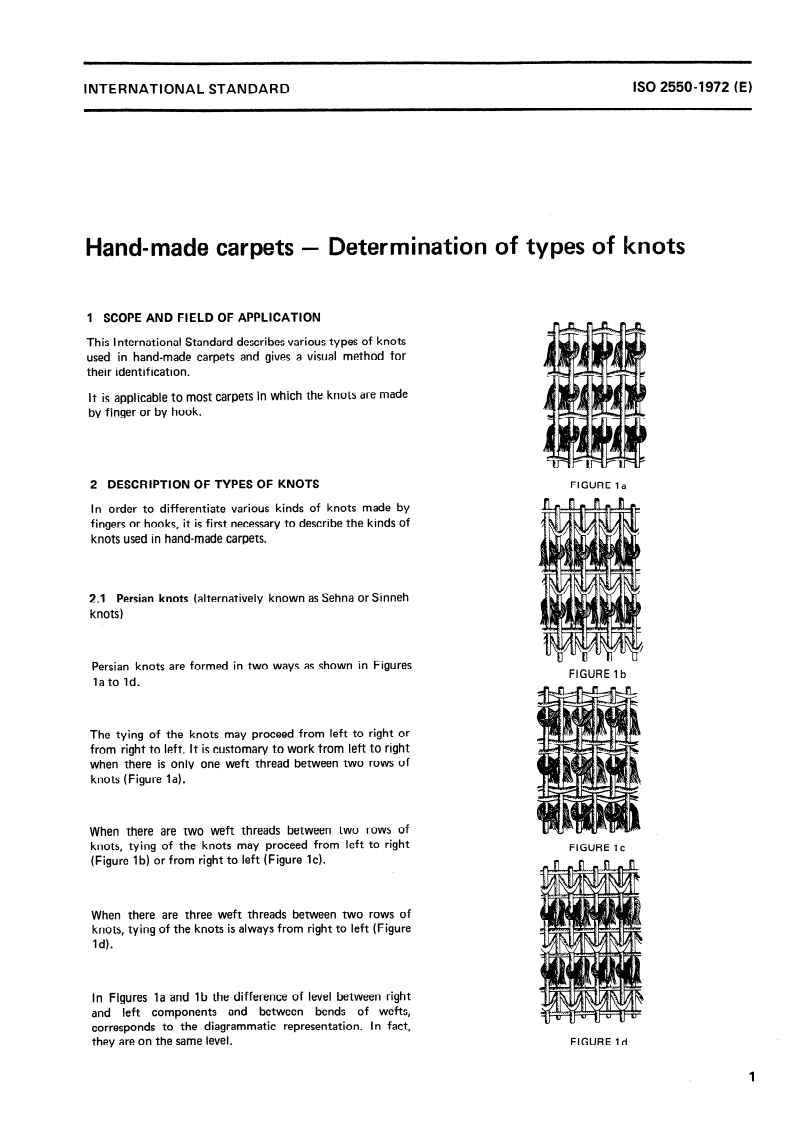
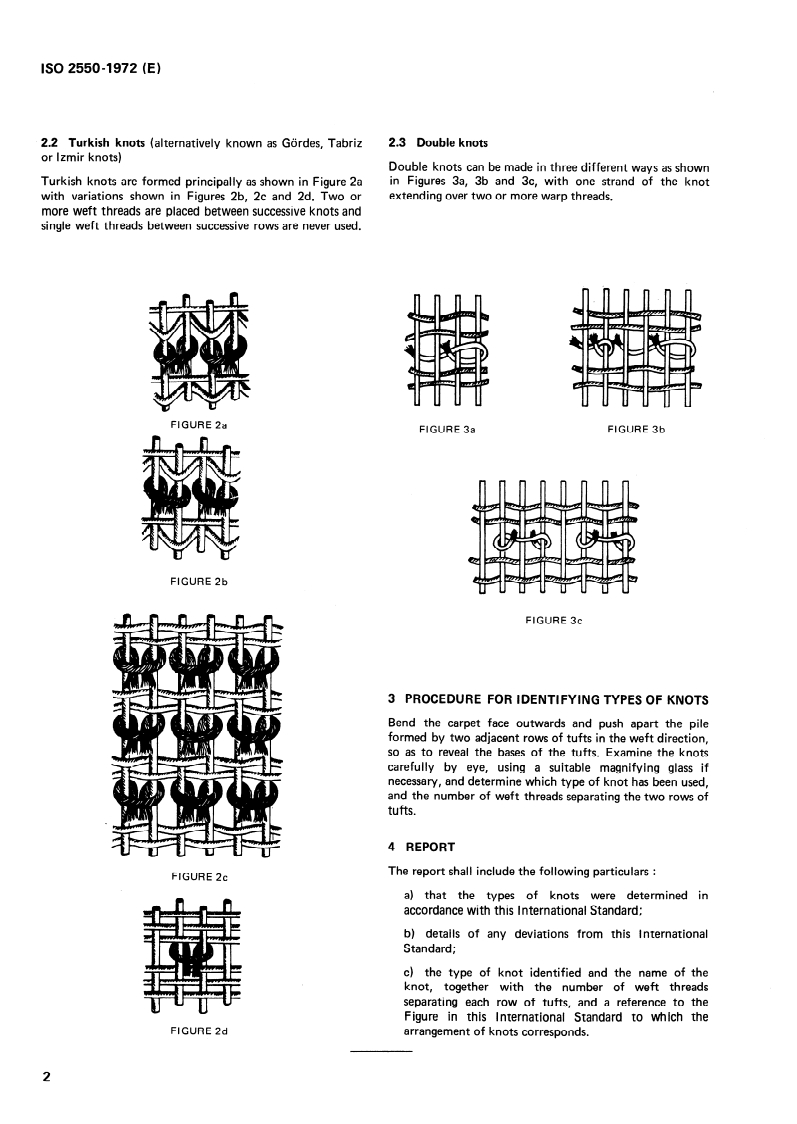
ISO 2550:1972 - Textile floor coverings — Hand-made carpets — Determination of types of knots/1/1972
ISO 2550:1972 - Tapis faits à la main — Détermination des types de noeuds/1/1972
ISO 2550:1972 - Tapis faits à la main — Détermination des types de noeuds/1/1972
Overview
ISO 2550:1972 is an international standard established by the International Organization for Standardization (ISO) that focuses on hand-made textile floor coverings, specifically carpets. This standard provides a clear method for determining and identifying the different types of knots used in manufacturing hand-made carpets. Primarily, it addresses knots tied by finger or by hook and offers a visual identification technique to recognize knot types. This standard is essential for textile manufacturers, carpet appraisers, quality control professionals, and researchers involved in the carpet industry.
Key Topics
Types of Knots in Hand-Made Carpets
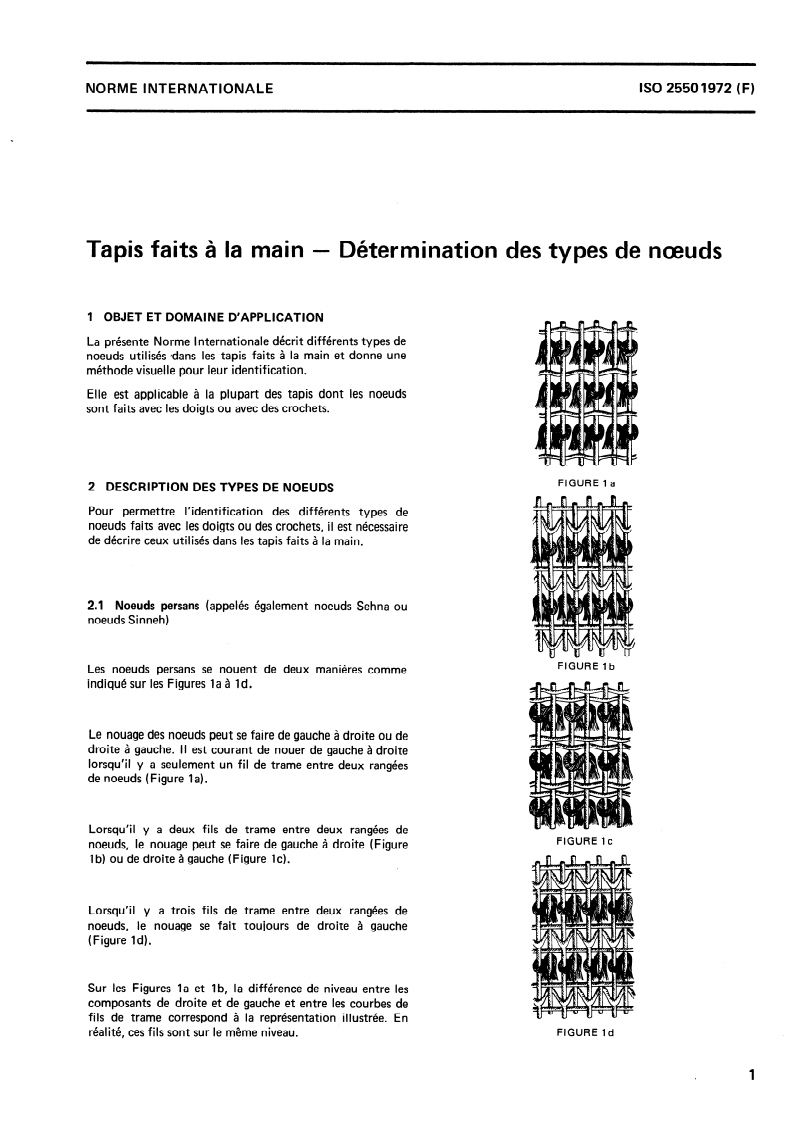
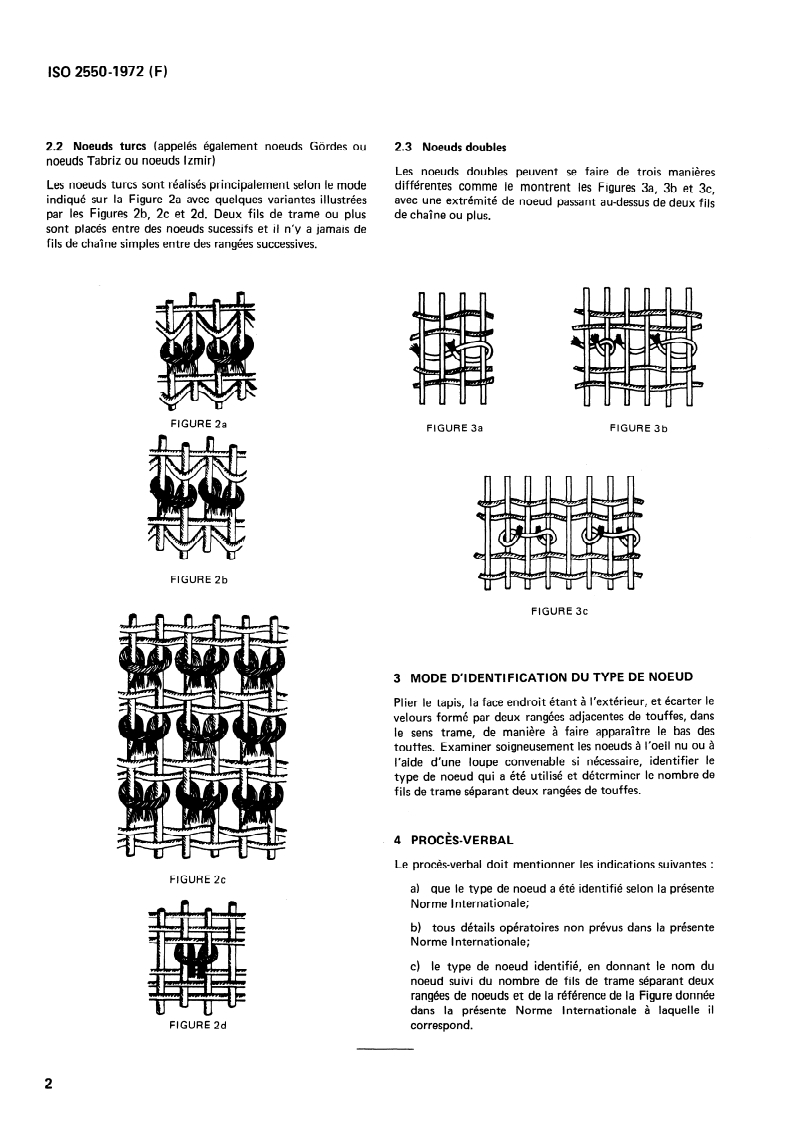
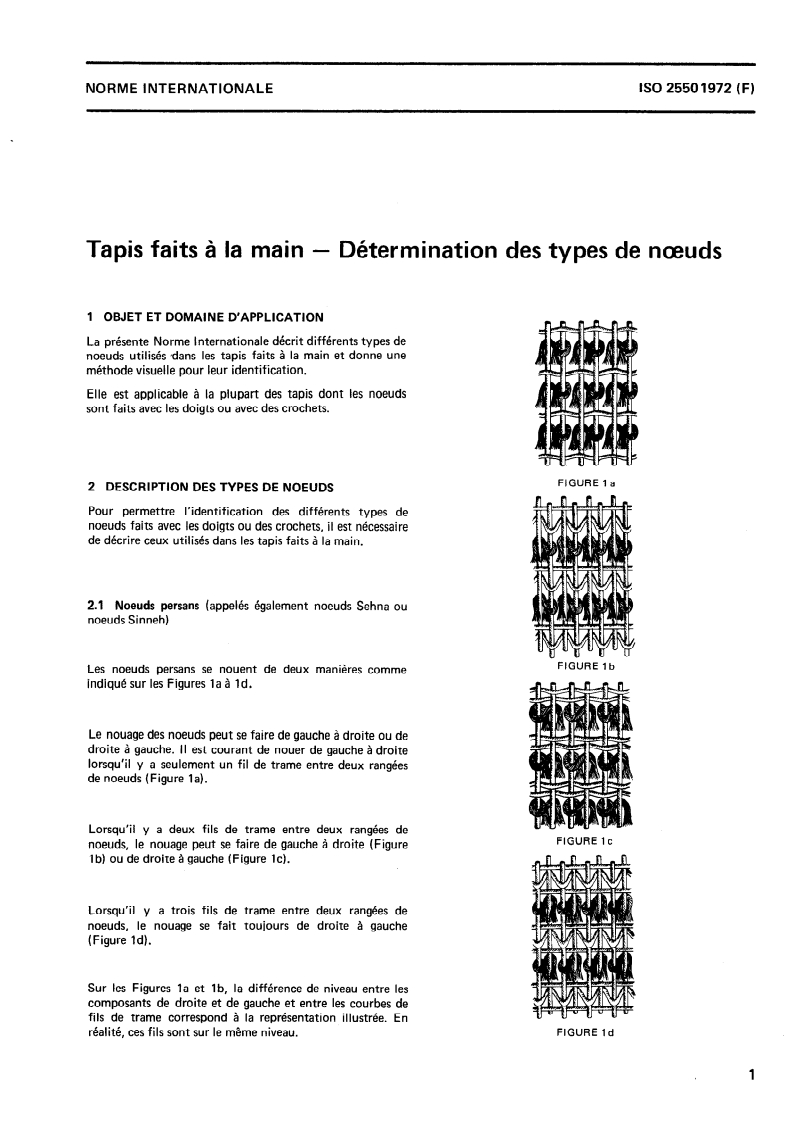
ISO 2550:1972 describes the most common knot types including:- Persian knots (Sehna or Sinneh knots): These knots can be tied from left to right or right to left depending on the number of weft threads between rows, with specific formation variations.
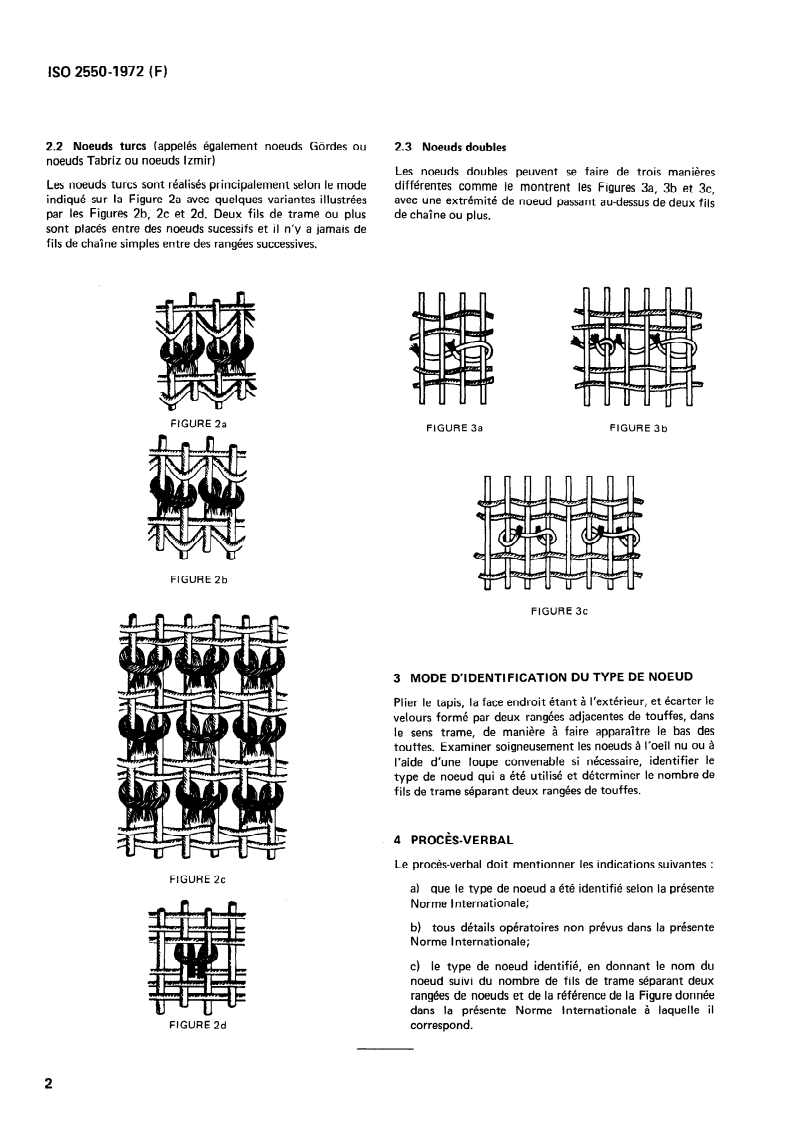
- Turkish knots (Gordes, Tabriz, or Izmir knots): Typically formed over two or more warp threads with multiple weft threads separating knot rows.
- Double knots: Detailed variations of double knot formations to enhance carpet strength and design complexity.
Visual Identification Method
The standard prescribes a step-by-step procedure for identifying knot types:- Bending the carpet face outward to expose tuft bases.
- Separating the pile between rows of tufts to reveal the knot structure.
- Careful examination, possibly with a magnifying glass, to determine the knot type and count the weft threads separating rows.
Reporting Requirements
Detailed reporting guidelines include:- Confirmation that knot identification follows ISO 2550.
- Documentation of any deviations from the standard.
- Identification of knot type, corresponding name, number of weft threads, and reference to the applicable figures from the standard.
Applications
ISO 2550:1972 is directly applicable to industries and professionals involved in:
- Carpet Manufacturing: Enabling consistent identification of knot types to maintain quality standards and enhance production accuracy.
- Textile Quality Control: Facilitating standardized evaluation of hand-crafted carpets in both factory inspections and final product certification.
- Appraisal and Authentication: Assisting expert evaluators in authenticating carpets by identifying knot types, which can impact value and origin classification.
- Educational and Research Institutions: Providing a reliable reference for teaching and studying textile craftsmanship related to carpet knotting techniques.
Related Standards
- ISO/TC 38 - Textiles: The technical committee responsible for this standard produces additional documents related to textile testing and classification.
- ISO 2424 - Textile floor coverings - Vocabulary: Offers terminology that may complement knot type identification and carpet manufacturing standards.
- ISO 12507 - Textile floor coverings - Determination of pile thickness and height: Relevant for complete assessment of hand-made carpets alongside knot type analysis.
By adhering to ISO 2550:1972, industry stakeholders ensure standardized identification of carpet knots, which is critical for quality assurance, product classification, and maintaining heritage techniques in hand-made carpet production. This supports the global marketplace in promoting trust and transparency through recognized textile flooring standards.
Relations
- Consolidated By
ISO 11985:1997 - Ophthalmic optics — Contact lenses — Ageing by exposure to UV and visible radiation (in vitro method) - Effective Date
- 06-Jun-2022
Buy Documents
ISO 2550:1972 - Textile floor coverings — Hand-made carpets — Determination of types of knots/1/1972
ISO 2550:1972 - Tapis faits à la main — Détermination des types de noeuds/1/1972
ISO 2550:1972 - Tapis faits à la main — Détermination des types de noeuds/1/1972
Get Certified
Connect with accredited certification bodies for this standard

Control Union Certifications
Global certification for agriculture and sustainability.

Hohenstein Institut
Textile testing and certification.

Bureau Veritas Bangladesh
Bureau Veritas certification services in Bangladesh.
Sponsored listings
Frequently Asked Questions
ISO 2550:1972 is a standard published by the International Organization for Standardization (ISO). Its full title is "Textile floor coverings — Hand-made carpets — Determination of types of knots". This standard covers: Describes different types of knots used in manufacturing hand-made carpets. A visual method for identification of types of knots is given. Applicable to most carpets in which knots are tied by finger or by hook. Exyamples of types of knots are shown in figures.
Describes different types of knots used in manufacturing hand-made carpets. A visual method for identification of types of knots is given. Applicable to most carpets in which knots are tied by finger or by hook. Exyamples of types of knots are shown in figures.
ISO 2550:1972 is classified under the following ICS (International Classification for Standards) categories: 59.080.60 - Textile floor coverings; 97.150 - Floor coverings. The ICS classification helps identify the subject area and facilitates finding related standards.
ISO 2550:1972 has the following relationships with other standards: It is inter standard links to ISO 11985:1997. Understanding these relationships helps ensure you are using the most current and applicable version of the standard.
ISO 2550:1972 is available in PDF format for immediate download after purchase. The document can be added to your cart and obtained through the secure checkout process. Digital delivery ensures instant access to the complete standard document.
Standards Content (Sample)
INTERNATIONAL STANDARD
INTERNATIONAL ORGANIZATION FOR STANDARDIZATION l MElKflYHAI’OflHAII OPT‘AHM3AUM5l IlO CTAHLlAPTM3AUMM .ORGANISATION INTERNATIONALE DE NORMALISATION
Determination of types of knots
Hand-made carpets -
First edition - 1972-08-15
Ref. No. IS0 2550-1972 (E)
UDC 645.12 : 620.1
Descriptors : carpets, knots, identifying.
Price based on 2 pages
FOREWORD
IS0 (the International Organization for Standardization) is a worldwide federation
of national standards institutes (IS0 Member Bodies). The work of developing
International Standards is carried out through IS0 Technical Committees. Every
Member Body interested in a subject for which a Technical Committee has been set
up has the right to be represented on that Committee. international organizations,
governmental and non-governmental, in liaison with ISO, also take part in the work.
Draft International Standards adopted by the Technical Committees are circulated
to the Member Bodies for approval before their acceptance as International
Standards by the IS0 Council.
International Standard IS0 2550 was drawn up by Technical Committee
I SO/TC 38, Textiles.
It wasapproved in February 1972 by the Member Bodies of the following countries :
Belgium India South Africa, Rep. of
Brazil I ran Spain
Canada Ireland Sweden
Czechoslovakia Israel Switzerland
Denmark Japan Thailand
Egypt, Arab Rep. of Netherlands Turkey
Finland New Zealand United Kingdom
France Norway U.S.A.
Germany Poland U.S.S.R.
Hungary
Romania
No Member Body expressed disapproval of the document.
0 International Organization for Standardization, 1972 l
Printed in Switzerland
INTERNATIONAL STANDARD IS0 2550-1972 (E)
Hand-made carpets - Determination of types of knots
1 SCOPE AND FIELD OF APPLICATION
This International Standard describes various types of knots
used in hand-made carpets and gives a visual method for
their identification.
lt is applicable to most carpets in which the knots are made
by finger or by hook.
2 DESCRIPTION OF TYPES OF KNOTS
FIGURE la
In order to differentiate various kinds of knots made by
fingers or hooks, it is first necessary to describe the kinds of
knots used in hand-made carpets.
2.1 Persian knots (alternatively known
...
NORME INTERNATIONALE
INTERNATIONAL ORGANIZATION FOR STANDARDIZATION l MElK~YHAI’OLtHAII OPPAHM3ALlMJl Il0 CTAHAAPTM3ALlMM *ORGANISATION INTERNATIONALE DE NORMALISATION
Tapis faits à la main - Détermination des types de noeuds
Première édition - 1972-08 -15
Réf. No : ISO 2550-1972 (F)
CDU 645.12 : 620.1
Descripteurs : tapis, noeuds, identification.
Prix basé sur 2 pages
AVANT-PROPOS
ISO (Organisation Internationale de Normalisation) est une fédération mondiale
d’organismes nationaux de normalisation (Comités Membres 60). L’élaboration de
Normes internationales est confiée aux Comités Techniques ISO. Chaque Comité
Membre intéressé par une étude a le droit de faire partie du Comité Technique
correspondant. Les organisations internationales, gouvernementales et non
gouvernementales, en liaison avec I’ISO, participent également aux travaux.
Les Projets de Normes Internationales adoptés par les Comités Techniques sont
soumis aux Comités Membres pour approbation, avant leur acceptation comme
Normes Internationales par le Conseil de I’ISO.
La Norme Internationale ISO 2550 a été établie par le Comité Technique
I SO/TC 38, Textiles.
Elle fut approuvée en février 1972 par les Comités Membres des pays suivants :
Afrique du Sud, Rép. d’
Hongrie Roumanie
Allemagne Inde Royaume-Uni
Belgique Iran Suède
Brésil Irlande Suisse
Canada Israël
Tchécoslovaquie
Danemark Japon Thaïlande
Egypte, Rép. arabe d’ Norvège Turquie
Nouvel le-Zélande
Espagne U.R.S.S.
Finlande Pays-Bas
U.S.A.
France Pologne
Aucun Comité Membre n’a désapprouvé le document.
0 Organisation Internationale de Normalisation, 1972 l
Imprimé en Suisse
ISO 2550 1972 (F)
NORME INTERNATIONALE
Tapis faits à la main - Détermination des types de noeuds
1 OBJET ET DOMAINE D’APPLICATION
La présente Norme Internationale décrit différents types de
noeuds utilisés jdans les tapis faits à la main et donne une
méthode visuelle pour leur identification.
Elle est applicable à la plupart des tapis dont les noeuds
sont faits avec les doigts ou avec des crochets.
FIGURE 1 a
2 DESCRIPTION DES TYPES DE NOEUDS
Pour permettre l’identification des différents types de
noeuds faits avec les doigts ou des crochets, il est nécessaire
de décrire ceux utilisés dans les tapis faits à la main.
2.1 Noeuds persans (appelés également noeuds Sehna ou
noeuds Sinneh)
FIGURE 1 b
Les noeuds persans se nouent
...