

ISO 16014-1:2019
(Main)Plastics — Determination of average molecular weight and molecular weight distribution of polymers using size-exclusion chromatography — Part 1: General principles
General Information
- Abstract
This document specifies a general method for determining the average molecular weight and the molecular weight distribution of polymers using size-exclusion chromatography (SEC). The average molecular weight and the molecular weight distribution are calculated from a calibration curve constructed using polymer standards if using one of the SEC techniques described in ISO 16014-2 to ISO 16014-4 or from a calibration curve constructed using absolute molecular weight data if using size-exclusion chromatography coupled with light-scattering detection (SEC-LS) as described in ISO 16014-5.
- Status
- Published
- Publication Date
- 14-May-2019
- Technical Committee
- ISO/TC 61/SC 5 - Physical-chemical properties
- Drafting Committee
- ISO/TC 61/SC 5/WG 11 - Analytical methods
- Current Stage
- 9093 - International Standard confirmed
- Start Date
- 06-Jun-2024
- Completion Date
- 29-Aug-2026
Buy Documents
ISO 16014-1:2019 - Plastics -- Determination of average molecular weight and molecular weight distribution of polymers using size-exclusion chromatography
ISO 16014-1:2019 - Plastics — Determination of average molecular weight and molecular weight distribution of polymers using size-exclusion chromatography — Part 1: General principles/15/2019
Overview
ISO 16014-1:2019 - "Plastics - Determination of average molecular weight and molecular weight distribution of polymers using size‑exclusion chromatography - Part 1: General principles" defines the general principles for using size‑exclusion chromatography (SEC) to determine the average molecular weight and molecular weight distribution of polymers. Part 1 sets out the method concept, essential reagents, apparatus, procedural steps, and data‑processing concepts. It explains when to use calibration curves from polymer standards versus absolute molecular weight data obtained by light‑scattering detection (SEC‑LS).
Key topics and requirements
- Principle: Separation by hydrodynamic volume; larger molecules elute earlier than smaller ones and concentration is monitored to produce an SEC chromatogram.
- Calibration approach:
- Relative methods (ISO 16014-2 to -4): molecular weight at each elution time is determined from a calibration curve built with polymer standards of narrow molecular weight distribution.
- Absolute method (ISO 16014-5 / SEC‑LS): calibration uses absolute molecular weight data from light‑scattering detection.
- Reagents: Requirements for eluents (high purity, particle‑free), column evaluation reagents, molecular weight standards characterized by absolute techniques, and appropriate additives when needed.
- Apparatus and system evaluation: Pumping system, injector, columns (theoretical plates, resolution, asymmetry), detectors (concentration and optionally LS), tubing, temperature control, and data acquisition hardware/software.
- Data acquisition & processing: Baseline determination, selection of calculation range, derivation of differential and cumulative molecular weight distributions, and calculation of average molecular weights (e.g., number‑ and mass‑average).
- Reporting & precision: Required information for test reports includes apparatus settings, calibration details, and computed results; the document also addresses precision considerations and system calibration checks.
- Important note: Mixed eluents can be used in some SEC methods but are not suitable for SEC‑LS, because selective adsorption of eluent components can bias light‑scattering measurements.
Applications
- Routine and research analysis of polymer molecular weight and polydispersity for:
- Quality control in polymer production
- Formulation and material development in plastics, coatings and adhesives
- Comparative R&D studies and failure analysis
- Regulatory and compliance testing where molecular weight profile is relevant
Who should use this standard
- Analytical chemists and laboratory managers in polymer and plastics industries
- Quality assurance professionals and process engineers monitoring molecular properties
- Instrument manufacturers and service providers implementing SEC or SEC‑LS systems
- Accreditation bodies and test laboratories preparing validated SEC methods
Related standards
- ISO 16014-2: Universal calibration method
- ISO 16014-3: Low‑temperature method
- ISO 16014-4: High‑temperature method
- ISO 16014-5: Light‑scattering (SEC‑LS) method
- ISO 472: Plastics - Vocabulary
Keywords: ISO 16014-1:2019, size‑exclusion chromatography, SEC, SEC‑LS, molecular weight distribution, average molecular weight, polymers, calibration curve, light‑scattering detection.
Relations
- Effective Date
- 25-Aug-2026
- Effective Date
- 15-Dec-2017
Buy Documents
ISO 16014-1:2019 - Plastics -- Determination of average molecular weight and molecular weight distribution of polymers using size-exclusion chromatography
ISO 16014-1:2019 - Plastics — Determination of average molecular weight and molecular weight distribution of polymers using size-exclusion chromatography — Part 1: General principles/15/2019
Get Certified
Connect with accredited certification bodies for this standard

DIN CERTCO
DIN Group product certification.

Smithers Quality Assessments
US management systems and product certification.
Sponsored listings
Frequently Asked Questions
ISO 16014-1:2019 is a standard published by the International Organization for Standardization (ISO). Its full title is "Plastics — Determination of average molecular weight and molecular weight distribution of polymers using size-exclusion chromatography — Part 1: General principles". This standard covers: This document specifies a general method for determining the average molecular weight and the molecular weight distribution of polymers using size-exclusion chromatography (SEC). The average molecular weight and the molecular weight distribution are calculated from a calibration curve constructed using polymer standards if using one of the SEC techniques described in ISO 16014-2 to ISO 16014-4 or from a calibration curve constructed using absolute molecular weight data if using size-exclusion chromatography coupled with light-scattering detection (SEC-LS) as described in ISO 16014-5.
This document specifies a general method for determining the average molecular weight and the molecular weight distribution of polymers using size-exclusion chromatography (SEC). The average molecular weight and the molecular weight distribution are calculated from a calibration curve constructed using polymer standards if using one of the SEC techniques described in ISO 16014-2 to ISO 16014-4 or from a calibration curve constructed using absolute molecular weight data if using size-exclusion chromatography coupled with light-scattering detection (SEC-LS) as described in ISO 16014-5.
ISO 16014-1:2019 is classified under the following ICS (International Classification for Standards) categories: 83.080.01 - Plastics in general. The ICS classification helps identify the subject area and facilitates finding related standards.
ISO 16014-1:2019 has the following relationships with other standards: It is inter standard links to EN ISO 16014-5:2019, ISO 16014-1:2012. Understanding these relationships helps ensure you are using the most current and applicable version of the standard.
ISO 16014-1:2019 is available in PDF format for immediate download after purchase. The document can be added to your cart and obtained through the secure checkout process. Digital delivery ensures instant access to the complete standard document.
Standards Content (Sample)
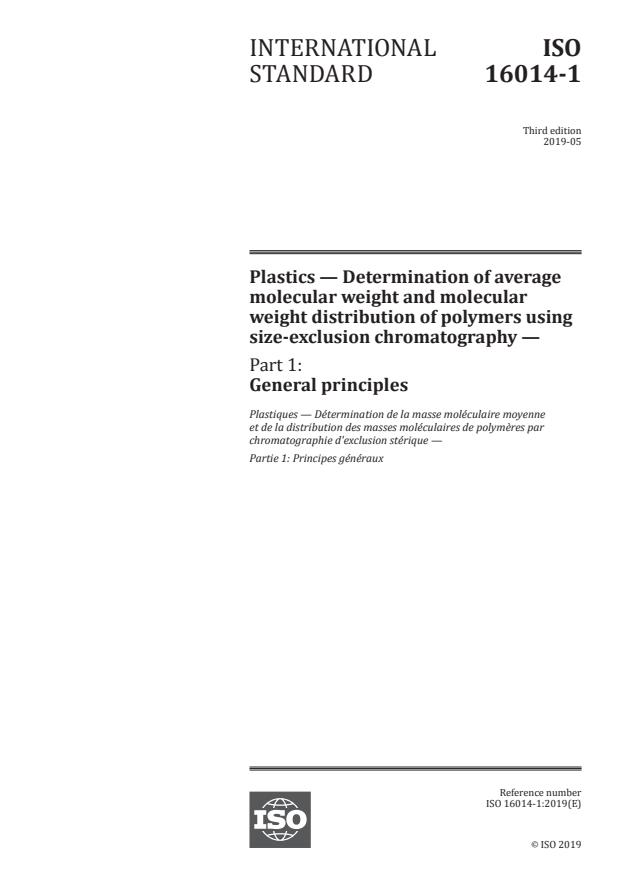
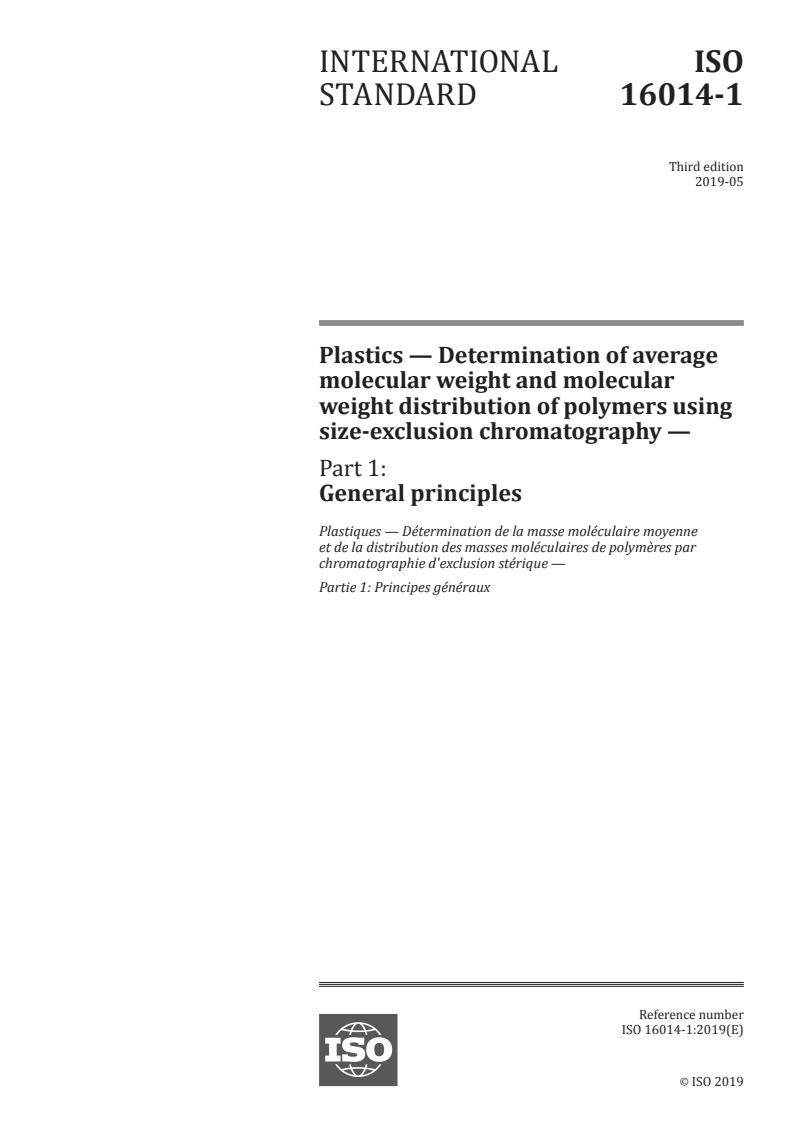
INTERNATIONAL ISO
STANDARD 16014-1
Third edition
2019-05
Plastics — Determination of average
molecular weight and molecular
weight distribution of polymers using
size-exclusion chromatography —
Part 1:
General principles
Plastiques — Détermination de la masse moléculaire moyenne
et de la distribution des masses moléculaires de polymères par
chromatographie d'exclusion stérique —
Partie 1: Principes généraux
Reference number
©
ISO 2019
© ISO 2019
All rights reserved. Unless otherwise specified, or required in the context of its implementation, no part of this publication may
be reproduced or utilized otherwise in any form or by any means, electronic or mechanical, including photocopying, or posting
on the internet or an intranet, without prior written permission. Permission can be requested from either ISO at the address
below or ISO’s member body in the country of the requester.
ISO copyright office
CP 401 • Ch. de Blandonnet 8
CH-1214 Vernier, Geneva
Phone: +41 22 749 01 11
Fax: +41 22 749 09 47
Email: copyright@iso.org
Website: www.iso.org
Published in Switzerland
ii © ISO 2019 – All rights reserved
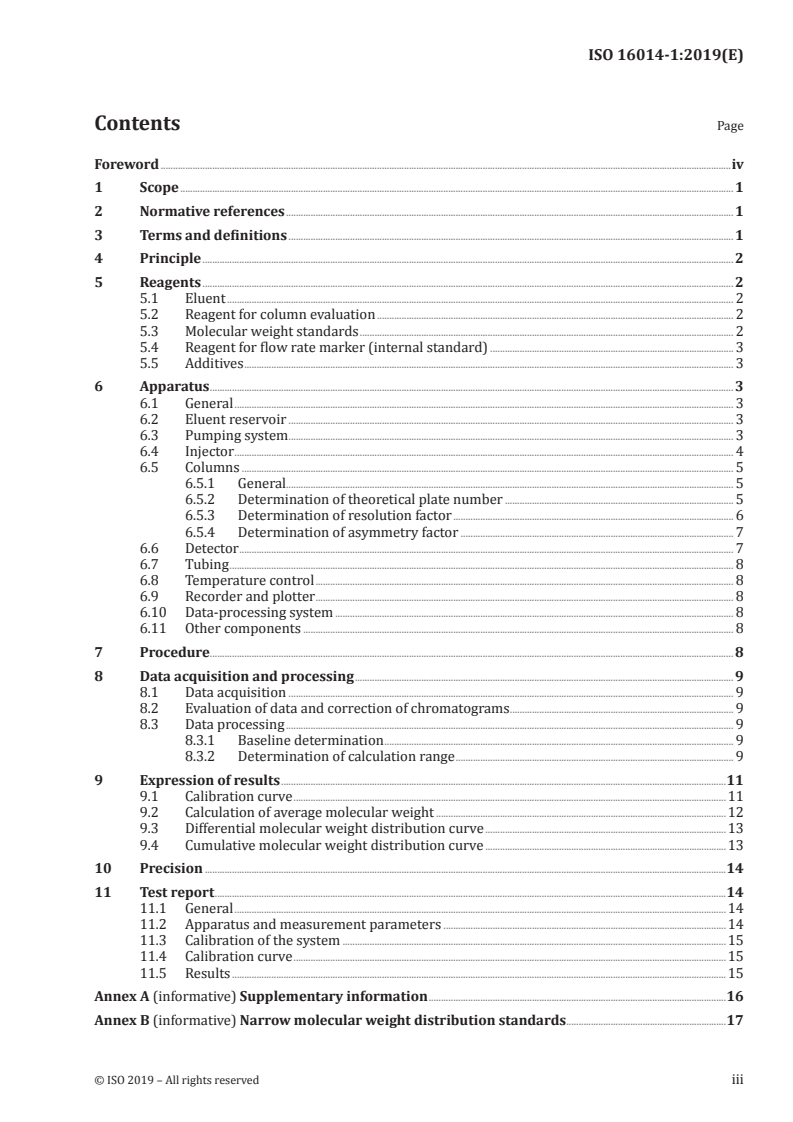
Contents Page
Foreword .iv
1 Scope . 1
2 Normative references . 1
3 Terms and definitions . 1
4 Principle . 2
5 Reagents . 2
5.1 Eluent . 2
5.2 Reagent for column evaluation . 2
5.3 Molecular weight standards . 2
5.4 Reagent for flow rate marker (internal standard) . 3
5.5 Additives . 3
6 Apparatus . 3
6.1 General . 3
6.2 Eluent reservoir . 3
6.3 Pumping system . 3
6.4 Injector . 4
6.5 Columns . 5
6.5.1 General. 5
6.5.2 Determination of theoretical plate number . 5
6.5.3 Determination of resolution factor . 6
6.5.4 Determination of asymmetry factor . 7
6.6 Detector . 7
6.7 Tubing . 8
6.8 Temperature control . 8
6.9 Recorder and plotter . 8
6.10 Data-processing system . 8
6.11 Other components . 8
7 Procedure. 8
8 Data acquisition and processing . 9
8.1 Data acquisition . 9
8.2 Evaluation of data and correction of chromatograms . 9
8.3 Data processing . 9
8.3.1 Baseline determination . 9
8.3.2 Determination of calculation range . 9
9 Expression of results .11
9.1 Calibration curve .11
9.2 Calculation of average molecular weight .12
9.3 Differential molecular weight distribution curve .13
9.4 Cumulative molecular weight distribution curve .13
10 Precision .14
11 Test report .14
11.1 General .14
11.2 Apparatus and measurement parameters .14
11.3 Calibration of the system .15
11.4 Calibration curve .15
11.5 Results .15
Annex A (informative) Supplementary information .16
Annex B (informative) Narrow molecular weight distribution standards .17
Foreword
ISO (the International Organization for Standardization) is a worldwide federation of national standards
bodies (ISO member bodies). The work of preparing International Standards is normally carried out
through ISO technical committees. Each member body interested in a subject for which a technical
committee has been established has the right to be represented on that committee. International
organizations, governmental and non-governmental, in liaison with ISO, also take part in the work.
ISO collaborates closely with the International Electrotechnical Commission (IEC) on all matters of
electrotechnical standardization.
The procedures used to develop this document and those intended for its further maintenance are
described in the ISO/IEC Directives, Part 1. In particular, the different approval criteria needed for the
different types of ISO documents should be noted. This document was drafted in accordance with the
editorial rules of the ISO/IEC Directives, Part 2 (see www .iso .org/directives).
Attention is drawn to the possibility that some of the elements of this document may be the subject of
patent rights. ISO shall not be held responsible for identifying any or all such patent rights. Details of
any patent rights identified during the development of the document will be in the Introduction and/or
on the ISO list of patent declarations received (see www .iso .org/patents).
Any trade name used in this document is information given for the convenience of users and does not
constitute an endorsement.
For an explanation of the voluntary nature of standards, the meaning of ISO specific terms and
expressions related to conformity assessment, as well as information about ISO's adherence to the
World Trade Organization (WTO) principles in the Technical Barriers to Trade (TBT) see www .iso
.org/iso/foreword .html.
This document was prepared by Technical Committee ISO/TC 61, Plastics, Subcommittee SC 5, Physical-
chemical properties.
This third edition cancels and replaces the second edition (ISO 16014-1:2012), which has been
technically revised. The main changes compared to the previous edition are as follows:
— publication dates of references have been removed;
— the term “system peak” has been added to Figure 4;
— molecular mass has been changed to molecular weight according to IUPAC rule.
A list of all parts in the ISO 16014 series can be found on the ISO website.
Any feedback or questions on this document should be directed to the user’s national standards body. A
complete listing of these bodies can be found at www .iso .org/members .html.
iv © ISO 2019 – All rights reserved
INTERNATIONAL STANDARD ISO 16014-1:2019(E)
Plastics — Determination of average molecular weight
and molecular weight distribution of polymers using size-
exclusion chromatography —
Part 1:
General principles
1 Scope
This document specifies a general method for determining the average molecular weight and the
molecular weight distribution of polymers using size-exclusion chromatography (SEC).
The average molecular weight and the molecular weight distribution are calculated from a calibration
curve constructed using polymer standards if using one of the SEC techniques described in ISO 16014-2
to ISO 16014-4 or from a calibration curve constructed using absolute molecular weight data if using
size-exclusion chromatography coupled with light-scattering detection (SEC-LS) as described in
ISO 16014-5.
2 Normative references
The following documents are referred to in the text in such a way that some or all of their content
constitutes requirements of this document. For dated references, only the edition cited applies. For
undated references, the latest edition of the referenced document (including any amendments) applies.
ISO 472, Plastics — Vocabulary
ISO 16014-2, Plastics — Determination of average molecular weight and molecular weight distribution of
polymers using size-exclusion chromatography — Part 2: Universal calibration method
ISO 16014-3, Plastics — Determination of average molecular weight and molecular weight distribution of
polymers using size-exclusion chromatography — Part 3: Low-temperature method
ISO 16014-4, Plastics — Determination of average molecular weight and molecular weight distribution of
polymers using size-exclusion chromatography — Part 4: High-temperature method
ISO 16014-5, Plastics — Determination of average molecular weight and molecular weight distribution of
polymers using size-exclusion chromatography — Part 5: Light-scattering method
3 Terms and definitions
For the purposes of this document, the terms and definitions given in ISO 472 and the following apply.
ISO and IEC maintain terminological databases for use in standardization at the following addresses:
— ISO Online browsing platform: available at https: //www .iso .org/obp
— IEC Electropedia: available at http: //www .electropedia .org/
3.1
light-scattering detection
LS detection
technique for determining the mass or size of polymer molecules dissolved in solution by measuring
the light scattered by the polymer molecules
4 Principle
A polymer sample is dissolved in a suitable solvent to make a dilute solution. This solution is injected
into the mobile phase and onto the SEC column, which is packed with non-adsorbing material made
up of small particles having pores of similar or varying size. As the polymer sample passes through
the column, the polymer molecules are separated from each other according to the difference in their
molecular masses, or more precisely, the difference in their molecular sizes (i.e. their hydrodynamic
volume). In SEC, the larger-size molecules cannot permeate into the pores, and thus elute faster, while
smaller molecules can permeate into the pores and elute more slowly. The polymer concentration in the
eluate is continuously monitored by a concentration-sensitive detector (coupled to a light-scattering
detector if SEC-LS is being used) to give an SEC chromatogram.
In the SEC techniques described in ISO 16014-2 to ISO 16014-4, the molecular weight at any elution time
on the SEC chromatogram is determined from a calibration curve which is constructed using reference
polymer standards with a narrow molecular weight distribution. In SEC-LS, described in ISO 16014-5,
a calibration curve constructed using absolute molecular weight data obtained from the SEC-
LSchromatogram at any elution time is used. The average molecular weight and the molecular weight
distribution of the unknown polymer are calculated by using the molecular weight and concentration
data corresponding to each elution time.
5 Reagents
5.1 Eluent
The required purity of the eluent used for SEC varies with the application, but in general the solvent
should be free of particulate matter and substances that react with the polymer or interfere with
detection of the polymer. Additives such as antioxidants and salts can be used to prevent the degradation
of the eluent, the aggregation of polymer molecules, the adsorption of the polymer on the packing
material and for other purposes. A mixed eluent may also be used in the SEC techniques described in
ISO 16014-2 to ISO 16014-4 to modify the solubility and the refractive index, or to reduce the cost of the
mobile phase. A mixed eluent cannot be used for SEC-LS measurements, however, because the polymer
selectively adsorbs the components of the mixed eluent, thus giving an erroneous result.
5.2 Reagent for column evaluation
A low molecular weight compound is used for the determination of the theoretical plate number,
asymmetry factor and resolution factor of the column.
5.3 Molecular weight standards
The test methods described in ISO 16014-2 to ISO 16014-4are not absolute methods but relative ones;
they require a calibration curve for the calculation of the average molecular weight and the molecular
weight distribution from the SEC chromatogram. This calibration curve is plotted using standards
of known molecular weight and narrow molecular weight distribution. The value of M and/or M
w n
of the standard determined by an absolute method, such as light scattering, membrane osmometry,
vapour pressure osmometry, ultracentrifugation or end-group analysis. The polydispersity M /M is
w n
calculated by dividing the absolute value of M by the absolute value of M . The polydispersity of the
w n
polymer standards shall lie within the following ranges:
M < 2 ⋅ 10 M /M < 1,20
p w n
3 6
2 ⋅ 10 ≤ M < 10 M /M < 1,10
p w n
10 ≤ M M /M < 1,20
p w n
2 © ISO 2019 – All rights reserved
where
M is the mass-average molecular weight;
w
M is the number-average molecular weight;
n
M is the molecular weight at peak maximum.
p
M can be calculated from Formula (1):
p
12/
MM=×()M (1)
pn w
NOTE Some commercially available molecular weight standards specify the value of M and M but not M .
w n p
In such cases, Formula (1) can be used to provide the value of M , provided the molecular weight distribution of
p
the polymer sample is a logarithmic normal distribution.
Some examples of commercially available molecular weight standards are given in Annex B.
In the case of SEC-LS (see ISO 16014-5), such molecular weight standards are unnecessary because SEC-
LS is an absolute method.
5.4 Reagent for flow rate marker (internal standard)
A low molecular weight compound is used to monitor the accuracy of the elution time, i.e. to evaluate
whether or not the data are within the specification.
5.5 Additives
Additives to the eluents may be used to improve SEC performance and prevent sample degradation and
the like.
6 Apparatus
6.1 General
A schematic diagram of an SEC system is shown in Figure 1. The essential components are an eluent
reservoir, a pumping system, an injector, column(s), a detector, tubing, a recorder, a temperature-
control system, and a data-processing system. For SEC-LS measurements, a light-scattering detector, i.e.
a molecular-weight-sensitive detector, is coupled to the normal (concentration-sensitive) detector. Any
light-scattering detector that meets the requirements specified for this method may be used.
6.2 Eluent reservoir
The eluent reservoir should preferably have sufficient capacity to hold the amount of eluent required
for column calibration and successive measurements. Dissolved air in the eluent should preferably be
removed before use by placing the solvent in a suitable container designed to reduce the pressure and
placing this container in an ultrasonic bath, or by using a vacuum degasser between the reservoir and
the pumping system. Particles in the eluent may be removed by membrane filtration. It is desirable in
addition to bubble an inert gas through the eluent in the reservoir and blanket the surface of the eluent
with the gas, and to shield the reservoir from light.
6.3 Pumping system
A constant, pulseless flow of eluent through the column is desirable. The flow rate should preferably
be approximately 1 cm /min for a column of approximately 8 mm inner diameter. The SEC system
shall have an overall flow-rate precision of within ±0,3 %. Lower flow rates are recommended for high
molecular weight and/or shear-sensitive polymers and viscous eluents. To keep the flow rate constant,
temperature control
...
INTERNATIONAL ISO
STANDARD 16014-1
Third edition
2019-05
Plastics — Determination of average
molecular weight and molecular
weight distribution of polymers using
size-exclusion chromatography —
Part 1:
General principles
Plastiques — Détermination de la masse moléculaire moyenne
et de la distribution des masses moléculaires de polymères par
chromatographie d'exclusion stérique —
Partie 1: Principes généraux
Reference number
©
ISO 2019
© ISO 2019
All rights reserved. Unless otherwise specified, or required in the context of its implementation, no part of this publication may
be reproduced or utilized otherwise in any form or by any means, electronic or mechanical, including photocopying, or posting
on the internet or an intranet, without prior written permission. Permission can be requested from either ISO at the address
below or ISO’s member body in the country of the requester.
ISO copyright office
CP 401 • Ch. de Blandonnet 8
CH-1214 Vernier, Geneva
Phone: +41 22 749 01 11
Fax: +41 22 749 09 47
Email: copyright@iso.org
Website: www.iso.org
Published in Switzerland
ii © ISO 2019 – All rights reserved
Contents Page
Foreword .iv
1 Scope . 1
2 Normative references . 1
3 Terms and definitions . 1
4 Principle . 2
5 Reagents . 2
5.1 Eluent . 2
5.2 Reagent for column evaluation . 2
5.3 Molecular weight standards . 2
5.4 Reagent for flow rate marker (internal standard) . 3
5.5 Additives . 3
6 Apparatus . 3
6.1 General . 3
6.2 Eluent reservoir . 3
6.3 Pumping system . 3
6.4 Injector . 4
6.5 Columns . 5
6.5.1 General. 5
6.5.2 Determination of theoretical plate number . 5
6.5.3 Determination of resolution factor . 6
6.5.4 Determination of asymmetry factor . 7
6.6 Detector . 7
6.7 Tubing . 8
6.8 Temperature control . 8
6.9 Recorder and plotter . 8
6.10 Data-processing system . 8
6.11 Other components . 8
7 Procedure. 8
8 Data acquisition and processing . 9
8.1 Data acquisition . 9
8.2 Evaluation of data and correction of chromatograms . 9
8.3 Data processing . 9
8.3.1 Baseline determination . 9
8.3.2 Determination of calculation range . 9
9 Expression of results .11
9.1 Calibration curve .11
9.2 Calculation of average molecular weight .12
9.3 Differential molecular weight distribution curve .13
9.4 Cumulative molecular weight distribution curve .13
10 Precision .14
11 Test report .14
11.1 General .14
11.2 Apparatus and measurement parameters .14
11.3 Calibration of the system .15
11.4 Calibration curve .15
11.5 Results .15
Annex A (informative) Supplementary information .16
Annex B (informative) Narrow molecular weight distribution standards .17
Foreword
ISO (the International Organization for Standardization) is a worldwide federation of national standards
bodies (ISO member bodies). The work of preparing International Standards is normally carried out
through ISO technical committees. Each member body interested in a subject for which a technical
committee has been established has the right to be represented on that committee. International
organizations, governmental and non-governmental, in liaison with ISO, also take part in the work.
ISO collaborates closely with the International Electrotechnical Commission (IEC) on all matters of
electrotechnical standardization.
The procedures used to develop this document and those intended for its further maintenance are
described in the ISO/IEC Directives, Part 1. In particular, the different approval criteria needed for the
different types of ISO documents should be noted. This document was drafted in accordance with the
editorial rules of the ISO/IEC Directives, Part 2 (see www .iso .org/directives).
Attention is drawn to the possibility that some of the elements of this document may be the subject of
patent rights. ISO shall not be held responsible for identifying any or all such patent rights. Details of
any patent rights identified during the development of the document will be in the Introduction and/or
on the ISO list of patent declarations received (see www .iso .org/patents).
Any trade name used in this document is information given for the convenience of users and does not
constitute an endorsement.
For an explanation of the voluntary nature of standards, the meaning of ISO specific terms and
expressions related to conformity assessment, as well as information about ISO's adherence to the
World Trade Organization (WTO) principles in the Technical Barriers to Trade (TBT) see www .iso
.org/iso/foreword .html.
This document was prepared by Technical Committee ISO/TC 61, Plastics, Subcommittee SC 5, Physical-
chemical properties.
This third edition cancels and replaces the second edition (ISO 16014-1:2012), which has been
technically revised. The main changes compared to the previous edition are as follows:
— publication dates of references have been removed;
— the term “system peak” has been added to Figure 4;
— molecular mass has been changed to molecular weight according to IUPAC rule.
A list of all parts in the ISO 16014 series can be found on the ISO website.
Any feedback or questions on this document should be directed to the user’s national standards body. A
complete listing of these bodies can be found at www .iso .org/members .html.
iv © ISO 2019 – All rights reserved
INTERNATIONAL STANDARD ISO 16014-1:2019(E)
Plastics — Determination of average molecular weight
and molecular weight distribution of polymers using size-
exclusion chromatography —
Part 1:
General principles
1 Scope
This document specifies a general method for determining the average molecular weight and the
molecular weight distribution of polymers using size-exclusion chromatography (SEC).
The average molecular weight and the molecular weight distribution are calculated from a calibration
curve constructed using polymer standards if using one of the SEC techniques described in ISO 16014-2
to ISO 16014-4 or from a calibration curve constructed using absolute molecular weight data if using
size-exclusion chromatography coupled with light-scattering detection (SEC-LS) as described in
ISO 16014-5.
2 Normative references
The following documents are referred to in the text in such a way that some or all of their content
constitutes requirements of this document. For dated references, only the edition cited applies. For
undated references, the latest edition of the referenced document (including any amendments) applies.
ISO 472, Plastics — Vocabulary
ISO 16014-2, Plastics — Determination of average molecular weight and molecular weight distribution of
polymers using size-exclusion chromatography — Part 2: Universal calibration method
ISO 16014-3, Plastics — Determination of average molecular weight and molecular weight distribution of
polymers using size-exclusion chromatography — Part 3: Low-temperature method
ISO 16014-4, Plastics — Determination of average molecular weight and molecular weight distribution of
polymers using size-exclusion chromatography — Part 4: High-temperature method
ISO 16014-5, Plastics — Determination of average molecular weight and molecular weight distribution of
polymers using size-exclusion chromatography — Part 5: Light-scattering method
3 Terms and definitions
For the purposes of this document, the terms and definitions given in ISO 472 and the following apply.
ISO and IEC maintain terminological databases for use in standardization at the following addresses:
— ISO Online browsing platform: available at https: //www .iso .org/obp
— IEC Electropedia: available at http: //www .electropedia .org/
3.1
light-scattering detection
LS detection
technique for determining the mass or size of polymer molecules dissolved in solution by measuring
the light scattered by the polymer molecules
4 Principle
A polymer sample is dissolved in a suitable solvent to make a dilute solution. This solution is injected
into the mobile phase and onto the SEC column, which is packed with non-adsorbing material made
up of small particles having pores of similar or varying size. As the polymer sample passes through
the column, the polymer molecules are separated from each other according to the difference in their
molecular masses, or more precisely, the difference in their molecular sizes (i.e. their hydrodynamic
volume). In SEC, the larger-size molecules cannot permeate into the pores, and thus elute faster, while
smaller molecules can permeate into the pores and elute more slowly. The polymer concentration in the
eluate is continuously monitored by a concentration-sensitive detector (coupled to a light-scattering
detector if SEC-LS is being used) to give an SEC chromatogram.
In the SEC techniques described in ISO 16014-2 to ISO 16014-4, the molecular weight at any elution time
on the SEC chromatogram is determined from a calibration curve which is constructed using reference
polymer standards with a narrow molecular weight distribution. In SEC-LS, described in ISO 16014-5,
a calibration curve constructed using absolute molecular weight data obtained from the SEC-
LSchromatogram at any elution time is used. The average molecular weight and the molecular weight
distribution of the unknown polymer are calculated by using the molecular weight and concentration
data corresponding to each elution time.
5 Reagents
5.1 Eluent
The required purity of the eluent used for SEC varies with the application, but in general the solvent
should be free of particulate matter and substances that react with the polymer or interfere with
detection of the polymer. Additives such as antioxidants and salts can be used to prevent the degradation
of the eluent, the aggregation of polymer molecules, the adsorption of the polymer on the packing
material and for other purposes. A mixed eluent may also be used in the SEC techniques described in
ISO 16014-2 to ISO 16014-4 to modify the solubility and the refractive index, or to reduce the cost of the
mobile phase. A mixed eluent cannot be used for SEC-LS measurements, however, because the polymer
selectively adsorbs the components of the mixed eluent, thus giving an erroneous result.
5.2 Reagent for column evaluation
A low molecular weight compound is used for the determination of the theoretical plate number,
asymmetry factor and resolution factor of the column.
5.3 Molecular weight standards
The test methods described in ISO 16014-2 to ISO 16014-4are not absolute methods but relative ones;
they require a calibration curve for the calculation of the average molecular weight and the molecular
weight distribution from the SEC chromatogram. This calibration curve is plotted using standards
of known molecular weight and narrow molecular weight distribution. The value of M and/or M
w n
of the standard determined by an absolute method, such as light scattering, membrane osmometry,
vapour pressure osmometry, ultracentrifugation or end-group analysis. The polydispersity M /M is
w n
calculated by dividing the absolute value of M by the absolute value of M . The polydispersity of the
w n
polymer standards shall lie within the following ranges:
M < 2 ⋅ 10 M /M < 1,20
p w n
3 6
2 ⋅ 10 ≤ M < 10 M /M < 1,10
p w n
10 ≤ M M /M < 1,20
p w n
2 © ISO 2019 – All rights reserved
where
M is the mass-average molecular weight;
w
M is the number-average molecular weight;
n
M is the molecular weight at peak maximum.
p
M can be calculated from Formula (1):
p
12/
MM=×()M (1)
pn w
NOTE Some commercially available molecular weight standards specify the value of M and M but not M .
w n p
In such cases, Formula (1) can be used to provide the value of M , provided the molecular weight distribution of
p
the polymer sample is a logarithmic normal distribution.
Some examples of commercially available molecular weight standards are given in Annex B.
In the case of SEC-LS (see ISO 16014-5), such molecular weight standards are unnecessary because SEC-
LS is an absolute method.
5.4 Reagent for flow rate marker (internal standard)
A low molecular weight compound is used to monitor the accuracy of the elution time, i.e. to evaluate
whether or not the data are within the specification.
5.5 Additives
Additives to the eluents may be used to improve SEC performance and prevent sample degradation and
the like.
6 Apparatus
6.1 General
A schematic diagram of an SEC system is shown in Figure 1. The essential components are an eluent
reservoir, a pumping system, an injector, column(s), a detector, tubing, a recorder, a temperature-
control system, and a data-processing system. For SEC-LS measurements, a light-scattering detector, i.e.
a molecular-weight-sensitive detector, is coupled to the normal (concentration-sensitive) detector. Any
light-scattering detector that meets the requirements specified for this method may be used.
6.2 Eluent reservoir
The eluent reservoir should preferably have sufficient capacity to hold the amount of eluent required
for column calibration and successive measurements. Dissolved air in the eluent should preferably be
removed before use by placing the solvent in a suitable container designed to reduce the pressure and
placing this container in an ultrasonic bath, or by using a vacuum degasser between the reservoir and
the pumping system. Particles in the eluent may be removed by membrane filtration. It is desirable in
addition to bubble an inert gas through the eluent in the reservoir and blanket the surface of the eluent
with the gas, and to shield the reservoir from light.
6.3 Pumping system
A constant, pulseless flow of eluent through the column is desirable. The flow rate should preferably
be approximately 1 cm /min for a column of approximately 8 mm inner diameter. The SEC system
shall have an overall flow-rate precision of within ±0,3 %. Lower flow rates are recommended for high
molecular weight and/or shear-sensitive polymers and viscous eluents. To keep the flow rate constant,
temperature control
...