

ISO 105-B07:2009
(Main)Textiles — Tests for colour fastness — Part B07: Colour fastness to light of textiles wetted with artificial perspiration
General Information
- Abstract
ISO 105-B07:2009 specifies a method for determining the resistance of the colour of textiles, of all kinds and in all forms, to the combined effect of wetting with acid or alkaline artificial perspiration solutions and an artificial light source representing natural daylight (D65).
- Status
- Published
- Publication Date
- 19-Apr-2009
- Technical Committee
- ISO/TC 38/SC 1 - Tests for coloured textiles and colorants
- Drafting Committee
- ISO/TC 38/SC 1/WG 1 - Light and weathering
- Current Stage
- 9093 - International Standard confirmed
- Start Date
- 16-Oct-2025
- Completion Date
- 29-Aug-2026
Buy Documents
ISO 105-B07:2009 - Textiles — Tests for colour fastness — Part B07: Colour fastness to light of textiles wetted with artificial perspiration Released:4/20/2009
ISO 105-B07:2009 - Textiles — Essais de solidité des teintures — Partie B07: Solidité des teintures a la lumiere de textiles mouillés par de la sueur artificielle Released:4/20/2009
Overview
ISO 105-B07:2009 is an international standard established by the International Organization for Standardization (ISO) that specifies a reliable method to test the colour fastness of textiles to light when wetted with artificial perspiration. This test is crucial for evaluating the durability and resistance of textile colors against the combined effects of perspiration and daylight exposure. The artificial perspiration simulates acidic or alkaline conditions typical of human sweat, while the artificial light source represents natural daylight (D65). This standard applies to all textiles, in any form, ensuring universal applicability.
Keywords: ISO 105-B07, colour fastness, textiles, artificial perspiration, lightfastness, D65 light source, textile testing, perspiration resistance
Key Topics
Scope and Purpose: ISO 105-B07:2009 focuses on assessing colour resistance of textiles exposed to artificial light after being wetted with acid or alkaline artificial perspiration solutions. This simulates real-life conditions under which textiles might degrade.
Test Principle: Textile specimens soaked in artificial perspiration solution are exposed to xenon-arc artificial light. A blue wool reference fabric is used as a benchmark to determine when sufficient fading has occurred. Changes in specimen colour are evaluated using a grey scale or instrumental colorimetry.
Artificial Perspiration Solutions: The standard includes detailed preparation for various artificial perspiration solutions-acid perspiration solutions at pH ~4.3 and 5.5, and an alkali solution at pH ~8.0. These solutions replicate typical human sweat chemistry affecting textile color.
Apparatus and Materials: Testing requires precise equipment including a xenon-arc lamp fading apparatus, pH meter, grey scale for colour assessment, blue wool reference materials, and accurate weighing scales. High-purity water and appropriate specimen holders ensure testing accuracy.
Specimen Preparation: Textile samples must be wetted to a specified wet pick-up level (~100%) and properly mounted alongside control materials for exposure in the fading apparatus.
Exposure and Evaluation: Specimens and reference material are simultaneously exposed under strict lighting conditions until the reference fades to a predetermined level. Textile colour change is then assessed visually or instrumentally to quantify fastness.
Reporting: The test report includes detailed information on samples, perspiration solution used, blue wool reference batch, test apparatus conditions, ratings for colour change, and any deviations from the procedure.
Applications
Textile Quality Control: ISO 105-B07:2009 is essential for manufacturers to verify that fabric colors can withstand exposure to sweat and daylight, ensuring product durability and consumer satisfaction.
Performance Testing for Apparel: Sportswear, uniforms, and outdoor clothing benefit from this test as they frequently face perspiration and sunlight exposure.
Textile Research and Development: Innovators use this standard to design improved dyes and fabric treatments that enhance resistance to fading in challenging environmental conditions.
Compliance and Certification: Helps textile producers meet regulatory and industry quality benchmarks for colour fastness to light and perspiration.
Material Comparison: Enables manufacturers and buyers to compare different textiles' performance reliably, supporting material selection decisions.
Related Standards
- ISO 105-A02: Grey scale for assessing change in colour
- ISO 105-A05: Instrumental colorimetric assessment of colour change
- ISO 105-B02: Colour fastness to artificial light using xenon arc fading lamp
- ISO 105-E04: Colour fastness to perspiration
- ISO 3696: Specification for grade 3 water used in laboratories
Together, these standards provide a comprehensive framework for evaluating textile colour fastness under various environmental stresses, ensuring consistent and globally recognized testing procedures.
By using ISO 105-B07:2009, textile professionals can confidently assess and improve the longevity of fabric colors when exposed to human perspiration and light, enhancing product reliability and consumer trust worldwide.
Relations
- Effective Date
- 12-Feb-2026
Buy Documents
ISO 105-B07:2009 - Textiles — Tests for colour fastness — Part B07: Colour fastness to light of textiles wetted with artificial perspiration Released:4/20/2009
ISO 105-B07:2009 - Textiles — Essais de solidité des teintures — Partie B07: Solidité des teintures a la lumiere de textiles mouillés par de la sueur artificielle Released:4/20/2009
Get Certified
Connect with accredited certification bodies for this standard

Control Union Certifications
Global certification for agriculture and sustainability.

Hohenstein Institut
Textile testing and certification.

Bureau Veritas Bangladesh
Bureau Veritas certification services in Bangladesh.
Sponsored listings
Frequently Asked Questions
ISO 105-B07:2009 is a standard published by the International Organization for Standardization (ISO). Its full title is "Textiles — Tests for colour fastness — Part B07: Colour fastness to light of textiles wetted with artificial perspiration". This standard covers: ISO 105-B07:2009 specifies a method for determining the resistance of the colour of textiles, of all kinds and in all forms, to the combined effect of wetting with acid or alkaline artificial perspiration solutions and an artificial light source representing natural daylight (D65).
ISO 105-B07:2009 specifies a method for determining the resistance of the colour of textiles, of all kinds and in all forms, to the combined effect of wetting with acid or alkaline artificial perspiration solutions and an artificial light source representing natural daylight (D65).
ISO 105-B07:2009 is classified under the following ICS (International Classification for Standards) categories: 59.080.01 - Textiles in general. The ICS classification helps identify the subject area and facilitates finding related standards.
ISO 105-B07:2009 has the following relationships with other standards: It is inter standard links to EN ISO 105-B07:2009. Understanding these relationships helps ensure you are using the most current and applicable version of the standard.
ISO 105-B07:2009 is available in PDF format for immediate download after purchase. The document can be added to your cart and obtained through the secure checkout process. Digital delivery ensures instant access to the complete standard document.
Standards Content (Sample)
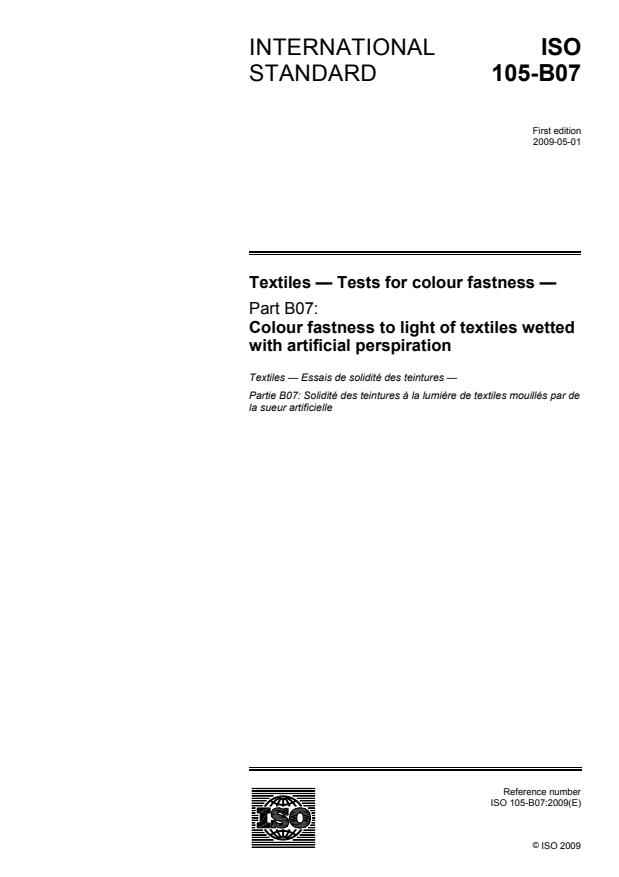
INTERNATIONAL ISO
STANDARD 105-B07
First edition
2009-05-01
Textiles — Tests for colour fastness —
Part B07:
Colour fastness to light of textiles wetted
with artificial perspiration
Textiles — Essais de solidité des teintures —
Partie B07: Solidité des teintures à la lumière de textiles mouillés par de
la sueur artificielle
Reference number
©
ISO 2009
PDF disclaimer
This PDF file may contain embedded typefaces. In accordance with Adobe's licensing policy, this file may be printed or viewed but
shall not be edited unless the typefaces which are embedded are licensed to and installed on the computer performing the editing. In
downloading this file, parties accept therein the responsibility of not infringing Adobe's licensing policy. The ISO Central Secretariat
accepts no liability in this area.
Adobe is a trademark of Adobe Systems Incorporated.
Details of the software products used to create this PDF file can be found in the General Info relative to the file; the PDF-creation
parameters were optimized for printing. Every care has been taken to ensure that the file is suitable for use by ISO member bodies. In
the unlikely event that a problem relating to it is found, please inform the Central Secretariat at the address given below.
© ISO 2009
All rights reserved. Unless otherwise specified, no part of this publication may be reproduced or utilized in any form or by any means,
electronic or mechanical, including photocopying and microfilm, without permission in writing from either ISO at the address below or
ISO's member body in the country of the requester.
ISO copyright office
Case postale 56 • CH-1211 Geneva 20
Tel. + 41 22 749 01 11
Fax + 41 22 749 09 47
E-mail copyright@iso.org
Web www.iso.org
Published in Switzerland
ii © ISO 2009 – All rights reserved
Foreword
ISO (the International Organization for Standardization) is a worldwide federation of national standards bodies
(ISO member bodies). The work of preparing International Standards is normally carried out through ISO
technical committees. Each member body interested in a subject for which a technical committee has been
established has the right to be represented on that committee. International organizations, governmental and
non-governmental, in liaison with ISO, also take part in the work. ISO collaborates closely with the
International Electrotechnical Commission (IEC) on all matters of electrotechnical standardization.
International Standards are drafted in accordance with the rules given in the ISO/IEC Directives, Part 2.
The main task of technical committees is to prepare International Standards. Draft International Standards
adopted by the technical committees are circulated to the member bodies for voting. Publication as an
International Standard requires approval by at least 75 % of the member bodies casting a vote.
Attention is drawn to the possibility that some of the elements of this document may be the subject of patent
rights. ISO shall not be held responsible for identifying any or all such patent rights.
ISO 105-B07 was prepared by Technical Committee ISO/TC 38, Textiles, Subcommittee SC 1, Tests for
coloured textiles and colorants.
ISO 105 was previously published in 13 “parts”, each designated by a letter (e.g. “Part A”), with publication
dates between 1978 and 1985. Each part contained a series of “sections”, each designated by the respective
part letter and by a two-digit serial number (e.g. “Section A01”). These sections are now being republished as
separate documents, themselves designated “parts” but retaining their earlier alphanumeric designations. A
[2]
complete list of these parts is given in ISO 105-A01 .
Introduction
This part of ISO 105 was developed using acid perspiration solution 1 and the exposure conditions listed in
ISO 105-B02.
iv © ISO 2009 – All rights reserved
INTERNATIONAL STANDARD ISO 105-B07:2009(E)
Textiles — Tests for colour fastness —
Part B07:
Colour fastness to light of textiles wetted with artificial
perspiration
1 Scope
This part of ISO 105 specifies a method for determining the resistance of the colour of textiles, of all kinds and
in all forms, to the combined effect of wetting with acid or alkaline artificial perspiration solutions and an
artificial light source representing natural daylight (D65).
2 Normative reference(s)
The following referenced documents are indispensable for the application of this document. For dated
references, only the edition cited applies. For undated references, the latest edition of the referenced
document (including any amendments) applies.
ISO 105-A02, Textiles — Tests for colour fastness — Part A02: Grey scale for assessing change in colour
ISO 105-A05, Textiles — Tests for colour fastness — Part A05: Instrumental assessment of change in colour
for determination of grey scale rating
ISO 105-B02, Textiles — Tests for colour fastness — Part B02: Colour fastness to artificial light: Xenon arc
fading lamp test
ISO 105-E04, Textiles — Tests for colour fastness — Part E04: Colour fastness to perspiration
ISO 3696, Water for analytical laboratory use — Specification and test methods
3 Principle
Specimens of textiles wetted with a selected artificial perspiration solution are exposed to artificial light under
prescribed conditions, together with a specified blue wool reference material. When this blue wool reference
material shows the prescribed change of colour, the specimens are removed and the change in colour of each
specimen is assessed by comparison with the grey scale for assessing change in colour
...
NORME ISO
INTERNATIONALE 105-B07
Première édition
2009-05-01
Textiles — Essais de solidité
des teintures —
Partie B07:
Solidité des teintures à la lumière
de textiles mouillés par de la sueur
artificielle
Textiles — Tests for colour fastness —
Part B07: Colour fastness to light of textiles wetted with artificial
perspiration
Numéro de référence
©
ISO 2009
PDF – Exonération de responsabilité
Le présent fichier PDF peut contenir des polices de caractères intégrées. Conformément aux conditions de licence d'Adobe, ce fichier
peut être imprimé ou visualisé, mais ne doit pas être modifié à moins que l'ordinateur employé à cet effet ne bénéficie d'une licence
autorisant l'utilisation de ces polices et que celles-ci y soient installées. Lors du téléchargement de ce fichier, les parties concernées
acceptent de fait la responsabilité de ne pas enfreindre les conditions de licence d'Adobe. Le Secrétariat central de l'ISO décline toute
responsabilité en la matière.
Adobe est une marque déposée d'Adobe Systems Incorporated.
Les détails relatifs aux produits logiciels utilisés pour la création du présent fichier PDF sont disponibles dans la rubrique General Info
du fichier; les paramètres de création PDF ont été optimisés pour l'impression. Toutes les mesures ont été prises pour garantir
l'exploitation de ce fichier par les comités membres de l'ISO. Dans le cas peu probable où surviendrait un problème d'utilisation,
veuillez en informer le Secrétariat central à l'adresse donnée ci-dessous.
DOCUMENT PROTÉGÉ PAR COPYRIGHT
© ISO 2009
Droits de reproduction réservés. Sauf prescription différente, aucune partie de cette publication ne peut être reproduite ni utilisée sous
quelque forme que ce soit et par aucun procédé, électronique ou mécanique, y compris la photocopie et les microfilms, sans l'accord écrit
de l'ISO à l'adresse ci-après ou du comité membre de l'ISO dans le pays du demandeur.
ISO copyright office
Case postale 56 • CH-1211 Geneva 20
Tel. + 41 22 749 01 11
Fax + 41 22 749 09 47
E-mail copyright@iso.org
Web www.iso.org
Publié en Suisse
ii © ISO 2009 – Tous droits réservés
Avant-propos
L'ISO (Organisation internationale de normalisation) est une fédération mondiale d'organismes nationaux de
normalisation (comités membres de l'ISO). L'élaboration des Normes internationales est en général confiée
aux comités techniques de l'ISO. Chaque comité membre intéressé par une étude a le droit de faire partie du
comité technique créé à cet effet. Les organisations internationales, gouvernementales et non
gouvernementales, en liaison avec l'ISO participent également aux travaux. L'ISO collabore étroitement avec
la Commission électrotechnique internationale (CEI) en ce qui concerne la normalisation électrotechnique.
Les Normes internationales sont rédigées conformément aux règles données dans les Directives ISO/CEI,
Partie 2.
La tâche principale des comités techniques est d'élaborer les Normes internationales. Les projets de Normes
internationales adoptés par les comités techniques sont soumis aux comités membres pour vote. Leur
publication comme Normes internationales requiert l'approbation de 75 % au moins des comités membres
votants.
L'attention est appelée sur le fait que certains des éléments du présent document peuvent faire l'objet de
droits de propriété intellectuelle ou de droits analogues. L'ISO ne saurait être tenue pour responsable de ne
pas avoir identifié de tels droits de propriété et averti de leur existence.
L'ISO 105-B07 a été élaborée par le comité technique ISO/TC 38, Textiles, sous-comité SC 1, Essais des
textiles colorés et des colorants.
L'ISO 105 a auparavant été publiée en 13 «parties», chacune désignée par une lettre (par exemple
«Partie A»), avec une date de publication comprise entre 1978 et 1985. Chaque partie contenait une série de
«sections» chacune désignée par une lettre correspondant à la partie et par un numéro de série à deux
chiffres (par exemple «Section A01»). Ces sections sont à présent publiées à nouveau comme documents
séparés, eux-mêmes désignés «parties» mais conservant leurs désignations alphanumériques antérieures.
[2]
Une liste complète de ces parties est donnée dans l'ISO 105-A01 .
Introduction
La présente partie de l'ISO 105 a été mise au point en utilisant la solution de sueur acide n°1 et les conditions
d'exposition indiquées dans l'ISO 105-B02.
iv © ISO 2009 – Tous droits réservés
NORME INTERNATIONALE ISO 105-B07:2009(F)
Textiles — Essais de solidité des teintures —
Partie B07:
Solidité des teintures à la lumière de textiles mouillés
par de la sueur artificielle
1 Domaine d'application
La présente partie de l'ISO 105 spécifie une méthode de détermination de la solidité des teintures de textiles,
de toutes sortes et de toutes formes, aux effets combinés d'une solution de sueur artificielle acide ou alcaline
et d'une source de lumière artificielle représentative de la lumière du jour (D65).
2 Références normatives
Les documents de référence suivants sont indispensables pour l'application du présent document. Pour les
références datées, seule l'édition citée s'applique. Pour les références non datées, la dernière édition du
document de référence s'applique (y compris les éventuels amendements).
ISO 105-A02, Textiles — Essais de solidité des teintures — Partie A02: Échelle de gris pour l'évaluation des
dégradations
ISO 105-A05, Textiles — Essais de solidité des teintures — Partie A05: Évaluation instrumentale du
changement de couleur pour conversion en degrés de l'échelle de gris
ISO 105-B02, Textiles — Essais de solidité des teintures — Partie B02: Solidité des teintures à la lumière
artificielle: Lampe à arc au xénon
ISO 105-E04, Textiles — Essais de solidité des teintures — Partie E04: Solidité des teintures à la sueur
ISO 3696, Eau pour laboratoire à usage analytique — Spécification et méthodes d'essai
3 Principe
Des éprouvettes de textiles mouillés avec une solution de sueur artificielle choisie sont exposées à la lumière
artificielle dans des conditions prescrites en même temps qu'un étalon de laine teinte en bleu spécifié. Dès
que cet étalon de laine teinte en bleu présente la dégradation requise, les éprouvettes sont retirées et la
dégradation de couleur de chaque éprouvette est évaluée par comparaison avec l'échell
...