

ISO 19461-1:2018
(Main)Radiological protection — Measurement for the clearance of waste contaminated with radioisotopes for medical application — Part 1: Measurement of radioactivity
General Information
- Abstract
This document establishes a method for radioactivity measurement and determination of the storage periods of the radioactive wastes produced as a result of the medical application of radioisotopes based on counting measurements using a detector and decay correction of the initial activity concentration of the radioisotopes contained in the waste stream. It provides a set of controls and measurements for the self-clearance of the radioactive wastes by which the medical facility can be assured of meeting the clearance level. This document can also be used by testing laboratories or radioactive waste disposal operators. This document can also be useful for the guidance of the regulatory body. NOTE Due to the nature of the tests outlined, this document cannot be applied to pure beta emitting nuclides nor to alpha emitting nuclides with low energy gamma rays.
- Status
- Published
- Publication Date
- 16-Jul-2018
- Technical Committee
- ISO/TC 85/SC 2 - Radiological protection
- Drafting Committee
- ISO/TC 85/SC 2 - Radiological protection
- Current Stage
- 9093 - International Standard confirmed
- Start Date
- 20-Dec-2023
- Completion Date
- 29-Aug-2026
Buy Documents
ISO 19461-1:2018 - Radiological protection -- Measurement for the clearance of waste contaminated with radioisotopes for medical application
ISO 19461-1:2018 - Radiological protection — Measurement for the clearance of waste contaminated with radioisotopes for medical application — Part 1: Measurement of radioactivity/17/2018
Overview
ISO 19461-1:2018 - Radiological protection - Measurement for the clearance of waste contaminated with radioisotopes for medical application - Part 1: Measurement of radioactivity - specifies a method for measuring radioactivity and determining minimum storage periods for radioactive wastes generated by medical use of radioisotopes. The standard uses counting measurements with detectors and decay correction of initial activity concentration to verify wastes meet a designated clearance level. It supports self-clearance by medical facilities and can be used by testing laboratories, waste disposal operators, and regulators. Note: this Part 1 method does not apply to pure beta emitters or alpha emitters with low-energy gamma rays.
Key topics
- Measurement method: Counting measurements using detectors with decay correction to estimate initial activity concentration and evaluate decay to clearance.
- Storage-period determination: Procedures to calculate minimum storage durations so waste decays below the applicable clearance level.
- Controls and requirements: Pre-storage controls, measurement before storage, storage container and disposal method guidance.
- Uncertainty and quality control: Requirements for evaluating measurement uncertainty, documentation, reporting and ongoing quality assurance.
- Scope limitations: Explicit exclusion of pure beta-emitting nuclides and alpha emitters with low-energy gamma rays.
- Supporting materials: Annexes provide example procedures and sample measurement results to aid implementation.
Applications
Who uses ISO 19461-1:2018 and how:
- Medical facilities (hospitals, nuclear medicine departments): To implement self-clearance processes for short-lived radioisotope waste and to calculate storage time before non-radioactive disposal.
- Testing laboratories: To perform traceable radioactivity measurements and report results consistent with clearance verification.
- Radioactive waste disposal operators: To accept, verify and manage decay-storage of medical radioactive wastes.
- Regulatory bodies: For guidance on acceptable measurement methods, documentation and demonstrating compliance with clearance criteria.
Practical benefits include standardized detector-based measurement procedures, traceable documentation of decay-based clearance, and improved confidence that disposed materials meet public dose and environmental protection objectives.
Related standards
- ISO 19461 series (other parts) - for broader guidance across the clearance workflow.
- International Atomic Energy Agency (IAEA) guidance (referenced in the standard) - for dose- and concentration-based clearance criteria and complementary approaches.
Keywords: ISO 19461-1:2018, radiological protection, measurement for the clearance of waste, radioactivity measurement, medical radioisotopes, decay correction, clearance level, self-clearance, radioactive waste disposal.
Buy Documents
ISO 19461-1:2018 - Radiological protection -- Measurement for the clearance of waste contaminated with radioisotopes for medical application
ISO 19461-1:2018 - Radiological protection — Measurement for the clearance of waste contaminated with radioisotopes for medical application — Part 1: Measurement of radioactivity/17/2018
Get Certified
Connect with accredited certification bodies for this standard

BSMI (Bureau of Standards, Metrology and Inspection)
Taiwan's standards and inspection authority.
CIS Institut d.o.o.
Personal Protective Equipment (PPE) certification body. Notified Body NB-2890 for EU Regulation 2016/425 PPE.

Kiwa BDA Testing
Building and construction product certification.
Sponsored listings
Frequently Asked Questions
ISO 19461-1:2018 is a standard published by the International Organization for Standardization (ISO). Its full title is "Radiological protection — Measurement for the clearance of waste contaminated with radioisotopes for medical application — Part 1: Measurement of radioactivity". This standard covers: This document establishes a method for radioactivity measurement and determination of the storage periods of the radioactive wastes produced as a result of the medical application of radioisotopes based on counting measurements using a detector and decay correction of the initial activity concentration of the radioisotopes contained in the waste stream. It provides a set of controls and measurements for the self-clearance of the radioactive wastes by which the medical facility can be assured of meeting the clearance level. This document can also be used by testing laboratories or radioactive waste disposal operators. This document can also be useful for the guidance of the regulatory body. NOTE Due to the nature of the tests outlined, this document cannot be applied to pure beta emitting nuclides nor to alpha emitting nuclides with low energy gamma rays.
This document establishes a method for radioactivity measurement and determination of the storage periods of the radioactive wastes produced as a result of the medical application of radioisotopes based on counting measurements using a detector and decay correction of the initial activity concentration of the radioisotopes contained in the waste stream. It provides a set of controls and measurements for the self-clearance of the radioactive wastes by which the medical facility can be assured of meeting the clearance level. This document can also be used by testing laboratories or radioactive waste disposal operators. This document can also be useful for the guidance of the regulatory body. NOTE Due to the nature of the tests outlined, this document cannot be applied to pure beta emitting nuclides nor to alpha emitting nuclides with low energy gamma rays.
ISO 19461-1:2018 is classified under the following ICS (International Classification for Standards) categories: 13.280 - Radiation protection; 17.240 - Radiation measurements. The ICS classification helps identify the subject area and facilitates finding related standards.
ISO 19461-1:2018 is available in PDF format for immediate download after purchase. The document can be added to your cart and obtained through the secure checkout process. Digital delivery ensures instant access to the complete standard document.
Standards Content (Sample)
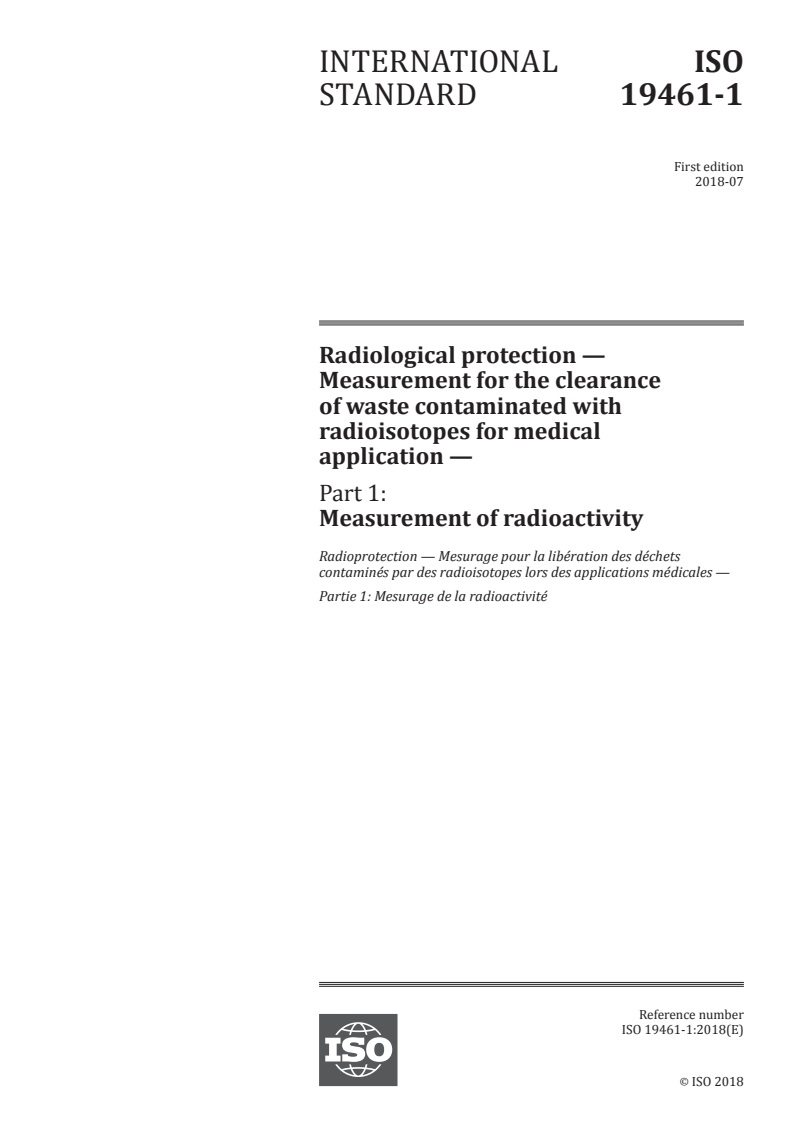
INTERNATIONAL ISO
STANDARD 19461-1
First edition
2018-07
Radiological protection —
Measurement for the clearance
of waste contaminated with
radioisotopes for medical
application —
Part 1:
Measurement of radioactivity
Radioprotection — Mesurage pour la libération des déchets
contaminés par des radioisotopes lors des applications médicales —
Partie 1: Mesurage de la radioactivité
Reference number
©
ISO 2018
© ISO 2018
All rights reserved. Unless otherwise specified, or required in the context of its implementation, no part of this publication may
be reproduced or utilized otherwise in any form or by any means, electronic or mechanical, including photocopying, or posting
on the internet or an intranet, without prior written permission. Permission can be requested from either ISO at the address
below or ISO’s member body in the country of the requester.
ISO copyright office
CP 401 • Ch. de Blandonnet 8
CH-1214 Vernier, Geneva
Phone: +41 22 749 01 11
Fax: +41 22 749 09 47
Email: copyright@iso.org
Website: www.iso.org
Published in Switzerland
ii © ISO 2018 – All rights reserved
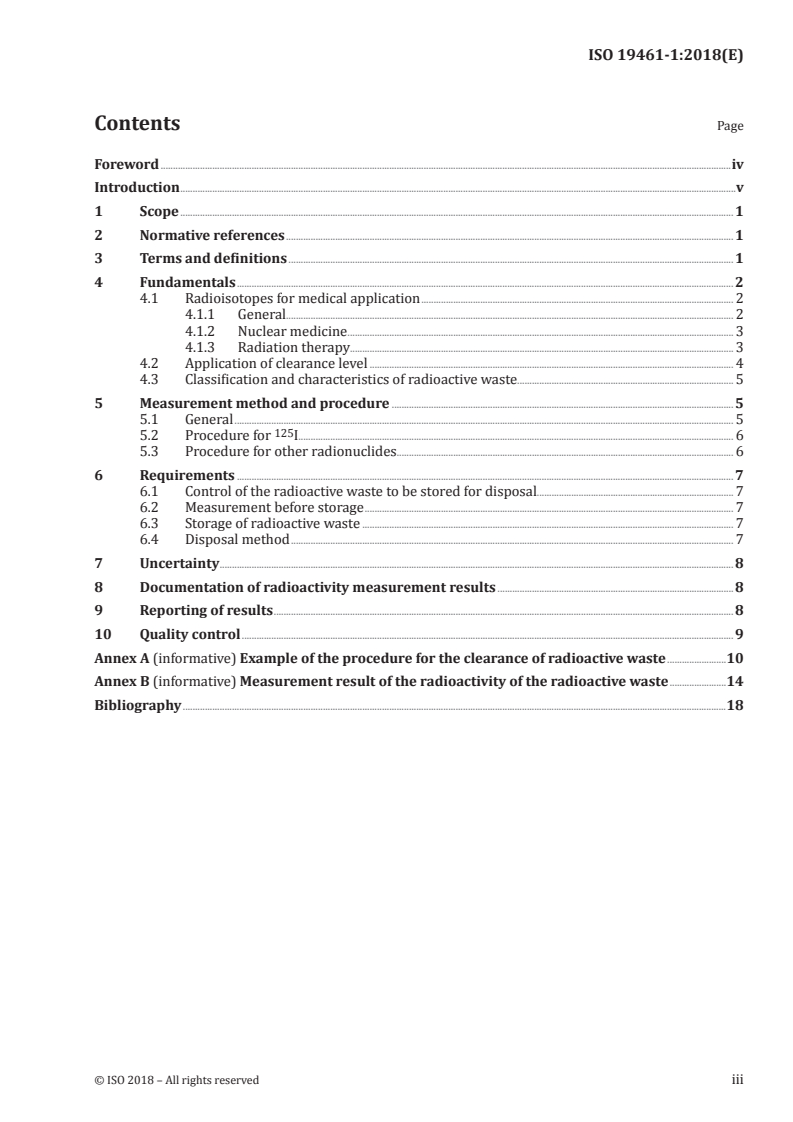
Contents Page
Foreword .iv
Introduction .v
1 Scope . 1
2 Normative references . 1
3 Terms and definitions . 1
4 Fundamentals . 2
4.1 Radioisotopes for medical application . 2
4.1.1 General. 2
4.1.2 Nuclear medicine . 3
4.1.3 Radiation therapy . . . 3
4.2 Application of clearance level . 4
4.3 Classification and characteristics of radioactive waste. 5
5 Measurement method and procedure . 5
5.1 General . 5
5.2 Procedure for I. 6
5.3 Procedure for other radionuclides. 6
6 Requirements . 7
6.1 Control of the radioactive waste to be stored for disposal. 7
6.2 Measurement before storage . 7
6.3 Storage of radioactive waste . 7
6.4 Disposal method . 7
7 Uncertainty . 8
8 Documentation of radioactivity measurement results . 8
9 Reporting of results . 8
10 Quality control . 9
Annex A (informative) Example of the procedure for the clearance of radioactive waste .10
Annex B (informative) Measurement result of the radioactivity of the radioactive waste .14
Bibliography .18
Foreword
ISO (the International Organization for Standardization) is a worldwide federation of national standards
bodies (ISO member bodies). The work of preparing International Standards is normally carried out
through ISO technical committees. Each member body interested in a subject for which a technical
committee has been established has the right to be represented on that committee. International
organizations, governmental and non-governmental, in liaison with ISO, also take part in the work.
ISO collaborates closely with the International Electrotechnical Commission (IEC) on all matters of
electrotechnical standardization.
The procedures used to develop this document and those intended for its further maintenance are
described in the ISO/IEC Directives, Part 1. In particular the different approval criteria needed for the
different types of ISO documents should be noted. This document was drafted in accordance with the
editorial rules of the ISO/IEC Directives, Part 2 (see www .iso .org/directives).
Attention is drawn to the possibility that some of the elements of this document may be the subject of
patent rights. ISO shall not be held responsible for identifying any or all such patent rights. Details of
any patent rights identified during the development of the document will be in the Introduction and/or
on the ISO list of patent declarations received (see www .iso .org/patents).
Any trade name used in this document is information given for the convenience of users and does not
constitute an endorsement.
For an explanation on the voluntary nature of standards, the meaning of ISO specific terms and
expressions related to conformity assessment, as well as information about ISO's adherence to the
World Trade Organization (WTO) principles in the Technical Barriers to Trade (TBT) see the following
URL: www .iso .org/iso/foreword .html.
This document was prepared by Technical Committee ISO/TC 85, Nuclear energy nuclear technologies
and radiological protection, Subcommittee SC 2, Radiation protection.
A list of all the parts in the ISO 19461 series can be found on the ISO website.
iv © ISO 2018 – All rights reserved
Introduction
This document addresses the method for radioactivity measurement, the procedure for determining the
storage period, the condition for the clearance of waste contaminated with radioisotopes for medical
application based on the initial condition of each type of waste, and the equation to obtain radioactivity
from counting measurements using a detector. From the equation, the appropriate duration of storage
for the radioactive waste before final disposal can be evaluated.
The amounts of radioisotopes used in medical facilities that are disposed of as waste have been
increasing rapidly, due to the development of various technologies applied to diagnosis and radiation
treatment using nuclear medicine.
Most of the nuclear medicine applications employ radioisotopes with a short half-life, such as F being
99m
used in positron emission tomography/computed tomography (PET/CT) diagnosis and Tc being
used for a bone or thyroid scan. However, the quantities used in the medical facility can be so large that
the disposal of the consequent radioactive waste becomes a serious concern.
The International Atomic Energy Agency (IAEA) proposed criteria for the clearance level of radioactive
waste depending on the individual dose (10 μSv/y) and collective dose (1 man-Sv/y) (IAEA Safety Series
[10] [11]
No 111-P-1.1) , and concentration of each nuclide (IAEA RS-G-1.7) , and methods for determining
the clearance level from the criteria by evaluating the dose or concentration of the radioactive waste on
a case-by-case basis.
However, the practical application of the IAEA methods is so complicated that most countries use an
alternative method to determine the minimum storage time based on the measurement of radioactivity
and radioactive decay for the mainly short-lived radioactive wastes instead of the direct application of
IAEA criteria. Therefore, the measurement of radioactivity becomes more significant for obtaining an
accurate minimum storage time for each radioactive waste before its disposal.
By considering the current situation regarding the clearance level, this document proposes radioactivity
measurement methods useful for establishing the minimum storage duration necessary to attain the
applicable clearance level for radioactive wastes, and for verifying wastes have decayed to below the
applicable clearance level prior to disposal as non-radioactive waste.
The medical administration of radioactive material is carefully controlled. Therefore, in most cases
an estimate of initial activity in waste, sufficient for calculating the minimum storage time for decay
to clearance levels, can be derived from knowledge of the administration process, and no initial
measurement is necessary or warranted. In such cases the method described in 5.3 can be used to
estimate the appropriate storage time.
INTERNATIONAL STANDARD ISO 19461-1:2018(E)
Radiological protection — Measurement for the clearance
of waste contaminated with radioisotopes for medical
application —
Part 1:
Measurement of radioactivity
1 Scope
This document establishes a method for radioactivity measurement and determination of the storage
periods of the radioactive wastes produced as a result of the medical application of radioisotopes based
on counting measurements using a detector and decay correction of the initial activity concentration of
the radioisotopes contained in the waste stream.
It provides a set of controls and measurements for the self-clearance of the radioactive wastes by which
the medical facility can be assured of meeting the clearance level.
This document can also be used by testing laboratories or radioactive waste disposal operators.
This document can also be useful for the guidance of the regulatory body.
NOTE Due to the nature of the tests outlined, this document cannot be applied to pure beta emitting nuclides
nor to alpha emitting nuclides with low energy gamma rays.
2 Normative references
There are no normative references in this document.
3 Terms and definitions
For the purposes of this document, the following terms and definitions apply.
ISO and IEC maintain terminological databases for use in standardization at the following addresses:
— ISO Online browsing platform: available at https: //www .iso .org/obp
— IEC Electropedia: available at http: //www .electropedia .org/
3.1
activity
number of spontaneous nuclear disintegrations per unit time.
Note 1 to entry: The activity is expressed in becquerels (Bq).
3.2
bulk
anything greater than the amount of moderate quantities
Note 1 to entry: The term of moderate quantities indicates quantities that “are at most on the order of a ton” of
material.
3.3
calibration
set of operations that establishes, under specific conditions, the relationship between values of a
quantity and the corresponding values traceable to primary standards
3.4
certified reference material
CRM
reference material characterized by a metrologically valid procedure for one or more specified
properties, accompanied by a certificate that provides the value of the specified property, its associated
uncertainty, and a statement of metrological traceability
3.5
clearance level
value established by the competent authority, expressed in terms of activity, activity concentration
or surface contamination (fixed and non-fixed) at or below which radioactive material or radioactive
objects within authorized practice may be removed from any further regulatory control by the
regulatory body
3.6
decay
spontaneous transformation of one radioisotope into one or more different isotopes (known as “decay
products” or “daughter products”), accompanied by a decrease in radioactivity of the parent material
Note 1 to entry: The rates of these transformations are unique for each radioisotope and are stated in terms of
“half-life,” which is the period of time for the activity of a specified isotope to fall to half its original value. The
transformations can be a result of electron capture, fission, or the emission of alpha particles, beta particles, or
photons (gamma radiation) from the nucleus of an unstable atom.
3.7
medical application
intentional internal or external administration of radioactive material or radiation from radioactive
material to patients or research subjects under the supervision of an authorized user
3.8
radioactive waste
radioactive materials at the end of their useful life or in a product that is no longer useful and requires
proper disposal
3.9
radioisotope
unstable isotope of an element that decays or disintegrates spontaneously, thereby emitting radiation
Note 1 to entry: Approximately 5 000 natural and artificial radioisotopes have been identified.
3.10
storage container
container in which radioactive waste is secured and stored
4 Fundamentals
4.1 Radioisotopes for medical application
4.1.1 General
Many countries have worked to promote the use of radioactive material in medicine by collaborating
with international organizations through projects, programs and agreements. The use of nuclear
techniques in medicine has become one of the most widespread peaceful applications of atomic energy.
2 © ISO 2018 – All rights reserved
In modern society, an overview of the two main themes of the application of radioisotopes for medical
use includes nuclear medicine and radiotherapy.
4.1.2 Nuclear medicine
The field of nuclear medicine uses a trace amount of radioactive substances called radioisotopes for the
diagnosis and treatment of many health conditions such as certain cancers and neurological and heart
diseases.
In nuclear medicine, radionuclides are used to provide diagnostic information about the body. The
techniques in this field can be broadly divided into two categories: in vivo and in vitro procedures.
1)
a) In vivo
In vivo non-invasive procedures occur inside the body and account for most of those procedures
performed in nuclear medicine. These methods involve the use of radiopharmaceuticals, which are
carefully chosen among radioactive materials that are absorbed into a patient’s body and, due to
their specific chemical properties, target specific tissues and organs, such as the lungs or heart,
without disturbing or damaging them.
The material is then identified using a special detector that can detect the small amounts of
radiation released from the material, such as a gamma camera, placed outside of the body. The
camera can then translate the information into two-dimensional or three-dimensional images of
the specific tissue or organ. Among the more well-known and fastest growing of these techniques
is positron emission tomography (PET). Practitioners use special instruments called positron
emission tomography scanners to obtain scans that track body chemistry and organ function on
a molecular level, allowing the identification of more nuanced changes in the health of a patient
at an earlier stage than many other diagnostic techniques. PET scans can be combined with other
scanning techniques, such as computed tomography, to further enhance the speed, accuracy and
usefulness of nuclear medical imaging. Nuclear medicine techniques such as these, unlike traditional
X-ray imaging, which depicts anatomical details, reveal how the body functions showing important
dynamic physiological or biochemical qualities of the targeted body part. The information
produced during such diagnostic procedures frequently supplements static X-ray images, assisting
the physician in determining the status and function of different organs, particularly because the
physician makes critical decisions and tailors treatment to the patient’s needs.
2)
b) In vitro
In vitro diagnostic procedures are performed outside of the body, such as in a test tube or a
culture dish. Within the field of nuclear medicine, procedures such as radioimmunoassay or
immunoradiometric assay primarily focus on identifying predispositions to certain health
conditions and early diagnosis using genotyping and molecular profiling for various conditions.
This can range from identifying changes in cancer cells and tumor markers to measuring and
tracking hormones, vitamins and drugs for detecting nutritional and endocrine disorders, as well
as, bacterial and parasitic infections such as tuberculosis and malaria.
4.1.3 Radiation therapy
Radiation therapy, or radiotherapy, is a branch of medicine that focuses on the use of radiation to treat
cancer and other medical conditions. Radiotherapy is designed to use radiation to target and kill cells.
In the case of cancer, when the radiation is applied to a cancerous tumor, or a mass of malignant cells,
the targeted cells are damaged and killed, leading to a reduction of the tumor size or, in some cases, the
disappearance of the mass. There are primarily three types of radiation therapy treatment options:
external beam radiation therapy, brachytherapy and systemic radioisotope therapy.
1) In vivo: from the Latin for "in one that is living" occurring within the living.
2) In vitro: from the Latin for "in glass" isolated from the living organism and artificially maintained, as in a test
tube.
4.2 Application of clearance level
Clearance is defined as the removal of radioactive materials or radioactive objects within authorized
practices from any further regulatory control by the regulatory body. Furthermore, the Basic Safety
Standard (BSS) of the IAEA states that the clearance levels “shall take account of the exemption criteria
and shall not be higher than the exemption levels or defined by the regulatory body”. A footnote
indicates that the “clearance of bulk amounts of materials with activity concentrations lower than the
guidance exemption levels may require further consideration by the regulatory body”.
In summary, the BSS provides radiological criteria to serve as a basis for the derivation of clearance
levels but provides no definitive quantitative guidance on the clearance levels. The activity concentration
values developed in Table 1 for use in making decisions on the exemption of bulk materials may be used
by regulatory bodies based on the clearance of such materials.
Table 1 — Criteria for radionuclides in bulk amounts of materials
Radionuclides Level (Bq/g)
I-129 0,01
a a a a
Na-22; Sc-46; Mn-54; Co-56; Co-60; Zn-65; Nb-94; Ru-106 ; Ag-110m ; Sb-125 ; Cs-134; Cs-137 ;
a a
Eu-152; Eu-154; Ta-182; Bi-207; Th-229; U-232 ; Pu-238; Pu-239; Pu-240; Pu-242; Pu-244 ; Am-241; 0,1
a a a a
Am-242m ; Am-243 ; Cm-245; Cm-246; Cm-247 ; Cm-248; Cf-249; Cf-251; Es-254
a a
C-14; Na-24; Cl-36; Sc-48; V-48; Mn-52; Fe-59; Co-57; Co-58; Se-75; Br-82; Sr-85; Sr-90 ; Zr-95 ;
a a a a
Nb-95; Tc-96; Tc-99; Ru-103 ; Ag-105; Cd-109 ; Sn-113 ; Sb-124; Te-123m; Te-132 ; Cs-136; Ba-140;
a
La-140; Ce-139; Eu-155; Tb-160; Hf-181; Os-185; Ir-190; Ir-192; Tl-204; Bi-206; U-233; Np-237 ;
Pu-236; Cm-243; Cm-244; Cf-248; Cf-250; Cf-252; Cf-254
a
Be-7; F-18; Cl-38; K-40; K-43; Ca-47; Mn-51; Mn-52m; Mn-56; Fe-52 ; Co-55; Co-62m; Ni-65;
a a a a
Zn-69m ; Ga-72; As-74; As-76; Sr-91 ; Sr-92; Zr-93; Zr-97 ; Nb-93m; Nb-97 ; Nb-98; Mo-90;
a a a a a
Mo-93; Mo-99 ; Mo-101 ; Tc-97; Ru-97; Ru-105 ; Cd-115 ; In-111; In-114m ; Sn-125; Sb-122; Te-
a a a
127m ; Te-129m ; Te-131m ; Te-133; Te-133m; Te-134; I-126; I-130; I-131; I-132; I-133; I-134; 10
a
I-135; Cs-129; Cs-132; Cs-138; Ba-131; Ce-143; Ce-144 ; Gd-153; W-181; W-187; Pt-191; Au-198;
Hg-203; Tl-200; Tl-202; Pb-203; Po-203; Po-205; Po-207; Ra-225; Pa-230; Pa-233; U-230; U-236;
a
Np-240; Pu-241; Cm-242; Es-254m
H-3; S-35; K-42; Ca-45; Sc-47; Cr-51; Mn-53; Co-61; Ni-59; Ni-63; Cu-64; Rb-86; Sr-85m; Sr-87m;
a a
Y-91; Y-91m; Y-92; Y-93; Tc-97m; Tc-99m; Rh-105; Pd-109 ; Ag-111; Cd-115m ; In-113m; In-115m;
Te-129; Te-131; I-123; I-125; Cs-135; Ce-141; Pr-142; Nd-147; Nd-149; Sm-153; Eu-152m; Gd-159;
Dy-166; Ho-166; Er-171; Tm-170; Yb-175; Lu-177; Re-188; Os-191; Os-193; Ir-194; Pt-197m; Au-199;
a
Hg-197; Hg-197m; Tl-201; Ra-227; U-231; U-237; U-239; U-240 ; Np-239; Pu-234; Pu-235; Pu-237;
Bk-249; Cf-253; Es-253; Fm-255
a
Si-31; P-32; P-33; Fe-55; Co-60m; Zn-69; As-73; As-77; Sr-89; Y-90; Tc-96m; Pd-103 ; Te-125m;
Te-127; Cs-131; Cs-134m; Pr-143; Pm-147; Pm-149; Sm-151; Dy-165; Er-169; Tm-171; W-185; 1 000
Re-186; Os-191m; Pt-193m; Pt-197; At-211; Th-226; Pu-243; Am-242; Cf-246
Co-58m; Ge-71; Rh-103m; Fm-254 10 000
a
Parent radionuclides, and their progeny whose dose contributions are taken into account in the dose calculations (thus
requiring only the exemption level of the parent radionuclide to be considered), are listed here:
Fe-52 Mn-52m; Zn-69m Zn-69; Sr-90 Y-90; Sr-91 Y-91m; Zr-95 Nb-95; Zr-97 Nb-97m Nb-97; Nb-97 Nb-97m;
Mo-99 Tc-99m; Mo-101 Tc-101; Ru-103 Rh-103m; Ru-105 Rh-105m; Ru-106 Rh-106; Pd-103 Rh-103m;
Pd-109 Ag-109m; Ag-110m Ag-110; Cd-109 Ag-109m; Cd-115 In-115m; Cd-115m In-115m; In-114m In-114;
Sn-113 In-113m; Sb-125 Te-125m; Te-127m Te-127; Te-129m Te-129; Te-131m Te-131; Te-132 I-132;
Cs-137 Ba-137m; Ce-144 Pr-144 Pr-144m; U-232 Th-228 Ra-224 Rn-220 Po-216 Pb-212 Bi-212 Tl-208;
U-240 Np-240m Np-240; Np-237 Pa-233; Pu-244 U-240 Np-240m Np-240; Am-242m Np-238; Am-243 Np-239; Cm-247 Pu-
243; Es-254 Bk-250; Es-254m Fm-254.
For clearance of radioactive material containing more than one radionuclide of artificial origin,
on the basis of the levels given in Table 1, the condition for clearance is that the sum of the activity
4 © ISO 2018 – All rights reserved
concentrations for individual radionuclides is less than the derived clearance level for the mixture (X ),
m
determined as given in Formula (1):
X = (1)
m
n
fi
()
∑
Xi
()
i=1
where
f(i) is the fraction of activity concentration of radionuclide i in the mixture;
X(i) is the applicable level for radionuclide i as given in Table 1;
n is the number of radionuclides present.
4.3 Classification and characteristics of radioactive waste
Medical radioactive waste tends to contain alpha particles, beta particles and gamma ray emitters.
It can be divided into two main classes. In diagnostic nuclear medicine, several short-lived gamma
emitters, such as technetium-99m, are used. Many of these can be disposed of by allowing them to
decay for a short time before disposal as non-radioactive waste. Other isotopes used in medicine, with
half-lives in parentheses, include the following:
a) F-18, used for PET-CT (110 m);
b) I-125, used for biological assays (60 d);
c) I-131, used for thyroid function tests and treating thyroid cancer (8 d);
d) Tl-201, used for heart diagnosis (12 d).
Low-level waste (LLW) is generated by medical facilities and industry. LLW includes paper, rags,
syringes, vials, tubes, tools, clothing, filters, and other items that contain radioactive material. Materials
that originate from any region of an active area are commonly designated LLW as a precautionary
measure even if there is only a remote possibility of being contaminated with radioactive materials.
Such LLW typically exhibits no higher radioactivity than one would expect from the amount of naturally
occurring radioactive materials present in many common building materials. Some high-activity LLW
requires shielding during handling and transport but most LLW is suitable for shallow lan
...
INTERNATIONAL ISO
STANDARD 19461-1
First edition
2018-07
Radiological protection —
Measurement for the clearance
of waste contaminated with
radioisotopes for medical
application —
Part 1:
Measurement of radioactivity
Radioprotection — Mesurage pour la libération des déchets
contaminés par des radioisotopes lors des applications médicales —
Partie 1: Mesurage de la radioactivité
Reference number
©
ISO 2018
© ISO 2018
All rights reserved. Unless otherwise specified, or required in the context of its implementation, no part of this publication may
be reproduced or utilized otherwise in any form or by any means, electronic or mechanical, including photocopying, or posting
on the internet or an intranet, without prior written permission. Permission can be requested from either ISO at the address
below or ISO’s member body in the country of the requester.
ISO copyright office
CP 401 • Ch. de Blandonnet 8
CH-1214 Vernier, Geneva
Phone: +41 22 749 01 11
Fax: +41 22 749 09 47
Email: copyright@iso.org
Website: www.iso.org
Published in Switzerland
ii © ISO 2018 – All rights reserved
Contents Page
Foreword .iv
Introduction .v
1 Scope . 1
2 Normative references . 1
3 Terms and definitions . 1
4 Fundamentals . 2
4.1 Radioisotopes for medical application . 2
4.1.1 General. 2
4.1.2 Nuclear medicine . 3
4.1.3 Radiation therapy . . . 3
4.2 Application of clearance level . 4
4.3 Classification and characteristics of radioactive waste. 5
5 Measurement method and procedure . 5
5.1 General . 5
5.2 Procedure for I. 6
5.3 Procedure for other radionuclides. 6
6 Requirements . 7
6.1 Control of the radioactive waste to be stored for disposal. 7
6.2 Measurement before storage . 7
6.3 Storage of radioactive waste . 7
6.4 Disposal method . 7
7 Uncertainty . 8
8 Documentation of radioactivity measurement results . 8
9 Reporting of results . 8
10 Quality control . 9
Annex A (informative) Example of the procedure for the clearance of radioactive waste .10
Annex B (informative) Measurement result of the radioactivity of the radioactive waste .14
Bibliography .18
Foreword
ISO (the International Organization for Standardization) is a worldwide federation of national standards
bodies (ISO member bodies). The work of preparing International Standards is normally carried out
through ISO technical committees. Each member body interested in a subject for which a technical
committee has been established has the right to be represented on that committee. International
organizations, governmental and non-governmental, in liaison with ISO, also take part in the work.
ISO collaborates closely with the International Electrotechnical Commission (IEC) on all matters of
electrotechnical standardization.
The procedures used to develop this document and those intended for its further maintenance are
described in the ISO/IEC Directives, Part 1. In particular the different approval criteria needed for the
different types of ISO documents should be noted. This document was drafted in accordance with the
editorial rules of the ISO/IEC Directives, Part 2 (see www .iso .org/directives).
Attention is drawn to the possibility that some of the elements of this document may be the subject of
patent rights. ISO shall not be held responsible for identifying any or all such patent rights. Details of
any patent rights identified during the development of the document will be in the Introduction and/or
on the ISO list of patent declarations received (see www .iso .org/patents).
Any trade name used in this document is information given for the convenience of users and does not
constitute an endorsement.
For an explanation on the voluntary nature of standards, the meaning of ISO specific terms and
expressions related to conformity assessment, as well as information about ISO's adherence to the
World Trade Organization (WTO) principles in the Technical Barriers to Trade (TBT) see the following
URL: www .iso .org/iso/foreword .html.
This document was prepared by Technical Committee ISO/TC 85, Nuclear energy nuclear technologies
and radiological protection, Subcommittee SC 2, Radiation protection.
A list of all the parts in the ISO 19461 series can be found on the ISO website.
iv © ISO 2018 – All rights reserved
Introduction
This document addresses the method for radioactivity measurement, the procedure for determining the
storage period, the condition for the clearance of waste contaminated with radioisotopes for medical
application based on the initial condition of each type of waste, and the equation to obtain radioactivity
from counting measurements using a detector. From the equation, the appropriate duration of storage
for the radioactive waste before final disposal can be evaluated.
The amounts of radioisotopes used in medical facilities that are disposed of as waste have been
increasing rapidly, due to the development of various technologies applied to diagnosis and radiation
treatment using nuclear medicine.
Most of the nuclear medicine applications employ radioisotopes with a short half-life, such as F being
99m
used in positron emission tomography/computed tomography (PET/CT) diagnosis and Tc being
used for a bone or thyroid scan. However, the quantities used in the medical facility can be so large that
the disposal of the consequent radioactive waste becomes a serious concern.
The International Atomic Energy Agency (IAEA) proposed criteria for the clearance level of radioactive
waste depending on the individual dose (10 μSv/y) and collective dose (1 man-Sv/y) (IAEA Safety Series
[10] [11]
No 111-P-1.1) , and concentration of each nuclide (IAEA RS-G-1.7) , and methods for determining
the clearance level from the criteria by evaluating the dose or concentration of the radioactive waste on
a case-by-case basis.
However, the practical application of the IAEA methods is so complicated that most countries use an
alternative method to determine the minimum storage time based on the measurement of radioactivity
and radioactive decay for the mainly short-lived radioactive wastes instead of the direct application of
IAEA criteria. Therefore, the measurement of radioactivity becomes more significant for obtaining an
accurate minimum storage time for each radioactive waste before its disposal.
By considering the current situation regarding the clearance level, this document proposes radioactivity
measurement methods useful for establishing the minimum storage duration necessary to attain the
applicable clearance level for radioactive wastes, and for verifying wastes have decayed to below the
applicable clearance level prior to disposal as non-radioactive waste.
The medical administration of radioactive material is carefully controlled. Therefore, in most cases
an estimate of initial activity in waste, sufficient for calculating the minimum storage time for decay
to clearance levels, can be derived from knowledge of the administration process, and no initial
measurement is necessary or warranted. In such cases the method described in 5.3 can be used to
estimate the appropriate storage time.
INTERNATIONAL STANDARD ISO 19461-1:2018(E)
Radiological protection — Measurement for the clearance
of waste contaminated with radioisotopes for medical
application —
Part 1:
Measurement of radioactivity
1 Scope
This document establishes a method for radioactivity measurement and determination of the storage
periods of the radioactive wastes produced as a result of the medical application of radioisotopes based
on counting measurements using a detector and decay correction of the initial activity concentration of
the radioisotopes contained in the waste stream.
It provides a set of controls and measurements for the self-clearance of the radioactive wastes by which
the medical facility can be assured of meeting the clearance level.
This document can also be used by testing laboratories or radioactive waste disposal operators.
This document can also be useful for the guidance of the regulatory body.
NOTE Due to the nature of the tests outlined, this document cannot be applied to pure beta emitting nuclides
nor to alpha emitting nuclides with low energy gamma rays.
2 Normative references
There are no normative references in this document.
3 Terms and definitions
For the purposes of this document, the following terms and definitions apply.
ISO and IEC maintain terminological databases for use in standardization at the following addresses:
— ISO Online browsing platform: available at https: //www .iso .org/obp
— IEC Electropedia: available at http: //www .electropedia .org/
3.1
activity
number of spontaneous nuclear disintegrations per unit time.
Note 1 to entry: The activity is expressed in becquerels (Bq).
3.2
bulk
anything greater than the amount of moderate quantities
Note 1 to entry: The term of moderate quantities indicates quantities that “are at most on the order of a ton” of
material.
3.3
calibration
set of operations that establishes, under specific conditions, the relationship between values of a
quantity and the corresponding values traceable to primary standards
3.4
certified reference material
CRM
reference material characterized by a metrologically valid procedure for one or more specified
properties, accompanied by a certificate that provides the value of the specified property, its associated
uncertainty, and a statement of metrological traceability
3.5
clearance level
value established by the competent authority, expressed in terms of activity, activity concentration
or surface contamination (fixed and non-fixed) at or below which radioactive material or radioactive
objects within authorized practice may be removed from any further regulatory control by the
regulatory body
3.6
decay
spontaneous transformation of one radioisotope into one or more different isotopes (known as “decay
products” or “daughter products”), accompanied by a decrease in radioactivity of the parent material
Note 1 to entry: The rates of these transformations are unique for each radioisotope and are stated in terms of
“half-life,” which is the period of time for the activity of a specified isotope to fall to half its original value. The
transformations can be a result of electron capture, fission, or the emission of alpha particles, beta particles, or
photons (gamma radiation) from the nucleus of an unstable atom.
3.7
medical application
intentional internal or external administration of radioactive material or radiation from radioactive
material to patients or research subjects under the supervision of an authorized user
3.8
radioactive waste
radioactive materials at the end of their useful life or in a product that is no longer useful and requires
proper disposal
3.9
radioisotope
unstable isotope of an element that decays or disintegrates spontaneously, thereby emitting radiation
Note 1 to entry: Approximately 5 000 natural and artificial radioisotopes have been identified.
3.10
storage container
container in which radioactive waste is secured and stored
4 Fundamentals
4.1 Radioisotopes for medical application
4.1.1 General
Many countries have worked to promote the use of radioactive material in medicine by collaborating
with international organizations through projects, programs and agreements. The use of nuclear
techniques in medicine has become one of the most widespread peaceful applications of atomic energy.
2 © ISO 2018 – All rights reserved
In modern society, an overview of the two main themes of the application of radioisotopes for medical
use includes nuclear medicine and radiotherapy.
4.1.2 Nuclear medicine
The field of nuclear medicine uses a trace amount of radioactive substances called radioisotopes for the
diagnosis and treatment of many health conditions such as certain cancers and neurological and heart
diseases.
In nuclear medicine, radionuclides are used to provide diagnostic information about the body. The
techniques in this field can be broadly divided into two categories: in vivo and in vitro procedures.
1)
a) In vivo
In vivo non-invasive procedures occur inside the body and account for most of those procedures
performed in nuclear medicine. These methods involve the use of radiopharmaceuticals, which are
carefully chosen among radioactive materials that are absorbed into a patient’s body and, due to
their specific chemical properties, target specific tissues and organs, such as the lungs or heart,
without disturbing or damaging them.
The material is then identified using a special detector that can detect the small amounts of
radiation released from the material, such as a gamma camera, placed outside of the body. The
camera can then translate the information into two-dimensional or three-dimensional images of
the specific tissue or organ. Among the more well-known and fastest growing of these techniques
is positron emission tomography (PET). Practitioners use special instruments called positron
emission tomography scanners to obtain scans that track body chemistry and organ function on
a molecular level, allowing the identification of more nuanced changes in the health of a patient
at an earlier stage than many other diagnostic techniques. PET scans can be combined with other
scanning techniques, such as computed tomography, to further enhance the speed, accuracy and
usefulness of nuclear medical imaging. Nuclear medicine techniques such as these, unlike traditional
X-ray imaging, which depicts anatomical details, reveal how the body functions showing important
dynamic physiological or biochemical qualities of the targeted body part. The information
produced during such diagnostic procedures frequently supplements static X-ray images, assisting
the physician in determining the status and function of different organs, particularly because the
physician makes critical decisions and tailors treatment to the patient’s needs.
2)
b) In vitro
In vitro diagnostic procedures are performed outside of the body, such as in a test tube or a
culture dish. Within the field of nuclear medicine, procedures such as radioimmunoassay or
immunoradiometric assay primarily focus on identifying predispositions to certain health
conditions and early diagnosis using genotyping and molecular profiling for various conditions.
This can range from identifying changes in cancer cells and tumor markers to measuring and
tracking hormones, vitamins and drugs for detecting nutritional and endocrine disorders, as well
as, bacterial and parasitic infections such as tuberculosis and malaria.
4.1.3 Radiation therapy
Radiation therapy, or radiotherapy, is a branch of medicine that focuses on the use of radiation to treat
cancer and other medical conditions. Radiotherapy is designed to use radiation to target and kill cells.
In the case of cancer, when the radiation is applied to a cancerous tumor, or a mass of malignant cells,
the targeted cells are damaged and killed, leading to a reduction of the tumor size or, in some cases, the
disappearance of the mass. There are primarily three types of radiation therapy treatment options:
external beam radiation therapy, brachytherapy and systemic radioisotope therapy.
1) In vivo: from the Latin for "in one that is living" occurring within the living.
2) In vitro: from the Latin for "in glass" isolated from the living organism and artificially maintained, as in a test
tube.
4.2 Application of clearance level
Clearance is defined as the removal of radioactive materials or radioactive objects within authorized
practices from any further regulatory control by the regulatory body. Furthermore, the Basic Safety
Standard (BSS) of the IAEA states that the clearance levels “shall take account of the exemption criteria
and shall not be higher than the exemption levels or defined by the regulatory body”. A footnote
indicates that the “clearance of bulk amounts of materials with activity concentrations lower than the
guidance exemption levels may require further consideration by the regulatory body”.
In summary, the BSS provides radiological criteria to serve as a basis for the derivation of clearance
levels but provides no definitive quantitative guidance on the clearance levels. The activity concentration
values developed in Table 1 for use in making decisions on the exemption of bulk materials may be used
by regulatory bodies based on the clearance of such materials.
Table 1 — Criteria for radionuclides in bulk amounts of materials
Radionuclides Level (Bq/g)
I-129 0,01
a a a a
Na-22; Sc-46; Mn-54; Co-56; Co-60; Zn-65; Nb-94; Ru-106 ; Ag-110m ; Sb-125 ; Cs-134; Cs-137 ;
a a
Eu-152; Eu-154; Ta-182; Bi-207; Th-229; U-232 ; Pu-238; Pu-239; Pu-240; Pu-242; Pu-244 ; Am-241; 0,1
a a a a
Am-242m ; Am-243 ; Cm-245; Cm-246; Cm-247 ; Cm-248; Cf-249; Cf-251; Es-254
a a
C-14; Na-24; Cl-36; Sc-48; V-48; Mn-52; Fe-59; Co-57; Co-58; Se-75; Br-82; Sr-85; Sr-90 ; Zr-95 ;
a a a a
Nb-95; Tc-96; Tc-99; Ru-103 ; Ag-105; Cd-109 ; Sn-113 ; Sb-124; Te-123m; Te-132 ; Cs-136; Ba-140;
a
La-140; Ce-139; Eu-155; Tb-160; Hf-181; Os-185; Ir-190; Ir-192; Tl-204; Bi-206; U-233; Np-237 ;
Pu-236; Cm-243; Cm-244; Cf-248; Cf-250; Cf-252; Cf-254
a
Be-7; F-18; Cl-38; K-40; K-43; Ca-47; Mn-51; Mn-52m; Mn-56; Fe-52 ; Co-55; Co-62m; Ni-65;
a a a a
Zn-69m ; Ga-72; As-74; As-76; Sr-91 ; Sr-92; Zr-93; Zr-97 ; Nb-93m; Nb-97 ; Nb-98; Mo-90;
a a a a a
Mo-93; Mo-99 ; Mo-101 ; Tc-97; Ru-97; Ru-105 ; Cd-115 ; In-111; In-114m ; Sn-125; Sb-122; Te-
a a a
127m ; Te-129m ; Te-131m ; Te-133; Te-133m; Te-134; I-126; I-130; I-131; I-132; I-133; I-134; 10
a
I-135; Cs-129; Cs-132; Cs-138; Ba-131; Ce-143; Ce-144 ; Gd-153; W-181; W-187; Pt-191; Au-198;
Hg-203; Tl-200; Tl-202; Pb-203; Po-203; Po-205; Po-207; Ra-225; Pa-230; Pa-233; U-230; U-236;
a
Np-240; Pu-241; Cm-242; Es-254m
H-3; S-35; K-42; Ca-45; Sc-47; Cr-51; Mn-53; Co-61; Ni-59; Ni-63; Cu-64; Rb-86; Sr-85m; Sr-87m;
a a
Y-91; Y-91m; Y-92; Y-93; Tc-97m; Tc-99m; Rh-105; Pd-109 ; Ag-111; Cd-115m ; In-113m; In-115m;
Te-129; Te-131; I-123; I-125; Cs-135; Ce-141; Pr-142; Nd-147; Nd-149; Sm-153; Eu-152m; Gd-159;
Dy-166; Ho-166; Er-171; Tm-170; Yb-175; Lu-177; Re-188; Os-191; Os-193; Ir-194; Pt-197m; Au-199;
a
Hg-197; Hg-197m; Tl-201; Ra-227; U-231; U-237; U-239; U-240 ; Np-239; Pu-234; Pu-235; Pu-237;
Bk-249; Cf-253; Es-253; Fm-255
a
Si-31; P-32; P-33; Fe-55; Co-60m; Zn-69; As-73; As-77; Sr-89; Y-90; Tc-96m; Pd-103 ; Te-125m;
Te-127; Cs-131; Cs-134m; Pr-143; Pm-147; Pm-149; Sm-151; Dy-165; Er-169; Tm-171; W-185; 1 000
Re-186; Os-191m; Pt-193m; Pt-197; At-211; Th-226; Pu-243; Am-242; Cf-246
Co-58m; Ge-71; Rh-103m; Fm-254 10 000
a
Parent radionuclides, and their progeny whose dose contributions are taken into account in the dose calculations (thus
requiring only the exemption level of the parent radionuclide to be considered), are listed here:
Fe-52 Mn-52m; Zn-69m Zn-69; Sr-90 Y-90; Sr-91 Y-91m; Zr-95 Nb-95; Zr-97 Nb-97m Nb-97; Nb-97 Nb-97m;
Mo-99 Tc-99m; Mo-101 Tc-101; Ru-103 Rh-103m; Ru-105 Rh-105m; Ru-106 Rh-106; Pd-103 Rh-103m;
Pd-109 Ag-109m; Ag-110m Ag-110; Cd-109 Ag-109m; Cd-115 In-115m; Cd-115m In-115m; In-114m In-114;
Sn-113 In-113m; Sb-125 Te-125m; Te-127m Te-127; Te-129m Te-129; Te-131m Te-131; Te-132 I-132;
Cs-137 Ba-137m; Ce-144 Pr-144 Pr-144m; U-232 Th-228 Ra-224 Rn-220 Po-216 Pb-212 Bi-212 Tl-208;
U-240 Np-240m Np-240; Np-237 Pa-233; Pu-244 U-240 Np-240m Np-240; Am-242m Np-238; Am-243 Np-239; Cm-247 Pu-
243; Es-254 Bk-250; Es-254m Fm-254.
For clearance of radioactive material containing more than one radionuclide of artificial origin,
on the basis of the levels given in Table 1, the condition for clearance is that the sum of the activity
4 © ISO 2018 – All rights reserved
concentrations for individual radionuclides is less than the derived clearance level for the mixture (X ),
m
determined as given in Formula (1):
X = (1)
m
n
fi
()
∑
Xi
()
i=1
where
f(i) is the fraction of activity concentration of radionuclide i in the mixture;
X(i) is the applicable level for radionuclide i as given in Table 1;
n is the number of radionuclides present.
4.3 Classification and characteristics of radioactive waste
Medical radioactive waste tends to contain alpha particles, beta particles and gamma ray emitters.
It can be divided into two main classes. In diagnostic nuclear medicine, several short-lived gamma
emitters, such as technetium-99m, are used. Many of these can be disposed of by allowing them to
decay for a short time before disposal as non-radioactive waste. Other isotopes used in medicine, with
half-lives in parentheses, include the following:
a) F-18, used for PET-CT (110 m);
b) I-125, used for biological assays (60 d);
c) I-131, used for thyroid function tests and treating thyroid cancer (8 d);
d) Tl-201, used for heart diagnosis (12 d).
Low-level waste (LLW) is generated by medical facilities and industry. LLW includes paper, rags,
syringes, vials, tubes, tools, clothing, filters, and other items that contain radioactive material. Materials
that originate from any region of an active area are commonly designated LLW as a precautionary
measure even if there is only a remote possibility of being contaminated with radioactive materials.
Such LLW typically exhibits no higher radioactivity than one would expect from the amount of naturally
occurring radioactive materials present in many common building materials. Some high-activity LLW
requires shielding during handling and transport but most LLW is suitable for shallow lan
...