


ISO 4359:2013
(Main)Flow measurement structures — Rectangular, trapezoidal and U-shaped flumes
Flow measurement structures — Rectangular, trapezoidal and U-shaped flumes
ISO 4359:2013 specifies methods for the measurement of flow in rivers and artificial channels under steady or slowly varying flow conditions, using certain types of standing-wave, or critical-depth, flumes. A wide variety of flumes has been developed, but only those which have received general acceptance after adequate research and field testing, and which therefore do not require in situ calibration, are considered. The flow conditions considered are uniquely dependent on the upstream head, i.e. subcritical flow must exist upstream of the flume, after which the flow accelerates through the contraction and passes through its critical depth. The water level downstream of the structure is low enough to have no influence upon its performance. ISO 4359:2013 is applicable to three commonly used types of flumes, covering a wide range of applications, namely rectangular-throated, trapezoidal-throated and U-throated. It is not applicable to a form of flume referred to in the literature (sometimes called a "Venturi" flume) in which the flow remains subcritical throughout.
Structures de mesure du débit — Canaux jaugeurs à col rectangulaire, à col trapézoïdal et à col en U
General Information
- Status
- Withdrawn
- Publication Date
- 07-Feb-2013
- Technical Committee
- ISO/TC 113/SC 2 - Flow measurement structures
- Drafting Committee
- ISO/TC 113/SC 2 - Flow measurement structures
- Current Stage
- 9599 - Withdrawal of International Standard
- Start Date
- 19-Dec-2022
- Completion Date
- 14-Feb-2026
Relations
- Effective Date
- 21-Aug-2021
- Effective Date
- 26-Nov-2021
- Effective Date
- 28-Feb-2009

Get Certified
Connect with accredited certification bodies for this standard

BSMI (Bureau of Standards, Metrology and Inspection)
Taiwan's standards and inspection authority.
Sponsored listings
Frequently Asked Questions
ISO 4359:2013 is a standard published by the International Organization for Standardization (ISO). Its full title is "Flow measurement structures — Rectangular, trapezoidal and U-shaped flumes". This standard covers: ISO 4359:2013 specifies methods for the measurement of flow in rivers and artificial channels under steady or slowly varying flow conditions, using certain types of standing-wave, or critical-depth, flumes. A wide variety of flumes has been developed, but only those which have received general acceptance after adequate research and field testing, and which therefore do not require in situ calibration, are considered. The flow conditions considered are uniquely dependent on the upstream head, i.e. subcritical flow must exist upstream of the flume, after which the flow accelerates through the contraction and passes through its critical depth. The water level downstream of the structure is low enough to have no influence upon its performance. ISO 4359:2013 is applicable to three commonly used types of flumes, covering a wide range of applications, namely rectangular-throated, trapezoidal-throated and U-throated. It is not applicable to a form of flume referred to in the literature (sometimes called a "Venturi" flume) in which the flow remains subcritical throughout.
ISO 4359:2013 specifies methods for the measurement of flow in rivers and artificial channels under steady or slowly varying flow conditions, using certain types of standing-wave, or critical-depth, flumes. A wide variety of flumes has been developed, but only those which have received general acceptance after adequate research and field testing, and which therefore do not require in situ calibration, are considered. The flow conditions considered are uniquely dependent on the upstream head, i.e. subcritical flow must exist upstream of the flume, after which the flow accelerates through the contraction and passes through its critical depth. The water level downstream of the structure is low enough to have no influence upon its performance. ISO 4359:2013 is applicable to three commonly used types of flumes, covering a wide range of applications, namely rectangular-throated, trapezoidal-throated and U-throated. It is not applicable to a form of flume referred to in the literature (sometimes called a "Venturi" flume) in which the flow remains subcritical throughout.
ISO 4359:2013 is classified under the following ICS (International Classification for Standards) categories: 17.120.20 - Flow in open channels. The ICS classification helps identify the subject area and facilitates finding related standards.
ISO 4359:2013 has the following relationships with other standards: It is inter standard links to ISO 4359:2013/Amd 1:2017, ISO 4359:2022, ISO 4359:1983. Understanding these relationships helps ensure you are using the most current and applicable version of the standard.
ISO 4359:2013 is available in PDF format for immediate download after purchase. The document can be added to your cart and obtained through the secure checkout process. Digital delivery ensures instant access to the complete standard document.
Standards Content (Sample)
INTERNATIONAL ISO
STANDARD 4359
Second edition
2013-02-15
Flow measurement structures —
Rectangular, trapezoidal and
U-shaped flumes
Structures de mesure du débit — Canaux jaugeurs à col rectangulaire,
à col trapézoïdal et à col en U
Reference number
©
ISO 2013
© ISO 2013
All rights reserved. Unless otherwise specified, no part of this publication may be reproduced or utilized otherwise in any form
or by any means, electronic or mechanical, including photocopying, or posting on the internet or an intranet, without prior
written permission. Permission can be requested from either ISO at the address below or ISO’s member body in the country of
the requester.
ISO copyright office
Case postale 56 • CH-1211 Geneva 20
Tel. + 41 22 749 01 11
Fax + 41 22 749 09 47
E-mail copyright@iso.org
Web www.iso.org
Published in Switzerland
ii © ISO 2013 – All rights reserved
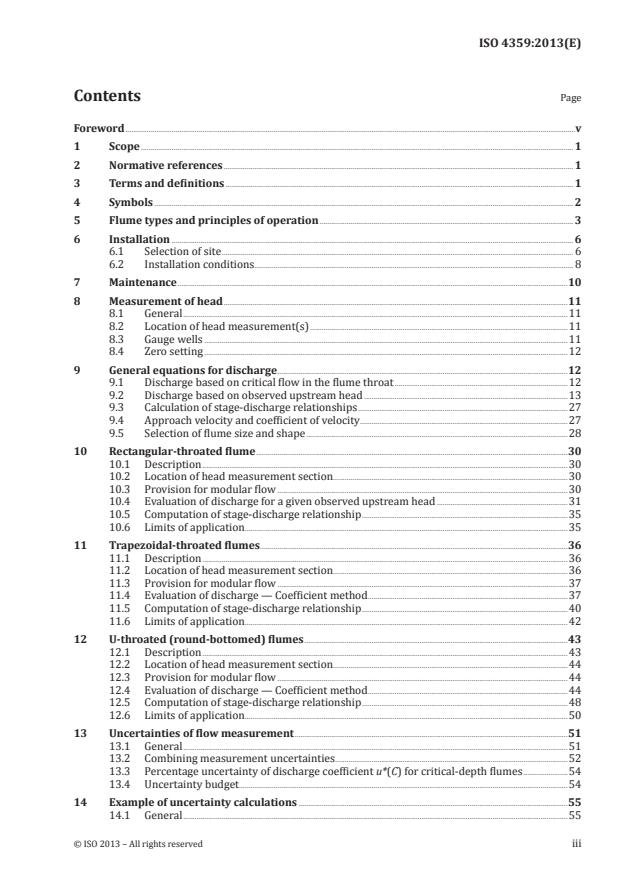
Contents Page
Foreword .v
1 Scope . 1
2 Normative references . 1
3 Terms and definitions . 1
4 Symbols . 2
5 Flume types and principles of operation . 3
6 Installation . 6
6.1 Selection of site . 6
6.2 Installation conditions. 8
7 Maintenance .10
8 Measurement of head .11
8.1 General .11
8.2 Location of head measurement(s) .11
8.3 Gauge wells .11
8.4 Zero setting .12
9 General equations for discharge .12
9.1 Discharge based on critical flow in the flume throat .12
9.2 Discharge based on observed upstream head .13
9.3 Calculation of stage-discharge relationships .27
9.4 Approach velocity and coefficient of velocity .27
9.5 Selection of flume size and shape .28
10 Rectangular-throated flume .30
10.1 Description .30
10.2 Location of head measurement section .30
10.3 Provision for modular flow .30
10.4 Evaluation of discharge for a given observed upstream head .31
10.5 Computation of stage-discharge relationship .35
10.6 Limits of application.35
11 Trapezoidal-throated flumes .36
11.1 Description .36
11.2 Location of head measurement section .36
11.3 Provision for modular flow .37
11.4 Evaluation of discharge — Coefficient method .37
11.5 Computation of stage-discharge relationship .40
11.6 Limits of application.42
12 U-throated (round-bottomed) flumes .43
12.1 Description .43
12.2 Location of head measurement section .44
12.3 Provision for modular flow .44
12.4 Evaluation of discharge — Coefficient method .44
12.5 Computation of stage-discharge relationship .48
12.6 Limits of application.50
13 Uncertainties of flow measurement .51
13.1 General .51
13.2 Combining measurement uncertainties .52
13.3 Percentage uncertainty of discharge coefficient u*(C) for critical-depth flumes .54
13.4 Uncertainty budget.54
14 Example of uncertainty calculations .55
14.1 General .55
14.2 Characteristics — Gauging structure .55
14.3 Characteristics — Discharge calculation .55
14.4 Characteristics — Discharge coefficient .55
14.5 Characteristics — Gauged head instrumentation .56
14.6 Characteristics — Throat width .56
14.7 Overall uncertainty in discharge .57
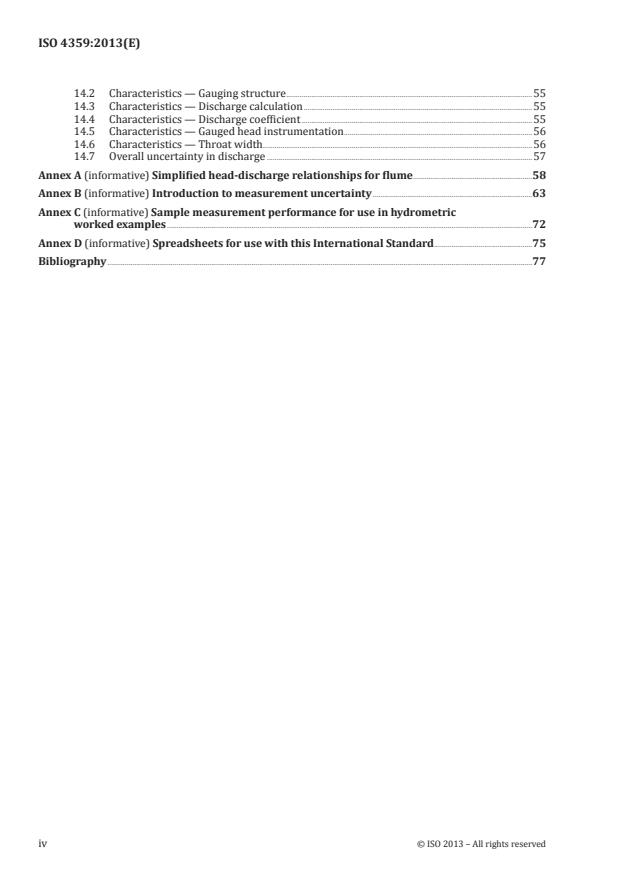
Annex A (informative) Simplified head-discharge relationships for flume .58
Annex B (informative) Introduction to measurement uncertainty .63
Annex C (informative) Sample measurement performance for use in hydrometric
worked examples .72
Annex D (informative) Spreadsheets for use with this International Standard .75
Bibliography .77
iv © ISO 2013 – All rights reserved
Foreword
ISO (the International Organization for Standardization) is a worldwide federation of national standards
bodies (ISO member bodies). The work of preparing International Standards is normally carried out
through ISO technical committees. Each member body interested in a subject for which a technical
committee has been established has the right to be represented on that committee. International
organizations, governmental and non-governmental, in liaison with ISO, also take part in the work.
ISO collaborates closely with the International Electrotechnical Commission (IEC) on all matters of
electrotechnical standardization.
International Standards are drafted in accordance with the rules given in the ISO/IEC Directives, Part 2.
The main task of technical committees is to prepare International Standards. Draft International
Standards adopted by the technical committees are circulated to the member bodies for voting.
Publication as an International Standard requires approval by at least 75 % of the member bodies
casting a vote.
Attention is drawn to the possibility that some of the elements of this document may be the subject of
patent rights. ISO shall not be held responsible for identifying any or all such patent rights.
ISO 4359 was prepared by Technical Committee ISO/TC 113, Hydrometry, Subcommittee SC 2, Flow
measurement structures.
This second edition cancels and replaces the first edition (ISO 4359:1983), which has been technically
revised. It also incorporates the Technical Corrigendum ISO 4359:1983/Corr.1:1999.
INTERNATIONAL STANDARD ISO 4359:2013(E)
Flow measurement structures — Rectangular, trapezoidal
and U-shaped flumes
1 Scope
This International Standard specifies methods for the measurement of flow in rivers and artificial
channels under steady or slowly varying flow conditions, using certain types of standing-wave, or
critical-depth, flumes.
A wide variety of flumes has been developed, but only those which have received general acceptance after
adequate research and field testing, and which therefore do not require in situ calibration, are considered.
The flow conditions considered are uniquely dependent on the upstream head, i.e. subcritical flow
must exist upstream of the flume, after which the flow accelerates through the contraction and passes
through its critical depth (see Figure 1). The water level downstream of the structure is low enough to
have no influence upon its performance.
This International Standard is applicable to three commonly used types of flumes, covering a wide
range of applications, namely rectangular-throated, trapezoidal-throated and U-throated. Typical field
installations are shown in Figure 2. Site conditions are important and Figure 3 shows acceptable velocity
profiles in the approach channel.
Detailed illustrations of the three types of flumes covered by this International Standard are given as follows:
a) rectangular-throated (see Figure 4);
b) trapezoidal-throated (see Figure 5);
c) U-throated, i.e. round-bottomed (see Figure 6).
It is not applicable to a form of flume referred to in the literature — sometimes called a “Venturi” flume
— in which the flow remains subcritical throughout.
NOTE This form is based on the same principle as a Venturi meter used within a closed conduit system and
relies upon gauging the head at two locations and the application of Bernoulli’s energy equation.
2 Normative references
The following documents, in whole or in part, are normatively referenced in this document and are
indispensable for its application. For dated references, only the edition cited applies. For undated
references, the latest edition of the referenced document (including any amendments) applies.
ISO 772, Hydrometry — Vocabulary and symbols
3 Terms and definitions
For the purposes of this document, the terms and definitions given in ISO 772 apply.
4 Symbols
Units of measurement are metres (m) and seconds (s) or derivatives of these.
Symbol Quantity Unit of measurement
A area of cross-section of flow m
B width of approach channel (width at bed if trapezoidal) m
b width of flume throat (width at bed if trapezoidal) m
C overall coefficient of discharge (rectangular flumes) non-dimensional
C coefficient of contraction non-dimensional
c
C coefficient of discharge non-dimensional
D
C shape coefficient for trapezoidal throated and U-throated flumes non-dimensional
s
C coefficient allowing for the effect of approach velocity non-dimensional
v
D diameter of base of U-throated flume m
d depth of flow m
E specific energy (relative to local invert) m
Fr Froude number non-dimensional
g gravitational acceleration m/s
H total head (relative to a specified datum, such as a flume invert) m
H correction to the total head m
*
h gauged head m
k equivalent sand roughness of surface, after Nikuradse mm
s
L length of prismatic section of the contraction at a flume m
L length of bellmouth entrance m
L length of slope (if present) between throat and downstream still- m
ing basin or channel floor
L length of stilling basin (if present) m
m side-slope (m horizontal to 1 vertical) non-dimensional
n number of measurements in series non-dimensional
P wetted perimeter of flow cross-section m
p height of flume invert above the invert of the approach channel m
Q discharge m /s
R radius m
Re Reynolds number non-dimensional
r radius of hump m
p
R radius of bellmouth entrance m
S standard deviation —
standard error of the mean —
S
average velocity through a cross-section, defined by Q/A m/s
V
w water surface width m
2 © ISO 2013 – All rights reserved
Symbol Quantity Unit of measurement
u*(Q) overall percentage uncertainty in the determination of discharge non-dimensional
expressed as a percentage standard deviation at 68 % confi-
dence limits
u*(b) percentage uncertainty in b (or D) non-dimensional
u*(C) percentage uncertainty in the combined coefficient value non-dimensional
u*(h) percentage uncertainty in h non-dimensional
u*(m) percentage uncertainty in m non-dimensional
α kinetic energy correction coefficient (taking into account non- non-dimensional
uniformity of velocity distribution)
β coefficient dependent on mean curvature of stream lines non-dimensional
γ, φ, ψ coefficients in the uncertainty computation —
δ* boundary layer displacement thickness m
η a numerical coefficient related to the sideslope angle in trapezoi- non-dimensional
dal flumes
ν kinematic viscosity of the fluid m /s
θ semi-angle subtended at the centre of curvature of the invert of a non-dimensional
U-throated flume between the water surface and the vertical
σ semi-angle subtended at the centre of curvature of the invert of a non-dimensional
U-throated flume between the water surface and the horizontal
Subscripts
a values in approach channel
c values at critical flow
d values downstream of the flume
e effective values after making allowance for boundary layer
effects
1 values assuming an ideal frictionless fluid
M maximum value
5 Flume types and principles of operation
5.1 The flumes covered by this International Standard are often known as “long-throated” or “critical-
depth” flumes and rely fundamentally on the occurrence of critical flow in the flume throat. When this
occurs, there is a unique relationship, for a given flume geometry, between the upstream head and the
discharge, that is independent of the conditions downstream of the flume throat. Figure 1 shows a
simplified sketch of where the critical depth typically occurs in a critical depth flume and the consequent
water surface profile through a long-throated trapezoidal flume, together with key hydraulic and
geometrical parameters.
a)
b) Section in approach channel upstream from throat
c) Section at downstream end of throat
Key
1 total energy line
2 typical flow profile
3 edge of boundary layer displacement thickness
δ* has been exaggerated.
Figure 1 — Trapezoidal-throated flume showing key geometrical parameters, water surface
profile and development of boundary layer displacement thickness (after Figure 8.1, Ref.[9])
5.2 Because the flume design is based on critical flow, this International Standard is largely based on
fundamental hydraulic theory, without the need for the large-scale volumetric testing that has been used
to derive the coefficients for other forms of flow measurement structure. In order to obtain critical flow
within the throat of the flume, the following conditions shall be satisfied.
a) The throat of the flume shall be long enough for the flow to be virtually parallel with the flume
invert, so that hydrostatic pressure conditions occur at the control section.
b) The entrance to the flume throat shall be shaped so that there are virtually no energy losses between
the point where the head is gauged and the point where critical flow occurs.
c) The flume throat shall constrict the channel severely enough to raise the energy level in the throat
sufficiently high above the energy level downstream to ensure that the flume is “modular”.
5.3 Figure 2 shows examples of flow in rectangular-throated, trapezoidal-throated and U-throated
flumes. The choice of flume type from these three depends upon several factors, such as the range of
discharge to be measured, the accuracy required, the head available and whether or not the flow carries
sediment that is liable to accrete. The graphs in Annex A give the user of this International Standard a
means of quickly comparing the idealized performance of a range of flume designs, to aid a preliminary
choice of the size and form of flume needed to deliver the required discharge capacity and stage–discharge
relationship.
4 © ISO 2013 – All rights reserved
a) Rectangular-throated flume b) Trapezoidal-throated flume c) U-throated flume
Figure 2 — Examples of rectangular-throated, trapezoidal-throated and U-throated flumes
5.4 The rectangular-throated flume is the simplest to construct. It generally proves necessary to raise
the invert of the flume throat above the bed of the channel upstream, in order to generate a constriction
that is sufficiently severe to allow low flows to be gauged. However, this may result in a regime of cyclic
sediment accretion and erosion upstream, which would affect the accuracy and consistency of gauging.
5.5 The trapezoidal-throated flume is more appropriate where a wide range of discharge is to be
measured with consistent accuracy. This shape of throat is also more likely to be suitable where it is
desirable to produce a particular stage-discharge relationship. In some cases, it is not necessary to raise
the invert of the throat above the approach channel invert when using a trapezoidal-throated flume, so
reducing the risk of upstream sediment accretion.
5.6 The U-throated flume is useful for installation in a U-shaped channel or where the flow is from a
circular-section conduit. It has found particular application in sewers and at sewage works.
5.7 The detailed theory for the critical-depth flume is given in Clauses 9 to 12, but is introduced here in
simplified form, based on the assumption of a uniform velocity across the flow section and disregarding
boundary layer effects. The basic discharge equation for a critical-depth flume can be derived from the
general energy equation:
V Q
Hd=+ =+d
2g
2gA
(1)
where
H is the total head above the flume invert;
d is the depth of flow;
V
is the average velocity through the section (= Q/A);
Q is the discharge;
A is the area of the flow cross-section;
g is the gravitational acceleration.
By differentiating the energy Formula (1) with respect to depth, it can be shown that, for critical flow:
gA
c
Q=
w
c
(2)
where subscript c refers to conditions at the critical-flow section.
Substituting Formula (2) into Formula (1) and disregarding any energy losses between the gauging
section and the critical-flow section, the following is obtained:
A
c
Hd=+
c
2w
c
(3)
5.8 In general, Formulae (2) and (3) are solved alongside each other for successive values of depth d
c
(with the corresponding values of area and surface width) to obtain the relationship between H and Q, but
for the special case of a flume with a rectangular throat (see Figure 4), they can be combined to produce
the explicit relationship:
2 2g
15,
Q= bH
3 3
(4)
5.9 This is readily recognizable as the same equation that applies (for an ideal fluid) for the flow over
a round-nosed horizontal-crested weir. In order to extend the use of this equation, three additional
coefficients may be introduced, resulting in the following generalized equation for long-throated critical-
depth flumes:
2 2g
15,
Q= CC Cbh
Ds v
3 3
(5)
where the coefficients are as follows:
C is a discharge coefficient that takes account of the non-ideal fluid properties, in particular the
D
effect of the boundary layer in the throat;
C is a shape coefficient, to allow for the effect of a non-rectangular flow section in the throat;
s
C is a velocity coefficient, to allow the upstream gauged head, h, to be used in place of the total
v
head or specific energy, H.
5.10 Equations for these coefficients are given in Clauses 9 to 12 and generally require an iterative
approach to be adopted.
6 Installation
6.1 Selection of site
6.1.1 The flume shall be located in a straight section of channel, avoiding local obstructions, roughness
or unevenness of the bed.
6 © ISO 2013 – All rights reserved
6.1.2 A preliminary study shall be made of the physical and hydraulic features of the proposed site, to
check that it conforms (or can be constructed or modified so as to conform) to the requirements necessary
for measurement of discharge by a flume. Particular attention should be paid to the following features in
selecting the site.
a) The availability of a straight length of approach channel of at least 10 times the maximum head
anticipated.
b) The existing velocity distribution.
c) The avoidance of a steep channel, the characteristics of which would induce supercritical flow.
d) The effects of any raised upstream water levels due to the measuring structure.
e) Conditions downstream, including such influences as tides, confluences with other streams, sluice
gates, mill dams and other controlling features which might cause submerged flow.
f) The impermeability of the ground on which the structure is to be founded and the necessity for
piling, grouting or other means of controlling seepage.
g) The necessity for floodbanks, to confine the maximum discharge to the channel.
h) The stability of the banks, and the necessity for trimming and/or revetment in natural channels.
i) The clearance of rocks or boulders from the bed of the approach channel.
j) Wind, which can have a considerable effect on the flow in a river, weir or flume, especially when
these are wide and the head is small and when the prevailing wind is in a transverse direction
(which would introduce a bias whose direction would depend on whether the gauge were at the
windward or leeward side of the approach channel).
6.1.3 If the site does not possess the characteristics necessary for satisfactory measurement, the site
shall be rejected unless suitable improvements are practicable.
6.1.4 If an inspection of the stream shows that the existing velocity distribution is reasonably uniform, then
it may be assumed that the velocity distribution will remain satisfactory after the construction of the flume.
6.1.5 If the existing velocity distribution is markedly non-uniform and no other site for the flume is
feasible, due consideration shall be given to checking the distribution after installation of the flume and
to improving it if necessary.
6.1.6 Several methods are available for obtaining a more precise indication of irregular velocity
distribution: velocity rods, floats or concentrations of dye can be used in small channels, the latter being
useful in checking conditions at the bottom of the channel. A complete and quantitative assessment of
velocity distribution may be made by means of a current-meter and other point velocity measurements.
NOTE Information about the use of current-meters is given in ISO 748. Further information on measuring
river velocities and using acoustic Doppler profilers can be found in ISO/TS 24154.
The user should confirm that the dye material used is acceptable for flow measurement purposes within
a natural channel in the country of operation.
6.1.7 Figure 3 gives typical examples of velocity distributions in channels of varying shape that can be
taken as acceptable for flow measurement purposes.
6.1.8 Flumes can act as obstacles to the movement of fish and other aquatic species. Care should
therefore be taken to ensure that the installation of gauging structures such as flumes does not have a
detrimental affect on the aquatic ecology where this might be an issue. In addition, the gauging structure
may be subject to compliance with national or supranational legislation or regulations, such as the
European Parliament EU Water Framework Directive (Directive 2000/60/EC). Where the movement of
aquatic life could be compromised by the installation of a flow measurement structure this should be
reflected in the design. Alternatively, a fishpass in accordance with ISO 26906 should be installed.
6.1.9 Reference to appropriate legislation should be made before a site for a measuring weir is chosen.
6.2 Installation conditions
6.2.1 General requirements
6.2.1.1 The complete measuring installation consists of an approach channel, a measuring structure
and a downstream channel. The conditions of each of these three components affect the overall accuracy
of the measurements.
6.2.1.2 Installation requirements include features such as the surface finish of the flume, the cross-
sectional shape of channel, the channel roughness and the influence of control devices upstream or
downstream of the gauging structure.
6.2.1.3 The distribution and direction of velocity have an important influence on the performance of
the flume, these factors being determined by the features mentioned above.
6.2.1.4 Once a gauging flume has been installed, the user shall prevent any change that could affect the
discharge characteristics.
6.2.2 Flume structure
6.2.2.1 The structure shall be rigid and watertight and capable of withstanding flood flow conditions
without distortion or fracture, from outflanking or from downstream erosion. The axis shall be in line
with the direction of flow of the upstream channel, and the geometry shall conform to the dimensions
given in Clauses 10, 11 and 12.
6.2.2.2 The surfaces of the flume throat and the immediate approach channel shall be smooth. They
shall be constructed in concrete with a smooth cement finish or surfaced with a smooth non-corrodible
material. In laboratory installations, the finish shall be equivalent to rigid plastic, rolled sheet metal or
planed, sanded and painted timber. The surface finish is of particular importance within the prismatic
part of the throat but can be relaxed a distance along the profile 0,5H upstream and downstream of
max
the throat proper.
The user should confirm that the building materials used in the construction of natural channels are
acceptable in the country of operation.
6.2.2.3 In order to minimize the uncertainty in the discharge, the following tolerances are acceptable:
a) on the bottom width of the throat, 0,2 % of this width with an absolute maximum of 0,01 m;
b) on deviation from a plane of the plane surfaces in the throat, 0,1 % of L;
c) on the width between vertical surfaces in the throat, 0,2 % of this width with a maximum of 0,01 m;
d) on the average longitudinal and transverse slopes of the base of the throat, 0,1 %;
e) on a slope of inclined surfaces in the throat, 0,1 %;
f) on a length of the throat, 1 % of L;
g) on deviation from a cylindrical or a conical surface in the entrance transition to the throat, 0,1 % of L;
8 © ISO 2013 – All rights reserved
h) on deviation from a plane of the plane surfaces in the entrance transition to the throat, 0,1 % of L;
i) on deviation from a plan of the plane surface in the exit transition from the throat, 0,3 % of L;
j) on other vertical or inclined surfaces, deviation from a plane or curve, 1 %;
k) on deviation from a plane of the bed of the lined approach channel, 0,1 % of L.
6.2.2.4 The structure shall be measured on completion, and average values of relevant dimensions and
their standard deviations at 68 % confidence limits computed. The former shall be used for computation
of discharge and the latter shall be used to obtain the overall uncertainty in the determination of discharge.
6.2.3 Approach channel
6.2.3.1 On all installations the flow in the approach channel shall be free from disturbance and shall
have a velocity distribution as uniform as reasonably practicable over the cross-sectional area. Figure 3
shows typical dimensionless velocity distributions in rectangular and trapezoidal channels, which are
relevant in site selection. For a given shape of channel, the velocity distribution should be reasonably
similar to one of those presented in Figure 3. This can usually be verified by inspection or measurement.
In the case of natural streams or rivers this can only be attained by having a long straight approach channel
free from projections into the flow.
6.2.3.2 The following are general recommendations and requirements related to the approach channel.
a) Any alteration in the flow conditions owing to the construction of the flume should be considered.
For example, there might be a build-up of shoals or debris upstream of the structure, which in time
might affect the flow conditions. Any likely consequential changes in the water level therefore need
to be taken into account in the design of gauging stations.
b) In an artificial channel the cross-section shall be uniform and the channel shall be straight for a
length equal to at least 10 times its water-surface width.
c) In a natural stream or river the cross-section shall be reasonably uniform and the channel shall be
straight for a sufficient length to ensure a reasonably uniform velocity distribution.
d) If the entry to the approach channel is through a bend, or if the flow is discharged into the channel
through a conduit or a channel of smaller cross-section, or at an angle, then a longer length of straight
approach channel may be required to achieve a reasonably uniform velocity distribution.
e) Vanes to straighten the flow shall not be installed closer to the points of measurement than a
distance 10 times the maximum head to be measured.
f) Under certain conditions, a standing wave may occur upstream of the gauging flume, for example if
the approach channel is steep. Provided that this wave is at a distance of not less than 30 times the
maximum head upstream, flow measurement is feasible, subject to confirmation that a reasonably
uniform velocity distribution exists at the gauging station and that the Froude number in this section
is no more than 0,6. Ideally, high Froude numbers should be avoided in the approach channel for
accurate flow measurement. If a standing wave occurs within this distance the approach conditions
and/or the flume shall be modified.
a)
b)
c)
Figure 3 — Examples of typical dimensionless velocity distributions in approach channels
6.2.4 Downstream conditions
6.2.4.1 The channel downstream of the structure is usually of no importance as such if the flume has
been so designed that the flow is modular under all operating conditions. A downstream gauge shall be
provided to measure tailwater levels to determine if and when drowned flow occurs.
6.2.4.2 If downstream scouring (which could lead to instability of the structure) is anticipated, then
particular measures to prevent this may be necessary.
7 Maintenance
7.1 Maintenance of the measuring structure and the approach channel is important, in order to secure
accurate continuous measurements.
7.2 The approach channel shall be kept free of silt, vegetation and obstructions that might have
deleterious effects on flow conditions specified for the standard installation. The float well and the entry
from the approach channel shall also be kept clean and free from deposits. The downstream channel shall
be kept free of obstructions that might cause the weir to drown.
7.3 The flume structure shall be kept clean and free from clinging debris, particularly within the throat
section, and care shall be taken in the process of cleaning to avoid damage to the structure.
7.4 Head-measurement devices, connecting conduits and stilling wells shall be cleaned and checked
for leakage. The hook or point gauge, float or other instrument used to measure head shall be checked
periodically to ensure accuracy.
10 © ISO 2013 – All rights reserved
8 Measurement of head
8.1 General
8.1.1 Where spot measurements are required, the heads can be measured by vertical gauges, hooks,
points, wires or tape gauges. Where continuous records are required, recording gauges shall be used,
typically based on float and shaft encoders, ultrasonics or pressure transducers.
8.1.2 As the size of the flume and head reduces, small discrepancies in construction and in the zero
setting and reading of the head measuring device become of greater relative importance.
8.2 Location of head measurement(s)
8.2.1 Stations for the measurement of head on the flume shall be located at a sufficient distance
upstream from the flume to avoid the region of surface drawdown. On the other hand, they shall be close
enough to the flume to ensure that the energy loss between the section of measurement and the control
section within the flume throat shall be negligible. The location for head measurement is dealt with in
Clauses 10, 11 and 12.
8.2.2 Flow is modular when it is independent of variations in tailwater level. This condition is met
when the tailwater total head above flume invert level is less than or equal to the submergence ratio at
the modular limit, as defined in Clauses 10, 11 and 12 for rectangular, trapezoidal and U-throated flumes.
8.2.3 A significant error in the calculated discharge will develop if the tailwater level causes the
submergence ratio to exceed the modular limit. A downstream gauge shall be installed to check that
the modular limit is not exceeded. A simple staff gauge in the downstream channel will normally be the
minimum requirement for this purpose.
8.3 Gauge wells
8.3.1 It is common to measure the upstream head in a gauge well to reduce the effects of water
surface oscillations. Alternatively, data-logged results can be post-processed to eliminate or reduce such
oscillations.
8.3.2 Periodic checks on the measurement of the head in the approach channel shall be made.
8.3.3 Gauge wells shall be vertical and of sufficient height and depth to cover the full range of water
levels. In field installations they shall have a minimum height of 0,3 m above the highest water levels
expected. Gauge wells shall be connected to the appropriate head measurement positions by means of
suitable conduits.
8.3.4 Both the well and the connecting pipe shall be watertight. Where the well is provided for the
accommodation of the float of a level recorder, it shall be of adequate size and depth.
8.3.5 The pipe shall have its invert not less than 0,06 m below the lowest level to be gauged.
8.3.6 Pipe connections to the measurement position shall terminate either flush with, or at right angles
to, the boundary of the approach channel. The channel boundary shall be plain and smooth (equivalent
to carefully finished concrete) within a distance 10 times the diameter of the pipes from the centreline of
the connection. The pipes may be oblique to the wall only if they are fitted with a removable cap or plate,
set flush with the wall, through which a number of holes are drilled. The edges of these holes shall not be
rounded or burred. Perforated cover plates are not recommended where weed or silt are likely to be present.
8.4 Zero setting
8.4.1 Accurate initial setting of the zero of the head measuring device with reference to the level of the
flume invert and subsequent regular checking of the settings are essential.
8.4.2 An accurate means of checking the zero at frequent intervals shall be provided. Benchmarks, in the
form of horizontal metal plates, shall be set up on the top of the vertical sidewalls and in the gauge wells.
These shall be accurately levelled to ensure their elevation relative to the flume invert level is known.
8.4.3 Instrument zeros can be checked relative to these benchmarks without the necessity of resurveying
the crest each time. Any settlement of the structure may, however, affect the relationships between the
flume invert and benchmark levels and it is advisable to make occasional checks on these relationships.
8.4.4 For small installations, a zero check based on the water level (either when the flow ceases or just
begins) is susceptible to serious errors due to surface tension effects and shall not be relied upon.
9 General equations for discharge
9.1 Discharge based on critical flow in the flume throat
9.1.1 Critical depth theory, augmented by experimental data, may be used to deduce the basic equations
for free discharge through streamlined contractions. Since the simple theory relates to the frictionless flow
of an ideal fluid, an additional coefficient, known as the coefficient of discharge, C has to be introduced
D,
to deal with the flow of a real fluid, such as water, and to take into account the development of boundary
layers that occur within the throat. The value of the coefficient C is usually either based on experimental
D
studies or deduced by considering a modification to the simple theory. Another coefficient, known as the
shape coefficient, C , is then required to generalize the simple theory to make it applicable to flow through
s
any cross-sectional shape, rather than just flow through a rectangular flume. Finally, a third coefficient,
known as the velocity of approach coefficient, C , is then used to relate the head in the throat with the
v
gauged head, typically measured a short distance upstream of the throat in the approach channel.
9.1.2 The specific energy, E, of flow in an open channel is given by:
αV
Ed=+β
2g
(6)
where
d is the depth of flow;
V is the average velocity through the section;
α is the kinetic energy correction coefficient, which takes into account the non-uniformity in
velocity distribution;
β is a coefficient which depends on the mean curvature of the streamlines.
9.1.3 The equation of continuity is
12 © ISO 2013 – All rights reserved
QA= V
(7)
where
Q is the discharge;
A is the area of the flow cross-section.
Hence:
αQ
Ed=+β
2gA
(8)
9.1.4 Critical flow occurs when E has a minimum value for a given discharge Q, treating depth d and
area A, which is related to d for any given cross-sectional geometry, as the variables. It can be shown that
the specific energy is a minimum when
βgA
Q = (9)
αw
where w is the water surface width.
9.1.5 Experimentally observed velocity profiles indicate that the velocity distribution is almost uniform
in the throat of a flume, an
...
Questions, Comments and Discussion
Ask us and Technical Secretary will try to provide an answer. You can facilitate discussion about the standard in here.
Loading comments...