

ISO/IEC 24800-3:2010/Cor 1:2012
(Corrigendum)Information technology — JPSearch — Part 3: Query format — Technical Corrigendum 1
General Information
- Abstract
- Status
- Published
- Publication Date
- 01-Aug-2012
- Current Stage
- 6060 - International Standard published
- Start Date
- 02-Aug-2012
- Due Date
- 17-Feb-2015
- Completion Date
- 17-Feb-2015


Overview
ISO/IEC 24800-3:2010/Cor 1:2012 is a Technical Corrigendum issued by the International Organization for Standardization (ISO) and the International Electrotechnical Commission (IEC) to update Part 3 of the JPSearch series. This standard pertains to Information Technology with a focus on the JPSearch Query Format (JPQF)-a framework designed for querying metadata and content related to still images. The corrigendum refines definitions, disables certain query and datatype functionalities, and clarifies the schema and tools associated with the query format.
This update ensures clearer interoperability within the JPSearch architecture, emphasizing still image queries and streamlining query tools to better suit their intended domain while maintaining compatibility with related MPEG standards.
Key Topics
JPSearch Architecture Layers
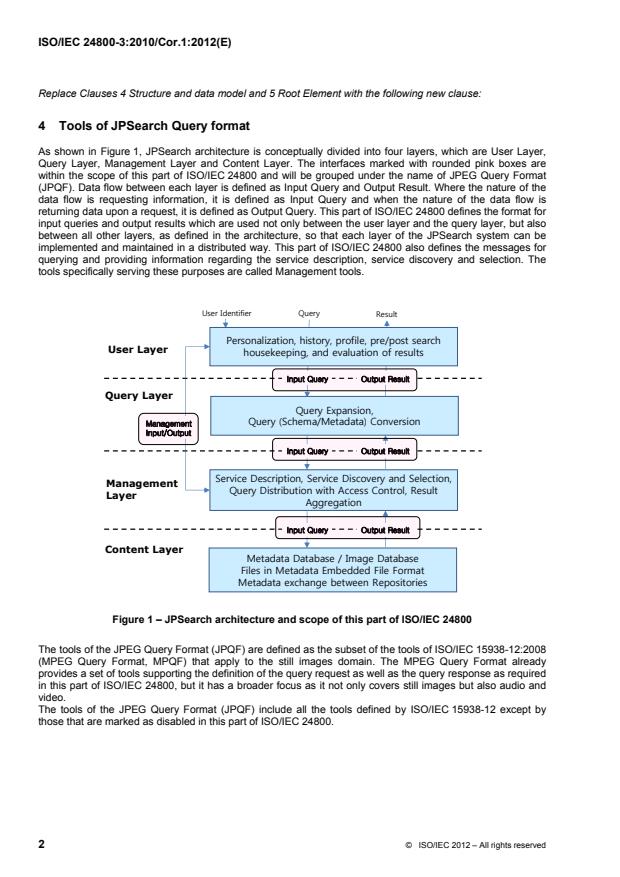
The architecture is structured into four key layers to modularize functionality:- User Layer: Manages user identifiers, personalization, history, and post-search evaluation.
- Query Layer: Handles query expansion and schema or metadata conversion.
- Management Layer: Supports service description, discovery, selection, access control, and query distribution.
- Content Layer: Contains the image and metadata repositories, facilitating data exchange.
JPEG Query Format (JPQF) and MPEG Query Format (MPQF)
JPQF is defined as a subset of MPQF tools from ISO/IEC 15938-12, adapted exclusively for still images. It supports both input queries and output results across all JPSearch layers, enabling distributed implementation and maintenance.Schema Conventions and Structure
The corrigendum updates the XML schema definitions governing query syntax, including namespace declarations and element formulations to ensure uniformity in query construction and processing.Disabled Queries and Datatypes
To maintain focus on image-based queries, the corrigendum disables or restricts certain query types and datatypes from the original MPEG query format, such as:- Disabling TemporalQuery completely.
- Restricting QueryByMedia to image-only media types.
- Disabling temporal regions in QueryByROI.
- Limiting mimeType usage to still images or text only.
Applications
ISO/IEC 24800-3's Technical Corrigendum 1 enhances practical applications around:
Digital Image Libraries and Repositories
Facilitates efficient metadata-driven search and retrieval of still images by standardizing query formats and communication across different system components.Multimedia Content Management Systems
Supports distributed system architectures allowing flexible integration of user queries, management tools, and content layers while ensuring interoperability.Image Search Engines and Services
Provides robust querying capabilities tailored for still images that can be used by developers and organizations building advanced search platforms with personalized user interaction.Service Discovery and Query Management
Enables service-oriented architectures where discovery, selection, and management of image query services follow a standardized approach.
Related Standards
ISO/IEC 24800 Series
The larger standard series covers various aspects of JPSearch including indexing, metadata management, and query handling.ISO/IEC 15938-12:2008 (MPEG Query Format - MPQF)
JPQF is a specialized subset of this multimedia query standard addressing image search specifically.W3C XML Schema Definition
The corrigendum references XML schema standards for data modeling and query syntax validation.
Keywords: ISO/IEC 24800-3, JPSearch, JPEG Query Format, JPQF, MPEG Query Format, MPQF, image query format, metadata search, ISO corrigendum, digital image retrieval, multimedia query standards, XML schema, query input/output, still image search, distributed query system
Relations
- Effective Date
- 04-Dec-2021
Get Certified
Connect with accredited certification bodies for this standard

BSI Group
BSI (British Standards Institution) is the business standards company that helps organizations make excellence a habit.

NYCE
Mexican standards and certification body.
Sponsored listings
Frequently Asked Questions
ISO/IEC 24800-3:2010/Cor 1:2012 is a standard published by the International Organization for Standardization (ISO). Its full title is "Information technology — JPSearch — Part 3: Query format — Technical Corrigendum 1". This standard covers: Information technology — JPSearch — Part 3: Query format — Technical Corrigendum 1
Information technology — JPSearch — Part 3: Query format — Technical Corrigendum 1
ISO/IEC 24800-3:2010/Cor 1:2012 is classified under the following ICS (International Classification for Standards) categories: 35.040 - Information coding; 35.040.30 - Coding of graphical and photographical information. The ICS classification helps identify the subject area and facilitates finding related standards.
ISO/IEC 24800-3:2010/Cor 1:2012 has the following relationships with other standards: It is inter standard links to ISO/IEC 24800-3:2010. Understanding these relationships helps ensure you are using the most current and applicable version of the standard.
ISO/IEC 24800-3:2010/Cor 1:2012 is available in PDF format for immediate download after purchase. The document can be added to your cart and obtained through the secure checkout process. Digital delivery ensures instant access to the complete standard document.
Standards Content (Sample)
INTERNATIONAL STANDARD ISO/IEC 24800-3:2010
TECHNICAL CORRIGENDUM 1
Published 2012-08-15
INTERNATIONAL ORGANIZATION FOR STANDARDIZATION МЕЖДУНАРОДНАЯ ОРГАНИЗАЦИЯ ПО СТАНДАРТИЗАЦИИ ORGANISATION INTERNATIONALE DE NORMALISATION
INTERNATIONAL ELECTROTECHNICAL COMMISSION МЕЖДУНАРОДНАЯ ЭЛЕКТРОТЕХНИЧЕСКАЯ КОМИССИЯ COMMISSION ÉLECTROTECHNIQUE INTERNATIONALE
Information technology — JPSearch —
Part 3:
Query format
TECHNICAL CORRIGENDUM 1
Technologies de l'information — JPSearch —
Partie 3: Format d'interrogation
RECTIFICATIF TECHNIQUE 1
Technical Corrigendum 1 to ISO/IEC 24800-3:2010 was prepared by Joint Technical Committee ISO/IEC
JTC 1, Information technology, Subcommittee SC 29, Coding of audio, picture, multimedia and hypermedia
information.
Replace 3.3 Conventions with the following:
3.3 Conventions and schema
The Syntax defined in this part of ISO/IEC 24800 assumes the following Schema Wrapper.
xmlns="http://www.w3.org/2001/XMLSchema"
xmlns:mpqf="urn:mpeg:mpqf:schema:2008"
targetNamespace="urn:jpeg:jpqf:schema:2008" elementFormDefault="qualified"
attributeFormDefault="unqualified">
ICS 35.040 Ref. No. ISO/IEC 24800-3:2010/Cor.1:2012(E)
© ISO/IEC 2012 – All rights reserved
Published in Switzerland
ISO/IEC 24800-3:2010/Cor.1:2012(E)
Replace Clauses 4 Structure and data model and 5 Root Element with the following new clause:
4 Tools of JPSearch Query format
As shown in Figure 1, JPSearch architecture is conceptually divided into four layers, which are User Layer,
Query Layer, Management Layer and Content Layer. The interfaces marked with rounded pink boxes are
within the scope of this part of ISO/IEC 24800 and will be grouped under the name of JPEG Query Format
(JPQF). Data flow between each layer is defined as Input Query and Output Result. Where the nature of the
data flow is requesting information, it is defined as Input Query and when the nature of the data flow is
returning data upon a request, it is defined as Output Query. This part of ISO/IEC 24800 defines the format for
input queries and output results which are used not only between the user layer and the query layer, but also
between all other layers, as defined in the architecture, so that each layer of the JPSearch system can be
implemented and maintained in a distributed way. This part of ISO/IEC 24800 also defines the messages for
querying and providing information regarding the service description, service discovery and select
...