

ISO 12578:2016
(Main)Timber structures — Glued laminated timber — Component performance requirements
General Information
- Abstract
ISO 12578:2016 specifies requirements for the components of glued laminated timber members for structural use. ISO 12578:2016 is applicable to products with a finished lamination thickness of not more than 50 mm. Although most glued laminated timber is made from coniferous species, this International Standard also applies to broad leaf species if the tests specified in this International Standard show that a satisfactory glue bond can be achieved. The basic requirements apply to structural members of all service classes; however, special precautions are necessary for service class 3, for example, the use of weather resistant adhesives (see 5.3). ISO 12578:2016 does not apply to the determination of strength and stiffness characteristics. Annex B contains informative materials for formaldehyde emission.
- Status
- Published
- Publication Date
- 11-Apr-2016
- Technical Committee
- ISO/TC 165 - Timber structures
- Drafting Committee
- ISO/TC 165/WG 2 - Structural glued wood products
- Current Stage
- 9092 - International Standard to be revised
- Start Date
- 24-Jun-2025
- Completion Date
- 29-Aug-2026
Buy Documents
ISO 12578:2016 - Timber structures -- Glued laminated timber -- Component performance requirements
ISO 12578:2016 - Timber structures — Glued laminated timber — Component performance requirements/12/2016
Overview
ISO 12578:2016 - Timber structures - Glued laminated timber - Component performance requirements defines minimum component and production requirements for glued laminated timber (glulam) intended for structural use. The standard applies to laminations with a finished thickness of not more than 50 mm, and covers timber species (coniferous and broad leaf where valid bonding can be demonstrated). It focuses on component performance (timber, adhesives, end joints, glue-line integrity) and quality control rather than on overall strength and stiffness determination.
Key topics and technical requirements
Scope limits
- Applicable to laminations ≤ 50 mm thickness.
- Applies across service classes 1–3, with special precautions for service class 3 (e.g., weather-resistant adhesives).
- Does not determine overall strength/stiffness characteristics (see ISO 8375 for those tests).
Timber grading and laminations
- Laminations must be graded per ISO 9709 (visual) or ISO 13912 (machine grading).
- Laminations and end joints must produce reliable strength/stiffness properties.
Adhesives and bonding
- Adhesives chosen must ensure durable bonds for the intended service life and conditions (climate, moisture, temperature, timber species, preservatives).
- Adhesives shall meet ISO 20152-1 requirements.
- For service class 3, weather-resistant adhesives and appropriate production controls are required.
End joints
- End-joint qualification and ongoing verification follow ISO 10983:2014 procedures.
- Manufacturers may declare mean and characteristic end-joint strengths following qualification testing or validated historical data.
Glue-line integrity and delamination
- Bond strength is verified by block shear tests (see ISO 12579).
- Delamination testing follows ISO 12580 (methods A–E); maximum total and single-glue-line delamination percentages are specified depending on service class and method.
- Representative full cross-sectional specimens are required for glue-line testing.
Quality management
- Contains manufacturing, factory production control and quality system requirements (personnel, records, on-going testing).
- Annex B is informative on formaldehyde emission.
Practical applications
- Provides minimum performance requirements for manufacturers producing glulam beams, columns and other structural elements.
- Supports:
- Production quality control and factory testing programs
- Product qualification for building approvals and procurement specifications
- Selection and validation of adhesives and end-joint systems
- Third-party certification bodies and testing laboratories
Who should use this standard
- Glulam manufacturers and production engineers
- Structural timber product designers and specifiers
- Quality assurance/quality control personnel and auditors
- Adhesive suppliers and material testers
- Building code authorities and certification bodies
Related standards (for implementation)
- ISO 9709 - Visual strength grading
- ISO 13912 - Machine strength grading
- ISO 10983:2014 - Finger/joint qualification and testing
- ISO 12579 - Block shear test methods (glue line)
- ISO 12580 - Delamination test methods
- ISO 20152-1 - Bond performance of adhesives
- ISO 8375 - Strength and stiffness test methods (see for structural characteristic tests)
- EN 14080 - Alternative provisions for delamination (referenced as an option)
Keywords: ISO 12578:2016, glued laminated timber, glulam, component performance requirements, glue-line integrity, delamination, end joints, adhesives, service class, timber grading, quality control.
Relations
- Effective Date
- 03-Mar-2012
Buy Documents
ISO 12578:2016 - Timber structures -- Glued laminated timber -- Component performance requirements
ISO 12578:2016 - Timber structures — Glued laminated timber — Component performance requirements/12/2016
Get Certified
Connect with accredited certification bodies for this standard

DIBt (Deutsches Institut für Bautechnik)
German Institute for Building Technology.
DIN CERTCO
DIN Group product certification.

Aboma Certification B.V.
Specialized in construction, metal, and transport sectors.
Sponsored listings
Frequently Asked Questions
ISO 12578:2016 is a standard published by the International Organization for Standardization (ISO). Its full title is "Timber structures — Glued laminated timber — Component performance requirements". This standard covers: ISO 12578:2016 specifies requirements for the components of glued laminated timber members for structural use. ISO 12578:2016 is applicable to products with a finished lamination thickness of not more than 50 mm. Although most glued laminated timber is made from coniferous species, this International Standard also applies to broad leaf species if the tests specified in this International Standard show that a satisfactory glue bond can be achieved. The basic requirements apply to structural members of all service classes; however, special precautions are necessary for service class 3, for example, the use of weather resistant adhesives (see 5.3). ISO 12578:2016 does not apply to the determination of strength and stiffness characteristics. Annex B contains informative materials for formaldehyde emission.
ISO 12578:2016 specifies requirements for the components of glued laminated timber members for structural use. ISO 12578:2016 is applicable to products with a finished lamination thickness of not more than 50 mm. Although most glued laminated timber is made from coniferous species, this International Standard also applies to broad leaf species if the tests specified in this International Standard show that a satisfactory glue bond can be achieved. The basic requirements apply to structural members of all service classes; however, special precautions are necessary for service class 3, for example, the use of weather resistant adhesives (see 5.3). ISO 12578:2016 does not apply to the determination of strength and stiffness characteristics. Annex B contains informative materials for formaldehyde emission.
ISO 12578:2016 is classified under the following ICS (International Classification for Standards) categories: 91.080.20 - Timber structures. The ICS classification helps identify the subject area and facilitates finding related standards.
ISO 12578:2016 has the following relationships with other standards: It is inter standard links to ISO 12578:2008. Understanding these relationships helps ensure you are using the most current and applicable version of the standard.
ISO 12578:2016 is available in PDF format for immediate download after purchase. The document can be added to your cart and obtained through the secure checkout process. Digital delivery ensures instant access to the complete standard document.
Standards Content (Sample)
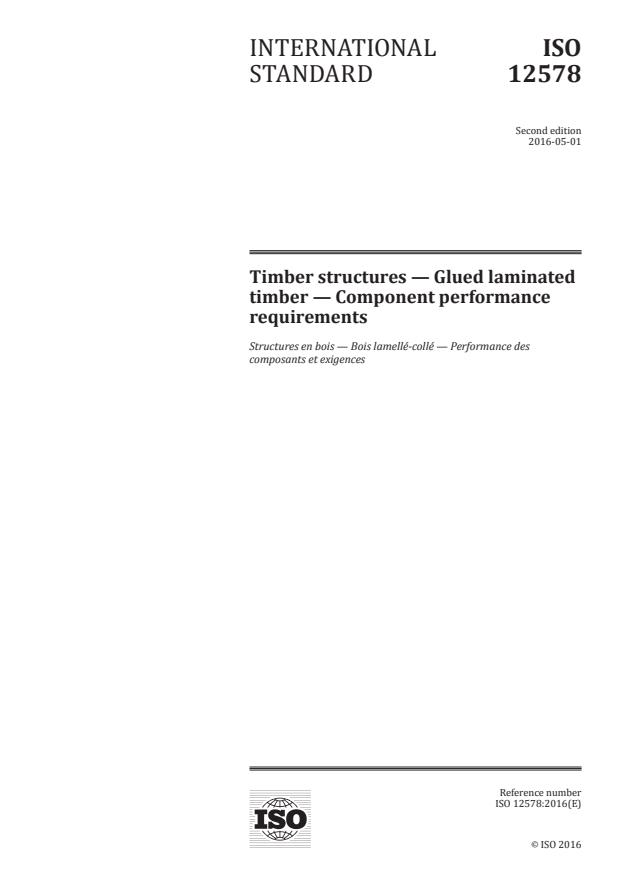
INTERNATIONAL ISO
STANDARD 12578
Second edition
2016-05-01
Timber structures — Glued laminated
timber — Component performance
requirements
Structures en bois — Bois lamellé-collé — Performance des
composants et exigences
Reference number
©
ISO 2016
© ISO 2016, Published in Switzerland
All rights reserved. Unless otherwise specified, no part of this publication may be reproduced or utilized otherwise in any form
or by any means, electronic or mechanical, including photocopying, or posting on the internet or an intranet, without prior
written permission. Permission can be requested from either ISO at the address below or ISO’s member body in the country of
the requester.
ISO copyright office
Ch. de Blandonnet 8 • CP 401
CH-1214 Vernier, Geneva, Switzerland
Tel. +41 22 749 01 11
Fax +41 22 749 09 47
copyright@iso.org
www.iso.org
ii © ISO 2016 – All rights reserved
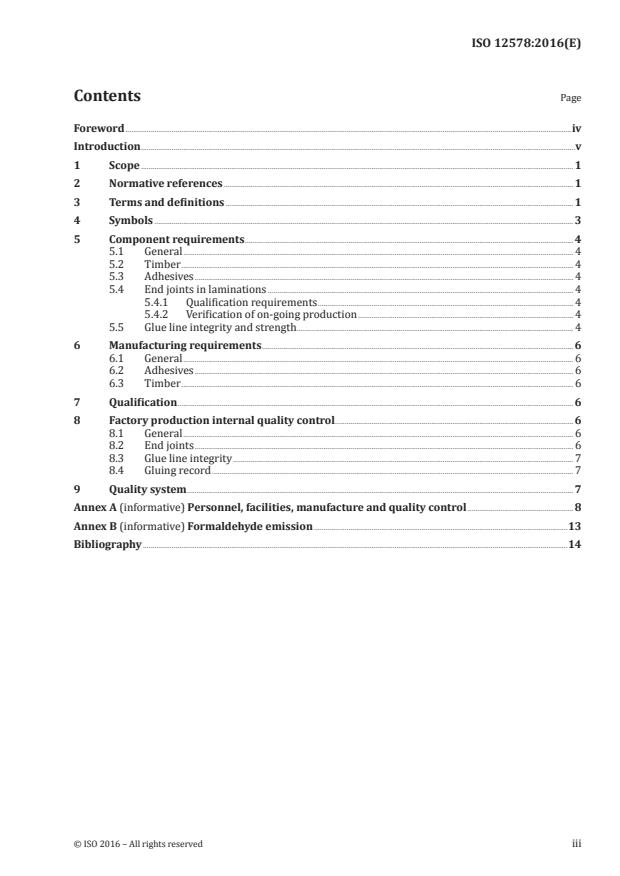
Contents Page
Foreword .iv
Introduction .v
1 Scope . 1
2 Normative references . 1
3 Terms and definitions . 1
4 Symbols . 3
5 Component requirements . 4
5.1 General . 4
5.2 Timber . 4
5.3 Adhesives . 4
5.4 End joints in laminations . 4
5.4.1 Qualification requirements . 4
5.4.2 Verification of on-going production . 4
5.5 Glue line integrity and strength . . 4
6 Manufacturing requirements . 6
6.1 General . 6
6.2 Adhesives . 6
6.3 Timber . 6
7 Qualification . 6
8 Factory production internal quality control . 6
8.1 General . 6
8.2 End joints . 6
8.3 Glue line integrity . 7
8.4 Gluing record . 7
9 Quality system . 7
Annex A (informative) Personnel, facilities, manufacture and quality control .8
Annex B (informative) Formaldehyde emission .13
Bibliography .14
Foreword
ISO (the International Organization for Standardization) is a worldwide federation of national standards
bodies (ISO member bodies). The work of preparing International Standards is normally carried out
through ISO technical committees. Each member body interested in a subject for which a technical
committee has been established has the right to be represented on that committee. International
organizations, governmental and non-governmental, in liaison with ISO, also take part in the work.
ISO collaborates closely with the International Electrotechnical Commission (IEC) on all matters of
electrotechnical standardization.
The procedures used to develop this document and those intended for its further maintenance are
described in the ISO/IEC Directives, Part 1. In particular the different approval criteria needed for the
different types of ISO documents should be noted. This document was drafted in accordance with the
editorial rules of the ISO/IEC Directives, Part 2 (see www.iso.org/directives).
Attention is drawn to the possibility that some of the elements of this document may be the subject of
patent rights. ISO shall not be held responsible for identifying any or all such patent rights. Details of
any patent rights identified during the development of the document will be in the Introduction and/or
on the ISO list of patent declarations received (see www.iso.org/patents).
Any trade name used in this document is information given for the convenience of users and does not
constitute an endorsement.
For an explanation on the meaning of ISO specific terms and expressions related to conformity assessment,
as well as information about ISO’s adherence to the World Trade Organization (WTO) principles in the
Technical Barriers to Trade (TBT) see the following URL: www.iso.org/iso/foreword.html.
The committee responsible for this document is ISO/TC 165, Timber structures.
This second edition cancels and replaces the first edition (ISO 12578:2008), which has been technically
revised.
iv © ISO 2016 – All rights reserved
Introduction
Glued laminated timber is obtained by bonding together a number of laminations having their grain
essentially parallel. In this way, a member with rectangular solid cross-section can be produced. Other
non-rectangular shapes can also be produced.
The purpose of the requirements in this International Standard is to provide minimum performance
requirements to ensure the in-service performance of the glued laminated timber. The requirements
will need to be supplemented to take into consideration special conditions, materials or functional
requirements.
INTERNATIONAL STANDARD ISO 12578:2016(E)
Timber structures — Glued laminated timber —
Component performance requirements
1 Scope
This International Standard specifies requirements for the components of glued laminated timber
members for structural use.
This International Standard is applicable to products with a finished lamination thickness of not more
than 50 mm.
Although most glued laminated timber is made from coniferous species, this International Standard
also applies to broad leaf species if the tests specified in this International Standard show that a
satisfactory glue bond can be achieved.
The basic requirements apply to structural members of all service classes; however, special precautions
are necessary for service class 3, for example, the use of weather resistant adhesives (see 5.3).
This International Standard does not apply to the determination of strength and stiffness characteristics.
Annex B contains informative materials for formaldehyde emission.
2 Normative references
The following documents, in whole or in part, are normatively referenced in this document and are
indispensable for its application. For dated references, only the edition cited applies. For undated
references, the latest edition of the referenced document (including any amendments) applies.
ISO 9709, Structural timber — Visual strength grading — Basic principles
ISO 13912, Structural timber — Machine strength grading — Basic principles
ISO 10983:2014, Timber — Finger joints — Minimum production requirements and testing methods
1)
ISO 8375:— , Timber structures — Glued laminated timber — Test methods for determination of physical
and mechanical properties
ISO 12579, Timber structures — Glued laminated timber — Method of test for shear strength of glue lines
ISO 12580, Timber structures — Glued laminated timber — Methods of test for glue-line delamination
ISO 20152-1, Timber structures — Bond performance of adhesives — Part 1: Basic requirements
3 Terms and definitions
For the purposes of this document, the terms and definitions given in ISO 12579, ISO 12580, ISO 20152-1
and the following apply.
3.1
glued laminated timber
glulam
structural member formed by bonding together timber laminations (3.7) with their grain running
essentially parallel to the member’s longitudinal axis
1) To be published. (Revision of ISO 8375:2009)
3.2
horizontal glulam
glued laminated timber (3.1) with the wide faces of the laminations (3.7) perpendicular to the direction
of the larger cross-sectional dimension
Note 1 to entry: See Figure 1.
Note 2 to entry: This International Standard does not cover vertical glulam.
3.3
service class
group designation characterized by the moisture content of the members corresponding to the
temperature and relative humidity of the surrounding air
3.3.1
service class 1
group designation characterized by a moisture content in the materials corresponding to a temperature
of 20 °C and the relative humidity of the surrounding air exceeding 65 % for a few weeks per year
Note 1 to entry: In service class 1, the average equilibrium moisture content of most softwoods does not
exceed 12 %.
[SOURCE: ISO 20152-1:2010, 3.1]
3.3.2
service class 2
group designation characterized by a moisture content in the materials corresponding to a temperature
of 20 °C and the relative humidity of the surrounding air exceeding 85 % for a few weeks per year
Note 1 to entry: In service class 2, the average equilibrium moisture content of most softwoods does not exceed
20 %. Such conditions include resistance to the effects of moisture on structural performance due to construction
delays or other conditions of similar severity.
[SOURCE: ISO 20152-1:2010, 3.2]
3.3.3
service class 3
group designation characterized by climatic conditions leading to moisture contents higher than
service class 2 (3.3.2), such as when a member is fully exposed to the weather
[SOURCE: ISO 20152-1:2010, 3.3]
3.4
maximum delamination percentage
maximum delamination length of one glue line in the test piece, measured on both end-grain surfaces
of the test specimen multiplied by 100 and divided by the total length of glue lines on the two end-grain
surfaces of each test piece for a single glue line in a test piece
Note 1 to entry: As defined in ISO 12580:2007, 8.3.
3.5
total delamination percentage
delamination length of all glue lines on the two end-grain surfaces in the test piece multiplied by 100
and divided by two times the length of one glue line
Note 1 to entry: As defined in ISO 12580:2007, 8.2.
3.6
wood failure percentage
percentage of the wood failure area in relation to the total sheared area
[SOURCE: ISO 12579:2007, 3.5]
2 © ISO 2016 – All rights reserved
3.7
lamination
piece or pieces of timber of not more than 50 mm in thickness, with or without end joints forming part
of a glulam member
Figure 1 — Glue lines in cross-sections showing the normal position of the glue lines
3.8
declared strengths
mean strength, f , and characteristic strength, f , of end joints strengths
x,dc x,dc,k
chosen by the manufacturer and used as a basis for determining compliance with the end joint strength
requirements of this International Standard
Note 1 to entry: All values can be either bending (m) or tension (t) strength depending on which method of
compliance testing is chosen.
Note 2 to entry: For established production facilities, the declared strengths may be determined using historical
data and appropriate statistical methods.
3.9
qualification
process of assessing, through physical testing and statistical processing of test data, if the output from
a combination of tools, materials and people engaged in producing glued laminated timber products
meets the requirements of this International Standard
4 Symbols
mean end joint strength determined by qualification testing and statistical processing (mPa)
f
x
characteristic end joint strength determined by qualification tests and statistical process-
f
x,k
ing (mPa)
required mean strength of the end joints (mPa)
f
x,dc
shear strength (mPa)
f
v
x subscript indicating bending (m) or tension (t)
dc declared properties
5 Component requirements
5.1 General
The grading of the timber shall result in reliable strength and stiffness properties in the laminations.
The bonding operations shall result in reliable and durable bonds in end joints and between laminations.
5.2 Timber
The timber shall be graded in conformity with either ISO 9709 or ISO 13912. The strength and stiffness
properties of the glued laminated timber shall be established in accordance with ISO 8375.
5.3 Adhesives
The adhesive shall enable joints of such strength and durability to be produced such that the integrity
of the bond is maintained throughout the intended lifetime of the structure.
The adhesive shall be chosen considering the conditions during construction and in service including
climate, moisture conditions, exposure to elevated temperature, the timber species, the preservative
used (if any) and the production methods.
Adhesives shall meet the requirements of ISO 20152-1.
NOTE Additional requirements for adhesives may be specified by national standards or governing codes.
5.4 End joints in laminations
5.4.1 Qualification requirements
Mean declared strength, f , and characteristic declared strength, f , of end joints shall be
x,dc x,dc,k
selected by the manufacturer after qualification testing using one of the methods described in
ISO 10983:2014, 6.5. Alternatively, the values may be obtained from historical records where these are
available. Declared values of this strength shall satisfy the following:
— mean declared strength, ff£ ;
x,dc x,k
— characteristic declared strength, ff£ .
x,dc,k x,k
5.4.2 Verification of on-going production
End joints shall comply with the requirements of ISO 10983:2014, 6.6. In interpreting ISO 10983:2014,
6.6, the declared values may be used in lieu of the corresponding f and f values.
x x,k
5.5 Glue line integrity and strength
5.5.1 The glue line integrity shall be based on testing of the glue line in a full cross-sectional specimen,
cut from the manufactured glulam member.
The spe
...
INTERNATIONAL ISO
STANDARD 12578
Second edition
2016-05-01
Timber structures — Glued laminated
timber — Component performance
requirements
Structures en bois — Bois lamellé-collé — Performance des
composants et exigences
Reference number
©
ISO 2016
© ISO 2016, Published in Switzerland
All rights reserved. Unless otherwise specified, no part of this publication may be reproduced or utilized otherwise in any form
or by any means, electronic or mechanical, including photocopying, or posting on the internet or an intranet, without prior
written permission. Permission can be requested from either ISO at the address below or ISO’s member body in the country of
the requester.
ISO copyright office
Ch. de Blandonnet 8 • CP 401
CH-1214 Vernier, Geneva, Switzerland
Tel. +41 22 749 01 11
Fax +41 22 749 09 47
copyright@iso.org
www.iso.org
ii © ISO 2016 – All rights reserved
Contents Page
Foreword .iv
Introduction .v
1 Scope . 1
2 Normative references . 1
3 Terms and definitions . 1
4 Symbols . 3
5 Component requirements . 4
5.1 General . 4
5.2 Timber . 4
5.3 Adhesives . 4
5.4 End joints in laminations . 4
5.4.1 Qualification requirements . 4
5.4.2 Verification of on-going production . 4
5.5 Glue line integrity and strength . . 4
6 Manufacturing requirements . 6
6.1 General . 6
6.2 Adhesives . 6
6.3 Timber . 6
7 Qualification . 6
8 Factory production internal quality control . 6
8.1 General . 6
8.2 End joints . 6
8.3 Glue line integrity . 7
8.4 Gluing record . 7
9 Quality system . 7
Annex A (informative) Personnel, facilities, manufacture and quality control .8
Annex B (informative) Formaldehyde emission .13
Bibliography .14
Foreword
ISO (the International Organization for Standardization) is a worldwide federation of national standards
bodies (ISO member bodies). The work of preparing International Standards is normally carried out
through ISO technical committees. Each member body interested in a subject for which a technical
committee has been established has the right to be represented on that committee. International
organizations, governmental and non-governmental, in liaison with ISO, also take part in the work.
ISO collaborates closely with the International Electrotechnical Commission (IEC) on all matters of
electrotechnical standardization.
The procedures used to develop this document and those intended for its further maintenance are
described in the ISO/IEC Directives, Part 1. In particular the different approval criteria needed for the
different types of ISO documents should be noted. This document was drafted in accordance with the
editorial rules of the ISO/IEC Directives, Part 2 (see www.iso.org/directives).
Attention is drawn to the possibility that some of the elements of this document may be the subject of
patent rights. ISO shall not be held responsible for identifying any or all such patent rights. Details of
any patent rights identified during the development of the document will be in the Introduction and/or
on the ISO list of patent declarations received (see www.iso.org/patents).
Any trade name used in this document is information given for the convenience of users and does not
constitute an endorsement.
For an explanation on the meaning of ISO specific terms and expressions related to conformity assessment,
as well as information about ISO’s adherence to the World Trade Organization (WTO) principles in the
Technical Barriers to Trade (TBT) see the following URL: www.iso.org/iso/foreword.html.
The committee responsible for this document is ISO/TC 165, Timber structures.
This second edition cancels and replaces the first edition (ISO 12578:2008), which has been technically
revised.
iv © ISO 2016 – All rights reserved
Introduction
Glued laminated timber is obtained by bonding together a number of laminations having their grain
essentially parallel. In this way, a member with rectangular solid cross-section can be produced. Other
non-rectangular shapes can also be produced.
The purpose of the requirements in this International Standard is to provide minimum performance
requirements to ensure the in-service performance of the glued laminated timber. The requirements
will need to be supplemented to take into consideration special conditions, materials or functional
requirements.
INTERNATIONAL STANDARD ISO 12578:2016(E)
Timber structures — Glued laminated timber —
Component performance requirements
1 Scope
This International Standard specifies requirements for the components of glued laminated timber
members for structural use.
This International Standard is applicable to products with a finished lamination thickness of not more
than 50 mm.
Although most glued laminated timber is made from coniferous species, this International Standard
also applies to broad leaf species if the tests specified in this International Standard show that a
satisfactory glue bond can be achieved.
The basic requirements apply to structural members of all service classes; however, special precautions
are necessary for service class 3, for example, the use of weather resistant adhesives (see 5.3).
This International Standard does not apply to the determination of strength and stiffness characteristics.
Annex B contains informative materials for formaldehyde emission.
2 Normative references
The following documents, in whole or in part, are normatively referenced in this document and are
indispensable for its application. For dated references, only the edition cited applies. For undated
references, the latest edition of the referenced document (including any amendments) applies.
ISO 9709, Structural timber — Visual strength grading — Basic principles
ISO 13912, Structural timber — Machine strength grading — Basic principles
ISO 10983:2014, Timber — Finger joints — Minimum production requirements and testing methods
1)
ISO 8375:— , Timber structures — Glued laminated timber — Test methods for determination of physical
and mechanical properties
ISO 12579, Timber structures — Glued laminated timber — Method of test for shear strength of glue lines
ISO 12580, Timber structures — Glued laminated timber — Methods of test for glue-line delamination
ISO 20152-1, Timber structures — Bond performance of adhesives — Part 1: Basic requirements
3 Terms and definitions
For the purposes of this document, the terms and definitions given in ISO 12579, ISO 12580, ISO 20152-1
and the following apply.
3.1
glued laminated timber
glulam
structural member formed by bonding together timber laminations (3.7) with their grain running
essentially parallel to the member’s longitudinal axis
1) To be published. (Revision of ISO 8375:2009)
3.2
horizontal glulam
glued laminated timber (3.1) with the wide faces of the laminations (3.7) perpendicular to the direction
of the larger cross-sectional dimension
Note 1 to entry: See Figure 1.
Note 2 to entry: This International Standard does not cover vertical glulam.
3.3
service class
group designation characterized by the moisture content of the members corresponding to the
temperature and relative humidity of the surrounding air
3.3.1
service class 1
group designation characterized by a moisture content in the materials corresponding to a temperature
of 20 °C and the relative humidity of the surrounding air exceeding 65 % for a few weeks per year
Note 1 to entry: In service class 1, the average equilibrium moisture content of most softwoods does not
exceed 12 %.
[SOURCE: ISO 20152-1:2010, 3.1]
3.3.2
service class 2
group designation characterized by a moisture content in the materials corresponding to a temperature
of 20 °C and the relative humidity of the surrounding air exceeding 85 % for a few weeks per year
Note 1 to entry: In service class 2, the average equilibrium moisture content of most softwoods does not exceed
20 %. Such conditions include resistance to the effects of moisture on structural performance due to construction
delays or other conditions of similar severity.
[SOURCE: ISO 20152-1:2010, 3.2]
3.3.3
service class 3
group designation characterized by climatic conditions leading to moisture contents higher than
service class 2 (3.3.2), such as when a member is fully exposed to the weather
[SOURCE: ISO 20152-1:2010, 3.3]
3.4
maximum delamination percentage
maximum delamination length of one glue line in the test piece, measured on both end-grain surfaces
of the test specimen multiplied by 100 and divided by the total length of glue lines on the two end-grain
surfaces of each test piece for a single glue line in a test piece
Note 1 to entry: As defined in ISO 12580:2007, 8.3.
3.5
total delamination percentage
delamination length of all glue lines on the two end-grain surfaces in the test piece multiplied by 100
and divided by two times the length of one glue line
Note 1 to entry: As defined in ISO 12580:2007, 8.2.
3.6
wood failure percentage
percentage of the wood failure area in relation to the total sheared area
[SOURCE: ISO 12579:2007, 3.5]
2 © ISO 2016 – All rights reserved
3.7
lamination
piece or pieces of timber of not more than 50 mm in thickness, with or without end joints forming part
of a glulam member
Figure 1 — Glue lines in cross-sections showing the normal position of the glue lines
3.8
declared strengths
mean strength, f , and characteristic strength, f , of end joints strengths
x,dc x,dc,k
chosen by the manufacturer and used as a basis for determining compliance with the end joint strength
requirements of this International Standard
Note 1 to entry: All values can be either bending (m) or tension (t) strength depending on which method of
compliance testing is chosen.
Note 2 to entry: For established production facilities, the declared strengths may be determined using historical
data and appropriate statistical methods.
3.9
qualification
process of assessing, through physical testing and statistical processing of test data, if the output from
a combination of tools, materials and people engaged in producing glued laminated timber products
meets the requirements of this International Standard
4 Symbols
mean end joint strength determined by qualification testing and statistical processing (mPa)
f
x
characteristic end joint strength determined by qualification tests and statistical process-
f
x,k
ing (mPa)
required mean strength of the end joints (mPa)
f
x,dc
shear strength (mPa)
f
v
x subscript indicating bending (m) or tension (t)
dc declared properties
5 Component requirements
5.1 General
The grading of the timber shall result in reliable strength and stiffness properties in the laminations.
The bonding operations shall result in reliable and durable bonds in end joints and between laminations.
5.2 Timber
The timber shall be graded in conformity with either ISO 9709 or ISO 13912. The strength and stiffness
properties of the glued laminated timber shall be established in accordance with ISO 8375.
5.3 Adhesives
The adhesive shall enable joints of such strength and durability to be produced such that the integrity
of the bond is maintained throughout the intended lifetime of the structure.
The adhesive shall be chosen considering the conditions during construction and in service including
climate, moisture conditions, exposure to elevated temperature, the timber species, the preservative
used (if any) and the production methods.
Adhesives shall meet the requirements of ISO 20152-1.
NOTE Additional requirements for adhesives may be specified by national standards or governing codes.
5.4 End joints in laminations
5.4.1 Qualification requirements
Mean declared strength, f , and characteristic declared strength, f , of end joints shall be
x,dc x,dc,k
selected by the manufacturer after qualification testing using one of the methods described in
ISO 10983:2014, 6.5. Alternatively, the values may be obtained from historical records where these are
available. Declared values of this strength shall satisfy the following:
— mean declared strength, ff£ ;
x,dc x,k
— characteristic declared strength, ff£ .
x,dc,k x,k
5.4.2 Verification of on-going production
End joints shall comply with the requirements of ISO 10983:2014, 6.6. In interpreting ISO 10983:2014,
6.6, the declared values may be used in lieu of the corresponding f and f values.
x x,k
5.5 Glue line integrity and strength
5.5.1 The glue line integrity shall be based on testing of the glue line in a full cross-sectional specimen,
cut from the manufactured glulam member.
The spe
...