


ISO 21138-3:2007
(Main)Plastics piping systems for non-pressure underground drainage and sewerage — Structured-wall piping systems of unplasticized poly(vinyl chloride) (PVC-U), polypropylene (PP) and polyethylene (PE) — Part 3: Pipes and fittings with non-smooth external surface, Type B
Plastics piping systems for non-pressure underground drainage and sewerage — Structured-wall piping systems of unplasticized poly(vinyl chloride) (PVC-U), polypropylene (PP) and polyethylene (PE) — Part 3: Pipes and fittings with non-smooth external surface, Type B
ISO 21138-3:2007, together with ISO 21138-1, specifies the definitions and requirements for pipes with a non-smooth external surface (Type B), fittings and the system based on unplasticized poly(vinyl chloride) (PVC-U), polypropylene (PP) and polyethylene (PE) structured-wall piping systems in the field of non-pressure systems for underground drainage and sewerage. ISO 21138-3:2007 specifically refers to PVC, PP and PE materials. ISO 21138-3:2007 specifies test methods and test parameters. ISO 21138-3:2007 covers a range of pipe and fitting sizes, materials, pipe constructions and nominal ring stiffnesses, and gives recommendations concerning colours. In conjunction with ISO 21138-1, it is applicable to PVC-U, PP and PE structured-wall pipes and fittings, to their joints and to joints with components of other plastics and non-plastics materials intended to be used for buried piping systems for the transport of drainage and sewage. ISO 21138-3:2007 is applicable to PVC-U, PP and PE structured-wall pipes and fittings with or without an integral socket with elastomeric ring seal joints as well as welded and fused joints.
Systèmes de canalisations en plastique pour les branchements et les collecteurs d'assainissement sans pression enterrés — Systèmes de canalisations à parois structurées en poly(chlorure de vinyle) non plastifié (PVC-U), polypropylène (PP) et polyéthylène (PE) — Partie 3: Tubes et raccords avec une surface externe non lisse, type B
L'ISO 21138-3:2007, conjointement avec l'ISO 21138-1, spécifie les définitions et les exigences pour les tubes avec une surface externe non lisse (Type B), les raccords et le système fabriqués à partir de poly(chlorure de vinyle) non plastifié (PVC‑U), polypropylène (PP) et polyéthylène (PE) destinés à être utilisés en tant que systèmes de canalisations à parois structurées dans le domaine des branchements et des collecteurs d'assainissement enterrés sans pression. L'ISO 21138-3:2007 se réfère spécifiquement aux matériaux PVC, PP et PE. Elle spécifie les méthodes d'essai et les paramètres d'essai. Elle couvre une gamme de dimensions de tubes et de raccords, de matériaux, de construction de tubes, de rigidité annulaire nominale et donne des recommandations concernant les couleurs. Conjointement avec l'ISO 21138‑1, elle s'applique aux tubes et raccords à parois structurées en PVC‑U, PP et PE, à leurs assemblages ainsi qu'aux assemblages avec d'autres composants en d'autres matières, plastiques ou non, destinés à être utilisés pour les systèmes de canalisations enterrées pour le transport des eaux de drainage et d'assainissement, de drainage de grand route et de surface. L'ISO 21138-3:2007 s'applique aux tubes et raccords à parois structurées en PVC‑U, PP et PE, qui comprennent des assemblages avec ou sans emboîture intégrée à bague d'étanchéité en élastomère ainsi que des assemblages soudés et les assemblages obtenus par fusion.
General Information
- Status
- Withdrawn
- Publication Date
- 22-Oct-2007
- Withdrawal Date
- 22-Oct-2007
- Current Stage
- 9599 - Withdrawal of International Standard
- Start Date
- 20-Jan-2020
- Completion Date
- 14-Feb-2026
Relations
- Effective Date
- 04-Nov-2015
Buy Documents
ISO 21138-3:2007 - Plastics piping systems for non-pressure underground drainage and sewerage -- Structured-wall piping systems of unplasticized poly(vinyl chloride) (PVC-U), polypropylene (PP) and polyethylene (PE)
ISO 21138-3:2007 - Systemes de canalisations en plastique pour les branchements et les collecteurs d'assainissement sans pression enterrés -- Systemes de canalisations a parois structurées en poly(chlorure de vinyle) non plastifié (PVC-U), polypropylene (PP) et polyéthylene (PE)
Get Certified
Connect with accredited certification bodies for this standard

ICC Evaluation Service
Building products evaluation and certification.

QAI Laboratories
Building and construction product testing and certification.

Zavod za gradbeništvo Slovenije (ZAG) - Inšpekcija
ZAG inspection body for construction products, structures, and materials.
Sponsored listings
Frequently Asked Questions
ISO 21138-3:2007 is a standard published by the International Organization for Standardization (ISO). Its full title is "Plastics piping systems for non-pressure underground drainage and sewerage — Structured-wall piping systems of unplasticized poly(vinyl chloride) (PVC-U), polypropylene (PP) and polyethylene (PE) — Part 3: Pipes and fittings with non-smooth external surface, Type B". This standard covers: ISO 21138-3:2007, together with ISO 21138-1, specifies the definitions and requirements for pipes with a non-smooth external surface (Type B), fittings and the system based on unplasticized poly(vinyl chloride) (PVC-U), polypropylene (PP) and polyethylene (PE) structured-wall piping systems in the field of non-pressure systems for underground drainage and sewerage. ISO 21138-3:2007 specifically refers to PVC, PP and PE materials. ISO 21138-3:2007 specifies test methods and test parameters. ISO 21138-3:2007 covers a range of pipe and fitting sizes, materials, pipe constructions and nominal ring stiffnesses, and gives recommendations concerning colours. In conjunction with ISO 21138-1, it is applicable to PVC-U, PP and PE structured-wall pipes and fittings, to their joints and to joints with components of other plastics and non-plastics materials intended to be used for buried piping systems for the transport of drainage and sewage. ISO 21138-3:2007 is applicable to PVC-U, PP and PE structured-wall pipes and fittings with or without an integral socket with elastomeric ring seal joints as well as welded and fused joints.
ISO 21138-3:2007, together with ISO 21138-1, specifies the definitions and requirements for pipes with a non-smooth external surface (Type B), fittings and the system based on unplasticized poly(vinyl chloride) (PVC-U), polypropylene (PP) and polyethylene (PE) structured-wall piping systems in the field of non-pressure systems for underground drainage and sewerage. ISO 21138-3:2007 specifically refers to PVC, PP and PE materials. ISO 21138-3:2007 specifies test methods and test parameters. ISO 21138-3:2007 covers a range of pipe and fitting sizes, materials, pipe constructions and nominal ring stiffnesses, and gives recommendations concerning colours. In conjunction with ISO 21138-1, it is applicable to PVC-U, PP and PE structured-wall pipes and fittings, to their joints and to joints with components of other plastics and non-plastics materials intended to be used for buried piping systems for the transport of drainage and sewage. ISO 21138-3:2007 is applicable to PVC-U, PP and PE structured-wall pipes and fittings with or without an integral socket with elastomeric ring seal joints as well as welded and fused joints.
ISO 21138-3:2007 is classified under the following ICS (International Classification for Standards) categories: 23.040.20 - Plastics pipes; 23.040.45 - Plastics fittings; 91.140.80 - Drainage systems; 93.030 - External sewage systems. The ICS classification helps identify the subject area and facilitates finding related standards.
ISO 21138-3:2007 has the following relationships with other standards: It is inter standard links to ISO 21138-3:2020. Understanding these relationships helps ensure you are using the most current and applicable version of the standard.
ISO 21138-3:2007 is available in PDF format for immediate download after purchase. The document can be added to your cart and obtained through the secure checkout process. Digital delivery ensures instant access to the complete standard document.
Standards Content (Sample)
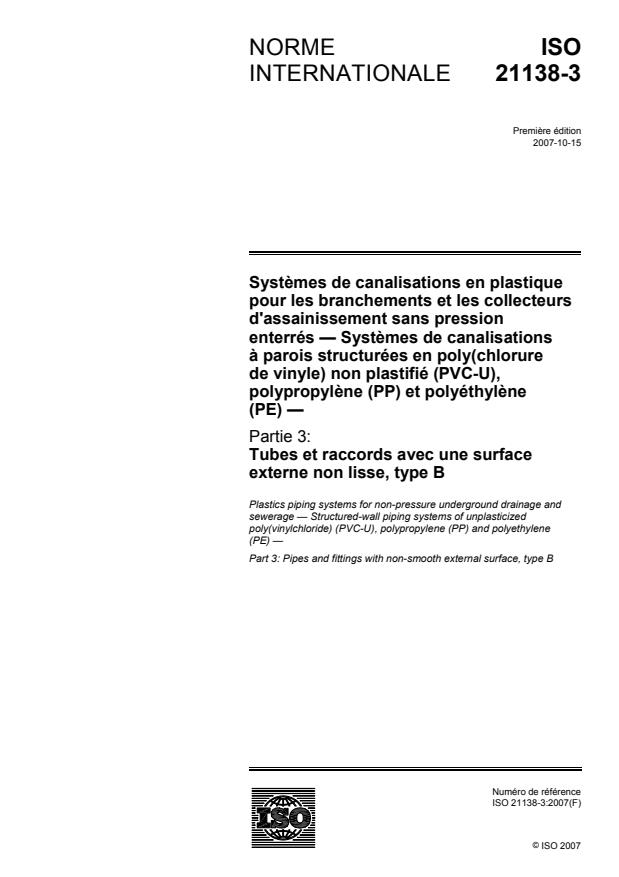
INTERNATIONAL ISO
STANDARD 21138-3
First edition
2007-10-15
Plastics piping systems for non-pressure
underground drainage and sewerage —
Structured-wall piping systems of
unplasticized poly(vinyl chloride)
(PVC-U), polypropylene (PP) and
polyethylene (PE) —
Part 3:
Pipes and fittings with non-smooth
external surface, Type B
Systèmes de canalisations en plastique pour les branchements et les
collecteurs d'assainissement sans pression enterrés — Systèmes de
canalisations à parois structurées en poly(chlorure de vinyle) non
plastifié (PVC-U), polypropylène (PP) et polyéthylène (PE) —
Partie 3: Tubes et raccords avec une surface externe non lisse, type B
Reference number
©
ISO 2007
PDF disclaimer
This PDF file may contain embedded typefaces. In accordance with Adobe's licensing policy, this file may be printed or viewed but
shall not be edited unless the typefaces which are embedded are licensed to and installed on the computer performing the editing. In
downloading this file, parties accept therein the responsibility of not infringing Adobe's licensing policy. The ISO Central Secretariat
accepts no liability in this area.
Adobe is a trademark of Adobe Systems Incorporated.
Details of the software products used to create this PDF file can be found in the General Info relative to the file; the PDF-creation
parameters were optimized for printing. Every care has been taken to ensure that the file is suitable for use by ISO member bodies. In
the unlikely event that a problem relating to it is found, please inform the Central Secretariat at the address given below.
© ISO 2007
All rights reserved. Unless otherwise specified, no part of this publication may be reproduced or utilized in any form or by any means,
electronic or mechanical, including photocopying and microfilm, without permission in writing from either ISO at the address below or
ISO's member body in the country of the requester.
ISO copyright office
Case postale 56 • CH-1211 Geneva 20
Tel. + 41 22 749 01 11
Fax + 41 22 749 09 47
E-mail copyright@iso.org
Web www.iso.org
Published in Switzerland
ii © ISO 2007 – All rights reserved
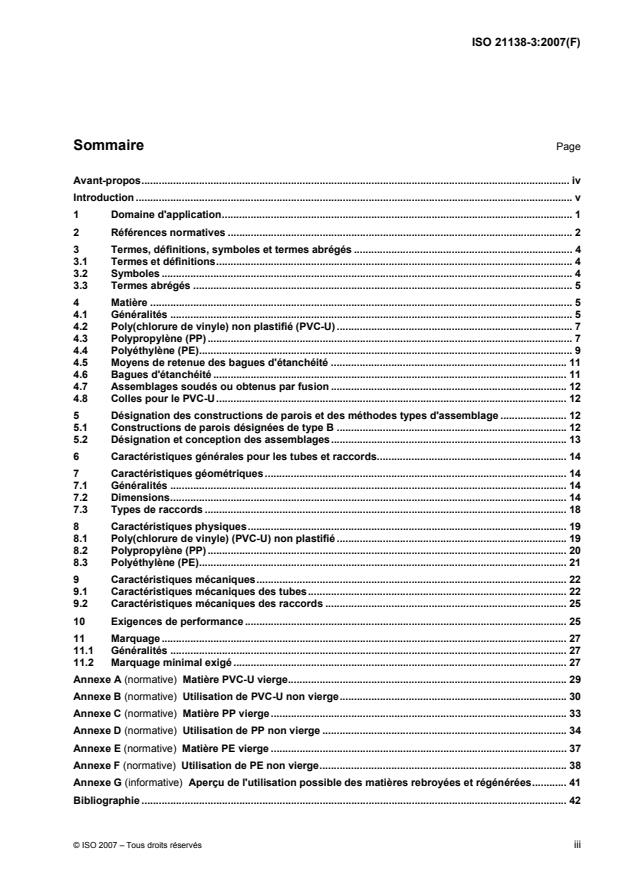
Contents Page
Foreword. iv
Introduction . v
1 Scope . 1
2 Normative references . 2
3 Terms, definitions, symbols and abbreviated terms. 4
3.1 Terms and definitions. 4
3.2 Symbols . 4
3.3 Abbreviated terms . 5
4 Material . 5
4.1 General. 5
4.2 Unplasticized poly(vinyl chloride) (PVC-U). 6
4.3 Polypropylene (PP). 7
4.4 Polyethylene (PE). 9
4.5 Sealing ring retaining components. 11
4.6 Sealing rings . 11
4.7 Fused or welded joints. 11
4.8 Adhesives for PVC-U. 11
5 Designation of wall construction and examples of typical jointing methods . 12
5.1 Wall constructions designated as Type B. 12
5.2 Designation and design of joints . 13
6 General characteristics for pipes and fittings — Colour. 13
7 Geometrical characteristics. 13
7.1 General. 13
7.2 Dimensions. 13
7.3 Types of fitting . 17
8 Physical characteristics. 18
8.1 Unplasticized poly(vinyl chloride) (PVC-U).18
8.2 Polypropylene (PP). 19
8.3 Polyethylene (PE). 19
9 Mechanical characteristics . 20
9.1 Mechanical characteristics of pipes . 20
9.2 Mechanical characteristics of fittings. 22
10 Performance requirements . 24
11 Marking . 25
11.1 General. 25
11.2 Minimum required marking. 25
Annex A (normative) Virgin PVC-U material. 27
Annex B (normative) Utilization of non-virgin PVC-U material. 28
Annex C (normative) Virgin PP material . 31
Annex D (normative) Utilization of non-virgin PP material. 32
Annex E (normative) Virgin PE material . 34
Annex F (normative) Utilization of non-virgin PE material . 35
Annex G (informative) Survey of possible use of reprocessable and recyclable material. 38
Bibliography . 39
Foreword
ISO (the International Organization for Standardization) is a worldwide federation of national standards bodies
(ISO member bodies). The work of preparing International Standards is normally carried out through
ISO technical committees. Each member body interested in a subject for which a technical committee has
been established has the right to be represented on that committee. International organizations, governmental
and non-governmental, in liaison with ISO, also take part in the work. ISO collaborates closely with the
International Electrotechnical Commission (IEC) on all matters of electrotechnical standardization.
International Standards are drafted in accordance with the rules given in the ISO/IEC Directives, Part 2.
The main task of technical committees is to prepare International Standards. Draft International Standards
adopted by the technical committees are circulated to the member bodies for voting. Publication as an
International Standard requires approval by at least 75 % of the member bodies casting a vote.
Attention is drawn to the possibility that some of the elements of this document may be the subject of patent
rights. ISO shall not be held responsible for identifying any or all such patent rights.
ISO 21138-3 was prepared by Technical Committee ISO/TC 138, Plastics pipes, fittings and valves for the
transport of fluids, Subcommittee SC 1, Plastics pipes and fittings for soil, waste and drainage (including land
drainage).
ISO 21138 consists of the following parts, under the general title Plastics piping systems for non-pressure
underground drainage and sewerage — Structured-wall piping systems of unplasticized poly(vinyl chloride)
(PVC-U), polypropylene (PP) and polyethylene (PE):
⎯ Part 1: Material specifications and performance criteria for pipes, fittings and system
⎯ Part 2: Pipes and fittings with smooth external surface, Type A
⎯ Part 3: Pipes and fittings with non-smooth external surface, Type B
iv © ISO 2007 – All rights reserved
Introduction
ISO 21138 is the system standard covering the plastics piping systems for non-pressure underground
drainage and sewerage, in particular thermoplastics structured-wall piping systems.
INTERNATIONAL STANDARD ISO 21138-3:2007(E)
Plastics piping systems for non-pressure underground
drainage and sewerage — Structured-wall piping systems of
unplasticized poly(vinyl chloride) (PVC-U), polypropylene (PP)
and polyethylene (PE) —
Part 3:
Pipes and fittings with non-smooth external surface, Type B
1 Scope
This part of ISO 21138, together with ISO 21138-1, specifies the definitions and requirements for pipes with a
non-smooth external surface (Type B), fittings and systems based on unplasticized poly(vinyl chloride) (PVC-
U), polypropylene (PP) and polyethylene (PE) structured-wall piping systems in the field of non-pressure
systems for underground drainage and sewerage.
NOTE 1 These pipes, fittings and the system can be used for highway drainage and surface water.
This part of ISO 21138 specifically refers to PVC, PP and PE materials.
NOTE 2 Other thermoplastic materials may be added via an addendum.
This part of ISO 21138 specifies test methods and test parameters.
This part of ISO 21138 covers a range of pipe and fitting sizes, materials, pipe constructions and nominal ring
stiffnesses, and gives recommendations concerning colours.
NOTE 3 It is the responsibility of the purchaser or specifier to make the appropriate selections from these aspects,
taking into account their particular requirements and any relevant national regulations and installation practices or codes.
In conjunction with ISO 21138-1, this part of ISO 21138 is applicable to PVC-U, PP and PE structured-wall
pipes and fittings, to their joints and to joints with components of other plastics and non-plastics materials
intended to be used for buried piping systems for the transport of drainage and sewage.
It is applicable to PVC-U, PP and PE structured-wall pipes and fittings with or without an integral socket with
elastomeric ring seal joints as well as welded and fused joints.
NOTE 4 Pipes, fittings and other components conforming to any plastics product standards referred to in Clause 2 can
be used with pipes and fittings conforming to this part of ISO 21138, when they conform to the requirements for joint
dimensions given in parts 2 and 3 of this International Standard and to the performance requirements given in Clause 10.
NOTE 5 For dimensions larger than DN/OD 1200 or DN/ID 1200 this standard can serve as a general guide regarding
appearance, colour, physical and mechanical characteristics as well as performance requirements.
Test methods are not included in this document.
2 Normative references
The following referenced documents are indispensable for the application of this document. For dated
references, only the edition cited applies. For undated references, the latest edition of the referenced
document (including any amendments) applies.
ISO 178, Plastics — Determination of flexural properties
ISO 306:1994, Plastics — Thermoplastic materials — Determination of Vicat softening temperature (VST)
ISO 527-2:1993, Plastics — Determination of tensile properties — Part 2: Test conditions for moulding and
extrusion plastics
ISO 580:2005, Plastics piping and ducting systems — Injection-moulded thermoplastics fittings — Methods for
visually assessing the effects of heating
ISO 1133:2005, Plastics — Determination of the melt mass-flow rate (MFR) and the melt volume-flow rate
(MVR) of thermoplastics
ISO 1167-1, Thermoplastics pipes, fittings and assemblies for the conveyance of fluids — Determination of
the resistance to internal pressure — Part 1: General method
ISO 1167-2, Thermoplastics pipes, fittings and assemblies for the conveyance of fluids — Determination of
the resistance to internal pressure — Part 2: Preparation of pipe test pieces
ISO 1183-1, Plastics — Methods for determining the density of non-cellular plastics — Part 1: Immersion
method, liquid pyknometer method and titration method
ISO 2507-1, Thermoplastics pipes and fittings — Vicat softening temperature — Part 1: General test method
ISO 2507-2, Thermoplastics pipes and fittings — Vicat softening temperature — Part 2: Test conditions for
unplasticized poly(vinyl chloride) (PVC-U) or chlorinated poly(vinyl chloride) (PVC-C) pipes and fittings and for
high impact resistance poly(vinyl chloride) (PVC-Hi) pipes
ISO 3126, Plastics piping systems — Plastics components — Determination of dimensions
ISO 3127, Thermoplastics pipes — Determination of resistance to external blows — Round-the-clock method
ISO 3451-1:1997, Plastics — Determination of ash — Part 1: General methods
ISO 4435:2003, Plastics piping systems for non-pressure underground drainage and sewerage —
Unplasticized poly(vinyl chloride) (PVC-U)
ISO 8772:2006, Plastics piping systems for non-pressure underground drainage and sewerage —
Polyethylene (PE)
ISO 8773:2006, Plastics piping systems for non-pressure underground drainage and sewerage —
Polypropylene (PP)
ISO 9852, Unplasticized poly(vinyl chloride) (PVC-U) pipes — Dichloromethane resistance at specified
temperature (DCMT) — Test method
ISO 9967, Thermoplastics pipes — Determination of creep ratio
ISO 9969, Thermoplastics pipes — Determination of ring stiffness
ISO 11173, Thermoplastics pipes — Determination of resistance to external blows — Staircase method
2 © ISO 2007 – All rights reserved
ISO 11357-6, Plastics — Differential scanning calorimetry (DSC) — Part 6: Determination of oxidation
induction time (isothermal OIT) and oxidation induction temperature (dynamic OIT)
ISO 12091, Structured-wall thermoplastics pipes — Oven test
ISO 13967, Thermoplastics fittings — Determination of ring stiffness
ISO 21138-1, Plastics piping systems for non-pressure underground drainage and sewerage — Structured-
wall piping systems of unplasticized poly(vinyl chloride) (PVC-U), polypropylene (PP) and polyethylene
(PE) — Part 1: Material specifications and performance criteria for pipes, fittings and system
ISO 21138-2, Plastics piping systems for non-pressure underground drainage and sewerage — Structured-
wall piping systems of unplasticized poly(vinyl chloride) (PVC-U), polypropylene (PP) and polyethylene
(PE) — Part 2: Pipes and fittings with smooth external surface, Type A
ISO 22088-3, Plastics — Determination of resistance to environmental stress cracking (ESC) — Part 3: Bent
strip method
EN 681-1, Elastomeric seals — Materials requirements for pipe joint seals used in water and drainage
applications — Part 1: Vulcanized rubber
EN 681-2, Elastomeric seals — Materials requirements for pipe joint seals used in water and drainage
applications — Part 2: Thermoplastic elastomers
EN 681-4, Elastomeric seals — Materials requirements for pipe joint seals used in water and drainage
applications — Part 4: Cast polyurethane sealing elements
EN 922, Plastics piping and ducting systems — Pipes and fittings of unplasticized poly(vinyl chloride)
(PVC-U) — Specimen preparation for determination of the viscosity number and calculation of the K-value
EN 1053, Plastics piping systems — Thermoplastics piping systems for non-pressure applications — Test
method for watertightness
EN 1277:2003, Plastics piping systems — Thermoplastics piping systems for buried non-pressure
applications — Test methods for leaktightness of elastomeric sealing ring type joints
EN 1437:2002, Plastics piping systems — Piping systems for underground drainage and sewerage — Test
method for resistance to combined temperature cycling and external loading
EN 1446, Plastics piping and ducting systems — Thermoplastics pipes — Determination of ring flexibility
EN 1905, Plastics piping systems — Unplasticized poly(vinyl chloride) (PVC-U) pipes, fittings and material —
Method for assessment of the PVC content based on total chlorine content
EN 1979, Plastics piping and ducting systems — Thermoplastics spirally-formed structured-wall pipes —
Determination of the tensile strength of a seam
EN 10204:2004, Metallic products — Types of inspection documents
EN 12061, Plastics piping systems ⎯ Thermoplastics fittings ⎯ Test method for impact resistance
EN 12099, Plastics piping systems — Polyethylene piping materials and components — Determination of
volatile content
EN 12256, Plastics piping systems — Thermoplastics fittings — Test method for mechanical strength or
flexibility of fabricated fittings
EN 14741, Thermoplastics piping and ducting systems — Joints for buried non-pressure applications — Test
method for the long-term sealing performance of joints with elastomeric seals by estimating the sealing
pressure
1)
EN 15344:— , Plastics — Recycled plastics — Characterisation of polyethylene)(PE) recyclates
1)
EN 15345:— , Plastics — Recycled plastics — Characterisation of polypropylene)(PP) recyclates
1)
EN 15346:— , Plastics — Recycled plastics — Characterisation of poly(vinyl chloride)(PVC) recyclates
3 Terms, definitions, symbols and abbreviated terms
For the purposes of this document, the following terms, definitions, symbols and abbreviated terms apply.
3.1 Terms and definitions
The terms and definitions given in ISO 21138-1 apply.
3.2 Symbols
A length of engagement, or maximum pull-out whilst maintaining tightness
D socket inside diameter
i
D minimum mean inside diameter of a socket
im,min
d outside diameter
e
d mean outside diameter
em
d inside diameter
i
d mean inside diameter
im
e wall thickness (at any point)
e construction height
c
e wall thickness of the socket
e wall thickness of the groove
e wall thickness of the inside layer (waterway wall thickness)
e wall thickness of the inside layer under a hollow section
F distance from the spigot end to the effective sealing point
l effective length of a pipe
L minimum length of a spigot
1,min
1) To be published.
4 © ISO 2007 – All rights reserved
3.3 Abbreviated terms
CaCO calcium carbonate
CT close tolerance class
DN nominal size
DN/ID nominal size related to inside diameter
DN/OD nominal size related to outside diameter
ID inside diameter
MgCO magnesium carbonate
MFR melt mass-flow rate
OD outside diameter
OIT oxidation induction time
PE polyethylene
PP polypropylene
PVC-U unplasticized poly(vinyl chloride)
S pipe series S
SDR standard dimension ratio
SN nominal ring stiffness
TIR true impact rate
TPE thermoplastic elastomer
VST Vicat softening temperature
4 Material
4.1 General
The material shall be one of the following, unplasticized poly(vinyl chloride) (PVC-U), polypropylene (PP) or
polyethylene (PE) to which are added those additives that are needed to facilitate the manufacture of
components conforming to this part of ISO 21138, including the relevant annexes.
Spirally formed Type B pipes may include a support profile (see Figure 1) made from polymers other than
PVC-U, PP or PE.
Spirally formed pipe constructions may include a continuous elastomeric sealing component of a material
conforming to EN 681-1, EN 681-2 or EN 681-4 as applicable, or a continuous adhesive conforming to 4.8.
Key
1 supporting profile
Figure 1 — Typical examples of Type B wall construction
4.2 Unplasticized poly(vinyl chloride) (PVC-U)
4.2.1 General
The raw material shall be PVC-U to which are added those additives that are needed to facilitate the
manufacture of components conforming to the requirements of this part of ISO 21138 (see also Annex A).
NOTE Additional information on the characteristics of PVC-U material or components made thereof is given in
ISO 21138-1:2007, Annex A.
6 © ISO 2007 – All rights reserved
4.2.2 Pipe and fitting material characteristics
When tested in accordance with the test method specified in Table 1, using the indicated parameters, the
material shall have characteristics conforming to the requirements given in Table 1.
Table 1 — Material characteristics of PVC-U pipes and injection-moulded fittings
Characteristic Requirements Test parameters Test method
Resistance to No failure during the End caps Type A or B ISO 1167-1
internal pressure test period
Orientation Free
a, b
Number of test pieces 3 ISO 1167-2
Test temperature 60 °C
Circumferential stress
pipe material 10 MPa
fitting material 6,3 MPa
Conditioning period In accordance with
ISO 1167-1
Type of test Water-in-water
Test period 1 000 h
a
For extrusion compounds this test shall be carried out in the form of a solid-wall pipe made from the relevant extrusion material.
b
For injection-moulding compounds this test shall be carried out in the form of an injection-moulded or extruded sample in solid-wall
pipe form made from the relevant material.
4.2.3 Utilization of non-virgin materials
For the utilization of non-virgin PVC-U materials, conditions and requirements are given in Annex B, and the
PVC recyclates shall conform to the characterization specified in EN 15346.
NOTE Annex G gives a survey of the possible uses of reprocessable and recyclable materials.
4.3 Polypropylene (PP)
4.3.1 General
The compound for pipes and fittings shall be PP base material to which are added those additives that are
needed to facilitate the manufacture of components conforming to the requirements of this part of ISO 21138.
See also Annex C.
NOTE Additional information on the characteristics of PP material or components made thereof is given in Annex A
of ISO 21138-1:2007.
4.3.2 Pipe and fitting material characteristics
When tested in accordance with the test methods specified in Table 2, using the indicated parameters, the
material shall have characteristics conforming to the requirements given in Table 2.
Table 2 — Material characteristics of PP pipes and injection-moulded fittings
Characteristic Requirements Test parameters Test method
Resistance to No failure during End caps Type A or B ISO 1167-1
internal pressure, the test period
Test temperature 80 °C
a, b
140 h
Orientation Free ISO 1167-2
Number of test pieces 3
Circumferential stress 4,2 MPa
Conditioning period In accordance with
ISO 1167-1
Type of test Water-in-water
Test period 140 h
Resistance to No failure during End caps Type A or B ISO 1167-1
internal pressure the test period
Test temperature 95 °C
a, b
1 000 h
Orientation Free ISO 1167-2
Number of test pieces 3
Circumferential stress 2,5 MPa
Conditioning period In accordance with
ISO 1167-1
Type of test Water-in-water
Test period 1 000 h
Melt mass-flow
u 1,5 g/10 min Temperature 230 °C ISO 1133:2005
rate
Loading mass 2,16 kg Condition M
Thermal stability, W 8 min Temperature 200 °C ISO 11357-6
c
OIT
a
For extrusion compounds this test shall be carried out in the form of a solid-wall pipe made from the relevant extrusion material.
b
For injection-moulding compounds this test shall be carried out in the form of an injection-moulded, or extruded sample in solid-wall
pipe form made from the relevant material.
c
This requirement is only valid for pipes and fittings intended to be jointed in the field by fusing or welding.
4.3.3 Melt mass-flow rate classification
Materials for pipes and fittings intended for jointing in the field by fusion or welding shall be designated by the
following MFR classes:
⎯ Class A: MFR u 0,3 g/10 min
⎯ Class B: 0,3 g/10 min < MFR u 0,6 g/10 min
⎯ Class C: 0,6 g/10 min < MFR u 0,9 g/10 min
⎯ Class D: 0,9 g/10 min < MFR u 1,5 g/10 min
In the case where a raw material, because of its MFR tolerance, arbitrarily falls in one of two adjacent classes,
the manufacturer of the components may mark the MFR class on the product as follows:
⎯ for an MFR value across the border between A and B it is permitted to classify as class A;
⎯ for an MFR value across the border between B and C it is permitted to classify as class C;
⎯ for an MFR value across the border between C and D it is permitted to classify as class D.
8 © ISO 2007 – All rights reserved
4.3.4 Utilization of non-virgin materials
For the utilization of non-virgin PP materials, conditions and requirements are given in Annex D, and the PP
recyclates shall conform to the characterization specified in EN 15345.
NOTE Annex G gives a survey of the possible uses of reprocessable and recyclable materials.
4.4 Polyethylene (PE)
4.4.1 General
The base material shall be polyethylene (PE) to which are added those additives that are needed to facilitate
the manufacture of components conforming to this part of ISO 21138. See also Annex E.
NOTE Additional information on the characteristics of PE material or components made thereof is given in Annex A
of ISO 21138-1:2007.
4.4.2 Material characteristics of pipes and injection-moulded fittings
When tested in accordance with the test method specified in Table 3, using the indicated parameters, the
material shall have characteristics conforming to the requirements given in Table 3.
4.4.3 Material characteristics of rotational-moulded fittings
When tested in accordance with the test methods specified in Table 4, using the indicated parameters, the
material shall have characteristics conforming to the requirements given in Table 4.
4.4.4 Utilization of non-virgin materials
For the utilization of non-virgin PE materials, conditions and requirements are given in Annex F, and the PE
recyclates shall conform to the characterization specified in EN 15344.
NOTE Annex G gives a survey of the possible uses of reprocessable and recyclable materials.
Table 3 — Material characteristics of PE pipes and injection-moulded fittings
Characteristic Requirements Test parameters Test method
Resistance to No failure during the End caps Type A or B ISO 1167-1
internal pressure test period
Test temperature 80 °C
a, b
165 h
Orientation Free ISO 1167-2
Number of test pieces 3
Circumferential stress 4,0 MPa
Conditioning period In accordance with
ISO 1167-1
Type of test Water-in-water
Test period 165 h
Resistance to No failure during the End caps Type A or B ISO 1167-1
internal pressure test period
Test temperature 80 °C
a, b
1 000 h
Orientation Free ISO 1167-2
Number of test pieces 3
Circumferential stress 2,8 MPa
Conditioning period In accordance with
ISO 1167-1
Type of test Water-in-water
Test period 1 000 h
Melt mass-flow u 1,6 g/10 min Temperature 190 °C ISO 1133:2005
rate
Loading mass 5 kg Condition T
Thermal stability, W 20 min Temperature 200 °C ISO 11357-6
c
OIT
Reference density W 930 kg/m In accordance with ISO 1183-1 ISO 1183-1
a
This test shall be carried out in the form of a solid-wall pipe made from the relevant extrusion material.
b
For injection-moulding compounds this test shall be carried out in the form of an injection-moulded or extruded sample in solid-wall
pipe form made from the relevant material.
c
This requirement is only valid for pipes and fittings intended to be jointed in field by fusing or welding.
10 © ISO 2007 – All rights reserved
Table 4 — Material characteristics of PE rotational-moulded fittings
Characteristic Requirements Test parameters Test
Resistance to internal No failure during the End caps Type A or B ISO 1167-1
a
pressure 165 h test period
Orientation Free
Number of test pieces 3 ISO 1167-2
Temperature 60 °C
Circumferential stress 3,9 MPa
Conditioning period In accordance with
ISO 1167-1
Type of test Water-in-water
Test period 165 h
Resistance to internal No failure during the End caps Type A or B ISO 1167-1
a
pressure 1 000 h test period
Orientation Free
Number of test pieces 3 ISO 1167-2
Temperature 60 °C
Circumferential stress 3,2 MPa
Conditioning period In accordance with
ISO 1167-1
Type of test Water-in-water
Test period 1 000 h
Melt mass-flow rate 3 g/10 min u MFR Temperature 190 °C ISO 1133:2005
u 16 g/10 min Loading mass 5 Kg Condition T
Thermal stability OIT W 10 min Temperature 200 °C ISO 11357-6
Reference density W 925 kg/m Temperature (23 ± 2) °C ISO 1183-1
a
This test shall be carried out in the form of an injection-moulded or extruded sample in solid-wall pipe form made from the relevant
material.
4.5 Sealing ring retaining components
It is permitted that sealing rings be retained using components made from any polymer.
4.6 Sealing rings
The sealing ring material shall conform to EN 681-1, EN 681-2 or EN 681-4, as applicable.
The sealing ring shall have no detrimental effects on the properties of the components and shall not cause the
test assembly to fail the performance requirements given in Clause 10.
4.7 Fused or welded joints
The design of fused or welded joints together with the manufacturer's instructions for the jointing process shall
not cause the test assembly to fail the performance requirements given in Clause 10.
4.8 Adhesives for PVC-U
The adhesive for solvent cement jointing of PVC-U shall be solvent cement and shall be as specified by the
manufacturer of the pipes or fittings, where appropriate.
The adhesive shall have no detrimental effects on the properties of components and shall not cause the test
assembly to fail the performance requirements given in Clause 10.
5 Designation of wall construction and examples of typical jointing methods
NOTE The figures are schematic sketches only to indicate the relevant dimensions. They do not necessarily
represent the manufactured components.
5.1 Wall constructions designated as Type B
5.1.1 Ribbed or corrugated construction
A pipe or fitting with a plain inside surface and a solid or hollow spiral or annular ribbed external surface shall
be designated Type B.
Typical examples of Type B constructions are shown in Figure 1.
5.1.2 Typical jointing methods for structured-wall Type B pipes
Relevant jointing dimensions for typical Type B joint constructions are shown in Figure 2 and Figure 3.
Figure 2 — Typical examples of elastomeric sealing ring joints with the sealing
ring located on the spigot, Type B
12 © ISO 2007 – All rights reserved
Figure 3 — Typical example of an elastomeric sealing ring joint with sealing
ring located in the socket, Type B
5.2 Designation and design of joints
Pipes and fittings may be designed with spigot ends and sockets of another construction than the pipe or
fitting body. Such constructions may be Type A1, A2 or B or solid plain. For definitions and specifications for
Type A1 and A2 pipes see ISO 21138-2.
NOTE Joints with elastomeric sealing rings are designed either with the sealing ring positioned on the spigot (see
Figure 2) or in the socket (see Figure 3).
6 General characteristics for pipes and fittings — Colour
Colour and appearance are specified in ISO 21138-1.
7 Geometrical characteristics
7.1 General
All dimensions shall be measured in accordance with ISO 3126.
7.2 Dimensions
7.2.1 Designation
Pipes and fittings are sized according to their outside diameter (DN/OD series) and/or according to their inside
diameter (DN/ID series).
Type B DN/OD pipes and fittings with plain spigot jointing dimensions conforming to ISO 4435, ISO 8772 or
ISO 8773 for PVC-U, PP and PE respectively, and with larger d than the spigot, are permitted to be
e
designated by the spigot dimension.
7.2.2 Lengths of pipe
The effective length of pipe, l, shall be not less than that specified by the manufacturer when measured as
shown in Figure 2 and/or Figure 3.
7.2.3 Diameters of Type B pipes and spigots of pipes or fittings
The nominal sizes and minimum mean inside diameters for DN/OD and DN/ID series are specified in Table 5.
Other nominal sizes, greater than DN/ID 100 and DN/OD 110 and less than DN/OD and DN/ID 1200, than
those given in Table 5, are permitted.
NOTE They should preferably be selected from ISO 161-1.
For DN/ODs and DN/IDs not specified in Table 5, the minimum inside diameter, d , shall be linearly
im,min
interpolated between the adjacent values specified in the Table 5.
Table 5 — Nominal sizes, minimum mean inside diameters,
thickness of inside layers and socket length
Dimensions in millimetres
a
Diameters Minimum wall thickness
Socket
DN/OD series DN/ID series
b b, c
PVC-U PP/ PE
DN/OD d d DN/ID d e e A
im,min im,min im,min 4,min 5,min min
110 97 90 100 95 1,0 1,0 32
125 107 105 1,1 1,0 35
125 120 1,2 1,0 38
160 135 134 1,2 1,0 42
150 145 1,3 1,0 43
200 172 167 1,4 1,1 50
200 195 1,5 1,1 54
250 216 209 225 220 1,7 1,4 55
250 245 1,8 1,5 59
315 270 263 1,9 1,6 62
300 294 2,0 1,7 64
400 340 335 2,3 2,0 70
400 392 2,5 2,3 74
500 432 418 2,8 2,8 80
500 490 3,0 3,0 85
630 540 527 3,3 3,3 93
600 588 3,5 3,5 96
800 680 669 4,1 4,1 110
800 785 4,5 4,5 118
1 000 864 837 5,0 5,0 130
1 000 985 5,0 5,0 140
1 200 1 037 1 005 5,0 5,0 150
1 200 1 185 5,0 5,0 162
a
For selection of the A requirements for a socket, refer to the pipe material and construction. For pipes longer than 6 m it is
min
recommended that one produce a larger A than is specified in this table.
mi,n
b
The actual inside diameter of a pipe depends on the material, construction and stiffness. It may be considerably higher than the
minimum specified in this table. For more information see the manufacturer's documentation.
c
The minimum mean inside diameter, d , of a fitting shall be not less than 98 % of the specified minimum mean inside diameter
im,min
of the pipe for which it is designed or conform to this table, whichever is the greater value.
14 © ISO 2007 – All rights reserved
DN/OD series pipes and spigots intended to have jointing dimensions as pipes and/or fittings according to
ISO 4435, ISO 8772 or ISO 8773 for PVC, PP or PE respectively, shall comply with whichever of those
documents is relevant regarding the outside diameters and tolerances of the spigot.
For pipes and fittings not intended to have jointing dimensions as pipes and/or fittings according to ISO 4435,
ISO 8772 or ISO 8773 for PVC, PP or PE respectively, the tolerance of the outside diameter of pipe and
spigot shall be:
d W 0,994 × d
em, min e
d u 1,003 × d
em, max e
where d equals either the nominal size of a DN/OD pipe or the outside diameter as specified by the
e
manufacturer of a DN/ID pipe.
The results are to be rounded to the next higher 0,1 mm.
7.2.4 Diameters and jointing dimensions of sockets and spigots
7.2.4.1 Joints with the elastomeric sealing ring positioned in the socket (combined with Type B
pipes or fittings)
For Type B pipes, the requirement regarding the socket and spigot dimension, A , specified in Table 5
min
applies.
In the case where other nominal sizes than those specified in Table 5 are selected for Type B pipes, the
requirements regarding the socket dimension A shall be linearly interpolated between the adjacent values
min
specified in Table 5.
D shall be equal to d .
i,min e,max
For Type B pipes greater than DN/OD 630 and DN/ID 600 when they are designed for a specific project, A
min
may be shorter than is specified in Table 5. However it shall be not less that 85 mm. Such pipes shall be
marked “SHORT SOCKET”.
7.2.4.2 Joints with the elastomeric sealing ring positioned on the spigot
The spigot A shall comply with Table 5.
min
In the case where other nominal sizes than those listed in Table 5 are selected, the requirement regarding
A shall be linearly interpolated from the adjacent values specified in Table 5.
min
L shall conform to the following:
1, min
L = A + F
1, min min
where F is the distance from the end of the spigot to the effective sealing point. See Figure 2.
NOTE The manufacturer should specify in which position the sealing ring shall be placed if there is more than one
possibility.
D shall be equal to d .
i,min e,max
For Type B pipes greater than DN/OD 630 and DN/ID 600 when they are designed for a specific project, A
min
may be shorter than is specified in Table 5. However it shall be not less that 85 mm. Such pipes shall be
marked “SHORT SOCKET”.
7.2.5 Wall thicknesses
7.2.5.1 Wall thickness of sockets and joint design requirements
7.2.5.1.1 General
In addition to the minimum required wall thickness of sockets and spigots as specified below, their ring
stiffness, when determined in accordance with ISO 9969, shall conform to the following equation:
S + W SN
so Ssp pipe
For the test it is permitted to use cut-off straight socket and spigot parts even if they do not conform to the
length requirements specified in ISO 9969.
For dimensions W 500 mm the stiffness may be calculated provided reliable information regarding the
E-modulus is available.
7.2.5.1.2 Spigots
When the spigot has the same design as the pipe, the wall thickness requirements for the corresponding pipe
dimension and construction apply.
In the case of a solid plain spigot design, the wall thickness, e, shall conform to Table 6. The values shall be
calculated to the second decimal place and rounded to the next higher 0,1 mm.
Table 6 — Minimum required wall thicknesses of solid plain spigots
Dimensions in millimetres
Material Outside diameter e
min
d u 500 d /51 but not less than 3,2
e e
PVC-U
d > 500 9,8
e
d u 500 d /41 but not less than 3,4
e e
PP
d > 500 12,2
e
d u 500 d /33 but not less than 4,2
e e
PE
d > 500 15,2
e
7.2.5.1.3 Sockets in accordance with ISO 4435, ISO 8772 or ISO 8773
When a socket is intended to conform to one of the above mentioned International Standards it shall comply
with the wall thickness requirements of the appropriate document.
7.2.5.1.4 Sockets heat formed on the pipes
When a socket is heat formed on a pipe or pipe segment the following is permitted:
⎯ for joints with the sealing ring positioned in the socket: a reduction of the wall thicknesses, as applicable,
to 85 % in the cylindrical part of the socket and to 75 % in the groove area of a socket;
⎯ for joints with the sealing ring positioned on the pipe: a reduction of the wall thicknesses e and e , as
4 5
applicable, to 75 %.
In both cases the manufacturer specifies the reference value for the wall thickness.
16 © ISO 2007 – All rights reserved
7.2.5.1.5 Other sockets with stiffness W 4 kN/m
For structured-wall designed sockets the wall thicknesses e and e , as applicable, shall comply with the
4 5
requirements given in Table 5.
7.2.5.1.6 Other sockets with stiffness < 4 kN/m
The thickness of the inner wall of the socket shall be at least 1,5 × e as specified in Table 5.
7.2.5.2 Injection-moulded fittings
The minimum wall thickness in the body of injection-moulded fittings of Type B construction, e , for
4,min
DN/OD u 315 and DN/ID u 300 shall be 2,0 mm. For larger sizes it shall conform to the requirements for
e as specified in Table 5.
4, min
The construction height of the body wall, e , for injection-moulded fittings up to 200 mm DN/OD and up to
c
200 mm actual outside diameter of pipes in the DN/ID series shall be at least as specified for e for:
min
⎯ the SDR 41 series in ISO 4435;
⎯ the SDR 33 series in ISO 8773;
⎯ the SDR 26 series in ISO 8772;
for PVC-U, PP and PE respectively.
In the case of ID series fittings the calculation shall be based on the actual outside diameter of the
corresponding pipe.
The jointing design including socket and spigot dimensions shall conform to 7.2.5.1.
7.2.5.3 Fabricated fittings
The wall thickness of the body of fittings fabricated from pipes shall conform to the requirements of the
corresponding pipe. Wall thickness reductions due to the process is permitted provided the requirements in
Table 16 are satisfied.
The jointing design including socket and spigot dimensions shall conform to 7.2.5.1.
7.2.5.4 Rotational moulded fittings
The minimum wall thickness in the body of rotational-moulded fittings, e , shall be 1,25 × the values
4,min
specified for injection-moulded fittings, rounded to the next higher 0,1 mm.
If a rotational-moulded fitting has a solid plain spigot and/or socket, the minimum required wall thicknesses e,
e and e as applicable shall be 1,25 × the values derived from 7.2.5.
2 3
The s
...
NORME ISO
INTERNATIONALE 21138-3
Première édition
2007-10-15
Systèmes de canalisations en plastique
pour les branchements et les collecteurs
d'assainissement sans pression
enterrés — Systèmes de canalisations
à parois structurées en poly(chlorure
de vinyle) non plastifié (PVC-U),
polypropylène (PP) et polyéthylène
(PE) —
Partie 3:
Tubes et raccords avec une surface
externe non lisse, type B
Plastics piping systems for non-pressure underground drainage and
sewerage — Structured-wall piping systems of unplasticized
poly(vinylchloride) (PVC-U), polypropylene (PP) and polyethylene
(PE) —
Part 3: Pipes and fittings with non-smooth external surface, type B
Numéro de référence
©
ISO 2007
PDF – Exonération de responsabilité
Le présent fichier PDF peut contenir des polices de caractères intégrées. Conformément aux conditions de licence d'Adobe, ce fichier
peut être imprimé ou visualisé, mais ne doit pas être modifié à moins que l'ordinateur employé à cet effet ne bénéficie d'une licence
autorisant l'utilisation de ces polices et que celles-ci y soient installées. Lors du téléchargement de ce fichier, les parties concernées
acceptent de fait la responsabilité de ne pas enfreindre les conditions de licence d'Adobe. Le Secrétariat central de l'ISO décline toute
responsabilité en la matière.
Adobe est une marque déposée d'Adobe Systems Incorporated.
Les détails relatifs aux produits logiciels utilisés pour la création du présent fichier PDF sont disponibles dans la rubrique General Info
du fichier; les paramètres de création PDF ont été optimisés pour l'impression. Toutes les mesures ont été prises pour garantir
l'exploitation de ce fichier par les comités membres de l'ISO. Dans le cas peu probable où surviendrait un problème d'utilisation,
veuillez en informer le Secrétariat central à l'adresse donnée ci-dessous.
DOCUMENT PROTÉGÉ PAR COPYRIGHT
© ISO 2007
Droits de reproduction réservés. Sauf prescription différente, aucune partie de cette publication ne peut être reproduite ni utilisée sous
quelque forme que ce soit et par aucun procédé, électronique ou mécanique, y compris la photocopie et les microfilms, sans l'accord écrit
de l'ISO à l'adresse ci-après ou du comité membre de l'ISO dans le pays du demandeur.
ISO copyright office
Case postale 56 • CH-1211 Geneva 20
Tel. + 41 22 749 01 11
Fax. + 41 22 749 09 47
E-mail copyright@iso.org
Web www.iso.org
Publié en Suisse
ii © ISO 2007 – Tous droits réservés
Sommaire Page
Avant-propos. iv
Introduction . v
1 Domaine d'application. 1
2 Références normatives . 2
3 Termes, définitions, symboles et termes abrégés . 4
3.1 Termes et définitions. 4
3.2 Symboles . 4
3.3 Termes abrégés . 5
4 Matière . 5
4.1 Généralités . 5
4.2 Poly(chlorure de vinyle) non plastifié (PVC-U) .7
4.3 Polypropylène (PP). 7
4.4 Polyéthylène (PE). 9
4.5 Moyens de retenue des bagues d'étanchéité . 11
4.6 Bagues d'étanchéité . 11
4.7 Assemblages soudés ou obtenus par fusion . 12
4.8 Colles pour le PVC-U. 12
5 Désignation des constructions de parois et des méthodes types d'assemblage . 12
5.1 Constructions de parois désignées de type B . 12
5.2 Désignation et conception des assemblages. 13
6 Caractéristiques générales pour les tubes et raccords. 14
7 Caractéristiques géométriques . 14
7.1 Généralités . 14
7.2 Dimensions. 14
7.3 Types de raccords . 18
8 Caractéristiques physiques. 19
8.1 Poly(chlorure de vinyle) (PVC-U) non plastifié . 19
8.2 Polypropylène (PP). 20
8.3 Polyéthylène (PE). 21
9 Caractéristiques mécaniques. 22
9.1 Caractéristiques mécaniques des tubes. 22
9.2 Caractéristiques mécaniques des raccords . 25
10 Exigences de performance . 25
11 Marquage . 27
11.1 Généralités . 27
11.2 Marquage minimal exigé . 27
Annexe A (normative) Matière PVC-U vierge. 29
Annexe B (normative) Utilisation de PVC-U non vierge. 30
Annexe C (normative) Matière PP vierge. 33
Annexe D (normative) Utilisation de PP non vierge . 34
Annexe E (normative) Matière PE vierge . 37
Annexe F (normative) Utilisation de PE non vierge. 38
Annexe G (informative) Aperçu de l'utilisation possible des matières rebroyées et régénérées. 41
Bibliographie . 42
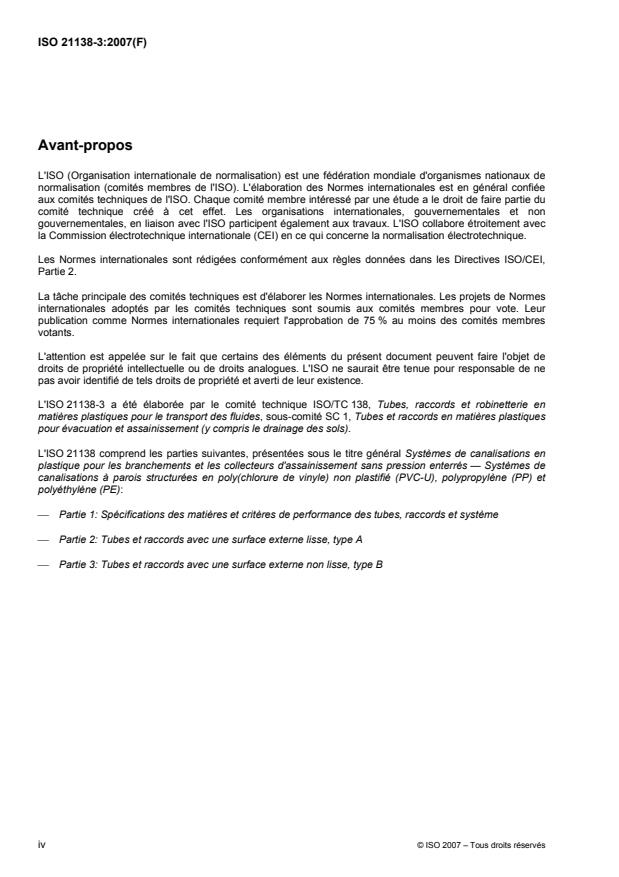
Avant-propos
L'ISO (Organisation internationale de normalisation) est une fédération mondiale d'organismes nationaux de
normalisation (comités membres de l'ISO). L'élaboration des Normes internationales est en général confiée
aux comités techniques de l'ISO. Chaque comité membre intéressé par une étude a le droit de faire partie du
comité technique créé à cet effet. Les organisations internationales, gouvernementales et non
gouvernementales, en liaison avec l'ISO participent également aux travaux. L'ISO collabore étroitement avec
la Commission électrotechnique internationale (CEI) en ce qui concerne la normalisation électrotechnique.
Les Normes internationales sont rédigées conformément aux règles données dans les Directives ISO/CEI,
Partie 2.
La tâche principale des comités techniques est d'élaborer les Normes internationales. Les projets de Normes
internationales adoptés par les comités techniques sont soumis aux comités membres pour vote. Leur
publication comme Normes internationales requiert l'approbation de 75 % au moins des comités membres
votants.
L'attention est appelée sur le fait que certains des éléments du présent document peuvent faire l'objet de
droits de propriété intellectuelle ou de droits analogues. L'ISO ne saurait être tenue pour responsable de ne
pas avoir identifié de tels droits de propriété et averti de leur existence.
L'ISO 21138-3 a été élaborée par le comité technique ISO/TC 138, Tubes, raccords et robinetterie en
matières plastiques pour le transport des fluides, sous-comité SC 1, Tubes et raccords en matières plastiques
pour évacuation et assainissement (y compris le drainage des sols).
L'ISO 21138 comprend les parties suivantes, présentées sous le titre général Systèmes de canalisations en
plastique pour les branchements et les collecteurs d'assainissement sans pression enterrés — Systèmes de
canalisations à parois structurées en poly(chlorure de vinyle) non plastifié (PVC-U), polypropylène (PP) et
polyéthylène (PE):
⎯ Partie 1: Spécifications des matières et critères de performance des tubes, raccords et système
⎯ Partie 2: Tubes et raccords avec une surface externe lisse, type A
⎯ Partie 3: Tubes et raccords avec une surface externe non lisse, type B
iv © ISO 2007 – Tous droits réservés
Introduction
L'ISO 21138 est un système de normes couvrant les systèmes de canalisations en plastique pour les
branchements et les collecteurs d'assainissement enterrés sans pression et en particulier les systèmes de
canalisations thermoplastiques à parois structurées.
NORME INTERNATIONALE ISO 21138-3:2007(F)
Systèmes de canalisations en plastique pour les branchements
et les collecteurs d'assainissement sans pression enterrés —
Systèmes de canalisations à parois structurées en
poly(chlorure de vinyle) non plastifié (PVC-U), polypropylène
(PP) et polyéthylène (PE) —
Partie 3:
Tubes et raccords avec une surface externe non lisse, type B
1 Domaine d'application
La présente partie de l'ISO 21138, conjointement avec l'ISO 21138-1, spécifie les définitions et les exigences
pour les tubes avec une surface externe non lisse (Type B), les raccords et les systèmes fabriqués à partir de
poly(chlorure de vinyle) non plastifié (PVC-U), polypropylène (PP) et polyéthylène (PE) destinés à être utilisés
en tant que systèmes de canalisations à parois structurées dans le domaine des branchements et des
collecteurs d'assainissement enterrés sans pression.
NOTE 1 Ces tubes, raccords et système peuvent être utilisés pour le transport des eaux de drainage et de surface.
La présente partie de l'ISO 21138 se réfère spécifiquement aux matériaux PVC, PP et PE.
NOTE 2 D'autres matériaux thermoplastiques peuvent être introduits dans un additif.
La présente partie de l'ISO 21138 spécifie les méthodes d'essai et les paramètres d'essai.
Elle couvre une gamme de dimensions de tubes et de raccords, de matériaux, de construction de tubes, de
rigidité annulaire nominale et donne des recommandations concernant les couleurs.
NOTE 3 Il est de la responsabilité de l'acheteur ou du prescripteur de faire les sélections appropriées à partir de ces
aspects, en tenant compte des exigences particulières et des règles nationales concernées et des pratiques ou codes de
pose.
Conjointement avec l'ISO 21138-1, elle s'applique aux tubes et raccords à parois structurées en PVC-U, PP et
PE, à leurs assemblages ainsi qu'aux assemblages avec d'autres composants en d'autres matières,
plastiques ou non, destinés à être utilisés pour les systèmes de canalisations enterrées pour le transport des
eaux de drainage et d'assainissement, de drainage de grand-route et de surface.
La présente partie de l'ISO 21138 s'applique aux tubes et raccords à parois structurées en PVC-U, PP et PE,
qui comprennent des assemblages avec ou sans emboîture intégrée à bague d'étanchéité en élastomère
ainsi que des assemblages soudés et les assemblages obtenus par fusion.
NOTE 4 Les tubes, raccords et autres composants conformes aux normes de produits plastiques indiquées à l'Article 2
peuvent être utilisés avec des tubes et des raccords conformes à la présente partie de l'ISO 21138, lorsqu'ils satisfont aux
exigences dimensionnelles des assemblages indiquées dans l'ISO 21138-2 et dans la présente partie de l'ISO 21138 et
aux exigences de performance indiquées à l'Article 10.
NOTE 5 Pour les dimensions plus grandes que DN/OD 1 200 ou DN/ID 1 200, la présente partie de l'ISO 21138 peut
servir comme guide général en ce qui concerne l'aspect, la couleur, les caractéristiques physiques et mécaniques aussi
bien que pour les exigences de performance.
Les méthodes d'essai ne sont pas incluses dans la présente partie de l'ISO 21138.
2 Références normatives
Les documents de référence suivants sont indispensables pour l'application du présent document. Pour les
références datées, seule l'édition citée s'applique. Pour les références non datées, la dernière édition du
document de référence s'applique (y compris les éventuels amendements).
ISO 178, Plastiques — Détermination des propriétés en flexion
ISO 306, Plastiques — Matières thermoplastiques — Détermination de la température de ramollissement
Vicat (VST)
ISO 527-2:1993, Plastiques — Détermination des propriétés en traction — Partie 2: conditions d'essai des
plastiques pour moulage et extrusion
ISO 580:2005, Systèmes de canalisations et de gaines en plastiques — Raccords thermoplastiques moulés
par injection — Méthodes d'essai pour estimer visuellement les effets de la chaleur
ISO 1133:2005, Plastiques — Détermination de l'indice de fluidité à chaud des thermoplastiques, en masse
(MFR) et en volume (MVR)
ISO 1167-1, Tubes, raccords et assemblages en matières thermoplastiques pour le transport des fluides —
Détermination de la résistance à la pression interne — Partie 1: Méthode générale
ISO 1167-2, Tubes, raccords et assemblages en matières thermoplastiques pour le transport des fluides —
Détermination de la résistance à la pression interne — Partie 2: Préparation des éprouvettes tubulaires
ISO 1183-1, Plastiques — Méthodes de détermination de la masse volumique des plastiques non alvéolaires —
Partie 1: méthode par immersion, méthode du pycnomètre en milieu liquide et méthode par titrage
ISO 2507-1, Tubes et raccords en matières thermoplastiques — Température de ramollissement Vicat —
Partie 1: méthode générale d'essai
ISO 2507-2, Tubes et raccords en matières thermoplastiques — Température de ramollissement Vicat —
Partie 2: conditions particulières d'essai pour tubes et raccords en poly(chlorure de vinyle) non plastifié
(PVC-U) ou en poly(chlorure de vinyle) chlore (PVC-C) et tubes en poly(chlorure de vinyle) à résistance au
choc améliorée (PVC-HI)
ISO 3126, Systèmes de canalisations en plastiques — Composants en plastiques — Détermination des
dimensions
ISO 3127, Tubes en matières thermoplastiques — Détermination de la résistance aux chocs extérieurs —
Méthode autour du cadran
ISO 3451-1:1997, Plastiques — Détermination du taux de cendres — Partie 1: Méthodes générales
ISO 4435:2003, Systèmes de canalisations en plastique pour les branchements et les collecteurs
d'assainissement enterrés sans pression — Poly(chlorure de vinyle) non plastifié (PVC-U)
ISO 8772:2006, Systèmes de canalisations en plastique pour les branchements et les collecteurs
d'assainissement enterrés sans pression — Polyéthylène (PE)
ISO 8773:2006, Systèmes de canalisations en plastique pour les branchements et les collecteurs
d'assainissement enterrés sans pression — Polypropylène (PP)
2 © ISO 2007 – Tous droits réservés
ISO 9852, Tubes en poly(chlorure de vinyle) non plastifié (PVC-U) — Résistance au dichlorométhane à une
température spécifiée (DCMT) — Méthode d'essai
ISO 9967, Tubes en matières thermoplastiques — Détermination du taux de fluage
ISO 9969, Tubes en matières thermoplastiques — Détermination de la rigidité annulaire
ISO 11173:1994, Tubes en matières thermoplastiques — Détermination de la résistance aux chocs extérieurs —
Méthode en escalier
ISO 11357-6, Plastiques — Analyse calorimétrique différentielle (DSC) — Partie 6: Détermination du temps
d'induction à l'oxydation
ISO 12091, Tubes en matières thermoplastiques à parois structurées — Essai à l'étuve
ISO 13967, Raccords en matières thermoplastiques — Détermination de la rigidité annulaire
ISO 21138-1, Systèmes de canalisations en plastique pour les branchements et les collecteurs
d'assainissement sans pression enterrés — Systèmes de canalisations à parois structurées en poly(chlorure
de vinyle) non plastifié (PVC-U), polypropylène (PP) et polyéthylène (PE) — Partie 1: Spécifications des
matières et de performance des tubes, raccords et système
ISO 21138-2, Systèmes de canalisations en plastique pour les branchements et les collecteurs
d'assainissement sans pression enterrés — Systèmes de canalisations à parois structurées en poly(chlorure
de vinyle) non plastifié (PVC-U), polypropylène (PP) et polyéthylène (PE) — Partie 2: Tubes et raccords avec
une surface externe lisse, type A
ISO 22088-3, Plastiques — Détermination de la fissuration sous contrainte dans un environnement donné
(ESC) — Partie 3: Méthode de l'éprouvette courbée
EN 681-1, Garnitures d'étanchéité en caoutchouc — Spécification des matériaux pour garnitures d'étanchéité
pour joints de canalisations utilisées dans le domaine de l'eau et de l'évacuation — Partie 1: Caoutchouc
vulcanisé
EN 681-2, Garnitures d'étanchéité en caoutchouc — Spécification des matériaux pour garnitures d'étanchéité
pour joints de canalisations utilisées dans le domaine de l'eau et de l'évacuation — Partie 2: Élastomères
thermoplastiques
EN 681-4, Garnitures d'étanchéité en caoutchouc — Spécification des matériaux pour garnitures d'étanchéité
pour joints de canalisations utilisées dans le domaine de l'eau et de l'évacuation — Partie 4: Éléments
d’étanchéité en polyuréthane moulé
EN 922, Systèmes de canalisations et des gaines en plastiques — Tubes et raccords en poly(chlorure de
vinyle) non plastifié (PVC-U) — Préparation d'un échantillon pour la détermination de l'indice de viscosité et le
calcul de la valeur-K
EN 1053, Systèmes de canalisations en plastiques — Systèmes de canalisations thermoplastiques pour
applications sans pression — Méthode d'essai de l'étanchéité à l'eau
EN 1277:2003, Systèmes de canalisations en plastiques — Systèmes de canalisations thermoplastiques pour
applications enterrées sans pression — Méthodes d'essai d'étanchéité des assemblages à bague
d'étanchéité en élastomère
EN 1437:2002, Systèmes de canalisations en plastique — Systèmes de canalisations pour assainissement
enterré — Méthode d'essai pour la résistance à un cycle de températures et de charge externe combinés
EN 1446, Systèmes de canalisations et de gaines en plastiques — Tubes thermoplastiques — Détermination
d'essai de la flexibilité annulaire
EN 1905, Systèmes de canalisations en plastique — Tubes, raccords et matières en poly(chlorure de vinyle)
non plastifié (PVC-U) — Méthode d'évaluation de la teneur en PVC sur la base de la teneur totale en chlore
EN 1979, Systèmes de canalisations et de gaines en matières plastiques — Tubes thermoplastiques à paroi
structurée enroulés en hélice — Détermination de la résistance en traction de la ligne de soudure
EN 10204:2004, Produits métalliques — Types de documents de contrôle
EN 12061, Systèmes de canalisation en plastique — Raccords en thermoplastique — Méthode d’essai de
résistance au choc
EN 12099, Systèmes de canalisations en plastiques — Matériaux et composants de tuyauterie en
polyéthylène — Détermination de la teneur en matières volatiles
EN 12256, Systèmes de canalisations en plastique — Raccords thermoplastiques — Méthode d'essai de la
résistance mécanique ou de la flexibilité des raccords façonnés
EN 14741, Systèmes de canalisations et de gaines en thermoplastiques — Assemblages pour applications
enterrées sans pression — Méthode d'essai pour la performance à long terme des assemblages avec
garnitures d’étanchéité en élastomère par l'estimation de la pression d'étanchéité
1)
EN 15344:— , Plastiques — Plastiques recyclés — Caractérisation des recyclats de polyéthylène (PE)
1)
EN 15345:— , Plastiques — Plastiques recyclés — Caractérisation des recyclats de polypropylène (PP)
1)
EN 15346:— , Plastiques — Plastiques recyclés — Caractérisation des recyclats de poly(chlorure de
vinyle)(PVC)
3 Termes, définitions, symboles et termes abrégés
Pour les besoins du présent document, les termes et définitions donnés dans l'ISO 21138-1 ainsi que les
symboles et termes abrégés suivants s'appliquent.
3.1 Termes et définitions
Les termes et définitions donnés dans l’ISO 21138-1 s’appliquent.
3.2 Symboles
A longueur de chambre, ou emboîtement maximal à partir du point d'étanchéité
D diamètre intérieur d'emboîture
i
D
im,min diamètre intérieur moyen minimal d'emboîture
d diamètre extérieur
e
d diamètre extérieur moyen
em
d diamètre intérieur
i
d diamètre intérieur moyen
im
e épaisseur de paroi (en un point quelconque)
e hauteur de construction
c
e épaisseur de paroi de l'emboîture
1) À publier.
4 © ISO 2007 – Tous droits réservés
e épaisseur de paroi de la gorge
e épaisseur de paroi de la couche intérieure (épaisseur de paroi au contact de l'effluent)
e épaisseur de paroi de la couche intérieure sous une section creuse
F distance entre l'extrémité du bout mâle et le point d'étanchéité effectif
l longueur effective d'un tube
L longueur minimale d'un bout mâle
1,min
3.3 Termes abrégés
CaCO carbonate de calcium
CT tolérance étroite
DN dimension nominale
DN/ID dimension nominale liée au diamètre intérieur
DN/OD dimension nominale liée au diamètre extérieur
ID diamètre intérieur
MgCO carbonate de magnésium
MFR indice de fluidité à chaud en masse
OD diamètre extérieur
OIT temps d'induction à l'oxydation
PE polyéthylène
PP polypropylène
PVC-U poly(chlorure de vinyle) non plastifié
S tube de série S
SDR rapport des dimensions nominales
SN rigidité annulaire nominale
TIR taux réel de rupture
TPE élastomère thermoplastique
VST température de ramollissement Vicat
4 Matière
4.1 Généralités
La matière doit être l'une des suivantes: du poly(chlorure de vinyle) non plastifié (PVC-U), du polypropylène
(PP) ou du polyéthylène (PE) auxquels sont ajoutés les additifs nécessaires pour faciliter la fabrication de
composants conformes à la présente partie de l'ISO 21138, y compris aux annexes concernées.
Pour les tubes spiralés de type B, il est admis d'incorporer un profilé de soutien (voir Figure 1), fabriqué à
partir d'autres polymères que PVC-U, PP ou PE.
Dans les constructions de tubes spiralés, il est admis d'incorporer un joint en élastomère continu, fabriqué à
partir d'une matière conforme à l'EN 681-1, à l'EN 681-2 ou à l'EN 681-4, ou de coller en continu
conformément à 4.8.
Légende
1 profilé de soutien
Figure 1 — Exemples types de constructions de parois de type B
6 © ISO 2007 – Tous droits réservés
4.2 Poly(chlorure de vinyle) non plastifié (PVC-U)
4.2.1 Généralités
La matière de base doit être du PVC-U auquel sont ajoutés les additifs nécessaires pour faciliter la fabrication
de composants conformes aux exigences de la présente partie de l'ISO 21138 (voir également l'Annexe A).
NOTE Des informations supplémentaires concernant les caractéristiques de la matière ou des composants en
PVC-U sont données dans l'ISO 21138-1:2007, Annexe A.
4.2.2 Caractéristiques de la matière des tubes et raccords
Lorsqu'elle est essayée conformément à la méthode d'essai spécifiée dans le Tableau 1 en utilisant les
paramètres indiqués, la matière doit avoir des caractéristiques conformes aux exigences données dans le
Tableau 1.
Tableau 1 — Caractéristiques de la matière des tubes en PVC-U et des raccords moulés par injection
Caractéristique Exigences Paramètres d'essai Méthode d'essai
Résistance à la Pas de rupture Embouts Type A ou B ISO 1167-1
a, b
pendant la période
pression interne
Orientation Libre
d'essai
Nombre d'éprouvettes 3 ISO 1167-2
Température d'essai 60 °C
Contrainte
circonférentielle
— matière du tube 10 MPa
— matière du raccord 6,3 MPa
Durée de Doit être conforme à
conditionnement l'ISO 1167-1
Type d'essai Eau-dans-eau
Durée d'essai 1 000 h
a
Pour les compositions extrudées, cet essai doit être réalisé sous la forme d'un tube à paroi compacte fabriqué à partir de la matière
d'extrusion concernée.
b
Pour les compositions pour moulage par injection, cet essai doit être réalisé sous la forme d'un échantillon moulé par injection ou
extrudé dans un tube à paroi compacte fabriqué à partir de la matière concernée.
4.2.3 Utilisation de matières non vierges
Les conditions et les exigences concernant l'utilisation de matières non vierges sont données à l'Annexe B et
les recyclats de PVC doivent être conformes à la caractérisation spécifiée dans l'EN 15346.
NOTE L'Annexe G donne un aperçu des possibilités d'emploi de matières rebroyées et régénérées.
4.3 Polypropylène (PP)
4.3.1 Généralités
La composition pour les tubes et les raccords doit être une matière à base de PP, à laquelle sont ajoutés les
additifs nécessaires pour faciliter la fabrication de composants conformes aux exigences de la présente partie
de l'ISO 21138. Voir aussi l'Annexe C.
NOTE Des informations supplémentaires concernant les caractéristiques de la matière ou des composants en PP
sont données dans l'ISO 21138-1:2007, Annexe A.
4.3.2 Caractéristiques de la matière des tubes et raccords
Lorsqu'elle est essayée conformément aux méthodes d'essai spécifiées dans le Tableau 2, en utilisant les
paramètres indiqués, la matière doit avoir des caractéristiques conformes aux exigences données dans le
Tableau 2.
Tableau 2 — Caractéristiques de la matière des tubes en PP et des raccords moulés par injection
Caractéristique Exigences Paramètres d'essai Méthode d'essai
Résistance à la pression Pas de rupture Embouts Type A ou B ISO 1167-1
a, b
interne 140 h pendant la période
Température d'essai 80 °C
d'essai
Orientation Libre ISO 1167-2
Nombre d'éprouvettes 3
Contrainte 4,2 MPa
circonférentielle
Durée de Doit être conforme à
conditionnement l'ISO 1167-1
Type d'essai Eau-dans-eau
Durée d'essai 140 h
Résistance à la pression Pas de rupture Embouts Type A ou B ISO 1167-1
interne pendant la période
Température d'essai 95 °C
a, b
1 000 h d'essai
Orientation Libre ISO 1167-2
Nombre d'éprouvettes 3
Contrainte 2,5 MPa
circonférentielle
Durée de Doit être conforme
conditionnement à l'ISO 1167-1
Type d'essai Eau-dans-eau
Durée d'essai 1 000 h
Indice de fluidité à chaud u 1,5 g/10 min Température d'essai 230 °C ISO 1133:2005
Charge 2,16 kg Condition M
c
Stabilité thermique, OIT W 8 min Température d'essai 200 °C ISO 11357-6
a
Pour les compositions extrudées, cet essai doit être réalisé sous la forme d'un tube à paroi compacte fabriqué à partir de la matière
d'extrusion concernée.
b
Pour les compositions moulées par injection, cet essai doit être réalisé sous la forme d'un échantillon moulé par injection ou
extrudé dans un tube à paroi compacte fabriqué à partir de la matière concernée.
c
Cette exigence n'est valable que pour les tubes et raccords destinés à être assemblés sur le chantier par fusion ou soudage.
8 © ISO 2007 – Tous droits réservés
4.3.3 Classification en fonction de l'indice de fluidité à chaud
Les matières pour les tubes et raccords destinés à être assemblés sur le chantier par fusion ou soudage
doivent être désignés par les classes MFR suivantes:
Classe A: MFR u 0,3 g/10 min
Classe B: 0,3 g/10 min < MFR u 0,6 g/10 min
Classe C: 0,6 g/10 min < MFR u 0,9 g/10 min
Classe D: 0,9 g/10 min < MFR u 1,5 g/10 min
Dans le cas où la matière première du fait de la tolérance de classe MFR tombe arbitrairement dans une des
classes adjacentes le fabricant des composants peut marquer la classe MFR sur le produit comme suit:
⎯ pour la valeur de MFR chevauchant entre A et B il est permis de le classer en tant que classe A;
⎯ pour la valeur de MFR chevauchant entre B et C il est permis de le classer en tant que classe C;
⎯ pour la valeur de MFR chevauchant entre C et D il est permis de le classer en tant que classe D.
4.3.4 Utilisation de matières non vierges
Les conditions et les exigences concernant l'utilisation de matières non vierges en PP sont données à
l'Annexe D et les recyclats de PP doivent être conformes à la caractérisation spécifiée dans l'EN 15345.
NOTE L'Annexe G donne un aperçu des possibilités d'emploi de matières rebroyées et régénérées.
4.4 Polyéthylène (PE)
4.4.1 Généralités
La matière de base doit être du polyéthylène (PE) auquel sont ajoutés les additifs nécessaires pour faciliter la
fabrication de composants conformes à la présente partie de l'ISO 21138. Voir aussi l'Annexe E.
NOTE Des informations supplémentaires concernant les caractéristiques ou l'évaluation de la matière ou des
composants en PE sont données dans l'ISO 21138-1:2007, Annexe A.
4.4.2 Caractéristiques de la matière des tubes et des raccords moulés par injection
Lorsqu'elle est essayée conformément à la méthode d'essai spécifiée dans le Tableau 3 en utilisant les
paramètres indiqués, la matière doit avoir des caractéristiques conformes aux exigences données dans le
Tableau 3.
Tableau 3 — Caractéristiques de la matière des tubes en PE et des raccords moulés par injection
Caractéristique Exigences Paramètres d'essai Méthode d'essai
Résistance à la pression Pas de rupture Embouts Type A ou B ISO 1167-1
a, b
interne 165 h pendant la période
Température d'essai 80 °C
d'essai
Orientation Libre ISO 1167-2
Nombre d'éprouvettes 3
Contrainte 4,0 MPa
circonférentielle
Durée de Doit être conforme à
conditionnement l'ISO 1167-1
Type d'essai Eau-dans-eau
Durée d'essai 165 h
Résistance à la pression Pas de rupture Embouts Type A ou B ISO 1167-1
interne pendant la période
Température d'essai 80 °C
a, b
1 000 h d'essai
Orientation Libre ISO 1167-2
Nombre d'éprouvettes 3
Contrainte 2,8 MPa
circonférentielle
Durée de Doit être conforme
conditionnement à l'ISO 1167-1
Type d'essai Eau-dans-eau
Durée d'essai 1 000 h
Indice de fluidité à chaud u 1,6 g/10 min Température 190 °C ISO 1133:2005
Charge 5 kg Condition T
c
Stabilité thermique, OIT W 20 min Température d'essai 200 °C ISO 11357-6
Masse volumique W 930 kg/m Doit être conforme à l'ISO 1183-1 ISO 1183-1
de référence
a
Cet essai doit être effectué sous la forme d'un tube à paroi compacte, fabriqué à partir de la matière d'extrusion concernée, ou sur
le tube réel.
b
Pour les compositions pour moulage par injection, cet essai doit être réalisé sous la forme d'un échantillon moulé par injection ou
extrudé dans un tube à paroi compacte fait à partir de la matière concernée.
c
Cette exigence n'est valable que pour les tubes et raccords destinés à être assemblés sur le chantier par fusion ou soudage.
4.4.3 Caractéristiques de la matière moulée par rotation
Lorsqu'elle est essayée conformément aux méthodes d'essai spécifiées dans le Tableau 4 en utilisant les
paramètres indiqués, la matière doit avoir des caractéristiques conformes aux exigences données dans le
Tableau 4.
10 © ISO 2007 – Tous droits réservés
Tableau 4 — Caractéristiques de la matière des raccords en PE moulés par rotation
Caractéristique Exigences Paramètres d'essai Méthode d'essai
Résistance à la pression Pas de rupture Embouts Type A ou B ISO 1167-1
a
interne 165 h pendant la période
Orientation Libre
d'essai
Nombre d'éprouvettes 3 ISO 1167-2
Température 60 °C
Contrainte 3,9 MPa
circonférentielle
Durée de Doit être conforme à
conditionnement l'ISO 1167-1
Type d'essai Eau-dans-eau
Durée d'essai 165 h
Résistance à la pression Pas de rupture Embouts Type A ou B ISO 1167-1
a
interne 1 000 h pendant la période
Orientation Libre
d'essai
Nombre d'éprouvettes 3 ISO 1167-2
Température 60 °C
Contrainte 3,2 MPa
circonférentielle
Durée de Doit être conforme
conditionnement à l'ISO 1167-1
Type d'essai Eau-dans-eau
Durée d'essai 1 000 h
Indice de fluidité à chaud 3 g/10 min u MFR Température 190 °C ISO 1133:2005
u 1,6 g/10 min Charge 5 kg Condition T
c
Stabilité thermique, OIT W 10 min Température 200 °C ISO 11357-6
Masse volumique de Température ISO 1183-1
W 925 kg/m (23 ± 2) °C
référence
a
Cet essai doit être effectué sous la forme d'un tube à paroi compacte, fabriqué à partir de la matière d'extrusion concernée, ou sur
le tube réel.
4.4.4 Utilisation de matières non vierges
Les conditions et exigences concernant l'utilisation de matières non vierges en PE sont données à l'Annexe F
et les recyclats de PE doivent être conformes à la caractérisation spécifiée dans l'EN 15344.
NOTE L'Annexe G donne un aperçu des possibilités d'emploi de matières rebroyées et régénérées.
4.5 Moyens de retenue des bagues d'étanchéité
Il est admis de retenir les bagues d'étanchéité à l'aide d'éléments fabriqués à partir d'autres polymères.
4.6 Bagues d'étanchéité
La matière de la bague d'étanchéité doit être conforme à l'EN 681-1, à l'EN 681-2 ou à l'EN 681-4, selon le
cas.
La bague d'étanchéité ne doit pas avoir d'effets nuisibles sur les propriétés des composants et ne doit pas
affecter les exigences de performance de l'assemblage pour essai données à l'Article 10.
4.7 Assemblages soudés ou obtenus par fusion
La conception des assemblages par soudage selon les instructions du fabricant pour le procédé de soudage
ne doit pas affecter les exigences de performance de l'assemblage pour essai données à l'Article 10.
4.8 Colles pour le PVC-U
La colle pour l'assemblage à solvant du PVC-U doit être un adhésif à solvant et doit être celle spécifiée par le
fabricant des tubes ou des raccords lorsque cela est approprié.
La colle ne doit pas avoir d'effets nuisibles sur les composants et ne doit pas affecter les exigences de
performance de l'assemblage pour essai données à l'Article 10.
5 Désignation des constructions de parois et des méthodes types d'assemblage
NOTE Les figures sont des représentations schématiques destinées uniquement à indiquer les dimensions
appropriées. Elles ne représentent pas nécessairement des composants fabriqués.
5.1 Constructions de parois désignées de type B
5.1.1 Construction à nervures ou à annelures
Un tube ou un raccord ayant une surface intérieure lisse et une surface extérieure compacte, ou spiralée
creuse ou nervurée/annelée, doit être désigné de type B.
Des exemples types de constructions de type B sont montrés à la Figure 1.
5.1.2 Méthodes types d'assemblage pour des parois structurées de type B
Les dimensions d'assemblage applicables aux exemples types de systèmes de construction de type B sont
montrées aux Figures 2 et 3.
12 © ISO 2007 – Tous droits réservés
Figure 2 — Exemples types d'assemblages à bague d'étanchéité en élastomère
avec la bague d'étanchéité située sur le bout mâle, de type B
Figure 3 — Exemple type d'assemblage à bague d'étanchéité en élastomère
avec la bague d'étanchéité située dans l'emboîture, de type B
5.2 Désignation et conception des assemblages
Les tubes et raccords peuvent être conçus avec des bouts mâles et des emboîtures d'un autre type de
construction que le corps du tube ou du raccord. De tels constructions peuvent être de type A1, A2 ou B ou
compactes et lisses. Pour les définitions et spécifications des tubes de types A1 et A2, voir l'ISO 21138-2.
NOTE Les assemblages à bague d'étanchéité en élastomère sont conçus avec la bague d'étanchéité située sur le
bout mâle, voir Figure 2, ou dans l'emboîture, voir Figure 3.
6 Caractéristiques générales pour les tubes et raccords — Couleur
La couleur et l'aspect sont spécifiés dans l'ISO 21138-1:2007.
7 Caractéristiques géométriques
7.1 Généralités
Toutes les dimensions doivent être mesurées conformément à l'ISO 3126.
7.2 Dimensions
7.2.1 Désignation
Les dimensions des tubes et raccords sont établies en fonction de leur diamètre extérieur (série DN/OD) et/ou
de leur diamètre intérieur (série DN/ID).
Les tubes DN/OD et les raccords de type B avec dimensions d'assemblage de bout mâle lisse conformes à
l'ISO 4435, à l'ISO 8772 ou à l'ISO 8773, pour le PVC-U, le PP et le PE, et avec un d plus grand que le bout
e
mâle peuvent être désignés par la dimension du bout mâle.
7.2.2 Longueur des tubes
La longueur effective d'un tube, l, ne doit pas être inférieure à celle spécifiée par le fabricant, lorsqu'elle est
mesurée comme indiqué à la Figure 2 et/ou la Figure 3.
7.2.3 Diamètres des tubes de type B et des bouts mâles pour tubes ou raccords
Les dimensions nominales et les diamètres intérieurs moyen minimaux, d , pour les séries DN/OD et
im,min
DN/ID sont spécifiés dans le Tableau 5.
Des dimensions nominales plus grandes que DN/ID 100 et DN/OD 110 et inférieures à DN/OD et DN/ID 1200
données dans le Tableau 5, sont autorisées.
NOTE Elles doivent être choisies de préférence à partir de l’ISO 161-1.
Pour les séries DN/OD et DN/ID non spécifiées dans le Tableau 5, le diamètre intérieur moyen d'emboîture
minimal, d , doit être interpolé linéairement entre les valeurs contiguës spécifiées dans le Tableau 5.
im, min
14 © ISO 2007 – Tous droits réservés
Tableau 5 — Dimensions nominales, diamètres intérieurs moyen minimaux,
épaisseur des couches intérieures et longueur des emboîtures
Dimensions en millimètres
Épaisseur de paroi
a
Diamètres
Emboîture
minimale
DN/OD séries DN/ID séries
b b c
PVC-U PP/ PE
DN/OD d d DN/ID d e e A
im,min im,min im,min 4,min 5,min min
110 97 90 100 95 1,0 1,0 32
125 107 105 1,1 1,0 35
125 120 1,2 1,0 38
160 135 134 1,2 1,0 42
150 145 1,3 1,0 43
200 172 167 1,4 1,1 50
200 195 1,5 1,1 54
250 216 209 225 220 1,7 1,4 55
250 245 1,8 1,5 59
315 270 263 1,9 1,6 62
300 294 2,0 1,7 64
400 340 335 2,3 2,0 70
400 392 2,5 2,3 74
500 432 418 2,8 2,8 80
500 490 3,0 3,0 85
630 540 527 3,3 3,3 93
600 588 3,5 3,5 96
800 680 669 4,1 4,1 110
800 785 4,5 4,5 118
1 000 864 837 5,0 5,0 130
1 000 985 5,0 5,0 140
1 200 1 037 1 005 5,0 5,0 150
1 200 1 185 5,0 5,0 162
a
Pour la sélection des exigences concernant la dimension A pour une emboîture, se reporter à la matière et à la construction du
min
tube. Pour les tubes de longueur supérieure à 6 m, il est recommandé de produire une longueur A supérieure à ce qui est spécifié
min
dans le présent tableau.
b
Le diamètre intérieur réel d'un tube dépend de la matière, de la construction et de la rigidité. Il peut être considérablement plus
élevé que le minimum spécifié dans le présent tableau. Pour plus d'informations se reporter à la documentation du fabricant.
c
Le diamètre intérieur moyen minimal, d , du raccord ne doit pas être inférieur à 98 % du diamètre intérieur moyen minimal du
im,min
tube pour lequel il est conçu ou doit être conforme à celui qui a la plus grande valeur.
Les séries DN/OD des tubes et bouts mâles destinés à avoir des dimensions d'assemblage sous forme de
tubes et/ou raccords conformes à l'ISO 4435, à l'ISO 8772 ou à l'ISO 8773, pour respectivement le PVC, le
PP et le PE, doivent être conformes aux dimensions correspondantes indiquées dans ces documents pour ce
qui concerne les diamètres extérieurs et les tolérances sur le bout mâle.
Pour les tubes et les bouts mâles non destinés à avoir des dimensions d'assemblage sous forme de tubes
et/ou raccords conformes à l'ISO 4435, à l'ISO 8772 ou à l'ISO 8773, pour respectivement le PVC, le PP et le
PE, la tolérance du diamètre extérieur du tube et du bout mâle doit être:
d W 0,994 × d
e,min e
d u 1,003 × d
e,max e
où d est égal soit à la dimension nominale d'un tube DN/OD ou au diamètre extérieur tel que spécifié par le
e
fabricant d'un tube DN/ID.
Les résultats doivent être arrondis au 0,1 mm supérieur le plus proche.
7.2.4 Diamètres et dimensions des emboîtures et bouts mâles
7.2.4.1 Assemblages avec bague d'étanchéité en élastomère située dans l'emboîture (combinés
avec tubes et raccords de type B)
Pour les tubes de type B, l'exigence relative à la dimension de l'emboîture et du bout mâle, A , spécifiée
min
dans le Tableau 5, s'applique.
Dans le cas où des dimensions nominales autres que celles spécifiées dans le Tableau 5 sont choisies pour
les tubes de type B, les exigences relatives à la dimension de l'emboîture, A , doivent être interpolées
min
linéairement entre les valeurs contiguës spécifiées dans le Tableau 5.
D doit être égal à d .
i,min e,max
Pour les tubes de type B de dimensions nominales supérieures à DN/OD 630 et DN/ID 600 conçus pour un
projet spécifique, il est admis que A soit inférieure à la valeur spécifiée dans le Tableau 5. Cependant, elle
min
ne doit pas être inférieure à 85 mm. De tels tubes doivent être marqués «EMBOÎTURE COURTE».
7.2.4.2 Assemblages avec bague d
...
Questions, Comments and Discussion
Ask us and Technical Secretary will try to provide an answer. You can facilitate discussion about the standard in here.
Loading comments...