

ISO/IEC TS 24462:2024
(Main)Information security, cybersecurity and privacy protection — Ontology building blocks for security and risk assessment
General Information
- Abstract
This document defines an inventory of building blocks conceptually associated with different types of assessments of information and communication technology (ICT) trustworthiness. These assessments apply to areas such as governance, risk management, security evaluation, secure development lifecycle (SDL), supply chain integrity and privacy. This document also defines an ontology that organizes these building blocks and provides instructions for using the inventory of building blocks and the ontology. Formalizing the types, categories, and structural characteristics of building blocks in the area of ICT trustworthiness assessment aims to increase efficiency and improve future harmonization in standards development and their use. Building blocks can refer to structural components as well as semantic components. These components can be connected to a variety of concepts and activities related to trustworthiness assessments, including process related, such as traceability or elements of assessment methodologies.
- Status
- Published
- Publication Date
- 04-Mar-2024
- Technical Committee
- ISO/IEC JTC 1 - Information technology
- Drafting Committee
- ISO/IEC JTC 1/WG 13 - Trustworthiness
- Current Stage
- 6060 - International Standard published
- Start Date
- 05-Mar-2024
- Due Date
- 13-Sep-2023
- Completion Date
- 05-Mar-2024
ISO/IEC TS 24462:2024 - Overview
ISO/IEC TS 24462:2024 (Technical Specification, first edition, March 2024) defines an inventory of ontology building blocks for information security, cybersecurity and privacy protection focused on security and risk assessment. The document formalizes reusable components - both structural and semantic building blocks (BBs) - and provides an ontology that organizes these BBs plus instructions for their practical use. The outcome is a standardized way to describe assessment types, assessment components, relationships (traceability, lifecycle), and machine-readable encodings (XML/OWL) to support harmonized ICT trustworthiness assessments.
Key topics and technical scope
- Inventory of Building Blocks: Catalogues uniform components used across assessment-related standards (definitions, principles, assessment types, atomic assessment components).
- Structural vs Semantic BBs: Structural BBs cover generic units (definitions, principles); semantic BBs represent assessment-specific concepts (assessment types, components).
- Assessment BBs and Components: Defines assessment building blocks (e.g., risk assessment, application security assessment) and non‑further‑fragmentable assessment component BBs.
- Ontology & Relationships: Formal ontology (OWL-compatible) that captures relationships among BBs, object/data properties, datatypes and individuals for semantic interoperability.
- Methodology & Lifecycle: Guidance on collecting BBs, structuring assessments, reusing components, and BB lifecycle management.
- Machine-Readable Encodings: Complete XML encoding and references to OWL 2 for semantic web representation and tool integration.
- Scope of application: Governance, risk management, secure development lifecycle (SDL), supply chain integrity, security evaluation, privacy assessments.
Practical applications and who should use it
ISO/IEC TS 24462 is designed for organizations and professionals who develop, apply or integrate ICT trustworthiness assessments:
- Standards bodies and technical committees - accelerate harmonized standards development and reuse of assessment components.
- Security architects & risk managers - map, structure and trace assessment processes across governance, SDL and supply chain scenarios.
- Auditors and evaluators - standardize assessment criteria and component definitions for consistent evaluations.
- Tool and platform vendors - implement XML/OWL encodings for automated assessments, reporting, and interoperability.
- Regulators and procurement teams - reference consistent terminology and assessment building blocks for compliance and supplier assurance.
Related standards (select)
- ISO/IEC 27034-7, ISO/IEC 27007, ISO/IEC 27036-1 (assessment-related standards referenced in development)
- ISO/TR 11633‑2:2021, ISO/IEC 29134:2023, ISO/IEC/IEEE 26514:2022, ISO/IEC 27034‑3:2018 (examples of semantic BBs and assessment guidance)
Using ISO/IEC TS 24462:2024 helps organizations create reusable, interoperable, and machine-actionable assessment artifacts that improve efficiency and harmonization in information security, cybersecurity and privacy risk assessments.
Get Certified
Connect with accredited certification bodies for this standard

BSI Group
BSI (British Standards Institution) is the business standards company that helps organizations make excellence a habit.

Bureau Veritas
Bureau Veritas is a world leader in laboratory testing, inspection and certification services.

DNV
DNV is an independent assurance and risk management provider.
Sponsored listings
Frequently Asked Questions
ISO/IEC TS 24462:2024 is a technical specification published by the International Organization for Standardization (ISO). Its full title is "Information security, cybersecurity and privacy protection — Ontology building blocks for security and risk assessment". This standard covers: This document defines an inventory of building blocks conceptually associated with different types of assessments of information and communication technology (ICT) trustworthiness. These assessments apply to areas such as governance, risk management, security evaluation, secure development lifecycle (SDL), supply chain integrity and privacy. This document also defines an ontology that organizes these building blocks and provides instructions for using the inventory of building blocks and the ontology. Formalizing the types, categories, and structural characteristics of building blocks in the area of ICT trustworthiness assessment aims to increase efficiency and improve future harmonization in standards development and their use. Building blocks can refer to structural components as well as semantic components. These components can be connected to a variety of concepts and activities related to trustworthiness assessments, including process related, such as traceability or elements of assessment methodologies.
This document defines an inventory of building blocks conceptually associated with different types of assessments of information and communication technology (ICT) trustworthiness. These assessments apply to areas such as governance, risk management, security evaluation, secure development lifecycle (SDL), supply chain integrity and privacy. This document also defines an ontology that organizes these building blocks and provides instructions for using the inventory of building blocks and the ontology. Formalizing the types, categories, and structural characteristics of building blocks in the area of ICT trustworthiness assessment aims to increase efficiency and improve future harmonization in standards development and their use. Building blocks can refer to structural components as well as semantic components. These components can be connected to a variety of concepts and activities related to trustworthiness assessments, including process related, such as traceability or elements of assessment methodologies.
ISO/IEC TS 24462:2024 is classified under the following ICS (International Classification for Standards) categories: 35.030 - IT Security. The ICS classification helps identify the subject area and facilitates finding related standards.
ISO/IEC TS 24462:2024 is available in PDF format for immediate download after purchase. The document can be added to your cart and obtained through the secure checkout process. Digital delivery ensures instant access to the complete standard document.
Standards Content (Sample)
Technical
Specification
ISO/IEC TS 24462
First edition
Information security, cybersecurity
2024-03
and privacy protection — Ontology
building blocks for security and risk
assessment
Sécurité de l'information, cybersécurité et protection de la vie
privée — Blocs de construction pour l'ontologie de l'évaluation de
la sécurité et des risques
Reference number
© ISO/IEC 2024
All rights reserved. Unless otherwise specified, or required in the context of its implementation, no part of this publication may
be reproduced or utilized otherwise in any form or by any means, electronic or mechanical, including photocopying, or posting on
the internet or an intranet, without prior written permission. Permission can be requested from either ISO at the address below
or ISO’s member body in the country of the requester.
ISO copyright office
CP 401 • Ch. de Blandonnet 8
CH-1214 Vernier, Geneva
Phone: +41 22 749 01 11
Email: copyright@iso.org
Website: www.iso.org
Published in Switzerland
© ISO/IEC 2024 – All rights reserved
ii
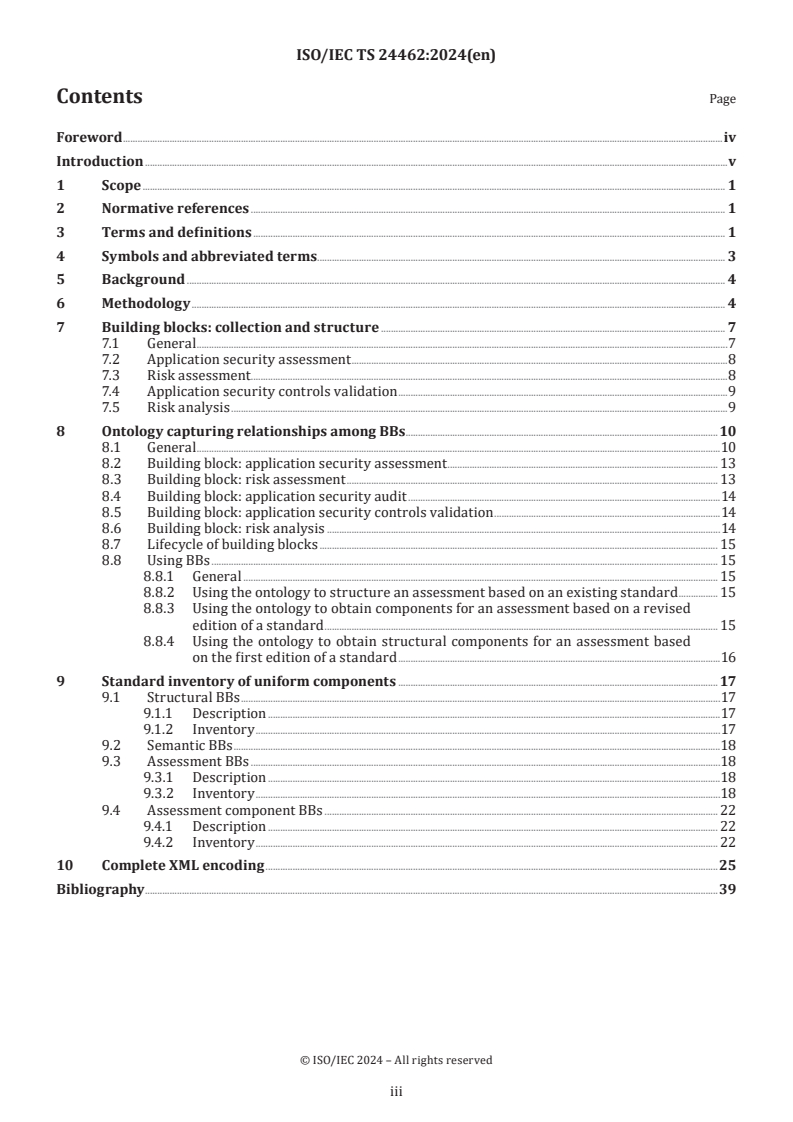
Contents Page
Foreword .iv
Introduction .v
1 Scope . 1
2 Normative references . 1
3 Terms and definitions . 1
4 Symbols and abbreviated terms. 3
5 Background . 4
6 Methodology . 4
7 Building blocks: collection and structure . 7
7.1 General .7
7.2 Application security assessment .8
7.3 Risk assessment .8
7.4 Application security controls validation .9
7.5 Risk analysis .9
8 Ontology capturing relationships among BBs . 10
8.1 General .10
8.2 Building block: application security assessment . 13
8.3 Building block: risk assessment . 13
8.4 Building block: application security audit .14
8.5 Building block: application security controls validation .14
8.6 Building block: risk analysis .14
8.7 Lifecycle of building blocks . 15
8.8 Using BBs . 15
8.8.1 General . 15
8.8.2 Using the ontology to structure an assessment based on an existing standard . 15
8.8.3 Using the ontology to obtain components for an assessment based on a revised
edition of a standard . 15
8.8.4 Using the ontology to obtain structural components for an assessment based
on the first edition of a standard .16
9 Standard inventory of uniform components . 17
9.1 Structural BBs .17
9.1.1 Description .17
9.1.2 Inventory .17
9.2 Semantic BBs .18
9.3 A ssessment BBs .18
9.3.1 Description .18
9.3.2 Inventory .18
9.4 A ssessment component BBs . 22
9.4.1 Description . 22
9.4.2 Inventory . 22
10 Complete XML encoding .25
Bibliography .39
© ISO/IEC 2024 – All rights reserved
iii
Foreword
ISO (the International Organization for Standardization) and IEC (the International Electrotechnical
Commission) form the specialized system for worldwide standardization. National bodies that are
members of ISO or IEC participate in the development of International Standards through technical
committees established by the respective organization to deal with particular fields of technical activity.
ISO and IEC technical committees collaborate in fields of mutual interest. Other international organizations,
governmental and non-governmental, in liaison with ISO and IEC, also take part in the work.
The procedures used to develop this document and those intended for its further maintenance are described
in the ISO/IEC Directives, Part 1. In particular, the different approval criteria needed for the different types
of document should be noted. This document was drafted in accordance with the editorial rules of the ISO/
IEC Directives, Part 2 (see www.iso.org/directives or www.iec.ch/members_experts/refdocs).
ISO and IEC draw attention to the possibility that the implementation of this document may involve the
use of (a) patent(s). ISO and IEC take no position concerning the evidence, validity or applicability of any
claimed patent rights in respect thereof. As of the date of publication of this document, ISO and IEC had not
received notice of (a) patent(s) which may be required to implement this document. However, implementers
are cautioned that this may not represent the latest information, which may be obtained from the patent
database available at www.iso.org/patents and https://patents.iec.ch. ISO and IEC shall not be held
responsible for identifying any or all such patent rights.
Any trade name used in this document is information given for the convenience of users and does not
constitute an endorsement.
For an explanation of the voluntary nature of standards, the meaning of ISO specific terms and expressions
related to conformity assessment, as well as information about ISO's adherence to the World Trade
Organization (WTO) principles in the Technical Barriers to Trade (TBT) see www.iso.org/iso/foreword.html.
In the IEC, see www.iec.ch/understanding-standards.
This document was prepared by Joint Technical Committee ISO/IEC JTC 1, Information technology,
Subcommittee SC 27, Information security, cybersecurity and privacy protection.
Any feedback or questions on this document should be directed to the user’s national standards
body. A complete listing of these bodies can be found at www.iso.org/members.html and
www.iec.ch/national-committees.
© ISO/IEC 2024 – All rights reserved
iv
Introduction
The assessment of trustworthiness within information and computer technologies (ICT) is associated with
various types of best practices and evaluations, such as governance, secure development lifecycle, security
evaluation and risk assessment.
This document was developed to build upon international standards dealing with ICT assessment such as
ISO/IEC 27034-7, ISO/IEC 27007 and ISO/IEC 27036-1.
When a new technology or use case becomes prominent, novel approaches to assessments should be defined,
which take existing frameworks into consideration. The dynamic cycle of technological development and
integrated environments increase the need for international standards. This document aims to simplify the
approach for creating new assessments and for analysing existing assessments for their applicability in the
emerging and mature technology areas.
This document contains the following elements:
a) an inventory of uniform components of assessment-related standards, called building blocks (BBs), and
their structure;
b) ontology capturing relationships among BBs;
c) guidelines for using standardized BBs.
Figure 1 and Figure 2 provide an overview of a representative hierarchy of BBs from this document. Figure 1
depicts the top-level classes of the hierarchy. Figure 2 illustrates the semantic building block branch of the
hierarchy, with its building blocks for assessments and assessment components.
Figure 1 — Top levels of the ontology
© ISO/IEC 2024 – All rights reserved
v
Figure 2 — Semantic Building Block branch of the ontology
© ISO/IEC 2024 – All rights reserved
vi
Technical Specification ISO/IEC TS 24462:2024(en)
Information security, cybersecurity and privacy protection —
Ontology building blocks for security and risk assessment
1 Scope
This document defines an inventory of building blocks conceptually associated with different types of
assessments of information and communication technology (ICT) trustworthiness. These assessments apply
to areas such as governance, risk management, security evaluation, secure development lifecycle (SDL),
supply chain integrity and privacy. This document also defines an ontology that organizes these building
blocks and provides instructions for using the inventory of building blocks and the ontology.
Formalizing the types, categories, and structural characteristics of building blocks in the area of
ICT trustworthiness assessment aims to increase efficiency and improve future harmonization in
standards development and their use. Building blocks can refer to structural components as well as
semantic components. These components can be connected to a variety of concepts and activities related
to trustworthiness assessments, including process related, such as traceability or elements of assessment
methodologies.
2 Normative references
There are no normative references in this document.
3 Terms and definitions
For the purposes of this document, the following terms and definitions apply.
ISO and IEC maintain terminology databases for use in standardization at the following addresses:
— ISO Online browsing platform: available at https:// www .iso .org/ obp
— IEC Electropedia: available at https:// www .electropedia .org/
3.1
structural building block
structural units that are independent of the particular assessment type, such as definitions and principles
Note 1 to entry: Structural building blocks are found in many assessment-related standards, e.g. ISO/IEC 27034-7,
ISO/IEC 27007 and ISO/IEC 27036-1.
3.2
semantic building block
conceptual units that are specific to assessment types
Note 1 to entry: Examples of semantic building blocks can be found in ISO/TR 11633-2:2021, ISO/IEC 29134:2023: 3.7,
ISO/IEC/IEEE 26514:2022, 4.4 and ISO/IEC 27034-3:2018, 3.1.
3.3
assessment building block
semantic building block (3.2) describing a type of information and communication technology assessment
Note 1 to entry: Information and communication technology assessment is the action of applying specific documented
criteria to a specific software or hardware module, package or product for the purpose of determining acceptance or
release of the software module, package or product.
© ISO/IEC 2024 – All rights reserved
3.4
assessment component building block
semantic building block (3.2) constituting an element of an assessment building block (3.3) that cannot be
further fragmented
3.5
data property
properties that connect individuals with data values such as particular strings or integers
Note 1 to entry: In some knowledge representation systems, functional data properties are called attributes.
[SOURCE: OWL 2 Web Ontology Language Quick Reference Guide (Second Edition), 2012]
3.6
datatype
entities that refer to sets of data values such as particular strings or integers
Note 1 to entry: In this sense, datatypes are analogous to classes, the main difference being that the former contain
data values such as strings and integers, rather than individuals.
[SOURCE: OWL 2 Web Ontology Language Quick Reference Guide (Second Edition), 2012]
3.7
extensible markup language
XML
subset of the Standard Generalized Markup Language (SGML)
Note 1 to entry: The goal of XML is to enable generic SGML to be served, received, and processed on the Web in the way
that is now possible with HTML. XML has been designed for ease of implementation and for interoperability with both
SGML and HTML.
[SOURCE: OWL 2 Web Ontology Language Quick Reference Guide (Second Edition), 2012]
3.8
individual
syntactic element of owl 2 web ontology language (OWL) (3.11) representing actual objects from the domain
[SOURCE: OWL 2 Web Ontology Language Quick Reference Guide (Second Edition), 2012]
3.9
object property
properties that connect sets of individuals (3.8)
[SOURCE: OWL 2 Web Ontology Language Quick Reference Guide (Second Edition), 2012]
3.10
ontology
formal description of a domain of interest, consisting of the following three different syntactic categories:
(a) entities, such as classes, properties (3.12), and individuals (3.8), identified by IRIs; (b) expressions,
representing complex notions in the domain being described; (c) axioms, formalizing statements that are
asserted to be true in the domain being described
Note 1 to entry: Entities form the primitive terms of an ontology and constitute the basic elements of an ontology. For
example, a class a:Person can be used to represent the set of all people. Similarly, the object property a:parentOf can
be used to represent the parent-child relationship. Finally, the individual a:Peter can be used to represent a particular
person called “Peter”.
[SOURCE: OWL 2 Web Ontology Language Quick Reference Guide (Second Edition), 2012]
© ISO/IEC 2024 – All rights reserved
3.11
owl 2 web ontology language
OWL
ontology language for the Semantic Web with formally defined meaning
Note 1 to entry: OWL 2 ontologies provide classes, properties (3.12), individuals (3.8), and data values and are stored
as Semantic Web documents. OWL 2 ontologies can be used along with information written in RDF (3.13), and OWL 2
ontologies themselves are primarily exchanged as RDF documents.
[SOURCE: OWL 2 Web Ontology Language Quick Reference Guide (Second Edition), 2012]
3.12
property
quality common to all members of an object class
[SOURCE: ISO/IEC 11179-1:2023, 3.3.2, modified — Domain and Note 1 to entry added.]
3.13
resource description framework
RDF
framework for representing information in the Web
Note 1 to entry: The core structure of the abstract syntax is a set of triples, each consisting of a subject, a predicate
and an object. A set of such triples is called an RDF graph.
[SOURCE: OWL 2 Web Ontology Language Quick Reference Guide (Second Edition), 2012]
3.14
subclass
class derived from another class by specialization
[SOURCE: ISO/IEC 10165-1:1993, 3.8.32]
3.15
application security control
data structure, which includes requirements, descriptions, graphical representations, and XML (3.7) schema
4 Symbols and abbreviated terms
ASC application security control
ASMP application security management process
BB building block
ICT information and communication technologies
IRI internationalized resource identifier
OWL owl 2 web ontology language
RDF resource description framework
SDL security development lifecycle
URI uniform resource identifier
XML extensible markup language
© ISO/IEC 2024 – All rights reserved
5 Background
There are a large number of international standards dealing with ICT assessments covering ICT areas
such as governance, secure development lifecycle, deterministic testing, or risk assessment. This body of
[21] [26] [30] [32]
knowledge also includes reports and best practices documents , as well as position papers ,
focusing on different approaches to ICT assessments.
When a new technology or use case becomes prominent, it is necessary to define new approaches to
assessments which consider existing frameworks. However, aligning new approaches to existing standards
and developing new standards is a resource intensive process that requires specialized expertise (see
Reference [26] for an example). Furthermore, the dynamic cycle of technological development, and the
massive need for integration of multiple systems, where independent technology domains are connected,
as well as the global nature of the digital infrastructure, has elevated the need for international standards.
As the body of available standards continues to grow and the diversification of the ICT space intensifies, it
has become more difficult to ensure consistency of approaches used in similar standard ICT assessments.
At the same time, the need to streamline, harmonize, and quickly develop assessment-relevant standards
has become acute, brought on to the dynamic technology development, increasing concerns about security,
privacy, and assurance, and growing diversity in the technology space and contexts where similar
technologies are used.
Thus, new frameworks and standards for developing new ICT assessments and analysing the existing ones
with greater efficiency would be useful. Defining these methodologies can also lead to the development of
more focused and context specific requirements in the area of ICT assessment, which is the purpose of this
document.
It is worth noting that significant work has been done in international standards bodies with regard to
using ontologies to harmonize concepts within specific domains. For example, ISO/IEC 21838-1 defines
characteristics of a top-level ontology that can be used with lower-level domain-specific ontologies.
Standardization work using ontologies to improve the efficiency of building, analysing, and implementing
standards has been more limited, but it has been covered in research literature. Reference [27] uses
ontologies to link standardized tags related to properties of the IoT space to the descriptions of the
functions they denote. In the medical field, Reference [28] uses an ontology to standardize and classify
adverse drug reactions based on the Adverse Drug Reaction Classification System. Reference [29] describes
how ontologies can be used to map existing security standards, and Reference [30] developed ontologies to
formalize security knowledge and make it more amenable to various analyses. Reference [31] developed an
ontology for ISO software engineering standards, complete with a prototype demonstrating their approach.
6 Methodology
A methodology was devised to build this document. The methodology consists of:
a) the methodology for identifying and describing BBs and their relationships with each other;
b) the approach for using the ontology and its BBs to build new assessment standards and frameworks;
c) the approach to the governance of the ontology and its elements; and
d) the methodology for the maintenance of the BBs.
The inventory of the BBs was informed by the study and analysis of standards, specifications, guidelines and
best practices documents as well as research output in the area of the ICT assessments. The elements of the
documents were examined, yielding the times and instances of BBs.
It should be noted that there are structural similarities in the structural organization, semantic affinities of
similar elements, and similarities among relationships linking various elements in documents related to ICT
assessments. This document builds upon the observation that these documents include similar components,
especially in a given field of application, e.g. security assessment and privacy assessment.
A number of standards documents from different standards development organizations were examined to
identify the recurrent elements (building blocks). It was observed that, while semantically these parts are
© ISO/IEC 2024 – All rights reserved
not always identical, in a given field there is a shared high-level compatibility of the semantics. For example,
deterministic security assessment is used in both References [19] and [24] and examples of guidelines are
available in Reference [21].
These structural and semantic similarities in assessment-related standards documents are generalized in
structural and semantic building blocks (BBs). Semantic BBs can be composed of one or more structural
BBs.
An inventory of BBs was iteratively created from a representative sample of standards documents related to
assessments and analysis of experts’ contributions. The complete inventory is available in Clause 9. For each
BB, the inventory includes the type, location and description of the BB. The typology of BBs was then refined
through the analysis of relevant ontologies, such as in References [32] to [35].
The minimal possible number of structural and semantic BBs were identified. The following steps were
followed to develop the inventory of BBs:
e) identify pertinent structural BBs, such as definitions or principles;
f) identify semantic BBs.
The inventory was then organized in a hierarchy that reflects the logical links among BBs. The links are
based on the observed similarities in structural organization and the abovementioned semantic affinities,
as well as the relationships between components as they were found to occur in the documents.
Drawing from the inventory, an ontology was created that included BBs, types, and relations from the
inventory and made them more precise. Additional information on the types and nature of BBs is described
in Clause 7. The inventory of the BBs is presented in Clause 9. The organization follows these core criteria,
which are expected to be generally applicable.
The criteria include:
g) BBs are divided into structural and semantic (see Figure 3);
h) semantic BBs are partitioned in assessments and “assessment components”. The difference between
them is that assessment BBs can contain other semantic BBs, while assessment components are atomic
objects that are not further fragmented. This is illustrated in Figure 4, where the UML annotation 0.n on
a class indicates that the relationship can apply to an arbitrary set of instances of that class, as opposed
to a single instance;
i) within the above categories, BBs are hierarchically organized by a class-subclass relation (see Figure 5);
j) the relationship between assessments and BBs that occur in them is captured by a containment relation
(see Figure 5);
k) the containment relation is inherited at the class level, i.e. if a BB type A contains certain types of BBs,
then any sub-class of A also contains those types of BBs (see Figure 5).
Figure 3 — BBs divided into structural and semantic BBs
© ISO/IEC 2024 – All rights reserved
Figure 4 — Semantic building blocks
Figure 5 — Building block and assessment hierarchy
The characterization of the structure of standards documents presents certain challenges. Certain concepts
are used in different documents with somewhat different informal meanings. Additionally, repeated
components are present in certain assessment documents.
The ontology should be used to assist in planning new ICT assessment standards or use cases associated
with existing standards. The ontology is not intended to suggest alteration to any existing assessment
standards. The developer of the new assessment should follow the steps included below, which can also be
automated by software tools.
— The developer should identify pertinent structural building blocks for the proposed assessment from the
inventory, such as definitions or principles and observe their positioning in the ontology.
— The developer should identify semantic building blocks by considering whether the new assessment has
similarities with existing assessment types.
— If there are similarities with a single existing assessment, then the new use case should include the
assessment components from the existing assessment.
— If there are similarities with multiple existing assessments, then the new use case should include the
assessment components of all of them.
As an example, an application security assessment of optical eye-level displays is considered. A standard
for the application security assessment of video displays already exists (in this example). In the first
step of the process, inspection of the existing standard enables definitions to be identified as a pertinent
structural building block that is present in the video displays standard. Next, the similarities between the
© ISO/IEC 2024 – All rights reserved
new assessment and the existing assessments are considered at the level of the semantic building blocks.
Application security audit and application security testing are identified as relevant assessment component
building blocks from the existing standard(s). These building blocks are then considered for inclusion in the
standard. Additionally, the availability of machine-readable XML supports the automation of the process.
The approach to automation has been demonstrated in a more general context in Reference [37].
7 Building blocks: collection and structure
7.1 General
The term building blocks (BBs) shall refer to structural components as well as semantic components. The
inventory of BBs is provided later in Clauses 8, 9 and 10.
Structural BBs cover characteristics that are independent of the assessment type and are intended to
capture kinds of information that is found in most standards. Examples of structural BBs include concepts,
definitions and guidelines.
Semantic BBs shall be further divided into assessment and assessment component BBs. Assessment BBs can
contain other semantic BBs, while assessment components should be atomic objects that are not further
fragmented.
For the purpose of the ontology developed in this document, the inventory of assessment BBs (see Clause 9
for details) shall include:
a) security assessment;
b) privacy assessment;
c) compliance assessment;
d) governance assessment;
e) risk assessment.
These BBs can be further broken down. For example, security assessment can contain:
f) SDL (secure development lifecycle);
g) deterministic security assessment;
h) application security assessment.
© ISO/IEC 2024 – All rights reserved
The assessment component BBs can also be broken down. The current inventory of assessment component
BBs and associated children shall include:
— audit;
— application security audit;
— analysis;
— risk analysis;
— verification;
— application security verification;
— validation;
— application security controls validation;
— testing;
— application security testing.
Assessment BBs can contain one or more other semantic BBs. The application security assessment
component can contain assessment components such as:
— application security audit;
— application security verification;
— application security controls validation;
— application security testing.
Each BB shall contain at a minimum: a name, a description, a source, and a creation date, where the creation
date shall indicate the date in which the BB was introduced in the collection.
Examples of BBs, and XML encoding of BBs are presented in 7.2 to 7.6. In these examples, each BB term
is represented by an ontological class with a matching individual. The properties provide the BBs with an
adopted description and its source.
7.2 Application security assessment
Application security assessment is the evaluation of applications, with the intent of identifying vulnerabilities,
and confirming that interactions with users, other applications and environments are secure.
The creation date is the publication date of this document.
See NIST SP 800-115:2008, Appendix C.
In this inventory, application security assessment is represented by an XML block as shown below. The
properties provide the adopted description and source of the assessment.
Evaluation of applications with intent of identifying
vulnerabilities, and confirming interactions with users, other applications and environments
are secure.
[release date of this TS]
NIST SP800-115:Appendix C
7.3 Risk assessment
Risk assessment covers risk identification, analysis and evaluation.
© ISO/IEC 2024 – All rights reserved
The creation date is the publication date of this document.
ISO 22734:2019, 3.30.
In this inventory, risk assessment is represented by an XML block as shown below. The properties provide
the adopted description and source of the assessment.
Assessment covering risk identification, analysis, and
evaluation.
[release date of this TS]
NIST SPECIAL PUBLICATION 800-160, VOLUME 1 Appendix B
ts:adoptedDescriptionSource>
Application security audit
Application security audit is the process through which it is determined if all application security controls
(ASCs) have successfully passed their verification process.
The creation date is the publication date of this document.
See ISO/IEC 27034-3:2018, 3.1.
In this inventory, application security audit is represented by an XML block as shown below. The properties
provide the BBs adopted description and its source.
owl#Application_Security_Audit”>
Process through which it is determined if all Application
Security Controls (ASC's) have successfully passed their verification process.
ts:adoptedDescription>
[release date of this TS]
ISO/IEC 27034-3:2018: 3.1
7.4 Application security controls validation
Application security controls validation is the objective confirmation that all requirements for application
security controls (ASC) have been fulfilled.
The creation date is the publication date of this document.
See ISO/IEC 27034-1 and ISO 9000:2015, 3.8.13.
In this inventory, application security controls validation is represented by an XML block as shown below.
The properties provide the adopted description and source of the BB.
Objective confirmation that all requirements for Application
Security Controls (ASC) have been fulfilled.
[release date of this TS]
ISO/IEC 27034-1:2011; ISO 9000:2015:3.8.13
ts:adoptedDescriptionSource>
7.5 Risk analysis
Risk analysis is the process through which the level and nature of risk can be determined.
The creation date is the publication date of this document.
See ISO/Guide 73:2009, 3.6.1.
In this inventory, risk analysis is represented by an XML block as shown below. The properties provide the
adopted description and source of the BB.
© ISO/IEC 2024 – All rights reserved
Process through which the level and nature of risk can be
determined.
[release date of this TS]
ISO/Guide 73:2009: 3.6.1
8 Ontology capturing relationships among BBs
8.1 General
Ontologies are used to capture the salient aspects of a domain and to answer queries about them in a
mathematically precise and explainable way. While ontologies can seem analogous to taxonomies, there are
important distinctions. Similar to a taxonomy, an ontology provides uniform terminology for the domain of
interest, assuring interoperability and accurate communication among researchers, operators, practitioners,
regulators, and other interested parties. The ontology also captures the structural relationships from the
domain at hand, e.g. an ontology individual John belongs to class software-developer and class software-
developer is a subclass of class person. Differently from a taxonomy, an ontology can also include the
specification of dependencies, constraints, and other rule-based relationships among entities in the model.
Additionally, ontologies come with associated inference mechanisms that enable drawing conclusions
over virtually arbitrary combinations of structural relationships, dependencies, constraints and rule-like
relationships.
The BBs are organized according to these core criteria.
— BBs are hierarchically organized by a class-subclass relation.
— BBs are partitioned in structural and semantic categories. Structural BBs are found in many standards
and cover concepts that are independent of the particular assessment type, such as definitions or
principles. Semantic BBs describe specific types of assessment, such as privacy assessment or risk
assessment, or parts thereof, such as risk analysis.
— Semantic BBs are further divided into assessments and “assessment components”. The distinguishing
feature is that assessment components represent BBs of assessments that are not assessments themselves.
— The relationship between assessments and BBs that occur in them is captured by a containment relation.
— The containment relation is inherited. That is, if a BB class A contains a set of BBs, then any sub-class of
A also contains those BBs.
— The ontology is subject to the following structural constraints:
— Classes for structural BBs should not be subclasses of semantic BBs.
— Classes for semantic BBs should not be subclasses of structural BBs.
— A class should not be a subclass of multiple parent classes.
— An individual should not belong to multiple classes.
Thus, the inventory and corresponding hierarchy are represented in the ontology as follows.
— All BBs are represented by ontology classes and by identically-named ontology individuals.
— The class-subclass relation between BBs is represented by the class-subclass relation between ontology
classes that is built into ontologies.
— The containment relation is represented by an object property “contains”.
— The adopted description of a BB is represented by a data property “adoptedDescription” of type string.
The source(s) of the description are represented by a data property “adoptedDescriptionSource”.
© ISO/IEC 2024 – All rights reserved
— Object property “subsumes” (with domain and range corresponding to the class of all BBs) and data
properties “creationDate” and “endDate” (with the class of all BBs as domain and xsd: dateTime as the
range) are introduced for managing the lifecycle of BBs. Property “subsumes” represents the fact that
one BB subsumes another. Property “creationDate” specifies the creation time of a BB and “endDate”
specifies its end date. More details on the lifecycle can be found in 8.7.
Figure 6 and Figure 7 provide an illustration of a representative hierarchy of BBs. Figure 6 depicts the top-
level classes of the ontology. Figure 7 illustrates the semantic building block branch of the ontology, with its
building blocks for assessments and assessment components.
Figure 6 — Top levels of the ontology
Figure 7 — Semantic building block branch of the ontology
The ontology is encoded using XML. The XML encoding uses tags indicating the type of XML object: owl:
Class, owl: NamedIndividual, owl: ObjectProperty, or owl: DatatypeProperty. The rdf: about attribute defines
the name of the object. The content enclosed by the beginning and ending tags provides further information,
such as the parent class in a class-subclass relation (tag rdfs: subClassOf, used in conjunction with attribute
rdf: resource, which indicates the name of the parent class), the parent class of an individual (tag rdf: type,
also used in conjunction with rdf: resource), as well as information about the containment relation, the
adopted definition and adopted definition’s source (tags ts -v04: contains, ts -v04: adoptedDescription and ts
-v04: adop tedDescrip tionSource, respectively). For example, Assessment is defined by the XML blocks:
© ISO/IEC 2024 – All rights reserved
[release date of this TS]
where the first block states that Assessment is a class (first line), and that it is a subclass of class Semantic_
Building_Block (second line). The second block states that name Assessment is also associated with an
individual (first line) of class Assessment (second line).
The relations of the ontology are defined by the following XML code:
owl#contains”>
Block”/>
Block”/>
owl#subsumes”>
Block”/>
Block”/>
owl#adoptedDescription”>
...