

ISO/IEC 11801-6:2017/Amd 1:2026
(Amendment)Information technology — Generic cabling for customer premises — Part 6: Distributed building services — Amendment 1
- Status
- Published
- Publication Date
- 28-Sep-2026
- Technical Committee
- ISO/IEC JTC 1/SC 25 - Interconnection of information technology equipment
- Current Stage
- 6060 - International Standard published
- Start Date
- 29-Sep-2026
- Due Date
- 24-Mar-2028
- Completion Date
- 29-Sep-2026
ISO/IEC 11801-6:2017/Amd 1:2026 is an ISO and IEC amendment to Information technology - Generic cabling for customer premises - Part 6: Distributed building services. It updates the cabling rules for distributed building services in customer premises, with a focus on Type A and Type B implementations, single pair extensions, component choice, and related testing references. Designers, installers, commissioning teams, and buyers can use it to see how Part 6 changes the cabling architecture and performance model.
What does ISO/IEC 11801-6:2017/Amd 1:2026 specify?
ISO/IEC 11801-6:2017/Amd 1:2026 specifies changes to Part 6 for distributed building services cabling in customer premises. The amendment keeps the core Part 6 structure, but revises how Type A and Type B generic cabling are defined and how Type B may be extended with single pair cabling.
It also states that application-specific cabling and equipment beyond the SCP are outside the document, so the standard draws a clear line between the generic cabling system and equipment or cabling added after that point.
| Annex | What it covers |
|---|---|
| Annex A | Planning the number of SOs per room and service area |
| Annex C | Connecting hardware references for the cabling model |
The amendment touches Clause 2, Clause 5, Clause 6, Clause 7, Clause 8, Clause 10, Clause 11, Annex A, Annex C, and the Bibliography.
What are the key requirements of ISO/IEC 11801-6:2017/Amd 1:2026?
ISO/IEC 11801-6:2017/Amd 1:2026 introduces the main rules for Type A and Type B distributed building services cabling, then ties them to component category, temperature, and test practice. For a project team, the practical point is that the cabling design must be chosen as a matched system, not as isolated cables and cords.
- Clause 5.2.1 describes two implementations: Type A cabling to the SO and Type B cabling to the SCP. In practice, this matters because the SCP is the boundary for where generic cabling ends and application-specific cabling may begin.
- Clause 5.3.1 says Type A generic cabling shall be 4-pair copper or optical fibre in accordance with ISO/IEC 11801-1. This tells designers which media are acceptable for Type A.
- Clauses 5.6.2.1 and 5.6.2.2 tie Type A and Type B performance to channel and link performance, and point to commissioning and fault-location testing. This matters because installed links may be verified during handover or when faults are suspected.
- Clause 6.3.2.2 and Clause 7.2 define the single pair extension of Type B cabling. The extension shall deliver Class T1-A-100 or Class T1-B performance, depending on the base cabling class and the single pair component class used.
- Clause 8.2.1.2 sets the component selection logic for balanced cabling. The channel must achieve at least Class E, and the performance is governed by the lowest-performing component in the channel.
- Clause 8.2.3.3 gives channel-length guidance for Type B extensions using single pair cabling. It also applies temperature reduction factors and a 0.75 A limit when four-pair cabling from the SD to the SCP is extended with single pair cabling.
- Clause 10.2.2.3 and Clause 11.2 cover connecting hardware and cords for the onward connection to TE. The amendment favors pre-fabricated terminated balanced cords and points single pair cords to ISO/IEC 11801-1:2017/AMD1:2025.
What terms does ISO/IEC 11801-6:2017/Amd 1:2026 define?
ISO/IEC 11801-6:2017/Amd 1:2026 uses a small set of system terms that matter for design and testing.
- Generic cabling - the structured cabling system used as the common base for services in customer premises.
- Type A generic cabling - the implementation that runs to the SO and uses 4-pair copper or optical fibre.
- Type B generic cabling - the implementation that runs to the SCP and can be extended with single pair cabling.
- Service distribution cabling - the cabling whose performance is specified in the Part 6 transmission clauses.
- Channel - the transmission path between transmission equipment and terminal equipment, including cords and cabling subsystems where applicable.
- Link - the installed cabling path used for verification, commissioning, or fault finding.
- Connecting hardware - the term used for the hardware that joins cables, cords, and equipment in the cabling system.
Who uses ISO/IEC 11801-6:2017/Amd 1:2026?
ISO/IEC 11801-6:2017/Amd 1:2026 is used by cabling designers, system integrators, installers, commissioning engineers, and test teams working on customer premises. It is also useful for quality managers and buyers who need to specify the correct media, component categories, and test references for distributed building services cabling. In practice, it helps teams plan SO locations, select balanced or optical cabling, and check whether Type B extensions with single pair cabling fit the intended service.
What changed in ISO/IEC 11801-6:2017/Amd 1:2026 from the previous edition?
ISO/IEC 11801-6:2017/Amd 1:2026 updates the 2017 Part 6 text with these main changes:
- revises the normative reference to ISO/IEC 11801-1:2017 and ISO/IEC 11801-1:2017/AMD1:2025
- clarifies Type A and Type B stand-alone structure
- adds Type A media requirements for 4-pair copper or optical fibre
- adds single pair extension rules for Type B cabling, including performance classes and length guidance
- updates component choice, temperature-related length reduction, and cable-sharing guidance
- revises connecting hardware and balanced cord requirements
- updates Annex A and Annex C references
Which standards are used with ISO/IEC 11801-6:2017/Amd 1:2026?
| Standard | What it contributes |
|---|---|
| ISO/IEC 11801-1:2017 | General requirements for generic cabling, used throughout Part 6 |
| ISO/IEC 11801-1:2017/AMD1:2025 | Updated requirements for classes, components, and single pair use |
| IEC 61935-1 | Testing of installed balanced cabling |
| IEC 61935-4 | Testing of installed balanced single-pair cabling |
| ISO/IEC TR 11801-9911 | Guidance on balanced single pair applications within a balanced 4-pair system |
| ISO/IEC 14763-2 | Further guidance on installation-related temperature and cabling considerations |
What does the ISO/IEC 11801-6:2017/Amd 1:2026 document contain?
ISO/IEC 11801-6:2017/Amd 1:2026 contains revised clause text, one replaced figure on Type B structure, a new figure showing a single pair generic extension, and Table 4 with length equations for service distribution channels using single pair extensions. It also updates the guidance on component category selection, temperature derating, cable sharing, connecting hardware, and balanced cords. Annex A is updated for SO planning, and Annex C is updated for connecting hardware references.
Relations
- Effective Date
- 26-Sep-2026
Get Certified
Connect with accredited certification bodies for this standard

BSI Group
BSI (British Standards Institution) is the business standards company that helps organizations make excellence a habit.

NYCE
Mexican standards and certification body.
Sponsored listings
Frequently Asked Questions
ISO/IEC 11801-6:2017/Amd 1:2026 is a standard published by the International Organization for Standardization (ISO). Its full title is "Information technology — Generic cabling for customer premises — Part 6: Distributed building services — Amendment 1". This standard covers: Information technology — Generic cabling for customer premises — Part 6: Distributed building services — Amendment 1
Information technology — Generic cabling for customer premises — Part 6: Distributed building services — Amendment 1
ISO/IEC 11801-6:2017/Amd 1:2026 is classified under the following ICS (International Classification for Standards) categories: 35.200 - Interface and interconnection equipment. The ICS classification helps identify the subject area and facilitates finding related standards.
ISO/IEC 11801-6:2017/Amd 1:2026 has the following relationships with other standards: It is inter standard links to ISO/IEC 11801-6:2017. Understanding these relationships helps ensure you are using the most current and applicable version of the standard.
ISO/IEC 11801-6:2017/Amd 1:2026 is available in PDF format for immediate download after purchase. The document can be added to your cart and obtained through the secure checkout process. Digital delivery ensures instant access to the complete standard document.
Standards Content (Sample)
ISO/IEC 11801-6
Edition 1.0 2026-09
INTERNATIONAL
STANDARD
AMENDMENT 1
Information technology - Generic cabling for customer premises -
Part 6: Distributed building services
ICS 35.200 ISBN 978-2-8327-1504-8
ISO/IEC 11801-6:2017-11/AMD1:2026-09(en)
All rights reserved. Unless otherwise specified, no part of this publication may be reproduced or utilized in any form or
by any means, electronic or mechanical, including photocopying and microfilm, without permission in writing from either
IEC or IEC's member National Committee in the country of the requester. If you have any questions about IEC copyright
or have an enquiry about obtaining additional rights to this publication, please contact the address below or your local
IEC member National Committee for further information.
IEC Secretariat Tel.: +41 22 919 02 11
3, rue de Varembé info@iec.ch
CH-1211 Geneva 20 www.iec.ch
Switzerland
About the IEC
The International Electrotechnical Commission (IEC) is the leading global organization that prepares and publishes
International Standards for all electrical, electronic and related technologies.
About IEC publications
The technical content of IEC publications is kept under constant review by the IEC. Please make sure that you have the
latest edition, a corrigendum or an amendment might have been published.
IEC publications search - IEC Products & Services Portal - products.iec.ch
webstore.iec.ch/advsearchform Discover our powerful search engine and read freely all the
The advanced search enables to find IEC publications by a publications previews, graphical symbols and the glossary. With
variety of criteria (reference number, text, technical a subscription you will always have access to up to date content
committee, …). It also gives information on projects, replaced tailored to your needs.
and withdrawn publications.
Electropedia - www.electropedia.org
The world's leading online dictionary on electrotechnology,
IEC Just Published - webstore.iec.ch/justpublished
Stay up to date on all new IEC publications. Just Published containing more than 22 500 terminological entries in English
details all new publications released. Available online and and French, with equivalent terms in 25 additional languages.
once a month by email. Also known as the International Electrotechnical Vocabulary
(IEV) online.
IEC Customer Service Centre - webstore.iec.ch/csc
If you wish to give us your feedback on this publication or need
further assistance, please contact the Customer Service
Centre: sales@iec.ch.
ISO/IEC 11801-6:2017/AMD1:2026 © ISO/IEC 2026
Information technology - Generic cabling for customer premises -
Part 6: Distributed building services
AMENDMENT 1
FOREWORD
1) ISO (the International Organization for Standardization) and IEC (the International Electrotechnical Commission)
form the specialized system for worldwide standardization. National bodies that are members of ISO or IEC
participate in the development of International Standards through technical committees established by the
respective organization to deal with particular fields of technical activity. ISO and IEC technical committees
collaborate in fields of mutual interest. Other international organizations, governmental and non-governmental,
in liaison with ISO and IEC, also take part in the work.
2) The formal decisions or agreements of IEC and ISO on technical matters express, as nearly as possible, an
international consensus of opinion on the relevant subjects since each technical committee has representation
from all interested IEC and ISO National bodies.
3) IEC and ISO documents have the form of recommendations for international use and are accepted by IEC and
ISO National bodies in that sense. While all reasonable efforts are made to ensure that the technical content of
IEC and ISO documents is accurate, IEC and ISO cannot be held responsible for the way in which they are used
or for any misinterpretation by any end user.
4) In order to promote international uniformity, IEC and ISO National bodies undertake to apply IEC and
ISO documents transparently to the maximum extent possible in their national and regional publications. Any
divergence between any IEC and ISO document and the corresponding national or regional publication shall be
clearly indicated in the latter.
5) IEC and ISO do not provide any attestation of conformity. Independent certification bodies provide conformity
assessment services and, in some areas, access to IEC and ISO marks of conformity. IEC and ISO are not
responsible for any services carried out by independent certification bodies.
6) All users should ensure that they have the latest edition of this document.
7) No liability shall attach to IEC and ISO or their directors, employees, servants or agents including individual
experts and members of its technical committees and IEC and ISO National bodies for any personal injury,
property damage or other damage of any nature whatsoever, whether direct or indirect, or for costs (including
legal fees) and expenses arising out of the publication, use of, or reliance upon, this ISO/IEC document or any
other IEC and ISO documents.
8) Attention is drawn to the Normative references cited in this document. Use of the referenced publications is
indispensable for the correct application of this document.
9) IEC and ISO draw attention to the possibility that the implementation of this document may involve the use of (a)
patent(s). IEC and ISO take no position concerning the evidence, validity or applicability of any claimed patent
rights in respect thereof. As of the date of publication of this document, IEC and ISO had not received notice of
(a) patent(s), which may be required to implement this document. However, implementers are cautioned that this
may not represent the latest information, which may be obtained from the patent database available at
https://patents.iec.ch and www.iso.org/patents. IEC and ISO shall not be held responsible for identifying any or
all such patent rights.
Amendment 1 to ISO/IEC 11801-6:2017 has been prepared by subcommittee 25:
Interconnection of information technology equipment, of ISO/IEC joint technical committee 1:
Information technology.
The text of this Amendment is based on the following documents:
Draft Report on voting
JTC1-SC25/3364/FDIS JTC1-SC25/3370/RVD
Full information on the voting for its approval can be found in the report on voting indicated in
the above table.
The language used for the development of this Amendment is English.
This document was drafted in accordance with ISO/IEC Directives, Part 2, and developed in
accordance with ISO/IEC Directives, Part 1, and the ISO/IEC Directives, JTC 1 Supplement
available at www.iec.ch/members_experts/refdocs and www.iso.org/directives.
ISO/IEC 11801-6:2017/AMD1:2026 © ISO/IEC 2026
2 Normative references
Replace the ISO/IEC 11801-1:2017 reference with the following new reference:
ISO/IEC 11801-1:2017, Information technology - Generic cabling for customer premises -
Part 1: General requirements
ISO/IEC 11801-1:2017/AMD1:2025
5.2.1 Stand-alone structure
Replace the first two paragraphs with the following:
In addition to the functional elements specified in ISO/IEC 11801-1, this document specifies
two implementations of generic cabling for distributed building services. This document
specifies the use of the following.
– Type A generic cabling to the SO: the SO can be placed where the service is needed.
– Type B generic cabling to the SCP: the SCP should be placed where the service is needed,
thereby providing more flexibility in the cabling allowed between the SCP and the
telecommunication equipment. Type B provides the opportunity for
• application-specific cabling to be installed between the SCP and terminal equipment,
• application-specific equipment to be connected at the SCP,
• generic cabling to be installed between the SCP and the SO.
Any application-specific cabling and equipment beyond the SCP is outside the scope of this
document. This information is needed, as only the 1P option is generic.
5.3.1 Type A generic cabling
Add, after the first paragraph, the following new paragraph:
Type A generic cabling shall be 4-pair copper or optical fibre in accordance with
ISO/IEC 11801-1.
5.3.2 Type B generic cabling
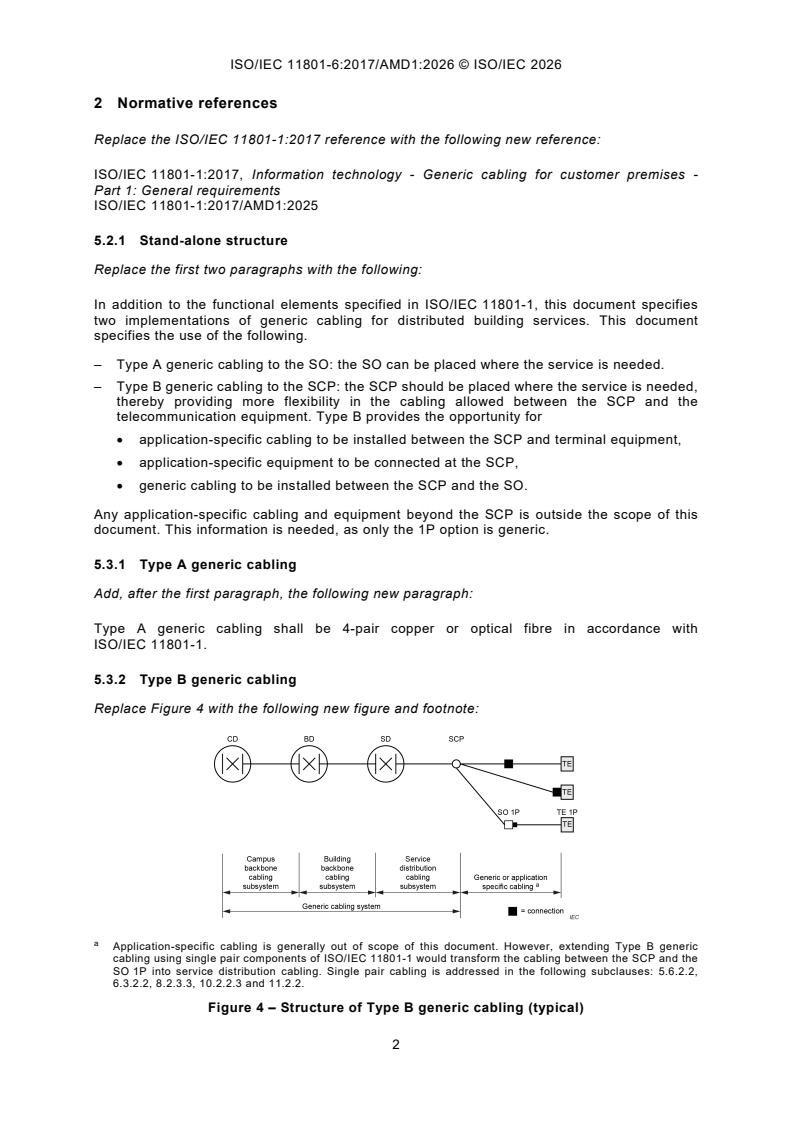
Replace Figure 4 with the following new figure and footnote:
a
Application-specific cabling is generally out of scope of this document. However, extending Type B generic
cabling using single pair components of ISO/IEC 11801-1 would transform the cabling between the SCP and the
SO 1P into service distribution cabling. Single pair cabling is addressed in the following subclauses: 5.6.2.2,
6.3.2.2, 8.2.3.3, 10.2.2.3 and 11.2.2.
Figure 4 – Structure of Type B generic cabling (typical)
ISO/IEC 11801-6:2017/AMD1:2026 © ISO/IEC 2026
5.6.2.1 Type A generic cabling
Replace the existing three paragraphs with the following new paragraphs:
The transmission performance of Type A generic cabling is detailed in Clause 6 for channels
and in Clause 7 for links.
The channel is the transmission path between the transmission equipment (EQP in Figure 9)
and the terminal equipment. A typical channel consists of the service distribution cabling
subsystem together with service area and equipment cords. For longer reach services, the
channel is formed by the connection of two or more subsystems (including service area cords
and/or equipment cords).
Links may be tested either during commissioning or for the detection of faults that are suspected
in the cabling. Further informati
...